Japan Poultry Farming Automation Market Size & Growth Rate
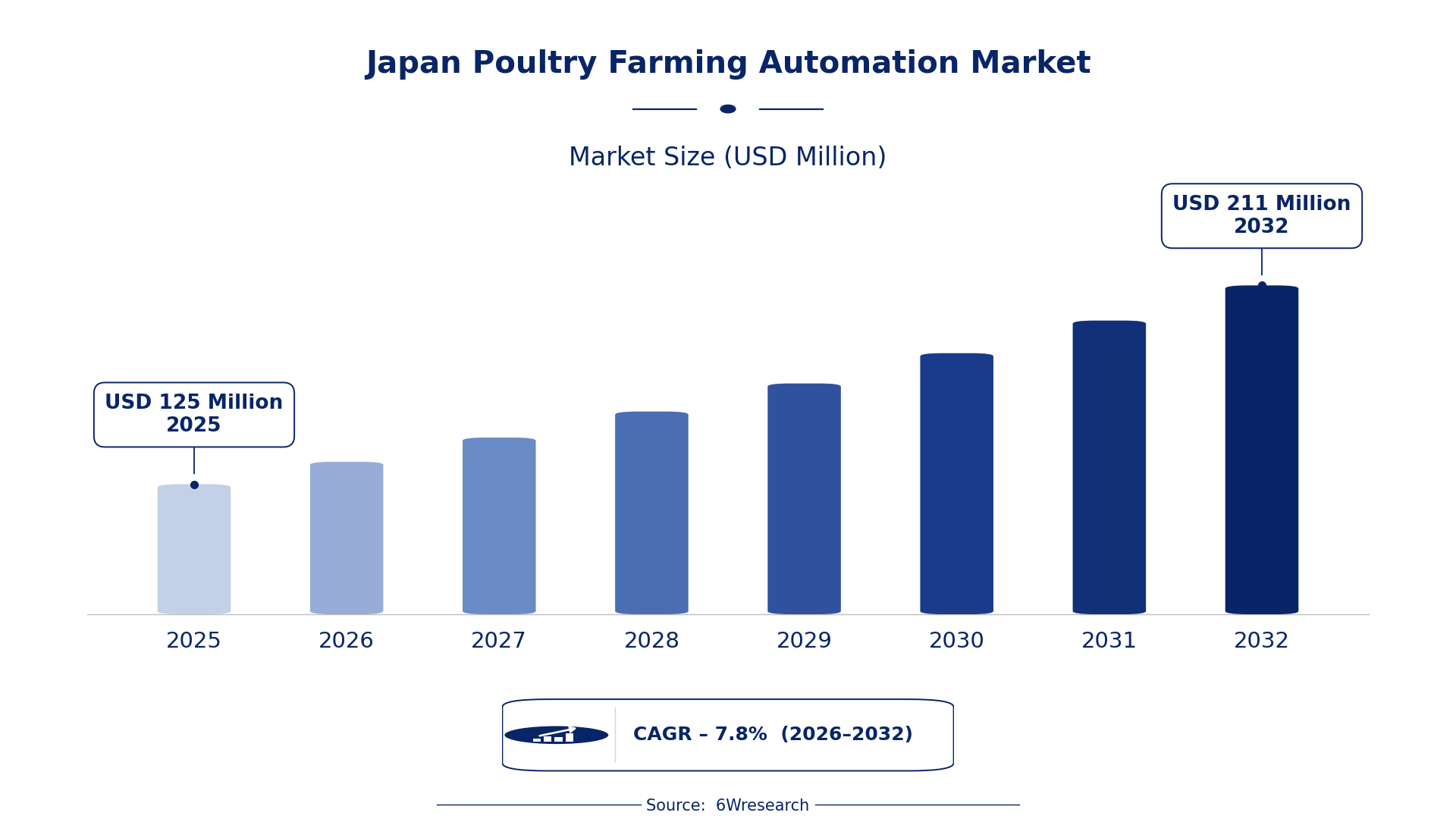
According to 6Wresearch internal database and industry insights, the Japan Poultry Farming Automation Market was valued at USD 125 Million in 2025 and is projected to reach USD 211 Million by 2032, growing at a CAGR of approximately 7.8% during 2026–2032.
Japan Poultry Farming Automation Market Highlights
| Report Metric | Details |
| Report Name | Japan Poultry Farming Automation Market (2026-2032) |
| Market Size 2025 | USD 125 Million |
| Market Size 2032 | USD 211 Million |
| Absolute Growth 2025–2032 | USD 86 Million |
| CAGR 2026–2032 | 7.8% |
| Peak Annual Growth | 11.0% in 2026 |
| Forecast Period | 2026–2032 |
| Historical Data | 2022–2025 |
| Base Year | 2025 |
| Leading Product Type, 2025 | Automated Brooders (41% share) |
| Leading Operation Type, 2025 | IoT-Based (42% share) |
| Leading Distribution Channel, 2025 | Agricultural Suppliers (37% share) |
| Leading End User, 2025 | Layer Farms (43% share) |
| Fastest-Growing Product Type | Data Monitoring Systems (11.0% CAGR) |
| Fastest-Growing Distribution Channel | Online Platforms (9.9% CAGR) |
| Fastest-Growing End User | Smart Poultry Units (10.1% CAGR) |
| Growing Sector | Poultry Farming |
| Key End Users | Layer Farms, Poultry Cooperatives, Breeder Farms |
Japan Poultry Farming Automation Market Year-wise Growth Rate and Key Drivers (2022–2032)
This graph illustrates the annual growth rates of the market from 2022 to 2032, highlighting a steady upward trajectory and projected market expansion over the forecast period.
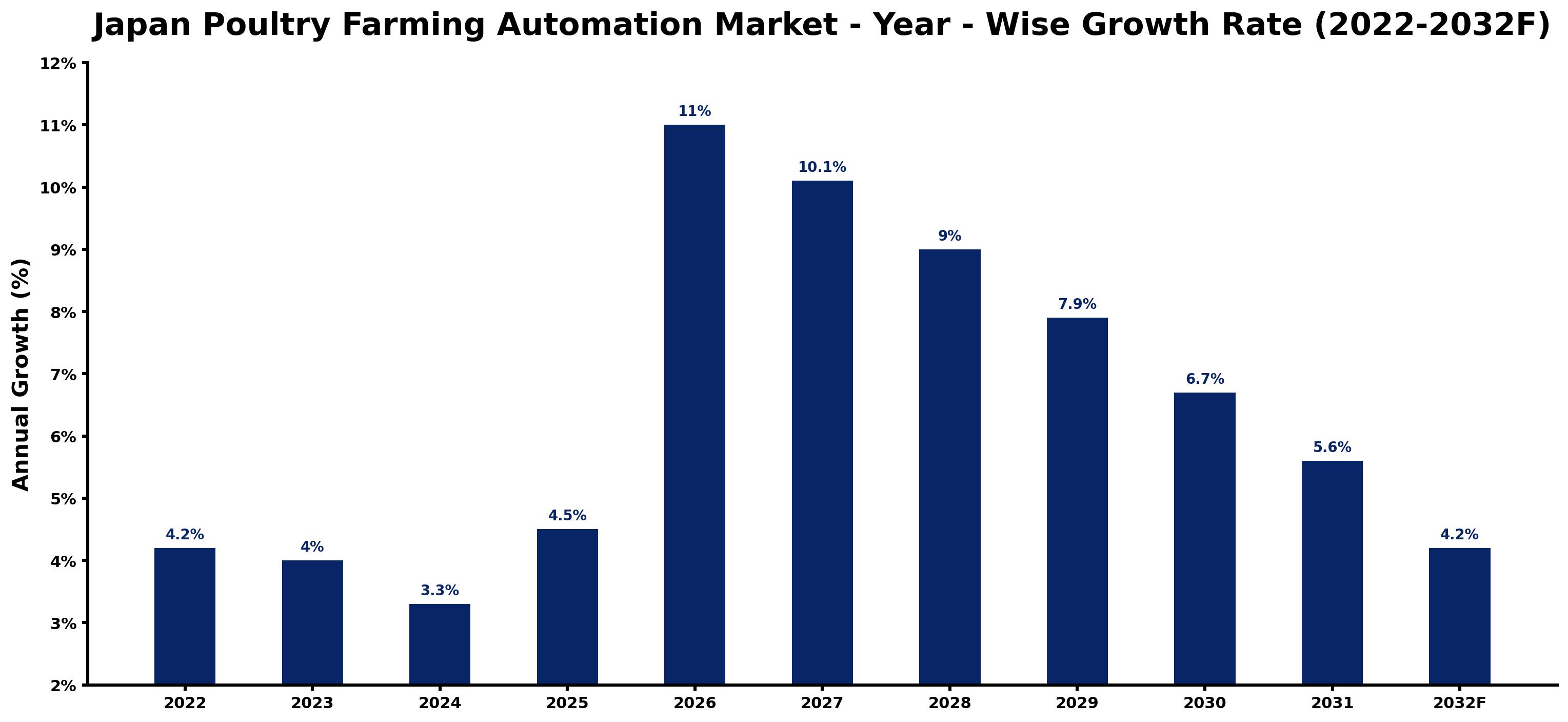
The following figures match every annual growth estimate with the main market development of that year, giving the reasoning behind each rise or slowdown.
| Year | Estimated Annual Growth (%) | Market Rationale |
| 2022 | 4.2 | The market experienced moderate growth due to ongoing investments in automation technology. |
| 2023 | 4.0 | Growth slowed as some poultry operations delayed upgrades amid economic uncertainties. |
| 2024 | 3.3 | A further slowdown occurred as producers faced rising operational costs and labor challenges. |
| 2025 | 4.5 | Growth accelerated as producers increasingly adopted automation to improve productivity. |
| 2026 | 11.0 | The market surged as investments in advanced automation technologies are expected to be realised. |
| 2027 | 10.1 | Growth is projected to slow slightly as the market begins to stabilise after rapid expansion. |
| 2028 | 9.0 | A continued slowdown is expected as the market adjusts to previous growth rates. |
| 2029 | 7.9 | Growth is anticipated to decelerate further as saturation in certain segments begins to emerge. |
| 2030 | 6.7 | The market will continue to grow, albeit at a slower pace, as producers focus on efficiency. |
| 2031 | 5.6 | A further slowdown is projected as competition intensifies and market dynamics shift. |
| 2032 | 4.2 | Growth is expected to stabilise as the market matures, with steady demand from key user segments. |
Note: Market size estimations and growth projections presented in this report are based on 6Wresearch's proprietary forecasting methodology, utilizing the latest available industry data, government publications, and primary research inputs.
Japan Poultry Farming Automation Market Synopsis
Poultry farming automation improves production efficiency through systems for watering, litter removal, and monitoring. These technologies increase productivity, lower labour costs, and support animal welfare. The Japan Poultry Farming Automation Market is growing due to rising domestic demand, driven by over 1,400 layer farms and a heightened focus on sustainable practices. Investments in automation technologies are expected to reach JPY 150 trillion over the next decade, propelling growth in this sector.
Market Dynamics Impact Analysis (2026–2032)
| Factor | Type | Impact | Primary Segment Affected |
| Increasing investments in automation technology enhance productivity and reduce labor costs. | Driver | High | Watering Systems |
| Growing focus on animal welfare drives demand for efficient farming solutions. | Driver | High | Litter Removal Systems |
| Emerging demand for data monitoring systems presents opportunities for innovation. | Opportunity | High | Data Monitoring Systems |
| The rise of smart poultry units creates a need for advanced automation solutions. | Opportunity | Medium | Automated Brooders |
| High initial investment costs can deter smaller farms from adopting automation. | Restraint | High | Automated Brooders |
| Limited awareness of automation benefits restricts market growth in certain regions. | Restraint | Medium | Data Monitoring Systems |
| Competition from traditional farming methods may hinder automation adoption. | Challenge | High | Watering Systems |
| Technological integration challenges can delay implementation of automation systems. | Challenge | Medium | Litter Removal Systems |
Evaluation of Drivers in Japan Poultry Farming Automation Market (2026–2032)
The main growth drivers and the segments they affect most are set out below.
| Drivers | Primary Segment Affected | Why It Matters (Evidence) |
| Rising domestic demand for poultry products drives automation adoption. | Watering Systems | Japan's poultry production reached 1.5 million tons in 2022, necessitating efficient systems. |
| Focus on sustainability encourages investments in automation technologies. | Litter Removal Systems | Japan aims for a 46% reduction in greenhouse gas emissions by 2030, promoting efficient practices. |
| Technological advancements in data monitoring support operational efficiency. | Data Monitoring Systems | Increasing adoption of smart poultry units drives the need for real-time health tracking. |
| Growing workforce challenges prompt farms to automate processes. | Automated Brooders | The poultry sector employs approximately 200,000 people, necessitating efficiency improvements. |
| Rising consumer awareness of animal welfare boosts demand for automation. | Watering Systems | Layer farms, which account for 43% of the end-user market, seek better welfare solutions. |
Spending rises because Japan's poultry production reached 1.5 million tons in 2022, driving demand for efficient watering systems. The focus on sustainability is clear as the country targets a 46% reduction in greenhouse gas emissions by 2030, prompting investments in litter removal systems. Technological advancements in data monitoring are increasingly adopted in smart poultry units, supporting operational efficiency. Workforce challenges are pressing, as the poultry sector employs around 200,000 people, necessitating automation in brooding processes. Consumer awareness of animal welfare also boosts demand for automation solutions, particularly in layer farms, which represent a substantial portion of the market.
Evaluation of Restraints in Japan Poultry Farming Automation Market
These restraints slow adoption and weigh on supplier margins.
| Market Restraint | Primary Segment Affected | Why It Matters (Evidence) |
| High initial investment costs deter smaller farms from automation. | Automated Brooders | Many smaller operations struggle to afford the upfront costs associated with advanced systems. |
| Limited awareness of automation benefits restricts market growth. | Data Monitoring Systems | Producers may not fully understand the advantages of implementing monitoring technologies. |
| Competition from traditional farming methods may hinder automation adoption. | Watering Systems | Some farms prefer conventional methods due to familiarity and perceived lower risks. |
| Technological integration challenges can delay implementation of automation systems. | Litter Removal Systems | Compatibility issues with existing systems can complicate the adoption of new technologies. |
| Regulatory compliance can increase operational complexities for automation. | Automated Brooders | Producers must navigate various regulations, which can slow down the adoption process. |
Japan Poultry Farming Automation Market Challenges
Japan produced approximately 1.5 million tons of poultry meat in 2022, yet many producers face skills shortages, as training lags behind automation advancements. Buyers encounter delays in acquiring automated systems due to stringent regulations from the Ministry of Agriculture, Forestry and Fisheries, which can extend lead times by up to six months. Importers face rising costs from compliance with the JIS Z 9940 standard, often increasing equipment prices by 15%. Escalating operational costs, driven by the national minimum wage rise to JPY 1,055 per hour, further pressure producers' profitability.
Trends in the Japan Poultry Farming Automation Market
The following changes are redrawing the Japan Poultry Farming Automation Market.
- Shift towards Smart Poultry Units: In 2023, the adoption of smart poultry units rose by 15%. This trend highlights a growing focus on data-driven farming practices, enabling better health monitoring and management of poultry.
- Transition from Traditional to Automated Systems: Since 2022, a clear transition from traditional farming methods to automated systems has occurred. This shift is motivated by the need for efficiency and sustainability, particularly in the Kanto region, a key poultry farming area.
- Emergence of Data Monitoring Systems: Data monitoring systems are gaining importance, with their adoption increasing among layer farms. This trend is driven by the need for real-time health tracking, which enhances overall productivity in poultry operations.
- Growing Demand for Sustainable Practices: The Japanese government advocates for sustainable farming practices, resulting in increased investments in automation. In 2023, the poultry industry is expected to invest substantially in technologies that align with these sustainability objectives.
Investment Opportunities in the Japan Poultry Farming Automation Market
The following areas offer the clearest openings for investors and suppliers in the Japan Poultry Farming Automation Market.
- Gap in Automation Adoption: With a 15% increase in online platforms for agricultural equipment, there is a gap in automation adoption among smaller farms. Partnering with local agricultural suppliers can facilitate access to these technologies.
- Entry into Smart Poultry Units: The growing interest in smart poultry units presents an opportunity for joint ventures. Layer farms, which account for 43% of the market, are seeking advanced automation solutions to improve productivity.
- Investment in Data Monitoring Technologies: As the demand for data monitoring systems rises, there is a clear opportunity for investment. The poultry cooperatives in the Kanto region are looking for solutions to improve operational efficiency.
- Focus on Sustainable Farming Technologies: With Japan targeting JPY 150 trillion in decarbonisation investments, now is the time to supply sustainable farming technologies. Collaborating with local partners can ease market entry.
Government Initiatives in the Japan Poultry Farming Automation Market
The New Robot Strategy, initiated in 2015, aims to expand automation across agriculture, including poultry farming. This measure encourages producers to adopt advanced technologies, improving productivity and sustainability in operations. The AI Promotion Act, set for 2025, establishes a framework for integrating AI in agriculture, further supporting automation efforts in the sector.
In 2023, the Ministry of Agriculture, Forestry and Fisheries allocated JPY 30 billion for agricultural innovation projects, including automation technology. This funding aims to support poultry farmers in upgrading their systems, ensuring compliance with modern standards and improving overall efficiency.
Future Insight of the Japan Poultry Farming Automation Market
By 2032, Japan's poultry farming sector will experience a policy-driven shift towards sustainability, with the government aiming for net zero emissions by 2050. This will encourage suppliers to invest in advanced automation technologies that improve efficiency and reduce environmental impact. The anticipated JPY 150 trillion investment in decarbonisation will support the incorporation of new farming practices. As data monitoring systems become standard in smart poultry units, buyers will benefit from improved productivity and streamlined operations.
Market Segmentation Analysis
Japan Poultry Farming Automation Market report covers a detailed analysis of the following market segments:
By Product Type – Automated Brooders Lead, Data Monitoring Systems Expected to Grow Fastest
According to Navya, Research Analyst at 6Wresearch, in 2025, Automated Brooders led the product type split with a 41% share. Automated brooders are essential for maintaining the optimal temperature required for chick survival and growth, making them indispensable for layer farms. Their significance in enhancing productivity ensures that they command the largest share in the market. Data Monitoring Systems are set to record the highest CAGR in this split, 11.0% over 2026–2032. Data monitoring systems are gaining traction as they provide vital health and growth metrics, which are crucial for improving production efficiency. This increasing reliance on data-driven management practices is expected to propel their growth rate further. Suppliers should focus on advancing data monitoring technologies to meet the rising demand in the market.
By Operation Type – IoT-Based Leads and Records the Fastest Growth
IoT-Based took 42% of operation type revenue in 2025, more than any other category. IoT-based solutions are increasingly favoured for poultry farming automation as they integrate various technologies, leading to improved operational efficiency. This preference is evident as more farms adopt smart farming practices across Japan, solidifying this segment's lead. IoT-Based is also forecast to expand faster than any other category, at a CAGR of 10.0% over 2026–2032. The IoT-based segment is set to maintain its rapid growth due to its incorporation of diverse technologies that enhance operational efficiency. As adoption rates increase, the gap between this segment and others will continue to widen. Suppliers must invest in IoT technologies to stay competitive in this evolving market.
By Distribution Channel – Agricultural Suppliers Lead, Online Platforms Expected to Grow Fastest
Agricultural Suppliers held 37% of the Japan Poultry Farming Automation Market by distribution channel in 2025. Agricultural suppliers serve as the primary distribution channel for automation products, ensuring essential access to farmers across Japan. Their established networks and agricultural expertise make them a trusted source for poultry farming technologies. The quickest growth will come from Online Platforms, forecast to expand at a CAGR of 9.9% between 2026 and 2032. Online platforms are experiencing growth as farmers increasingly seek digital solutions for their equipment needs, indicating a shift in purchasing behaviour. This trend presents opportunities for suppliers to expand their reach through online sales channels. Suppliers should enhance their online presence to attract the growing segment of buyers who prefer digital purchasing options.
By End User – Layer Farms Lead, Smart Poultry Units Expected to Grow Fastest
Layer Farms accounted for 43% of the market by end user in 2025. Layer farms are the predominant users of automation technologies, primarily for egg production, which is a critical segment of Japan's poultry industry. Their large-scale operations necessitate advanced automation to improve efficiency and productivity. Over 2026–2032, Smart Poultry Units are expected to post the fastest growth, at a CAGR of 10.1%. Smart poultry units are emerging as a new concept with potential for growth as farms aim to implement more advanced technologies. As the industry evolves, the adoption of these units may increase, further diversifying the market. Suppliers should consider developing solutions tailored for smart poultry units to capitalise on this emerging trend.
Key Attractiveness of the Report
- 10 Years of Market Numbers
- Historical Data Starting from 2022 to 2025
- Base Year 2025
- Forecast Data until 2032
- Key Performance Indicators Impacting the Market
- Major Upcoming Developments and Projects
Key Highlights of the Report:
- Japan Poultry Farming Automation Market Outlook
- Market Size of Japan Poultry Farming Automation Market, 2025
- Forecast of Japan Poultry Farming Automation Market, 2032
- Historical Data and Forecast of Japan Poultry Farming Automation Revenues & Volume for the Period 2022-2032F
- Japan Poultry Farming Automation Market Trend Evolution
- Japan Poultry Farming Automation Market Drivers and Challenges
- Japan Poultry Farming Automation Price Trends
- Japan Poultry Farming Automation Porter's Five Forces
- Japan Poultry Farming Automation Industry Life Cycle
- Historical Data and Forecast of Japan Poultry Farming Automation Market Revenues & Volume By Product Type for the Period 2022-2032F
- Historical Data and Forecast of Japan Poultry Farming Automation Market Revenues & Volume By Watering Systems for the Period 2022-2032F
- Historical Data and Forecast of Japan Poultry Farming Automation Market Revenues & Volume By Litter Removal Systems for the Period 2022-2032F
- Historical Data and Forecast of Japan Poultry Farming Automation Market Revenues & Volume By Automated Brooders for the Period 2022-2032F
- Historical Data and Forecast of Japan Poultry Farming Automation Market Revenues & Volume By Data Monitoring Systems for the Period 2022-2032F
- Historical Data and Forecast of Japan Poultry Farming Automation Market Revenues & Volume By Operation Type for the Period 2022-2032F
- Historical Data and Forecast of Japan Poultry Farming Automation Market Revenues & Volume By Pressure-Based for the Period 2022-2032F
- Historical Data and Forecast of Japan Poultry Farming Automation Market Revenues & Volume By Mechanical for the Period 2022-2032F
- Historical Data and Forecast of Japan Poultry Farming Automation Market Revenues & Volume By Thermostatic for the Period 2022-2032F
- Historical Data and Forecast of Japan Poultry Farming Automation Market Revenues & Volume By IoT-Based for the Period 2022-2032F
- Historical Data and Forecast of Japan Poultry Farming Automation Market Revenues & Volume By Distribution Channel for the Period 2022-2032F
- Historical Data and Forecast of Japan Poultry Farming Automation Market Revenues & Volume By Agricultural Suppliers for the Period 2022-2032F
- Historical Data and Forecast of Japan Poultry Farming Automation Market Revenues & Volume By Direct Sales for the Period 2022-2032F
- Historical Data and Forecast of Japan Poultry Farming Automation Market Revenues & Volume By Equipment Dealers for the Period 2022-2032F
- Historical Data and Forecast of Japan Poultry Farming Automation Market Revenues & Volume By Online Platforms for the Period 2022-2032F
- Historical Data and Forecast of Japan Poultry Farming Automation Market Revenues & Volume By End User for the Period 2022-2032F
- Historical Data and Forecast of Japan Poultry Farming Automation Market Revenues & Volume By Layer Farms for the Period 2022-2032F
- Historical Data and Forecast of Japan Poultry Farming Automation Market Revenues & Volume By Poultry Cooperatives for the Period 2022-2032F
- Historical Data and Forecast of Japan Poultry Farming Automation Market Revenues & Volume By Breeder Farms for the Period 2022-2032F
- Historical Data and Forecast of Japan Poultry Farming Automation Market Revenues & Volume By Smart Poultry Units for the Period 2022-2032F
- Japan Poultry Farming Automation Import Export Trade Statistics
- Market Opportunity Assessment By Product Type
- Market Opportunity Assessment By Operation Type
- Market Opportunity Assessment By Distribution Channel
- Market Opportunity Assessment By End User
- Japan Poultry Farming Automation Top Companies Market Share
- Japan Poultry Farming Automation Competitive Benchmarking By Technical and Operational Parameters
- Japan Poultry Farming Automation Company Profiles
- Japan Poultry Farming Automation Key Strategic Recommendations
Market Covered
This report examines the market across the segments below.
By Product Type
- Watering Systems
- Litter Removal Systems
- Automated Brooders
- Data Monitoring Systems
By Operation Type
- Pressure-Based
- Mechanical
- Thermostatic
- IoT-Based
By Distribution Channel
- Agricultural Suppliers
- Direct Sales
- Equipment Dealers
- Online Platforms
By End User
- Layer Farms
- Poultry Cooperatives
- Breeder Farms
- Smart Poultry Units






































