Japan Powder Coating Market Size & Growth Rate
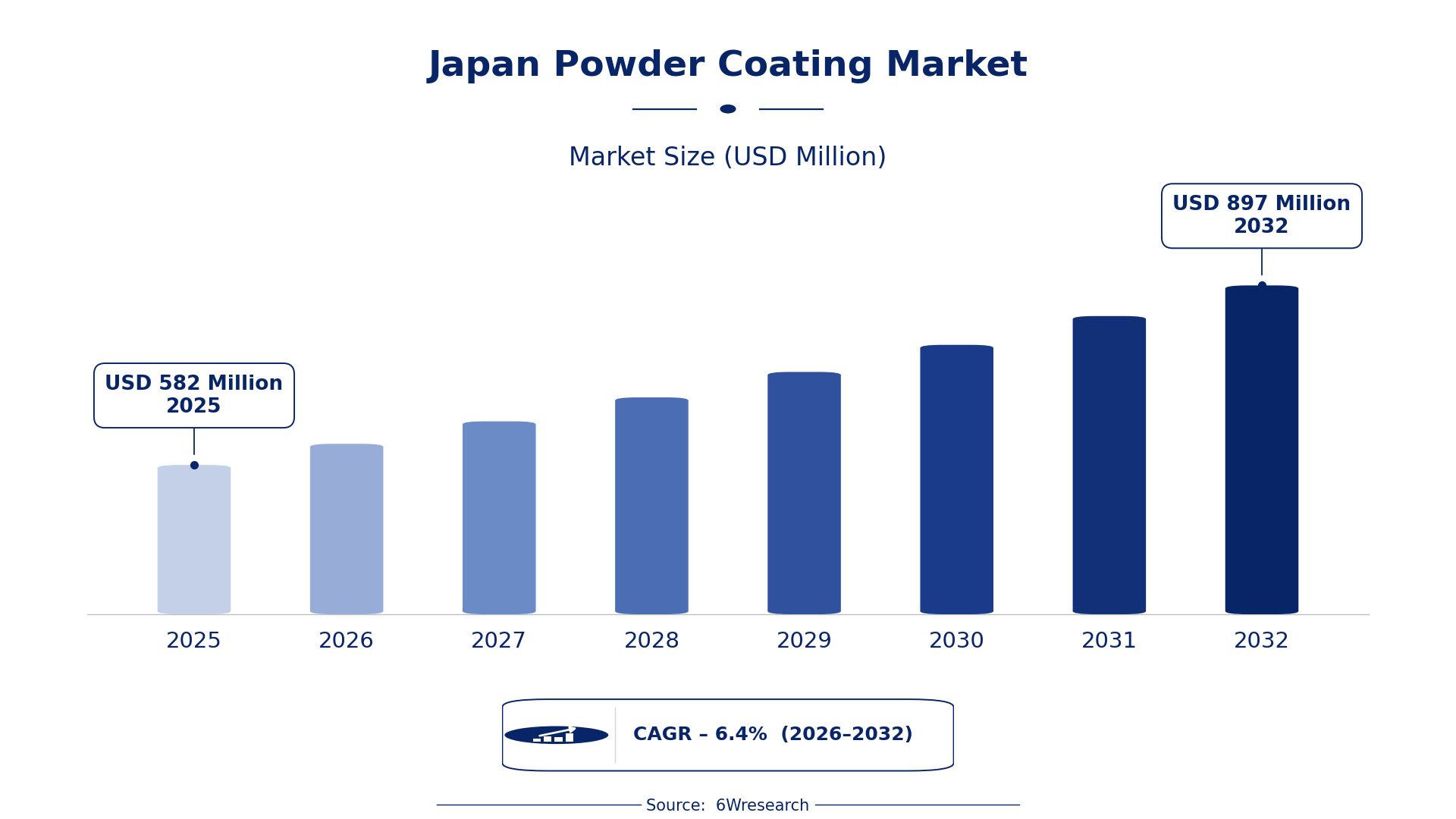
According to 6Wresearch internal database and industry insights, the Japan Powder Coating Market was valued at USD 582 Million in 2025 and is projected to reach USD 897 Million by 2032, growing at a CAGR of approximately 6.4% during 2026–2032.
Japan Powder Coating Market Highlights
| Report Metric | Details |
| Report Name | Japan Powder Coating Market (2026-2032) |
| Market Size 2025 | USD 582 Million |
| Market Size 2032 | USD 897 Million |
| Absolute Growth 2025–2032 | USD 315 Million |
| CAGR 2026–2032 | 6.4% |
| Peak Annual Growth | 8.0% in 2032 |
| Forecast Period | 2026–2032 |
| Historical Data | 2022–2025 |
| Base Year | 2025 |
| Leading Resin, 2025 | Epoxy-Polyester (33% share) |
| Leading Application, 2025 | Automotive (31% share) |
| Fastest-Growing Resin | Acrylic (8.6% CAGR) |
| Fastest-Growing Application | Architectural (9.1% CAGR) |
| Growing Sector | Architectural |
| Key End Users | Automotive manufacturers, construction firms, consumer goods producers |
Japan Powder Coating Market Year-wise Growth Rate and Key Drivers (2022–2032)
This graph illustrates the annual growth rates of the market from 2022 to 2032, highlighting a steady upward trajectory and projected market expansion over the forecast period.
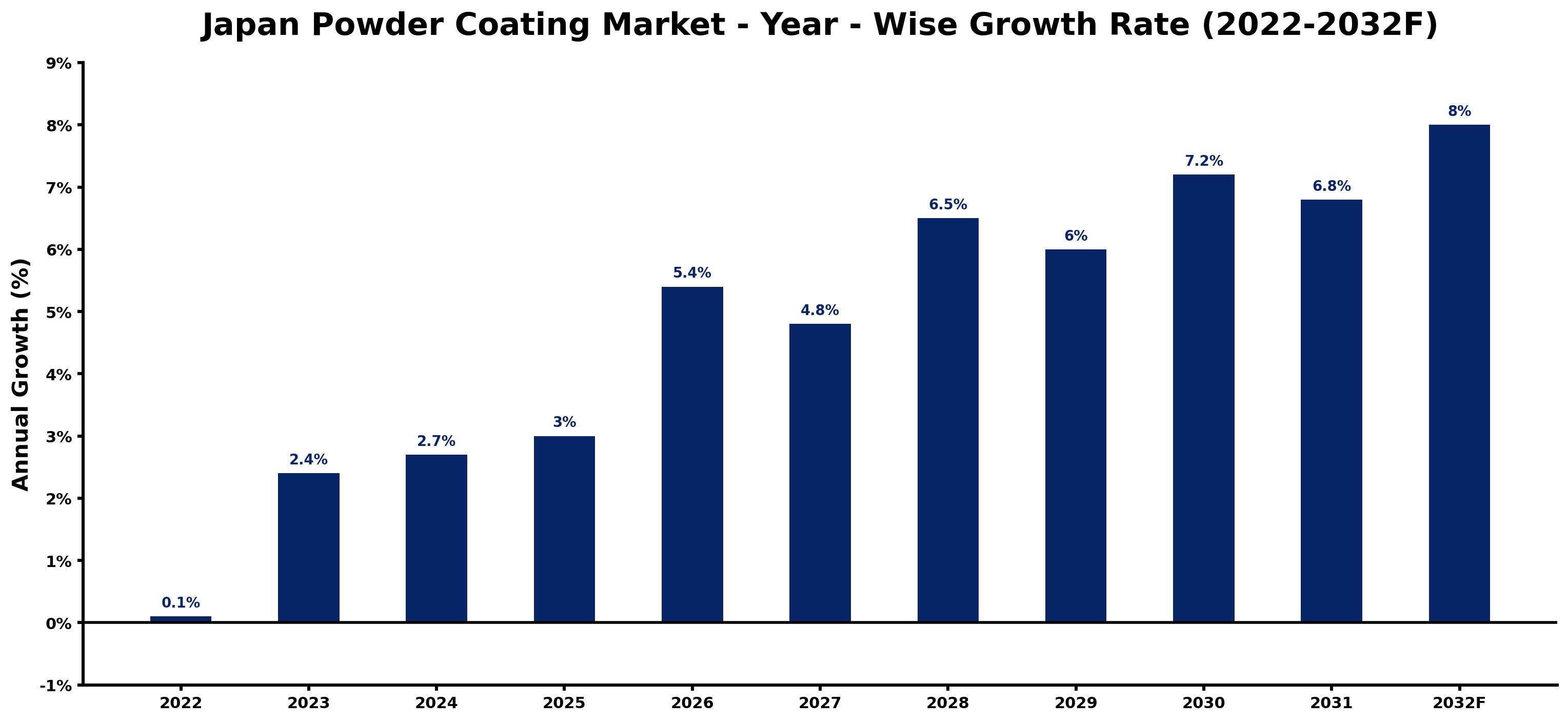
For each year, the table pairs the estimated growth rate with the leading influence on demand, showing how the drivers changed across the period.
| Year | Estimated Annual Growth (%) | Market Rationale |
| 2022 | 0.1 | The market showed minimal growth due to stabilisation after previous fluctuations. |
| 2023 | 2.4 | Demand increased as the automotive sector ramped up production and consumer goods expanded. |
| 2024 | 2.7 | Growth continued with rising interest in durable coatings among manufacturers. |
| 2025 | 3.0 | The automotive sector maintained strong demand, leading to steady growth in powder coatings. |
| 2026 | 5.4 | Demand is expected to surge as architectural projects increase, requiring high-quality finishes. |
| 2027 | 4.8 | Growth is projected to slow slightly as the market adjusts to higher production capacities. |
| 2028 | 6.5 | Demand is expected to accelerate again, driven by a resurgence in construction and automotive production. |
| 2029 | 6.0 | A slight slowdown is projected as the market stabilises after rapid growth phases. |
| 2030 | 7.2 | Growth is expected to pick up again, supported by technological advancements in coating processes. |
| 2031 | 6.8 | A minor slowdown is projected as the market matures and competition intensifies. |
| 2032 | 8.0 | The market is projected to peak as eco-friendly coatings gain traction. |
Note: Market size estimations and growth projections presented in this report are based on 6Wresearch's proprietary forecasting methodology, utilizing the latest available industry data, government publications, and primary research inputs.
Japan Powder Coating Market Synopsis
Powder coating is a dry finishing process that creates a durable finish for metal products, primarily used in automotive and architectural applications. The Japan Powder Coating Market is expanding due to the automotive sector, which utilises powder coatings in over 50% of applications. The architectural segment benefits from stringent building standards, while the consumer goods sector is influenced by Japan's large population of approximately 125 million. Technological advancements and eco-friendly initiatives are driving market growth, with average annual consumption estimated at 100,000 tons.
Market Dynamics Impact Analysis (2026–2032)
| Factor | Type | Impact | Primary Segment Affected |
| Strong demand from the automotive sector drives powder coating usage. | Driver | High | Automotive |
| Technological advancements in powder coating equipment enhance production efficiency. | Driver | High | Epoxy-Polyester |
| Increasing construction projects create a need for architectural coatings. | Opportunity | High | Architectural |
| Growing consumer goods market demands durable and aesthetic finishes. | Opportunity | Medium | Consumer Goods |
| Regulatory compliance increases costs for manufacturers of coatings. | Restraint | High | Epoxy-Polyester |
| Limited awareness of powder coating benefits among smaller manufacturers. | Restraint | Medium | Epoxy-Polyester |
| Competition from alternative coating technologies pressures pricing. | Challenge | High | Epoxy-Polyester |
| Supply chain disruptions can delay production and delivery schedules. | Challenge | Medium | Epoxy-Polyester |
Evaluation of Drivers in Japan Powder Coating Market (2026–2032)
These are the developments adding the most demand over the forecast period.
| Drivers | Primary Segment Affected | Why It Matters (Evidence) |
| Rising automotive production in Japan fuels powder coating demand. | Automotive | In 2023, thousands of vehicles were produced, increasing the need for protective finishes. |
| Advancements in powder coating technology improve application efficiency. | Epoxy-Polyester | The installed base for powder coating equipment is growing steadily, enhancing production capabilities. |
| Demand for high-quality architectural coatings is increasing due to strict standards. | Architectural | Japan's stringent building standards drive the need for durable coatings. |
| Consumer goods manufacturers seek durable finishes for appliances and electronics. | Consumer Goods | The average annual consumption of powder coatings in Japan is estimated at 100,000 tons. |
| The promotion of eco-friendly coatings aligns with market trends. | Epoxy-Polyester | The Chemical Substances Control Law requires evaluation of new chemical substances, raising costs. |
What keeps demand rising is the substantial automotive production in Japan, with thousands of vehicles produced annually, leading to increased needs for protective finishes. Architectural projects are also driving demand, supported by stringent building standards. In the consumer goods sector, the average annual consumption of powder coatings reflects the growing interest in durable finishes. Technological advancements in powder coating equipment improve production efficiency, further boosting demand.
Evaluation of Restraints in Japan Powder Coating Market
The following restraints limit how fast demand can grow.
| Market Restraint | Primary Segment Affected | Why It Matters (Evidence) |
| Regulatory compliance costs increase operational expenses for manufacturers. | Epoxy-Polyester | The Chemical Substances Control Law requires evaluation of new chemical substances, raising costs for manufacturers. |
| Limited awareness of powder coating benefits restricts market growth among smaller firms. | Epoxy-Polyester | Many smaller manufacturers lack knowledge about the advantages of powder coatings. |
| Competition from alternative coatings can divert potential customers. | Epoxy-Polyester | Liquid coatings offer cheaper alternatives, impacting powder coating sales. |
| Supply chain disruptions can lead to delays in production and delivery. | Epoxy-Polyester | Global supply chain issues affect the availability of raw materials for powder coatings. |
| High initial investment costs for advanced powder coating equipment deter entry. | Epoxy-Polyester | The need for significant capital investment limits access for smaller manufacturers. |
Japan Powder Coating Market Challenges
Japan's powder coating market consumes approximately 100,000 tons annually, yet producers struggle with outdated technology that can delay production by up to three weeks. Regulatory requirements, especially adherence to JIS A 5759 building standards, escalate costs for manufacturers, increasing operational expenses by around 15%. Distributors face supply chain disruptions that can lead to stock shortages, impacting delivery schedules for buyers and potentially delaying projects. A lack of skilled workers hinders producers from optimising processes, resulting in inefficiencies that can reduce output by 20%.
Trends in the Japan Powder Coating Market
Several trends are reshaping the Japan Powder Coating Market; the most important are set out below.
- Shift from Liquid to Powder Coatings: Since 2023, the architectural sector has increasingly adopted powder coatings over liquid alternatives due to their durability and eco-friendliness, reflected in a 9.1% CAGR in architectural applications.
- Emergence of Eco-Friendly Coatings: Government initiatives have prompted manufacturers to focus on sustainable powder coatings, with over 50% of automotive applications now utilising eco-friendly options.
- Transition to Automated Powder Coating Processes: In 2023, automated systems for powder coating application are being implemented more widely, improving efficiency and consistency in production, particularly in the automotive sector.
- Increased Demand for Specialty Coatings: The furniture industry is increasingly adopting powder coatings for their durability, with a notable rise in applications reported in 2023.
Investment Opportunities in the Japan Powder Coating Market
The openings below show where demand in the Japan Powder Coating Market is visible and how suppliers can enter.
- Growing Demand for Architectural Coatings: With Japan's construction industry valued at over 600 billion USD, there is an opportunity to supply powder coatings for architectural applications, particularly in urban areas.
- Rising Consumer Goods Market: The consumer goods sector is expanding, with a need for durable finishes. Suppliers can target appliance manufacturers looking for high-quality coatings.
- Technological Advancements in Coating Equipment: Investing in advanced powder coating equipment can capture the growing market, particularly in regions with high automotive production, such as Aichi Prefecture.
- Focus on Eco-Friendly Solutions: With the government's push for sustainable coatings, there is an opportunity to supply eco-friendly powder coatings to various industries, including automotive and construction.
Government Initiatives in the Japan Powder Coating Market
The Food Sanitation Act amendment in 2018 introduced a positive list system for synthetic resins, enhancing safety standards for coatings used in food-related applications. This measure, effective from June 2020, complements existing regulations like the Chemical Substances Control Law, which governs chemical evaluations and controls, thus impacting powder coating producers and buyers.
Buyers in the food industry benefit from the positive list system, ensuring that only safe materials are used in coatings. This regulation, administered by the Ministry of Health, Labour and Welfare, ensures consumer confidence and compliance with safety standards.
Future Insight of the Japan Powder Coating Market
By 2032, buyers in the automotive sector will benefit from advancements in powder coating technology, enabling faster application methods. Suppliers must comply with evolving quality management standards, ensuring products meet heightened consumer expectations. The furniture industry will increasingly embrace durable coatings, reflecting consumer preferences for longevity. Japan's construction industry, valued at over 600 billion USD, will further elevate the demand for high-quality finishes, prompting suppliers to refine their product offerings.
Market Segmentation Analysis
Japan Powder Coating Market report covers a detailed analysis of the following market segments:
By Resin – Epoxy-Polyester Leads, Acrylic Expected to Grow Fastest
According to Shubham Padhi, Research Analyst at 6Wresearch, in 2025, Epoxy-Polyester led the resin split with a 33% share. The epoxy-polyester segment holds the largest share as it is extensively utilised in automotive applications where durability and corrosion resistance are paramount. This resin type is essential for achieving long-lasting finishes on numerous vehicles produced annually in Japan. Over 2026–2032, Acrylic is expected to post the fastest growth, at a CAGR of 8.6%. The acrylic segment is experiencing rapid growth due to its specific application in high-gloss finishes, particularly in consumer products that demand exceptional colour retention. As aesthetic preferences among consumers continue to evolve, the demand for acrylic coatings is expected to increase significantly. Suppliers should focus on developing acrylic formulations to align with the rising market demand.
By Application – Automotive Leads, Architectural Expected to Grow Fastest
Automotive held 31% of the Japan Powder Coating Market by application in 2025. The automotive application leads the market owing to the high volume of vehicles produced in Japan, which necessitates protective finishes to withstand harsh conditions. This sector's substantial demand for powder coatings is evidenced by their use in over 50% of automotive applications. Architectural is set to record the highest CAGR in this split, 9.1% over 2026–2032. The architectural segment is the fastest growing, spurred by Japan's stringent building standards and the increasing value of the construction industry, which exceeded 600 billion USD in 2023. This growth reflects a rising trend towards high-quality finishes in building projects. Buyers in the architectural sector should consider suppliers that can meet stringent quality standards to ensure compliance and durability.
Key Attractiveness of the Report
- 10 Years of Market Numbers
- Historical Data Starting from 2022 to 2025
- Base Year 2025
- Forecast Data until 2032
- Key Performance Indicators Impacting the Market
- Major Upcoming Developments and Projects
Key Highlights of the Report:
- Japan Powder Coating Market Outlook
- Market Size of Japan Powder Coating Market, 2025
- Forecast of Japan Powder Coating Market, 2032
- Historical Data and Forecast of Japan Powder Coating Revenues & Volume for the Period 2022-2032
- Japan Powder Coating Market Trend Evolution
- Japan Powder Coating Market Drivers and Challenges
- Japan Powder Coating Price Trends
- Japan Powder Coating Porter's Five Forces
- Japan Powder Coating Industry Life Cycle
- Historical Data and Forecast of Japan Powder Coating Market Revenues & Volume By Resin for the Period 2022-2032
- Historical Data and Forecast of Japan Powder Coating Market Revenues & Volume By Epoxy-Polyester for the Period 2022-2032
- Historical Data and Forecast of Japan Powder Coating Market Revenues & Volume By Epoxy for the Period 2022-2032
- Historical Data and Forecast of Japan Powder Coating Market Revenues & Volume By Acrylic for the Period 2022-2032
- Historical Data and Forecast of Japan Powder Coating Market Revenues & Volume By Polyester for the Period 2022-2032
- Historical Data and Forecast of Japan Powder Coating Market Revenues & Volume By Polyurethane for the Period 2022-2032
- Historical Data and Forecast of Japan Powder Coating Market Revenues & Volume By Others for the Period 2022-2032
- Historical Data and Forecast of Japan Powder Coating Market Revenues & Volume By Application for the Period 2022-2032
- Historical Data and Forecast of Japan Powder Coating Market Revenues & Volume By Automotive for the Period 2022-2032
- Historical Data and Forecast of Japan Powder Coating Market Revenues & Volume By Consumer Goods for the Period 2022-2032
- Historical Data and Forecast of Japan Powder Coating Market Revenues & Volume By Architectural for the Period 2022-2032
- Historical Data and Forecast of Japan Powder Coating Market Revenues & Volume By Furniture for the Period 2022-2032
- Historical Data and Forecast of Japan Powder Coating Market Revenues & Volume By Oil and Gas for the Period 2022-2032
- Historical Data and Forecast of Japan Powder Coating Market Revenues & Volume By Pipeline for the Period 2022-2032
- Historical Data and Forecast of Japan Powder Coating Market Revenues & Volume By Others for the Period 2022-2032
- Japan Powder Coating Import Export Trade Statistics
- Market Opportunity Assessment By Resin
- Market Opportunity Assessment By Application
- Japan Powder Coating Top Companies Market Share
- Japan Powder Coating Competitive Benchmarking By Technical and Operational Parameters
- Japan Powder Coating Company Profiles
- Japan Powder Coating Key Strategic Recommendations
Market Covered
The following segment groups are covered in the report.
By Resin
- Epoxy-Polyester
- Epoxy
- Acrylic
- Polyester
- Polyurethane
- Others
By Application
- Automotive
- Consumer Goods
- Architectural
- Furniture
- Oil and Gas
- Pipeline
- Others































