Japan Power Infrastructure Market Size & Growth Rate
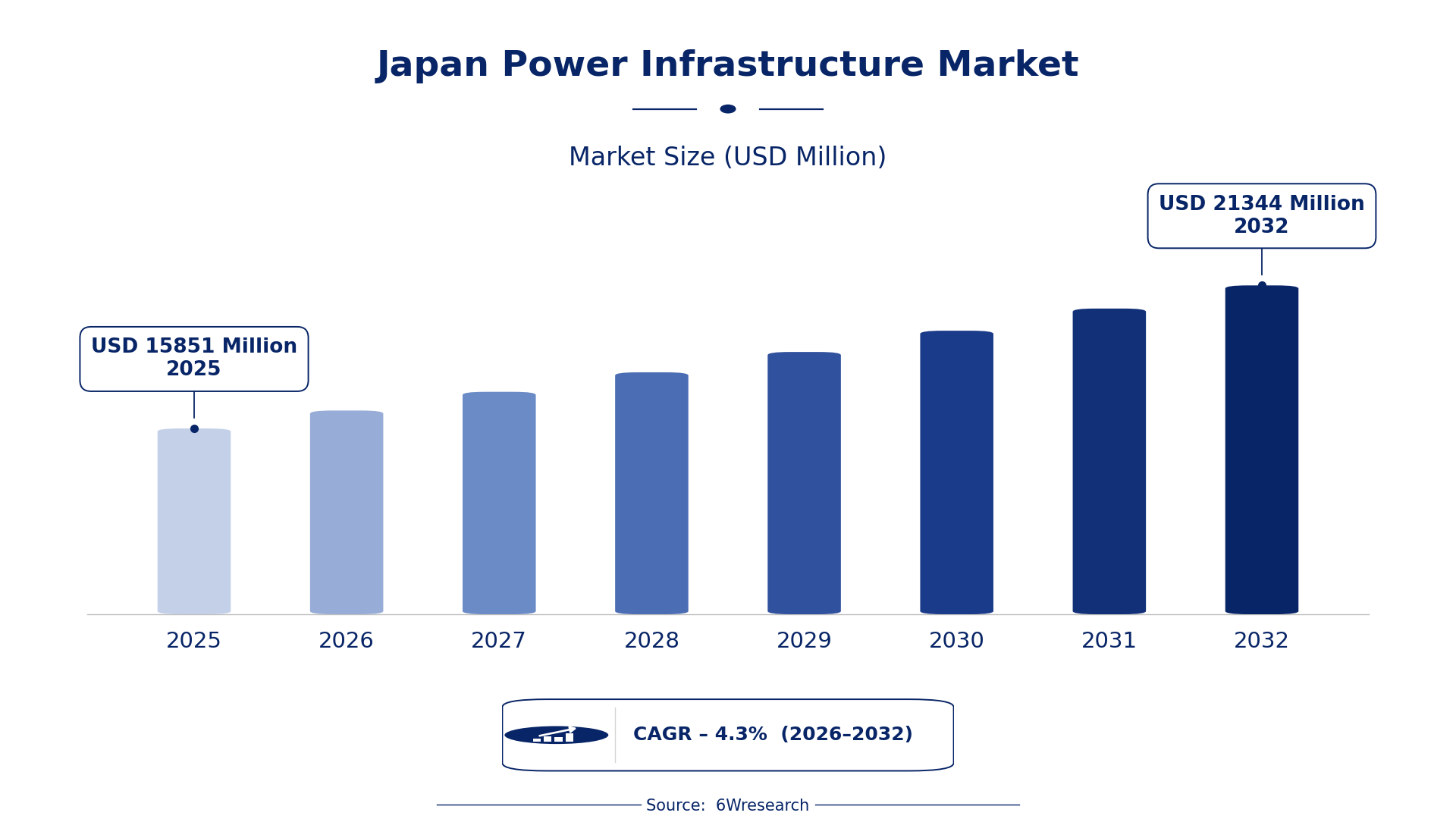
According to 6Wresearch internal database and industry insights, the Japan Power Infrastructure Market was valued at USD 15,851 Million in 2025 and is projected to reach USD 21,344 Million by 2032, growing at a CAGR of approximately 4.3% during 2026–2032.
Japan Power Infrastructure Market Highlights
| Report Metric | Details |
| Report Name | Japan Power Infrastructure Market (2026-2032) |
| Market Size 2025 | USD 15,851 Million |
| Market Size 2032 | USD 21,344 Million |
| Absolute Growth 2025–2032 | USD 5,493 Million |
| CAGR 2026–2032 | 4.3% |
| Peak Annual Growth | 5.3% in 2028 |
| Forecast Period | 2026–2032 |
| Historical Data | 2022–2025 |
| Base Year | 2025 |
| Leading Component Type, 2025 | Substations (46% share) |
| Leading Infrastructure Segment, 2025 | Transmission/Distribution (43% share) |
| Leading Distribution Channel, 2025 | Direct Sales (38% share) |
| Leading End User, 2025 | Grid Developers (49% share) |
| Fastest-Growing Component Type | Switchyards (5.9% CAGR) |
| Fastest-Growing Infrastructure Segment | Outdoor (5.5% CAGR) |
| Fastest-Growing Distribution Channel | Engineering Contractors (5.6% CAGR) |
| Fastest-Growing End User | Public Utility Services (5.4% CAGR) |
| Growing Sector | Power Distribution |
| Key End Users | Grid Developers, Public Utility Services, Power Distribution Firms |
Japan Power Infrastructure Market Year-wise Growth Rate and Key Drivers (2022–2032)
This graph illustrates the annual growth rates of the market from 2022 to 2032, highlighting a steady upward trajectory and projected market expansion over the forecast period.
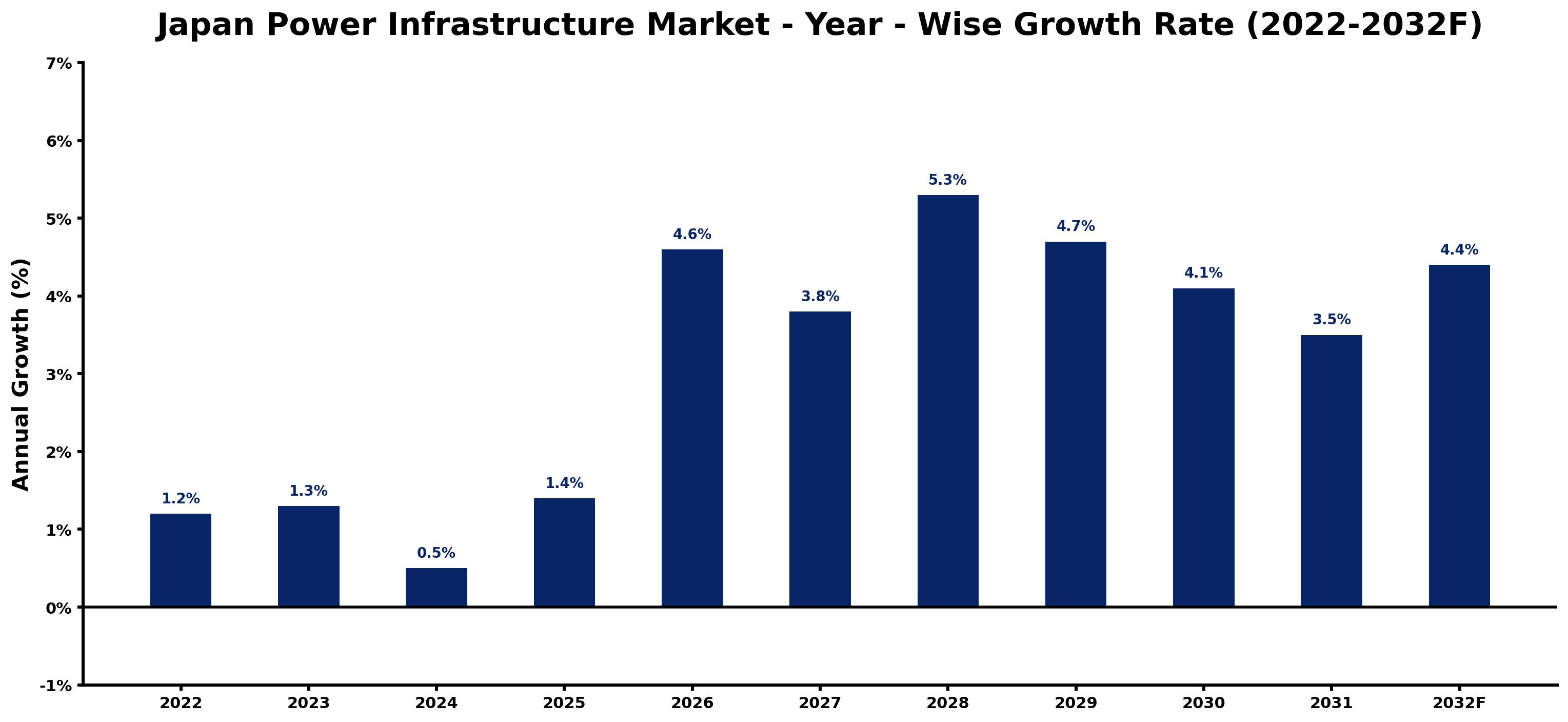
The yearly estimates that follow link every growth rate to its principal driver, so readers can see why the pace changed in each period.
| Year | Estimated Annual Growth (%) | Market Rationale |
| 2022 | 1.2 | The market experienced steady growth, reflecting ongoing investments in infrastructure. |
| 2023 | 1.3 | Growth accelerated due to increased demand for reliable electricity supply across urban areas. |
| 2024 | 0.5 | Growth slowed as projects faced delays in implementation and funding adjustments. |
| 2025 | 1.4 | Demand rose as public utility services expanded their operational capacity and efficiency. |
| 2026 | 4.6 | Investment in renewable energy integration is expected to spur infrastructure upgrades and expansions. |
| 2027 | 3.8 | Growth is projected to slow slightly due to market saturation in certain regions and project completion. |
| 2028 | 5.3 | The market is expected to peak as major infrastructure projects reach completion, boosting capacity. |
| 2029 | 4.7 | Growth is anticipated to moderate as the focus shifts towards maintenance and upgrades of existing systems. |
| 2030 | 4.1 | Demand is projected to stabilise as the government sets ambitious targets for renewable energy integration. |
| 2031 | 3.5 | Growth is expected to continue slowing as the market adjusts to new energy policies and regulations. |
| 2032 | 4.4 | A renewed focus on smart grid technology is expected to drive growth in infrastructure. |
Note: Market size estimations and growth projections presented in this report are based on 6Wresearch's proprietary forecasting methodology, utilizing the latest available industry data, government publications, and primary research inputs.
Japan Power Infrastructure Market Synopsis
Power infrastructure encompasses systems and equipment for electricity generation, transmission, and distribution, including substations and transmission towers. The Japan Power Infrastructure Market is growing, driven by a commitment to renewable energy integration and investments, highlighted by the JPY 150 trillion decarbonisation investment target over the next decade. The push for smart grids and the need for reliable electricity supply fuel demand, particularly in densely populated urban areas.
Market Dynamics Impact Analysis (2026–2032)
| Factor | Type | Impact | Primary Segment Affected |
| Investment in renewable energy integration | Driver | High | Transmission/Distribution |
| Government targets for greenhouse gas emissions reduction | Driver | High | Public Utility Services |
| Emerging demand for smart grid technologies | Opportunity | High | Control Rooms |
| Need for infrastructure upgrades post-disaster | Opportunity | Medium | Transmission Towers |
| Delays in project approvals and funding | Restraint | High | Switchyards |
| High costs associated with advanced technology adoption | Restraint | Medium | Substations |
| Competition for resources among contractors | Challenge | High | Engineering Contractors |
| Regulatory compliance costs for energy efficiency | Challenge | Medium | Power Distribution Firms |
Evaluation of Drivers in Japan Power Infrastructure Market (2026–2032)
The table below links each growth driver to the segment it affects and the evidence for it.
| Drivers | Primary Segment Affected | Why It Matters (Evidence) |
| Increased investments in renewable energy projects | Transmission/Distribution | Japan's installed capacity for renewable energy reached 100 GW in 2022, leading to greater demand for transmission infrastructure. |
| Government initiatives to reduce emissions | Public Utility Services | Japan targets a 46% cut in greenhouse-gas emissions by 2030, prompting utilities to upgrade their infrastructure. |
| Growing urban population requiring reliable power | Substations | With a population of approximately 125 million, demand for substations to support urban electricity needs is rising. |
| Adoption of SCADA systems for efficiency | Control Rooms | SCADA systems are increasingly adopted for real-time monitoring in 90% of major utilities, improving operational efficiency. |
| Government funding for energy infrastructure improvements | Transmission Towers | The Japanese government has invested over ¥1 trillion in energy infrastructure improvements since 2020, boosting demand for transmission towers. |
The strongest pull on demand comes from increased investments in renewable energy projects, with Japan's installed capacity for renewable energy reaching 100 GW in 2022. This surge prompts utilities to upgrade their infrastructure, particularly control rooms, to meet the needs of a population of approximately 125 million. Over ¥1 trillion has been allocated for infrastructure upgrades since 2020, impacting the requirements for transmission and distribution systems. The trend towards smart grid technology improves operational capabilities, leading to increased purchases by public utility services.
Evaluation of Restraints in Japan Power Infrastructure Market
These are the pressures that could keep growth below its potential.
| Market Restraint | Primary Segment Affected | Why It Matters (Evidence) |
| Delays in project approvals and funding | Switchyards | Delays in securing funding for new projects can hinder timely infrastructure upgrades, affecting overall efficiency and reliability. |
| High costs associated with advanced technology adoption | Substations | The investment required for modernising substations with the latest technology can be prohibitive for many utilities, limiting their ability to upgrade. |
| Regulatory compliance costs for energy efficiency | Power Distribution Firms | Compliance with energy efficiency regulations can increase operational costs for power distribution firms, impacting their profitability. |
| Competition for resources among contractors | Engineering Contractors | Limited availability of skilled contractors can delay project timelines and increase costs for infrastructure development, affecting project delivery. |
| Market saturation in certain regions | Transmission Towers | In some areas, existing infrastructure limits the potential for new transmission tower projects, slowing growth and investment. |
Japan Power Infrastructure Market Challenges
Buyers encounter reliability issues as outdated power infrastructure struggles to meet electricity demand, especially in urban areas like Tokyo, leading to outages that cost public utility services substantial revenue. Suppliers face fierce competition from emerging energy technologies, complicating contract acquisition for traditional infrastructure projects. Escalating raw material costs, particularly steel, have risen by 20% over the past year, tightening margins for producers and inflating project expenses. Supply chain disruptions, exacerbated by global events, delay essential infrastructure developments, extending timelines for energy providers and increasing costs for consumers.
Trends in the Japan Power Infrastructure Market
Several trends are reshaping the Japan Power Infrastructure Market; the most important are set out below.
- Shift Towards Smart Grid Technologies: The Tohoku region is increasingly adopting smart grid technologies, improving energy management. In 2023, the Ministry of the Environment launched a program promoting smart grids, reflecting a growing trend in infrastructure development.
- Transition to Renewable Energy Sources: Japan is moving towards renewable energy sources, aiming for a 36-38% share by 2030. This shift is supported by substantial investments in solar and wind energy infrastructure.
- Standardisation of SCADA Systems in Utilities: SCADA systems are becoming standard in major utilities, with 90% adoption reported in 2022. This transition allows for real-time monitoring and improved operational efficiency across the grid.
- Focus on Decarbonisation Investments: The government has set a target of JPY 150 trillion for decarbonisation investments over the next decade. This funding will drive infrastructure projects aimed at reducing greenhouse gas emissions.
Investment Opportunities in the Japan Power Infrastructure Market
The following opportunities in the Japan Power Infrastructure Market pair current demand with a clear way in.
- Partnerships for Smart Grid Development: Now is the time for partnerships in smart grid development, with the government promoting new technologies. Grid developers in urban areas seek local partners to improve infrastructure efficiency.
- Investment in Renewable Energy Infrastructure: The growing demand for renewable energy presents an opportunity for investment in infrastructure upgrades. Public utility services are actively seeking engineering contractors to facilitate this transition.
- Expansion of Transmission Networks: The increasing need for reliable power supply creates a gap in transmission networks. Engineering contractors in the Chubu region are expected to expand these networks significantly.
- Energy Efficiency Project Approvals: With the government targeting energy efficiency, there is a significant opportunity for projects that meet these standards. Contractors can enter by obtaining necessary certifications and approvals.
Government Initiatives in the Japan Power Infrastructure Market
The GX Promotion Act (2023) reinforces the legal framework for Japan's decarbonisation strategy, mandating large energy users to improve efficiency. This ensures that power infrastructure projects align with national energy goals and support the transition to sustainable energy.
In 2023, the government allocated JPY 150 trillion for decarbonisation investments, overseen by the Ministry of Economy, Trade and Industry. This funding supports various energy infrastructure projects aimed at improving efficiency and reducing emissions, benefiting both producers and buyers.
Future Insight of the Japan Power Infrastructure Market
Investment in decarbonisation is set to exceed ¥1 trillion, generating demand for modern power infrastructure. By 2032, renewable energy's share is expected to reach 36-38%, necessitating extensive system upgrades. The government's smart grid programme will enhance operational efficiency and reliability for buyers, while suppliers will benefit from increased project opportunities. Adoption of ISO 50001 will improve energy management practices, leading to better performance across the sector.
Market Segmentation Analysis
Japan Power Infrastructure Market report covers a detailed analysis of the following market segments:
By Component Type – Substations Lead, Switchyards Expected to Grow Fastest
According to Navya, Research Analyst at 6Wresearch, Substations held 46% of the Japan Power Infrastructure Market by component type in 2025. Substations are vital for voltage regulation and distribution, forming the backbone of Japan's power infrastructure. With over 8,000 substations operating across the country, they ensure a reliable electricity supply for various sectors. The quickest growth will come from Switchyards, forecast to expand at a CAGR of 5.9% between 2026 and 2032. Switchyards are rapidly growing due to their critical function in connecting different transmission lines, which enhances overall grid flexibility. The increasing complexity of energy sources necessitates more switchyards to manage diverse inputs effectively. Suppliers must prioritise the development of advanced switchyard technologies to address the rising demand.
By Infrastructure Segment – Transmission/Distribution Leads, Outdoor Expected to Grow Fastest
The largest infrastructure segment category in 2025 was Transmission/Distribution, at 43% of revenue. Transmission and distribution systems are fundamental for electricity delivery, forming the core of Japan's power infrastructure. The extensive network of approximately 25,000 kilometres of high voltage transmission lines underscores their importance in maintaining grid stability. Outdoor is set to record the highest CAGR in this split, 5.5% over 2026–2032. Outdoor infrastructure is growing quickly as it is increasingly used for installations in open environments, accommodating the need for renewable energy integration. The push for decarbonisation and expansion of renewable sources drives this segment's rapid development. Buyers must consider outdoor solutions to ensure adaptability in their infrastructure projects.
By Distribution Channel – Direct Sales Leads, Engineering Contractors Expected to Grow Fastest
With 38% of distribution channel revenue in 2025, Direct Sales was the largest category. Direct sales serve as the primary method of component distribution, enabling manufacturers to engage directly with customers for tailored solutions. This approach ensures that products meet specific market needs, leading to higher customer satisfaction. Over 2026–2032, Engineering Contractors are expected to post the fastest growth, at a CAGR of 5.6%. Engineering contractors are becoming increasingly important as they play a vital role in project implementation, reflecting a shift towards specialised project management. Their expertise is essential for navigating complex infrastructure projects efficiently and effectively. Suppliers should strengthen collaborations with engineering contractors to enhance their market presence.
By End User – Grid Developers Lead, Public Utility Services Expected to Grow Fastest
In 2025, Grid Developers led the end user split with a 49% share. Grid developers are the leading end users of power infrastructure, responsible for advancing new grid projects across Japan. Their role is crucial in expanding and modernising the electricity grid to accommodate future energy demands. Public Utility Services are projected to grow fastest, at a CAGR of 5.4% during 2026–2032. Public utility services are the fastest-growing end users, as they provide reliable electricity to over 90% of the population. Their ongoing investments in infrastructure improvements significantly contribute to this growth trajectory. Suppliers need to align their products with the changing needs of public utility services.
Key Attractiveness of the Report
- 10 Years of Market Numbers
- Historical Data Starting from 2022 to 2025
- Base Year 2025
- Forecast Data until 2032
- Key Performance Indicators Impacting the Market
- Major Upcoming Developments and Projects
Key Highlights of the Report:
- Japan Power Infrastructure Market Outlook
- Market Size of Japan Power Infrastructure Market, 2025
- Forecast of Japan Power Infrastructure Market, 2032
- Historical Data and Forecast of Japan Power Infrastructure Revenues & Volume for the Period 2022-2032F
- Japan Power Infrastructure Market Trend Evolution
- Japan Power Infrastructure Market Drivers and Challenges
- Japan Power Infrastructure Price Trends
- Japan Power Infrastructure Porter's Five Forces
- Japan Power Infrastructure Industry Life Cycle
- Historical Data and Forecast of Japan Power Infrastructure Market Revenues & Volume By Component Type for the Period 2022-2032F
- Historical Data and Forecast of Japan Power Infrastructure Market Revenues & Volume By Substations for the Period 2022-2032F
- Historical Data and Forecast of Japan Power Infrastructure Market Revenues & Volume By Switchyards for the Period 2022-2032F
- Historical Data and Forecast of Japan Power Infrastructure Market Revenues & Volume By Transmission Towers for the Period 2022-2032F
- Historical Data and Forecast of Japan Power Infrastructure Market Revenues & Volume By Control Rooms for the Period 2022-2032F
- Historical Data and Forecast of Japan Power Infrastructure Market Revenues & Volume By Infrastructure Segment for the Period 2022-2032F
- Historical Data and Forecast of Japan Power Infrastructure Market Revenues & Volume By Transmission/Distribution for the Period 2022-2032F
- Historical Data and Forecast of Japan Power Infrastructure Market Revenues & Volume By Outdoor for the Period 2022-2032F
- Historical Data and Forecast of Japan Power Infrastructure Market Revenues & Volume By Overhead for the Period 2022-2032F
- Historical Data and Forecast of Japan Power Infrastructure Market Revenues & Volume By SCADA-Based for the Period 2022-2032F
- Historical Data and Forecast of Japan Power Infrastructure Market Revenues & Volume By Distribution Channel for the Period 2022-2032F
- Historical Data and Forecast of Japan Power Infrastructure Market Revenues & Volume By Direct Sales for the Period 2022-2032F
- Historical Data and Forecast of Japan Power Infrastructure Market Revenues & Volume By Engineering Contractors for the Period 2022-2032F
- Historical Data and Forecast of Japan Power Infrastructure Market Revenues & Volume By Steel Suppliers for the Period 2022-2032F
- Historical Data and Forecast of Japan Power Infrastructure Market Revenues & Volume By Specialty Engineering Firms for the Period 2022-2032F
- Historical Data and Forecast of Japan Power Infrastructure Market Revenues & Volume By End User for the Period 2022-2032F
- Historical Data and Forecast of Japan Power Infrastructure Market Revenues & Volume By Grid Developers for the Period 2022-2032F
- Historical Data and Forecast of Japan Power Infrastructure Market Revenues & Volume By Public Utility Services for the Period 2022-2032F
- Historical Data and Forecast of Japan Power Infrastructure Market Revenues & Volume By High Voltage Networks for the Period 2022-2032F
- Historical Data and Forecast of Japan Power Infrastructure Market Revenues & Volume By Power Distribution Firms for the Period 2022-2032F
- Japan Power Infrastructure Import Export Trade Statistics
- Market Opportunity Assessment By Component Type
- Market Opportunity Assessment By Infrastructure Segment
- Market Opportunity Assessment By Distribution Channel
- Market Opportunity Assessment By End User
- Japan Power Infrastructure Top Companies Market Share
- Japan Power Infrastructure Competitive Benchmarking By Technical and Operational Parameters
- Japan Power Infrastructure Company Profiles
- Japan Power Infrastructure Key Strategic Recommendations
Market Covered
This report examines the market across the segments below.
By Component Type
- Substations
- Switchyards
- Transmission Towers
- Control Rooms
By Infrastructure Segment
- Transmission/Distribution
- Outdoor
- Overhead
- SCADA-Based
By Distribution Channel
- Direct Sales
- Engineering Contractors
- Steel Suppliers
- Specialty Engineering Firms
By End User
- Grid Developers
- Public Utility Services
- High Voltage Networks
- Power Distribution Firms































