Japan Pre-Plant & Soil Disinfections Market Size & Growth Rate
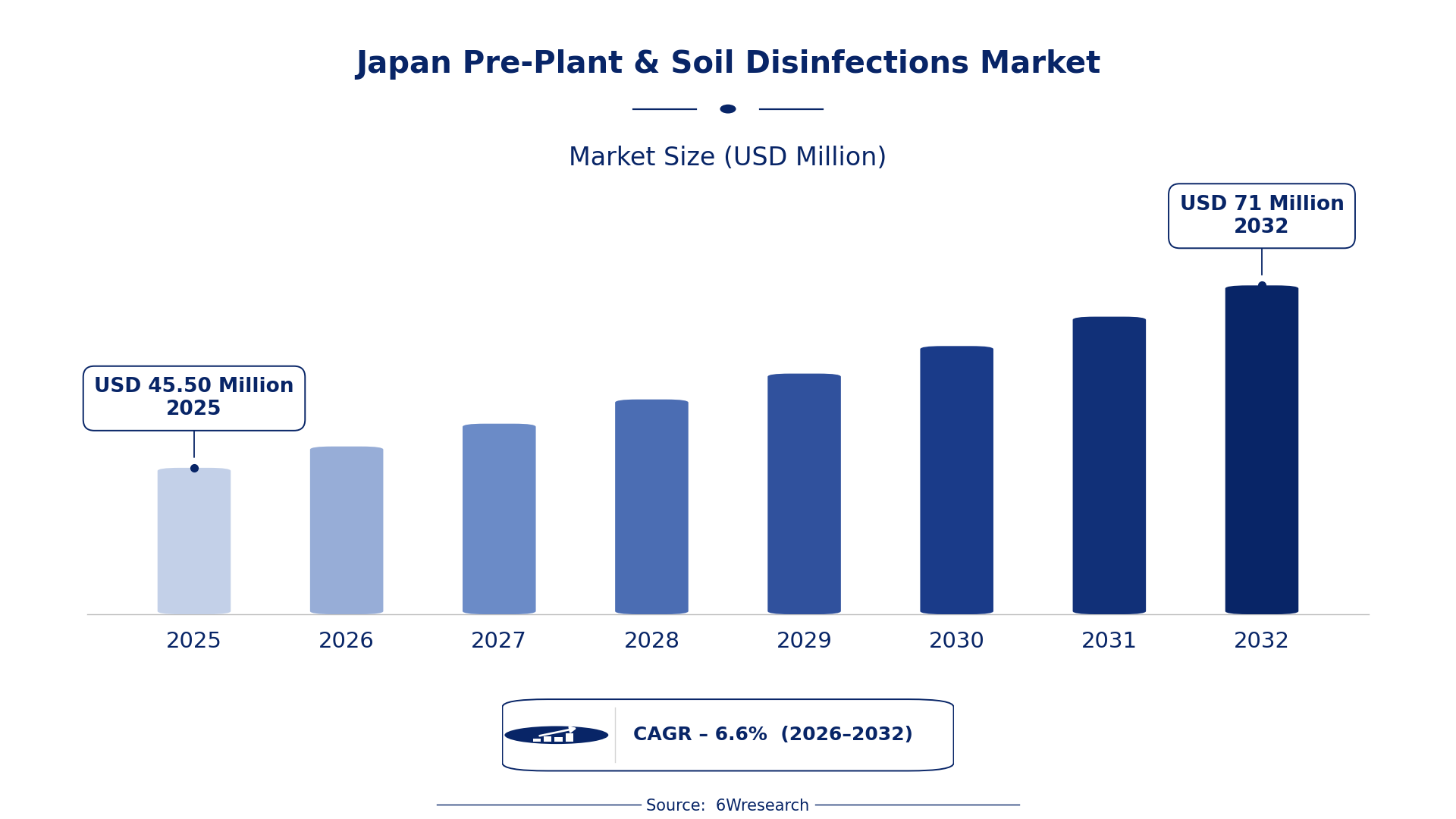
According to 6Wresearch internal database and industry insights, the Japan Pre-Plant & Soil Disinfections Market was valued at USD 45.50 Million in 2025 and is projected to reach USD 71 Million by 2032, growing at a CAGR of approximately 6.6% during 2026–2032.
Japan Pre-Plant & Soil Disinfections Market Highlights
| Report Metric | Details |
| Report Name | Japan Pre-Plant & Soil Disinfections Market (2026-2032) |
| Market Size 2025 | USD 45.50 Million |
| Market Size 2032 | USD 71 Million |
| Absolute Growth 2025–2032 | USD 25.50 Million |
| CAGR 2026–2032 | 6.6% |
| Peak Annual Growth | 7.3% in 2028 |
| Forecast Period | 2026–2032 |
| Historical Data | 2022–2025 |
| Base Year | 2025 |
| Leading Product Type, 2025 | Soil Fumigants (46% share) |
| Leading Chemical Type, 2025 | Methyl Bromide (49% share) |
| Leading Distribution Channel, 2025 | Agri Suppliers (49% share) |
| Leading End User, 2025 | Commercial Farmers (51% share) |
| Fastest-Growing Product Type | Natural Disinfectants (9.4% CAGR) |
| Fastest-Growing Chemical Type | Plant-Based Extracts (9.3% CAGR) |
| Fastest-Growing Distribution Channel | Agro-retailers (8.1% CAGR) |
| Fastest-Growing End User | Organic Growers (8.6% CAGR) |
| Growing Sector | Agriculture |
| Key End Users | Commercial Farmers, Organic Growers, Horticultural Units, Nursery Owners |
Japan Pre-Plant & Soil Disinfections Market Year-wise Growth Rate and Key Drivers (2022–2032)
This graph illustrates the annual growth rates of the market from 2022 to 2032, highlighting a steady upward trajectory and projected market expansion over the forecast period.
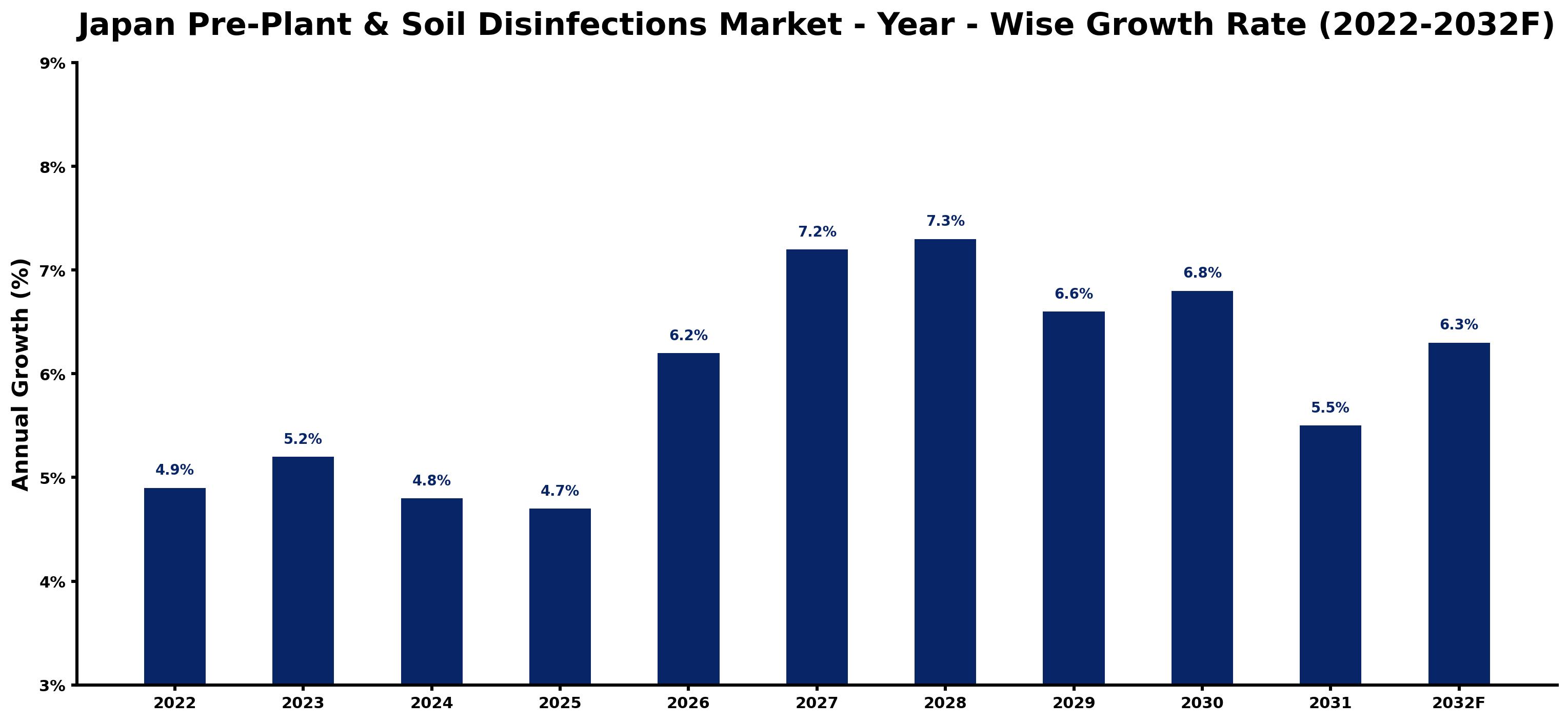
Each row of the following table gives one year's estimated growth and the event or demand shift that explains it.
| Year | Estimated Annual Growth (%) | Market Rationale |
| 2022 | 4.9 | The market experienced steady growth due to consistent agricultural practices. |
| 2023 | 5.2 | Growth accelerated as commercial farmers increased their use of soil disinfection products. |
| 2024 | 4.8 | Growth slowed as market saturation began to affect new purchases. |
| 2025 | 4.7 | A further slowdown occurred as the average age of farmers influenced adoption rates. |
| 2026 | 6.2 | Growth is expected to rise as organic farming gains traction among producers. |
| 2027 | 7.2 | Demand is projected to increase sharply as horticultural production expands in urban areas. |
| 2028 | 7.3 | The market is expected to peak with increased investments in sustainable agricultural practices. |
| 2029 | 6.6 | Growth is projected to slow as regulatory pressures on certain chemicals intensify. |
| 2030 | 6.8 | Demand is expected to increase as public awareness of soil health continues to rise. |
| 2031 | 5.5 | A slowdown is anticipated as market maturity leads to stabilisation in purchases. |
| 2032 | 6.3 | Growth is expected to resume as new disinfection methods gain acceptance. |
Note: Market size estimations and growth projections presented in this report are based on 6Wresearch's proprietary forecasting methodology, utilizing the latest available industry data, government publications, and primary research inputs.
Japan Pre-Plant & Soil Disinfections Market Synopsis
Pre-Plant & Soil Disinfections play a crucial role in eliminating pathogens and pests in soil before planting, promoting soil health and boosting crop yield. The Japan Pre-Plant & Soil Disinfections Market thrives within an agricultural sector valued at approximately ¥9 trillion, particularly benefiting horticulture and commercial farming. The rise of organic farming, which has expanded at 5% annually since 2018, alongside government initiatives that advocate for sustainable practices, are central to market growth.
Market Dynamics Impact Analysis (2026–2032)
| Factor | Type | Impact | Primary Segment Affected |
| Increasing adoption of organic farming practices | Driver | High | Natural Disinfectants |
| Rising awareness of soil health and sustainability | Driver | High | Soil Fumigants |
| Growing demand for eco-friendly agricultural solutions | Opportunity | High | Biocontrol Agents |
| Expansion of horticultural production in urban areas | Opportunity | Medium | Vapor-based Disinfection |
| Regulatory restrictions on Methyl Bromide usage | Restraint | High | Methyl Bromide |
| Aging farmer population affecting product adoption | Restraint | Medium | Natural Disinfectants |
| High costs associated with transitioning to organic methods | Challenge | High | Organic Growers |
| Limited awareness of new microbial products among farmers | Challenge | Medium | Commercial Farmers |
Evaluation of Drivers in Japan Pre-Plant & Soil Disinfections Market (2026–2032)
Key forces behind demand, with the segment each one moves most, are listed below.
| Drivers | Primary Segment Affected | Why It Matters (Evidence) |
| Growth in organic farming practices | Natural Disinfectants | Organic farming in Japan has seen a growth rate of 5% annually since 2018, leading to increased purchases of natural disinfectants. |
| Increased focus on soil health | Soil Fumigants | Soil health initiatives are prompting farmers to invest more in soil fumigants, with the agricultural sector valued at approximately ¥9 trillion. |
| Government support for eco-friendly practices | Biocontrol Agents | The national agricultural strategy promotes biocontrol agents, encouraging their adoption among farmers, with a ¥1 billion investment in 2023 for research. |
| Urban horticultural expansion | Vapor-based Disinfection | The Tokyo region, with over 30,000 commercial greenhouses installed, drives demand for effective disinfection methods. |
| Rising consumer demand for organic produce | Plant-Based Extracts | As consumer preferences shift towards organic produce, farmers are increasingly adopting plant-based extracts for soil treatment. |
Spending increases as the average size of commercial farms in Japan is around 1.5 hectares, prompting farmers to seek effective soil disinfection solutions. The agricultural sector, valued at roughly ¥9 trillion, underpins investments in sustainable practices. The average age of farmers in Japan, approximately 67, affects the adoption of new products. Urban horticulture in the Tokyo region, characterised by a high concentration of nursery owners, further stimulates demand for these products.
Evaluation of Restraints in Japan Pre-Plant & Soil Disinfections Market
Several factors work against faster growth; the main ones are summarised below.
| Market Restraint | Primary Segment Affected | Why It Matters (Evidence) |
| Regulatory restrictions on Methyl Bromide | Methyl Bromide | Methyl Bromide usage has declined due to international agreements, limiting options for farmers. |
| Aging farmer population | Natural Disinfectants | The average age of farmers in Japan is around 67, affecting the adoption of new products. |
| High transition costs to organic methods | Organic Growers | Transitioning to organic farming can incur costs of up to 20%, deterring some farmers from adopting these practices. |
| Limited awareness of microbial products | Commercial Farmers | Many commercial farmers lack knowledge about the benefits of microbial products, hindering their adoption. |
| Market saturation affecting new purchases | Soil Fumigants | As the market matures, saturation leads to slower growth in new purchases of soil fumigants. |
Japan Pre-Plant & Soil Disinfections Market Challenges
Many commercial farms in Japan encounter rising costs due to strict regulations, which can delay product availability and increase prices for farmers. Competition intensifies as the organic farming sector grows at 5% annually, compelling suppliers to invest in costly innovations that raise prices for distributors. Technology adoption lags because the average age of farmers is around 67, which limits the introduction of new products and methods, ultimately stunting producers' growth. Buyers in the Tokyo region face fluctuating demand from nursery owners, complicating inventory management and potentially resulting in financial losses.
Trends in the Japan Pre-Plant & Soil Disinfections Market
Below are the shifts with the largest effect on the Japan Pre-Plant & Soil Disinfections Market.
- Shift towards Natural Disinfectants: Natural Disinfectants gained a 20% market share in 2023, reflecting a growing trend among organic growers in Japan. This shift indicates a preference for eco-friendly solutions that improve soil health.
- Emergence of Biocontrol Agents: In 2023, Japan allocated ¥1 billion for research on biocontrol agents, marking a shift towards sustainable pest management. This trend is reshaping how farmers approach pest control.
- Increase in Urban Horticulture: The Tokyo region has seen a surge in urban horticultural production, with over 30,000 commercial greenhouses installed. This growth is driving demand for effective soil disinfection methods.
- Rising Demand for Plant-Based Extracts: Plant-Based Extracts are gaining popularity among organic growers, with a CAGR of 9.3% projected from 2026 to 2032. This trend reflects a shift towards sustainable agricultural practices.
Investment Opportunities in the Japan Pre-Plant & Soil Disinfections Market
The opportunities below stand out in the Japan Pre-Plant & Soil Disinfections Market for new entrants and existing suppliers.
- Natural Disinfectants for Organic Farming: With organic farming expanding at 5% annually, there is a chance to supply Natural Disinfectants. Farmers in areas like Tokyo are increasingly seeking these products to satisfy consumer demand.
- Biocontrol Agents for Sustainable Practices: The government’s investment of ¥1 billion in biocontrol research presents an opportunity to provide effective solutions. This is especially pertinent for commercial farmers aiming to improve sustainability.
- Vapor-based Disinfection Solutions: The growth of horticultural production in urban areas offers an opportunity to supply Vapor-based Disinfection solutions. Collaborating with local agro-retailers can ease market entry.
- Plant-Based Extracts for Soil Treatment: As demand for Plant-Based Extracts increases, suppliers can take advantage of this trend by partnering with organic growers. This aligns with the rising consumer preference for organic produce.
Government Initiatives in the Japan Pre-Plant & Soil Disinfections Market
The Waste Management and Public Cleansing Act affects producers of soil disinfectants by enforcing compliance with waste management standards. This law mandates producers to implement proper disposal methods to reduce environmental impact, influencing operational costs and compliance measures.
In 2023, the GX Basic Policy aims for about JPY 150 trillion of public-private decarbonisation investment over 10 years, managed by the Ministry of the Environment. This funding supports initiatives that encourage sustainable agricultural practices, prompting buyers to adopt eco-friendly soil disinfection methods.
Future Insight of the Japan Pre-Plant & Soil Disinfections Market
Japan's commitment to a 46% reduction in greenhouse-gas emissions by 2030 will propel the shift towards eco-friendly agricultural practices. By 2032, increased government funding for research will drive advancements in sustainable soil treatments, benefiting both farmers and suppliers. The implementation of JIS standards will elevate product quality and safety, boosting buyer trust. As the average size of commercial farms remains at approximately 1.5 hectares, suppliers must tailor solutions to meet the specific needs of smaller agricultural operations.
Market Segmentation Analysis
Japan Pre-Plant & Soil Disinfections Market report covers a detailed analysis of the following market segments:
By Product Type – Soil Fumigants Lead, Natural Disinfectants Expected to Grow Fastest
According to Uttkarsh, Research Associate at 6Wresearch, the largest product type category in 2025 was Soil Fumigants, at 46% of revenue. Soil Fumigants command the largest share due to their prevalent use for soil sterilisation before planting, especially in regions with intensive agricultural activities. The Tokyo region is a prime example, where horticultural production heavily relies on these solutions. Natural Disinfectants are projected to grow fastest, at a CAGR of 9.4% during 2026–2032. Natural Disinfectants are rapidly gaining traction as organic farming becomes more popular, with a 20% market share reflecting this trend. The government's recent programme to promote microbial products is expected to further boost their adoption among farmers. Suppliers should focus on expanding their range of natural disinfectants to meet the rising demand from organic farming.
By Chemical Type – Methyl Bromide Leads, Plant-Based Extracts Expected to Grow Fastest
In 2025, Methyl Bromide led the chemical type split with a 49% share. Methyl Bromide continues to lead the market despite regulatory constraints, as it has historically played a crucial role in soil treatment across various agricultural practices. Its long-standing application in the industry supports its dominant position. Over 2026–2032, Plant-Based Extracts are expected to post the fastest growth, at a CAGR of 9.3%. Plant-Based Extracts are witnessing the fastest growth, driven by increasing consumer demand for natural solutions in organic agriculture. This trend is reinforced by government initiatives that encourage sustainable agricultural practices. Buyers can anticipate a broader selection of plant-based products as suppliers adapt to changing regulations and consumer preferences.
By Distribution Channel – Agri Suppliers Lead, Agro-retailers Expected to Grow Fastest
Agri Suppliers took 49% of distribution channel revenue in 2025, more than any other category. Agri Suppliers are the primary distribution channel for agricultural products, ensuring that farmers have reliable access to essential soil disinfection solutions. Their established networks facilitate effective distribution throughout Japan. The quickest growth will come from Agro-retailers, forecast to expand at a CAGR of 8.1% between 2026 and 2032. Agro-retailers are experiencing the quickest growth as they effectively connect with local farmers, particularly in rural areas. Their ability to provide customised solutions makes them increasingly appealing to smaller agricultural operations. Suppliers should enhance partnerships with agro-retailers to better penetrate local markets and cater to the diverse needs of farmers.
By End User – Commercial Farmers Lead, Organic Growers Expected to Grow Fastest
Commercial Farmers held 51% of the Japan Pre-Plant & Soil Disinfections Market by end user in 2025. Commercial Farmers form the largest end user group, relying heavily on soil disinfection solutions to maintain crop yields. Their significant need for effective pest and pathogen control underscores their dominant market presence. Organic Growers are set to record the highest CAGR in this split, 8.6% over 2026–2032. Organic Growers represent the fastest-growing end user segment, motivated by their specific requirements for natural disinfection methods to comply with certification standards. This shift towards organic practices is transforming the demand landscape. Suppliers need to adjust their product lines to meet the unique needs of organic growers to take advantage of this expanding market segment.
Key Attractiveness of the Report
- 10 Years of Market Numbers
- Historical Data Starting from 2022 to 2025
- Base Year 2025
- Forecast Data until 2032
- Key Performance Indicators Impacting the Market
- Major Upcoming Developments and Projects
Key Highlights of the Report:
- Japan Pre-Plant & Soil Disinfections Market Outlook
- Market Size of Japan Pre-Plant & Soil Disinfections Market, 2025
- Forecast of Japan Pre-Plant & Soil Disinfections Market, 2032
- Historical Data and Forecast of Japan Pre-Plant & Soil Disinfections Revenues & Volume for the Period 2022-2032F
- Japan Pre-Plant & Soil Disinfections Market Trend Evolution
- Japan Pre-Plant & Soil Disinfections Market Drivers and Challenges
- Japan Pre-Plant & Soil Disinfections Price Trends
- Japan Pre-Plant & Soil Disinfections Porter's Five Forces
- Japan Pre-Plant & Soil Disinfections Industry Life Cycle
- Historical Data and Forecast of Japan Pre-Plant & Soil Disinfections Market Revenues & Volume By Product Type for the Period 2022-2032F
- Historical Data and Forecast of Japan Pre-Plant & Soil Disinfections Market Revenues & Volume By Soil Fumigants for the Period 2022-2032F
- Historical Data and Forecast of Japan Pre-Plant & Soil Disinfections Market Revenues & Volume By Natural Disinfectants for the Period 2022-2032F
- Historical Data and Forecast of Japan Pre-Plant & Soil Disinfections Market Revenues & Volume By Biocontrol Agents for the Period 2022-2032F
- Historical Data and Forecast of Japan Pre-Plant & Soil Disinfections Market Revenues & Volume By Vapor-based Disinfection for the Period 2022-2032F
- Historical Data and Forecast of Japan Pre-Plant & Soil Disinfections Market Revenues & Volume By Chemical Type for the Period 2022-2032F
- Historical Data and Forecast of Japan Pre-Plant & Soil Disinfections Market Revenues & Volume By Methyl Bromide for the Period 2022-2032F
- Historical Data and Forecast of Japan Pre-Plant & Soil Disinfections Market Revenues & Volume By Plant-Based Extracts for the Period 2022-2032F
- Historical Data and Forecast of Japan Pre-Plant & Soil Disinfections Market Revenues & Volume By Microbial Products for the Period 2022-2032F
- Historical Data and Forecast of Japan Pre-Plant & Soil Disinfections Market Revenues & Volume By Gas Diffusion Tech for the Period 2022-2032F
- Historical Data and Forecast of Japan Pre-Plant & Soil Disinfections Market Revenues & Volume By Distribution Channel for the Period 2022-2032F
- Historical Data and Forecast of Japan Pre-Plant & Soil Disinfections Market Revenues & Volume By Agri Suppliers for the Period 2022-2032F
- Historical Data and Forecast of Japan Pre-Plant & Soil Disinfections Market Revenues & Volume By Agro-retailers for the Period 2022-2032F
- Historical Data and Forecast of Japan Pre-Plant & Soil Disinfections Market Revenues & Volume By B2B Sales for the Period 2022-2032F
- Historical Data and Forecast of Japan Pre-Plant & Soil Disinfections Market Revenues & Volume By Fertilizer Distributors for the Period 2022-2032F
- Historical Data and Forecast of Japan Pre-Plant & Soil Disinfections Market Revenues & Volume By End User for the Period 2022-2032F
- Historical Data and Forecast of Japan Pre-Plant & Soil Disinfections Market Revenues & Volume By Commercial Farmers for the Period 2022-2032F
- Historical Data and Forecast of Japan Pre-Plant & Soil Disinfections Market Revenues & Volume By Organic Growers for the Period 2022-2032F
- Historical Data and Forecast of Japan Pre-Plant & Soil Disinfections Market Revenues & Volume By Horticultural Units for the Period 2022-2032F
- Historical Data and Forecast of Japan Pre-Plant & Soil Disinfections Market Revenues & Volume By Nursery Owners for the Period 2022-2032F
- Japan Pre-Plant & Soil Disinfections Import Export Trade Statistics
- Market Opportunity Assessment By Product Type
- Market Opportunity Assessment By Chemical Type
- Market Opportunity Assessment By Distribution Channel
- Market Opportunity Assessment By End User
- Japan Pre-Plant & Soil Disinfections Top Companies Market Share
- Japan Pre-Plant & Soil Disinfections Competitive Benchmarking By Technical and Operational Parameters
- Japan Pre-Plant & Soil Disinfections Company Profiles
- Japan Pre-Plant & Soil Disinfections Key Strategic Recommendations
Market Covered
The study includes the following segmentation.
By Product Type
- Soil Fumigants
- Natural Disinfectants
- Biocontrol Agents
- Vapor-based Disinfection
By Chemical Type
- Methyl Bromide
- Plant-Based Extracts
- Microbial Products
- Gas Diffusion Tech
By Distribution Channel
- Agri Suppliers
- Agro-retailers
- B2B Sales
- Fertilizer Distributors
By End User
- Commercial Farmers
- Organic Growers
- Horticultural Units
- Nursery Owners






































