Japan Pre-Plant Soil Treatment Market Size & Growth Rate
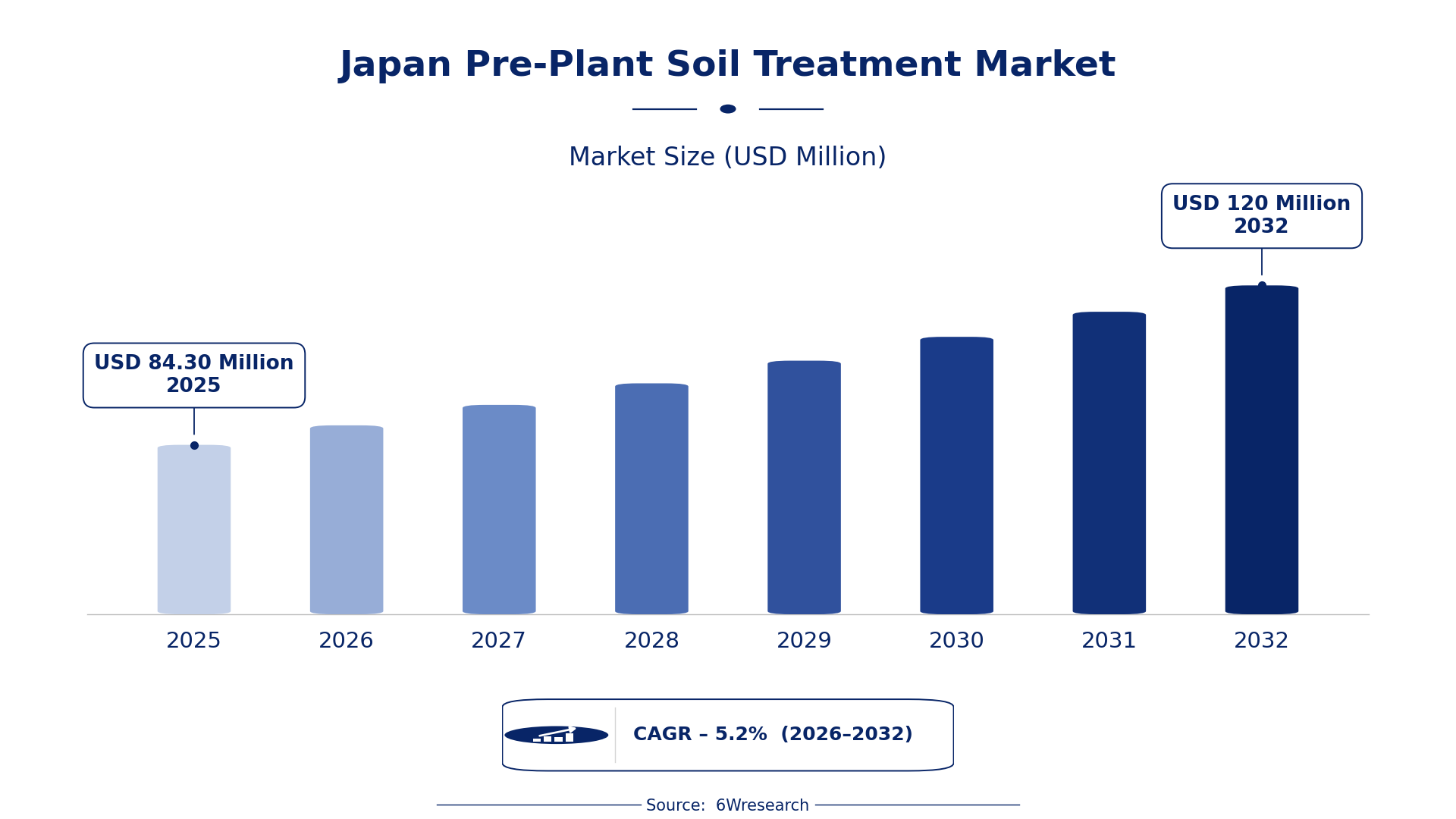
According to 6Wresearch internal database and industry insights, the Japan Pre-Plant Soil Treatment Market was valued at USD 84.30 Million in 2025 and is projected to reach USD 120 Million by 2032, growing at a CAGR of approximately 5.2% during 2026–2032.
Japan Pre-Plant Soil Treatment Market Highlights
| Report Metric | Details |
| Report Name | Japan Pre-Plant Soil Treatment Market (2026-2032) |
| Market Size 2025 | USD 84.30 Million |
| Market Size 2032 | USD 120 Million |
| Absolute Growth 2025–2032 | USD 35.70 Million |
| CAGR 2026–2032 | 5.2% |
| Peak Annual Growth | 7.0% in 2027 |
| Forecast Period | 2026–2032 |
| Historical Data | 2022–2025 |
| Base Year | 2025 |
| Leading Product Type, 2025 | Soil Amendments (35% share) |
| Leading Treatment Type, 2025 | Compost-Based (40% share) |
| Leading Distribution Channel, 2025 | Agro Retail Chains (36% share) |
| Leading End User, 2025 | Agribusiness Firms (38% share) |
| Fastest-Growing Product Type | Bio-fertilizers (7.2% CAGR) |
| Fastest-Growing Treatment Type | Bacteria-Based (7.1% CAGR) |
| Fastest-Growing Distribution Channel | Online Agro Stores (6.4% CAGR) |
| Fastest-Growing End User | Sustainable Growers (6.7% CAGR) |
| Growing Sector | Agriculture |
| Key End Users | Agribusiness Firms, Organic Farmers, Sustainable Growers, Cash Crop Farmers |
Japan Pre-Plant Soil Treatment Market Year-wise Growth Rate and Key Drivers (2022–2032)
This graph illustrates the annual growth rates of the market from 2022 to 2032, highlighting a steady upward trajectory and projected market expansion over the forecast period.
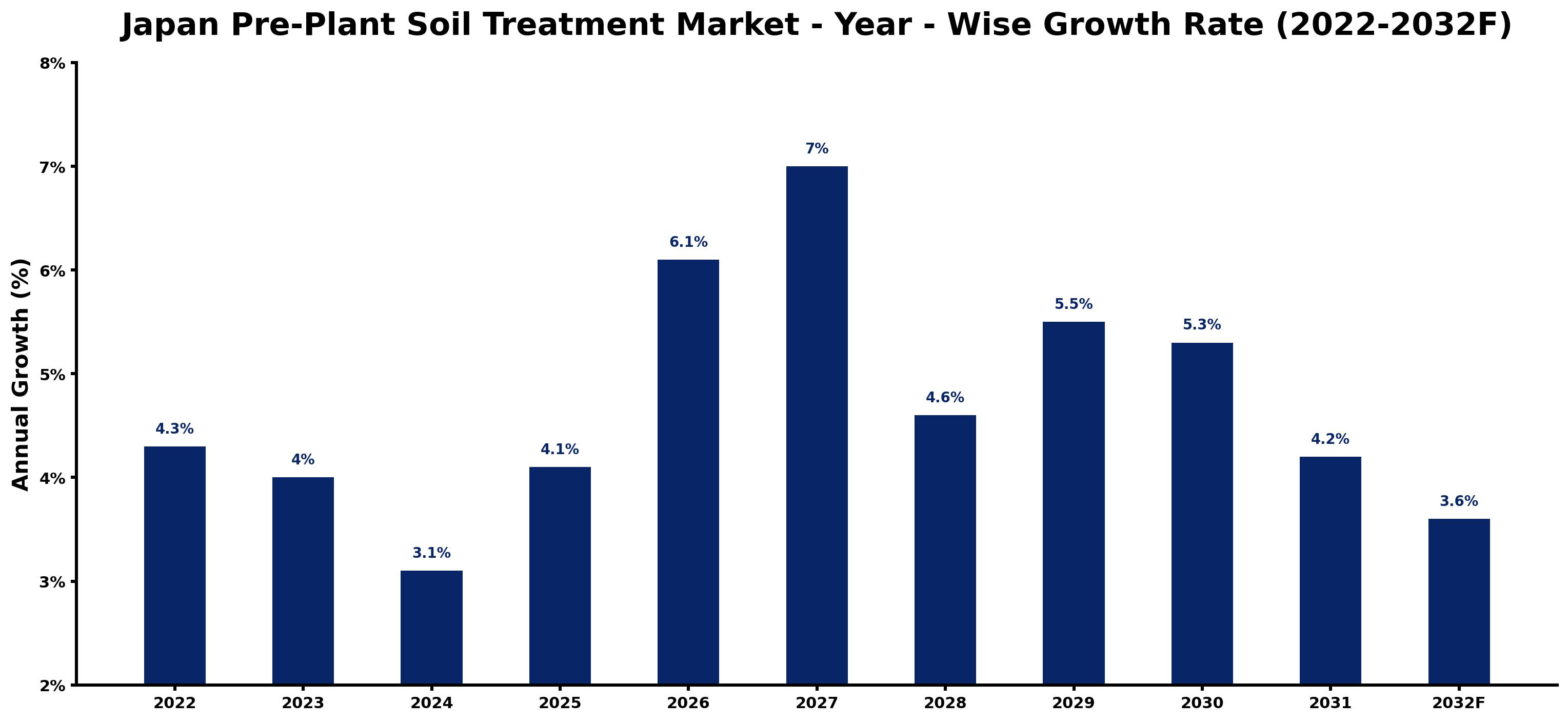
Each row of the following table gives one year's estimated growth and the event or demand shift that explains it.
| Year | Estimated Annual Growth (%) | Market Rationale |
| 2022 | 4.3 | The market experienced steady growth due to increased awareness of soil health among farmers. |
| 2023 | 4.0 | Demand growth slowed as farmers adjusted to rising input costs and changing agricultural practices. |
| 2024 | 3.1 | The market continued to slow as farmers faced challenges in adopting new technologies. |
| 2025 | 4.1 | Growth accelerated as agribusiness firms invested in sustainable practices and soil treatments. |
| 2026 | 6.1 | Demand is expected to surge with the introduction of new bio-fertilizers and compost-based treatments. |
| 2027 | 7.0 | The market is projected to peak as environmental regulations drive higher adoption of soil treatments. |
| 2028 | 4.6 | Growth is expected to decelerate as market saturation begins to affect new purchases of treatments. |
| 2029 | 5.5 | Demand will increase again as agribusiness firms seek to improve crop yields and sustainability. |
| 2030 | 5.3 | Growth is projected to slow as the market matures, with farmers focusing on efficiency and cost. |
| 2031 | 4.2 | The market will continue to grow, albeit at a slower pace, driven by ongoing sustainability efforts. |
| 2032 | 3.6 | Growth is expected to further slow as the market stabilises, with a focus on quality and compliance. |
Note: Market size estimations and growth projections presented in this report are based on 6Wresearch's proprietary forecasting methodology, utilizing the latest available industry data, government publications, and primary research inputs.
Japan Pre-Plant Soil Treatment Market Synopsis
Pre-Plant Soil Treatment involves various substances and techniques to improve soil quality before planting, including composting and chemical synthesis. The Japan Pre-Plant Soil Treatment Market is growing due to rising demand from agribusiness firms and the increase of organic farming, with bio-fertilizers gaining traction under the Green Food System. Japan's commitment to sustainable agriculture and the promotion of compost-based treatments under the Circular Economy policy further drive market growth, with soil amendments used in over 60% of rice cultivation areas.
Market Dynamics Impact Analysis (2026–2032)
| Factor | Type | Impact | Primary Segment Affected |
| Growing demand for sustainable agricultural practices | Driver | High | Bio-fertilizers |
| Increased investment in soil health initiatives | Driver | High | Compost-Based |
| Expansion of online agro stores for easier access | Opportunity | Medium | Online Agro Stores |
| Rising number of organic farmers seeking quality treatments | Opportunity | Medium | Organic Farmers |
| High costs of advanced soil treatments | Restraint | High | Chemical Treatments |
| Regulatory compliance requirements impacting product availability | Restraint | High | Fungicides & Pesticides |
| Aging farmer population affecting technology adoption | Challenge | Medium | Agri Inputs Market |
| Limited awareness of new treatment options among farmers | Challenge | Medium | Soil Amendments |
Evaluation of Drivers in Japan Pre-Plant Soil Treatment Market (2026–2032)
Key forces behind demand, with the segment each one moves most, are listed below.
| Drivers | Primary Segment Affected | Why It Matters (Evidence) |
| Increased focus on sustainable agriculture | Bio-fertilizers | This shift leads to higher demand for bio-fertilizers, with 80,000 organic farmers in Japan as of 2023. |
| Investment in soil health initiatives | Compost-Based | The Japanese government promotes compost-based treatments under the Circular Economy policy, supporting soil quality improvements. |
| Rising consumer demand for organic produce | Fertilizer Additives | The push for organic farming increases the need for effective fertilizer additives to boost crop yields. |
| Technological advancements in soil treatments | Soil Amendments | Stricter environmental regulations promote the use of nitrogen products in farming. |
| Growing awareness of soil quality importance | Soil Amendments | Awareness campaigns highlight the role of soil amendments in improving crop productivity across Japan. |
Orders keep climbing as agribusiness firms increasingly adopt sustainable practices, with the number of organic farmers reaching 80,000 in 2023. The promotion of compost-based treatments is leading to heightened demand for these products, particularly in regions with intensive farming. Approximately 1.3 million tons of fertilizers were consumed in 2022, driving the need for effective fertilizer additives.
Evaluation of Restraints in Japan Pre-Plant Soil Treatment Market
Several factors work against faster growth; the main ones are summarised below.
| Market Restraint | Primary Segment Affected | Why It Matters (Evidence) |
| High costs of advanced treatments limit adoption | Chemical Treatments | The average costs associated with chemical treatments deter many farmers from investing in these solutions. |
| Regulatory compliance can restrict product availability | Fungicides & Pesticides | Strict regulations complicate the market for fungicides, limiting options for farmers. |
| Limited access to new technologies for older farmers | Agri Inputs Market | With an average age of 66 years, many farmers struggle to adopt new soil treatment technologies. |
| Awareness of new treatment options is low among farmers | Soil Amendments | Many farmers remain uninformed about the benefits of modern soil amendments, hindering their adoption. |
| Market saturation affects growth potential | Bio-fertilizers | As the market matures, the influx of bio-fertilizers leads to increased competition and reduced growth rates. |
Japan Pre-Plant Soil Treatment Market Challenges
Soil treatment providers face intense competition, with 80,000 organic farmers competing for limited market share, which drives down prices and squeezes profit margins for suppliers. Many buyers, particularly older farmers averaging 66 years, struggle with outdated farming practices, resulting in delays in adopting effective soil treatment methods and limiting crop yields. Technology gaps hinder productivity; for instance, over 60% of rice cultivation areas still rely on traditional amendments, restricting advancements. Regulatory compliance adds complexity; stringent controls on fungicides and pesticides increase operational costs for producers, impacting their ability to compete effectively.
Trends in the Japan Pre-Plant Soil Treatment Market
Four trends stand out in the Japan Pre-Plant Soil Treatment Market.
- Shift from Chemical to Organic Treatments: Since 2022, there has been a notable shift towards organic soil treatments, with approximately 3% of farmland targeted for organic cultivation by 2030, encouraging suppliers to adapt their offerings.
- Transition to Digital Distribution Channels: The growth of online agro stores has accelerated since 2023, with a 6.4% CAGR expected through 2032, allowing farmers greater access to soil treatments and expanding purchasing options.
- Bacteria-Based Treatments Gaining Popularity: Bacteria-based treatments have emerged as a leading soil option since 2026, with a CAGR of 7.1%, reflecting the increasing focus on sustainable agricultural practices among Japanese farmers.
- Increased Adoption of Compost-Based Solutions: Compost-based treatments have seen a rise in usage since 2023, with over 40% of treatments being compost-based, highlighting the demand for organic soil enrichment.
Investment Opportunities in the Japan Pre-Plant Soil Treatment Market
Below are the investment opportunities with the strongest case in the Japan Pre-Plant Soil Treatment Market.
- Gap in Organic Soil Treatment Supply: With a target of 3% organic farmland by 2030, there is a gap in organic soil treatment supply. Suppliers can focus on developing organic amendments to meet this demand, particularly in regions like Kanto.
- Investment in Online Agro Stores: The rise of online agro stores presents an opportunity to supply digital platforms for agricultural inputs. With over 40% of distribution through agro retail chains, partnerships can enhance market access.
- Timing for Sustainable Practices: As Japan targets a 46% reduction in greenhouse gas emissions by 2030, the demand for sustainable soil treatments is increasing. This urgency creates opportunities for suppliers to invest in eco-friendly solutions.
- Entry through Local Partnerships: Forming joint ventures with local agribusiness firms can facilitate market entry. Collaborating with established distributors can streamline access to farmers and enhance product visibility.
Government Initiatives in the Japan Pre-Plant Soil Treatment Market
The GX Basic Policy, adopted in 2023, aims to drive approximately JPY 150 trillion in public-private decarbonisation investment over the next decade. This policy encourages the use of environmentally friendly soil treatments, promoting sustainable agricultural practices that benefit producers and buyers alike.
In 2023, the Ministry of Agriculture, Forestry and Fisheries (MAFF) allocated approximately 1 billion yen for agricultural innovation programs. These initiatives support the development and approval of new soil treatments, improving the availability of sustainable options for farmers.
Future Insight of the Japan Pre-Plant Soil Treatment Market
Policy initiatives will drive change, with the national strategy for promoting organic farming set to increase organic farmland to 3% by 2030. Suppliers will respond to rising demand for bio-fertilizers, particularly in urban agriculture, as these products gain traction. Technological advancements in soil treatment will emerge, supported by MAFF's budget for agricultural innovation programs. Compost-based treatments will align with Japan's Circular Economy policy, promoting sustainable practices and improving soil health.
Market Segmentation Analysis
Japan Pre-Plant Soil Treatment Market report covers a detailed analysis of the following market segments:
By Product Type – Soil Amendments Lead, Bio-fertilizers Expected to Grow Fastest
According to Uttkarsh, Research Associate at 6Wresearch, with 35% of product type revenue in 2025, Soil Amendments was the largest category. Soil amendments hold the largest share as they are essential for improving soil structure and nutrient content, particularly in rice cultivation where over 60% of areas utilise these treatments. This widespread application ensures a robust demand from agribusiness firms focused on enhancing crop yields. Bio-fertilizers are projected to grow fastest, at a CAGR of 7.2% during 2026–2032. Bio-fertilizers are experiencing rapid growth, supported by Japan's national strategy to promote organic farming by 2025, which appeals to a rising number of sustainable growers. This focus on eco-friendly practices will likely widen the lead of soil amendments as they integrate bio-fertilizers into their offerings. Suppliers must prioritise the development of bio-fertilizer products to align with the rising demand from environmentally conscious consumers.
By Treatment Type – Compost-Based Leads, Bacteria-Based Expected to Grow Fastest
The largest treatment type category in 2025 was Compost-Based, at 40% of revenue. Compost-based treatments dominate the market as they are widely used for enriching soil with organic matter, aligning with Japan's Circular Economy policy that encourages sustainable practices. This established usage among farmers contributes to a strong demand for compost-based solutions. Over 2026–2032, Bacteria-Based is expected to post the fastest growth, at a CAGR of 7.1%. Bacteria-based treatments are rapidly gaining traction, driven by their importance in promoting beneficial microbial activity essential for soil health. The push for sustainable agriculture practices is propelling their adoption among various farming sectors. Suppliers must invest in research and development of bacteria-based solutions to cater to the increasing interest in sustainable agriculture.
By Distribution Channel – Agro Retail Chains Lead, Online Agro Stores Expected to Grow Fastest
Agro Retail Chains held 36% of the Japan Pre-Plant Soil Treatment Market by distribution channel in 2025. Agro retail chains dominate the distribution landscape as they provide farmers with essential access to agricultural products, accounting for over 40% of distribution channels. Their established networks in rural areas ensure consistent supply to farmers who depend on these outlets for their agricultural needs. The quickest growth will come from Online Agro Stores, forecast to expand at a CAGR of 6.4% between 2026 and 2032. Online agro stores are witnessing the fastest growth as farmers increasingly prefer digital platforms for purchasing agricultural inputs, reflecting a significant shift in buying behaviours. This trend is particularly marked among younger farmers, indicating a long-term change in purchasing habits that will benefit online retailers. Suppliers should enhance their online presence to leverage the growing trend of digital purchasing among farmers.
By End User – Agribusiness Firms Lead, Sustainable Growers Expected to Grow Fastest
In 2025, Agribusiness Firms led the end user split with a 38% share. Agribusiness firms represent the largest end user group, relying heavily on soil treatments to optimise crop production and significantly influence Japan's agricultural output. Their extensive operations create a consistent demand for effective soil enhancement solutions, reinforcing their market position. Sustainable Growers are set to record the highest CAGR in this split, 6.7% over 2026–2032. Sustainable growers are the fastest-growing segment, driven by a heightened emphasis on eco-friendly practices and an increasing number of farmers adopting sustainable methods. This shift towards sustainability is reshaping market dynamics and encouraging the uptake of environmentally friendly products. Suppliers should tailor their offerings to meet the specific needs of sustainable growers to capture this expanding market segment.
Key Attractiveness of the Report
- 10 Years of Market Numbers
- Historical Data Starting from 2022 to 2025
- Base Year 2025
- Forecast Data until 2032
- Key Performance Indicators Impacting the Market
- Major Upcoming Developments and Projects
Key Highlights of the Report:
- Japan Pre-Plant Soil Treatment Market Outlook
- Market Size of Japan Pre-Plant Soil Treatment Market, 2025
- Forecast of Japan Pre-Plant Soil Treatment Market, 2032
- Historical Data and Forecast of Japan Pre-Plant Soil Treatment Revenues & Volume for the Period 2022-2032F
- Japan Pre-Plant Soil Treatment Market Trend Evolution
- Japan Pre-Plant Soil Treatment Market Drivers and Challenges
- Japan Pre-Plant Soil Treatment Price Trends
- Japan Pre-Plant Soil Treatment Porter's Five Forces
- Japan Pre-Plant Soil Treatment Industry Life Cycle
- Historical Data and Forecast of Japan Pre-Plant Soil Treatment Market Revenues & Volume By Product Type for the Period 2022-2032F
- Historical Data and Forecast of Japan Pre-Plant Soil Treatment Market Revenues & Volume By Soil Amendments for the Period 2022-2032F
- Historical Data and Forecast of Japan Pre-Plant Soil Treatment Market Revenues & Volume By Fertilizer Additives for the Period 2022-2032F
- Historical Data and Forecast of Japan Pre-Plant Soil Treatment Market Revenues & Volume By Bio-fertilizers for the Period 2022-2032F
- Historical Data and Forecast of Japan Pre-Plant Soil Treatment Market Revenues & Volume By Chemical Treatments for the Period 2022-2032F
- Historical Data and Forecast of Japan Pre-Plant Soil Treatment Market Revenues & Volume By Treatment Type for the Period 2022-2032F
- Historical Data and Forecast of Japan Pre-Plant Soil Treatment Market Revenues & Volume By Compost-Based for the Period 2022-2032F
- Historical Data and Forecast of Japan Pre-Plant Soil Treatment Market Revenues & Volume By Nitrogen Enhancers for the Period 2022-2032F
- Historical Data and Forecast of Japan Pre-Plant Soil Treatment Market Revenues & Volume By Bacteria-Based for the Period 2022-2032F
- Historical Data and Forecast of Japan Pre-Plant Soil Treatment Market Revenues & Volume By Fungicides & Pesticides for the Period 2022-2032F
- Historical Data and Forecast of Japan Pre-Plant Soil Treatment Market Revenues & Volume By Distribution Channel for the Period 2022-2032F
- Historical Data and Forecast of Japan Pre-Plant Soil Treatment Market Revenues & Volume By Agro Retail Chains for the Period 2022-2032F
- Historical Data and Forecast of Japan Pre-Plant Soil Treatment Market Revenues & Volume By Online Agro Stores for the Period 2022-2032F
- Historical Data and Forecast of Japan Pre-Plant Soil Treatment Market Revenues & Volume By Distributors for the Period 2022-2032F
- Historical Data and Forecast of Japan Pre-Plant Soil Treatment Market Revenues & Volume By Agri Inputs Market for the Period 2022-2032F
- Historical Data and Forecast of Japan Pre-Plant Soil Treatment Market Revenues & Volume By End User for the Period 2022-2032F
- Historical Data and Forecast of Japan Pre-Plant Soil Treatment Market Revenues & Volume By Organic Farmers for the Period 2022-2032F
- Historical Data and Forecast of Japan Pre-Plant Soil Treatment Market Revenues & Volume By Agribusiness Firms for the Period 2022-2032F
- Historical Data and Forecast of Japan Pre-Plant Soil Treatment Market Revenues & Volume By Sustainable Growers for the Period 2022-2032F
- Historical Data and Forecast of Japan Pre-Plant Soil Treatment Market Revenues & Volume By Cash Crop Farmers for the Period 2022-2032F
- Japan Pre-Plant Soil Treatment Import Export Trade Statistics
- Market Opportunity Assessment By Product Type
- Market Opportunity Assessment By Treatment Type
- Market Opportunity Assessment By Distribution Channel
- Market Opportunity Assessment By End User
- Japan Pre-Plant Soil Treatment Top Companies Market Share
- Japan Pre-Plant Soil Treatment Competitive Benchmarking By Technical and Operational Parameters
- Japan Pre-Plant Soil Treatment Company Profiles
- Japan Pre-Plant Soil Treatment Key Strategic Recommendations
Market Covered
This report examines the market across the segments below.
By Product Type
- Soil Amendments
- Fertilizer Additives
- Bio-fertilizers
- Chemical Treatments
By Treatment Type
- Compost-Based
- Nitrogen Enhancers
- Bacteria-Based
- Fungicides & Pesticides
By Distribution Channel
- Agro Retail Chains
- Online Agro Stores
- Distributors
- Agri Inputs Market
By End User
- Organic Farmers
- Agribusiness Firms
- Sustainable Growers
- Cash Crop Farmers






































