Japan Precision Agriculture Imaging Market Size & Growth Rate
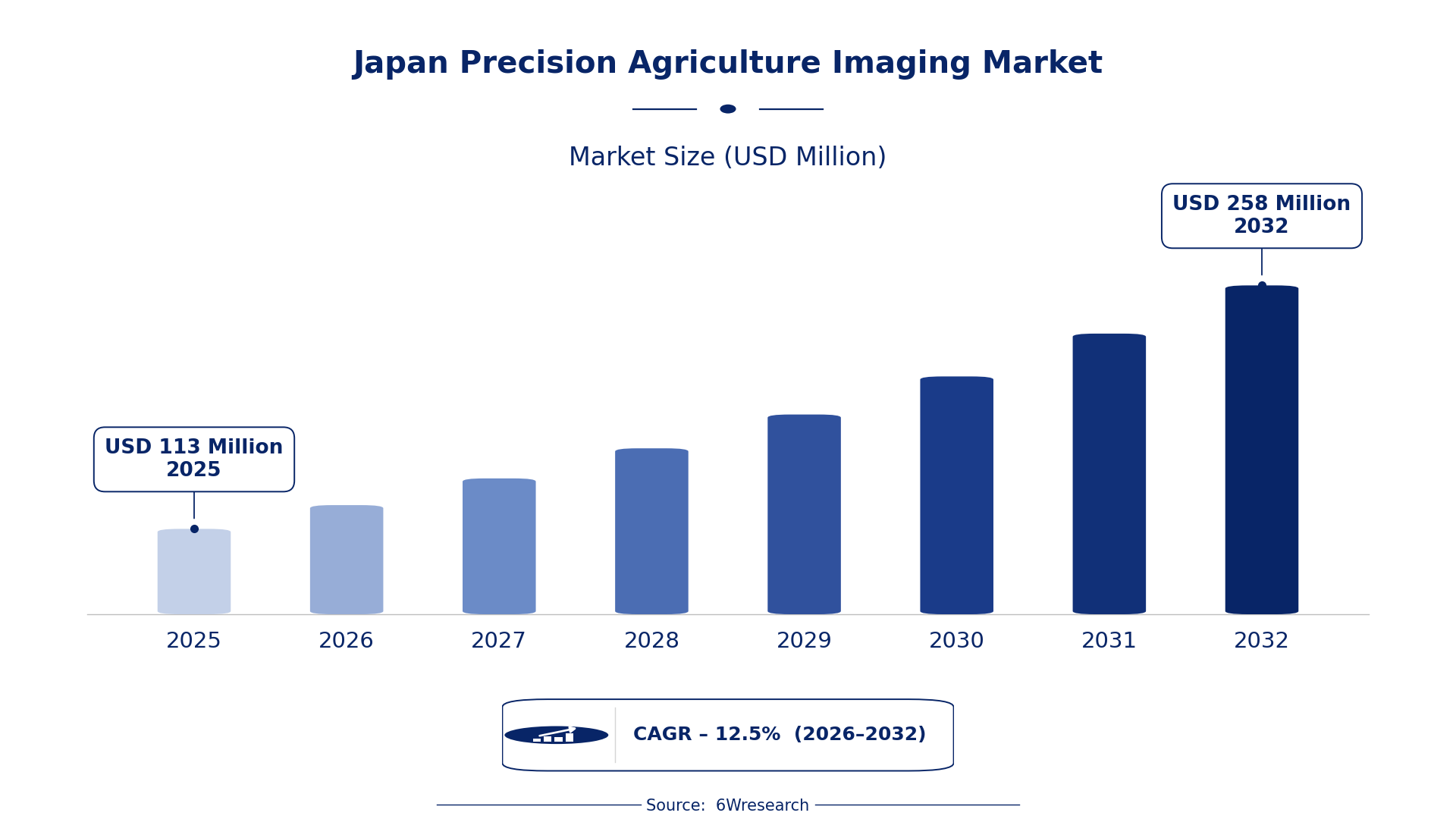
According to 6Wresearch internal database and industry insights, the Japan Precision Agriculture Imaging Market was valued at USD 113 Million in 2025 and is projected to reach USD 258 Million by 2032, growing at a CAGR of approximately 12.5% during 2026–2032.
Japan Precision Agriculture Imaging Market Highlights
| Report Metric | Details |
| Report Name | Japan Precision Agriculture Imaging Market (2026-2032) |
| Market Size 2025 | USD 113 Million |
| Market Size 2032 | USD 258 Million |
| Absolute Growth 2025–2032 | USD 145 Million |
| CAGR 2026–2032 | 12.5% |
| Peak Annual Growth | 13.5% in 2027 |
| Forecast Period | 2026–2032 |
| Historical Data | 2022–2025 |
| Base Year | 2025 |
| Leading Imaging Type, 2025 | Drone Multispectral (41% share) |
| Leading Platform, 2025 | UAV-Based (38% share) |
| Leading Distribution Channel, 2025 | Online Platforms (50% share) |
| Leading End User, 2025 | Crop Yield Analysts (50% share) |
| Fastest-Growing Imaging Type | Satellite Multispectral (17.3% CAGR) |
| Fastest-Growing Platform | Satellite Imagery (17.5% CAGR) |
| Fastest-Growing Distribution Channel | Service Providers (16.4% CAGR) |
| Fastest-Growing End User | Large-Scale Farmers (16.2% CAGR) |
| Growing Sector | Agricultural Technology |
| Key End Users | Large-Scale Farmers, Crop Yield Analysts, Field Management Companies, Agrochemical R&D Labs |
Japan Precision Agriculture Imaging Market Year-wise Growth Rate and Key Drivers (2022–2032)
This graph illustrates the annual growth rates of the market from 2022 to 2032, highlighting a steady upward trajectory and projected market expansion over the forecast period.
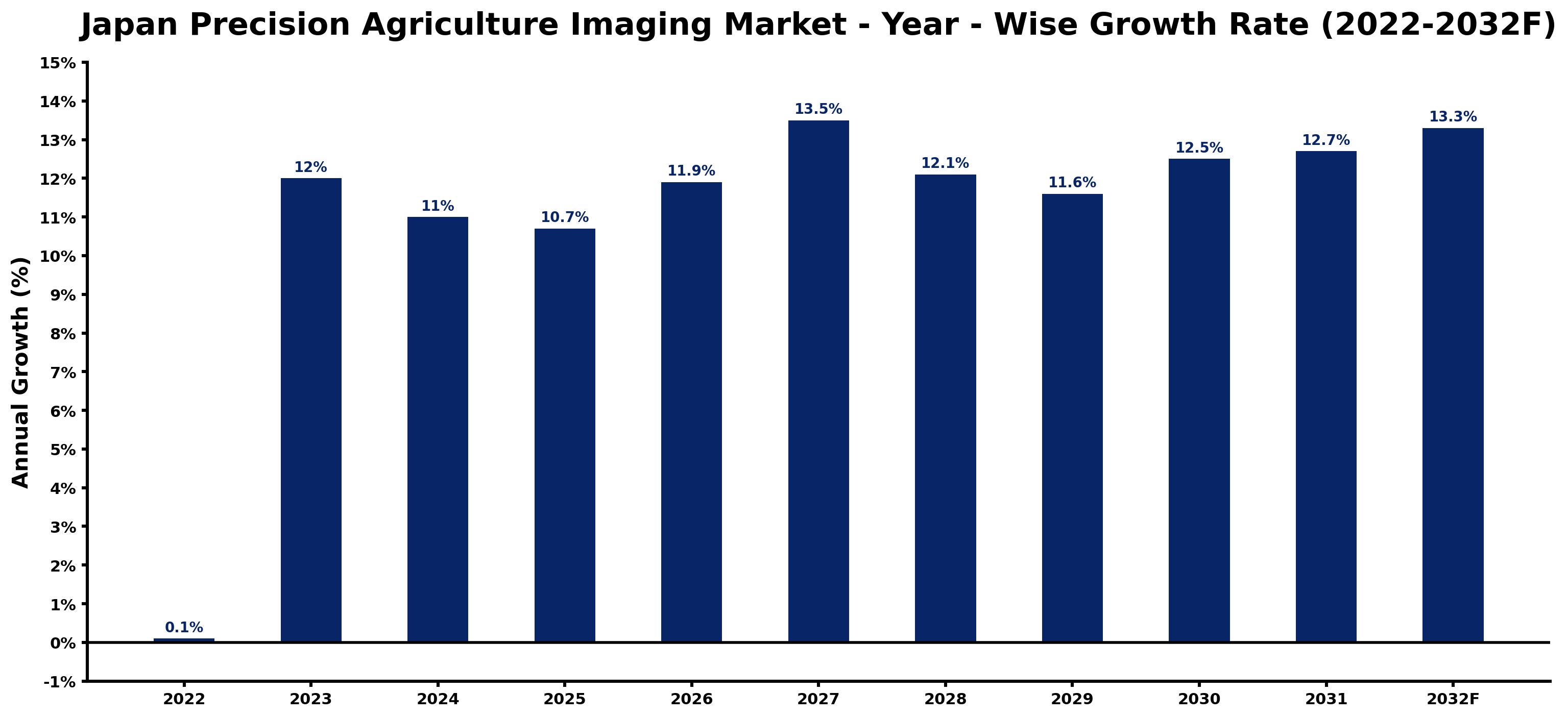
The yearly estimates that follow link every growth rate to its principal driver, so readers can see why the pace changed in each period.
| Year | Estimated Annual Growth (%) | Market Rationale |
| 2022 | 0.1 | The market showed minimal growth as early adopters began integrating imaging technologies. |
| 2023 | 12.0 | Demand surged due to increased awareness among large-scale farmers about precision agriculture benefits. |
| 2024 | 11.0 | Growth slowed as the market matured and adoption rates stabilised among existing users. |
| 2025 | 10.7 | The market continued to grow, but at a slower pace as saturation began to set in. |
| 2026 | 11.9 | Demand is expected to pick up again as new imaging technologies are introduced and gain traction. |
| 2027 | 13.5 | The market is projected to peak with substantial investments in precision agriculture initiatives and technology. |
| 2028 | 12.1 | Growth is anticipated to slow slightly as the market adjusts to the high adoption rates achieved in previous years. |
| 2029 | 11.6 | The market will continue to grow, albeit at a reduced rate as competition intensifies. |
| 2030 | 12.5 | Demand is expected to increase again as large-scale farmers seek to improve productivity through advanced imaging. |
| 2031 | 12.7 | Growth will remain strong with ongoing investments in precision agriculture technology and services. |
| 2032 | 13.3 | The market is projected to grow as more farmers adopt imaging solutions for efficiency. |
Note: Market size estimations and growth projections presented in this report are based on 6Wresearch's proprietary forecasting methodology, utilizing the latest available industry data, government publications, and primary research inputs.
Japan Precision Agriculture Imaging Market Synopsis
Precision Agriculture Imaging employs advanced imaging technologies to monitor crop health and optimise farming practices. In Japan, large-scale farmers and agricultural research institutions are primary users, driving demand for these solutions. The Japan Precision Agriculture Imaging Market is expanding due to substantial investments in precision agriculture initiatives, with the government allocating ¥3 billion in 2023 to promote these technologies. The estimated 25% adoption rate among large-scale farmers indicates a strong opportunity for growth in this sector.
Market Dynamics Impact Analysis (2026–2032)
| Factor | Type | Impact | Primary Segment Affected |
| Increased adoption of UAV-based imaging technologies | Driver | High | UAV-Based |
| Growing demand for crop monitoring and yield estimation | Driver | High | Drone Multispectral |
| Rising investment in precision agriculture initiatives | Opportunity | High | Field Management Companies |
| Expansion of agricultural research institutions integrating imaging technologies | Opportunity | Medium | Agrochemical R&D Labs |
| High costs associated with advanced imaging technologies | Restraint | High | Ground-Based Imaging |
| Limited awareness among smaller farmers about precision agriculture benefits | Restraint | Medium | Satellite Imagery |
| Insufficient supply chain capacity for imaging technology components | Challenge | High | Hyperspectral Cameras |
| Competition from alternative agricultural monitoring solutions | Challenge | Medium | Tractor-Mounted |
Evaluation of Drivers in Japan Precision Agriculture Imaging Market (2026–2032)
The following drivers explain most of the expected growth.
| Drivers | Primary Segment Affected | Why It Matters (Evidence) |
| Increased investment in UAV technology | UAV-Based | This investment has led to a rise in UAVs used in agriculture, reaching 10,000 units in 2022. |
| Growing focus on crop health monitoring | Drone Multispectral | With over 2 million hectares of farmland utilizing precision agriculture technologies, demand for detailed analysis has surged. |
| Government initiatives promoting precision agriculture | Field Management Companies | The Japanese government allocated ¥3 billion in 2023 to support precision agriculture initiatives. |
| Rising awareness among large-scale farmers | Large-Scale Farmers | The adoption rate of precision agriculture imaging is estimated at 25% among these farmers. |
| Technological advancements in imaging systems | Satellite Imagery | The JIS Z 8801 standard governs imaging technology specifications, ensuring quality and reliability. |
Volumes grow on the back of increased investment in UAV technology, which has led to the use of 10,000 units in agriculture by 2022. The focus on crop health monitoring drives demand, with over 2 million hectares of farmland adopting precision agriculture technologies. The ¥3 billion allocated in 2023 promotes precision agriculture practices among farmers. Awareness of the benefits of imaging technologies has contributed to an estimated 25% adoption rate among large-scale farmers. Advancements in imaging systems governed by the JIS Z 8801 standard improve reliability and performance.
Evaluation of Restraints in Japan Precision Agriculture Imaging Market
Below are the constraints most often cited by buyers and suppliers, with the segment each affects.
| Market Restraint | Primary Segment Affected | Why It Matters (Evidence) |
| High costs associated with advanced imaging technologies | Ground-Based Imaging | The initial investment required for high-resolution imaging systems can deter smaller farmers from adoption. |
| Limited awareness among smaller farmers | Satellite Imagery | Many smaller farmers lack knowledge about the benefits of precision agriculture, hindering market growth. |
| Insufficient supply chain capacity for imaging components | Hyperspectral Cameras | A lack of local suppliers for imaging technology components can delay project implementations. |
| Regulatory hurdles for new technology adoption | Drone Multispectral | Compliance with local regulations can slow the integration of UAVs in agricultural practices. |
| Dependence on skilled operators for imaging systems | UAV-Based | The need for trained personnel to operate imaging technologies can limit widespread adoption. |
Japan Precision Agriculture Imaging Market Challenges
Over 2 million hectares of farmland utilise precision agriculture technologies, yet competition among imaging technology providers forces many suppliers to lower prices, which can compromise quality and deter investment. High costs hinder adoption; initial expenses for large-scale farmers often exceed ¥1 million, delaying their transition to modern practices. The average age of farmers in Japan is 67, creating a skills gap that limits effective use of new imaging technologies and reduces operational efficiency. Buyers face slow uptake of imaging technologies, with only 25% adoption among large-scale farmers, negatively impacting productivity and resource management.
Trends in the Japan Precision Agriculture Imaging Market
Below are the shifts with the largest effect on the Japan Precision Agriculture Imaging Market.
- Launch of Digital Agriculture Program: In 2023, the Japanese government initiated a program with a budget of ¥5 billion to support digital agriculture. This initiative aims to increase the adoption of precision agriculture technologies among farmers, leading to improved efficiency and productivity.
- Tohoku Region Leading in Precision Agriculture: The Tohoku region has emerged as a key area for precision agriculture adoption, particularly in rice production. This focus has resulted in investments in imaging technologies, improving crop monitoring capabilities across the region.
- Shift Towards UAV-Based Imaging Solutions: Farmers are increasingly adopting UAV-based imaging solutions for aerial crop surveillance. This shift is driven by the need for real-time data collection, improving decision-making and resource management in agriculture.
- Growth of Crop Yield Analysis Services: The demand for crop yield analysis services is rising, with Crop Yield Analysts relying heavily on imaging technologies. This trend reflects a broader movement towards data-driven agriculture, improving productivity and sustainability.
Investment Opportunities in the Japan Precision Agriculture Imaging Market
Where to invest in the Japan Precision Agriculture Imaging Market: the main openings are set out below.
- Precision Agriculture Imaging Solutions: The demand for precision agriculture imaging solutions is increasing, with an estimated 25% adoption rate among large-scale farmers. Investing in UAV-based imaging technologies can address this need, particularly in the Tohoku region.
- Support for Digital Agriculture Initiatives: With the Japanese government allocating ¥5 billion for digital agriculture in 2023, there is an opportunity for suppliers to provide imaging technologies. Collaborating with agricultural research institutions can facilitate market entry.
- Expansion of Imaging Services for Farmers: The increasing reliance on imaging technologies by Field Management Companies presents a significant opportunity. Suppliers can invest in service models to cater to this growing demand, particularly in rural areas.
- Integration of Imaging Technologies in Agrochemical R&D: Agrochemical R&D Labs are increasingly integrating imaging technologies for crop research. This trend offers opportunities for suppliers to provide advanced imaging solutions tailored to research needs.
Government Initiatives in the Japan Precision Agriculture Imaging Market
The 2023 Digital Agriculture Program allocates ¥5 billion to support precision agriculture initiatives, promoting the integration of imaging technologies in farming. This measure builds on previous efforts by the Agriculture, Forestry and Fisheries Research Council to advance modern agricultural practices.
In 2023, the Ministry of Agriculture oversees various precision agriculture initiatives, including funding for research and development. This agency is crucial in approving projects that support the adoption of imaging technologies among farmers.
Future Insight of the Japan Precision Agriculture Imaging Market
By 2032, a significant policy shift will drive digital agriculture in Japan, supported by a ¥5 billion budget for precision agriculture initiatives. This will lead to increased adoption of advanced imaging technologies, with usage expected to rise among various agricultural sectors. The JIS Z 8801 standard will ensure quality and reliability in imaging technologies, building confidence among buyers. Enhanced collaboration between agricultural research institutions and farmers will improve crop monitoring and yield estimation practices, ultimately benefiting the agricultural sector.
Market Segmentation Analysis
Japan Precision Agriculture Imaging Market report covers a detailed analysis of the following market segments:
By Imaging Type – Drone Multispectral Leads, Satellite Multispectral Expected to Grow Fastest
According to Navya, Research Analyst at 6Wresearch, Drone Multispectral held 41% of the Japan Precision Agriculture Imaging Market by imaging type in 2025. Drone Multispectral imaging holds the largest share because it excels in detailed crop analysis and health monitoring. This technology is particularly favoured by large-scale farmers in regions like Tohoku, which is crucial for rice production. The quickest growth will come from Satellite Multispectral, forecast to expand at a CAGR of 17.3% between 2026 and 2032. Satellite Multispectral imaging is experiencing rapid growth due to its ability to cover extensive areas for large-scale crop assessment. The increasing number of UAVs, reaching 10,000 units in 2022, enhances data collection capabilities, further driving this segment. Suppliers should focus on developing advanced satellite imaging technologies to meet the rising demands of large-scale agricultural operations.
By Platform – UAV-Based Leads, Satellite Imagery Expected to Grow Fastest
In 2025, UAV-Based led the platform split with a 38% share. UAV-Based platforms lead the market as they are extensively employed for aerial crop surveillance and data collection. Their adoption is widespread among large-scale farmers, reflecting the ongoing precision agriculture initiatives supported by government programmes. Satellite Imagery is projected to grow fastest, at a CAGR of 17.5% during 2026–2032. Satellite Imagery is the fastest-growing platform because it plays a vital role in efficiently monitoring vast agricultural areas. The expected rise in the integration of imaging technologies in farming practices will further accelerate its adoption. Buyers should consider investing in satellite imagery solutions to improve their agricultural monitoring and management capabilities.
By Distribution Channel – Online Platforms Lead, Service Providers Expected to Grow Fastest
With 50% of distribution channel revenue in 2025, Online Platforms was the largest category. Online Platforms dominate the distribution channel as they provide easy access to imaging data for farmers. This channel is particularly beneficial for large-scale farmers aiming to enhance operational efficiency through timely information. Over 2026–2032, Service Providers are expected to post the fastest growth, at a CAGR of 16.4%. Service Providers are the fastest-growing distribution channel as they offer specialised imaging services directly to farmers and agronomists. This direct interaction is crucial as the agricultural sector increasingly seeks tailored support for precision agriculture. Suppliers must improve their service offerings to meet the growing demand for direct imaging services from farmers.
By End User – Crop Yield Analysts Lead, Large-Scale Farmers Expected to Grow Fastest
The largest end user category in 2025 was Crop Yield Analysts, at 50% of revenue. Crop Yield Analysts are the leading end user as they rely heavily on imaging for data-driven analysis to improve crop productivity. Their role is vital in agricultural research institutions, where precision agriculture is being actively promoted. Large-Scale Farmers are set to record the highest CAGR in this split, 16.2% over 2026–2032. Large-Scale Farmers are the fastest-growing end user segment due to their direct use of precision agriculture imaging for optimising yields. With an estimated 25% adoption rate, this segment is expected to expand as technology becomes more accessible. Suppliers should tailor their products to meet the specific needs of large-scale farmers to capitalise on this growth.
Key Attractiveness of the Report
- 10 Years of Market Numbers
- Historical Data Starting from 2022 to 2025
- Base Year 2025
- Forecast Data until 2032
- Key Performance Indicators Impacting the Market
- Major Upcoming Developments and Projects
Key Highlights of the Report:
- Japan Precision Agriculture Imaging Market Outlook
- Market Size of Japan Precision Agriculture Imaging Market, 2025
- Forecast of Japan Precision Agriculture Imaging Market, 2032
- Historical Data and Forecast of Japan Precision Agriculture Imaging Revenues & Volume for the Period 2022-2032F
- Japan Precision Agriculture Imaging Market Trend Evolution
- Japan Precision Agriculture Imaging Market Drivers and Challenges
- Japan Precision Agriculture Imaging Price Trends
- Japan Precision Agriculture Imaging Porter's Five Forces
- Japan Precision Agriculture Imaging Industry Life Cycle
- Historical Data and Forecast of Japan Precision Agriculture Imaging Market Revenues & Volume By Imaging Type for the Period 2022-2032F
- Historical Data and Forecast of Japan Precision Agriculture Imaging Market Revenues & Volume By Drone Multispectral for the Period 2022-2032F
- Historical Data and Forecast of Japan Precision Agriculture Imaging Market Revenues & Volume By Satellite Multispectral for the Period 2022-2032F
- Historical Data and Forecast of Japan Precision Agriculture Imaging Market Revenues & Volume By Ground-Based Imaging for the Period 2022-2032F
- Historical Data and Forecast of Japan Precision Agriculture Imaging Market Revenues & Volume By Hyperspectral Cameras for the Period 2022-2032F
- Historical Data and Forecast of Japan Precision Agriculture Imaging Market Revenues & Volume By Platform for the Period 2022-2032F
- Historical Data and Forecast of Japan Precision Agriculture Imaging Market Revenues & Volume By UAV-Based for the Period 2022-2032F
- Historical Data and Forecast of Japan Precision Agriculture Imaging Market Revenues & Volume By Satellite Imagery for the Period 2022-2032F
- Historical Data and Forecast of Japan Precision Agriculture Imaging Market Revenues & Volume By Tractor-Mounted for the Period 2022-2032F
- Historical Data and Forecast of Japan Precision Agriculture Imaging Market Revenues & Volume By Aerial Mounted for the Period 2022-2032F
- Historical Data and Forecast of Japan Precision Agriculture Imaging Market Revenues & Volume By Distribution Channel for the Period 2022-2032F
- Historical Data and Forecast of Japan Precision Agriculture Imaging Market Revenues & Volume By Online Platforms for the Period 2022-2032F
- Historical Data and Forecast of Japan Precision Agriculture Imaging Market Revenues & Volume By Service Providers for the Period 2022-2032F
- Historical Data and Forecast of Japan Precision Agriculture Imaging Market Revenues & Volume By OEM Suppliers for the Period 2022-2032F
- Historical Data and Forecast of Japan Precision Agriculture Imaging Market Revenues & Volume By Specialty Distributors for the Period 2022-2032F
- Historical Data and Forecast of Japan Precision Agriculture Imaging Market Revenues & Volume By End User for the Period 2022-2032F
- Historical Data and Forecast of Japan Precision Agriculture Imaging Market Revenues & Volume By Crop Yield Analysts for the Period 2022-2032F
- Historical Data and Forecast of Japan Precision Agriculture Imaging Market Revenues & Volume By Large-Scale Farmers for the Period 2022-2032F
- Historical Data and Forecast of Japan Precision Agriculture Imaging Market Revenues & Volume By Field Management Companies for the Period 2022-2032F
- Historical Data and Forecast of Japan Precision Agriculture Imaging Market Revenues & Volume By Agrochemical R&D Labs for the Period 2022-2032F
- Japan Precision Agriculture Imaging Import Export Trade Statistics
- Market Opportunity Assessment By Imaging Type
- Market Opportunity Assessment By Platform
- Market Opportunity Assessment By Distribution Channel
- Market Opportunity Assessment By End User
- Japan Precision Agriculture Imaging Top Companies Market Share
- Japan Precision Agriculture Imaging Competitive Benchmarking By Technical and Operational Parameters
- Japan Precision Agriculture Imaging Company Profiles
- Japan Precision Agriculture Imaging Key Strategic Recommendations
Market Covered
This report examines the market across the segments below.
By Imaging Type
- Drone Multispectral
- Satellite Multispectral
- Ground-Based Imaging
- Hyperspectral Cameras
By Platform
- UAV-Based
- Satellite Imagery
- Tractor-Mounted
- Aerial Mounted
By Distribution Channel
- Online Platforms
- Service Providers
- OEM Suppliers
- Specialty Distributors
By End User
- Crop Yield Analysts
- Large-Scale Farmers
- Field Management Companies
- Agrochemical R&D Labs






































