Japan Precision Agriculture Sensors Market Size & Growth Rate
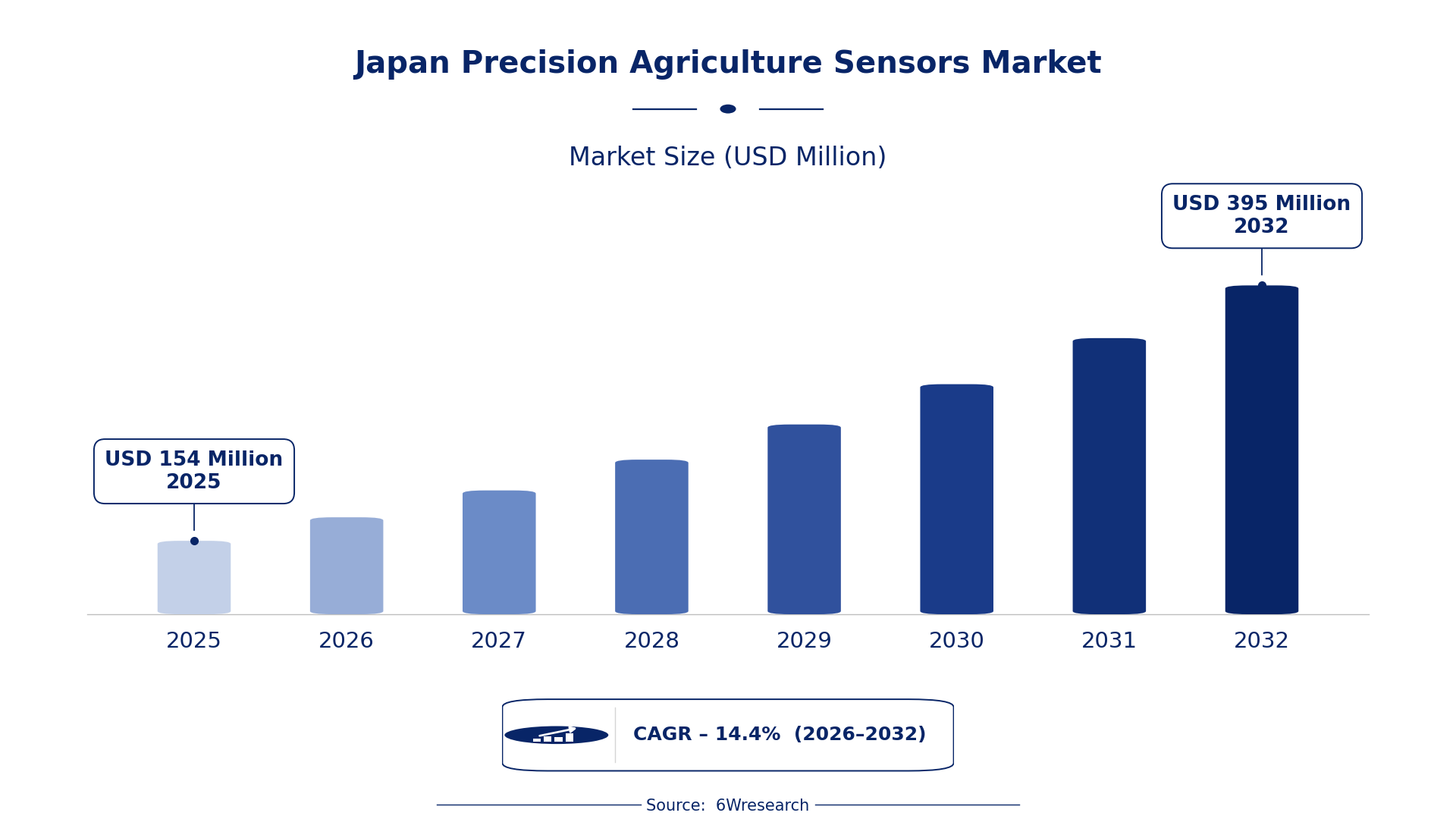
According to 6Wresearch internal database and industry insights, the Japan Precision Agriculture Sensors Market was valued at USD 154 Million in 2025 and is projected to reach USD 395 Million by 2032, growing at a CAGR of approximately 14.4% during 2026–2032.
Japan Precision Agriculture Sensors Market Highlights
| Report Metric | Details |
| Report Name | Japan Precision Agriculture Sensors Market (2026-2032) |
| Market Size 2025 | USD 154 Million |
| Market Size 2032 | USD 395 Million |
| Absolute Growth 2025–2032 | USD 241 Million |
| CAGR 2026–2032 | 14.4% |
| Peak Annual Growth | 16.1% in 2032 |
| Forecast Period | 2026–2032 |
| Historical Data | 2022–2025 |
| Base Year | 2025 |
| Leading Sensor Type, 2025 | Soil Moisture Sensors (39% share) |
| Leading Parameter Measured, 2025 | Volumetric Water Content (47% share) |
| Leading Distribution Channel, 2025 | Reseller Networks (47% share) |
| Leading End User, 2025 | Irrigation Service Firms (43% share) |
| Fastest-Growing Sensor Type | Leaf Nutrient Sensors (15.7% CAGR) |
| Fastest-Growing Parameter Measured | Chlorophyll/N Itrogen (19.8% CAGR) |
| Fastest-Growing Distribution Channel | Direct Sales (19.3% CAGR) |
| Fastest-Growing End User | Fertilizer Companies (18.7% CAGR) |
| Growing Sector | Fertilizer Companies |
| Key End Users | Irrigation Service Firms, Fertilizer Companies, Farm Management Services, Agronomists |
Japan Precision Agriculture Sensors Market Year-wise Growth Rate and Key Drivers (2022–2032)
This graph illustrates the annual growth rates of the market from 2022 to 2032, highlighting a steady upward trajectory and projected market expansion over the forecast period.
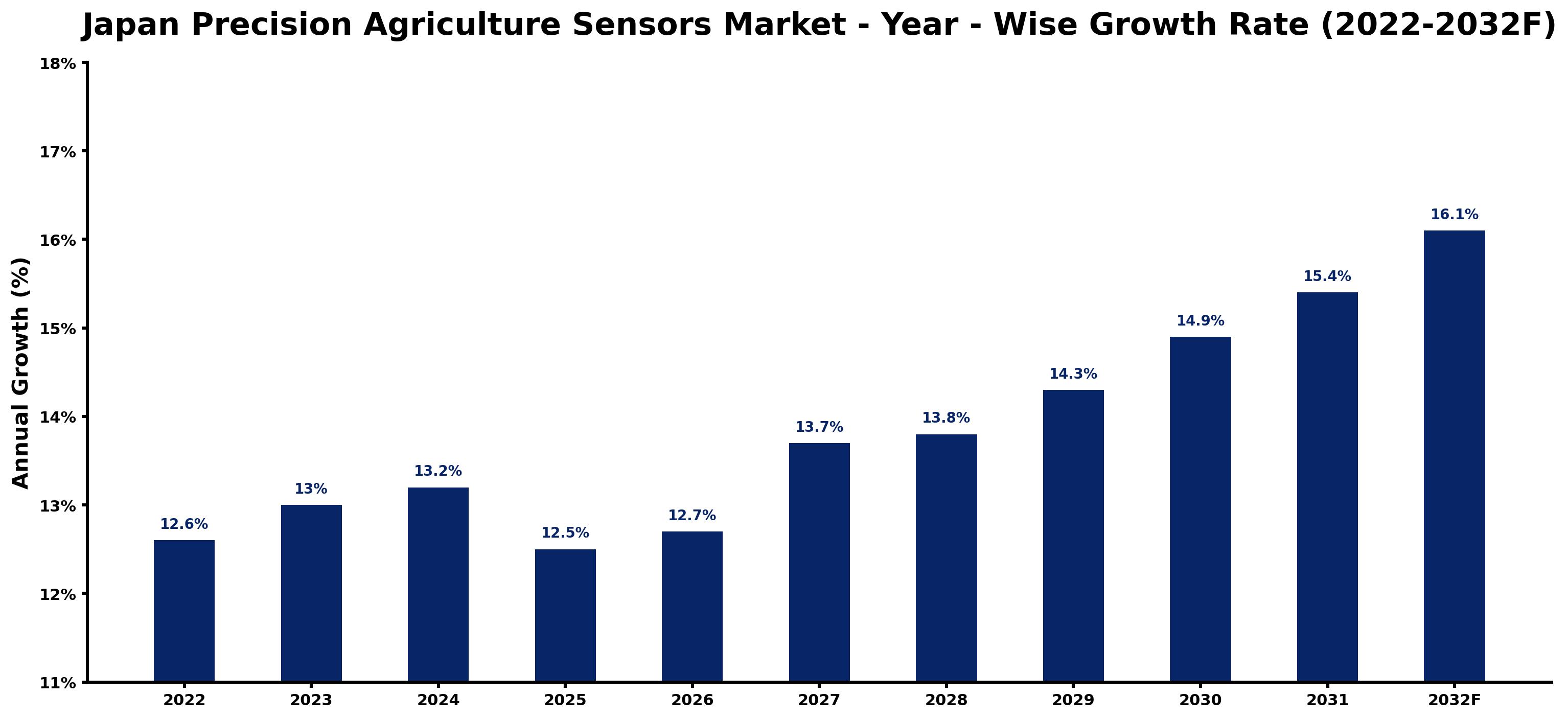
Year by year, the estimates below pair each growth rate with the development that shaped it.
| Year | Estimated Annual Growth (%) | Market Rationale |
| 2022 | 12.6 | The market showed solid demand driven by technology adoption in agriculture. |
| 2023 | 13.0 | Growth accelerated as more farms integrated precision agriculture technologies. |
| 2024 | 13.2 | The market continued to expand due to rising awareness of efficiency benefits. |
| 2025 | 12.5 | Growth slowed slightly as some buyers delayed investments in new technologies. |
| 2026 | 12.7 | Demand is expected to increase as farmers seek to optimise irrigation practices. |
| 2027 | 13.7 | The market will see a boost from increased government support for smart agriculture. |
| 2028 | 13.8 | Adoption rates will rise as technology becomes more accessible to farmers. |
| 2029 | 14.3 | Demand is projected to surge with the introduction of new sensor technologies. |
| 2030 | 14.9 | Investment will continue to rise as precision agriculture gains traction. |
| 2031 | 15.4 | The market will expand further as farmers increasingly rely on data-driven decisions. |
| 2032 | 16.1 | Growth will peak as the sector fully embraces advanced sensor technologies. |
Note: Market size estimations and growth projections presented in this report are based on 6Wresearch's proprietary forecasting methodology, utilizing the latest available industry data, government publications, and primary research inputs.
Japan Precision Agriculture Sensors Market Synopsis
Precision Agriculture Sensors are advanced devices that monitor critical parameters for crop health and irrigation management, utilising IoT and data analytics. The Japan Precision Agriculture Sensors Market is projected to grow due to a 30% technology adoption rate and government initiatives. Increased investment in precision agriculture technologies and the need for efficient resource management are key factors propelling market growth.
Market Dynamics Impact Analysis (2026–2032)
| Factor | Type | Impact | Primary Segment Affected |
| Growing adoption of precision agriculture technologies | Driver | High | Soil Moisture Sensors |
| Government incentives for smart agriculture | Driver | High | Irrigation Service Firms |
| Rising demand for efficient irrigation solutions | Opportunity | High | Chlorophyll/N Itrogen |
| Increased investment in agricultural technology | Opportunity | High | Leaf Nutrient Sensors |
| High initial investment costs for sensors | Restraint | Medium | Weather Sensors |
| Limited awareness among traditional farmers | Restraint | Medium | Crop Health Sensors |
| Compliance with stringent industry standards | Challenge | High | Volumetric Water Content |
| Capacity constraints in sensor manufacturing | Challenge | Medium | NDVI/Plant Health |
Evaluation of Drivers in Japan Precision Agriculture Sensors Market (2026–2032)
Demand rests on the following drivers, each shown with the segment it touches most.
| Drivers | Primary Segment Affected | Why It Matters (Evidence) |
| Increased focus on irrigation efficiency | Soil Moisture Sensors | Japan has over 4 million hectares of arable land, prompting farmers to optimise water usage. |
| Government support for smart agriculture initiatives | Chlorophyll/N Itrogen | The Ministry of Agriculture allocated ¥10 billion in 2023 to support precision agriculture. |
| Rising crop yield demands from consumers | Leaf Nutrient Sensors | With a 30% technology adoption rate, farmers are investing in advanced monitoring solutions. |
| Technological advancements in sensor capabilities | Weather Sensors | ISO 9001 standards ensure high-quality manufacturing, driving demand for reliable sensors. |
| Growing interest in data-driven farming practices | Crop Health Sensors | Agricultural cooperatives are increasingly adopting precision agriculture technologies. |
Purchasing is picking up as Japan's precision agriculture technology adoption rate reaches around 30%. Farmers are investing in Soil Moisture Sensors to optimise water usage across over 4 million hectares of arable land. A budget of ¥10 billion for 2023 supports projects that encourage more farmers to adopt advanced technologies. Increased consumer demand for higher crop yields drives investments in Leaf Nutrient Sensors, while ISO 9001 standards ensure quality in manufacturing Weather Sensors. Cooperatives are also integrating Crop Health Sensors to make data-driven decisions, further boosting market demand.
Evaluation of Restraints in Japan Precision Agriculture Sensors Market
Several factors work against faster growth; the main ones are summarised below.
| Market Restraint | Primary Segment Affected | Why It Matters (Evidence) |
| High initial costs of precision agriculture sensors | Soil Moisture Sensors | Farmers face challenges in affording advanced technologies, impacting adoption rates. |
| Limited awareness of precision agriculture benefits | Crop Health Sensors | Traditional farmers may hesitate to invest in new technologies, slowing market growth. |
| Regulatory compliance requirements | NDVI/Plant Health | Manufacturers must adhere to strict standards, increasing production costs. |
| Supply chain disruptions affecting sensor availability | Chlorophyll/N Itrogen | Global supply chain issues can delay the delivery of essential components. |
| Competition from alternative farming practices | Weather Sensors | Some farmers may opt for traditional methods, reducing sensor demand. |
Japan Precision Agriculture Sensors Market Challenges
Producers encounter intense competition from global agricultural sensor providers, which forces them to reduce prices and erodes profit margins. Technology adoption remains low at around 30%, limiting farmers' effective use of precision agriculture sensors and leading to inefficient crop management. Supply chain disruptions often delay sensor deliveries, causing farmers to miss critical planting windows, potentially reducing crop yields by 20%. Regulatory requirements, such as adherence to ISO 9001 standards, increase production costs, diverting funds from essential research and development for producers.
Trends in the Japan Precision Agriculture Sensors Market
The shifts below are changing how Japan Precision Agriculture Sensors Market products are bought and supplied.
- Shift from Traditional to Precision Farming: Japan is experiencing a shift towards precision farming as technology adoption increases. The Ministry of Agriculture's initiatives aim to improve productivity, with a projected investment of ¥10 billion.
- Emergence of Data-Driven Farming: Data-driven farming is gaining traction, especially in regions like Kanto, where soil moisture sensors are commonly used. This trend is expected to improve irrigation efficiency.
- Growth of Online Platforms for Sensor Sales: Online platforms are becoming a popular channel for purchasing precision agriculture sensors, particularly among tech-savvy farmers. This shift is reflected in the growing market share of direct sales, projected to rise by 19.3%.
- Increasing Use of IoT in Agriculture: The integration of IoT in agriculture is transforming farming practices, with sensors providing real-time data. This trend is evident in Hokkaido, where NDVI sensors are widely used.
Investment Opportunities in the Japan Precision Agriculture Sensors Market
The opportunities below stand out in the Japan Precision Agriculture Sensors Market for new entrants and existing suppliers.
- Investment in Smart Agriculture Facilities: With Japan's precision agriculture technology adoption rate at 30%, there is a strong opportunity for investment in smart agriculture facilities. Irrigation Service Firms are increasingly seeking advanced solutions to optimise water usage.
- Supply of Advanced Sensor Technologies: The demand for advanced sensor technologies is rising, particularly in the Kanto region, where rice cultivation is prominent. Suppliers can enter the market by partnering with local agricultural cooperatives.
- Expansion of Direct Sales Channels: The direct sales channel is projected to grow by 19.3%, indicating a strong opportunity for suppliers. Fertilizer Companies are looking for innovative solutions to enhance their offerings.
- Development of Training Programs for Farmers: There is a gap in training programs for farmers. Collaborating with agricultural universities can help bridge this gap.
Government Initiatives in the Japan Precision Agriculture Sensors Market
The Semiconductor and Digital Industry Strategy launched in June 2021 improves Japan's domestic semiconductor manufacturing capabilities, which is essential for producing precision agriculture sensors. This measure builds on the Industrial Standardization Act, which governs product and test standards, ensuring that sensors meet high-quality benchmarks.
The Economic Security Promotion Act supports agricultural cooperatives in adopting precision agriculture technologies. This scheme provides funding for projects that improve productivity, enabling buyers to access advanced sensor technologies more easily.
Future Insight of the Japan Precision Agriculture Sensors Market
The launch of new sensor manufacturing facilities will begin by 2032, enhancing local production capabilities. Government incentives will drive investment in precision agriculture technologies, enabling farmers to optimise water usage and improve crop yields. By 2025, the implementation of the 'Smart Agriculture Strategy' will facilitate the integration of advanced tools into farming practices, boosting productivity. The Ministry of Agriculture, Forestry and Fisheries allocated ¥10 billion in 2023 to support precision agriculture initiatives, demonstrating a strong commitment to advancing the sector.
Market Segmentation Analysis
Japan Precision Agriculture Sensors Market report covers a detailed analysis of the following market segments:
By Sensor Type – Soil Moisture Sensors Lead, Leaf Nutrient Sensors Expected to Grow Fastest
According to Navya, Research Analyst at 6Wresearch, in 2025, Soil Moisture Sensors led the sensor type split with a 39% share. Soil moisture sensors are critical for irrigation management, making them indispensable for farmers in Japan. Their widespread application in the Kanto region, especially for rice cultivation, underscores their importance in effective water resource management. Leaf Nutrient Sensors are projected to grow fastest, at a CAGR of 15.7% during 2026–2032. The growth of leaf nutrient sensors is fuelled by the rising emphasis on assessing plant health to enhance crop yield. As farmers seek more accurate nutrient management practices, this segment is poised for rapid expansion. Suppliers should focus on developing soil moisture and leaf nutrient sensors to meet the increasing demands of the agricultural sector.
By Parameter Measured – Volumetric Water Content Leads, Chlorophyll/N Itrogen Expected to Grow Fastest
With 47% of parameter measured revenue in 2025, Volumetric Water Content was the largest category. Volumetric water content is essential for irrigation efficiency, acting as a fundamental parameter for farmers managing their water resources. Its significance is reinforced by the adoption of precision agriculture technologies aimed at optimising water usage across Japan's arable land. The quickest growth will come from Chlorophyll/N Itrogen, forecast to expand at a CAGR of 19.8% between 2026 and 2032. Chlorophyll/nitrogen measurement is gaining traction as farmers increasingly recognise the importance of precise nutrient management for improving crop yields. This segment's growth reflects a broader trend towards data-centric agricultural practices. Buyers should consider investing in sensors that measure volumetric water content and chlorophyll/nitrogen to improve their agricultural productivity.
By Distribution Channel – Reseller Networks Lead, Direct Sales Expected to Grow Fastest
Reseller Networks took 47% of distribution channel revenue in 2025, more than any other category. Reseller networks play a supportive role in distributing precision agriculture sensors, connecting manufacturers with end users effectively. Their established presence in the market helps facilitate access to these essential technologies for farmers across Japan. Direct Sales is set to record the highest CAGR in this split, 19.3% over 2026–2032. Direct sales are becoming the preferred channel as farmers seek immediate access to precision agriculture technologies. This trend indicates a shift towards more personalised service and direct engagement between suppliers and end users. Suppliers must strengthen their direct sales strategies to cater to the increasing preference among farmers for direct purchasing.
By End User – Irrigation Service Firms Lead, Fertilizer Companies Expected to Grow Fastest
Irrigation Service Firms held 43% of the Japan Precision Agriculture Sensors Market by end user in 2025. Irrigation service firms are the primary users of precision agriculture sensors, relying on them to enhance irrigation efficiency for their clients. Their vital role in the agricultural landscape highlights the necessity of these sensors for boosting crop productivity. Over 2026–2032, Fertilizer Companies are expected to post the fastest growth, at a CAGR of 18.7%. Fertilizer companies are rapidly integrating precision agriculture technologies into their nutrient application strategies. This trend indicates a growing recognition of the need for accurate fertilisation to optimise crop yields. Suppliers should target irrigation service firms and fertilizer companies to align with the rising demand for precision agriculture technologies.
Key Attractiveness of the Report
- 10 Years of Market Numbers
- Historical Data Starting from 2022 to 2025
- Base Year 2025
- Forecast Data until 2032
- Key Performance Indicators Impacting the Market
- Major Upcoming Developments and Projects
Key Highlights of the Report:
- Japan Precision Agriculture Sensors Market Outlook
- Market Size of Japan Precision Agriculture Sensors Market, 2025
- Forecast of Japan Precision Agriculture Sensors Market, 2032
- Historical Data and Forecast of Japan Precision Agriculture Sensors Revenues & Volume for the Period 2022-2032F
- Japan Precision Agriculture Sensors Market Trend Evolution
- Japan Precision Agriculture Sensors Market Drivers and Challenges
- Japan Precision Agriculture Sensors Price Trends
- Japan Precision Agriculture Sensors Porter's Five Forces
- Japan Precision Agriculture Sensors Industry Life Cycle
- Historical Data and Forecast of Japan Precision Agriculture Sensors Market Revenues & Volume By Sensor Type for the Period 2022-2032F
- Historical Data and Forecast of Japan Precision Agriculture Sensors Market Revenues & Volume By Soil Moisture Sensors for the Period 2022-2032F
- Historical Data and Forecast of Japan Precision Agriculture Sensors Market Revenues & Volume By Leaf Nutrient Sensors for the Period 2022-2032F
- Historical Data and Forecast of Japan Precision Agriculture Sensors Market Revenues & Volume By Weather Sensors for the Period 2022-2032F
- Historical Data and Forecast of Japan Precision Agriculture Sensors Market Revenues & Volume By Crop Health Sensors for the Period 2022-2032F
- Historical Data and Forecast of Japan Precision Agriculture Sensors Market Revenues & Volume By Parameter Measured for the Period 2022-2032F
- Historical Data and Forecast of Japan Precision Agriculture Sensors Market Revenues & Volume By Volumetric Water Content for the Period 2022-2032F
- Historical Data and Forecast of Japan Precision Agriculture Sensors Market Revenues & Volume By Chlorophyll/N Itrogen for the Period 2022-2032F
- Historical Data and Forecast of Japan Precision Agriculture Sensors Market Revenues & Volume By Temperature/Humidity for the Period 2022-2032F
- Historical Data and Forecast of Japan Precision Agriculture Sensors Market Revenues & Volume By NDVI/Plant Health for the Period 2022-2032F
- Historical Data and Forecast of Japan Precision Agriculture Sensors Market Revenues & Volume By Distribution Channel for the Period 2022-2032F
- Historical Data and Forecast of Japan Precision Agriculture Sensors Market Revenues & Volume By Reseller Networks for the Period 2022-2032F
- Historical Data and Forecast of Japan Precision Agriculture Sensors Market Revenues & Volume By Direct Sales for the Period 2022-2032F
- Historical Data and Forecast of Japan Precision Agriculture Sensors Market Revenues & Volume By Online Platforms for the Period 2022-2032F
- Historical Data and Forecast of Japan Precision Agriculture Sensors Market Revenues & Volume By Specialty Stores for the Period 2022-2032F
- Historical Data and Forecast of Japan Precision Agriculture Sensors Market Revenues & Volume By End User for the Period 2022-2032F
- Historical Data and Forecast of Japan Precision Agriculture Sensors Market Revenues & Volume By Irrigation Service Firms for the Period 2022-2032F
- Historical Data and Forecast of Japan Precision Agriculture Sensors Market Revenues & Volume By Fertilizer Companies for the Period 2022-2032F
- Historical Data and Forecast of Japan Precision Agriculture Sensors Market Revenues & Volume By Farm Management Services for the Period 2022-2032F
- Historical Data and Forecast of Japan Precision Agriculture Sensors Market Revenues & Volume By Agronomists for the Period 2022-2032F
- Japan Precision Agriculture Sensors Import Export Trade Statistics
- Market Opportunity Assessment By Sensor Type
- Market Opportunity Assessment By Parameter Measured
- Market Opportunity Assessment By Distribution Channel
- Market Opportunity Assessment By End User
- Japan Precision Agriculture Sensors Top Companies Market Share
- Japan Precision Agriculture Sensors Competitive Benchmarking By Technical and Operational Parameters
- Japan Precision Agriculture Sensors Company Profiles
- Japan Precision Agriculture Sensors Key Strategic Recommendations
Market Covered
Segments analysed in this report are listed below.
By Sensor Type
- Soil Moisture Sensors
- Leaf Nutrient Sensors
- Weather Sensors
- Crop Health Sensors
By Parameter Measured
- Volumetric Water Content
- Chlorophyll/N Itrogen
- Temperature/Humidity
- NDVI/Plant Health
By Distribution Channel
- Reseller Networks
- Direct Sales
- Online Platforms
- Specialty Stores
By End User
- Irrigation Service Firms
- Fertilizer Companies
- Farm Management Services
- Agronomists






































