Japan Precision Air Seeder Market Size & Growth Rate
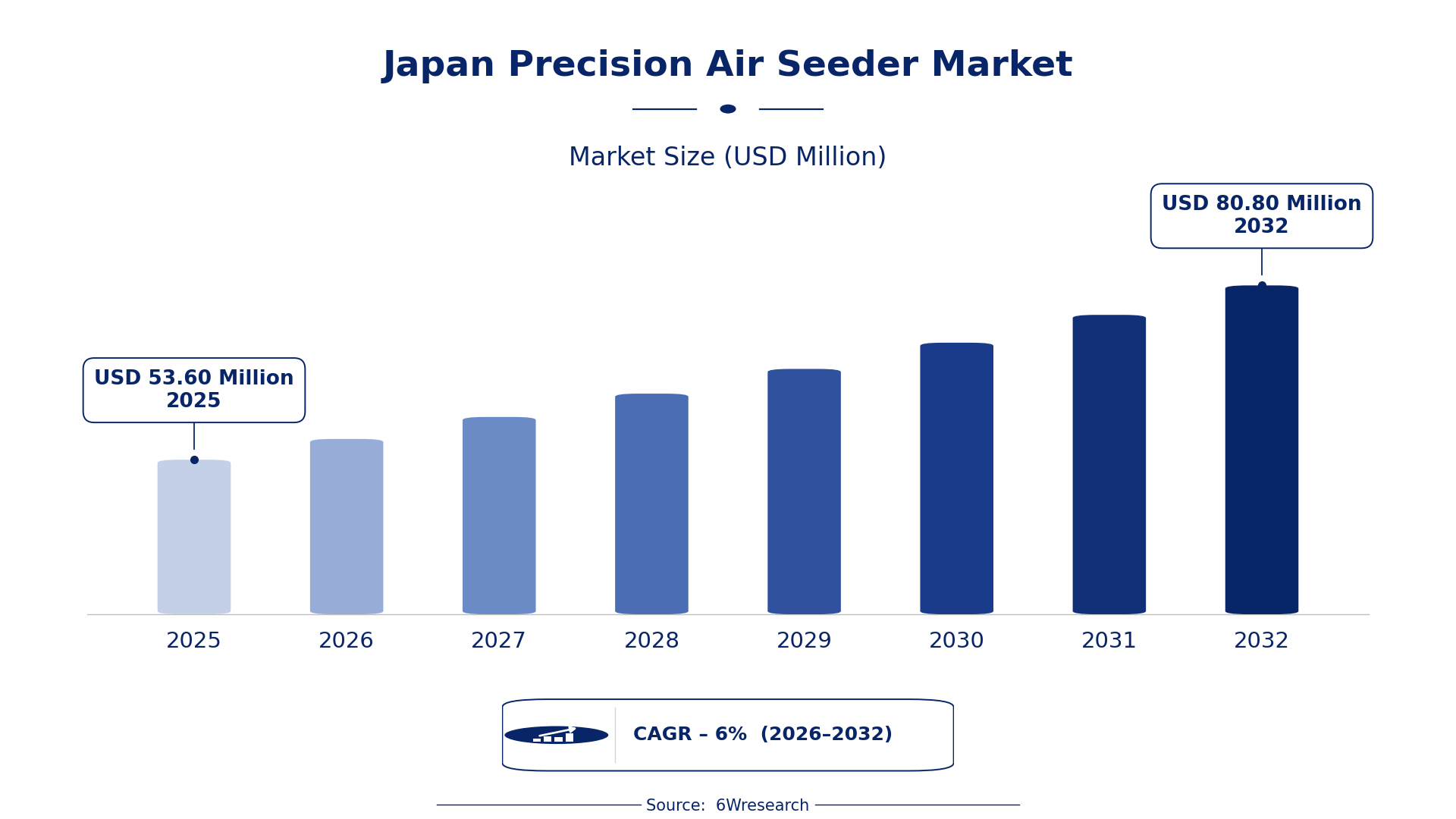
According to 6Wresearch internal database and industry insights, the Japan Precision Air Seeder Market was valued at USD 53.60 Million in 2025 and is projected to reach USD 80.80 Million by 2032, growing at a CAGR of approximately 6% during 2026–2032.
Japan Precision Air Seeder Market Highlights
| Report Metric | Details |
| Report Name | Japan Precision Air Seeder Market (2026-2032) |
| Market Size 2025 | USD 53.60 Million |
| Market Size 2032 | USD 80.80 Million |
| Absolute Growth 2025–2032 | USD 27.20 Million |
| CAGR 2026–2032 | 6% |
| Peak Annual Growth | 6.9% in 2032 |
| Forecast Period | 2026–2032 |
| Historical Data | 2022–2025 |
| Base Year | 2025 |
| Leading Seeder Type, 2025 | High-Performance Air Seeders (39% share) |
| Leading Seed Metering Control, 2025 | Precision Depth Control (51% share) |
| Leading Distribution Channel, 2025 | Direct Sales (38% share) |
| Leading End User, 2025 | Large-Scale Grain Farmers (46% share) |
| Fastest-Growing Seed Metering Control | Multiple Bins (8.0% CAGR) |
| Fastest-Growing Distribution Channel | Online Platforms (7.9% CAGR) |
| Fastest-Growing End User | Agricultural Cooperatives (7.7% CAGR) |
| Growing Sector | Agricultural Cooperatives |
| Key End Users | Large-Scale Grain Farmers, Agricultural Cooperatives, Commercial Seed Companies, Ag Equipment Rental Firms |
Japan Precision Air Seeder Market Year-wise Growth Rate and Key Drivers (2022–2032)
This graph illustrates the annual growth rates of the market from 2022 to 2032, highlighting a steady upward trajectory and projected market expansion over the forecast period.
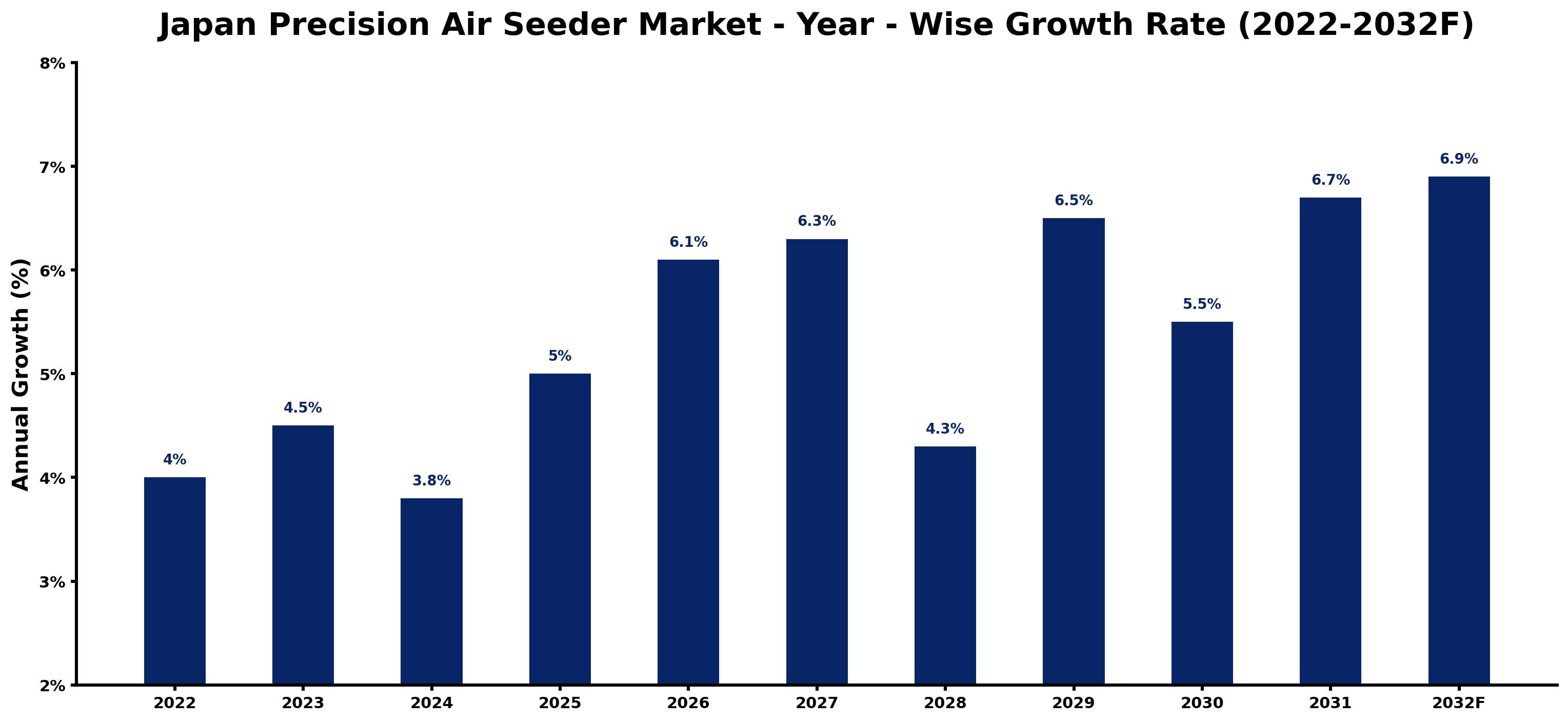
The yearly estimates that follow link every growth rate to its principal driver, so readers can see why the pace changed in each period.
| Year | Estimated Annual Growth (%) | Market Rationale |
| 2022 | 4.0 | The market showed steady demand from large-scale grain farmers and agricultural cooperatives. |
| 2023 | 4.5 | Increased interest in precision farming technologies drove faster growth compared to the previous year. |
| 2024 | 3.8 | The growth rate slowed slightly as market saturation began to impact new purchases. |
| 2025 | 5.0 | Demand surged as large-scale farmers adopted advanced planting techniques, boosting market performance. |
| 2026 | 6.1 | A rise in orders is expected as technological advancements in seeders enhance efficiency. |
| 2027 | 6.3 | Continued investment in precision agriculture technologies will support further growth in demand. |
| 2028 | 4.3 | Growth is projected to slow as market maturity sets in, with fewer new entrants in the segment. |
| 2029 | 6.5 | Increased adoption of air drill machines among farmers will lead to a faster growth rate. |
| 2030 | 5.5 | The market will see a slight slowdown as competition intensifies among suppliers. |
| 2031 | 6.7 | Demand is expected to rise again as agricultural cooperatives expand their support for advanced technologies. |
| 2032 | 6.9 | The market is projected to peak with a strong push for precision agriculture technologies among farmers. |
Note: Market size estimations and growth projections presented in this report are based on 6Wresearch's proprietary forecasting methodology, utilizing the latest available industry data, government publications, and primary research inputs.
Japan Precision Air Seeder Market Synopsis
Precision Air Seeders are agricultural machines that utilise pneumatic technology to plant seeds at precise depths and spacing. In Japan, the Japan Precision Air Seeder Market is growing, driven by large-scale grain farming, particularly in the Tohoku region. The Ministry of Agriculture, Forestry and Fisheries is promoting precision farming, aiming for a 20% increase in adoption by 2023. The rising trend towards high-performance air seeders and support from agricultural cooperatives further fuel investment in this market.
Market Dynamics Impact Analysis (2026–2032)
| Factor | Type | Impact | Primary Segment Affected |
| Increased adoption of precision farming techniques among large-scale grain farmers | Driver | High | High-Performance Air Seeders |
| Growing interest in reducing seed waste and improving crop yields | Driver | High | Pneumatic Seeders |
| Rising demand for efficient planting solutions in the Tohoku region | Opportunity | High | Air Drill Machines |
| Increased online sales of agricultural equipment, growing by 15% last year | Opportunity | Medium | Online Platforms |
| High initial investment costs for advanced seeding technology | Restraint | High | Precision Depth Control |
| Limited awareness of the benefits of precision air seeders among small farmers | Restraint | Medium | Pneumatic Seeders |
| Competition from traditional planting methods still prevalent in rural areas | Challenge | High | Air Drill Machines |
| Supply chain disruptions affecting the availability of components | Challenge | Medium | High-Performance Air Seeders |
Evaluation of Drivers in Japan Precision Air Seeder Market (2026–2032)
The main growth drivers and the segments they affect most are set out below.
| Drivers | Primary Segment Affected | Why It Matters (Evidence) |
| Increased investment in precision agriculture | High-Performance Air Seeders | This investment is linked to improved crop yields, with agricultural cooperatives supporting over 1 million farmers. |
| Advancements in seed metering systems | Precision Depth Control | These developments result in a 30% reduction in seed waste, enhancing overall planting efficiency. |
| Growing demand for high-efficiency planting solutions | Air Drill Machines | The average farm size of 1.5 hectares in Japan promotes the use of efficient planting technologies. |
| Government initiatives promoting precision farming | Pneumatic Seeders | The aim for a 20% increase in technology adoption by 2023 stimulates market growth. |
| Awareness of sustainable farming practices | Multiple Bins | Farmers are adopting practices that reduce environmental impact, boosting demand for advanced seeders. |
Behind the steady rise in orders is a growing investment in precision agriculture, with agricultural cooperatives supporting over 1 million farmers. The average farm size of 1.5 hectares in Japan encourages the adoption of efficient planting solutions, increasing demand for air drill machines. Advancements in seed metering systems have led to a marked reduction in seed waste, improving planting efficiency. Awareness of sustainable farming practices drives demand for multiple bins, allowing farmers to plant different seed types simultaneously.
Evaluation of Restraints in Japan Precision Air Seeder Market
Below are the constraints most often cited by buyers and suppliers, with the segment each affects.
| Market Restraint | Primary Segment Affected | Why It Matters (Evidence) |
| High initial investment costs for advanced seeding technology | Precision Depth Control | These costs deter small-scale farmers from adopting modern seeders, limiting market growth. |
| Limited awareness of the benefits of precision air seeders | Pneumatic Seeders | Many small farmers remain unaware of the advantages, hindering wider adoption of these technologies. |
| Competition from traditional planting methods | Air Drill Machines | Farmers in rural areas often prefer established practices, slowing the transition to precision technologies. |
| Supply chain disruptions affecting component availability | High-Performance Air Seeders | Delays in obtaining necessary parts can hinder production and availability for buyers. |
| Regulatory compliance costs for manufacturers | Pneumatic Seeders | Meeting JIS standards increases operational costs for producers, impacting pricing. |
Japan Precision Air Seeder Market Challenges
Approximately 15% of farmers in Japan face challenges in acquiring precision air seeders, which directly impacts their planting efficiency and can lead to lower crop yields. This situation stems from high demand in the Tohoku region, resulting in delays that hinder buyers from timely planting. Fierce competition among manufacturers has led to price increases of up to 15%, straining budgets for agricultural cooperatives. Many producers continue to use outdated technology, with 30% of seeders lacking modern pneumatic systems, limiting yield improvements for end users. Regulatory standards like JIS create compliance costs that delay product availability for suppliers.
Trends in the Japan Precision Air Seeder Market
Below are the shifts with the largest effect on the Japan Precision Air Seeder Market.
- Shift from Traditional to Precision Farming: The adoption of precision farming techniques is increasing, particularly among large-scale grain farmers in the Tohoku region. This trend is reflected in a target for technology adoption set by the Ministry of Agriculture, Forestry and Fisheries, aiming for a 20% increase.
- Rise of Online Sales Channels: Online platforms for agricultural equipment are gaining traction, with a 15% increase in sales last year. This shift allows farmers to access precision air seeders more conveniently, expanding market reach.
- Growing Popularity of High-Performance Air Seeders: High-Performance Air Seeders are becoming increasingly popular, with an expected CAGR of 8.7% from 2026 to 2032. Their efficiency in planting is driving demand among large-scale grain farmers.
- Increased Focus on Sustainable Agriculture: The emphasis on sustainable farming practices is leading farmers to adopt technologies that reduce waste. This is reflected in the reduction in seed waste attributed to pneumatic seeders, improving overall agricultural productivity.
Investment Opportunities in the Japan Precision Air Seeder Market
Where to invest in the Japan Precision Air Seeder Market: the main openings are set out below.
- Timing for Investment in Precision Air Seeders: With a projected increase in precision agriculture adoption by 20% in 2023, now is an ideal time for investment in precision air seeders. Agricultural cooperatives in the Tohoku region are actively seeking advanced planting technologies, making it a prime opportunity for suppliers.
- Entry through Local Partnerships: The growing demand for precision air seeders, with online sales increasing by 15% last year, presents a chance for foreign companies to enter the market through local partnerships. Collaborating with agricultural cooperatives can facilitate access to a wider farmer base.
- Focus on High-Performance Air Seeders: High-Performance Air Seeders are gaining traction, with an expected CAGR of 8.7% from 2026 to 2032. Suppliers should focus on this segment, as large-scale grain farmers in regions like Hokkaido are increasingly adopting these efficient planting solutions.
- Investment in Seed Metering Control Technologies: The demand for Multiple Bins technology is rising, driven by the need for efficient planting of various seed types. Suppliers can capitalise on this trend by investing in seed metering control technologies, appealing to large-scale grain farmers.
Government Initiatives in the Japan Precision Air Seeder Market
The Electrical Appliance and Material Safety Act (1961) regulates the safety of agricultural machinery, ensuring that precision air seeders meet strict performance standards. Compliance with this law is crucial for producers to market their equipment effectively.
The Ministry of Agriculture, Forestry and Fisheries approves funding for innovative agricultural projects, including precision farming technologies. This agency's support helps increase the adoption of advanced seeders among farmers, promoting sustainable agricultural practices.
Future Insight of the Japan Precision Air Seeder Market
Advancements in air blower systems will reshape demand for precision farming technology by 2032. The government’s ¥5 billion investment in agricultural innovation will drive the adoption of modern seeders. Increased online sales of agricultural equipment, which rose by 15% last year, will improve access for farmers, boosting their planting capabilities. A stronger focus on ISO 9001 certification among manufacturers will elevate quality standards, benefiting both buyers and suppliers.
Market Segmentation Analysis
Japan Precision Air Seeder Market report covers a detailed analysis of the following market segments:
By Seeder Type – High-Performance Air Seeders Lead and Record the Fastest Growth
According to Navya, Research Analyst at 6Wresearch, High-Performance Air Seeders accounted for 39% of the market by seeder type in 2025. High-Performance Air Seeders dominate the market due to their design specifically tailored for optimal planting precision, which is crucial for large-scale grain farming in regions like Tohoku. Their effectiveness in reducing seed waste and improving crop yields makes them indispensable for farmers. Its lead should widen, with a projected CAGR of 8.7% during 2026–2032, the highest in this split. The growth of High-Performance Air Seeders is fuelled by government initiatives aimed at increasing the adoption of precision agriculture technologies by 20%. As more farmers transition to these advanced seeders, their market lead is likely to widen further. Suppliers should prioritise advancements in High-Performance Air Seeders to stay competitive in this expanding market.
By Seed Metering Control – Precision Depth Control Leads, Multiple Bins Expected to Grow Fastest
Precision Depth Control took 51% of seed metering control revenue in 2025, more than any other category. Precision Depth Control leads the segment as it ensures seeds are planted at the correct depth, which is vital for achieving optimal crop yields. This technology has become a standard in new seeder models, reflecting its importance in the market. Over 2026–2032, Multiple Bins are expected to post the fastest growth, at a CAGR of 8.0%. The Multiple Bins segment is experiencing rapid growth due to its ability to allow planting of different seed types simultaneously, catering to diverse farming needs. This flexibility is increasingly appealing to farmers looking to optimise their planting strategies. Suppliers should consider expanding their offerings to include advanced seed metering technologies to meet evolving farmer demands.
By Distribution Channel – Direct Sales Leads, Online Platforms Expected to Grow Fastest
The largest distribution channel category in 2025 was Direct Sales, at 38% of revenue. Direct Sales is the leading distribution channel as farmers prefer purchasing directly from manufacturers, ensuring they receive the latest technology and support. This approach strengthens the connection between producers and users, fostering loyalty and trust in the products. Online Platforms are projected to grow fastest, at a CAGR of 7.9% during 2026–2032. Online Platforms are rapidly growing, evidenced by a 15% increase in sales over the past year, reflecting a shift towards digital purchasing methods among farmers. This trend indicates a growing acceptance of online transactions within the agricultural sector. Suppliers must enhance their online sales strategies to effectively reach the increasing number of farmers opting for digital purchasing.
By End User – Large-Scale Grain Farmers Lead, Agricultural Cooperatives Expected to Grow Fastest
In 2025, Large-Scale Grain Farmers led the end user split with a 46% share. Large-Scale Grain Farmers are the primary users of precision seeders, as their farming operations require advanced planting technologies to maximise efficiency and yield. Their significant influence in the agricultural sector drives the demand for high-performance seeders. The quickest growth will come from Agricultural Cooperatives, forecast to expand at a CAGR of 7.7% between 2026 and 2032. Agricultural Cooperatives are the fastest-growing end user group, providing access to advanced planting technology for over 1 million farmers. This support plays a crucial role in promoting the adoption of precision farming techniques among smaller farmers. Suppliers should collaborate with agricultural cooperatives to expand their market reach and enhance their impact.
Key Attractiveness of the Report
- 10 Years of Market Numbers
- Historical Data Starting from 2022 to 2025
- Base Year 2025
- Forecast Data until 2032
- Key Performance Indicators Impacting the Market
- Major Upcoming Developments and Projects
Key Highlights of the Report:
- Japan Precision Air Seeder Market Outlook
- Market Size of Japan Precision Air Seeder Market, 2025
- Forecast of Japan Precision Air Seeder Market, 2032
- Historical Data and Forecast of Japan Precision Air Seeder Revenues & Volume for the Period 2022-2032F
- Japan Precision Air Seeder Market Trend Evolution
- Japan Precision Air Seeder Market Drivers and Challenges
- Japan Precision Air Seeder Price Trends
- Japan Precision Air Seeder Porter's Five Forces
- Japan Precision Air Seeder Industry Life Cycle
- Historical Data and Forecast of Japan Precision Air Seeder Market Revenues & Volume By Seeder Type for the Period 2022-2032F
- Historical Data and Forecast of Japan Precision Air Seeder Market Revenues & Volume By Pneumatic Seeders for the Period 2022-2032F
- Historical Data and Forecast of Japan Precision Air Seeder Market Revenues & Volume By Air Drill Machines for the Period 2022-2032F
- Historical Data and Forecast of Japan Precision Air Seeder Market Revenues & Volume By High-Performance Air Seeders for the Period 2022-2032F
- Historical Data and Forecast of Japan Precision Air Seeder Market Revenues & Volume By Air Seeders with Compound Discs for the Period 2022-2032F
- Historical Data and Forecast of Japan Precision Air Seeder Market Revenues & Volume By Seed Metering Control for the Period 2022-2032F
- Historical Data and Forecast of Japan Precision Air Seeder Market Revenues & Volume By Air-Blown Seeding for the Period 2022-2032F
- Historical Data and Forecast of Japan Precision Air Seeder Market Revenues & Volume By Precision Depth Control for the Period 2022-2032F
- Historical Data and Forecast of Japan Precision Air Seeder Market Revenues & Volume By Multiple Bins for the Period 2022-2032F
- Historical Data and Forecast of Japan Precision Air Seeder Market Revenues & Volume By ESA Technology for the Period 2022-2032F
- Historical Data and Forecast of Japan Precision Air Seeder Market Revenues & Volume By Distribution Channel for the Period 2022-2032F
- Historical Data and Forecast of Japan Precision Air Seeder Market Revenues & Volume By OEM Dealers for the Period 2022-2032F
- Historical Data and Forecast of Japan Precision Air Seeder Market Revenues & Volume By Direct Sales for the Period 2022-2032F
- Historical Data and Forecast of Japan Precision Air Seeder Market Revenues & Volume By Online Platforms for the Period 2022-2032F
- Historical Data and Forecast of Japan Precision Air Seeder Market Revenues & Volume By Specialty Dealers for the Period 2022-2032F
- Historical Data and Forecast of Japan Precision Air Seeder Market Revenues & Volume By End User for the Period 2022-2032F
- Historical Data and Forecast of Japan Precision Air Seeder Market Revenues & Volume By Large-Scale Grain Farmers for the Period 2022-2032F
- Historical Data and Forecast of Japan Precision Air Seeder Market Revenues & Volume By Agricultural Cooperatives for the Period 2022-2032F
- Historical Data and Forecast of Japan Precision Air Seeder Market Revenues & Volume By Commercial Seed Companies for the Period 2022-2032F
- Historical Data and Forecast of Japan Precision Air Seeder Market Revenues & Volume By Ag Equipment Rental Firms for the Period 2022-2032F
- Japan Precision Air Seeder Import Export Trade Statistics
- Market Opportunity Assessment By Seeder Type
- Market Opportunity Assessment By Seed Metering Control
- Market Opportunity Assessment By Distribution Channel
- Market Opportunity Assessment By End User
- Japan Precision Air Seeder Top Companies Market Share
- Japan Precision Air Seeder Competitive Benchmarking By Technical and Operational Parameters
- Japan Precision Air Seeder Company Profiles
- Japan Precision Air Seeder Key Strategic Recommendations
Market Covered
The study includes the following segmentation.
By Seeder Type
- Pneumatic Seeders
- Air Drill Machines
- High-Performance Air Seeders
- Air Seeders with Compound Discs
By Seed Metering Control
- Air-Blown Seeding
- Precision Depth Control
- Multiple Bins
- ESA Technology
By Distribution Channel
- OEM Dealers
- Direct Sales
- Online Platforms
- Specialty Dealers
By End User
- Large-Scale Grain Farmers
- Agricultural Cooperatives
- Commercial Seed Companies
- Ag Equipment Rental Firms






































