Japan Precision Breeding Market Size & Growth Rate
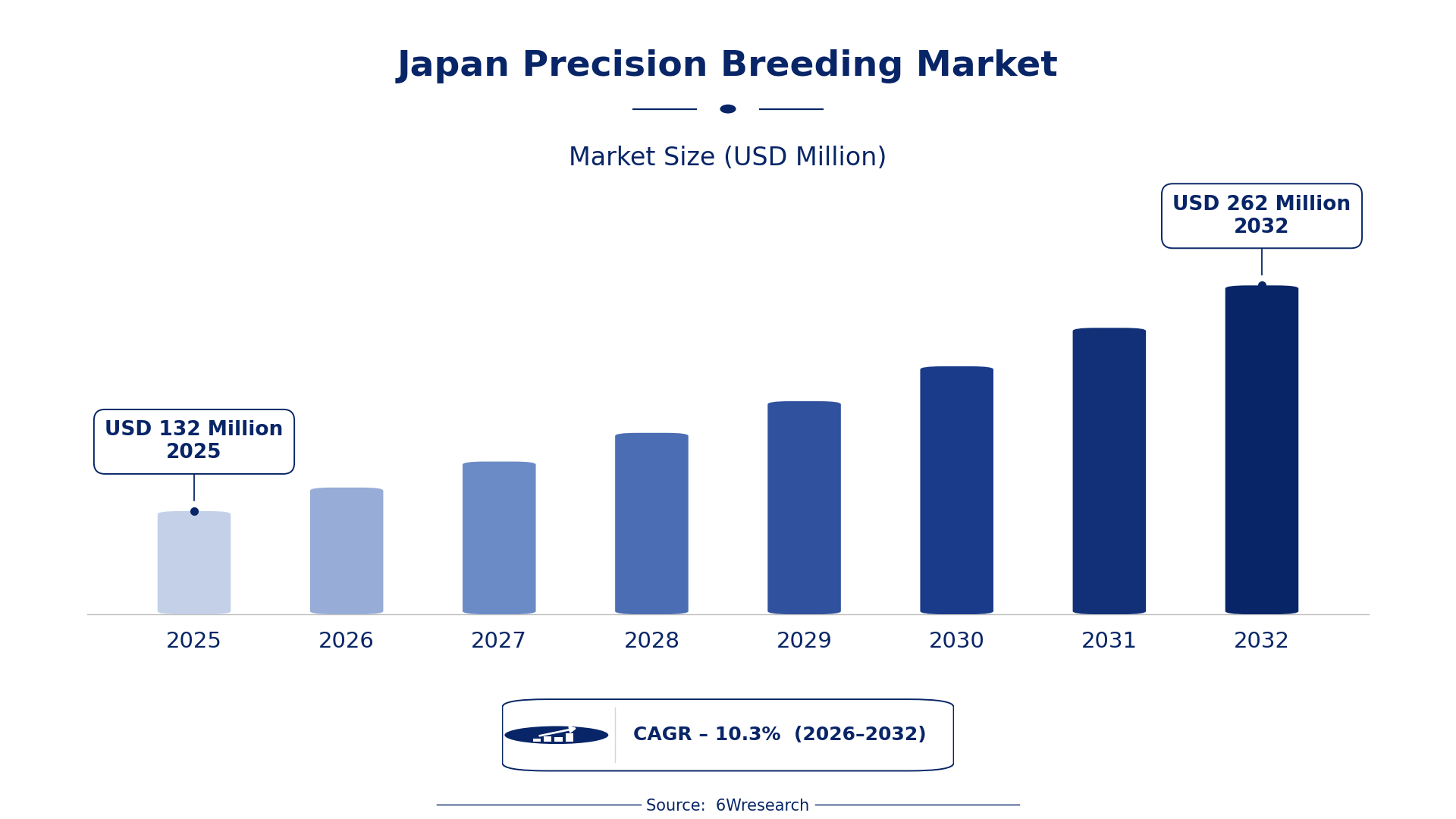
According to 6Wresearch internal database and industry insights, the Japan Precision Breeding Market was valued at USD 132 Million in 2025 and is projected to reach USD 262 Million by 2032, growing at a CAGR of approximately 10.3% during 2026–2032.
Japan Precision Breeding Market Highlights
| Report Metric | Details |
| Report Name | Japan Precision Breeding Market (2026-2032) |
| Market Size 2025 | USD 132 Million |
| Market Size 2032 | USD 262 Million |
| Absolute Growth 2025–2032 | USD 130 Million |
| CAGR 2026–2032 | 10.3% |
| Peak Annual Growth | 12.2% in 2032 |
| Forecast Period | 2026–2032 |
| Historical Data | 2022–2025 |
| Base Year | 2025 |
| Leading Technique, 2025 | Genome Editing (41% share) |
| Leading Breeding Method, 2025 | CRISPR/Cas9 (38% share) |
| Leading Distribution Channel, 2025 | Government Programs (35% share) |
| Leading End User, 2025 | Seed Companies (41% share) |
| Fastest-Growing Breeding Method | DNA Marker (14.8% CAGR) |
| Fastest-Growing Distribution Channel | Research Collaborations (13.1% CAGR) |
| Fastest-Growing End User | Crop Breeders (14.1% CAGR) |
| Growing Sector | agricultural biotechnology |
| Key End Users | seed companies, crop improvement labs, crop breeders, plant genetics research centers |
Japan Precision Breeding Market Year-wise Growth Rate and Key Drivers (2022–2032)
This graph illustrates the annual growth rates of the market from 2022 to 2032, highlighting a steady upward trajectory and projected market expansion over the forecast period.
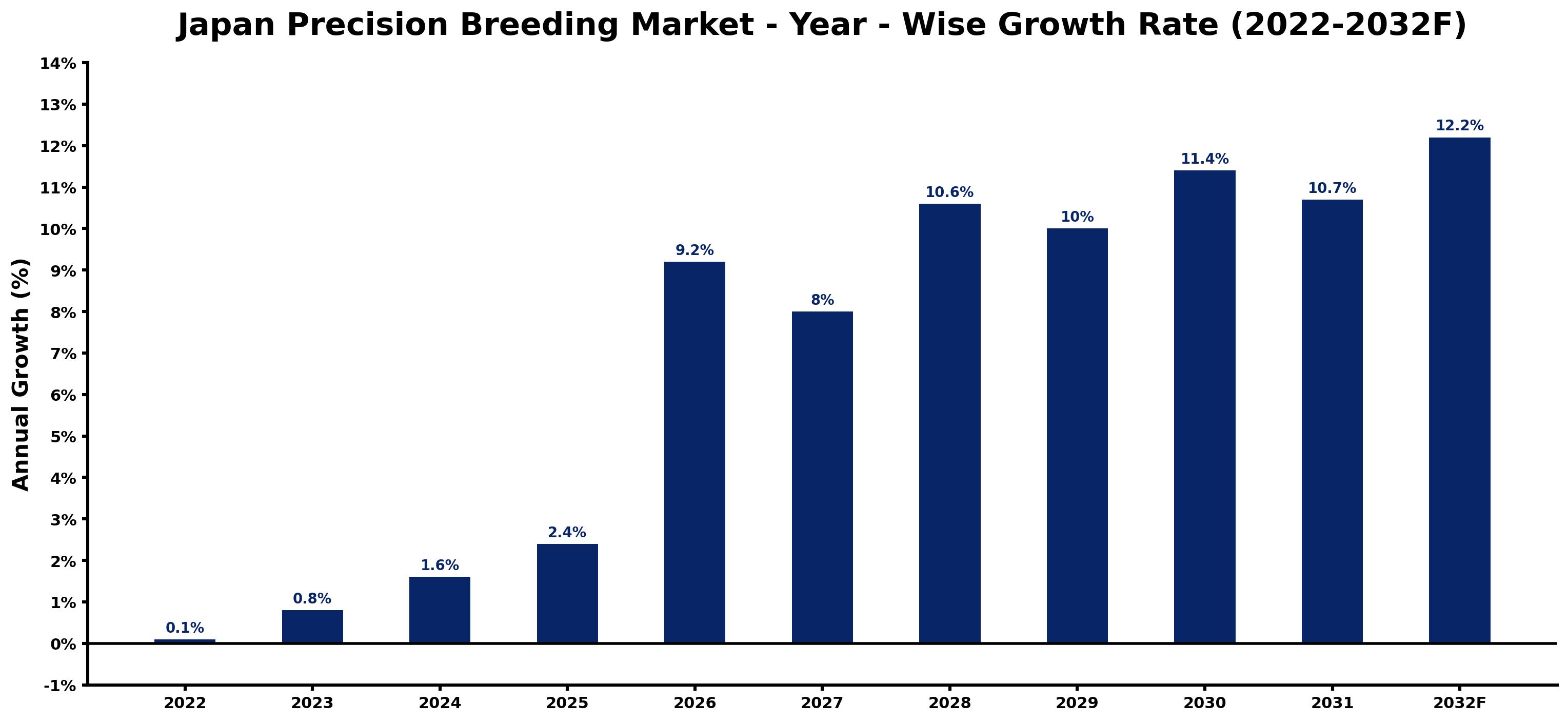
Year by year, the estimates below pair each growth rate with the development that shaped it.
| Year | Estimated Annual Growth (%) | Market Rationale |
| 2022 | 0.1 | The market showed minimal growth as seed companies began adopting precision breeding techniques. |
| 2023 | 0.8 | Growth accelerated as more seed companies integrated genome editing into their practices. |
| 2024 | 1.6 | Increased interest in crop resilience led to higher investments in precision breeding technologies. |
| 2025 | 2.4 | The market peaked historically as demand surged for improved crop traits amid climate concerns. |
| 2026 | 9.2 | Investment in agricultural biotechnology is expected to expand, driving growth in precision breeding. |
| 2027 | 8.0 | Growth is projected to slow slightly as the market adjusts to increased adoption rates among seed companies. |
| 2028 | 10.6 | The market is expected to rebound with renewed interest in genome editing and crop improvement initiatives. |
| 2029 | 10.0 | A slight slowdown is projected as the market stabilises after rapid growth in previous years. |
| 2030 | 11.4 | Growth is expected to accelerate again as new technologies gain traction in agricultural practices. |
| 2031 | 10.7 | The market will continue to expand, although at a slower pace than the previous year. |
| 2032 | 12.2 | Demand is projected to peak as precision breeding technologies become mainstream in crop production. |
Note: Market size estimations and growth projections presented in this report are based on 6Wresearch's proprietary forecasting methodology, utilizing the latest available industry data, government publications, and primary research inputs.
Japan Precision Breeding Market Synopsis
Precision breeding represents a biotechnological approach that improves plant breeding using genetic tools for better crop traits. In Japan, over 1,000 registered seed companies and more than 300 crop improvement labs drive the market. Growth stems from rising investments in genome editing technologies, alongside government initiatives like the 2023 program promoting these advancements, ultimately improving crop yield and resilience.
Market Dynamics Impact Analysis (2026–2032)
| Factor | Type | Impact | Primary Segment Affected |
| Growing investment in genome editing technologies | Driver | High | Genome Editing |
| Increased focus on crop resilience due to climate change | Driver | High | Marker-Assisted Breeding |
| Rising demand for genetically modified crops | Opportunity | High | Seed Companies |
| Expansion of research collaborations in agriculture | Opportunity | Medium | Research Collaborations |
| High costs associated with advanced breeding technologies | Restraint | High | Genome Editing |
| Regulatory hurdles in the approval process for genetically modified crops | Restraint | Medium | Government Programs |
| Limited access to funding for smaller seed companies | Challenge | High | Crop Improvement Labs |
| Shortage of skilled professionals in biotechnology | Challenge | Medium | Plant Genetics Research Centers |
Evaluation of Drivers in Japan Precision Breeding Market (2026–2032)
These are the developments adding the most demand over the forecast period.
| Drivers | Primary Segment Affected | Why It Matters (Evidence) |
| Increased funding for agricultural biotechnology research | Genome Editing | The Japanese government allocated ¥5 billion for agricultural biotechnology in 2023, boosting demand for genome editing technologies among seed companies. |
| Growing adoption of precision breeding technologies | Marker-Assisted Breeding | With an adoption rate of around 70%, seed companies are investing in marker-assisted breeding to improve crop traits. |
| Rising consumer demand for sustainable food sources | Seed Companies | The population of Japan, approximately 125 million, drives seed companies to seek improved crop yields through precision breeding. |
| Supportive government programs promoting innovation | Research Collaborations | The Ministry of Agriculture, Forestry and Fisheries allocated funding to support initiatives that encourage research collaborations in precision breeding. |
| Technological advancements in genetic research | Genome Editing | CRISPR technology is used in over 50% of genetic research projects, leading to increased investment in precision breeding. |
Approximately 70% of seed companies are now integrating precision breeding techniques to improve crop traits, driven by the need for sustainable food sources for the 125 million population. Technological advancements in genetic research are encouraging investment in precision breeding, enabling companies to improve crop yields and resilience.
Evaluation of Restraints in Japan Precision Breeding Market
Several factors work against faster growth; the main ones are summarised below.
| Market Restraint | Primary Segment Affected | Why It Matters (Evidence) |
| High costs associated with advanced breeding technologies | Genome Editing | The high costs of implementing genome editing technologies can deter smaller seed companies from adopting these methods. |
| Regulatory hurdles in the approval process for genetically modified crops | Government Programs | The lengthy approval process for genetically modified crops can delay product launches, impacting seed companies' competitiveness. |
| Limited access to funding for smaller seed companies | Crop Improvement Labs | Smaller crop improvement labs often struggle to secure funding, hindering their ability to invest in precision breeding technologies. |
| Shortage of skilled professionals in biotechnology | Plant Genetics Research Centers | A lack of qualified professionals in biotechnology limits the capacity of research centres to advance precision breeding initiatives. |
| Market saturation with existing breeding technologies | Marker-Assisted Breeding | The prevalence of established breeding technologies can slow the adoption of newer precision breeding methods among seed companies. |
Japan Precision Breeding Market Challenges
Precision breeding costs buyers in Japan approximately ¥2 billion annually due to regulatory delays in crop approvals. Skills shortages in advanced biotechnological techniques can reduce crop yield by 15%, affecting producers' competitiveness in the market. Limited access to quality genetic materials can delay supply chain projects by up to six months, hindering producers' ability to meet consumer demand. Technology adoption remains uneven, with only 70% of seed companies utilising precision breeding tools, restricting innovation and leaving some buyers reliant on outdated methods.
Trends in the Japan Precision Breeding Market
Four trends stand out in the Japan Precision Breeding Market.
- Shift from Traditional to Precision Breeding: In 2023, Japan experienced a shift from traditional breeding methods to precision breeding techniques. This change is marked by the increased adoption of CRISPR technology, which is now used in over 50% of genetic research projects, effectively improving crop traits.
- Emergence of Genome Editing as a Preferred Method: The rise of genome editing has transformed crop improvement strategies in Japan. In 2023, the government launched a program to promote genome editing technologies, resulting in a 70% adoption rate among seed companies.
- Growing Investment in Agricultural Biotechnology: Investment in agricultural biotechnology has surged, particularly in Tokyo and Hokkaido, where over 300 crop improvement labs are located. The Japanese government allocated ¥5 billion for research in 2023, indicating strong support for innovation.
- Increased Collaboration in Research and Development: Collaboration among research institutions has intensified, particularly through government programs. The establishment of the Japan Society for Bioscience, Biotechnology, and Agrochemistry has facilitated knowledge sharing, improving the development of precision breeding technologies.
Investment Opportunities in the Japan Precision Breeding Market
Several openings in the Japan Precision Breeding Market merit attention from investors.
- Precision Breeding Technologies: With an adoption rate of around 70%, there is an opportunity to supply precision breeding technologies to seed companies. Collaborating with local partners can facilitate market entry in regions like Tokyo and Hokkaido.
- Research Collaboration Services: The demand for research collaborations is rising, particularly in crop improvement labs. Engaging in joint ventures can help companies tap into this growing market, especially with government support.
- Genome Editing Tools and Services: Now is an ideal time to invest in genome editing tools, as the Japanese government promotes these technologies. Establishing partnerships with research institutions can strengthen market presence.
- Funding for Agricultural Biotechnology: The ¥5 billion allocated for agricultural biotechnology research in 2023 presents an opportunity for companies to invest in innovative breeding methods. Engaging with government programs can streamline access to funding.
Government Initiatives in the Japan Precision Breeding Market
The Industrial Standardization Act, amended in 2019, governs product and test standards in Japan, ensuring that precision breeding technologies meet quality requirements. The Act against Unjustifiable Premiums and Misleading Representations prohibits misleading labelling of genetically modified crops, protecting consumers and ensuring transparency in the market.
The Ministry of Agriculture, Forestry and Fisheries implements programs that support precision breeding initiatives. In 2023, MAFF launched a program to promote genome editing technologies, facilitating access to funding for seed companies and improving their research capabilities.
Future Insight of the Japan Precision Breeding Market
The launch of genome editing programmes in 2023 will streamline crop development processes for seed companies, improving their product offerings. By 2032, the installed base of genomic selection tools is expected to exceed 200 units, allowing for more efficient breeding practices. Increased government funding of ¥5 billion for agricultural biotechnology will support research and development initiatives across the country. Enhanced JIS standards will further ensure the quality of genetically modified crops, benefiting both buyers and suppliers in the market.
Market Segmentation Analysis
Japan Precision Breeding Market report covers a detailed analysis of the following market segments:
By Technique – Genome Editing Leads and Records the Fastest Growth
According to Navya, Research Analyst at 6Wresearch, Genome Editing accounted for 41% of the market by technique in 2025. Genome editing holds the largest share due to its extensive application in precise genetic modifications across various crops. The Japanese government's initiatives to promote genome editing technologies have significantly influenced its adoption among seed companies. The same category is also set to grow fastest, at a CAGR of 13.5% during 2026–2032. The continuous advancements in genome editing techniques, particularly CRISPR technology, are propelling its growth rate. With over 50% of genetic research projects in Japan employing CRISPR, this trend is expected to further strengthen its market position. Suppliers should enhance genome editing capabilities to meet the increasing demand from seed companies.
By Breeding Method – CRISPR/Cas9 Leads, DNA Marker Expected to Grow Fastest
CRISPR/Cas9 took 38% of breeding method revenue in 2025, more than any other category. CRISPR/Cas9 technology leads the market as it is the primary method for gene editing, widely adopted by seed companies for crop enhancement. Its established use in Japan's agricultural sector underscores its critical role in improving crop traits. DNA Marker is set to record the highest CAGR in this split, 14.8% over 2026–2032. The rapid integration of DNA marker techniques among breeders is driving its growth, as these markers are vital for tracking genetic traits in crops. This method's increasing adoption reflects the necessity for precise genetic monitoring. Buyers should invest in DNA marker technologies to remain competitive in crop development.
By Distribution Channel – Government Programs Lead, Research Collaborations Expected to Grow Fastest
With 35% of distribution channel revenue in 2025, Government Programs was the largest category. Government programmes dominate this segment as they provide essential funding and support for agricultural research and development. The Japanese government's allocation of ¥5 billion for agricultural biotechnology research highlights the significance of these initiatives. Over 2026–2032, Research Collaborations are expected to post the fastest growth, at a CAGR of 13.1%. Research collaborations are experiencing the fastest growth as they facilitate knowledge sharing among institutions, enhancing overall research output in precision breeding. This collaborative approach is becoming increasingly crucial for advancing agricultural practices. Suppliers must engage in partnerships with research institutions to leverage collaborative opportunities.
By End User – Seed Companies Lead, Crop Breeders Expected to Grow Fastest
In 2025, Seed Companies led the end user split with a 41% share. Seed companies represent the largest user group of precision breeding techniques, utilising these technologies to improve crop yields and resilience. Their active participation in the market is evidenced by the 70% adoption rate of precision breeding technologies. The quickest growth will come from Crop Breeders, forecast to expand at a CAGR of 14.1% between 2026 and 2032. Crop breeders are swiftly adopting precision breeding practices, which drives their growth in the market. Their integration of these technologies is essential for developing improved crop varieties that meet market needs. Buyers should align their practices with the latest precision breeding techniques to enhance crop outcomes.
Key Attractiveness of the Report
- 10 Years of Market Numbers
- Historical Data Starting from 2022 to 2025
- Base Year 2025
- Forecast Data until 2032
- Key Performance Indicators Impacting the Market
- Major Upcoming Developments and Projects
Key Highlights of the Report:
- Japan Precision Breeding Market Outlook
- Market Size of Japan Precision Breeding Market, 2025
- Forecast of Japan Precision Breeding Market, 2032
- Historical Data and Forecast of Japan Precision Breeding Revenues & Volume for the Period 2022-2032F
- Japan Precision Breeding Market Trend Evolution
- Japan Precision Breeding Market Drivers and Challenges
- Japan Precision Breeding Price Trends
- Japan Precision Breeding Porter's Five Forces
- Japan Precision Breeding Industry Life Cycle
- Historical Data and Forecast of Japan Precision Breeding Market Revenues & Volume By Technique for the Period 2022-2032F
- Historical Data and Forecast of Japan Precision Breeding Market Revenues & Volume By Marker-Assisted Breeding for the Period 2022-2032F
- Historical Data and Forecast of Japan Precision Breeding Market Revenues & Volume By Genome Editing for the Period 2022-2032F
- Historical Data and Forecast of Japan Precision Breeding Market Revenues & Volume By Genomic Selection for the Period 2022-2032F
- Historical Data and Forecast of Japan Precision Breeding Market Revenues & Volume By Double Haploid Methods for the Period 2022-2032F
- Historical Data and Forecast of Japan Precision Breeding Market Revenues & Volume By Breeding Method for the Period 2022-2032F
- Historical Data and Forecast of Japan Precision Breeding Market Revenues & Volume By DNA Marker for the Period 2022-2032F
- Historical Data and Forecast of Japan Precision Breeding Market Revenues & Volume By CRISPR/Cas9 for the Period 2022-2032F
- Historical Data and Forecast of Japan Precision Breeding Market Revenues & Volume By Statistical Genomics for the Period 2022-2032F
- Historical Data and Forecast of Japan Precision Breeding Market Revenues & Volume By Haploid Induction for the Period 2022-2032F
- Historical Data and Forecast of Japan Precision Breeding Market Revenues & Volume By Distribution Channel for the Period 2022-2032F
- Historical Data and Forecast of Japan Precision Breeding Market Revenues & Volume By Research Collaborations for the Period 2022-2032F
- Historical Data and Forecast of Japan Precision Breeding Market Revenues & Volume By Contract Research Organizations for the Period 2022-2032F
- Historical Data and Forecast of Japan Precision Breeding Market Revenues & Volume By Government Programs for the Period 2022-2032F
- Historical Data and Forecast of Japan Precision Breeding Market Revenues & Volume By Direct Sales for the Period 2022-2032F
- Historical Data and Forecast of Japan Precision Breeding Market Revenues & Volume By End User for the Period 2022-2032F
- Historical Data and Forecast of Japan Precision Breeding Market Revenues & Volume By Seed Companies for the Period 2022-2032F
- Historical Data and Forecast of Japan Precision Breeding Market Revenues & Volume By Crop Improvement Labs for the Period 2022-2032F
- Historical Data and Forecast of Japan Precision Breeding Market Revenues & Volume By Crop Breeders for the Period 2022-2032F
- Historical Data and Forecast of Japan Precision Breeding Market Revenues & Volume By Plant Genetics Research Centers for the Period 2022-2032F
- Japan Precision Breeding Import Export Trade Statistics
- Market Opportunity Assessment By Technique
- Market Opportunity Assessment By Breeding Method
- Market Opportunity Assessment By Distribution Channel
- Market Opportunity Assessment By End User
- Japan Precision Breeding Top Companies Market Share
- Japan Precision Breeding Competitive Benchmarking By Technical and Operational Parameters
- Japan Precision Breeding Company Profiles
- Japan Precision Breeding Key Strategic Recommendations
Market Covered
This report examines the market across the segments below.
By Technique
- Marker-Assisted Breeding
- Genome Editing
- Genomic Selection
- Double Haploid Methods
By Breeding Method
- DNA Marker
- CRISPR/Cas9
- Statistical Genomics
- Haploid Induction
By Distribution Channel
- Research Collaborations
- Contract Research Organizations
- Government Programs
- Direct Sales
By End User
- Seed Companies
- Crop Improvement Labs
- Crop Breeders
- Plant Genetics Research Centers






































