Japan Precision Farming Equipment Market Size & Growth Rate
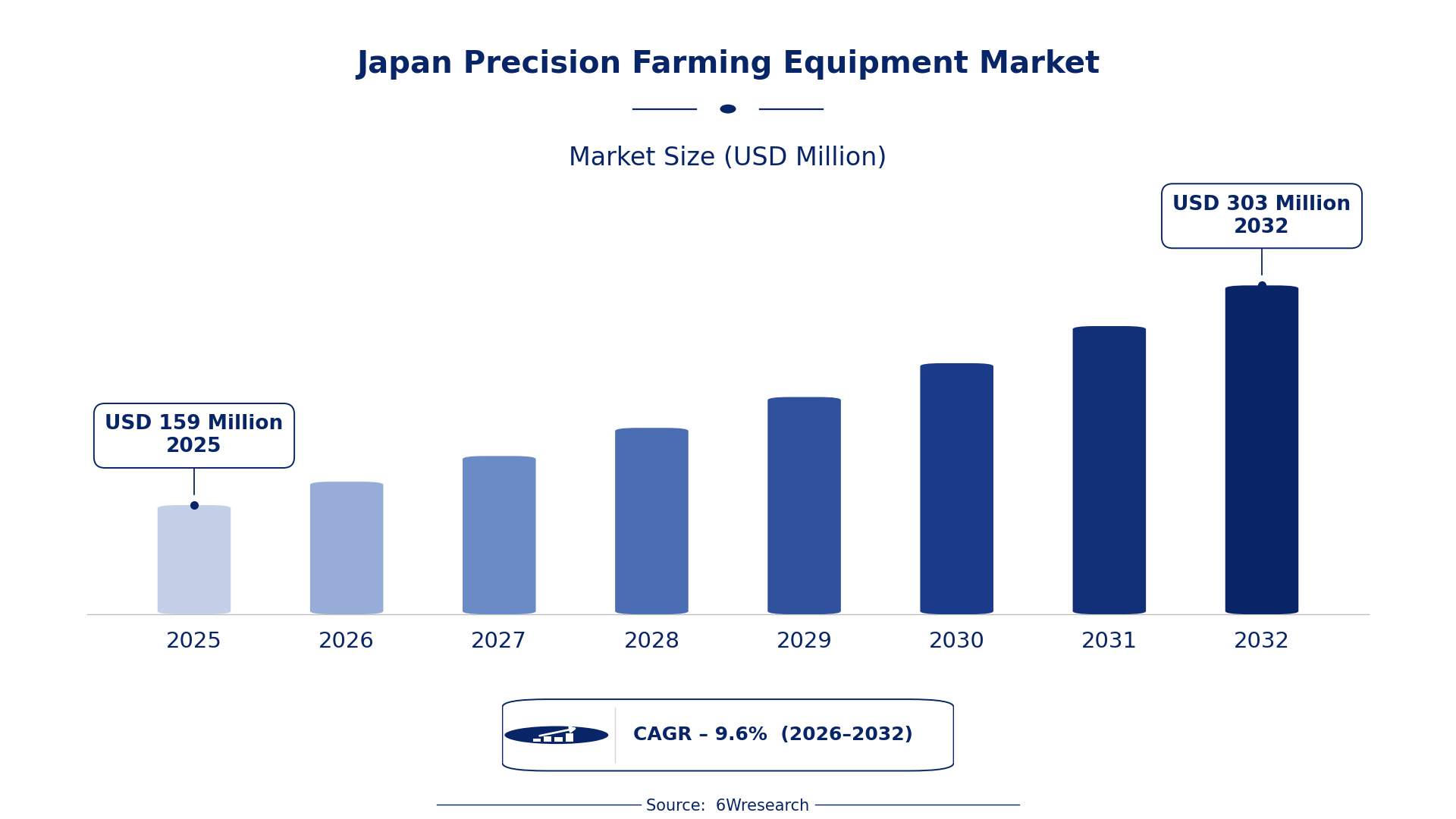
According to 6Wresearch internal database and industry insights, the Japan Precision Farming Equipment Market was valued at USD 159 Million in 2025 and is projected to reach USD 303 Million by 2032, growing at a CAGR of approximately 9.6% during 2026–2032.
Japan Precision Farming Equipment Market Highlights
| Report Metric | Details |
| Report Name | Japan Precision Farming Equipment Market (2026-2032) |
| Market Size 2025 | USD 159 Million |
| Market Size 2032 | USD 303 Million |
| Absolute Growth 2025–2032 | USD 144 Million |
| CAGR 2026–2032 | 9.6% |
| Peak Annual Growth | 11.1% in 2026 |
| Forecast Period | 2026–2032 |
| Historical Data | 2022–2025 |
| Base Year | 2025 |
| Leading Equipment Type, 2025 | Variable Rate Sprayers (39% share) |
| Leading Feature Type, 2025 | GPS Enabled (40% share) |
| Leading Distribution Channel, 2025 | Direct Sales (41% share) |
| Leading End User, 2025 | Agribusiness Firms (43% share) |
| Fastest-Growing Equipment Type | Precision Planters (13.3% CAGR) |
| Fastest-Growing Feature Type | Automated Seeding (14.1% CAGR) |
| Fastest-Growing Distribution Channel | Online Platforms (12.3% CAGR) |
| Fastest-Growing End User | Large Farms (11.9% CAGR) |
| Growing Sector | Agribusiness |
| Key End Users | Agribusiness Firms, Large Farms, Agri-Tech Companies |
Japan Precision Farming Equipment Market Year-wise Growth Rate and Key Drivers (2022–2032)
This graph illustrates the annual growth rates of the market from 2022 to 2032, highlighting a steady upward trajectory and projected market expansion over the forecast period.
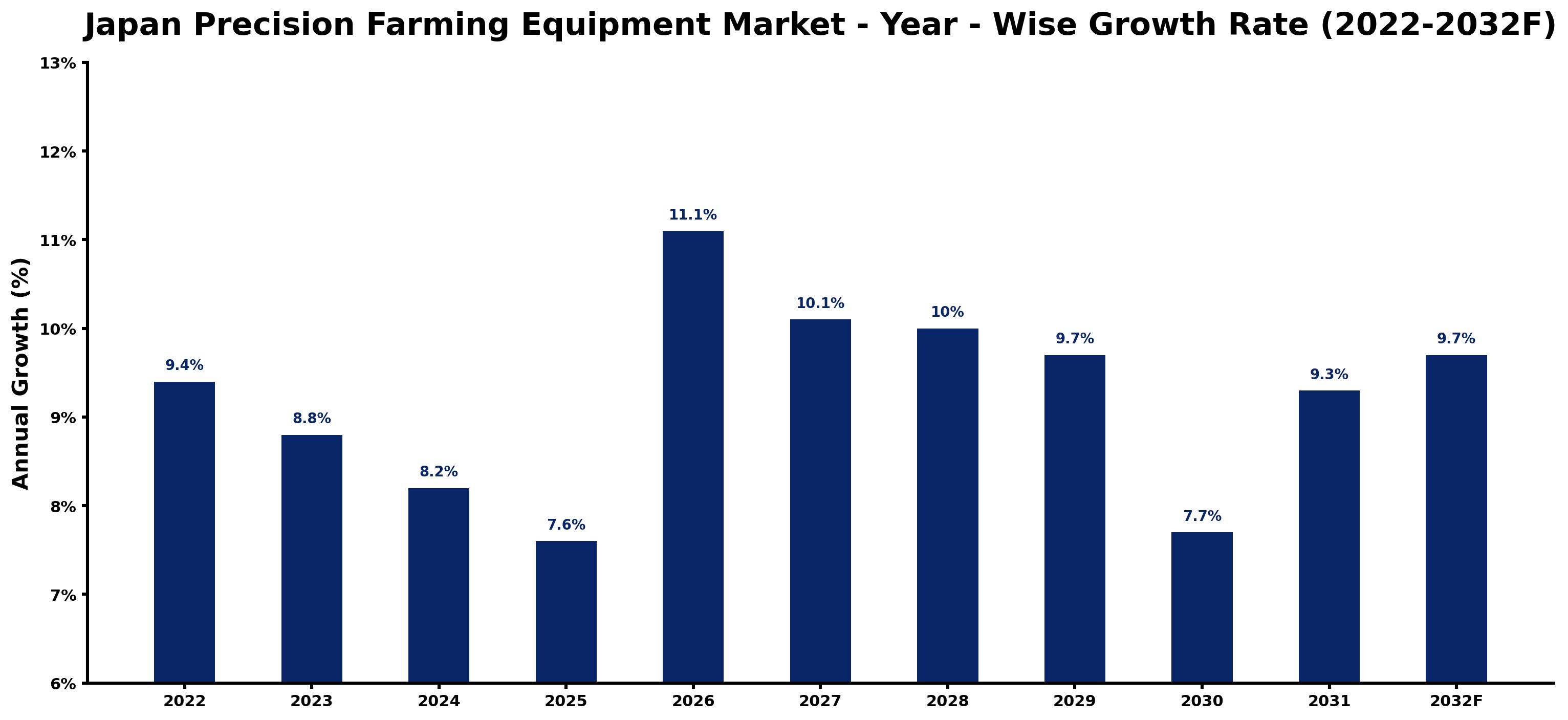
Year by year, the estimates below pair each growth rate with the development that shaped it.
| Year | Estimated Annual Growth (%) | Market Rationale |
| 2022 | 9.4 | The market experienced strong demand from agribusiness firms focusing on efficiency. |
| 2023 | 8.8 | Growth slowed due to market saturation and increased competition among suppliers. |
| 2024 | 8.2 | Demand continued to decelerate as farmers adjusted to new technologies and practices. |
| 2025 | 7.6 | The market saw a further slowdown as adoption rates stabilised among large farms. |
| 2026 | 11.1 | Growth accelerated as precision farming technologies gained traction in the Tohoku region. |
| 2027 | 10.1 | The market experienced a slight slowdown as competition intensified among equipment providers. |
| 2028 | 10.0 | Demand stabilised as agribusiness firms refined their operational strategies. |
| 2029 | 9.7 | Growth slowed as the market matured and technology adoption reached saturation. |
| 2030 | 7.7 | The market continued to grow as investments in smart agriculture technologies increased. |
| 2031 | 9.3 | Demand rose again as agribusiness firms expanded their operations and technology use. |
| 2032 | 9.7 | Growth accelerated as the government pushed for higher adoption rates in agriculture. |
Note: Market size estimations and growth projections presented in this report are based on 6Wresearch's proprietary forecasting methodology, utilizing the latest available industry data, government publications, and primary research inputs.
Japan Precision Farming Equipment Market Synopsis
Precision farming equipment includes advanced agricultural tools and technologies that improve farming efficiency and productivity through GPS, IoT, and sensors. The Japan Precision Farming Equipment Market is expanding as agribusiness firms and large farms prioritise sustainable practices. Recent government initiatives, including subsidy programs and a target for technology adoption, are set to increase demand. The agricultural sector aims to raise productivity by 30% by 2030, creating a robust market for precision farming equipment in the coming years.
Market Dynamics Impact Analysis (2026–2032)
| Factor | Type | Impact | Primary Segment Affected |
| Increased investment in smart agriculture technologies | Driver | High | Precision Planters |
| Growing focus on sustainable farming practices | Driver | High | Variable Rate Sprayers |
| Rising demand for precision farming tools among agribusiness firms | Opportunity | High | Yield Monitors |
| Expansion of precision farming training programs for farmers | Opportunity | Medium | Auto-steer Systems |
| High initial investment costs for precision farming equipment | Restraint | High | GPS Enabled |
| Limited awareness among small-scale farmers about precision farming benefits | Restraint | Medium | Automated Seeding |
| Challenges in integrating new technologies with existing farming practices | Challenge | High | IoT Connected |
| Competition from traditional farming methods and reluctance to change | Challenge | Medium | Sensor Controlled |
Evaluation of Drivers in Japan Precision Farming Equipment Market (2026–2032)
Below are the drivers that matter most for revenue growth, with supporting evidence.
| Drivers | Primary Segment Affected | Why It Matters (Evidence) |
| Growing agribusiness sector | Precision Planters | The agribusiness sector, accounting for 60% of the market, drives demand for precision planters to improve planting efficiency and yield. |
| Government subsidies for technology adoption | Variable Rate Sprayers | Subsidies launched in 2023 incentivise farmers to invest in variable rate sprayers, improving resource efficiency. |
| Increased focus on sustainability | Yield Monitors | Sustainability initiatives lead to higher adoption of yield monitors, enabling real-time assessment of crop performance. |
| Technological advancements in farming equipment | Auto-steer Systems | Advancements in auto-steer systems facilitate precise navigation, appealing to large farms aiming for operational efficiency. |
| Rising awareness of precision agriculture benefits | GPS Enabled | Awareness campaigns by industry associations boost adoption of GPS-enabled equipment among farmers. |
Most of the extra volume comes from increasing investment in smart agriculture technologies, with over 50 startups focusing on precision farming in Japan. This investment drives demand for precision planters, essential for accurate seed planting. The agricultural sector aims to increase productivity by 30% by 2030, leading to more purchases of yield monitors. As awareness of sustainability grows, more agribusiness firms opt for auto-steer systems to enhance operational efficiency.
Evaluation of Restraints in Japan Precision Farming Equipment Market
These are the pressures that could keep growth below its potential.
| Market Restraint | Primary Segment Affected | Why It Matters (Evidence) |
| High initial costs of precision farming equipment | GPS Enabled | The high costs deter small-scale farmers from investing in GPS-enabled tools, limiting market growth. |
| Limited knowledge about precision farming among farmers | Automated Seeding | Many farmers lack awareness of automated seeding benefits, hindering adoption rates. |
| Integration challenges with existing farming practices | IoT Connected | Farmers face difficulties in integrating IoT technologies with traditional methods, slowing market uptake. |
| Competition from conventional farming methods | Sensor Controlled | Many farmers prefer traditional methods, which slows the adoption of sensor-controlled technologies. |
| Inconsistent government support for technology adoption | Variable Rate Sprayers | Uncertain policies affect investment decisions in variable rate sprayers. |
Japan Precision Farming Equipment Market Challenges
Precision farming equipment dealers in Japan contend with intense competition, which squeezes profit margins and threatens the viability of smaller firms. Supply chain disruptions arise from reliance on specific high-tech components, causing delivery delays that can inflate costs for farmers by up to 15%. Regulatory hurdles stem from complex compliance standards, resulting in increased operational expenses for agribusiness firms that may exceed 10% of their budgets. Many farmers face challenges due to inadequate training on new technologies, leading to underutilisation of precision tools and jeopardising the goal of a 30% productivity increase by 2030.
Trends in the Japan Precision Farming Equipment Market
Below are the shifts with the largest effect on the Japan Precision Farming Equipment Market.
- Launch of Subsidy Program for Precision Farming: In 2023, the Japanese government introduced a subsidy program for precision farming equipment, aiming to increase adoption among farmers. This initiative is expected to raise the number of precision tools in use, thereby improving productivity.
- Smart Agriculture Adoption in Tohoku Region: The Tohoku region is undergoing a notable shift towards smart agriculture, with over 1.2 million hectares of farmland adopting precision farming techniques. This trend reflects a growing commitment to modernising agricultural practices.
- Expansion of Automated Seeding Technologies: The use of automated seeding technologies has surged, with a forecasted CAGR of 14.1% in the coming years. This trend is reshaping planting practices, particularly among large farms seeking efficiency.
- Increase in Yield Monitor Usage: Yield monitors are gaining popularity, with over 15,000 units installed across Japan. This trend aids farmers in making informed decisions based on real-time crop performance data.
Investment Opportunities in the Japan Precision Farming Equipment Market
Where to invest in the Japan Precision Farming Equipment Market: the main openings are set out below.
- Growing Demand for Precision Farming Tools: Agribusiness firms are increasingly seeking precision farming tools to enhance operational efficiency, with a market gap of USD 144 million. Collaborating with local distributors can facilitate market entry.
- Rising Need for Precision Planters: The demand for precision planters is on the rise, driven by the objective of improving crop yields. Suppliers can benefit by partnering with agribusiness firms to meet this need.
- Investment in Training Programs for Farmers: There is an opportunity to invest in training programs for farmers on precision technologies, targeting approximately 300,000 farmers. Collaborating with agricultural associations can improve outreach and effectiveness.
- Expansion of Online Sales Channels: With online platforms projected to grow at a rate of 12.3%, there is an opportunity to invest in digital sales channels. Engaging with farm equipment dealers can support market penetration.
Government Initiatives in the Japan Precision Farming Equipment Market
The Industrial Safety and Health Act of 1972 mandates that producers of precision farming equipment ensure safety standards for machinery and hazardous substances, impacting manufacturing processes. Compliance with these regulations necessitates investments in safety training and equipment testing, which can increase production costs but ultimately improves product reliability and market trust. Additionally, the Act on the Rational Use of Energy from 1979 compels manufacturers to enhance energy efficiency, influencing design choices and operational practices to meet energy consumption standards, thereby promoting sustainability in production.
Agribusiness firms benefit from the subsidy program launched in 2023, which provides financial support for acquiring precision farming equipment. This initiative encourages the adoption of advanced technologies, enabling farmers to invest in tools like yield monitors and variable rate sprayers. The Ministry of Agriculture, Forestry and Fisheries oversees this program, aiming for a substantial increase in productivity and efficiency across the sector, with targeted funding supporting training and technology integration.
Future Insight of the Japan Precision Farming Equipment Market
The investment pipeline for precision farming equipment will expand, driven by government subsidies and a target of 50% adoption by 2025. This growth will generate increased demand for advanced machinery and comprehensive training for farmers. By 2032, over 70% of farms are projected to adopt smart technologies, enhancing their operational efficiency. The annual agricultural machinery market is expected to maintain a valuation of around 1 trillion yen, underscoring the importance of precision farming in boosting agricultural productivity in Japan.
Market Segmentation Analysis
Japan Precision Farming Equipment Market report covers a detailed analysis of the following market segments:
By Equipment Type – Variable Rate Sprayers Lead, Precision Planters Expected to Grow Fastest
According to Navya, Research Analyst at 6Wresearch, Variable Rate Sprayers took 39% of equipment type revenue in 2025, more than any other category. Variable Rate Sprayers dominate the market because they are crucial for applying fertilisers and pesticides tailored to specific crop requirements, making them indispensable for large agribusinesses. Their extensive use in Japan's Tohoku region highlights their role in boosting agricultural efficiency. Precision Planters are projected to grow fastest, at a CAGR of 13.3% during 2026–2032. Precision Planters are experiencing rapid growth as they provide accurate seed placement, essential for maximising crop yields. The focus on improving rice cultivation practices in Japan is driving this surge in demand, as farmers seek to enhance planting precision. Suppliers should prioritise the development of precision planters to align with the increasing demand from farmers.
By Feature Type – GPS Enabled Leads, Automated Seeding Expected to Grow Fastest
The largest feature type category in 2025 was GPS Enabled, at 40% of revenue. GPS Enabled technologies lead the market as they are essential for mapping fields and guiding equipment, making them integral to precision farming practices. Their widespread adoption among agribusiness firms in Japan signifies their importance in modern agricultural operations. Over 2026–2032, Automated Seeding is expected to post the fastest growth, at a CAGR of 14.1%. Automated Seeding is the fastest-growing feature due to its ability to enhance planting speed and accuracy, which are vital for improving productivity. The increasing push for technological advancements in agriculture is accelerating the adoption of this feature among large farms. Buyers should consider investing in automated seeding technologies to improve their operational efficiency.
By Distribution Channel – Direct Sales Leads, Online Platforms Expected to Grow Fastest
Direct Sales accounted for 41% of the market by distribution channel in 2025. Direct Sales is the primary distribution channel as it allows manufacturers to connect directly with agribusiness firms, ensuring customised solutions for precision farming needs. This approach fosters strong relationships with key buyers in the agricultural sector. The quickest growth will come from Online Platforms, forecast to expand at a CAGR of 12.3% between 2026 and 2032. Online Platforms are rapidly gaining popularity as they offer farmers convenient access to information and purchasing options, reflecting the trend towards digitalisation in agriculture. As more farmers seek ease of access, this channel's growth is likely to continue. Suppliers should enhance their online strategies to effectively reach the growing segment of tech-savvy farmers.
By End User – Agribusiness Firms Lead, Large Farms Expected to Grow Fastest
With 43% of end user revenue in 2025, Agribusiness Firms was the largest category. Agribusiness Firms represent the largest segment as they are major users of precision farming technologies, employing advanced equipment for extensive farming operations. Their substantial investment in precision agriculture highlights the critical role they play in the market. Large Farms are set to record the highest CAGR in this split, 11.9% over 2026–2032. Large Farms are the fastest-growing end user group, driven by their need to maximise yields through the adoption of precision farming equipment. As these farms expand, their demand for efficient farming solutions will continue to rise. Suppliers must tailor their offerings to meet the specific needs of large farms to capitalise on this growth.
Key Attractiveness of the Report
- 10 Years of Market Numbers
- Historical Data Starting from 2022 to 2025
- Base Year 2025
- Forecast Data until 2032
- Key Performance Indicators Impacting the Market
- Major Upcoming Developments and Projects
Key Highlights of the Report:
- Japan Precision Farming Equipment Market Outlook
- Market Size of Japan Precision Farming Equipment Market, 2025
- Forecast of Japan Precision Farming Equipment Market, 2032
- Historical Data and Forecast of Japan Precision Farming Equipment Revenues & Volume for the Period 2022-2032F
- Japan Precision Farming Equipment Market Trend Evolution
- Japan Precision Farming Equipment Market Drivers and Challenges
- Japan Precision Farming Equipment Price Trends
- Japan Precision Farming Equipment Porter's Five Forces
- Japan Precision Farming Equipment Industry Life Cycle
- Historical Data and Forecast of Japan Precision Farming Equipment Market Revenues & Volume By Equipment Type for the Period 2022-2032F
- Historical Data and Forecast of Japan Precision Farming Equipment Market Revenues & Volume By Variable Rate Sprayers for the Period 2022-2032F
- Historical Data and Forecast of Japan Precision Farming Equipment Market Revenues & Volume By Precision Planters for the Period 2022-2032F
- Historical Data and Forecast of Japan Precision Farming Equipment Market Revenues & Volume By Yield Monitors for the Period 2022-2032F
- Historical Data and Forecast of Japan Precision Farming Equipment Market Revenues & Volume By Auto-steer Systems for the Period 2022-2032F
- Historical Data and Forecast of Japan Precision Farming Equipment Market Revenues & Volume By Feature Type for the Period 2022-2032F
- Historical Data and Forecast of Japan Precision Farming Equipment Market Revenues & Volume By GPS Enabled for the Period 2022-2032F
- Historical Data and Forecast of Japan Precision Farming Equipment Market Revenues & Volume By Automated Seeding for the Period 2022-2032F
- Historical Data and Forecast of Japan Precision Farming Equipment Market Revenues & Volume By IoT Connected for the Period 2022-2032F
- Historical Data and Forecast of Japan Precision Farming Equipment Market Revenues & Volume By Sensor Controlled for the Period 2022-2032F
- Historical Data and Forecast of Japan Precision Farming Equipment Market Revenues & Volume By Distribution Channel for the Period 2022-2032F
- Historical Data and Forecast of Japan Precision Farming Equipment Market Revenues & Volume By Direct Sales for the Period 2022-2032F
- Historical Data and Forecast of Japan Precision Farming Equipment Market Revenues & Volume By Online Platforms for the Period 2022-2032F
- Historical Data and Forecast of Japan Precision Farming Equipment Market Revenues & Volume By Farm Equipment Dealers for the Period 2022-2032F
- Historical Data and Forecast of Japan Precision Farming Equipment Market Revenues & Volume By Specialty Stores for the Period 2022-2032F
- Historical Data and Forecast of Japan Precision Farming Equipment Market Revenues & Volume By End User for the Period 2022-2032F
- Historical Data and Forecast of Japan Precision Farming Equipment Market Revenues & Volume By Agribusiness Firms for the Period 2022-2032F
- Historical Data and Forecast of Japan Precision Farming Equipment Market Revenues & Volume By Large Farms for the Period 2022-2032F
- Historical Data and Forecast of Japan Precision Farming Equipment Market Revenues & Volume By Food Supply Chains for the Period 2022-2032F
- Historical Data and Forecast of Japan Precision Farming Equipment Market Revenues & Volume By Agri-Tech Companies for the Period 2022-2032F
- Japan Precision Farming Equipment Import Export Trade Statistics
- Market Opportunity Assessment By Equipment Type
- Market Opportunity Assessment By Feature Type
- Market Opportunity Assessment By Distribution Channel
- Market Opportunity Assessment By End User
- Japan Precision Farming Equipment Top Companies Market Share
- Japan Precision Farming Equipment Competitive Benchmarking By Technical and Operational Parameters
- Japan Precision Farming Equipment Company Profiles
- Japan Precision Farming Equipment Key Strategic Recommendations
Market Covered
The report covers the following segments.
By Equipment Type
- Variable Rate Sprayers
- Precision Planters
- Yield Monitors
- Auto-steer Systems
By Feature Type
- GPS Enabled
- Automated Seeding
- IoT Connected
- Sensor Controlled
By Distribution Channel
- Direct Sales
- Online Platforms
- Farm Equipment Dealers
- Specialty Stores
By End User
- Agribusiness Firms
- Large Farms
- Food Supply Chains
- Agri-Tech Companies






































