Japan Precision Nutrient Delivery Market Size & Growth Rate
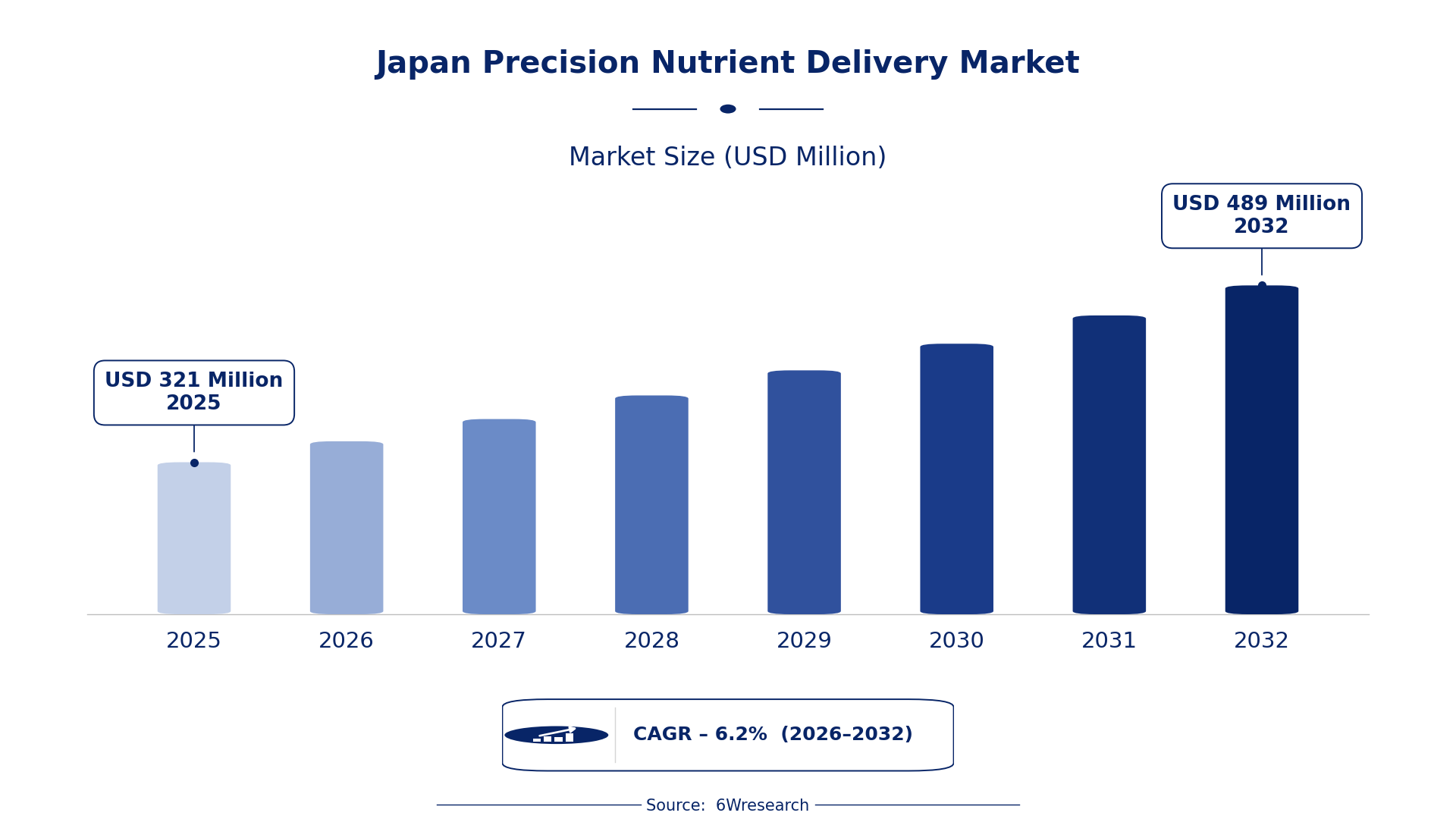
According to 6Wresearch internal database and industry insights, the Japan Precision Nutrient Delivery Market was valued at USD 321 Million in 2025 and is projected to reach USD 489 Million by 2032, growing at a CAGR of approximately 6.2% during 2026–2032.
Japan Precision Nutrient Delivery Market Highlights
| Report Metric | Details |
| Report Name | Japan Precision Nutrient Delivery Market (2026-2032) |
| Market Size 2025 | USD 321 Million |
| Market Size 2032 | USD 489 Million |
| Absolute Growth 2025–2032 | USD 168 Million |
| CAGR 2026–2032 | 6.2% |
| Peak Annual Growth | 6.8% in 2031 |
| Forecast Period | 2026–2032 |
| Historical Data | 2022–2025 |
| Base Year | 2025 |
| Leading Delivery System Type, 2025 | Soil-Based Systems (45% share) |
| Leading Method Used, 2025 | Drip Irrigation (40% share) |
| Leading Distribution Channel, 2025 | Direct Sales (41% share) |
| Leading End User, 2025 | Agrochemical Companies (51% share) |
| Fastest-Growing Delivery System Type | Sensor-Driven Dispensers (8.9% CAGR) |
| Fastest-Growing Method Used | IoT Enabled (9.1% CAGR) |
| Fastest-Growing Distribution Channel | Online Platforms (8.1% CAGR) |
| Fastest-Growing End User | Smart Farming Units (8.0% CAGR) |
| Growing Sector | Agricultural Technology |
| Key End Users | Agrochemical Companies, Fertilizer Producers, Smart Farming Units |
Japan Precision Nutrient Delivery Market Year-wise Growth Rate and Key Drivers (2022–2032)
This graph illustrates the annual growth rates of the market from 2022 to 2032, highlighting a steady upward trajectory and projected market expansion over the forecast period.
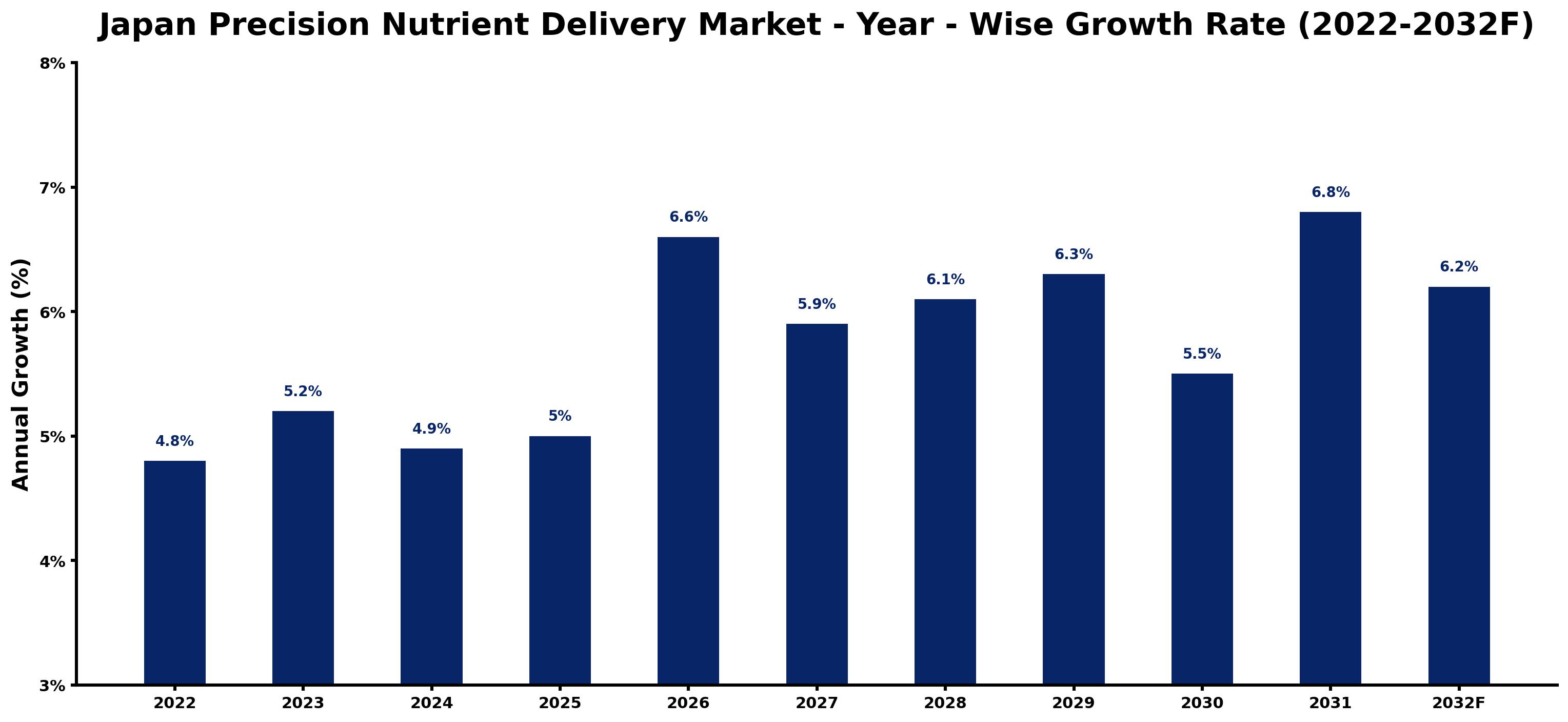
The table below sets out the estimated growth rate for each year and the main factor behind it.
| Year | Estimated Annual Growth (%) | Market Rationale |
| 2022 | 4.8 | The market showed steady growth due to increasing adoption of precision agriculture technologies. |
| 2023 | 5.2 | Growth accelerated as farmers sought to improve yields amid rising operational costs. |
| 2024 | 4.9 | The market experienced a slowdown as farmers adjusted to new technologies and practices. |
| 2025 | 5.0 | Demand increased as farmers focused on sustainable practices and efficient nutrient use. |
| 2026 | 6.6 | Growth surged with advancements in sensor-driven technologies and data analytics. |
| 2027 | 5.9 | The market saw a slowdown due to challenges in integrating new technologies. |
| 2028 | 6.1 | Demand rose again as more farmers adopted IoT-enabled nutrient delivery systems. |
| 2029 | 6.3 | Growth continued as farmers recognised the benefits of precision nutrient management. |
| 2030 | 5.5 | The market slowed slightly as farmers evaluated technology investments and returns. |
| 2031 | 6.8 | Demand peaked with the introduction of advanced nutrient delivery solutions. |
| 2032 | 6.2 | Growth moderated as the market stabilised with established technologies. |
Note: Market size estimations and growth projections presented in this report are based on 6Wresearch's proprietary forecasting methodology, utilizing the latest available industry data, government publications, and primary research inputs.
Japan Precision Nutrient Delivery Market Synopsis
Precision Nutrient Delivery involves advanced agricultural technologies that optimise nutrient application to crops, improving yield and efficiency. The Japan Precision Nutrient Delivery Market is expanding due to rising demand from domestic farmers and agrochemical companies focusing on sustainable practices. With precision agriculture adoption currently at 25%, a government initiative aims to increase this by 30% by 2023, driving further growth in the sector. The average yield increase from these technologies is estimated at 15%, prompting further investment in this area.
Market Dynamics Impact Analysis (2026–2032)
| Factor | Type | Impact | Primary Segment Affected |
| Growing adoption of precision agriculture technologies | Driver | High | Sensor-Driven Dispensers |
| Increased focus on sustainable farming practices | Driver | High | Drip Irrigation |
| Rising demand for efficient nutrient management solutions | Opportunity | High | Foliar Spray Systems |
| Expansion of smart farming units in agriculture | Opportunity | Medium | Smart Farming Units |
| High average age of farmers leading to slow adoption | Restraint | High | Soil-Based Systems |
| Limited access to funding for small-scale farmers | Restraint | Medium | Soil-Based Systems |
| High initial investment costs for precision technologies | Challenge | High | Soil-Based Systems |
| Challenges in integrating new technologies with traditional practices | Challenge | Medium | Soil-Based Systems |
Evaluation of Drivers in Japan Precision Nutrient Delivery Market (2026–2032)
The factors lifting demand, and the evidence behind each, are summarised below.
| Drivers | Primary Segment Affected | Why It Matters (Evidence) |
| Increased crop yields through precision nutrient application | Sensor-Driven Dispensers | The average yield increase from precision nutrient delivery is estimated at 15%, prompting farmers to adopt these technologies. |
| Focus on reducing waste in nutrient application | Drip Irrigation | Drip irrigation systems cover approximately 100,000 hectares, helping farmers efficiently manage resources. |
| Government initiatives promoting smart farming technologies | Foliar Spray Systems | Support for smart farming encourages farmers to invest in precision solutions, leading to increased adoption rates. |
| Rising agricultural exports driving efficiency needs | Agrochemical Companies | Japan's agricultural exports reached 1 trillion yen in 2022, highlighting the need for improved agricultural efficiency. |
| Technological advancements in sensor-driven systems | IoT Enabled | Sensor-driven technologies are implemented in over 10% of farms, improving real-time nutrient management. |
Orders keep climbing as farmers increasingly adopt precision nutrient delivery systems to improve crop yields. In Japan, the average yield increase from these technologies is estimated at 15%, encouraging farmers to invest in sensor-driven dispensers. Agricultural exports reached 1 trillion yen in 2022, pushing agrochemical companies to seek more efficient nutrient application methods. With sensor-driven technologies implemented in over 10% of farms, demand for IoT-enabled solutions is projected to grow.
Evaluation of Restraints in Japan Precision Nutrient Delivery Market
Below are the constraints most often cited by buyers and suppliers, with the segment each affects.
| Market Restraint | Primary Segment Affected | Why It Matters (Evidence) |
| High initial investment costs for precision technologies | Soil-Based Systems | The average age of farmers in Japan is 67 years, making them hesitant to invest in costly technologies. |
| Limited access to funding for small-scale farmers | Soil-Based Systems | Small-scale farmers struggle to secure financing for modern agricultural technologies, hindering adoption. |
| Slow adoption rates due to traditional farming practices | Soil-Based Systems | Soil-based systems are widely used in traditional farming, limiting the shift to advanced nutrient delivery methods. |
| Challenges in integrating new technologies with existing systems | Drip Irrigation | Farmers face difficulties adapting new precision technologies alongside established irrigation practices. |
| Regulatory hurdles for new agricultural technologies | Soil-Based Systems | Compliance with standards such as ISO 9001 can delay the introduction of new nutrient delivery solutions. |
Japan Precision Nutrient Delivery Market Challenges
Precision agriculture faces intense competition among farmers, as only 25% have adopted these technologies, leaving many at a disadvantage in productivity. High costs hinder adoption; for instance, the average budget for agricultural technology development is around 50 billion yen, which can strain smaller farms. Technological barriers exist since sensor-driven technologies are implemented in only over 10% of farms, delaying efficiency gains for producers. Supply chain issues arise from reliance on outdated practices, impacting the ability of farmers to meet the government's target of 50% smart technology adoption by 2030, ultimately reducing their competitiveness in the market.
Trends in the Japan Precision Nutrient Delivery Market
The following changes are redrawing the Japan Precision Nutrient Delivery Market.
- Shift towards IoT-Enabled Solutions: In 2023, Japan saw a 30% increase in precision farming technology adoption, driven by IoT-enabled solutions. This shift is improving real-time nutrient management, particularly in the Tohoku region.
- Transition from Traditional to Precision Agriculture: The adoption of precision agriculture technologies began in 2022, with farmers increasingly recognising the benefits of reduced waste and improved yields. This transition is particularly evident in the Kanto region, known for rice production.
- Emergence of Smart Farming Units: Smart farming units are rapidly growing, with an estimated CAGR of 8.0% from 2026 to 2032. This trend is driven by agrochemical companies seeking efficient nutrient delivery solutions.
- Prioritisation of Sustainable Practices: In 2023, the Japanese government launched initiatives to promote sustainable agricultural practices, aiming for a 20% increase in productivity by 2025. This focus is reshaping the nutrient delivery market.
Investment Opportunities in the Japan Precision Nutrient Delivery Market
Investors looking at the Japan Precision Nutrient Delivery Market should consider the following areas.
- Gap in Precision Agriculture Adoption: With only 25% of farmers adopting precision agriculture, there is a substantial opportunity for growth. Agrochemical companies are seeking effective solutions to improve efficiency and yield.
- Growing Demand from Agrochemical Companies: Agrochemical companies are increasingly looking for efficient nutrient delivery systems, especially in regions like Tohoku. Investing in precision nutrient technologies can effectively meet this demand.
- Timing for Investment in Smart Technologies: The Japanese government aims for 50% of farms to adopt smart technologies by 2030, creating a timely opportunity for investment in precision nutrient delivery solutions.
- Entry through Local Partnerships: Forming joint ventures with local agricultural cooperatives can facilitate entry into the Japanese market, especially for precision nutrient delivery systems.
Government Initiatives in the Japan Precision Nutrient Delivery Market
The Economic Security Promotion Act of 2022 supports supply-chain resilience for critical agricultural products, ensuring that producers can access necessary materials for precision nutrient delivery. This measure is vital for maintaining consistent production levels and improving agricultural efficiency in Japan. The act also aims to foster collaboration among stakeholders in the agricultural sector, promoting innovation and sustainability.
The Japan Agricultural Cooperatives (JA) approves funding for smart farming initiatives, with an annual budget of around 50 billion yen. This funding supports the development and adoption of precision nutrient delivery technologies, benefiting farmers and improving productivity. The JA also plays a significant role in promoting best practices and providing resources to farmers, ensuring effective implementation of these technologies.
Future Insight of the Japan Precision Nutrient Delivery Market
Sensor-driven technologies will transform demand by 2032, as the government aims for a 30% increase in precision farming technology. Improved data analytics will enable farmers to optimise nutrient delivery, increasing overall efficiency. The push for sustainable practices, supported by the Ministry of Environment, will stimulate innovation in farming methods. With agricultural productivity targeted to increase by 20% by 2025, both buyers and suppliers will experience heightened efficiency and productivity in the sector.
Market Segmentation Analysis
Japan Precision Nutrient Delivery Market report covers a detailed analysis of the following market segments:
By Delivery System Type – Soil-Based Systems Lead, Sensor-Driven Dispensers Expected to Grow Fastest
According to Navya, Research Analyst at 6Wresearch, Soil-Based Systems took 45% of delivery system type revenue in 2025, more than any other category. Soil-Based Systems hold the largest share as they align closely with traditional farming practices prevalent among Japan's agricultural population of approximately 1.5 million. This method is particularly effective in regions like Tohoku, where conventional farming remains dominant. Sensor-Driven Dispensers are projected to grow fastest, at a CAGR of 8.9% during 2026–2032. Sensor-Driven Dispensers are rapidly growing as farmers adopt real-time nutrient management technologies, supported by government initiatives promoting modernisation. The recent programme launched in 2023 aims to boost precision farming technology by 30%, further accelerating this segment's growth. Suppliers should prioritise the development of sensor-driven technologies to meet the increasing demand for precision nutrient delivery.
By Method Used – Drip Irrigation Leads, IoT Enabled Expected to Grow Fastest
The largest method used category in 2025 was Drip Irrigation, at 40% of revenue. Drip Irrigation is the leading method due to its effectiveness in delivering water and nutrients directly to crops, covering around 100,000 hectares in Japan. This method is particularly favoured by farmers aiming to improve yield and resource efficiency in their operations. Over 2026–2032, IoT Enabled is expected to post the fastest growth, at a CAGR of 9.1%. IoT Enabled systems are rapidly gaining popularity as they facilitate the integration of technology in farming, allowing for more precise nutrient application. The government's initiative to have 50% of farms adopt smart technologies by 2030 is a strong indicator of this segment's growth potential. Suppliers should focus on developing and promoting IoT Enabled solutions to meet the evolving needs of modern farmers.
By Distribution Channel – Direct Sales Leads, Online Platforms Expected to Grow Fastest
Direct Sales held 41% of the Japan Precision Nutrient Delivery Market by distribution channel in 2025. Direct Sales is the dominant distribution channel, providing a direct link between suppliers and farmers, which is essential for addressing specific agricultural needs. This method fosters trust and relationship-building, crucial in the agricultural sector where personal interactions matter. The quickest growth will come from Online Platforms, forecast to expand at a CAGR of 8.1% between 2026 and 2032. Online Platforms are emerging as the fastest-growing distribution channel, reflecting a shift towards digital purchasing methods among farmers. The increasing adoption of technology in agriculture is driving this change, as farmers seek more efficient ways to acquire products. Suppliers need to enhance their online presence to effectively reach and engage with the growing number of tech-savvy farmers.
By End User – Agrochemical Companies Lead, Smart Farming Units Expected to Grow Fastest
With 51% of end user revenue in 2025, Agrochemical Companies was the largest category. Agrochemical Companies represent the largest end user segment, utilising precision nutrient delivery systems to optimise their product application processes. Their significant role in the market is underscored by Japan's agricultural exports reaching 1 trillion yen in 2022, highlighting the need for effective nutrient management. Smart Farming Units are set to record the highest CAGR in this split, 8.0% over 2026–2032. Smart Farming Units are the fastest-growing end user segment, focusing on the integration of advanced technologies to improve agricultural practices. This aligns with governmental objectives for a 20% increase in agricultural productivity by 2025, driving demand for innovative solutions. Suppliers should prioritise Smart Farming Units to align with the future direction of the agricultural sector.
Key Attractiveness of the Report
- 10 Years of Market Numbers
- Historical Data Starting from 2022 to 2025
- Base Year 2025
- Forecast Data until 2032
- Key Performance Indicators Impacting the Market
- Major Upcoming Developments and Projects
Key Highlights of the Report:
- Japan Precision Nutrient Delivery Market Outlook
- Market Size of Japan Precision Nutrient Delivery Market, 2025
- Forecast of Japan Precision Nutrient Delivery Market, 2032
- Historical Data and Forecast of Japan Precision Nutrient Delivery Revenues & Volume for the Period 2022-2032F
- Japan Precision Nutrient Delivery Market Trend Evolution
- Japan Precision Nutrient Delivery Market Drivers and Challenges
- Japan Precision Nutrient Delivery Price Trends
- Japan Precision Nutrient Delivery Porter's Five Forces
- Japan Precision Nutrient Delivery Industry Life Cycle
- Historical Data and Forecast of Japan Precision Nutrient Delivery Market Revenues & Volume By Delivery System Type for the Period 2022-2032F
- Historical Data and Forecast of Japan Precision Nutrient Delivery Market Revenues & Volume By Soil-Based Systems for the Period 2022-2032F
- Historical Data and Forecast of Japan Precision Nutrient Delivery Market Revenues & Volume By Foliar Spray Systems for the Period 2022-2032F
- Historical Data and Forecast of Japan Precision Nutrient Delivery Market Revenues & Volume By Sensor-Driven Dispensers for the Period 2022-2032F
- Historical Data and Forecast of Japan Precision Nutrient Delivery Market Revenues & Volume By Variable Rate Systems for the Period 2022-2032F
- Historical Data and Forecast of Japan Precision Nutrient Delivery Market Revenues & Volume By Method Used for the Period 2022-2032F
- Historical Data and Forecast of Japan Precision Nutrient Delivery Market Revenues & Volume By Drip Irrigation for the Period 2022-2032F
- Historical Data and Forecast of Japan Precision Nutrient Delivery Market Revenues & Volume By Aerial Application for the Period 2022-2032F
- Historical Data and Forecast of Japan Precision Nutrient Delivery Market Revenues & Volume By IoT Enabled for the Period 2022-2032F
- Historical Data and Forecast of Japan Precision Nutrient Delivery Market Revenues & Volume By Satellite-Guided for the Period 2022-2032F
- Historical Data and Forecast of Japan Precision Nutrient Delivery Market Revenues & Volume By Distribution Channel for the Period 2022-2032F
- Historical Data and Forecast of Japan Precision Nutrient Delivery Market Revenues & Volume By Direct Sales for the Period 2022-2032F
- Historical Data and Forecast of Japan Precision Nutrient Delivery Market Revenues & Volume By Agricultural Dealers for the Period 2022-2032F
- Historical Data and Forecast of Japan Precision Nutrient Delivery Market Revenues & Volume By Online Platforms for the Period 2022-2032F
- Historical Data and Forecast of Japan Precision Nutrient Delivery Market Revenues & Volume By Specialty Agri Stores for the Period 2022-2032F
- Historical Data and Forecast of Japan Precision Nutrient Delivery Market Revenues & Volume By End User for the Period 2022-2032F
- Historical Data and Forecast of Japan Precision Nutrient Delivery Market Revenues & Volume By Smart Farming Units for the Period 2022-2032F
- Historical Data and Forecast of Japan Precision Nutrient Delivery Market Revenues & Volume By Agrochemical Companies for the Period 2022-2032F
- Historical Data and Forecast of Japan Precision Nutrient Delivery Market Revenues & Volume By Fertilizer Producers for the Period 2022-2032F
- Historical Data and Forecast of Japan Precision Nutrient Delivery Market Revenues & Volume By Crop Consultants for the Period 2022-2032F
- Japan Precision Nutrient Delivery Import Export Trade Statistics
- Market Opportunity Assessment By Delivery System Type
- Market Opportunity Assessment By Method Used
- Market Opportunity Assessment By Distribution Channel
- Market Opportunity Assessment By End User
- Japan Precision Nutrient Delivery Top Companies Market Share
- Japan Precision Nutrient Delivery Competitive Benchmarking By Technical and Operational Parameters
- Japan Precision Nutrient Delivery Company Profiles
- Japan Precision Nutrient Delivery Key Strategic Recommendations
Market Covered
The following segment groups are covered in the report.
By Delivery System Type
- Soil-Based Systems
- Foliar Spray Systems
- Sensor-Driven Dispensers
- Variable Rate Systems
By Method Used
- Drip Irrigation
- Aerial Application
- IoT Enabled
- Satellite-Guided
By Distribution Channel
- Direct Sales
- Agricultural Dealers
- Online Platforms
- Specialty Agri Stores
By End User
- Smart Farming Units
- Agrochemical Companies
- Fertilizer Producers
- Crop Consultants






































