Japan Precision Poultry Management Market Size & Growth Rate
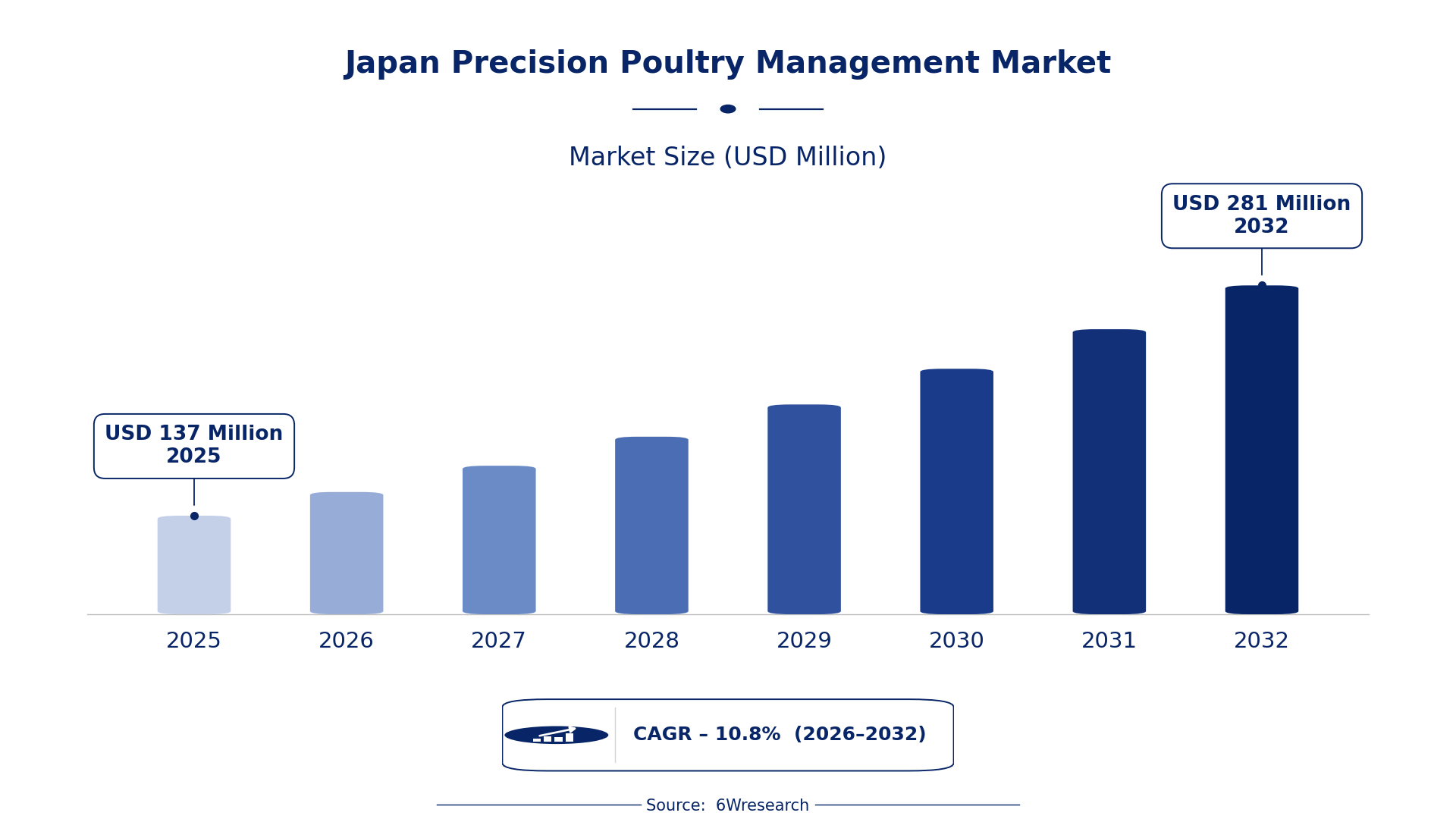
According to 6Wresearch internal database and industry insights, the Japan Precision Poultry Management Market was valued at USD 137 Million in 2025 and is projected to reach USD 281 Million by 2032, growing at a CAGR of approximately 10.8% during 2026–2032.
Japan Precision Poultry Management Market Highlights
| Report Metric | Details |
| Report Name | Japan Precision Poultry Management Market (2026-2032) |
| Market Size 2025 | USD 137 Million |
| Market Size 2032 | USD 281 Million |
| Absolute Growth 2025–2032 | USD 144 Million |
| CAGR 2026–2032 | 10.8% |
| Peak Annual Growth | 13.5% in 2032 |
| Forecast Period | 2026–2032 |
| Historical Data | 2022–2025 |
| Base Year | 2025 |
| Leading Technology Type, 2025 | Smart Feeding Systems (36% share) |
| Leading Application Area, 2025 | AI + IoT (39% share) |
| Leading Distribution Channel, 2025 | Direct Sales (42% share) |
| Leading End User, 2025 | Poultry Farms (38% share) |
| Fastest-Growing Technology Type | Automated Egg Collectors (16.0% CAGR) |
| Fastest-Growing Application Area | Robotic Systems (14.4% CAGR) |
| Fastest-Growing Distribution Channel | Online Platforms (14.5% CAGR) |
| Fastest-Growing End User | Hatcheries (14.1% CAGR) |
| Growing Sector | Poultry Farming |
| Key End Users | Poultry Farms, Hatcheries, Agricultural Equipment Suppliers |
Japan Precision Poultry Management Market Year-wise Growth Rate and Key Drivers (2022–2032)
This graph illustrates the annual growth rates of the market from 2022 to 2032, highlighting a steady upward trajectory and projected market expansion over the forecast period.
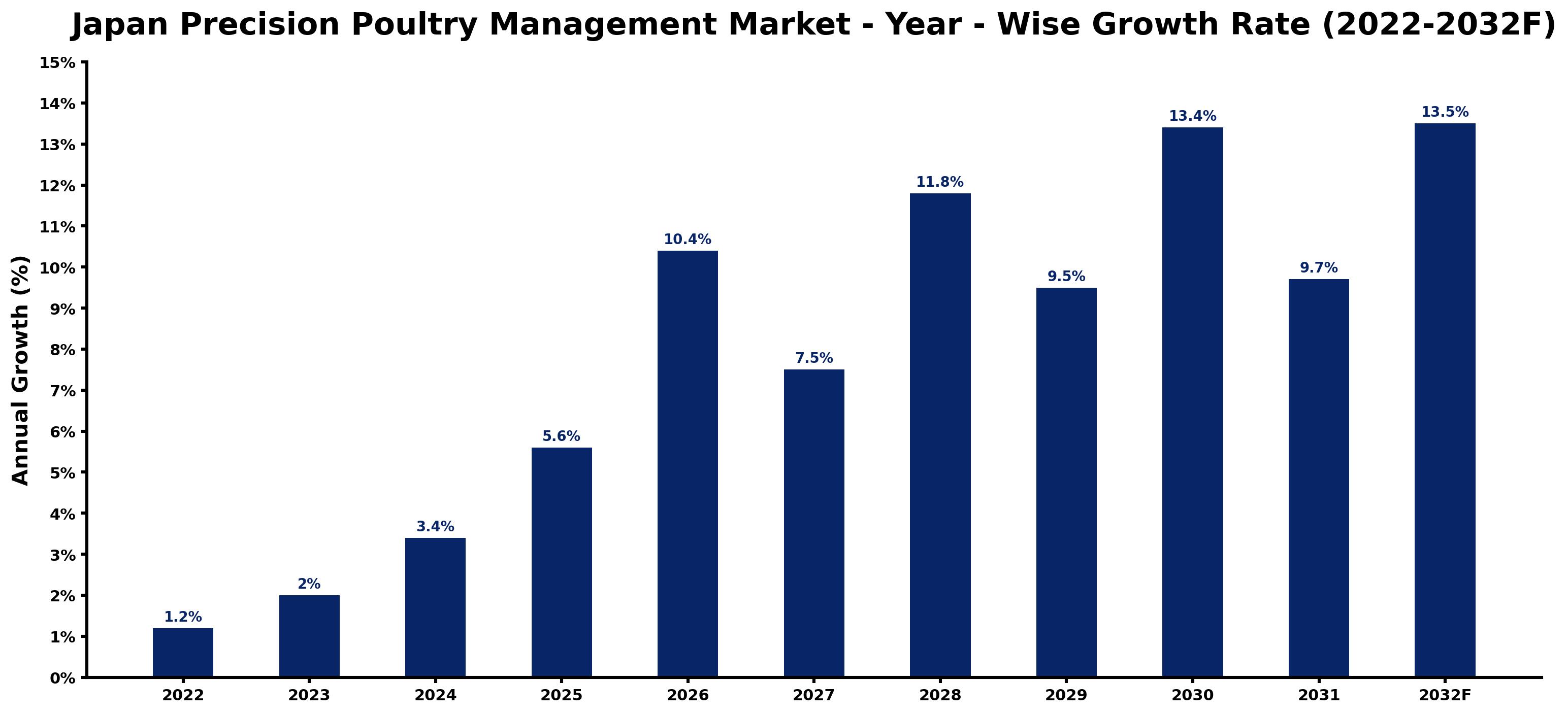
Annual growth estimates for each year appear below with the principal reason behind them, explaining the shifts that set the pace of the market.
| Year | Estimated Annual Growth (%) | Market Rationale |
| 2022 | 1.2 | The market showed steady activity with established poultry farms operating efficiently. |
| 2023 | 2.0 | Growth accelerated as poultry farms began adopting more advanced technologies. |
| 2024 | 3.4 | Increased investments in automation led to improved operational efficiencies. |
| 2025 | 5.6 | The market peaked as demand for precision management technologies surged. |
| 2026 | 10.4 | Growth accelerated significantly due to rising demand for smart feeding systems. |
| 2027 | 7.5 | Growth slowed slightly as the market adjusted to increased technology adoption. |
| 2028 | 11.8 | Demand rose again as climate monitoring units became more widely implemented. |
| 2029 | 9.5 | Growth decelerated as the market reached a maturity phase in technology usage. |
| 2030 | 13.4 | A new surge in demand emerged from the introduction of robotic systems. |
| 2031 | 9.7 | Growth slowed as the market stabilised after rapid technological advancements. |
| 2032 | 13.5 | Demand peaked with a strong focus on enhancing overall poultry production efficiency. |
Note: Market size estimations and growth projections presented in this report are based on 6Wresearch's proprietary forecasting methodology, utilizing the latest available industry data, government publications, and primary research inputs.
Japan Precision Poultry Management Market Synopsis
Precision Poultry Management involves advanced technologies for optimising poultry farming operations, including smart feeding, climate control, and health monitoring systems. The Japan Precision Poultry Management Market is expanding due to strong demand from over 1,300 poultry farms and hatcheries. Investment in automation, such as a ¥2 billion programme launched in 2023, further propels this growth, along with the rising adoption of AI and IoT technologies that improve operational efficiency and productivity in the sector.
Market Dynamics Impact Analysis (2026–2032)
| Factor | Type | Impact | Primary Segment Affected |
| Rising adoption of smart feeding systems among poultry farms | Driver | High | Smart Feeding Systems |
| Increased demand for climate monitoring units to ensure optimal conditions | Driver | High | Climate Monitoring Units |
| Growing need for automation in poultry farms to improve efficiency | Opportunity | High | Automated Egg Collectors |
| Expansion of online sales channels for agricultural equipment | Opportunity | Medium | Online Platforms |
| High average age of poultry farmers necessitating modernization | Restraint | High | Poultry Farms |
| Limited adoption of robotic systems due to high initial costs | Restraint | Medium | Robotic Systems |
| Rising operational costs affecting profitability for farmers | Challenge | High | Poultry Farms |
| Compliance with JIS standards increasing operational complexity | Challenge | Medium | Poultry Farms |
Evaluation of Drivers in Japan Precision Poultry Management Market (2026–2032)
The following drivers explain most of the expected growth.
| Drivers | Primary Segment Affected | Why It Matters (Evidence) |
| Increased feed efficiency from smart feeding systems | Smart Feeding Systems | Smart feeding systems can reduce feed costs by up to 10%, encouraging farms to invest. |
| Need for optimal living conditions from climate monitoring units | Climate Monitoring Units | Climate monitoring units are used in 70% of large poultry farms, ensuring better productivity. |
| Health monitoring tags for disease prevention | Health Monitoring Tags | Adoption of health monitoring tags in hatcheries has reached 30%, improving bird health management. |
| Efficiency improvements from automated egg collectors | Automated Egg Collectors | Automated egg collectors improve egg collection efficiency, driving demand from layer farms. |
| Integration of AI and IoT for operational automation | AI + IoT | AI and IoT technologies are integral for data analysis, improving decision-making in poultry management. |
What keeps demand rising is the increasing adoption of smart feeding systems, which can reduce feed costs by up to 10%. Climate monitoring units are now used in 70% of large poultry farms, ensuring optimal living conditions for the birds. Health monitoring tags are becoming essential, with a 30% adoption rate in hatcheries, allowing for better health tracking. Automated egg collectors improve efficiency, driving demand from layer farms. The integration of AI and IoT technologies is also vital, improving operational automation and data analysis in poultry management.
Evaluation of Restraints in Japan Precision Poultry Management Market
The table below lists the restraints and the evidence behind each.
| Market Restraint | Primary Segment Affected | Why It Matters (Evidence) |
| High average age of poultry farmers leading to resistance to change | Poultry Farms | The average age of poultry farmers in Japan is 58 years, which hinders modernization efforts. |
| Limited adoption of robotic systems due to cost concerns | Robotic Systems | Robotic systems for egg collection are being piloted in only 10 farms, indicating slow uptake. |
| Rising operational costs affecting profitability | Poultry Farms | Increasing costs of feed and maintenance are squeezing margins for poultry farmers. |
| Compliance with JIS standards increasing operational complexity | Poultry Farms | JIS standards require rigorous testing and certification, complicating operations for producers. |
| Slow integration of technology in smaller farms | Poultry Farms | Smaller farms struggle to invest in advanced technologies, limiting overall market growth. |
Japan Precision Poultry Management Market Challenges
Many poultry farmers face a skills gap, as the average age of farmers is 58 years, hindering the adoption of modern technologies that could boost productivity. Suppliers encounter fierce competition among over 1,300 poultry farms, compelling them to lower prices, which can affect the quality of equipment and services for buyers. Supply chain disruptions arise from reliance on specific technologies, causing delays in automation projects that impact operational efficiency for farmers. Buyers deal with rising costs, as feed expenses can increase by 10% without smart feeding systems, squeezing their profit margins.
Trends in the Japan Precision Poultry Management Market
Several trends are reshaping the Japan Precision Poultry Management Market; the most important are set out below.
- Launch of Automation Programme: In 2023, Japan initiated a ¥2 billion programme to support poultry farm automation, targeting improved efficiency. This investment is expected to accelerate the adoption of advanced technologies across the sector.
- Poultry Farms Prioritising Climate Monitoring: Poultry farms are increasingly prioritising climate monitoring units, with 70% of large farms adopting these technologies to maintain optimal living conditions for birds, boosting productivity.
- Shift Towards AI and IoT Integration: The integration of AI and IoT technologies is becoming standard in poultry management, with 39% of application areas dominated by these technologies, driving operational efficiency.
- Robotic Systems Gaining Traction: Since 2022, robotic systems have started to gain traction in poultry management, with pilots in 10 farms in Hokkaido, indicating a shift towards automation in egg collection.
Investment Opportunities in the Japan Precision Poultry Management Market
The openings below show where demand in the Japan Precision Poultry Management Market is visible and how suppliers can enter.
- Partner with Agricultural Equipment Suppliers: Now is a prime time to collaborate with agricultural equipment suppliers to improve distribution channels. With online sales expected to grow by 15% by 2025, this partnership can tap into new market segments.
- Invest in Automation Technologies: With the Japanese government aiming to increase poultry production efficiency by 20% by 2025, investing in automation technologies is timely. Poultry farms are eager to modernise operations.
- Focus on the Tokyo Region: The Tokyo region is a key area for poultry farming technology adoption, making it an ideal location for suppliers to introduce new products and services.
- Engage with Hatcheries for Technology Integration: Hatcheries are critical users of precision management technologies. Engaging with them can facilitate the adoption of advanced solutions, especially as their growth rate is projected at 14.1%.
Government Initiatives in the Japan Precision Poultry Management Market
The Economic Security Promotion Act (2022) directly impacts poultry farmers by enhancing supply-chain resilience for critical agricultural products. This measure encourages producers to invest in modern technologies, ensuring they meet the growing demand for efficiency in poultry management. Additionally, the Ministry of Agriculture, Forestry and Fisheries supports precision agriculture initiatives, which include funding and resources for adopting advanced systems in poultry farms, contributing to improved productivity and sustainability.
In 2023, Japan launched a program with a budget of ¥2 billion to enhance automation in poultry farms, administered by the Ministry of Agriculture, Forestry and Fisheries. This funding aims to support the integration of smart technologies, benefiting both producers and buyers by increasing efficiency and reducing operational costs. The program is expected to facilitate the adoption of innovative solutions, further driving growth in the precision poultry management sector.
Future Insight of the Japan Precision Poultry Management Market
By 2032, poultry farms will increasingly adopt advanced technologies, driven by government initiatives aimed at improving production efficiency by 20%. A budget of ¥2 billion for automation programs will support the integration of modern systems, benefiting both buyers and suppliers. Adoption of health monitoring tags in hatcheries is projected to reach 50%, improving flock management. The Tokyo region will become a hub for technological advancements in poultry management, leading to a more efficient industry.
Market Segmentation Analysis
Japan Precision Poultry Management Market report covers a detailed analysis of the following market segments:
By Technology Type – Smart Feeding Systems Lead, Automated Egg Collectors Expected to Grow Fastest
According to Navya, Research Analyst at 6Wresearch, the largest technology type category in 2025 was Smart Feeding Systems, at 36% of revenue. Smart feeding systems dominate the market as they are crucial for optimising feed efficiency and bird growth across Japan's poultry farms. Their ability to reduce feed costs by up to 10% makes them indispensable for farmers aiming to maximise profitability. Automated Egg Collectors are set to record the highest CAGR in this split, 16.0% over 2026–2032. Automated egg collectors are experiencing rapid growth due to their effectiveness in enhancing egg collection efficiency, with pilot projects implemented in 10 farms in Hokkaido. This technology is set to expand further, supported by government initiatives to promote automation in poultry operations. Suppliers should prioritise the development of smart feeding and automated egg collection systems to align with the growing needs of poultry farms.
By Application Area – AI + IoT Leads, Robotic Systems Expected to Grow Fastest
AI + IoT took 39% of application area revenue in 2025, more than any other category. The integration of advanced technologies is prevalent as they are essential for data analysis and operational automation in poultry farming. Their widespread application in 70% of large poultry farms underscores their critical role in boosting overall productivity and efficiency. Robotic Systems are projected to grow fastest, at a CAGR of 14.4% during 2026–2032. Robotic systems are the fastest-growing segment, driven by their potential to revolutionise poultry management, although their current adoption remains limited. The increasing interest in automation, bolstered by government initiatives, is likely to accelerate their implementation on farms. Buyers should consider investing in advanced technologies to improve their operational efficiency and maintain competitiveness in the poultry sector.
By Distribution Channel – Direct Sales Leads, Online Platforms Expected to Grow Fastest
Direct Sales accounted for 42% of the market by distribution channel in 2025. Direct sales are the primary channel for precision management products, providing farmers with direct access to essential technologies tailored to their specific needs. This method allows for better communication and support between suppliers and poultry farms. Over 2026–2032, Online Platforms are expected to post the fastest growth, at a CAGR of 14.5%. Online platforms are rapidly gaining traction, with a projected 15% increase in online sales of agricultural equipment by 2025. This trend reflects a shift in purchasing behaviour among farmers who prefer the convenience of digital transactions. Suppliers must strengthen their online sales strategies to effectively reach the growing number of buyers who favour digital purchasing options.
By End User – Poultry Farms Lead, Hatcheries Expected to Grow Fastest
In 2025, Poultry Farms led the end user split with a 38% share. Poultry farms are the primary end users of precision management technologies, leveraging these solutions to improve farm efficiency and productivity. Their significant presence in the industry ensures a steady demand for advanced management systems. The quickest growth will come from Hatcheries, forecast to expand at a CAGR of 14.1% between 2026 and 2032. Hatcheries are the fastest-growing end user segment, increasingly adopting technologies to enhance egg hatching processes. This trend is driven by the rising need for efficiency and productivity in poultry production. Suppliers should tailor their products to meet the specific demands of hatcheries, which are becoming increasingly vital in the market.
Key Attractiveness of the Report
- 10 Years of Market Numbers
- Historical Data Starting from 2022 to 2025
- Base Year 2025
- Forecast Data until 2032
- Key Performance Indicators Impacting the Market
- Major Upcoming Developments and Projects
Key Highlights of the Report:
- Japan Precision Poultry Management Market Outlook
- Market Size of Japan Precision Poultry Management Market, 2025
- Forecast of Japan Precision Poultry Management Market, 2032
- Historical Data and Forecast of Japan Precision Poultry Management Revenues & Volume for the Period 2022-2032F
- Japan Precision Poultry Management Market Trend Evolution
- Japan Precision Poultry Management Market Drivers and Challenges
- Japan Precision Poultry Management Price Trends
- Japan Precision Poultry Management Porter's Five Forces
- Japan Precision Poultry Management Industry Life Cycle
- Historical Data and Forecast of Japan Precision Poultry Management Market Revenues & Volume By Technology Type for the Period 2022-2032F
- Historical Data and Forecast of Japan Precision Poultry Management Market Revenues & Volume By Smart Feeding Systems for the Period 2022-2032F
- Historical Data and Forecast of Japan Precision Poultry Management Market Revenues & Volume By Climate Monitoring Units for the Period 2022-2032F
- Historical Data and Forecast of Japan Precision Poultry Management Market Revenues & Volume By Health Monitoring Tags for the Period 2022-2032F
- Historical Data and Forecast of Japan Precision Poultry Management Market Revenues & Volume By Automated Egg Collectors for the Period 2022-2032F
- Historical Data and Forecast of Japan Precision Poultry Management Market Revenues & Volume By Application Area for the Period 2022-2032F
- Historical Data and Forecast of Japan Precision Poultry Management Market Revenues & Volume By AI + IoT for the Period 2022-2032F
- Historical Data and Forecast of Japan Precision Poultry Management Market Revenues & Volume By Sensor-Based for the Period 2022-2032F
- Historical Data and Forecast of Japan Precision Poultry Management Market Revenues & Volume By Wearable Sensors for the Period 2022-2032F
- Historical Data and Forecast of Japan Precision Poultry Management Market Revenues & Volume By Robotic Systems for the Period 2022-2032F
- Historical Data and Forecast of Japan Precision Poultry Management Market Revenues & Volume By Distribution Channel for the Period 2022-2032F
- Historical Data and Forecast of Japan Precision Poultry Management Market Revenues & Volume By Direct Sales for the Period 2022-2032F
- Historical Data and Forecast of Japan Precision Poultry Management Market Revenues & Volume By Agricultural Equipment Suppliers for the Period 2022-2032F
- Historical Data and Forecast of Japan Precision Poultry Management Market Revenues & Volume By Online Platforms for the Period 2022-2032F
- Historical Data and Forecast of Japan Precision Poultry Management Market Revenues & Volume By Specialty Agri Stores for the Period 2022-2032F
- Historical Data and Forecast of Japan Precision Poultry Management Market Revenues & Volume By End User for the Period 2022-2032F
- Historical Data and Forecast of Japan Precision Poultry Management Market Revenues & Volume By Poultry Farms for the Period 2022-2032F
- Historical Data and Forecast of Japan Precision Poultry Management Market Revenues & Volume By Hatcheries for the Period 2022-2032F
- Historical Data and Forecast of Japan Precision Poultry Management Market Revenues & Volume By Livestock Consultants for the Period 2022-2032F
- Historical Data and Forecast of Japan Precision Poultry Management Market Revenues & Volume By Layer Farm Operators for the Period 2022-2032F
- Japan Precision Poultry Management Import Export Trade Statistics
- Market Opportunity Assessment By Technology Type
- Market Opportunity Assessment By Application Area
- Market Opportunity Assessment By Distribution Channel
- Market Opportunity Assessment By End User
- Japan Precision Poultry Management Top Companies Market Share
- Japan Precision Poultry Management Competitive Benchmarking By Technical and Operational Parameters
- Japan Precision Poultry Management Company Profiles
- Japan Precision Poultry Management Key Strategic Recommendations
Market Covered
The following segment groups are covered in the report.
By Technology Type
- Smart Feeding Systems
- Climate Monitoring Units
- Health Monitoring Tags
- Automated Egg Collectors
By Application Area
- AI + IoT
- Sensor-Based
- Wearable Sensors
- Robotic Systems
By Distribution Channel
- Direct Sales
- Agricultural Equipment Suppliers
- Online Platforms
- Specialty Agri Stores
By End User
- Poultry Farms
- Hatcheries
- Livestock Consultants
- Layer Farm Operators






































