Japan Prefabricated Building Market Size Growth Rate
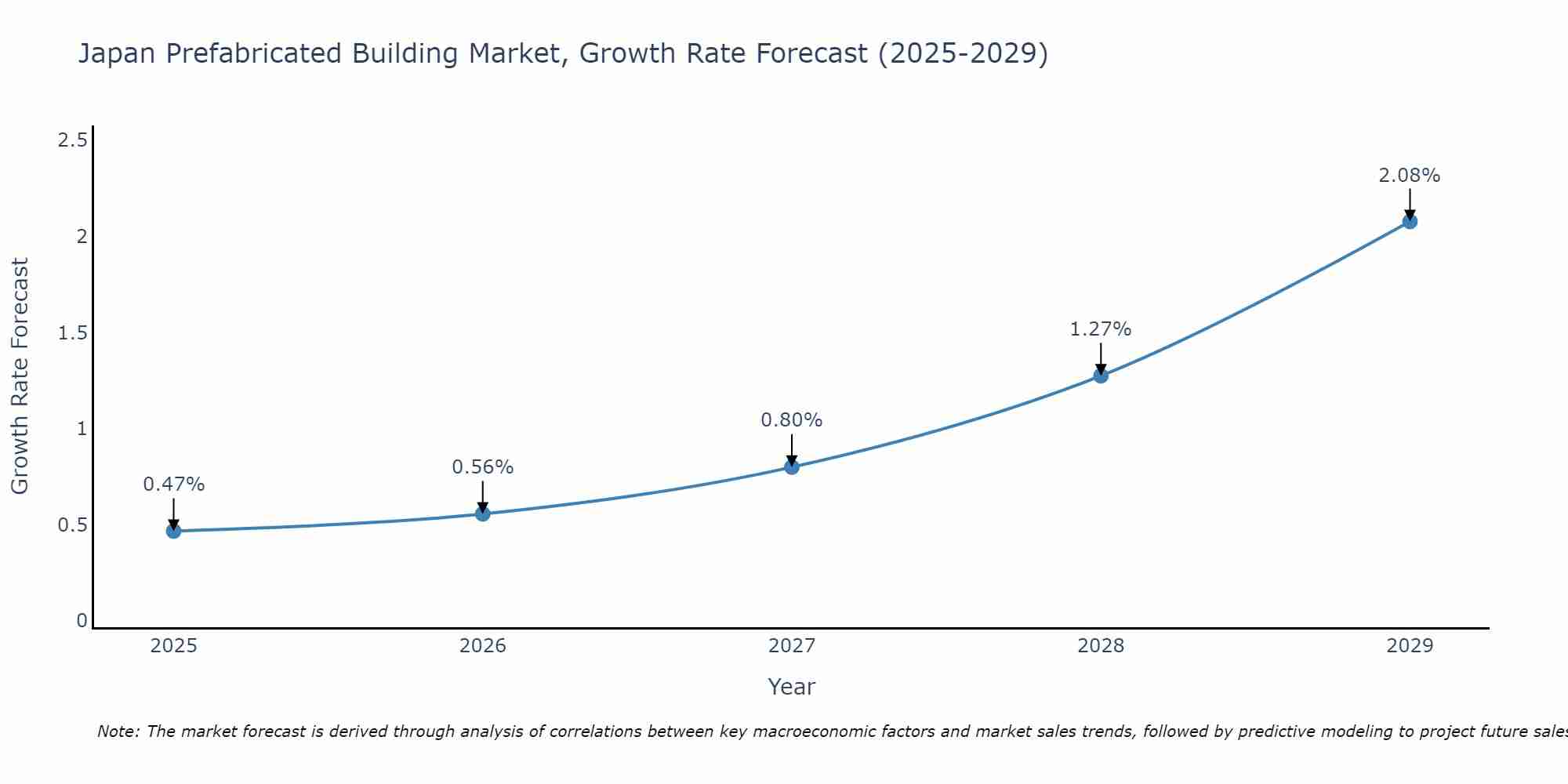
The Japan Prefabricated Building Market is likely to experience consistent growth rate gains over the period 2025 to 2029. From 0.47% in 2025, the growth rate steadily ascends to 2.08% in 2029.
Japan Prefabricated Building Market Overview
The Japan Prefabricated Building Market is experiencing steady growth due to factors such as rapid urbanization, a shortage of skilled labor, and the need for quick and cost-effective construction methods. Prefabricated buildings offer benefits such as reduced construction time, improved quality control, and sustainability. The market is driven by demand from various sectors including residential, commercial, and industrial. Government initiatives promoting energy-efficient and earthquake-resistant construction also contribute to the market`s expansion. Key players in the market include Daiwa House, Sekisui House, and Misawa Homes. The adoption of advanced technologies like Building Information Modeling (BIM) and off-site construction methods further propel the growth of the Japan Prefabricated Building Market.
Japan Prefabricated Building Market Trends
The Japan Prefabricated Building Market is experiencing significant growth due to various factors such as the increasing demand for sustainable and energy-efficient construction practices, rapid urbanization, and a shortage of skilled labor in the construction industry. Prefabricated buildings offer faster construction times, cost efficiency, and flexibility in design, making them an attractive option for developers and builders. Additionally, advancements in technology have led to the development of high-quality prefabricated building materials and components, further driving the market growth. The government`s initiatives to promote off-site construction methods and the implementation of stricter building regulations to enhance structural safety are also contributing to the positive momentum in the Japan Prefabricated Building Market.
Japan Prefabricated Building Market Challenges
In the Japan Prefabricated Building Market, some challenges faced include cultural preferences for traditional construction methods, strict building regulations that may hinder innovation and adoption of new technologies, and potential resistance from traditional construction companies. Additionally, the perception of prefabricated buildings as lower quality or less durable compared to traditional construction methods can be a barrier to widespread acceptance. The need for skilled labor and specialized training to work with prefabricated materials also presents a challenge, as well as concerns about transportation costs and logistics for delivering prefabricated components to construction sites. Overall, overcoming these challenges will require a combination of education, awareness building, collaboration between industry stakeholders, and continued innovation to drive the growth of the prefabricated building market in Japan.
Japan Prefabricated Building Market Investment Opportunities
The Japan Prefabricated Building Market presents attractive investment opportunities due to the increasing demand for sustainable and cost-effective construction solutions. With a rapidly aging population and a growing focus on disaster-resilient structures, there is a rising trend towards prefabricated buildings in Japan. Potential investment avenues include manufacturers of prefabricated building materials, construction companies specializing in modular construction, and technology providers offering innovative solutions for designing and constructing prefabricated buildings. Additionally, government initiatives promoting efficient and eco-friendly construction methods further support the market growth, making it a promising sector for investors looking to capitalize on the shifting trends in the Japanese construction industry.
Japan Prefabricated Building Market Government Policy
In Japan, the government has implemented various policies to promote the growth of the prefabricated building market. These policies include financial incentives such as subsidies and tax breaks for companies engaging in prefabricated construction, as well as regulations that encourage the use of prefabricated materials to improve construction efficiency and sustainability. The government has also introduced initiatives to standardize prefabricated building components and promote research and development in the sector. Additionally, there are efforts to streamline the approval process for prefabricated construction projects to accelerate the adoption of this innovative building method. Overall, the government`s policies aim to drive the adoption of prefabricated building technologies to address the country`s housing and infrastructure needs efficiently and sustainably.
Japan Prefabricated Building Market Future Outlook
The Japan Prefabricated Building Market is poised for significant growth in the coming years due to several factors. Increasing urbanization, a shortage of skilled labor in the construction industry, and the government`s focus on sustainable and disaster-resistant construction practices are driving the demand for prefabricated buildings in Japan. Additionally, the ongoing trend towards modular and off-site construction methods is expected to further boost the market. With advancements in technology and a growing emphasis on cost-efficiency and speed of construction, the Japan Prefabricated Building Market is likely to experience steady expansion. Companies in the market are also increasingly focusing on innovative designs and customization options to cater to diverse customer needs, indicating a promising future outlook for the industry.
Key Highlights of the Report:
- Japan Prefabricated Building Market Outlook
- Market Size of Japan Prefabricated Building Market, 2021
- Forecast of Japan Prefabricated Building Market, 2031
- Historical Data and Forecast of Japan Prefabricated Building Revenues & Volume for the Period 2018 - 2031
- Japan Prefabricated Building Market Trend Evolution
- Japan Prefabricated Building Market Drivers and Challenges
- Japan Prefabricated Building Price Trends
- Japan Prefabricated Building Porter's Five Forces
- Japan Prefabricated Building Industry Life Cycle
- Historical Data and Forecast of Japan Prefabricated Building Market Revenues & Volume By Dimensions for the Period 2018 - 2031
- Historical Data and Forecast of Japan Prefabricated Building Market Revenues & Volume By Skeleton System for the Period 2018 - 2031
- Historical Data and Forecast of Japan Prefabricated Building Market Revenues & Volume By Panel System for the Period 2018 - 2031
- Historical Data and Forecast of Japan Prefabricated Building Market Revenues & Volume By Cellular System for the Period 2018 - 2031
- Historical Data and Forecast of Japan Prefabricated Building Market Revenues & Volume By Combined System for the Period 2018 - 2031
- Historical Data and Forecast of Japan Prefabricated Building Market Revenues & Volume By Application for the Period 2018 - 2031
- Historical Data and Forecast of Japan Prefabricated Building Market Revenues & Volume By Residential for the Period 2018 - 2031
- Historical Data and Forecast of Japan Prefabricated Building Market Revenues & Volume By Non-Residential for the Period 2018 - 2031
- Japan Prefabricated Building Import Export Trade Statistics
- Market Opportunity Assessment By Dimensions
- Market Opportunity Assessment By Application
- Japan Prefabricated Building Top Companies Market Share
- Japan Prefabricated Building Competitive Benchmarking By Technical and Operational Parameters
- Japan Prefabricated Building Company Profiles
- Japan Prefabricated Building Key Strategic Recommendations






































