Japan Probe Card Market Size & Growth Rate
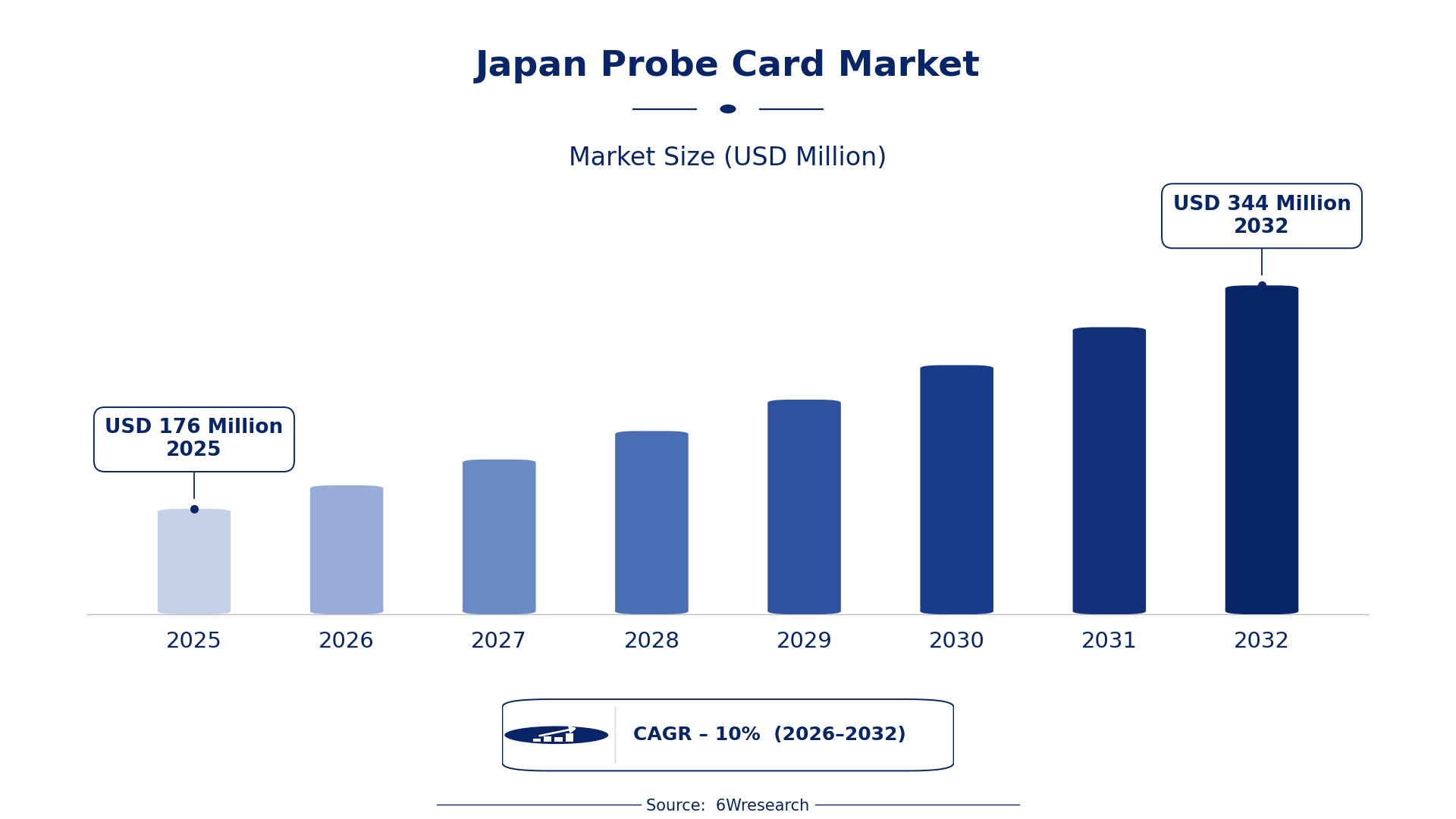
According to 6Wresearch internal database and industry insights, the Japan Probe Card Market was valued at USD 176 Million in 2025 and is projected to reach USD 344 Million by 2032, growing at a CAGR of approximately 10% during 2026–2032.
Japan Probe Card Market Highlights
| Report Metric | Details |
| Report Name | Japan Probe Card Market (2026-2032) |
| Market Size 2025 | USD 176 Million |
| Market Size 2032 | USD 344 Million |
| Absolute Growth 2025–2032 | USD 168 Million |
| CAGR 2026–2032 | 10% |
| Peak Annual Growth | 11.5% in 2029 |
| Forecast Period | 2026–2032 |
| Historical Data | 2022–2025 |
| Base Year | 2025 |
| Leading Probe Type, 2025 | Advanced Probe Card (66% share) |
| Leading Manufacturing Technology Type, 2025 | MEMS (30% share) |
| Leading Test, 2025 | DC Test (47% share) |
| Leading Material, 2025 | Tungsten (42% share) |
| Leading Application, 2025 | WLCSP (40% share) |
| Fastest-Growing Probe Type | Standard Probe Card (13.6% CAGR) |
| Fastest-Growing Manufacturing Technology Type | Vertical (13.9% CAGR) |
| Fastest-Growing Test | Functional Test (12.4% CAGR) |
| Fastest-Growing Material | Copper Clad Laminated (CCL) (13.4% CAGR) |
| Fastest-Growing Application | SIP (12.8% CAGR) |
| Growing Sector | Semiconductor Testing |
| Key End Users | Semiconductor manufacturers, electronics producers, research institutions |
Japan Probe Card Market Year-wise Growth Rate and Key Drivers (2022–2032)
This graph illustrates the annual growth rates of the market from 2022 to 2032, highlighting a steady upward trajectory and projected market expansion over the forecast period.
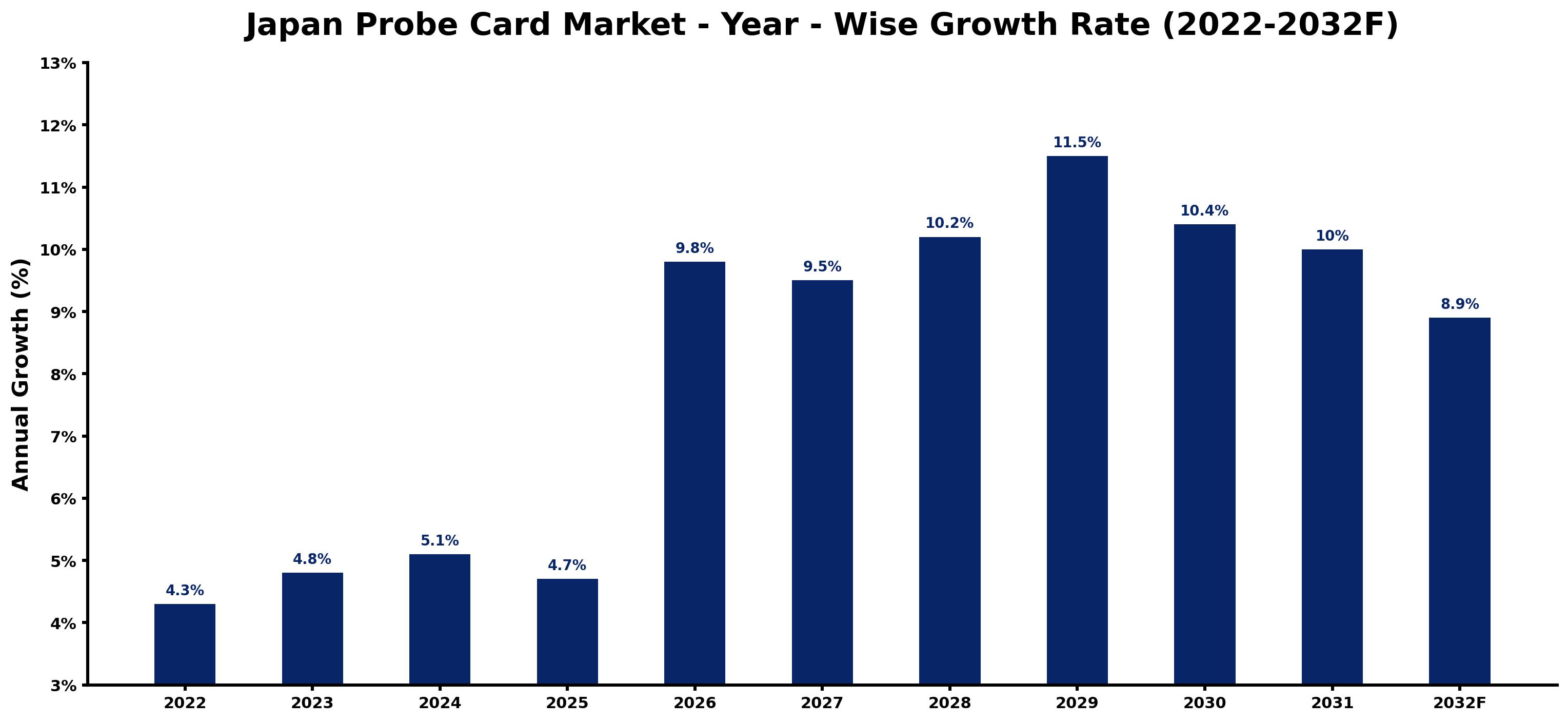
The following figures match every annual growth estimate with the main market development of that year, giving the reasoning behind each rise or slowdown.
| Year | Estimated Annual Growth (%) | Market Rationale |
| 2022 | 4.3 | The market showed steady growth as demand from domestic semiconductor manufacturers increased. |
| 2023 | 4.8 | Growth accelerated due to rising investments in semiconductor testing capabilities. |
| 2024 | 5.1 | The market continued to expand as production levels increased in key regions. |
| 2025 | 4.7 | Growth slowed slightly as manufacturers adjusted to market saturation. |
| 2026 | 9.8 | Demand surged with the adoption of advanced testing technologies among major players. |
| 2027 | 9.5 | Growth decelerated as competition intensified in the semiconductor testing sector. |
| 2028 | 10.2 | The market rebounded with renewed investments in semiconductor innovation. |
| 2029 | 11.5 | Demand peaked as advanced probe cards became essential for high-performance testing. |
| 2030 | 10.4 | Growth moderated as the market stabilised following rapid technological advancements. |
| 2031 | 10.0 | The market continued to grow, driven by ongoing investments in semiconductor production. |
| 2032 | 8.9 | Growth slowed as the market matured, but demand from key sectors remained strong. |
Note: Market size estimations and growth projections presented in this report are based on 6Wresearch's proprietary forecasting methodology, utilizing the latest available industry data, government publications, and primary research inputs.
Japan Probe Card Market Synopsis
Probe cards are essential tools in semiconductor testing, facilitating electrical connections between devices and testing equipment. The Japan Probe Card Market is experiencing growth driven by domestic manufacturers and advancements in testing technologies. With a market value of approximately 4.5 trillion JPY in 2022, the adoption of advanced probe cards is estimated at 70% among major manufacturers. Government initiatives, including a 100 billion JPY allocation for semiconductor R&D, further support this growth.
Market Dynamics Impact Analysis (2026–2032)
| Factor | Type | Impact | Primary Segment Affected |
| Increasing demand for high-performance semiconductor testing solutions | Driver | High | Advanced Probe Card |
| Growing adoption of MEMS technology in semiconductor applications | Driver | High | MEMS |
| Expansion of semiconductor manufacturing facilities in Tokyo and Osaka | Opportunity | High | Standard Probe Card |
| Rising investments in semiconductor research and development | Opportunity | High | Functional Test |
| High competition among semiconductor testing equipment suppliers | Restraint | Medium | DC Test |
| Challenges in sourcing high-quality materials for probe card production | Restraint | Medium | Tungsten |
| High costs associated with advanced probe card technologies | Challenge | High | Advanced Probe Card |
| Limited lifespan of probe cards leading to frequent replacements | Challenge | Medium | Standard Probe Card |
Evaluation of Drivers in Japan Probe Card Market (2026–2032)
Demand rests on the following drivers, each shown with the segment it touches most.
| Drivers | Primary Segment Affected | Why It Matters (Evidence) |
| Rising investments in semiconductor manufacturing | Standard Probe Card | Japan's semiconductor market was valued at approximately 4.5 trillion JPY in 2022, driving demand for testing solutions. |
| Increased adoption of advanced probe cards | Advanced Probe Card | An estimated 70% adoption rate among major manufacturers indicates a shift towards high-performance testing. |
| Growing demand for functional testing in semiconductor devices | Functional Test | Functional testing accounted for 40% of the total testing market in Japan, highlighting its importance. |
| Expansion of semiconductor fabs in key regions | MEMS | With around 30 semiconductor fabs in Japan, demand for MEMS testing solutions is set to rise. |
| Technological advancements in semiconductor testing | DC Test | The installed base of over 1 million testing units in Japan supports the need for advanced testing technologies. |
What keeps demand rising is the substantial investment in Japan's semiconductor sector, valued at approximately 4.5 trillion JPY in 2022. This investment drives buyers to seek advanced testing solutions, with a 70% adoption rate of advanced probe cards among major manufacturers. The presence of around 30 semiconductor fabs in Japan creates a growing requirement for effective testing technologies. The installed base of over 1 million testing units fuels the demand for advanced testing solutions, while the focus on functional testing, which comprises 40% of the total market, highlights the need for verifying device performance.
Evaluation of Restraints in Japan Probe Card Market
Several factors work against faster growth; the main ones are summarised below.
| Market Restraint | Primary Segment Affected | Why It Matters (Evidence) |
| Intense competition leading to price pressures | DC Test | Intense competition among suppliers results in reduced profit margins, affecting sustainability. |
| Challenges in sourcing high-quality tungsten for probe cards | Tungsten | Supply chain issues have led to increased costs and delays in production timelines. |
| Frequent replacements due to the short lifespan of probe cards | Standard Probe Card | The average lifespan of approximately 2 years necessitates regular purchases, impacting budgets. |
| Limited availability of skilled workforce in semiconductor testing | Advanced Probe Card | The industry employs around 150,000 people, but skilled labor shortages hinder growth. |
| Regulatory compliance costs for semiconductor testing equipment | Functional Test | Compliance with JIS standards increases operational costs for manufacturers. |
Japan Probe Card Market Challenges
Producers encounter a shortage of skilled workers, as Japan's semiconductor engineering programs graduate only about 3,000 qualified candidates each year. This skills gap can delay production timelines, making it difficult for manufacturers to meet probe card demand. Importers face rising costs due to fluctuating material prices, particularly tungsten, which can inflate input expenses by 15%, squeezing profit margins. Buyers struggle with inconsistent adherence to JIS standards, which can lead to testing failures and increase operational costs by up to 10%. Supply chain disruptions, especially in material transport, can cause delays of six weeks, impacting production schedules for manufacturers.
Trends in the Japan Probe Card Market
Four trends stand out in the Japan Probe Card Market.
- Shift from Standard to Advanced Probe Cards: Since 2023, there has been a notable shift towards advanced probe cards in semiconductor testing. This transition is prompted by the need for high-performance testing solutions, with an estimated 70% adoption rate among major manufacturers.
- Emergence of MEMS Testing Solutions: The adoption of MEMS technology in Japan is growing, projected to increase by 15% by 2026. This trend reflects the increasing need for micro-electromechanical systems testing in various applications.
- Increased Focus on Functional Testing: Functional testing has gained prominence, accounting for 40% of the total testing market in Japan. This trend highlights the critical need for verifying the operational functionality of semiconductor devices.
- Expansion of Semiconductor Manufacturing Facilities: The Japanese government aims to increase domestic semiconductor production by 20% by 2025. This initiative is expected to drive demand for testing solutions across various semiconductor applications.
Investment Opportunities in the Japan Probe Card Market
Investors looking at the Japan Probe Card Market should consider the following areas.
- Tokyo's Semiconductor Manufacturing Facilities: Tokyo is a key hub for semiconductor manufacturing, with investments expected to grow. The government allocated 100 billion JPY for R&D in 2023, creating opportunities for suppliers of advanced testing solutions.
- Growing Demand for Functional Testing: With functional testing accounting for 40% of the total testing market, suppliers can focus on this segment. Major manufacturers in Japan are increasingly investing in advanced testing technologies.
- Partnerships with Local Manufacturers: Local partnerships are essential for entering the Japanese semiconductor market. Collaborating with established manufacturers can facilitate access to the growing demand for testing solutions.
- Investment in MEMS Testing Technologies: The projected 15% increase in MEMS technology adoption by 2026 presents a valuable opportunity. Suppliers can target semiconductor manufacturers focusing on MEMS applications.
Government Initiatives in the Japan Probe Card Market
The Economic Security Promotion Act, enacted in 2022, aims to support supply-chain resilience for critical products, including semiconductor testing equipment. This law encourages manufacturers to invest in local production capabilities and improve quality standards. Additionally, the PRTR Law and Chemical Substances Control Law require businesses to comply with environmental regulations, ensuring that semiconductor testing equipment meets safety and quality benchmarks.
The Japan Electronics and Information Technology Industries Association (JEITA) oversees the implementation of various schemes to support semiconductor manufacturers. In 2023, METI allocated 100 billion JPY for semiconductor research and development, which benefits local manufacturers by providing funding for advanced testing technologies. The Semiconductor Industry Association of Japan (SIAJ) also promotes industry standards that help ensure compliance and quality in semiconductor testing.
Future Insight of the Japan Probe Card Market
The semiconductor testing sector will evolve by 2032, with buyers benefiting from improved technologies and standards. The government's investment in semiconductor R&D, amounting to 100 billion JPY, will stimulate innovation. The adoption of advanced probe cards is expected to reach 85% among major manufacturers, enhancing testing efficiency. Domestic semiconductor production is projected to increase by 20% by 2025, providing suppliers with a more robust market for their products.
Market Segmentation Analysis
Japan Probe Card Market report covers a detailed analysis of the following market segments:
By Probe Type – Advanced Probe Card Leads, Standard Probe Card Expected to Grow Fastest
According to Dhaval Chaurasia, Assistant Manager at 6Wresearch, in 2025, Advanced Probe Card led the probe type split with a 66% share. The advanced probe card segment holds the largest share due to its critical role in high-performance testing of advanced semiconductor devices, which are increasingly essential in the market. The high adoption rate of advanced probe cards among major manufacturers in Japan highlights their significance in ensuring device functionality. Standard Probe Card is projected to grow fastest, at a CAGR of 13.6% during 2026–2032. The standard probe card segment is experiencing rapid growth as it is widely utilised for general testing applications, addressing diverse semiconductor manufacturing needs. The increasing number of semiconductor fabs in Japan, currently around 30, supports this segment's expansion. Suppliers should focus on enhancing their offerings in standard probe cards to capitalise on this growing demand.
By Manufacturing Technology Type – MEMS Leads, Vertical Expected to Grow Fastest
MEMS accounted for 30% of the market by manufacturing technology type in 2025. MEMS technology leads this segment as it is crucial for testing micro-electromechanical systems, which are increasingly employed across various applications in the semiconductor industry. The robust demand for MEMS technology is supported by the skilled workforce of around 150,000 people in Japan. The quickest growth will come from Vertical, forecast to expand at a CAGR of 13.9% between 2026 and 2032. Vertical manufacturing technology is growing rapidly due to its preference for high-density interconnections in advanced packaging solutions. The government's recent allocation of 100 billion JPY for semiconductor research and development further reinforces this trend. Buyers should consider investing in vertical manufacturing technologies to stay competitive in advanced packaging.
By Test – DC Test Leads, Functional Test Expected to Grow Fastest
DC Test held 47% of the Japan Probe Card Market by test in 2025. DC test dominates this segment as it is vital for measuring the direct current characteristics of semiconductor devices, ensuring their proper functionality. This testing method is foundational for the over 1 million units of semiconductor testing equipment currently installed in Japan. Over 2026–2032, Functional Test is expected to post the fastest growth, at a CAGR of 12.4%. Functional testing is experiencing the fastest growth as it is essential for verifying the operational functionality of semiconductor devices, which is increasingly prioritised in the current market. The heightened focus on quality and performance in semiconductor production drives this demand. Suppliers should enhance their functional testing capabilities to meet the rising demand for operational verification.
By Material – Tungsten Leads, Copper Clad Laminated (CCL) Expected to Grow Fastest
The largest material category in 2025 was Tungsten, at 42% of revenue. Tungsten is the leading material due to its excellent conductivity and durability, making it the primary choice for probe tips in semiconductor testing applications. Its established use in the industry ensures a strong installed base and ongoing demand for tungsten-based probe cards. Copper Clad Laminated (CCL) is set to record the highest CAGR in this split, 13.4% over 2026–2032. Copper clad laminated (CCL) is the fastest-growing material as it is increasingly employed in the construction of certain probe card types, reflecting the industry's shift towards more versatile materials. The integration of new technologies in semiconductor testing accelerates this trend. Buyers should explore options for incorporating copper clad laminated materials into their testing processes to leverage new advancements.
By Application – WLCSP Leads, SIP Expected to Grow Fastest
With 40% of application revenue in 2025, WLCSP was the largest category. WLCSP is the leading application as it is specifically designed for testing wafer-level chip-scale packages, which are widely used in modern semiconductor devices. This application benefits from the strong semiconductor manufacturing base in regions like Tokyo and Osaka. SIP is projected to grow fastest, at a CAGR of 12.8% during 2026–2032. SIP is the fastest-growing application due to its common use in testing system-in-package applications, which are gaining traction in the market. The increasing complexity of semiconductor devices drives the need for effective testing solutions in this area. Suppliers should prioritise the development of solutions tailored for system-in-package applications to capture this growth opportunity.
Key Attractiveness of the Report
- 10 Years of Market Numbers
- Historical Data Starting from 2022 to 2025
- Base Year 2025
- Forecast Data until 2032
- Key Performance Indicators Impacting the Market
- Major Upcoming Developments and Projects
Key Highlights of the Report:
- Japan Probe Card Market Outlook
- Market Size of Japan Probe Card Market, 2025
- Forecast of Japan Probe Card Market, 2032
- Historical Data and Forecast of Japan Probe Card Revenues & Volume for the Period 2022-2032
- Japan Probe Card Market Trend Evolution
- Japan Probe Card Market Drivers and Challenges
- Japan Probe Card Price Trends
- Japan Probe Card Porter's Five Forces
- Japan Probe Card Industry Life Cycle
- Historical Data and Forecast of Japan Probe Card Market Revenues & Volume By Probe Type for the Period 2022-2032
- Historical Data and Forecast of Japan Probe Card Market Revenues & Volume By Advanced Probe Card for the Period 2022-2032
- Historical Data and Forecast of Japan Probe Card Market Revenues & Volume By Standard Probe Card for the Period 2022-2032
- Historical Data and Forecast of Japan Probe Card Market Revenues & Volume By Manufacturing Technology Type for the Period 2022-2032
- Historical Data and Forecast of Japan Probe Card Market Revenues & Volume By MEMS for the Period 2022-2032
- Historical Data and Forecast of Japan Probe Card Market Revenues & Volume By Vertical for the Period 2022-2032
- Historical Data and Forecast of Japan Probe Card Market Revenues & Volume By Cantilever for the Period 2022-2032
- Historical Data and Forecast of Japan Probe Card Market Revenues & Volume By Epoxy for the Period 2022-2032
- Historical Data and Forecast of Japan Probe Card Market Revenues & Volume By Blade for the Period 2022-2032
- Historical Data and Forecast of Japan Probe Card Market Revenues & Volume By Others for the Period 2022-2032
- Historical Data and Forecast of Japan Probe Card Market Revenues & Volume By Test for the Period 2022-2032
- Historical Data and Forecast of Japan Probe Card Market Revenues & Volume By DC Test for the Period 2022-2032
- Historical Data and Forecast of Japan Probe Card Market Revenues & Volume By Functional Test for the Period 2022-2032
- Historical Data and Forecast of Japan Probe Card Market Revenues & Volume By AC Test for the Period 2022-2032
- Historical Data and Forecast of Japan Probe Card Market Revenues & Volume By Material for the Period 2022-2032
- Historical Data and Forecast of Japan Probe Card Market Revenues & Volume By Tungsten for the Period 2022-2032
- Historical Data and Forecast of Japan Probe Card Market Revenues & Volume By Copper Clad Laminated (CCL) for the Period 2022-2032
- Historical Data and Forecast of Japan Probe Card Market Revenues & Volume By Aluminum for the Period 2022-2032
- Historical Data and Forecast of Japan Probe Card Market Revenues & Volume By Others for the Period 2022-2032
- Historical Data and Forecast of Japan Probe Card Market Revenues & Volume By Application for the Period 2022-2032
- Historical Data and Forecast of Japan Probe Card Market Revenues & Volume By WLCSP for the Period 2022-2032
- Historical Data and Forecast of Japan Probe Card Market Revenues & Volume By SIP for the Period 2022-2032
- Historical Data and Forecast of Japan Probe Card Market Revenues & Volume By Mixed Signal Flip Chip for the Period 2022-2032
- Historical Data and Forecast of Japan Probe Card Market Revenues & Volume By Analog for the Period 2022-2032
- Historical Data and Forecast of Japan Probe Card Market Revenues & Volume By End-Use for the Period 2022-2032
- Historical Data and Forecast of Japan Probe Card Market Revenues & Volume By Foundry for the Period 2022-2032
- Historical Data and Forecast of Japan Probe Card Market Revenues & Volume By Parametric for the Period 2022-2032
- Historical Data and Forecast of Japan Probe Card Market Revenues & Volume By Logic and Memory Device for the Period 2022-2032
- Historical Data and Forecast of Japan Probe Card Market Revenues & Volume By DRAM for the Period 2022-2032
- Historical Data and Forecast of Japan Probe Card Market Revenues & Volume By CMOS Image Sensor (CIS) for the Period 2022-2032
- Historical Data and Forecast of Japan Probe Card Market Revenues & Volume By Flash for the Period 2022-2032
- Historical Data and Forecast of Japan Probe Card Market Revenues & Volume By Others for the Period 2022-2032
- Japan Probe Card Import Export Trade Statistics
- Market Opportunity Assessment By Probe Type
- Market Opportunity Assessment By Manufacturing Technology Type
- Market Opportunity Assessment By Test
- Market Opportunity Assessment By Material
- Market Opportunity Assessment By Application
- Market Opportunity Assessment By End-Use
- Japan Probe Card Top Companies Market Share
- Japan Probe Card Competitive Benchmarking By Technical and Operational Parameters
- Japan Probe Card Company Profiles
- Japan Probe Card Key Strategic Recommendations
Market Covered
The following segment groups are covered in the report.
By Probe Type
- Advanced Probe Card
- Standard Probe Card
By Manufacturing Technology Type
- MEMS
- Vertical
- Cantilever
- Epoxy
- Blade
- Others
By Test
- DC Test
- Functional Test
- AC Test
By Material
- Tungsten
- Copper Clad Laminated (CCL)
- Aluminum
- Others
By Application
- WLCSP
- SIP
- Mixed Signal Flip Chip
- Analog































