Japan Processed Milk Processing Equipment Market Size & Growth Rate
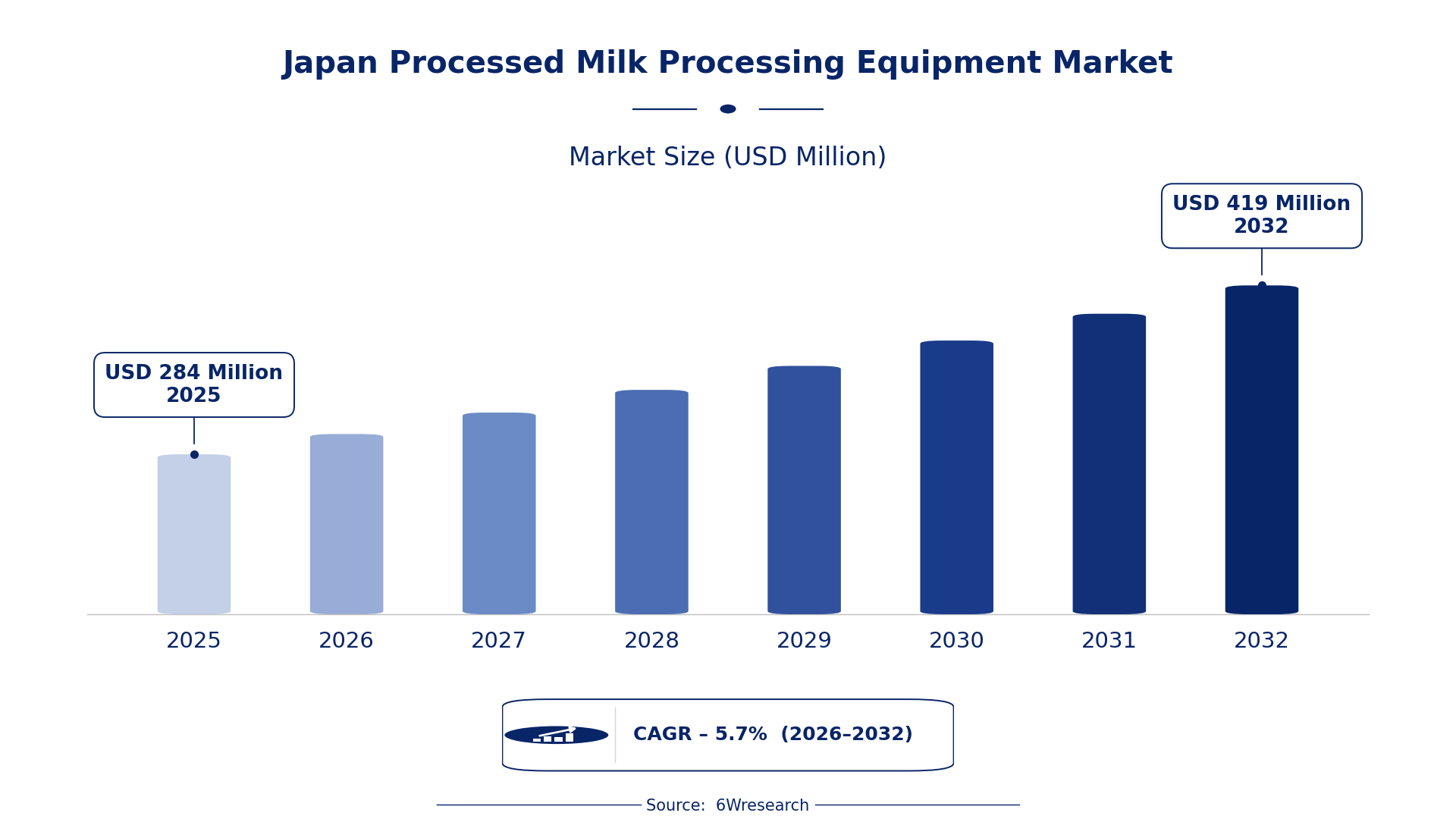
According to 6Wresearch internal database and industry insights, the Japan Processed Milk Processing Equipment Market was valued at USD 284 Million in 2025 and is projected to reach USD 419 Million by 2032, growing at a CAGR of approximately 5.7% during 2026–2032.
Japan Processed Milk Processing Equipment Market Highlights
| Report Metric | Details |
| Report Name | Japan Processed Milk Processing Equipment Market (2026-2032) |
| Market Size 2025 | USD 284 Million |
| Market Size 2032 | USD 419 Million |
| Absolute Growth 2025–2032 | USD 135 Million |
| CAGR 2026–2032 | 5.7% |
| Peak Annual Growth | 7.1% in 2027 |
| Forecast Period | 2026–2032 |
| Historical Data | 2022–2025 |
| Base Year | 2025 |
| Leading Type, 2025 | Pasteurizers (50% share) |
| Leading Separators, 2025 | Evaporators and Dryers (52% share) |
| Leading Operation, 2025 | Automatic (66% share) |
| Leading Distribution Channel, 2025 | Supermarkets/Hypermarkets (50% share) |
| Fastest-Growing Type | Homogenizers (7.9% CAGR) |
| Fastest-Growing Separators | Churning Equipment (7.3% CAGR) |
| Fastest-Growing Operation | Semi-Automatic (7.4% CAGR) |
| Fastest-Growing Distribution Channel | Convenience Stores (7.5% CAGR) |
| Growing Sector | Dairy Processing |
| Key End Users | Dairy processors, food manufacturers, retailers |
Japan Processed Milk Processing Equipment Market Year-wise Growth Rate and Key Drivers (2022–2032)
This graph illustrates the annual growth rates of the market from 2022 to 2032, highlighting a steady upward trajectory and projected market expansion over the forecast period.
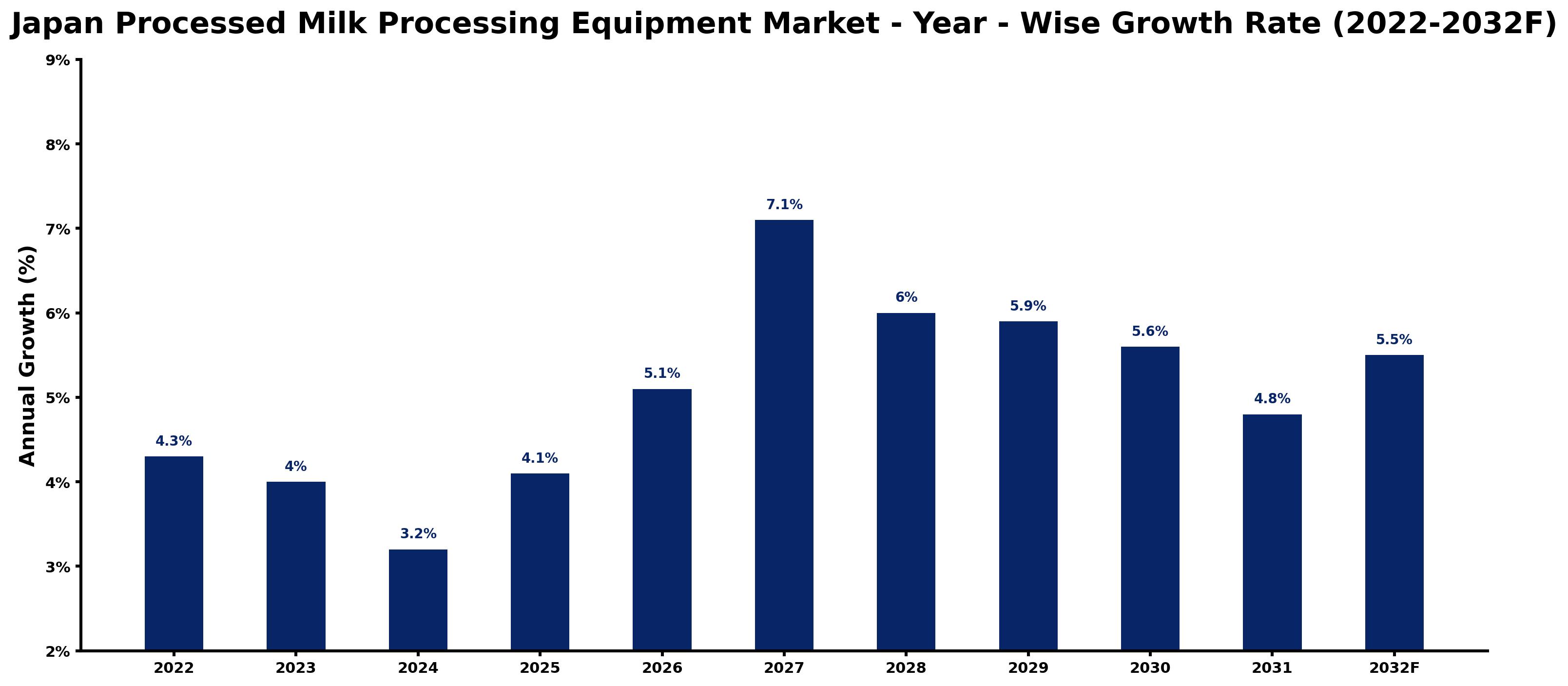
Annual growth estimates for each year appear below with the principal reason behind them, explaining the shifts that set the pace of the market.
| Year | Estimated Annual Growth (%) | Market Rationale |
| 2022 | 4.3 | The market experienced steady growth due to strong domestic demand for processed milk products. |
| 2023 | 4.0 | Growth slowed as manufacturers adjusted to rising operational costs and market conditions. |
| 2024 | 3.2 | Continued adjustments in production methods contributed to a further slowdown in growth rates. |
| 2025 | 4.1 | Demand increased as dairy producers invested in modern processing technologies to improve efficiency. |
| 2026 | 5.1 | Growth is expected to accelerate as health awareness among consumers drives higher demand for processed milk products. |
| 2027 | 7.1 | The market is projected to peak as innovations in processing equipment attract investments from dairy producers. |
| 2028 | 6.0 | Growth is anticipated to slow as market saturation begins to impact new equipment purchases and upgrades. |
| 2029 | 5.9 | A further slowdown is expected as competition intensifies among dairy processors in the region. |
| 2030 | 5.6 | Growth will continue to decelerate as producers focus on optimising existing equipment rather than new purchases. |
| 2031 | 4.8 | The market is projected to maintain a slower growth rate as consumer preferences shift towards alternative dairy products. |
| 2032 | 5.5 | Demand is expected to rise again as new processing technologies are adopted by dairy producers. |
Note: Market size estimations and growth projections presented in this report are based on 6Wresearch's proprietary forecasting methodology, utilizing the latest available industry data, government publications, and primary research inputs.
Japan Processed Milk Processing Equipment Market Synopsis
Processed milk processing equipment includes essential machinery such as pasteurizers and homogenizers used in dairy processing plants. The Japan Processed Milk Processing Equipment Market is projected to grow steadily due to increasing health awareness and rising consumption of processed milk products. In 2022, Japan's dairy production reached 8.4 million tons, with pasteurized milk accounting for 70% of total consumption. The government's recent programme to improve dairy farming efficiency further supports this growth, leading to increased demand for advanced processing technologies.
Market Dynamics Impact Analysis (2026–2032)
| Factor | Type | Impact | Primary Segment Affected |
| Rising health consciousness among consumers | Driver | High | Pasteurizers |
| Technological advancements in dairy processing | Driver | High | Homogenizers |
| Growing investment in dairy processing facilities | Opportunity | High | Mixers and Blenders |
| Expansion of retail channels for dairy products | Opportunity | Medium | Supermarkets/Hypermarkets |
| High operational costs for dairy processors | Restraint | High | Evaporators and Dryers |
| Limited availability of skilled workforce in dairy processing | Restraint | Medium | Churning Equipment |
| Competition from alternative dairy products | Challenge | High | Membrane Filtration Equipment |
| Regulatory compliance costs for dairy processors | Challenge | Medium | Automatic |
Evaluation of Drivers in Japan Processed Milk Processing Equipment Market (2026–2032)
Demand rests on the following drivers, each shown with the segment it touches most.
| Drivers | Primary Segment Affected | Why It Matters (Evidence) |
| Increased consumer demand for healthy dairy products | Pasteurizers | This drives dairy producers to invest in pasteurization equipment to ensure safety and quality. |
| Technological advancements in processing efficiency | Homogenizers | These innovations lead to improved product consistency, prompting more purchases from dairy manufacturers. |
| Growing health awareness among consumers | Mixers and Blenders | As consumers seek nutritious options, dairy processors are investing in advanced mixing technologies. |
| Rising milk production levels in Hokkaido | Evaporators and Dryers | Higher milk availability encourages investment in drying technologies for value-added products. |
| Expansion of retail channels for dairy products | Supermarkets/Hypermarkets | Increased shelf space for processed milk products drives demand for processing equipment. |
Orders keep climbing as health awareness among consumers drives demand for processed milk products. In 2022, Japan's dairy production reached 8.4 million tons, prompting processors to invest in pasteurizers to ensure safety. The Tokyo region, accounting for 30% of dairy processing facilities, is seeing increased investment in homogenizers, improving product consistency. The average Japanese consumes 30 liters of processed milk annually, further pushing demand for mixers and blenders. With technological advancements, processors are modernising their equipment, resulting in higher orders across the sector.
Evaluation of Restraints in Japan Processed Milk Processing Equipment Market
Below are the constraints most often cited by buyers and suppliers, with the segment each affects.
| Market Restraint | Primary Segment Affected | Why It Matters (Evidence) |
| High operational costs for dairy processing equipment | Evaporators and Dryers | These costs restrict smaller processors from investing in new technologies, hindering overall market growth. |
| Limited skilled workforce in dairy processing | Churning Equipment | The shortage of skilled workers hampers operational efficiency and increases reliance on outdated equipment. |
| Regulatory compliance costs for dairy processors | Automatic | Compliance with safety standards raises operational expenses, impacting profit margins for dairy manufacturers. |
| Market saturation in the processed milk sector | Homogenizers | As the market matures, growth opportunities diminish, resulting in cautious investment in new equipment. |
| Competition from alternative dairy products | Pasteurizers | The rise of plant-based alternatives pressures traditional dairy producers to innovate or risk losing market share. |
Japan Processed Milk Processing Equipment Market Challenges
Buyers are grappling with escalating operational costs as Japan's national minimum wage rose to JPY 1,055 per hour, pressuring profit margins for dairy processing plants. A shortage of skilled workers restricts suppliers' capacity to meet production demands, with the dairy industry employing around 50,000 individuals. Producers face supply chain disruptions due to Japan importing 1.2 million tons of dairy products in 2022, potentially delaying equipment availability. Compliance with standards such as ISO 22000 complicates matters for suppliers, increasing operational costs and challenging competitive pricing strategies.
Trends in the Japan Processed Milk Processing Equipment Market
Buyers and suppliers in the Japan Processed Milk Processing Equipment Market are adjusting to the following trends.
- Shift towards Healthier Dairy Products: The demand for healthier dairy options is on the rise, with 70% of milk consumption being pasteurized. This trend encourages processors to adopt advanced technologies to meet consumer expectations.
- Increase in Automation in Dairy Processing: Processing facilities are progressively implementing automatic systems, with 66% of operations now automated. This transition boosts efficiency and lowers labour costs, especially in regions like Hokkaido.
- Growth of Online Retail for Dairy Products: Online stores are emerging as a growing channel for niche dairy products, with a projected CAGR of 7.5%. This trend is reshaping how consumers access processed milk products.
- Expansion of Supermarkets for Dairy Sales: Supermarkets and hypermarkets represent 50% of dairy product sales in Japan. This dominance is driving investments in processing equipment to meet the rising demand.
Investment Opportunities in the Japan Processed Milk Processing Equipment Market
The following areas offer the clearest openings for investors and suppliers in the Japan Processed Milk Processing Equipment Market.
- Joint Ventures for Equipment Supply: Local partnerships are essential for entering the Japanese market, particularly in Hokkaido, where dairy production is highest. Collaborating with local firms can facilitate access to advanced processing technologies.
- Investment in Modern Dairy Processing Facilities: Processors are expanding operations in the Tokyo region, which houses 30% of processing facilities. Investing in modern equipment can improve production efficiency and product quality.
- Supply of Advanced Pasteurization Equipment: With pasteurized milk accounting for 70% of consumption, there is an opportunity to supply advanced pasteurization technologies to local producers.
- Expansion of Distribution Channels: Investing in the convenience store sector, which is growing rapidly, presents an opportunity to supply processed milk products to a broader audience.
Government Initiatives in the Japan Processed Milk Processing Equipment Market
The Industrial Safety and Health Act requires producers to ensure the safety of machinery used in processing. Compliance with this act necessitates manufacturers to invest in safety measures and regular inspections, ensuring that equipment meets stringent safety standards. This act directly influences operational costs for processors, as they must allocate resources for compliance and training.
The Ministry of Agriculture, Forestry and Fisheries regulates and approves safety standards for processing. Their funding initiatives support the adoption of modern technologies, enabling producers to improve efficiency and comply with regulations. This oversight guarantees that equipment used in processing meets national standards, benefiting both producers and consumers.
Future Insight of the Japan Processed Milk Processing Equipment Market
Dairy processing plants will increasingly adopt advanced technology by 2032, driven by the government's programme to improve farming efficiency. Buyers will benefit from improved production methods that ensure higher quality and safety standards, aligning with ISO 22000 requirements. Automation will likely rise in the Tokyo region, which accounts for 30% of Japan's dairy processing facilities, reducing labour costs. As health awareness grows, the average Japanese consumer's demand for processed milk, currently at 30 litres annually, will push suppliers to innovate and diversify their product offerings.
Market Segmentation Analysis
Japan Processed Milk Processing Equipment Market report covers a detailed analysis of the following market segments:
By Type – Pasteurizers Lead, Homogenizers Expected to Grow Fastest
According to Shubham Padhi, Research Analyst at 6Wresearch, Pasteurizers accounted for 50% of the market by type in 2025. Pasteurizers hold the largest market share due to their critical role in ensuring milk safety, with 70% of total milk consumption being pasteurized. Their widespread application in dairy processing facilities, particularly in the Tokyo region, reinforces their dominant position. Over 2026–2032, Homogenizers are expected to post the fastest growth, at a CAGR of 7.9%. Homogenizers are experiencing rapid growth as they improve product consistency, a key factor for consumer satisfaction. The increasing health awareness among Japanese consumers is significantly driving the demand for homogenized dairy products. Suppliers should prioritise the development of advanced homogenizers to align with consumer preferences for quality.
By Separators – Evaporators and Dryers Lead, Churning Equipment Expected to Grow Fastest
Evaporators and Dryers held 52% of the Japan Processed Milk Processing Equipment Market by separators in 2025. Evaporators and Dryers dominate the market as they are essential in specific dairy processes, contributing to the efficiency of milk processing. Their widespread application in facilities, especially in Hokkaido, underpins their leading position. Churning Equipment is set to record the highest CAGR in this split, 7.3% over 2026–2032. Churning Equipment is growing quickly, albeit from a smaller base, as it caters to niche markets for traditional dairy products. The rising interest in artisanal and specialty dairy items is driving this segment's growth. Suppliers may explore opportunities in artisanal dairy processing to capitalise on the rising demand for unique products.
By Operation – Automatic Leads, Semi-Automatic Expected to Grow Fastest
Automatic took 66% of operation revenue in 2025, more than any other category. Automatic systems dominate the market because they significantly enhance efficiency in milk processing operations. The preference for automation in larger dairy facilities is crucial for maintaining their leading market share. The quickest growth will come from Semi-Automatic, forecast to expand at a CAGR of 7.4% between 2026 and 2032. Semi-Automatic systems are growing quickly as smaller dairy operations seek cost-effective solutions that still offer some automation. The trend towards smaller, more adaptable dairy production methods is propelling this segment's expansion. Suppliers should focus on creating semi-automatic solutions that cater specifically to the needs of smaller dairy operations.
By Distribution Channel – Supermarkets/Hypermarkets Lead, Convenience Stores Expected to Grow Fastest
With 50% of distribution channel revenue in 2025, Supermarkets/Hypermarkets was the largest category. Supermarkets and Hypermarkets are the primary retail channel for processed milk products, capturing a substantial share of consumer purchases. Their extensive reach and ability to provide a variety of dairy options make them the preferred shopping destination for consumers. Convenience Stores are projected to grow fastest, at a CAGR of 7.5% during 2026–2032. Convenience Stores are growing rapidly, driven by their accessibility and the increasing trend of on-the-go consumption among consumers. The rise in urban living and busy lifestyles is significantly boosting demand for this retail segment. Suppliers should adjust their distribution strategies to include convenience stores, addressing the changing shopping behaviours of consumers.
Key Attractiveness of the Report
- 10 Years of Market Numbers
- Historical Data Starting from 2022 to 2025
- Base Year 2025
- Forecast Data until 2032
- Key Performance Indicators Impacting the Market
- Major Upcoming Developments and Projects
Key Highlights of the Report:
- Japan Processed Milk Processing Equipment Market Outlook
- Market Size of Japan Processed Milk Processing Equipment Market, 2025
- Forecast of Japan Processed Milk Processing Equipment Market, 2032
- Historical Data and Forecast of Japan Processed Milk Processing Equipment Revenues & Volume for the Period 2022-2032
- Japan Processed Milk Processing Equipment Market Trend Evolution
- Japan Processed Milk Processing Equipment Market Drivers and Challenges
- Japan Processed Milk Processing Equipment Price Trends
- Japan Processed Milk Processing Equipment Porter's Five Forces
- Japan Processed Milk Processing Equipment Industry Life Cycle
- Historical Data and Forecast of Japan Processed Milk Processing Equipment Market Revenues & Volume By Type for the Period 2022-2032
- Historical Data and Forecast of Japan Processed Milk Processing Equipment Market Revenues & Volume By Pasteurizers for the Period 2022-2032
- Historical Data and Forecast of Japan Processed Milk Processing Equipment Market Revenues & Volume By Homogenizers for the Period 2022-2032
- Historical Data and Forecast of Japan Processed Milk Processing Equipment Market Revenues & Volume By Mixers and Blenders for the Period 2022-2032
- Historical Data and Forecast of Japan Processed Milk Processing Equipment Market Revenues & Volume By Separators for the Period 2022-2032
- Historical Data and Forecast of Japan Processed Milk Processing Equipment Market Revenues & Volume By Evaporators and Dryers for the Period 2022-2032
- Historical Data and Forecast of Japan Processed Milk Processing Equipment Market Revenues & Volume By Churning Equipment for the Period 2022-2032
- Historical Data and Forecast of Japan Processed Milk Processing Equipment Market Revenues & Volume By Membrane Filtration Equipment for the Period 2022-2032
- Historical Data and Forecast of Japan Processed Milk Processing Equipment Market Revenues & Volume By Operation for the Period 2022-2032
- Historical Data and Forecast of Japan Processed Milk Processing Equipment Market Revenues & Volume By Automatic for the Period 2022-2032
- Historical Data and Forecast of Japan Processed Milk Processing Equipment Market Revenues & Volume By Semi-Automatic for the Period 2022-2032
- Historical Data and Forecast of Japan Processed Milk Processing Equipment Market Revenues & Volume By Distribution Channel for the Period 2022-2032
- Historical Data and Forecast of Japan Processed Milk Processing Equipment Market Revenues & Volume By Supermarkets/Hypermarkets for the Period 2022-2032
- Historical Data and Forecast of Japan Processed Milk Processing Equipment Market Revenues & Volume By Convenience Stores for the Period 2022-2032
- Historical Data and Forecast of Japan Processed Milk Processing Equipment Market Revenues & Volume By Online stores for the Period 2022-2032
- Japan Processed Milk Processing Equipment Import Export Trade Statistics
- Market Opportunity Assessment By Type
- Market Opportunity Assessment By Separators
- Market Opportunity Assessment By Operation
- Market Opportunity Assessment By Distribution Channel
- Japan Processed Milk Processing Equipment Top Companies Market Share
- Japan Processed Milk Processing Equipment Competitive Benchmarking By Technical and Operational Parameters
- Japan Processed Milk Processing Equipment Company Profiles
- Japan Processed Milk Processing Equipment Key Strategic Recommendations
Market Covered
The following segment groups are covered in the report.
By Type
- Pasteurizers
- Homogenizers
- Mixers and Blenders
By Separators
- Evaporators and Dryers
- Churning Equipment
- Membrane Filtration Equipment
By Operation
- Automatic
- Semi-Automatic
By Distribution Channel
- Supermarkets/Hypermarkets
- Convenience Stores
- Online stores






































