Japan Protease Feed Enzymes Market Size & Growth Rate
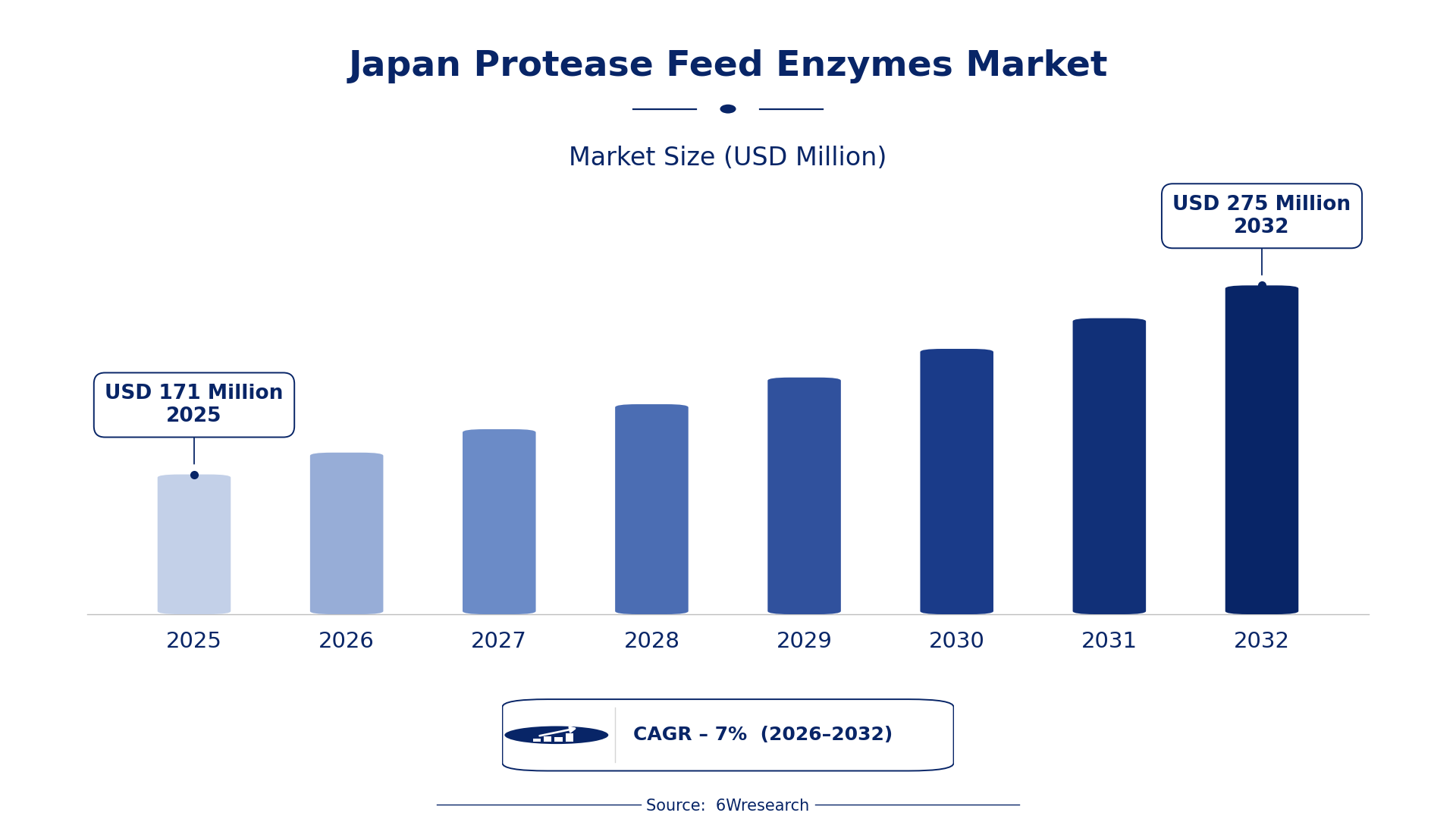
According to 6Wresearch internal database and industry insights, the Japan Protease Feed Enzymes Market was valued at USD 171 Million in 2025 and is projected to reach USD 275 Million by 2032, growing at a CAGR of approximately 7% during 2026–2032.
Japan Protease Feed Enzymes Market Highlights
| Report Metric | Details |
| Report Name | Japan Protease Feed Enzymes Market (2026-2032) |
| Market Size 2025 | USD 171 Million |
| Market Size 2032 | USD 275 Million |
| Absolute Growth 2025–2032 | USD 104 Million |
| CAGR 2026–2032 | 7% |
| Peak Annual Growth | 8.4% in 2032 |
| Forecast Period | 2026–2032 |
| Historical Data | 2022–2025 |
| Base Year | 2025 |
| Leading Product Type, 2025 | Acid Proteases (47% share) |
| Leading Source Type, 2025 | Microbial (46% share) |
| Leading Distribution Channel, 2025 | Direct Sales (36% share) |
| Leading End User, 2025 | Poultry Farms (34% share) |
| Fastest-Growing Product Type | Neutral Proteases (9.9% CAGR) |
| Fastest-Growing Source Type | Bacterial (10.4% CAGR) |
| Fastest-Growing Distribution Channel | Industrial Suppliers (9.4% CAGR) |
| Fastest-Growing End User | Dairy Cattle Farms (9.1% CAGR) |
| Growing Sector | Poultry |
| Key End Users | Poultry Farms, Aquaculture Facilities, Swine Feed Producers |
Japan Protease Feed Enzymes Market Year-wise Growth Rate and Key Drivers (2022–2032)
This graph illustrates the annual growth rates of the market from 2022 to 2032, highlighting a steady upward trajectory and projected market expansion over the forecast period.
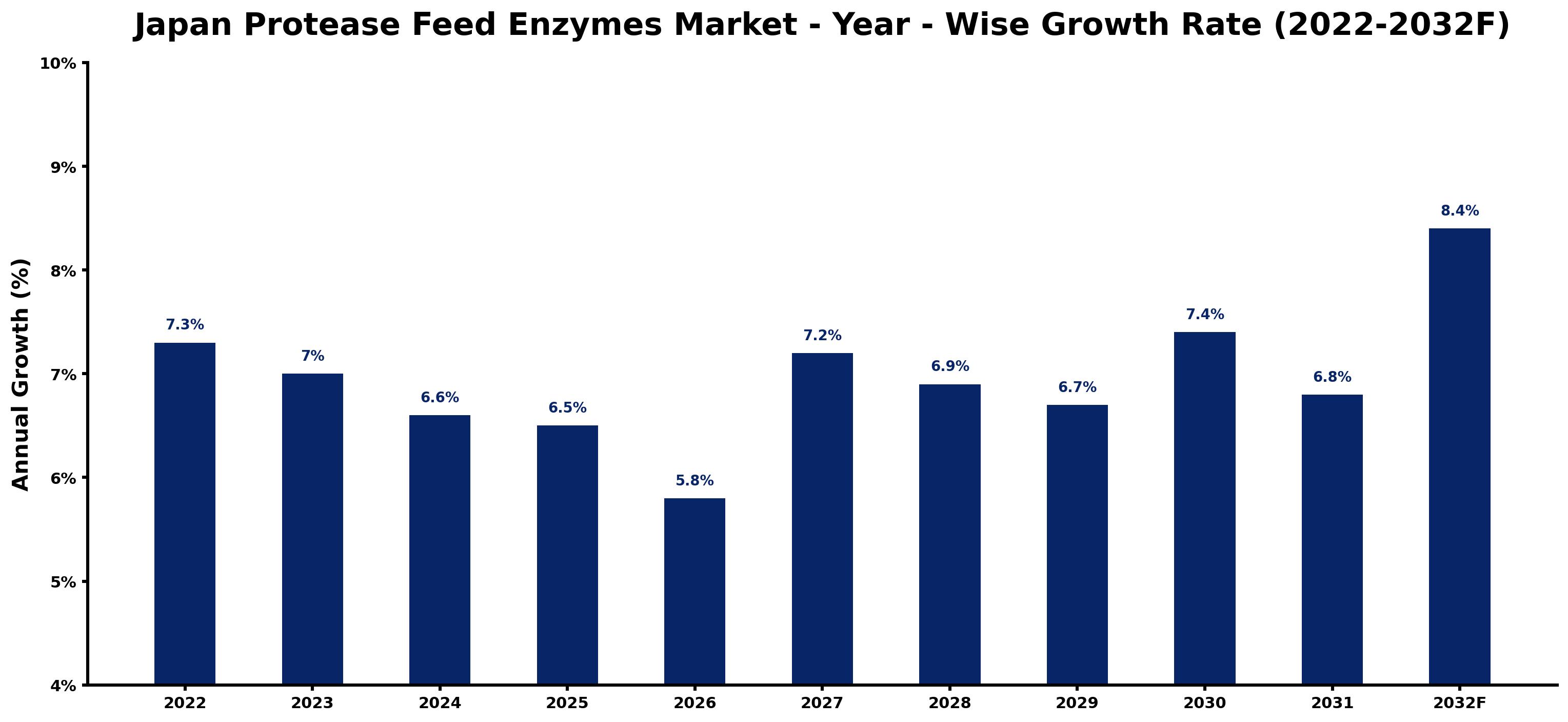
Year by year, the estimates below pair each growth rate with the development that shaped it.
| Year | Estimated Annual Growth (%) | Market Rationale |
| 2022 | 7.3 | The market experienced strong growth due to increased enzyme adoption in livestock feed. |
| 2023 | 7.0 | Demand growth slowed as feed manufacturers adjusted to market conditions and enzyme supply. |
| 2024 | 6.6 | The market continued to grow, albeit at a slower pace, as poultry production stabilised. |
| 2025 | 6.5 | Growth slowed further as the average age of livestock farmers impacted innovation. |
| 2026 | 5.8 | The market growth rate is expected to decrease as the focus shifts to cost reduction in feed. |
| 2027 | 7.2 | Demand is projected to rise again as the aquaculture sector expands with government support. |
| 2028 | 6.9 | Growth is anticipated to slow slightly as enzyme sales through online platforms increase competition. |
| 2029 | 6.7 | The market is expected to continue growing, driven by the rising poultry population and feed efficiency. |
| 2030 | 7.4 | Demand will accelerate as new enzyme formulations are introduced to improve feed performance. |
| 2031 | 6.8 | Growth is projected to slow as the market adjusts to changing livestock farming practices. |
| 2032 | 8.4 | The market is expected to peak with increased adoption of recombinant enzymes in various applications. |
Note: Market size estimations and growth projections presented in this report are based on 6Wresearch's proprietary forecasting methodology, utilizing the latest available industry data, government publications, and primary research inputs.
Japan Protease Feed Enzymes Market Synopsis
Protease feed enzymes are biological catalysts that break down proteins into peptides and amino acids, primarily derived from microbial, bacterial, or fungal sources. The Japan Protease Feed Enzymes Market is growing due to a poultry population of approximately 150 million and aquaculture production reaching 800,000 tons in 2022. Government support for enzyme use in livestock feed, particularly through the Ministry of Agriculture, Forestry and Fisheries, is creating new demand as local feed manufacturers adopt these solutions to improve nutrient absorption and digestibility.
Market Dynamics Impact Analysis (2026–2032)
| Factor | Type | Impact | Primary Segment Affected |
| Rising poultry population | Driver | High | Poultry Farms |
| Government support for enzyme adoption | Driver | High | Aquaculture Facilities |
| Increasing demand for feed efficiency | Opportunity | High | Swine Feed Producers |
| Growth in aquaculture production | Opportunity | High | Aquaculture Facilities |
| Aging livestock farmer population | Restraint | Medium | Poultry Farms |
| Limited awareness of enzyme benefits | Restraint | Medium | Dairy Cattle Farms |
| Supply chain disruptions | Challenge | High | Industrial Suppliers |
| Competition from alternative feed additives | Challenge | Medium | Direct Sales |
Evaluation of Drivers in Japan Protease Feed Enzymes Market (2026–2032)
Key forces behind demand, with the segment each one moves most, are listed below.
| Drivers | Primary Segment Affected | Why It Matters (Evidence) |
| Increased poultry population | Poultry Farms | The poultry population in Japan is approximately 150 million, leading to a higher demand for protease feed enzymes. |
| Government support for sustainable practices | Aquaculture Facilities | Government subsidies for sustainable aquaculture practices encourage the use of protease enzymes in fish feed, boosting overall demand. |
| Improved feed conversion ratios | Swine Feed Producers | The average feed conversion ratio for poultry improves by 5-10% with enzyme use, prompting swine producers to adopt these solutions. |
| Rising awareness of enzyme benefits | Dairy Cattle Farms | Neutral proteases are increasingly used for protein efficiency, driving demand in dairy cattle feed applications. |
| Growth of online sales channels | Online Platforms | Online platforms have seen a 30% increase in enzyme sales, expanding market reach for suppliers and attracting new buyers. |
Much of the new demand traces back to the poultry population, which is approximately 150 million. This figure drives feed manufacturers to improve digestibility and nutrient absorption in livestock feeds. The average feed conversion ratio for poultry improves by 5-10% with enzyme use, prompting swine feed producers to adopt these solutions. The aquaculture sector has seen production reach 800,000 tons in 2022, increasing the demand for protease enzymes. Additionally, the growing awareness of enzyme benefits among dairy cattle farmers is leading to more purchases of these products.
Evaluation of Restraints in Japan Protease Feed Enzymes Market
These restraints slow adoption and weigh on supplier margins.
| Market Restraint | Primary Segment Affected | Why It Matters (Evidence) |
| Aging livestock farmer population | Poultry Farms | The average age of livestock farmers in Japan is over 65 years, impacting innovation and adoption of new feed technologies. |
| Limited awareness of enzyme benefits | Dairy Cattle Farms | Many dairy farmers lack knowledge about the advantages of using protease enzymes for feed efficiency, limiting their adoption. |
| Supply chain disruptions | Industrial Suppliers | Recent supply chain disruptions have affected the availability of protease feed enzymes for local manufacturers, causing delays in production. |
| Competition from alternative feed additives | Direct Sales | The rise of alternative feed additives challenges the market share of protease enzymes, affecting sales for local suppliers. |
| Regulatory compliance costs | Online Platforms | Compliance with JIS standards increases operational costs for suppliers selling through online platforms, which can reduce profit margins. |
Japan Protease Feed Enzymes Market Challenges
Poultry producers in Japan face a 10% increase in feed costs this year due to supply chain disruptions that limit protease availability. Regulatory hurdles slow the introduction of new formulations, delaying product launches for suppliers by six months. The average age of livestock farmers exceeds 65 years, hindering technological adoption and innovation for producers. Rising production costs driven by sustainable practices are making feed less affordable for farmers, resulting in higher prices for consumers and reducing livestock profitability.
Trends in the Japan Protease Feed Enzymes Market
The shifts below are changing how Japan Protease Feed Enzymes Market products are bought and supplied.
- Shift from Traditional to Online Sales Channels: The distribution of protease feed enzymes is increasingly moving online, with a 30% rise in sales through digital platforms over the past year. This shift enables suppliers to reach a broader audience and streamline purchasing for buyers.
- Transition from Conventional to Recombinant Enzymes: Recombinant enzymes are gaining traction, with an expected adoption growth of 15% by 2026. This trend is driven by advancements in biotechnology, allowing for more efficient enzyme production for livestock feeds.
- Emergence of Sustainable Practices in Aquaculture: The aquaculture sector is increasingly adopting sustainable practices, supported by government subsidies. This shift is reflected in the growing production in the sector, encouraging the use of protease enzymes to meet new standards.
- Focus on Feed Efficiency Improvements: Feed efficiency is becoming a priority for livestock producers, with enzymes improving nutrient absorption. The average feed conversion ratio for poultry improves by 5-10% with enzyme use, driving demand for these products.
Investment Opportunities in the Japan Protease Feed Enzymes Market
The following areas offer the clearest openings for investors and suppliers in the Japan Protease Feed Enzymes Market.
- Tokyo Region as a Hub for Feed Production: The Tokyo region is a key hub for feed production, with a market valued at around 1 trillion yen annually. This presents opportunities for suppliers to establish partnerships with local manufacturers to expand their reach.
- Poultry Farms Seeking Efficiency Solutions: Poultry farms are increasingly searching for solutions to improve feed efficiency, with the poultry population at 150 million. Suppliers can enter this market by offering tailored enzyme formulations that meet specific needs.
- Growing Demand for Specialized Enzymes: The market gap for specialized enzyme formulations is expanding, with a notable increase in online sales. Suppliers can target niche markets by developing specific enzyme products for unique livestock needs, responding to buyer demands.
- Investment in Recombinant Enzyme Development: Investing in recombinant enzyme technology presents a promising opportunity, with expected growth of 15% by 2026. Collaborating with research institutions can facilitate innovation in this area, enhancing product offerings.
Government Initiatives in the Japan Protease Feed Enzymes Market
The Food Sanitation Act amendment (2018, fully applied June 2021) mandates HACCP-based hygiene management for food businesses, improving safety standards for protease feed enzymes. This law requires producers to implement rigorous hygiene protocols, ensuring the quality of enzyme products used in livestock feed, which benefits both producers and consumers.
The Japan Feed Manufacturers Association oversees the implementation of the PRTR Law and promotes enzyme use in livestock feed. This agency supports farmers in adopting safe and effective feed additives, ensuring compliance with safety standards while facilitating access to high-quality protease enzymes.
Future Insight of the Japan Protease Feed Enzymes Market
Technological advancements will transform demand for protease feed solutions by 2032. The Ministry of Agriculture, Forestry and Fisheries will promote the integration of innovative feed solutions, improving digestibility in livestock. Research into new protease applications will enable their use in high-temperature feeds, catering to diverse livestock needs. Government support for sustainable aquaculture practices will drive innovation, benefiting both buyers and suppliers in the evolving market.
Market Segmentation Analysis
Japan Protease Feed Enzymes Market report covers a detailed analysis of the following market segments:
By Product Type – Acid Proteases Lead, Neutral Proteases Expected to Grow Fastest
According to Uttkarsh, Research Associate at 6Wresearch, in 2025, Acid Proteases led the product type split with a 47% share. Acid proteases hold the largest share as they are crucial for improving protein digestion in livestock feeds, especially in poultry. Their effectiveness in enhancing feed conversion ratios makes them indispensable for feed manufacturers targeting this sector. Neutral Proteases are set to record the highest CAGR in this split, 9.9% over 2026–2032. Neutral proteases are witnessing rapid growth due to their ability to significantly enhance nutrient absorption in various livestock feeds. This trend is likely to continue as farmers increasingly seek to optimise feed formulations for better efficiency. Suppliers should focus on developing neutral proteases to meet the rising demand in the dairy sector.
By Source Type – Microbial Leads, Bacterial Expected to Grow Fastest
The largest source type category in 2025 was Microbial, at 46% of revenue. Microbial sources dominate the market as they are the primary means of enzyme production for feed applications. Their widespread use ensures consistent performance in livestock nutrition, making them the preferred choice for many manufacturers. The quickest growth will come from Bacterial, forecast to expand at a CAGR of 10.4% between 2026 and 2032. Bacterial sources are growing rapidly due to their targeted applications in specific protease formulations. This shift indicates a demand for more specialised enzyme solutions to improve feed efficiency. Suppliers may need to advance bacterial enzyme technologies to capture this expanding market segment.
By Distribution Channel – Direct Sales Leads, Industrial Suppliers Expected to Grow Fastest
With 36% of distribution channel revenue in 2025, Direct Sales was the largest category. Direct sales are the leading distribution channel, serving as the primary method for local feed manufacturers to obtain enzymes. This channel facilitates strong relationships between manufacturers and suppliers, allowing for tailored solutions. Industrial Suppliers are projected to grow fastest, at a CAGR of 9.4% during 2026–2032. Industrial suppliers are experiencing the fastest growth as they meet the rising demand for bulk enzyme supplies from large-scale feed producers. Their expansion reflects the industry's focus on enhancing supply chain efficiency. This trend suggests that suppliers should strengthen collaborations with industrial suppliers to optimise distribution strategies.
By End User – Poultry Farms Lead, Dairy Cattle Farms Expected to Grow Fastest
Poultry Farms accounted for 34% of the market by end user in 2025. Poultry farms are the primary end users of protease feed enzymes, supported by Japan's substantial poultry population of approximately 150 million. Their need for improved feed efficiency solidifies their dominant position in the market. Over 2026–2032, Dairy Cattle Farms are expected to post the fastest growth, at a CAGR of 9.1%. Dairy cattle farms are experiencing the fastest growth as they increasingly incorporate protease enzymes to enhance protein efficiency in their feed. This trend is crucial as the dairy sector seeks to improve production amidst rising costs. This indicates that suppliers should tailor their products to address the specific needs of dairy cattle farms.
Key Attractiveness of the Report
- 10 Years of Market Numbers
- Historical Data Starting from 2022 to 2025
- Base Year 2025
- Forecast Data until 2032
- Key Performance Indicators Impacting the Market
- Major Upcoming Developments and Projects
Key Highlights of the Report:
- Japan Protease Feed Enzymes Market Outlook
- Market Size of Japan Protease Feed Enzymes Market, 2025
- Forecast of Japan Protease Feed Enzymes Market, 2032
- Historical Data and Forecast of Japan Protease Feed Enzymes Revenues & Volume for the Period 2022-2032F
- Japan Protease Feed Enzymes Market Trend Evolution
- Japan Protease Feed Enzymes Market Drivers and Challenges
- Japan Protease Feed Enzymes Price Trends
- Japan Protease Feed Enzymes Porter's Five Forces
- Japan Protease Feed Enzymes Industry Life Cycle
- Historical Data and Forecast of Japan Protease Feed Enzymes Market Revenues & Volume By Product Type for the Period 2022-2032F
- Historical Data and Forecast of Japan Protease Feed Enzymes Market Revenues & Volume By Acid Proteases for the Period 2022-2032F
- Historical Data and Forecast of Japan Protease Feed Enzymes Market Revenues & Volume By Neutral Proteases for the Period 2022-2032F
- Historical Data and Forecast of Japan Protease Feed Enzymes Market Revenues & Volume By Alkaline Proteases for the Period 2022-2032F
- Historical Data and Forecast of Japan Protease Feed Enzymes Market Revenues & Volume By Thermostable Proteases for the Period 2022-2032F
- Historical Data and Forecast of Japan Protease Feed Enzymes Market Revenues & Volume By Source Type for the Period 2022-2032F
- Historical Data and Forecast of Japan Protease Feed Enzymes Market Revenues & Volume By Microbial for the Period 2022-2032F
- Historical Data and Forecast of Japan Protease Feed Enzymes Market Revenues & Volume By Bacterial for the Period 2022-2032F
- Historical Data and Forecast of Japan Protease Feed Enzymes Market Revenues & Volume By Fungal for the Period 2022-2032F
- Historical Data and Forecast of Japan Protease Feed Enzymes Market Revenues & Volume By Recombinant for the Period 2022-2032F
- Historical Data and Forecast of Japan Protease Feed Enzymes Market Revenues & Volume By Distribution Channel for the Period 2022-2032F
- Historical Data and Forecast of Japan Protease Feed Enzymes Market Revenues & Volume By Direct Sales for the Period 2022-2032F
- Historical Data and Forecast of Japan Protease Feed Enzymes Market Revenues & Volume By Industrial Suppliers for the Period 2022-2032F
- Historical Data and Forecast of Japan Protease Feed Enzymes Market Revenues & Volume By Online Platforms for the Period 2022-2032F
- Historical Data and Forecast of Japan Protease Feed Enzymes Market Revenues & Volume By Specialty Distributors for the Period 2022-2032F
- Historical Data and Forecast of Japan Protease Feed Enzymes Market Revenues & Volume By End User for the Period 2022-2032F
- Historical Data and Forecast of Japan Protease Feed Enzymes Market Revenues & Volume By Poultry Farms for the Period 2022-2032F
- Historical Data and Forecast of Japan Protease Feed Enzymes Market Revenues & Volume By Dairy Cattle Farms for the Period 2022-2032F
- Historical Data and Forecast of Japan Protease Feed Enzymes Market Revenues & Volume By Aquaculture Facilities for the Period 2022-2032F
- Historical Data and Forecast of Japan Protease Feed Enzymes Market Revenues & Volume By Swine Feed Producers for the Period 2022-2032F
- Japan Protease Feed Enzymes Import Export Trade Statistics
- Market Opportunity Assessment By Product Type
- Market Opportunity Assessment By Source Type
- Market Opportunity Assessment By Distribution Channel
- Market Opportunity Assessment By End User
- Japan Protease Feed Enzymes Top Companies Market Share
- Japan Protease Feed Enzymes Competitive Benchmarking By Technical and Operational Parameters
- Japan Protease Feed Enzymes Company Profiles
- Japan Protease Feed Enzymes Key Strategic Recommendations
Market Covered
The report covers the following segments.
By Product Type
- Acid Proteases
- Neutral Proteases
- Alkaline Proteases
- Thermostable Proteases
By Source Type
- Microbial
- Bacterial
- Fungal
- Recombinant
By Distribution Channel
- Direct Sales
- Industrial Suppliers
- Online Platforms
- Specialty Distributors
By End User
- Poultry Farms
- Dairy Cattle Farms
- Aquaculture Facilities
- Swine Feed Producers






































