Japan Protein Feed Ingredients Market Size & Growth Rate
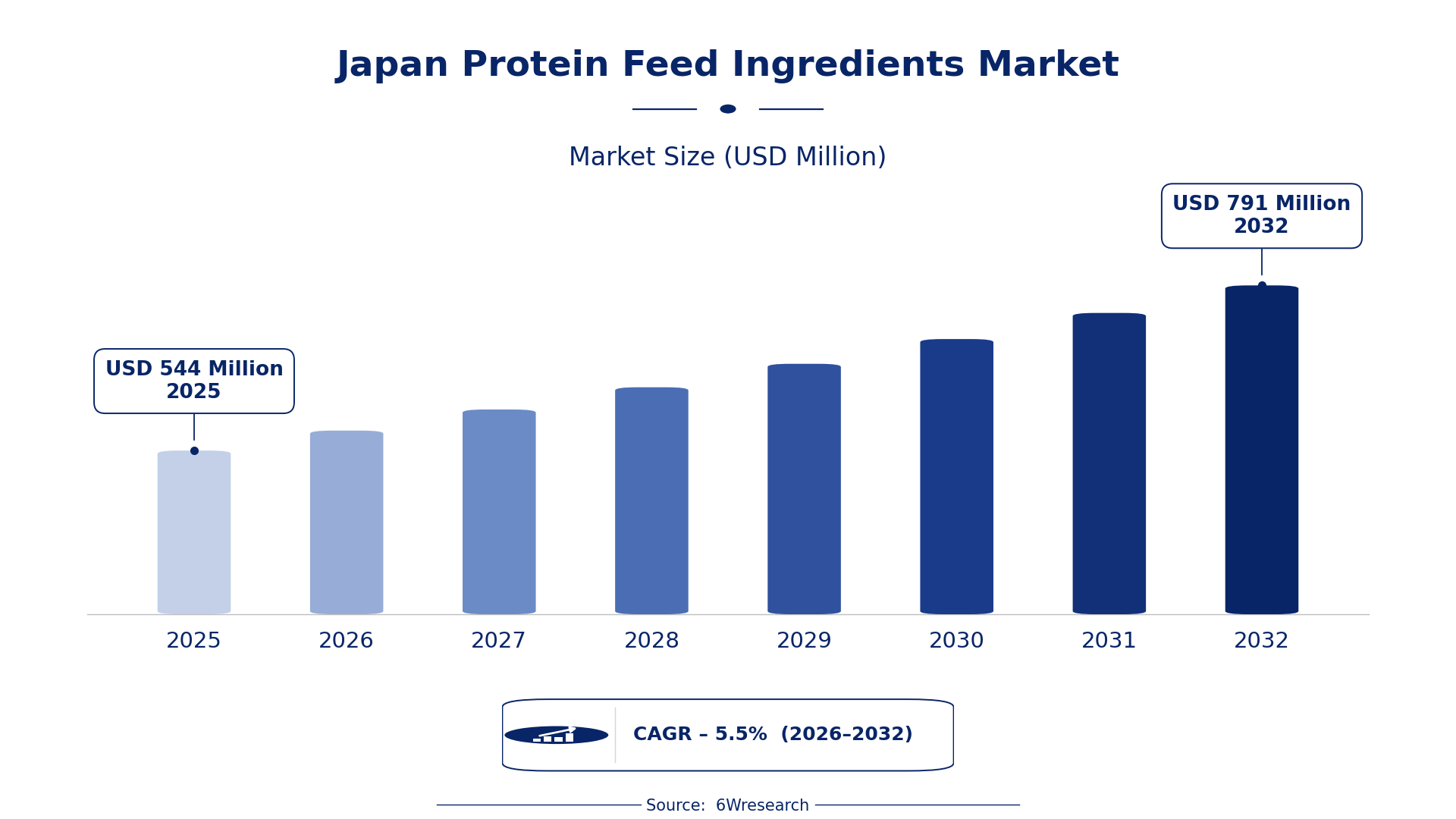
According to 6Wresearch internal database and industry insights, the Japan Protein Feed Ingredients Market was valued at USD 544 Million in 2025 and is projected to reach USD 791 Million by 2032, growing at a CAGR of approximately 5.5% during 2026–2032.
Japan Protein Feed Ingredients Market Highlights
| Report Metric | Details |
| Report Name | Japan Protein Feed Ingredients Market (2026-2032) |
| Market Size 2025 | USD 544 Million |
| Market Size 2032 | USD 791 Million |
| Absolute Growth 2025–2032 | USD 247 Million |
| CAGR 2026–2032 | 5.5% |
| Peak Annual Growth | 7.2% in 2032 |
| Forecast Period | 2026–2032 |
| Historical Data | 2022–2025 |
| Base Year | 2025 |
| Leading Ingredient Type, 2025 | Fish Meal (48% share) |
| Leading Protein Content, 2025 | 60–72% (51% share) |
| Leading Distribution Channel, 2025 | Industrial Suppliers (43% share) |
| Leading End User, 2025 | Fish & Shrimp Hatcheries (48% share) |
| Fastest-Growing Ingredient Type | Canola Meal (7.8% CAGR) |
| Fastest-Growing Protein Content | 36–38% (7.2% CAGR) |
| Fastest-Growing Distribution Channel | Direct Sales (7.4% CAGR) |
| Fastest-Growing End User | Poultry Feed Manufacturers (7.3% CAGR) |
| Growing Sector | Aquaculture |
| Key End Users | Fish & Shrimp Hatcheries, Poultry Feed Manufacturers, Dairy Farms, Cattle Feed Industry |
Japan Protein Feed Ingredients Market Year-wise Growth Rate and Key Drivers (2022–2032)
This graph illustrates the annual growth rates of the market from 2022 to 2032, highlighting a steady upward trajectory and projected market expansion over the forecast period.
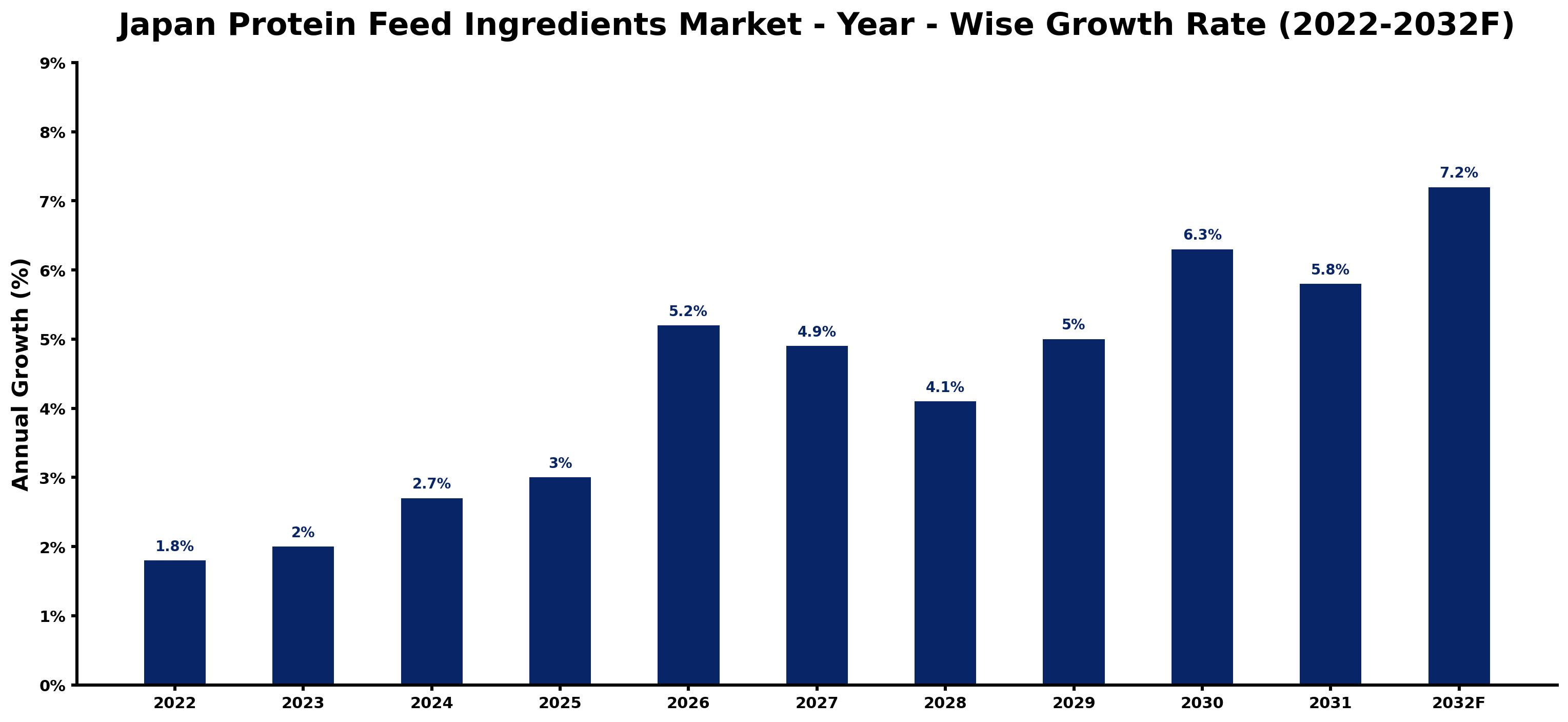
For each year, the table pairs the estimated growth rate with the leading influence on demand, showing how the drivers changed across the period.
| Year | Estimated Annual Growth (%) | Market Rationale |
| 2022 | 1.8 | The market showed steady growth, driven by increased demand for protein-rich feed ingredients. |
| 2023 | 2.0 | Growth accelerated as the poultry industry expanded, requiring more protein sources for feed. |
| 2024 | 2.7 | Demand continued to rise due to the thriving aquaculture sector and its need for high-protein ingredients. |
| 2025 | 3.0 | The market reached a historical peak, supported by strong livestock production and feed efficiency improvements. |
| 2026 | 5.2 | Growth surged as investments in sustainable aquaculture practices gained traction among producers. |
| 2027 | 4.9 | Growth slowed slightly as market adjustments occurred following the peak demand in previous years. |
| 2028 | 4.1 | Continued demand from the dairy sector contributed to a further slowdown in growth rates. |
| 2029 | 5.0 | A rebound in growth occurred as the poultry feed segment expanded its market share. |
| 2030 | 6.3 | Demand increased, driven by advancements in feed formulation technologies. |
| 2031 | 5.8 | Growth moderated as the market stabilised, reflecting mature demand patterns across sectors. |
| 2032 | 7.2 | The market is expected to peak, driven by rising aquaculture and livestock production needs. |
Note: Market size estimations and growth projections presented in this report are based on 6Wresearch's proprietary forecasting methodology, utilizing the latest available industry data, government publications, and primary research inputs.
Japan Protein Feed Ingredients Market Synopsis
Protein feed ingredients are derived from various plant and animal sources, primarily used to improve the nutritional value of animal feed. Key buyers include fish and shrimp hatcheries, poultry feed manufacturers, and dairy farms. The Japan Protein Feed Ingredients Market is expanding due to rising domestic demand from the aquaculture and livestock sectors, with the poultry industry producing approximately 1.4 million tons of meat annually. The focus on sustainable practices and improvements in feed efficiency further fuels market growth.
Market Dynamics Impact Analysis (2026–2032)
| Factor | Type | Impact | Primary Segment Affected |
| Growing aquaculture sector | Driver | High | Fish Meal |
| Increased poultry production | Driver | High | Canola Meal |
| Rising demand for organic feed | Opportunity | Medium | Specialty Distributors |
| Expansion of online sales channels | Opportunity | Medium | Online Platforms |
| Regulatory compliance costs | Restraint | High | Fish Meal |
| Limited availability of specific ingredients | Restraint | Medium | Fish Meal |
| High production costs for sustainable ingredients | Challenge | High | Fish Meal |
| Competition from alternative protein sources | Challenge | Medium | Canola Meal |
Evaluation of Drivers in Japan Protein Feed Ingredients Market (2026–2032)
Below are the drivers that matter most for revenue growth, with supporting evidence.
| Drivers | Primary Segment Affected | Why It Matters (Evidence) |
| Increased production in aquaculture | Fish Meal | Aquaculture contributes approximately 1.2% to Japan's GDP, driving demand for high-protein ingredients like fish meal. |
| Rising poultry meat production | Canola Meal | The poultry industry in Japan produces around 1.4 million tons of meat annually, increasing the need for canola meal in feed formulations. |
| Growing focus on sustainability | Specialty Distributors | The promotion of sustainable aquaculture practices leads to higher demand for organic and non-GMO feed products. |
| Investment in feed efficiency | Fish Meal | A new program launched in 2023 aims to improve feed efficiency, boosting demand for innovative feed solutions. |
| Expansion of online sales | Online Platforms | Online sales of feed ingredients have increased by 15% in the last year, indicating a shift in purchasing behaviour. |
Spending rises because aquaculture contributes approximately 1.2% to Japan's GDP, driving demand for high-protein ingredients like fish meal. The poultry industry produces around 1.4 million tons of meat annually, increasing the need for canola meal in formulations. Additionally, the focus on sustainability promotes organic and non-GMO feed products, while online sales of feed ingredients surged last year, reflecting changing purchasing behaviours.
Evaluation of Restraints in Japan Protein Feed Ingredients Market
These are the pressures that could keep growth below its potential.
| Market Restraint | Primary Segment Affected | Why It Matters (Evidence) |
| High production costs for sustainable ingredients | Canola Meal | Producers must invest to comply with sustainability standards, raising overall costs for feed production. |
| Limited ingredient availability | Fish Meal | Sourcing specific high-protein ingredients remains challenging, affecting supply for aquaculture feed. |
| Regulatory compliance costs | Fish Meal | Producers face high costs to meet the Food Sanitation Act's HACCP standards, impacting profitability. |
| Competition from alternative protein sources | Canola Meal | The rise of alternative protein sources creates pressure on traditional feed ingredients, affecting market share. |
| Market fluctuations | Fish Meal | Volatility in raw material prices can disrupt supply chains, leading to uncertainty for buyers. |
Japan Protein Feed Ingredients Market Challenges
Japan's regulatory framework imposes strict compliance requirements, raising production costs for suppliers and increasing prices for buyers in the poultry and aquaculture sectors. Intense competition among local feed manufacturers pressures profit margins, forcing producers to cut costs, which can compromise ingredient quality for livestock. Rapid technological advancements create a gap for many producers, delaying product launches and reducing market responsiveness for buyers. A shortage of skilled workers hampers production efficiency, causing supply delays that can adversely affect the health and productivity of livestock, particularly in the dairy sector with 1.5 million cows.
Trends in the Japan Protein Feed Ingredients Market
Buyers and suppliers in the Japan Protein Feed Ingredients Market are adjusting to the following trends.
- Shift towards Sustainable Feed Practices: The Fisheries Agency promotes sustainable aquaculture practices, increasing the demand for eco-friendly feed ingredients. By 2025, targets for sustainable fish meal sourcing will reshape procurement strategies.
- Growth in Online Sales Channels: Online platforms for feed ingredients are gaining traction, with a 15% increase in sales last year. This shift allows smaller producers to access broader markets.
- Increased Focus on Feed Efficiency: A recent program aims to improve feed efficiency, driving innovations in feed formulations and improving overall productivity in livestock sectors.
- Expansion of Organic Feed Products: The demand for organic and non-GMO feed products is rising, supported by local agricultural cooperatives. This trend is expected to grow as consumer preferences shift.
Investment Opportunities in the Japan Protein Feed Ingredients Market
Several openings in the Japan Protein Feed Ingredients Market merit attention from investors.
- Gap in Organic Feed Supply: With a growing demand for organic feed products, producers can invest in organic formulations. Local agricultural cooperatives are key buyers, providing a pathway for entry.
- Expansion of Aquaculture Facilities: Aquaculture facilities are expanding, leading to increased demand for high-protein feed ingredients. Investment in fish meal production can meet this rising need effectively.
- Direct Sales Growth: Direct sales channels are projected to grow, presenting an opportunity for suppliers to engage directly with end-users like poultry feed manufacturers.
- Investment in Alternative Protein Sources: Research for alternative protein sources is creating opportunities for suppliers to develop new feed solutions.
Government Initiatives in the Japan Protein Feed Ingredients Market
The GX Promotion Act, launched in 2023, reinforces Japan's commitment to sustainable practices in feed production. This act complements existing regulations like the Food Sanitation Act, which mandates HACCP-based hygiene management, ensuring higher safety standards for protein feed ingredients. The Fisheries Agency has set targets for increasing sustainable fish meal sourcing by 2025, which will further enhance the regulatory framework governing feed production.
The Fisheries Agency administers the GX Promotion Act, funding projects aimed at improving feed efficiency and sustainability. This agency supports fish and shrimp hatcheries in adopting better practices, contributing to the overall growth of the protein feed market. The Japan Feed Association oversees standards and regulations, ensuring compliance among producers.
Future Insight of the Japan Protein Feed Ingredients Market
Innovations in alternative protein sources will transform demand dynamics by 2032, driven by government-backed research initiatives that introduce diverse feed options. The Fisheries Agency's sustainability goals will encourage responsible sourcing practices in aquaculture, benefiting suppliers who align with these objectives. Programmes focused on improving feed efficiency will boost livestock productivity, providing advantages for buyers in the poultry and dairy sectors. Online sales of feed ingredients are expected to expand significantly, indicating a shift towards more digitalised distribution channels.
Market Segmentation Analysis
Japan Protein Feed Ingredients Market report covers a detailed analysis of the following market segments:
By Ingredient Type – Fish Meal Leads, Canola Meal Expected to Grow Fastest
According to Hittika Dhall, Research Associate at 6Wresearch, the largest ingredient type category in 2025 was Fish Meal, at 48% of revenue. Fish meal commands the largest share due to its critical role as a high-protein ingredient in aquaculture feed, serving over 1,500 fish and shrimp hatcheries in Japan. The established reliance on fish meal for optimal growth in aquaculture solidifies its status as a preferred choice among feed manufacturers. Canola Meal is projected to grow fastest, at a CAGR of 7.8% during 2026–2032. Canola meal is rapidly gaining traction as it becomes increasingly integrated into poultry feed formulations, with its inclusion accounting for 30% of feed mixes. This trend towards canola meal reflects the heightened emphasis on protein content in livestock nutrition, ensuring its growth continues. Suppliers should focus on increasing canola meal production to satisfy the growing demand in the poultry sector.
By Protein Content – 60–72% Leads, 36–38% Expected to Grow Fastest
In 2025, 60–72% led the protein content split with a 51% share. The 60–72% protein content is highly valued in aquaculture, providing essential nutrients that support the growth of fish and shrimp. This level of protein is critical for hatcheries that aim to maximise yield and operational efficiency. 36–38% is set to record the highest CAGR in this split, 7.2% over 2026–2032. The 36–38% protein content is increasingly favoured by poultry feed manufacturers who are focusing on optimising cost and nutritional value in their formulations. This trend reflects a growing preference for diverse protein sources in poultry diets, ensuring sustained growth in this segment. Buyers should explore various protein content options to improve feed efficiency and animal health.
By Distribution Channel – Industrial Suppliers Lead, Direct Sales Expected to Grow Fastest
Industrial Suppliers accounted for 43% of the market by distribution channel in 2025. Industrial suppliers lead the market as they are the primary source for bulk feed ingredients, providing a reliable supply to various sectors. Their established distribution networks and capacity for large-scale operations make them vital partners for feed manufacturers. The quickest growth will come from Direct Sales, forecast to expand at a CAGR of 7.4% between 2026 and 2032. Direct sales are rapidly growing as local producers and suppliers seek to streamline their operations and enhance customer relationships. This shift suggests a move towards more personalised service in the distribution of feed ingredients, improving market access. Suppliers need to adapt their strategies to leverage direct sales channels for better engagement with local customers.
By End User – Fish & Shrimp Hatcheries Lead, Poultry Feed Manufacturers Expected to Grow Fastest
Fish & Shrimp Hatcheries held 48% of the Japan Protein Feed Ingredients Market by end user in 2025. Fish and shrimp hatcheries are the largest consumers of protein feed ingredients, requiring high-protein formulations to ensure optimal growth and sustainability. Their significant role in aquaculture underscores the importance of this user group in the overall market. Over 2026–2032, Poultry Feed Manufacturers are expected to post the fastest growth, at a CAGR of 7.3%. Poultry feed manufacturers are experiencing the fastest growth as they respond to rising consumer demand for poultry products, increasing the need for various protein sources. This trend indicates a strong market for protein ingredients specifically designed for poultry nutrition. Suppliers should focus on developing tailored solutions for poultry feed manufacturers to take advantage of this growth opportunity.
Key Attractiveness of the Report
- 10 Years of Market Numbers
- Historical Data Starting from 2022 to 2025
- Base Year 2025
- Forecast Data until 2032
- Key Performance Indicators Impacting the Market
- Major Upcoming Developments and Projects
Key Highlights of the Report:
- Japan Protein Feed Ingredients Market Outlook
- Market Size of Japan Protein Feed Ingredients Market, 2025
- Forecast of Japan Protein Feed Ingredients Market, 2032
- Historical Data and Forecast of Japan Protein Feed Ingredients Revenues & Volume for the Period 2022-2032F
- Japan Protein Feed Ingredients Market Trend Evolution
- Japan Protein Feed Ingredients Market Drivers and Challenges
- Japan Protein Feed Ingredients Price Trends
- Japan Protein Feed Ingredients Porter's Five Forces
- Japan Protein Feed Ingredients Industry Life Cycle
- Historical Data and Forecast of Japan Protein Feed Ingredients Market Revenues & Volume By Ingredient Type for the Period 2022-2032F
- Historical Data and Forecast of Japan Protein Feed Ingredients Market Revenues & Volume By Fish Meal for the Period 2022-2032F
- Historical Data and Forecast of Japan Protein Feed Ingredients Market Revenues & Volume By Canola Meal for the Period 2022-2032F
- Historical Data and Forecast of Japan Protein Feed Ingredients Market Revenues & Volume By Sunflower Meal for the Period 2022-2032F
- Historical Data and Forecast of Japan Protein Feed Ingredients Market Revenues & Volume By Cottonseed Meal for the Period 2022-2032F
- Historical Data and Forecast of Japan Protein Feed Ingredients Market Revenues & Volume By Protein Content for the Period 2022-2032F
- Historical Data and Forecast of Japan Protein Feed Ingredients Market Revenues & Volume By 60 72 for the Period 2022-2032F
- Historical Data and Forecast of Japan Protein Feed Ingredients Market Revenues & Volume By 36 38 for the Period 2022-2032F
- Historical Data and Forecast of Japan Protein Feed Ingredients Market Revenues & Volume By 25 28 for the Period 2022-2032F
- Historical Data and Forecast of Japan Protein Feed Ingredients Market Revenues & Volume By 41 43 for the Period 2022-2032F
- Historical Data and Forecast of Japan Protein Feed Ingredients Market Revenues & Volume By Distribution Channel for the Period 2022-2032F
- Historical Data and Forecast of Japan Protein Feed Ingredients Market Revenues & Volume By Industrial Suppliers for the Period 2022-2032F
- Historical Data and Forecast of Japan Protein Feed Ingredients Market Revenues & Volume By Direct Sales for the Period 2022-2032F
- Historical Data and Forecast of Japan Protein Feed Ingredients Market Revenues & Volume By Online Platforms for the Period 2022-2032F
- Historical Data and Forecast of Japan Protein Feed Ingredients Market Revenues & Volume By Specialty Distributors for the Period 2022-2032F
- Historical Data and Forecast of Japan Protein Feed Ingredients Market Revenues & Volume By End User for the Period 2022-2032F
- Historical Data and Forecast of Japan Protein Feed Ingredients Market Revenues & Volume By Fish & Shrimp Hatcheries for the Period 2022-2032F
- Historical Data and Forecast of Japan Protein Feed Ingredients Market Revenues & Volume By Poultry Feed Manufacturers for the Period 2022-2032F
- Historical Data and Forecast of Japan Protein Feed Ingredients Market Revenues & Volume By Dairy Farms for the Period 2022-2032F
- Historical Data and Forecast of Japan Protein Feed Ingredients Market Revenues & Volume By Cattle Feed Industry for the Period 2022-2032F
- Japan Protein Feed Ingredients Import Export Trade Statistics
- Market Opportunity Assessment By Ingredient Type
- Market Opportunity Assessment By Protein Content
- Market Opportunity Assessment By Distribution Channel
- Market Opportunity Assessment By End User
- Japan Protein Feed Ingredients Top Companies Market Share
- Japan Protein Feed Ingredients Competitive Benchmarking By Technical and Operational Parameters
- Japan Protein Feed Ingredients Company Profiles
- Japan Protein Feed Ingredients Key Strategic Recommendations
Market Covered
Coverage by segment is as follows.
By Ingredient Type
- Fish Meal
- Canola Meal
- Sunflower Meal
- Cottonseed Meal
By Protein Content
- 60–72%
- 36–38%
- 25–28%
- 41–43%
By Distribution Channel
- Industrial Suppliers
- Direct Sales
- Online Platforms
- Specialty Distributors
By End User
- Fish & Shrimp Hatcheries
- Poultry Feed Manufacturers
- Dairy Farms
- Cattle Feed Industry






































