Japan Protein-Rich Feed Additives Market Size & Growth Rate
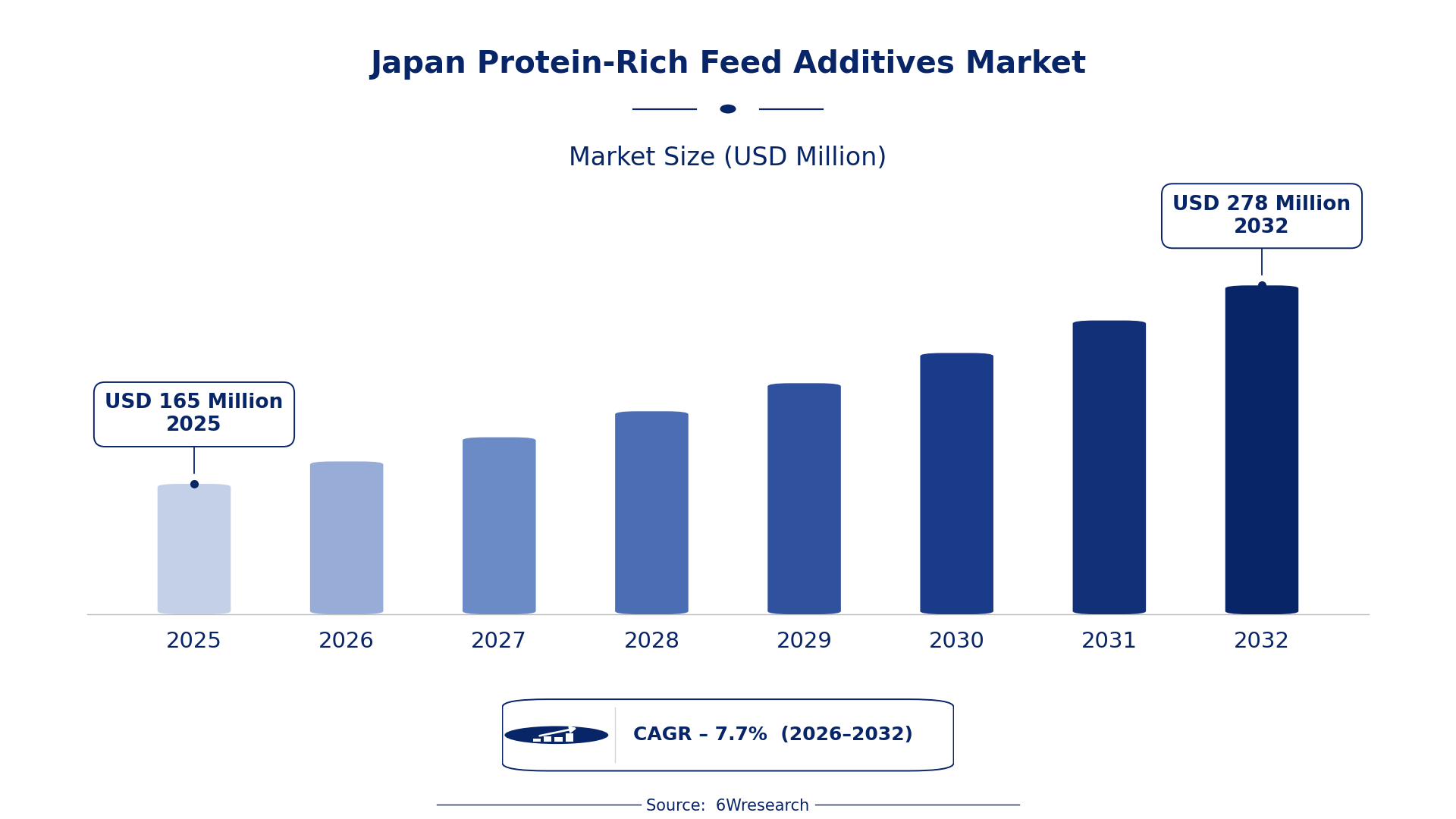
According to 6Wresearch internal database and industry insights, the Japan Protein-Rich Feed Additives Market was valued at USD 165 Million in 2025 and is projected to reach USD 278 Million by 2032, growing at a CAGR of approximately 7.7% during 2026–2032.
Japan Protein-Rich Feed Additives Market Highlights
| Report Metric | Details |
| Report Name | Japan Protein-Rich Feed Additives Market (2026-2032) |
| Market Size 2025 | USD 165 Million |
| Market Size 2032 | USD 278 Million |
| Absolute Growth 2025–2032 | USD 113 Million |
| CAGR 2026–2032 | 7.7% |
| Peak Annual Growth | 8.5% in 2027 |
| Forecast Period | 2026–2032 |
| Historical Data | 2022–2025 |
| Base Year | 2025 |
| Leading Product Type, 2025 | Plant-Based Protein (37% share) |
| Leading Source Type, 2025 | Soy (36% share) |
| Leading Distribution Channel, 2025 | Online Platforms (38% share) |
| Leading End User, 2025 | Organic Farms (48% share) |
| Fastest-Growing Product Type | Animal-Based Protein (10.9% CAGR) |
| Fastest-Growing Source Type | Pea (11.1% CAGR) |
| Fastest-Growing Distribution Channel | Direct Sales (10.2% CAGR) |
| Fastest-Growing End User | Livestock Farms (10.1% CAGR) |
| Growing Sector | Livestock Farms |
| Key End Users | Organic Farms, Livestock Farms, Pet Food Manufacturers, Poultry Feed Producers |
Japan Protein-Rich Feed Additives Market Year-wise Growth Rate and Key Drivers (2022–2032)
This graph illustrates the annual growth rates of the market from 2022 to 2032, highlighting a steady upward trajectory and projected market expansion over the forecast period.
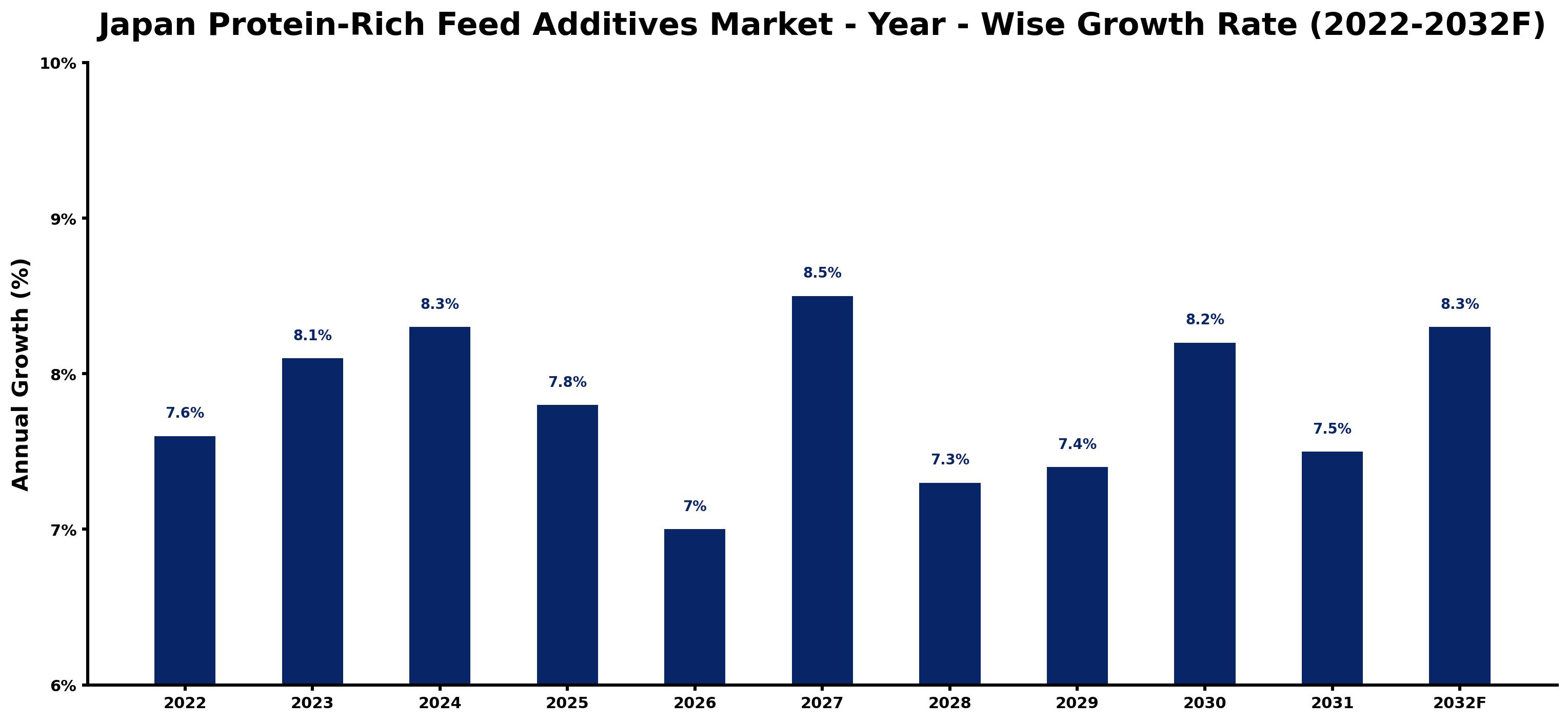
The following figures match every annual growth estimate with the main market development of that year, giving the reasoning behind each rise or slowdown.
| Year | Estimated Annual Growth (%) | Market Rationale |
| 2022 | 7.6 | The market showed steady growth, supported by strong demand from livestock farms. |
| 2023 | 8.1 | Growth accelerated due to increased adoption of protein-rich additives in feed formulations. |
| 2024 | 8.3 | The market continued to expand as poultry production increased, driving higher feed requirements. |
| 2025 | 7.8 | Growth slowed slightly as the market adjusted to previous rapid expansions in demand. |
| 2026 | 7.0 | A further slowdown is expected as market saturation begins to influence purchasing patterns. |
| 2027 | 8.5 | Demand is projected to surge again, driven by investments in sustainable agriculture practices. |
| 2028 | 7.3 | Growth is anticipated to slow once more as the market stabilises after the peak in 2027. |
| 2029 | 7.4 | An uptick in demand is expected as livestock farms seek to improve feed efficiency. |
| 2030 | 8.2 | Growth is set to accelerate again due to rising protein content requirements in livestock feed. |
| 2031 | 7.5 | A slowdown is projected as the market reaches a mature phase in its development. |
| 2032 | 8.3 | The market is expected to rebound with renewed interest in advanced feed solutions. |
Note: Market size estimations and growth projections presented in this report are based on 6Wresearch's proprietary forecasting methodology, utilizing the latest available industry data, government publications, and primary research inputs.
Japan Protein-Rich Feed Additives Market Synopsis
Protein-rich feed additives are substances that improve the nutritional value of animal feed, derived from plant, animal, or microbial sources. In Japan, the Protein-Rich Feed Additives Market is projected to reach 500,000 tons by 2025, driven by a growing poultry sector and a 10% increase in organic farming. Factors such as rising feed efficiency needs and investments in sustainable practices contribute to this expansion, as producers aim to optimise livestock health and productivity.
Market Dynamics Impact Analysis (2026–2032)
| Factor | Type | Impact | Primary Segment Affected |
| Increasing adoption of plant-based proteins in livestock feed | Driver | High | Plant-Based Protein |
| Rising demand from organic farms for natural feed solutions | Driver | High | Organic Farms |
| Growth in the organic farming sector creating demand for quality feed | Opportunity | High | Organic Farms |
| Emerging interest in fermentation-based protein sources | Opportunity | Medium | Fermentation-based |
| Stringent regulations governing feed safety and quality | Restraint | High | Animal-Based Protein |
| Limited awareness of newer protein sources among farmers | Restraint | Medium | Microbial Protein |
| High costs associated with sourcing quality protein additives | Challenge | High | Animal-Based Protein |
| Competition from alternative feed sources affecting market share | Challenge | Medium | Plant-Based Protein |
Evaluation of Drivers in Japan Protein-Rich Feed Additives Market (2026–2032)
The following drivers explain most of the expected growth.
| Drivers | Primary Segment Affected | Why It Matters (Evidence) |
| Growing livestock population increasing feed requirements | Animal-Based Protein | Japan's livestock population was approximately 4.5 million in 2022, driving demand for protein-rich additives. |
| Rising poultry production necessitating higher protein content in feed | Poultry Feed Producers | The poultry sector represents about 40% of total livestock production in Japan, increasing feed additive purchases. |
| Increase in organic farming leading to demand for natural feed solutions | Organic Farms | Organic farming in Japan has seen a 10% increase in the last three years, boosting demand for protein additives. |
| Focus on improving feed conversion ratios among livestock | Livestock Farms | The average feed conversion ratio for poultry is 1.6:1, prompting farms to invest in better feed options. |
| Technological advancements in protein extraction and fermentation | Fermentation-based | Fermentation-based protein sources are gaining traction, attracting investment and improving feed formulations. |
What keeps demand rising is the growing livestock population, which was approximately 4.5 million in 2022, prompting increased purchases of protein-rich additives. The poultry sector, representing about 40% of total livestock production, necessitates higher protein content in feed, further driving demand. The increase in organic farming, which has grown by 10% over the last three years, creates a strong market for natural feed solutions. The average feed conversion ratio for poultry, currently at 1.6:1, drives farmers to invest in better feed options. Recent advancements in protein extraction and fermentation are attracting new investments, improving the nutritional profiles of feed products.
Evaluation of Restraints in Japan Protein-Rich Feed Additives Market
Several factors work against faster growth; the main ones are summarised below.
| Market Restraint | Primary Segment Affected | Why It Matters (Evidence) |
| Stringent regulations impacting the approval process for feed additives | Animal-Based Protein | Japan has stringent regulations for animal feed additives to ensure safety, complicating market entry and increasing costs. |
| Limited awareness of alternative protein sources among farmers | Microbial Protein | Farmers often prefer traditional protein sources, limiting the adoption of newer options and slowing market growth. |
| High costs associated with sourcing quality protein additives | Animal-Based Protein | Sourcing quality additives can be expensive, affecting profitability for livestock producers and limiting their purchasing power. |
| Competition from alternative feed sources affecting market share | Plant-Based Protein | Alternative feed sources are increasingly being adopted, challenging the dominance of traditional proteins and impacting market dynamics. |
| Market saturation limiting growth potential in established segments | Plant-Based Protein | As the market matures, growth rates are expected to stabilise, limiting rapid expansion and new investments. |
Japan Protein-Rich Feed Additives Market Challenges
Buyers in Japan's livestock sector face rising costs due to a 5% increase in soybean imports, which directly raises feed prices and squeezes profit margins. Competition intensifies as organic farming grows by 10% over the last three years, forcing traditional livestock producers to adapt or risk losing customers. A shortage of skilled workers in fermentation techniques hampers innovation, delaying new product introductions for feed manufacturers. Supply chain inefficiencies in the Tokyo region lead to longer distribution times, increasing operational costs for producers and affecting their ability to meet market demand.
Trends in the Japan Protein-Rich Feed Additives Market
The following changes are redrawing the Japan Protein-Rich Feed Additives Market.
- Shift towards Fermentation-Based Proteins: Fermentation-based protein sources have gained traction in Japan's feed industry, with notable interest from livestock farms. This shift is supported by government-funded projects exploring algae use in feed, reflecting a growing trend towards sustainable practices.
- Increase in Organic Farming Practices: Since 2020, organic farming in Japan has increased by 10%, prompting a greater demand for natural feed solutions. This trend is evident in the growing area of organic farming, which now covers approximately 70,000 hectares.
- Rising Demand for Plant-Based Proteins: The use of plant-based proteins in livestock feed is increasing by 15% annually, driven by health-conscious consumer trends. This shift is particularly notable among organic farms seeking to enhance feed quality and sustainability.
- Growth of Direct Sales Channels: Direct sales channels have become increasingly popular, accounting for 38% of the market share in 2025. This trend reflects the need for livestock farms to source feed additives directly from suppliers for better pricing and quality assurance.
Investment Opportunities in the Japan Protein-Rich Feed Additives Market
Several openings in the Japan Protein-Rich Feed Additives Market merit attention from investors.
- Rising Demand for Sustainable Feed Solutions: With organic farming increasing by 10%, there is a growing need for natural feed additives. Suppliers can target organic farms, which accounted for 48% of the market in 2025, by offering certified organic protein sources.
- Investment in Fermentation Technologies: Investment in fermentation technologies is on the rise, with government support for algae projects. This presents opportunities for suppliers to develop innovative protein sources that meet evolving market demands.
- Expansion of Direct Sales Channels: With direct sales channels holding 38% of the market share, suppliers can invest in online platforms to reach livestock farms more effectively and improve distribution efficiency.
- Growth in Poultry Feed Production: As the poultry sector represents 40% of total livestock production, suppliers should focus on enhancing protein content in poultry feed to meet increasing production demands.
Government Initiatives in the Japan Protein-Rich Feed Additives Market
The Food Recycling Law (2000) requires food businesses to reduce waste and recycle it into feed, fertiliser, and energy, directly impacting producers by ensuring a sustainable source of feed materials. This law promotes the use of by-products in feed formulations, enhancing resource efficiency in the industry.
The Ministry of Agriculture, Forestry and Fisheries oversees the implementation of feed regulations, ensuring safety and quality standards are met. The government supports initiatives that encourage sustainable practices, including funding for research into alternative protein sources.
Future Insight of the Japan Protein-Rich Feed Additives Market
Investment in research and development will drive advancements in fermentation-based protein sources, meeting the growing demand for sustainable feed options by 2032. The increasing use of plant-based proteins, projected to rise by 15% annually, will create new opportunities for suppliers in the market. Government initiatives exploring algae in feed will enhance nutritional profiles, benefiting livestock health. As the livestock feed market approaches 500,000 tons by 2025, buyers will gain access to a broader range of products that improve feed efficiency.
Market Segmentation Analysis
Japan Protein-Rich Feed Additives Market report covers a detailed analysis of the following market segments:
By Product Type – Plant-Based Protein Leads, Animal-Based Protein Expected to Grow Fastest
According to Uttkarsh, Research Associate at 6Wresearch, in 2025, Plant-Based Protein led the product type split with a 37% share. Plant-based protein holds the largest share as it is widely used in animal feed for its nutritional benefits. This is crucial in a market where the average protein content in livestock feed is around 20-25%, ensuring optimal growth for livestock. The quickest growth will come from Animal-Based Protein, forecast to expand at a CAGR of 10.9% between 2026 and 2032. Animal-based protein is experiencing rapid growth due to its recognised benefits for livestock health and growth. The Japanese government's increasing focus on sustainable agriculture practices is further driving the demand for high-quality animal-based protein. Suppliers should prioritise the development of animal-based protein products to align with the growing market demand.
By Source Type – Soy Leads, Pea Expected to Grow Fastest
The largest source type category in 2025 was Soy, at 36% of revenue. Soy is the leading source of protein in livestock feed, accounting for a substantial portion of the market. The increase in soybean imports for feed by 5% in the last year underscores its critical role in the industry. Pea is set to record the highest CAGR in this split, 11.1% over 2026–2032. Pea protein is gaining traction due to its nutritional profile, appealing to a growing number of feed manufacturers. The 15% annual increase in the use of plant-based proteins indicates a shift towards more diverse protein sources. Buyers should consider diversifying their protein sources to include more pea protein to align with market trends.
By Distribution Channel – Online Platforms Lead, Direct Sales Expected to Grow Fastest
Online Platforms held 38% of the Japan Protein-Rich Feed Additives Market by distribution channel in 2025. Online platforms lead the market as they provide essential information and purchasing options for buyers. The trend of digital engagement among buyers highlights the importance of this channel in reaching a wider audience. Direct Sales is projected to grow fastest, at a CAGR of 10.2% during 2026–2032. Direct sales are the fastest-growing method for suppliers to engage directly with farms, improving communication and service delivery. This shift towards personalised interactions indicates a significant change in market dynamics. Suppliers need to strengthen their direct sales approaches to effectively engage with livestock farms.
By End User – Organic Farms Lead, Livestock Farms Expected to Grow Fastest
With 48% of end user revenue in 2025, Organic Farms was the largest category. Organic farms represent the largest segment due to their focus on natural feed solutions, reflecting the rising consumer demand for organic products. The total area for organic farming in Japan, approximately 70,000 hectares, underscores the segment's growth potential. Over 2026–2032, Livestock Farms are expected to post the fastest growth, at a CAGR of 10.1%. Livestock farms are the fastest-growing end user segment, being the primary consumers of feed additives. With Japan's livestock population at around 4.5 million, the demand for these additives is set to increase significantly. Suppliers should focus their marketing efforts on livestock farms to leverage this growth opportunity.
Key Attractiveness of the Report
- 10 Years of Market Numbers
- Historical Data Starting from 2022 to 2025
- Base Year 2025
- Forecast Data until 2032
- Key Performance Indicators Impacting the Market
- Major Upcoming Developments and Projects
Key Highlights of the Report:
- Japan Protein-Rich Feed Additives Market Outlook
- Market Size of Japan Protein-Rich Feed Additives Market, 2025
- Forecast of Japan Protein-Rich Feed Additives Market, 2032
- Historical Data and Forecast of Japan Protein-Rich Feed Additives Revenues & Volume for the Period 2022-2032F
- Japan Protein-Rich Feed Additives Market Trend Evolution
- Japan Protein-Rich Feed Additives Market Drivers and Challenges
- Japan Protein-Rich Feed Additives Price Trends
- Japan Protein-Rich Feed Additives Porter's Five Forces
- Japan Protein-Rich Feed Additives Industry Life Cycle
- Historical Data and Forecast of Japan Protein-Rich Feed Additives Market Revenues & Volume By Product Type for the Period 2022-2032F
- Historical Data and Forecast of Japan Protein-Rich Feed Additives Market Revenues & Volume By Plant-Based Protein for the Period 2022-2032F
- Historical Data and Forecast of Japan Protein-Rich Feed Additives Market Revenues & Volume By Animal-Based Protein for the Period 2022-2032F
- Historical Data and Forecast of Japan Protein-Rich Feed Additives Market Revenues & Volume By Microbial Protein for the Period 2022-2032F
- Historical Data and Forecast of Japan Protein-Rich Feed Additives Market Revenues & Volume By Single Cell Protein for the Period 2022-2032F
- Historical Data and Forecast of Japan Protein-Rich Feed Additives Market Revenues & Volume By Source Type for the Period 2022-2032F
- Historical Data and Forecast of Japan Protein-Rich Feed Additives Market Revenues & Volume By Soy, Pea for the Period 2022-2032F
- Historical Data and Forecast of Japan Protein-Rich Feed Additives Market Revenues & Volume By Blood Meal for the Period 2022-2032F
- Historical Data and Forecast of Japan Protein-Rich Feed Additives Market Revenues & Volume By Fermentation-based for the Period 2022-2032F
- Historical Data and Forecast of Japan Protein-Rich Feed Additives Market Revenues & Volume By Yeast/Algae for the Period 2022-2032F
- Historical Data and Forecast of Japan Protein-Rich Feed Additives Market Revenues & Volume By Distribution Channel for the Period 2022-2032F
- Historical Data and Forecast of Japan Protein-Rich Feed Additives Market Revenues & Volume By Online Platforms for the Period 2022-2032F
- Historical Data and Forecast of Japan Protein-Rich Feed Additives Market Revenues & Volume By Direct Sales for the Period 2022-2032F
- Historical Data and Forecast of Japan Protein-Rich Feed Additives Market Revenues & Volume By Industrial Suppliers for the Period 2022-2032F
- Historical Data and Forecast of Japan Protein-Rich Feed Additives Market Revenues & Volume By Specialty Stores for the Period 2022-2032F
- Historical Data and Forecast of Japan Protein-Rich Feed Additives Market Revenues & Volume By End User for the Period 2022-2032F
- Historical Data and Forecast of Japan Protein-Rich Feed Additives Market Revenues & Volume By Organic Farms for the Period 2022-2032F
- Historical Data and Forecast of Japan Protein-Rich Feed Additives Market Revenues & Volume By Livestock Farms for the Period 2022-2032F
- Historical Data and Forecast of Japan Protein-Rich Feed Additives Market Revenues & Volume By Pet Food Manufacturers for the Period 2022-2032F
- Historical Data and Forecast of Japan Protein-Rich Feed Additives Market Revenues & Volume By Poultry Feed Producers for the Period 2022-2032F
- Japan Protein-Rich Feed Additives Import Export Trade Statistics
- Market Opportunity Assessment By Product Type
- Market Opportunity Assessment By Source Type
- Market Opportunity Assessment By Distribution Channel
- Market Opportunity Assessment By End User
- Japan Protein-Rich Feed Additives Top Companies Market Share
- Japan Protein-Rich Feed Additives Competitive Benchmarking By Technical and Operational Parameters
- Japan Protein-Rich Feed Additives Company Profiles
- Japan Protein-Rich Feed Additives Key Strategic Recommendations
Market Covered
The report covers the following segments.
By Product Type
- Plant-Based Protein
- Animal-Based Protein
- Microbial Protein
- Single Cell Protein
By Source Type
- Soy
- Pea
- Blood Meal
- Fermentation-based
- Yeast/Algae
By Distribution Channel
- Online Platforms
- Direct Sales
- Industrial Suppliers
- Specialty Stores
By End User
- Organic Farms
- Livestock Farms
- Pet Food Manufacturers
- Poultry Feed Producers






































