Japan Public Transport Fare Systems Market Size & Growth Rate
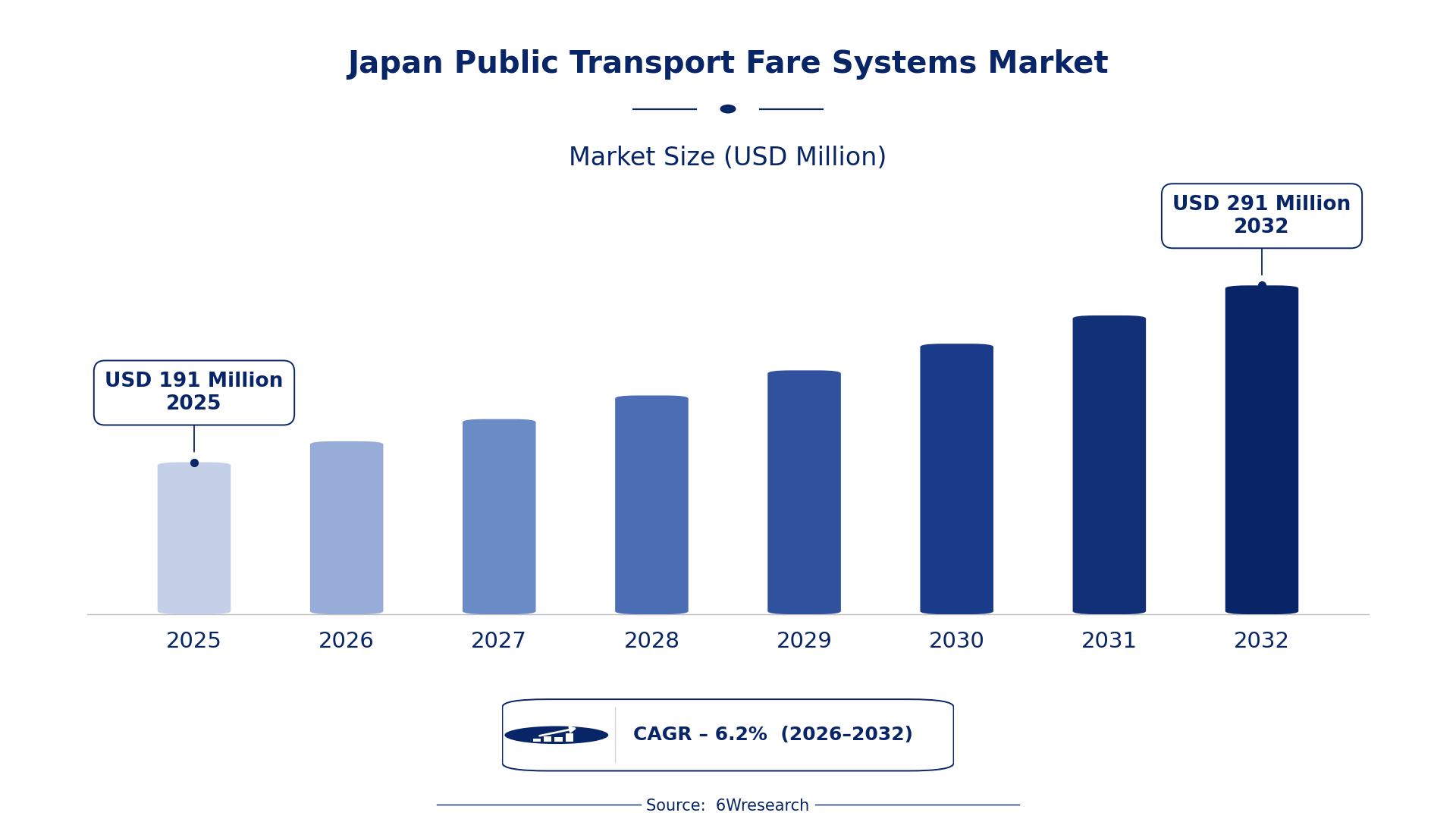
According to 6Wresearch internal database and industry insights, the Japan Public Transport Fare Systems Market was valued at USD 191 Million in 2025 and is projected to reach USD 291 Million by 2032, growing at a CAGR of approximately 6.2% during 2026–2032.
Japan Public Transport Fare Systems Market Highlights
| Report Metric | Details |
| Report Name | Japan Public Transport Fare Systems Market (2026-2032) |
| Market Size 2025 | USD 191 Million |
| Market Size 2032 | USD 291 Million |
| Absolute Growth 2025–2032 | USD 100 Million |
| CAGR 2026–2032 | 6.2% |
| Peak Annual Growth | 7.0% in 2032 |
| Forecast Period | 2026–2032 |
| Historical Data | 2022–2025 |
| Base Year | 2025 |
| Leading Fare Collection Type, 2025 | Contactless Cards (42% share) |
| Leading Technology Type, 2025 | RFID (46% share) |
| Leading Mode of Payment, 2025 | Prepaid Card (45% share) |
| Leading End User, 2025 | Urban Transit Agencies (45% share) |
| Fastest-Growing Fare Collection Type | Mobile Ticketing (9.2% CAGR) |
| Fastest-Growing Technology Type | QR Code (8.8% CAGR) |
| Fastest-Growing Mode of Payment | Mobile Wallet (8.5% CAGR) |
| Fastest-Growing End User | Commuters (8.1% CAGR) |
| Growing Sector | Public Transport |
| Key End Users | Urban Transit Agencies, Commuters, Metro Rail Corporations |
Japan Public Transport Fare Systems Market Year-wise Growth Rate and Key Drivers (2022–2032)
This graph illustrates the annual growth rates of the market from 2022 to 2032, highlighting a steady upward trajectory and projected market expansion over the forecast period.
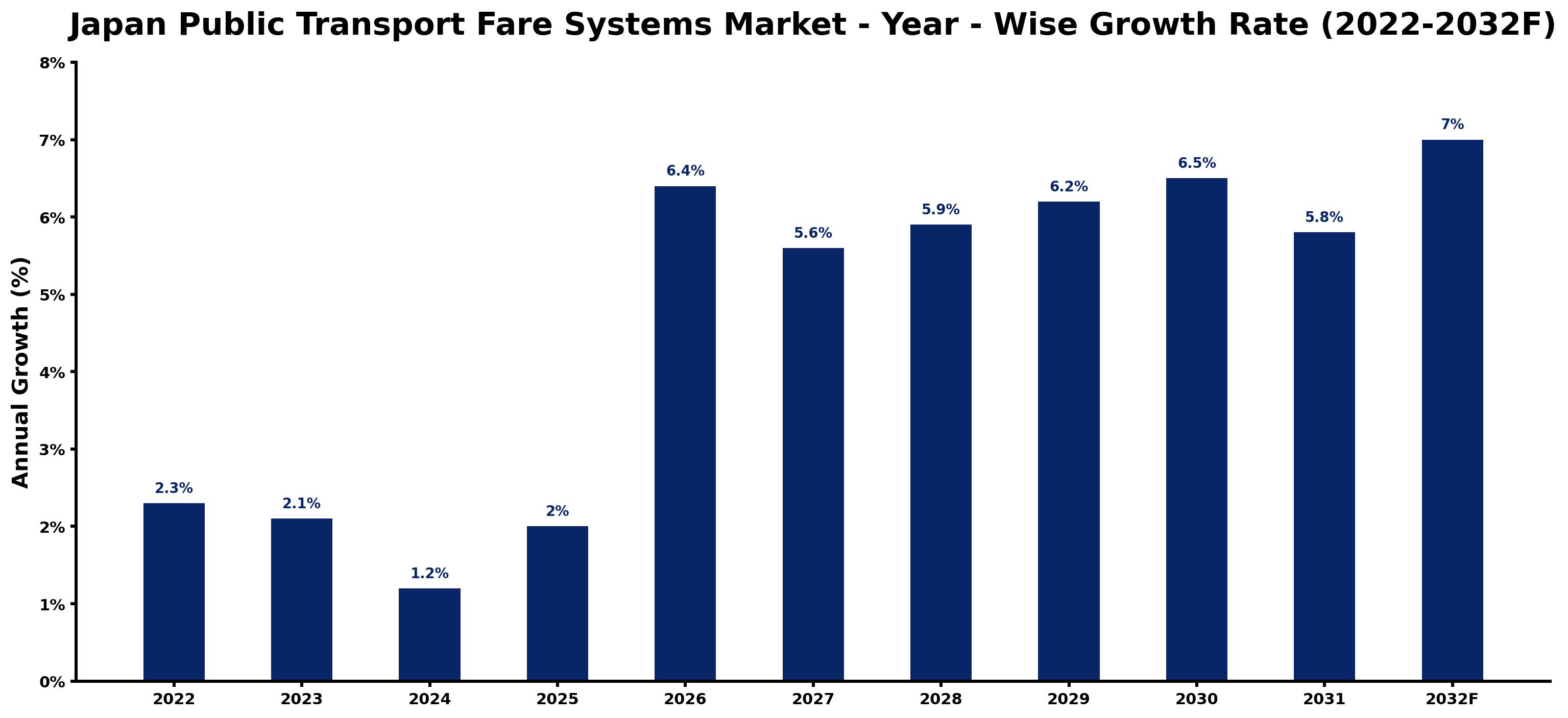
The yearly estimates that follow link every growth rate to its principal driver, so readers can see why the pace changed in each period.
| Year | Estimated Annual Growth (%) | Market Rationale |
| 2022 | 2.3 | The market experienced steady growth as urban transit agencies expanded services. |
| 2023 | 2.1 | Growth slowed slightly due to market saturation in major urban areas. |
| 2024 | 1.2 | Demand continued to slow as mobile ticketing adoption began to plateau. |
| 2025 | 2.0 | Growth picked up again as urban transit agencies invested in new technologies. |
| 2026 | 6.4 | The market is expected to surge as mobile ticketing gains traction among commuters. |
| 2027 | 5.6 | Growth is projected to slow again as competition intensifies among fare system providers. |
| 2028 | 5.9 | Demand is expected to increase as urban transit agencies upgrade their fare systems. |
| 2029 | 6.2 | The market will continue to grow as contactless payment methods gain popularity. |
| 2030 | 6.5 | Growth is projected to accelerate as the Tokyo Metropolitan Government implements new fare systems. |
| 2031 | 5.8 | The market will see a slight slowdown as existing systems reach maturity. |
| 2032 | 7.0 | Demand is expected to peak as advanced technologies are fully integrated into fare systems. |
Note: Market size estimations and growth projections presented in this report are based on 6Wresearch's proprietary forecasting methodology, utilizing the latest available industry data, government publications, and primary research inputs.
Japan Public Transport Fare Systems Market Synopsis
Public Transport Fare Systems in Japan utilise contactless payment technologies like RFID and QR codes for efficient fare collection. The Japan Public Transport Fare Systems Market is growing due to increased commuter demand, with over 70% of transactions in urban areas being contactless. Urban transit agencies are investing heavily in modernising their fare systems, as shown by the Tokyo Metropolitan Government's smart transport initiative launched in 2023, which aims to improve commuter convenience and operational efficiency.
Market Dynamics Impact Analysis (2026–2032)
| Factor | Type | Impact | Primary Segment Affected |
| Rising commuter numbers drive demand for efficient fare collection systems. | Driver | High | Urban Transit Agencies |
| Investment in smart transport initiatives creates opportunities for advanced fare systems. | Opportunity | High | Mobile Ticketing |
| Increased adoption of contactless payment methods enhances user convenience. | Driver | High | Contactless Cards |
| Growing smartphone penetration supports mobile ticketing solutions. | Opportunity | Medium | Mobile Wallet |
| High initial investment costs can deter smaller transit agencies from upgrading systems. | Restraint | High | Urban Transit Agencies |
| Regulatory compliance requirements can slow down system upgrades. | Restraint | Medium | Contactless Cards |
| Technological integration challenges can delay implementation of new systems. | Challenge | High | Mobile Ticketing |
| Competition among providers may lead to price wars, affecting profitability. | Challenge | Medium | Contactless Cards |
Evaluation of Drivers in Japan Public Transport Fare Systems Market (2026–2032)
The following drivers explain most of the expected growth.
| Drivers | Primary Segment Affected | Why It Matters (Evidence) |
| Investment in smart transport initiatives increases system upgrades. | Urban Transit Agencies | The Tokyo Metropolitan Government's initiative aims to modernise fare systems, driving demand for new technologies. |
| Growing commuter numbers necessitate efficient fare collection solutions. | Contactless Cards | Tokyo's public transport system serves over 9 million passengers daily, increasing the need for streamlined payment methods. |
| Rising smartphone usage facilitates mobile ticketing adoption. | Mobile Ticketing | With mobile wallet usage at over 80%, commuters are increasingly opting for digital ticketing solutions. |
| Increased focus on user convenience drives contactless payment adoption. | NFC | Over 70% of fare transactions in urban areas are now contactless, reflecting a shift in consumer preferences. |
| Technological advancements in fare systems improve operational efficiency. | Contactless Cards | ISO 9001 standards ensure quality management, prompting agencies to upgrade their systems. |
Commuter numbers are rising, with Tokyo's public transport serving over 9 million passengers daily, necessitating efficient fare collection solutions. The adoption of mobile wallets has surged, with NFC technology implemented in over 80% of these wallets, facilitating mobile ticketing. More than 70% of fare transactions in urban areas are contactless, reflecting a shift towards user convenience and streamlined payment methods. Advancements in fare systems, guided by ISO 9001 standards, are driving demand for upgrades and new implementations.
Evaluation of Restraints in Japan Public Transport Fare Systems Market
The table below lists the restraints and the evidence behind each.
| Market Restraint | Primary Segment Affected | Why It Matters (Evidence) |
| High initial investment costs deter smaller transit agencies from upgrading systems. | Urban Transit Agencies | Many smaller agencies struggle to allocate budgets for advanced fare technologies, limiting their operational efficiency. |
| Regulatory compliance requirements can slow down system upgrades. | Contactless Cards | Transit agencies must adhere to stringent regulations, which can delay the implementation of new technologies. |
| Integration challenges with existing systems hinder new technology adoption. | Mobile Ticketing | Transit agencies face difficulties in integrating mobile ticketing with legacy systems, affecting user experience. |
| Limited public awareness of new fare technologies restricts adoption. | Contactless Cards | Despite advancements, many commuters remain unaware of the benefits of contactless payment options. |
| Competition among providers may lead to price wars, affecting profitability. | Contactless Cards | Intensifying competition can drive down prices, impacting the financial sustainability of fare system providers. |
Japan Public Transport Fare Systems Market Challenges
One major obstacle in public transport fare systems is the supply of components, which often leads to production delays for manufacturers. This situation arises from reliance on specific suppliers, causing urban transit agencies to face budget overruns and project postponements. Technology integration issues persist as producers encounter difficulties in adopting new payment methods, resulting in inefficiencies that hinder buyers from accessing updated fare solutions. Regulatory changes from the Ministry of Land, Infrastructure, Transport and Tourism require costly adjustments, inflating operational expenses for urban transit agencies by approximately 15%.
Trends in the Japan Public Transport Fare Systems Market
Below are the shifts with the largest effect on the Japan Public Transport Fare Systems Market.
- Shift from Cash to Contactless Payments: Since 2023, urban transit agencies have increasingly adopted contactless payment methods, with over 70% of transactions now cashless. This trend enhances commuter convenience and reduces transaction times.
- Rise of Mobile Ticketing: Mobile ticketing adoption surged by 30% in the last year, driven by the growing smartphone user base. This shift allows commuters to purchase tickets seamlessly, improving overall travel experience.
- Integration of Fare Systems with Urban Planning: The Smart City initiative launched by the Tokyo Metropolitan Government in 2023 aims to integrate fare systems with urban infrastructure. This approach enhances operational efficiency and commuter convenience.
- Emergence of Biometric Fare Gates: Biometric fare gates are currently being tested in select Tokyo stations, reflecting a trend towards improved security in fare collection. This innovation aims to streamline access while enhancing safety.
Investment Opportunities in the Japan Public Transport Fare Systems Market
The openings below show where demand in the Japan Public Transport Fare Systems Market is visible and how suppliers can enter.
- Partnerships with Urban Transit Agencies: Urban transit agencies are seeking advanced fare systems, presenting opportunities for technology providers. The Tokyo Metropolitan Bureau of Transportation is implementing a new fare system by 2025.
- Supply of Mobile Wallet Solutions: With over 80% of mobile wallets used for transport featuring NFC technology, there is a gap in mobile ticketing solutions. Technology providers can partner with urban transit agencies to fill this need.
- Investment in Biometric Technologies: As biometric fare gates are tested in select stations, there is an opportunity to invest in biometric technologies for improved security. Urban transit agencies are keen on enhancing safety measures.
- Development of QR Code Ticketing Solutions: With QR code ticketing now available in over 100 cities, there is a growing demand for innovative solutions. Technology providers can enter this market through local partnerships.
Government Initiatives in the Japan Public Transport Fare Systems Market
The PMD Act regulates the approval and quality of public transport fare systems, ensuring that manufacturers adhere to strict standards. Compliance with this law is essential for urban transit agencies to maintain operational efficiency and passenger safety. The Ministry of Land, Infrastructure, Transport and Tourism oversees the implementation of these regulations, impacting how fare systems are developed and operated.
The Ministry of Internal Affairs and Communications supports digital payment initiatives, approving funding for projects that improve fare collection technologies. This agency facilitates the integration of advanced systems, ensuring that urban transit agencies can modernise their fare collection methods effectively.
Future Insight of the Japan Public Transport Fare Systems Market
Urban transit agencies will adopt more integrated fare systems by 2032, driven by the Smart City initiative connecting transport with urban planning. Mobile ticketing adoption is expected to rise, with projections indicating that over 70% of transactions will be contactless. The Tokyo Metropolitan Bureau of Transportation's new fare system rollout will enhance user experience across more than 1,000 stations. Research from the Japan Railway Technical Research Institute will lead to advancements in fare technology, allowing suppliers to better meet buyer demands.
Market Segmentation Analysis
Japan Public Transport Fare Systems Market report covers a detailed analysis of the following market segments:
By Fare Collection Type – Contactless Cards Lead, Mobile Ticketing Expected to Grow Fastest
According to Saurav Kr Singh, Senior Research Analyst at 6Wresearch, the largest fare collection type category in 2025 was Contactless Cards, at 42% of revenue. Contactless cards dominate the market as they are extensively used for quick fare payments in Japan's urban transit systems. The Suica card exemplifies this trend, facilitating seamless travel for millions of passengers daily. Over 2026–2032, Mobile Ticketing is expected to post the fastest growth, at a CAGR of 9.2%. Mobile ticketing is experiencing rapid growth, marked by a 30% increase in adoption over the last year. This surge is attributed to the convenience it offers users in purchasing tickets via their smartphones. Suppliers should prioritise the development of mobile ticketing solutions to align with the rising demand from commuters.
By Technology Type – RFID Leads, QR Code Expected to Grow Fastest
In 2025, RFID led the technology type split with a 46% share. RFID technology underpins contactless fare systems, enabling efficient transactions for millions of users daily. Its critical role is evident in systems like the Tokyo Metro, which operates multiple lines. The quickest growth will come from QR Code, forecast to expand at a CAGR of 8.8% between 2026 and 2032. QR code technology is gaining traction, especially for mobile ticketing and fare validation, allowing quick access to transport services. Currently, QR code ticketing is available in over 100 cities across Japan, reflecting its expanding use. Suppliers should consider investing in QR code technology to enhance their offerings in the competitive fare system market.
By Mode of Payment – Prepaid Card Leads, Mobile Wallet Expected to Grow Fastest
Prepaid Card held 45% of the Japan Public Transport Fare Systems Market by mode of payment in 2025. Prepaid cards are the most common method for advance fare payments, making them essential for urban transit agencies in Japan. With over 50% of transactions at JR East being via prepaid cards, their popularity is well-established. Mobile Wallet is projected to grow fastest, at a CAGR of 8.5% during 2026–2032. Mobile wallets are rapidly gaining popularity for fare transactions, reflecting a shift towards digital payment methods. The integration of NFC technology in over 80% of mobile wallets is a key factor in this growth. Suppliers should prioritise the development of mobile wallet compatibility to align with changing consumer preferences.
By End User – Urban Transit Agencies Lead, Commuters Expected to Grow Fastest
With 45% of end user revenue in 2025, Urban Transit Agencies was the largest category. Urban transit agencies are the primary users of fare systems, utilising these technologies to streamline fare collection processes effectively. Their continuous investments in infrastructure ensure a consistent demand for advanced fare solutions. Commuters are set to record the highest CAGR in this split, 8.1% over 2026–2032. Commuters benefit greatly from efficient fare collection, which drives the demand for more convenient payment options. With Tokyo's population nearing 14 million, the necessity for streamlined systems will continue to grow. Suppliers must focus on understanding commuter preferences to effectively capture market share in the public transport sector.
Key Attractiveness of the Report
- 10 Years of Market Numbers
- Historical Data Starting from 2022 to 2025
- Base Year 2025
- Forecast Data until 2032
- Key Performance Indicators Impacting the Market
- Major Upcoming Developments and Projects
Key Highlights of the Report:
- Japan Public Transport Fare Systems Market Outlook
- Market Size of Japan Public Transport Fare Systems Market, 2025
- Forecast of Japan Public Transport Fare Systems Market, 2032
- Historical Data and Forecast of Japan Public Transport Fare Systems Revenues & Volume for the Period 2022-2032F
- Japan Public Transport Fare Systems Market Trend Evolution
- Japan Public Transport Fare Systems Market Drivers and Challenges
- Japan Public Transport Fare Systems Price Trends
- Japan Public Transport Fare Systems Porter's Five Forces
- Japan Public Transport Fare Systems Industry Life Cycle
- Historical Data and Forecast of Japan Public Transport Fare Systems Market Revenues & Volume By Fare Collection Type for the Period 2022-2032F
- Historical Data and Forecast of Japan Public Transport Fare Systems Market Revenues & Volume By Contactless Cards for the Period 2022-2032F
- Historical Data and Forecast of Japan Public Transport Fare Systems Market Revenues & Volume By Mobile Ticketing for the Period 2022-2032F
- Historical Data and Forecast of Japan Public Transport Fare Systems Market Revenues & Volume By Smart Tokens for the Period 2022-2032F
- Historical Data and Forecast of Japan Public Transport Fare Systems Market Revenues & Volume By Biometric Fare Gates for the Period 2022-2032F
- Historical Data and Forecast of Japan Public Transport Fare Systems Market Revenues & Volume By Technology Type for the Period 2022-2032F
- Historical Data and Forecast of Japan Public Transport Fare Systems Market Revenues & Volume By RFID for the Period 2022-2032F
- Historical Data and Forecast of Japan Public Transport Fare Systems Market Revenues & Volume By QR Code for the Period 2022-2032F
- Historical Data and Forecast of Japan Public Transport Fare Systems Market Revenues & Volume By NFC for the Period 2022-2032F
- Historical Data and Forecast of Japan Public Transport Fare Systems Market Revenues & Volume By Facial Recognition for the Period 2022-2032F
- Historical Data and Forecast of Japan Public Transport Fare Systems Market Revenues & Volume By Mode of Payment for the Period 2022-2032F
- Historical Data and Forecast of Japan Public Transport Fare Systems Market Revenues & Volume By Prepaid Card for the Period 2022-2032F
- Historical Data and Forecast of Japan Public Transport Fare Systems Market Revenues & Volume By Mobile Wallet for the Period 2022-2032F
- Historical Data and Forecast of Japan Public Transport Fare Systems Market Revenues & Volume By Debit/Credit Card for the Period 2022-2032F
- Historical Data and Forecast of Japan Public Transport Fare Systems Market Revenues & Volume By Biometric Authentication for the Period 2022-2032F
- Historical Data and Forecast of Japan Public Transport Fare Systems Market Revenues & Volume By End User for the Period 2022-2032F
- Historical Data and Forecast of Japan Public Transport Fare Systems Market Revenues & Volume By Urban Transit Agencies for the Period 2022-2032F
- Historical Data and Forecast of Japan Public Transport Fare Systems Market Revenues & Volume By Commuters for the Period 2022-2032F
- Historical Data and Forecast of Japan Public Transport Fare Systems Market Revenues & Volume By Metro Rail Corporations for the Period 2022-2032F
- Historical Data and Forecast of Japan Public Transport Fare Systems Market Revenues & Volume By High-Security Transit Systems for the Period 2022-2032F
- Japan Public Transport Fare Systems Import Export Trade Statistics
- Market Opportunity Assessment By Fare Collection Type
- Market Opportunity Assessment By Technology Type
- Market Opportunity Assessment By Mode of Payment
- Market Opportunity Assessment By End User
- Japan Public Transport Fare Systems Top Companies Market Share
- Japan Public Transport Fare Systems Competitive Benchmarking By Technical and Operational Parameters
- Japan Public Transport Fare Systems Company Profiles
- Japan Public Transport Fare Systems Key Strategic Recommendations
Market Covered
The report covers the following segments.
By Fare Collection Type
- Contactless Cards
- Mobile Ticketing
- Smart Tokens
- Biometric Fare Gates
By Technology Type
- RFID
- QR Code
- NFC
- Facial Recognition
By Mode of Payment
- Prepaid Card
- Mobile Wallet
- Debit/Credit Card
- Biometric Authentication
By End User
- Urban Transit Agencies
- Commuters
- Metro Rail Corporations
- High-Security Transit Systems































