Japan Public Transport Information Systems Market Size & Growth Rate
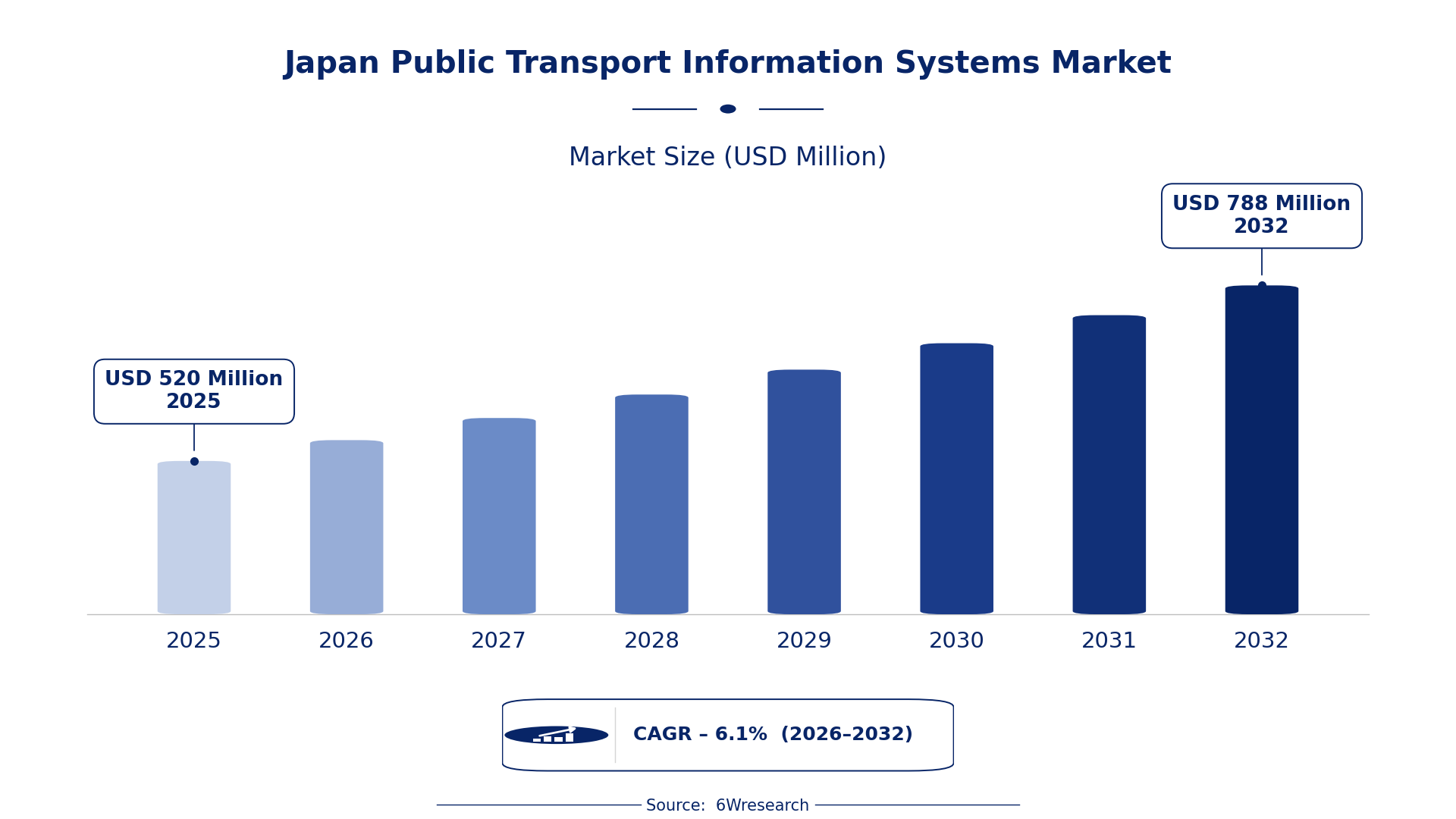
According to 6Wresearch internal database and industry insights, the Japan Public Transport Information Systems Market was valued at USD 520 Million in 2025 and is projected to reach USD 788 Million by 2032, growing at a CAGR of approximately 6.1% during 2026–2032.
Japan Public Transport Information Systems Market Highlights
| Report Metric | Details |
| Report Name | Japan Public Transport Information Systems Market (2026-2032) |
| Market Size 2025 | USD 520 Million |
| Market Size 2032 | USD 788 Million |
| Absolute Growth 2025–2032 | USD 268 Million |
| CAGR 2026–2032 | 6.1% |
| Peak Annual Growth | 6.7% in 2032 |
| Forecast Period | 2026–2032 |
| Historical Data | 2022–2025 |
| Base Year | 2025 |
| Leading System Type, 2025 | Real-Time Tracking (48% share) |
| Leading Technology Used, 2025 | GPS & IoT Sensors (35% share) |
| Leading Delivery Mode, 2025 | Cloud-Based (42% share) |
| Leading End User, 2025 | Metro Stations (36% share) |
| Fastest-Growing System Type | Mobile App Integration (8.9% CAGR) |
| Fastest-Growing Technology Used | 4G/5G Connectivity (9.4% CAGR) |
| Fastest-Growing Delivery Mode | App-Based (8.0% CAGR) |
| Fastest-Growing End User | Commuters (7.9% CAGR) |
| Growing Sector | Public Transport |
| Key End Users | Commuters, Metro Stations, Bus Operators, Railway Authorities |
Japan Public Transport Information Systems Market Year-wise Growth Rate and Key Drivers (2022–2032)
This graph illustrates the annual growth rates of the market from 2022 to 2032, highlighting a steady upward trajectory and projected market expansion over the forecast period.
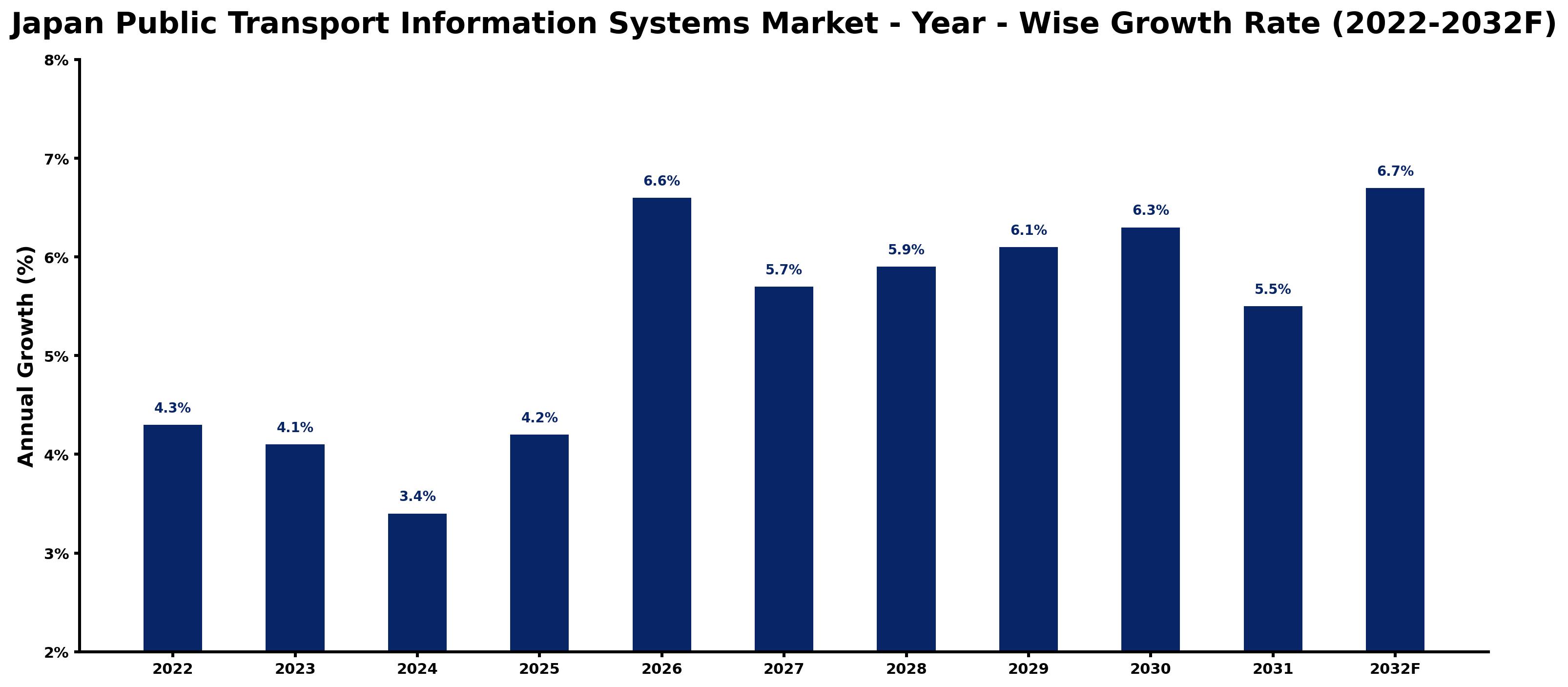
Year by year, the estimates below pair each growth rate with the development that shaped it.
| Year | Estimated Annual Growth (%) | Market Rationale |
| 2022 | 4.3 | The market was characterised by strong demand from urban commuters and technological advancements. |
| 2023 | 4.1 | Growth slowed due to market saturation in some urban areas and increased competition. |
| 2024 | 3.4 | The market continued to grow, albeit at a slower pace, as new technologies were integrated. |
| 2025 | 4.2 | Demand increased as cities invested in upgrading public transport systems for efficiency. |
| 2026 | 6.6 | Growth is expected to accelerate with greater adoption of mobile app integration among commuters. |
| 2027 | 5.7 | The market is projected to experience a slowdown as some regions face infrastructure challenges. |
| 2028 | 5.9 | Demand is expected to rise again as cities improve their transport systems with IoT technologies. |
| 2029 | 6.1 | Growth is projected to continue as public transport systems expand their digital capabilities. |
| 2030 | 6.3 | The market is expected to see steady growth driven by increased commuter reliance on mobile apps. |
| 2031 | 5.5 | Growth is projected to slow slightly as urban transport systems reach maturity. |
| 2032 | 6.7 | The market is expected to peak as cities implement advanced technologies for real-time tracking. |
Note: Market size estimations and growth projections presented in this report are based on 6Wresearch's proprietary forecasting methodology, utilizing the latest available industry data, government publications, and primary research inputs.
Japan Public Transport Information Systems Market Synopsis
Public Transport Information Systems in Japan integrate various technologies to improve public transport efficiency, including GPS and IoT sensors. The market is projected to grow, driven by over 100 million mobile app users seeking real-time information and continuous investment in transport technology upgrades, highlighted by Tokyo's ¥1 billion budget for 2023.
Market Dynamics Impact Analysis (2026–2032)
| Factor | Type | Impact | Primary Segment Affected |
| Increased urbanisation leads to higher demand for efficient transport solutions. | Driver | High | Real-Time Tracking |
| Technological advancements in IoT and GPS enhance system capabilities. | Driver | High | GPS & IoT Sensors |
| Growing commuter base in major cities creates a need for better information systems. | Opportunity | High | Mobile App Integration |
| Investment in transport technology upgrades is rising, particularly in metropolitan areas. | Opportunity | High | Cloud-Based |
| High initial investment costs may deter smaller operators from upgrading systems. | Restraint | Medium | Passenger Info Displays |
| Regulatory compliance can be complex and burdensome for new entrants. | Restraint | Medium | Voice Announcements |
| Competition among technology providers can lead to pricing pressures. | Challenge | High | GPS & IoT Sensors |
| Rapid technological changes may outpace some operators' abilities to adapt. | Challenge | Medium | Mobile App Integration |
Evaluation of Drivers in Japan Public Transport Information Systems Market (2026–2032)
The factors lifting demand, and the evidence behind each, are summarised below.
| Drivers | Primary Segment Affected | Why It Matters (Evidence) |
| Investment in GPS & IoT Sensors | GPS & IoT Sensors | This technology enhances tracking capabilities, leading to a 35% share in 2025 as transport authorities seek efficient solutions. |
| Growing mobile app usage | Mobile App Integration | With over 100 million users, the demand for integrated systems is rising, driving an 8.9% CAGR from 2026 to 2032. |
| Increased daily ridership | Passenger Info Displays | Tokyo's metro system, with over 7 million daily riders, necessitates real-time information displays, boosting demand for these systems. |
| Government funding for transport upgrades | Cloud-Based | The Tokyo Metropolitan Government's ¥1 billion budget for 2023 supports the adoption of cloud-based solutions, which hold a 42% market share. |
| Focus on accessibility features | Voice Announcements | The introduction of voice announcement systems in 2023 enhances accessibility, aligning with user needs and improving overall experience. |
Buyers are adding capacity as urbanisation drives the demand for efficient public transport solutions. The integration of GPS and IoT sensors improves operational efficiency, prompting transport authorities to invest in advanced tracking systems. With over 100 million mobile app users, demand for integrated transport information systems is rising. The average daily ridership of Tokyo's metro system, exceeding 7 million passengers, necessitates improved passenger information displays. Continuous investments in technology upgrades, such as Tokyo's ¥1 billion budget for 2023, further stimulate market growth.
Evaluation of Restraints in Japan Public Transport Information Systems Market
Below are the constraints most often cited by buyers and suppliers, with the segment each affects.
| Market Restraint | Primary Segment Affected | Why It Matters (Evidence) |
| High initial investment costs deter smaller operators from upgrading systems. | Passenger Info Displays | Smaller transport operators may struggle to afford the necessary upgrades, limiting their competitiveness. |
| Regulatory compliance can be complex and burdensome for new entrants. | Voice Announcements | Navigating regulatory requirements can delay implementation for new operators, impacting their market entry. |
| Limited awareness of advanced technologies among some operators hinders adoption. | Mobile App Integration | Some operators may lack knowledge of the latest technologies, slowing down system upgrades. |
| Intense competition among technology providers can lead to pricing pressures. | GPS & IoT Sensors | Competition may force providers to lower prices, affecting profitability for some suppliers. |
| Market saturation in certain urban areas limits growth potential. | Real-Time Tracking | As major cities reach saturation, the potential for new investments diminishes. |
Japan Public Transport Information Systems Market Challenges
Strict regulations delay the implementation of new technologies in public transport, with compliance checks taking up to six months, hindering timely upgrades for transport operators. The Ministry of Land, Infrastructure, Transport and Tourism enforces standards that complicate the integration of modern systems, causing inefficiencies for providers reliant on accurate data. Many operators struggle with outdated infrastructure that resists technological advancements, resulting in a 20% decrease in operational efficiency for buyers needing real-time information. Supply chain disruptions arise from dependence on specific components, leading to increased costs for operators, who may face a 15% rise in expenses when sourcing alternatives.
Trends in the Japan Public Transport Information Systems Market
The following changes are redrawing the Japan Public Transport Information Systems Market.
- Introduction of New Voice Announcement Systems: In 2023, Tokyo introduced a new voice announcement system to improve accessibility for visually impaired passengers. This initiative reflects a growing commitment to inclusivity in public transport, ensuring that all users receive timely information.
- Shift Towards Mobile App Integration: Commuters are increasingly relying on mobile applications for real-time transport information. This shift is evidenced by the growing number of mobile app users, which exceeds 100 million in Japan, indicating a strong demand for integrated solutions.
- Expansion of IoT Technologies in Public Transport: Kyoto's public transport system has integrated IoT sensors to improve operational efficiency. This change aligns with the broader trend of adopting smart technologies in urban transport, enhancing user experience and system reliability.
- Cloud-Based Solutions Gaining Popularity: Cloud-based systems are becoming the preferred choice for public transport operators, with a 42% share in 2025. This trend is driven by the need for scalable and efficient data management solutions in the transport sector.
Investment Opportunities in the Japan Public Transport Information Systems Market
The opportunities below stand out in the Japan Public Transport Information Systems Market for new entrants and existing suppliers.
- Metro Stations Seeking Advanced Information Systems: Metro stations are increasingly looking for advanced information systems to improve passenger experience. With the average daily ridership of Tokyo's metro system exceeding 7 million passengers, there is a clear opportunity for investment in real-time tracking technologies.
- Growing Demand for Mobile App Integration: The increasing number of mobile app users, over 100 million, highlights the demand for integrated transport solutions. Suppliers can enter this market by partnering with local transport authorities to develop user-friendly applications.
- Investment in Cloud-Based Solutions by Transport Authorities: Transport authorities are allocating budgets for technology upgrades, with Tokyo's ¥1 billion budget in 2023 as a prime example. Suppliers can collaborate with these authorities to provide cloud-based information systems.
- Expansion of IoT Sensor Integration in Public Transport: The integration of IoT sensors presents an opportunity for suppliers to improve operational efficiency. With cities like Kyoto adopting these technologies, there is a clear path for investment in smart transport solutions.
Government Initiatives in the Japan Public Transport Information Systems Market
The Digital Agency, established in September 2021, leads the government's digital transformation efforts. It oversees the implementation of common system standards, ensuring that public transport information systems meet modern technological requirements. This agency's initiatives are supported by the Building Energy Efficiency Act, which mandates energy-efficient standards for new public transport facilities by April 2025.
The Ministry of Land, Infrastructure, Transport and Tourism plays a critical role in approving and funding public transport projects. It monitors compliance with public transport standards and supports innovation programs through the National Institute of Advanced Industrial Science and Technology, which has allocated funding for various transport technology initiatives.
Future Insight of the Japan Public Transport Information Systems Market
Investment in transport technology will surge, supported by the Tokyo Metropolitan Government's budget of ¥1 billion for upgrades. This funding will create demand for advanced public transport solutions, particularly in real-time tracking and passenger information systems. By 2032, the integration of IoT sensors will streamline operations, benefiting both suppliers and transport operators. New accessibility features will improve user experience, attracting more riders and potentially increasing the average daily ridership of Tokyo's metro system beyond 8 million passengers.
Market Segmentation Analysis
Japan Public Transport Information Systems Market report covers a detailed analysis of the following market segments:
By System Type – Real-Time Tracking Leads, Mobile App Integration Expected to Grow Fastest
According to Saurav Kr Singh, Senior Research Analyst at 6Wresearch, the largest system type category in 2025 was Real-Time Tracking, at 48% of revenue. Real-Time Tracking holds the largest share because it is essential for providing updates on vehicle locations. This system is widely implemented in Tokyo, where the metro's average daily ridership exceeds 7 million passengers. Over 2026–2032, Mobile App Integration is expected to post the fastest growth, at a CAGR of 8.9%. Mobile App Integration is experiencing rapid growth as it significantly improves user experience by delivering transport information directly to smartphones. With over 100 million mobile app users in Japan, this segment is poised for substantial expansion. Suppliers should focus on mobile application development to cater to the increasing demand from commuters.
By Technology Used – GPS & IoT Sensors Lead, 4G/5G Connectivity Expected to Grow Fastest
With 35% of technology used revenue in 2025, GPS & IoT Sensors was the largest category. GPS & IoT Sensors lead the market as they are crucial for accurately tracking vehicle locations and ensuring operational efficiency. Their extensive use in cities like Osaka demonstrates their vital role in managing public transport effectively. The quickest growth will come from 4G/5G Connectivity, forecast to expand at a CAGR of 9.4% between 2026 and 2032. 4G/5G Connectivity is the fastest-growing segment because it facilitates rapid data transmission necessary for real-time updates. The rising demand for enhanced connectivity in urban environments is driving this growth. Investing in advanced connectivity solutions will be essential for suppliers to remain competitive.
By Delivery Mode – Cloud-Based Leads, App-Based Expected to Grow Fastest
Cloud-Based took 42% of delivery mode revenue in 2025, more than any other category. Cloud-Based systems lead the market as they enable efficient data storage and access for transport systems. This method is increasingly favoured by metro stations aiming to optimise their operations and service delivery. App-Based is projected to grow fastest, at a CAGR of 8.0% during 2026–2032. App-Based delivery is experiencing rapid growth since it provides users with convenient access to transport information via mobile applications. The surge in smartphone usage in Japan is a major factor driving this trend. Suppliers should focus on app development to cater to the expanding user base seeking easy access to transport information.
By End User – Metro Stations Lead, Commuters Expected to Grow Fastest
Metro Stations held 36% of the Japan Public Transport Information Systems Market by end user in 2025. Metro Stations represent the largest share as they integrate systems to improve passenger experience, making them vital in the public transport ecosystem. Their function in managing high volumes of daily commuters highlights their importance. Commuters are set to record the highest CAGR in this split, 7.9% over 2026–2032. Commuters are the fastest-growing segment as they are the primary users of information systems, driving the demand for real-time updates and mobile access. Their increasing reliance on technology for daily travel is a significant growth factor. Understanding commuter preferences will be crucial for suppliers aiming to enhance service offerings.
Key Attractiveness of the Report
- 10 Years of Market Numbers
- Historical Data Starting from 2022 to 2025
- Base Year 2025
- Forecast Data until 2032
- Key Performance Indicators Impacting the Market
- Major Upcoming Developments and Projects
Key Highlights of the Report:
- Japan Public Transport Information Systems Market Outlook
- Market Size of Japan Public Transport Information Systems Market, 2025
- Forecast of Japan Public Transport Information Systems Market, 2032
- Historical Data and Forecast of Japan Public Transport Information Systems Revenues & Volume for the Period 2022-2032F
- Japan Public Transport Information Systems Market Trend Evolution
- Japan Public Transport Information Systems Market Drivers and Challenges
- Japan Public Transport Information Systems Price Trends
- Japan Public Transport Information Systems Porter's Five Forces
- Japan Public Transport Information Systems Industry Life Cycle
- Historical Data and Forecast of Japan Public Transport Information Systems Market Revenues & Volume By System Type for the Period 2022-2032F
- Historical Data and Forecast of Japan Public Transport Information Systems Market Revenues & Volume By Real-Time Tracking for the Period 2022-2032F
- Historical Data and Forecast of Japan Public Transport Information Systems Market Revenues & Volume By Passenger Info Displays for the Period 2022-2032F
- Historical Data and Forecast of Japan Public Transport Information Systems Market Revenues & Volume By Mobile App Integration for the Period 2022-2032F
- Historical Data and Forecast of Japan Public Transport Information Systems Market Revenues & Volume By Voice Announcements for the Period 2022-2032F
- Historical Data and Forecast of Japan Public Transport Information Systems Market Revenues & Volume By Technology Used for the Period 2022-2032F
- Historical Data and Forecast of Japan Public Transport Information Systems Market Revenues & Volume By GPS & IoT Sensors for the Period 2022-2032F
- Historical Data and Forecast of Japan Public Transport Information Systems Market Revenues & Volume By LED & LCD Panels for the Period 2022-2032F
- Historical Data and Forecast of Japan Public Transport Information Systems Market Revenues & Volume By 4G/5G Connectivity for the Period 2022-2032F
- Historical Data and Forecast of Japan Public Transport Information Systems Market Revenues & Volume By Text-to-Speech Tech for the Period 2022-2032F
- Historical Data and Forecast of Japan Public Transport Information Systems Market Revenues & Volume By Delivery Mode for the Period 2022-2032F
- Historical Data and Forecast of Japan Public Transport Information Systems Market Revenues & Volume By Cloud-Based for the Period 2022-2032F
- Historical Data and Forecast of Japan Public Transport Information Systems Market Revenues & Volume By On-Site Hardware for the Period 2022-2032F
- Historical Data and Forecast of Japan Public Transport Information Systems Market Revenues & Volume By App-Based for the Period 2022-2032F
- Historical Data and Forecast of Japan Public Transport Information Systems Market Revenues & Volume By Embedded Systems for the Period 2022-2032F
- Historical Data and Forecast of Japan Public Transport Information Systems Market Revenues & Volume By End User for the Period 2022-2032F
- Historical Data and Forecast of Japan Public Transport Information Systems Market Revenues & Volume By Bus Operators for the Period 2022-2032F
- Historical Data and Forecast of Japan Public Transport Information Systems Market Revenues & Volume By Metro Stations for the Period 2022-2032F
- Historical Data and Forecast of Japan Public Transport Information Systems Market Revenues & Volume By Commuters for the Period 2022-2032F
- Historical Data and Forecast of Japan Public Transport Information Systems Market Revenues & Volume By Railway Authorities for the Period 2022-2032F
- Japan Public Transport Information Systems Import Export Trade Statistics
- Market Opportunity Assessment By System Type
- Market Opportunity Assessment By Technology Used
- Market Opportunity Assessment By Delivery Mode
- Market Opportunity Assessment By End User
- Japan Public Transport Information Systems Top Companies Market Share
- Japan Public Transport Information Systems Competitive Benchmarking By Technical and Operational Parameters
- Japan Public Transport Information Systems Company Profiles
- Japan Public Transport Information Systems Key Strategic Recommendations
Market Covered
The following segment groups are covered in the report.
By System Type
- Real-Time Tracking
- Passenger Info Displays
- Mobile App Integration
- Voice Announcements
By Technology Used
- GPS & IoT Sensors
- LED & LCD Panels
- 4G/5G Connectivity
- Text-to-Speech Tech
By Delivery Mode
- Cloud-Based
- On-Site Hardware
- App-Based
- Embedded Systems
By End User
- Bus Operators
- Metro Stations
- Commuters
- Railway Authorities































