Japan Pulp & Paper Processing Market Size & Growth Rate
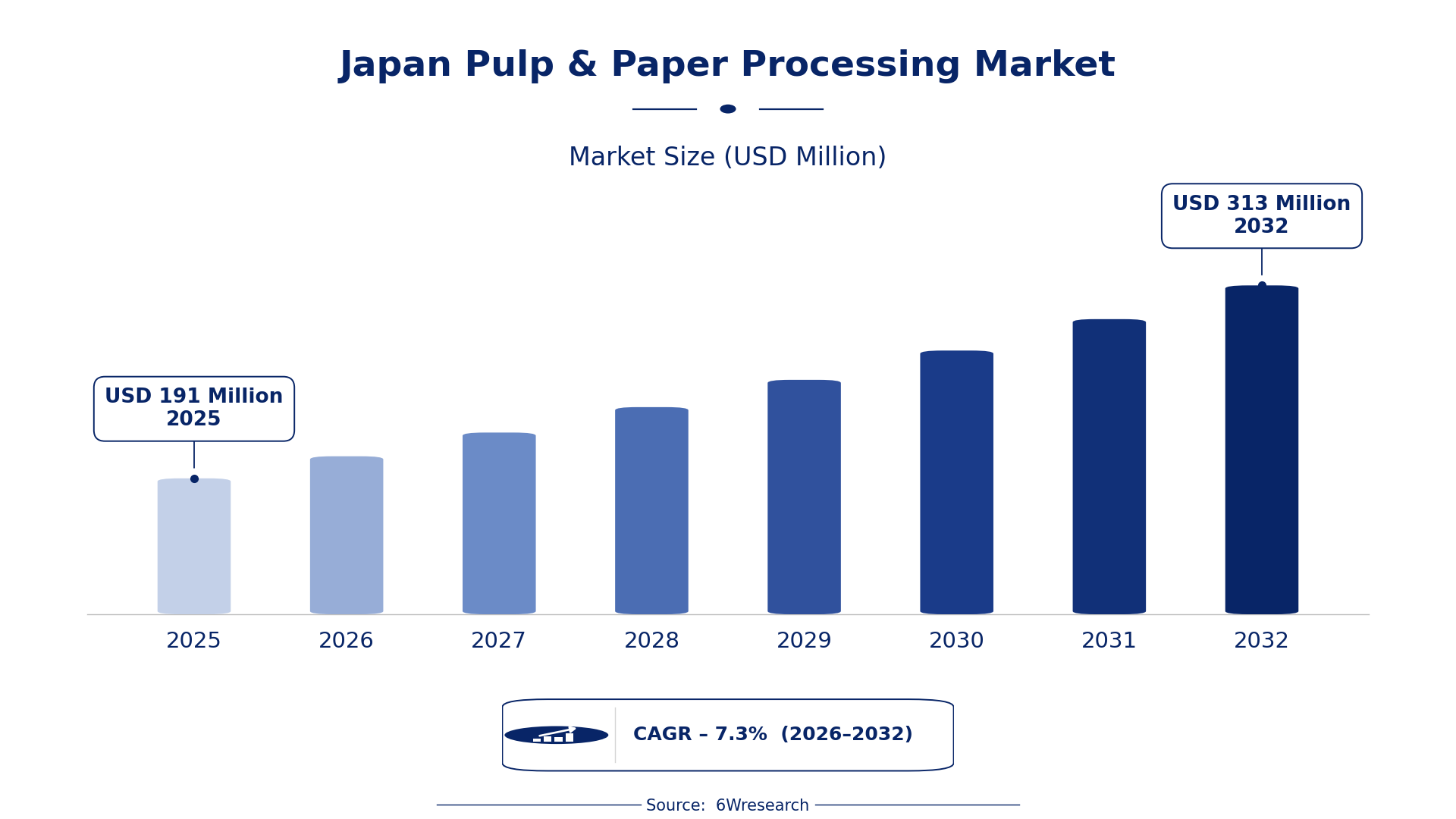
According to 6Wresearch internal database and industry insights, the Japan Pulp & Paper Processing Market was valued at USD 191 Million in 2025 and is projected to reach USD 313 Million by 2032, growing at a CAGR of approximately 7.3% during 2026–2032.
Japan Pulp & Paper Processing Market Highlights
| Report Metric | Details |
| Report Name | Japan Pulp & Paper Processing Market (2026-2032) |
| Market Size 2025 | USD 191 Million |
| Market Size 2032 | USD 313 Million |
| Absolute Growth 2025–2032 | USD 122 Million |
| CAGR 2026–2032 | 7.3% |
| Peak Annual Growth | 8.2% in 2027 |
| Forecast Period | 2026–2032 |
| Historical Data | 2022–2025 |
| Base Year | 2025 |
| Leading Processing Type, 2025 | Chemical Pulping (53% share) |
| Leading Equipment Used, 2025 | Digesters (41% share) |
| Leading Pulp Type, 2025 | Hardwood/Softwood (50% share) |
| Leading End User, 2025 | Packaging Industries (48% share) |
| Fastest-Growing Processing Type | Mechanical Pulping (10.6% CAGR) |
| Fastest-Growing Equipment Used | Grinders/Refiners (9.5% CAGR) |
| Fastest-Growing Pulp Type | Recycled Paper (10.5% CAGR) |
| Fastest-Growing End User | Printing Paper Suppliers (9.8% CAGR) |
| Growing Sector | Packaging Industries |
| Key End Users | Packaging Industries, Printing Paper Suppliers, Specialty Paper Makers |
Japan Pulp & Paper Processing Market Year-wise Growth Rate and Key Drivers (2022–2032)
This graph illustrates the annual growth rates of the market from 2022 to 2032, highlighting a steady upward trajectory and projected market expansion over the forecast period.
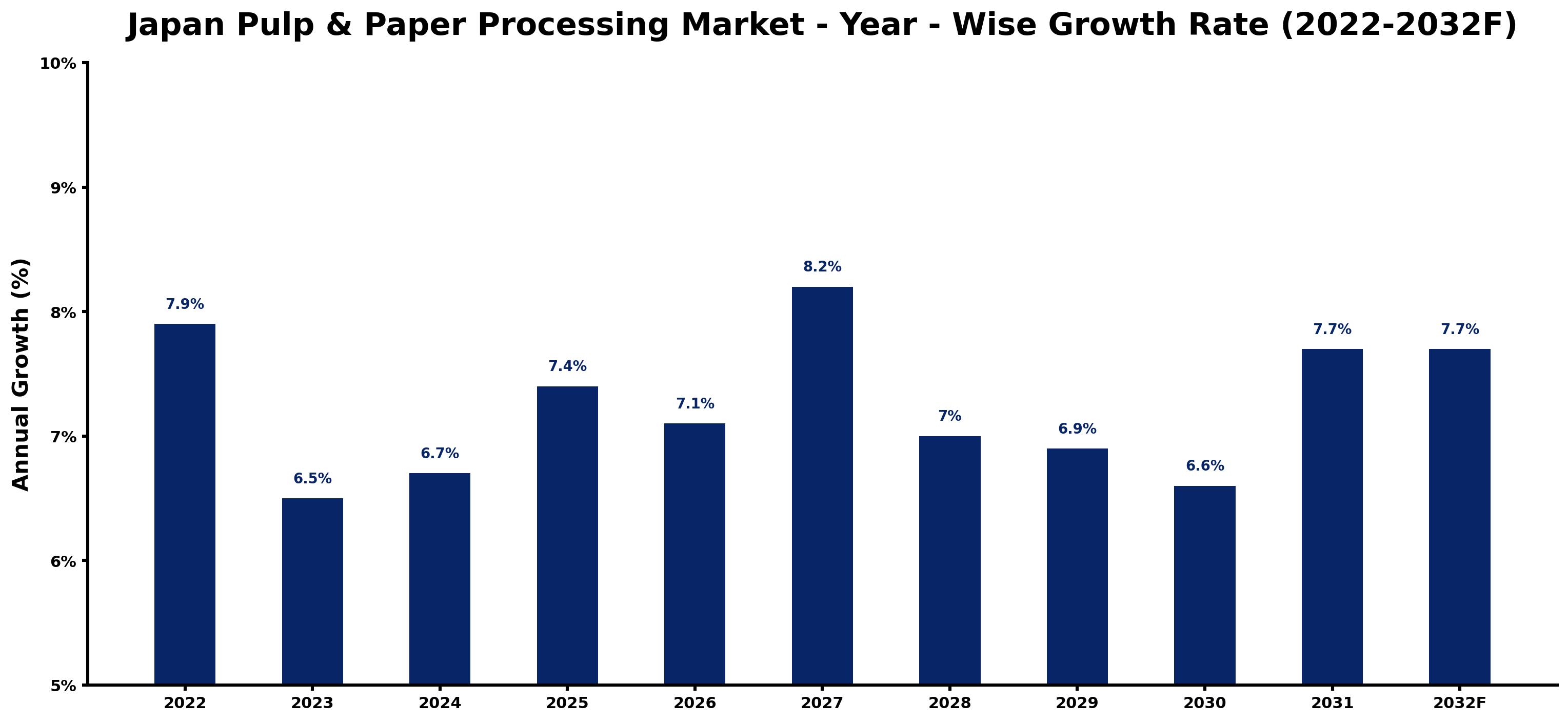
The yearly estimates that follow link every growth rate to its principal driver, so readers can see why the pace changed in each period.
| Year | Estimated Annual Growth (%) | Market Rationale |
| 2022 | 7.9 | The market showed strong activity, driven by high domestic demand and exports. |
| 2023 | 6.5 | Growth slowed due to market adjustments and increased competition among producers. |
| 2024 | 6.7 | Growth picked up as packaging industries expanded their production capabilities. |
| 2025 | 7.4 | Demand increased with the rise in specialty paper production and exports. |
| 2026 | 7.1 | Growth is expected to slow as the market stabilises after rapid expansion in previous years. |
| 2027 | 8.2 | The peak growth year will see a surge in investment in new processing technologies. |
| 2028 | 7.0 | Growth will slow slightly as the market adjusts to new production capacities. |
| 2029 | 6.9 | Demand will stabilise, reflecting a consistent need for packaging and printing papers. |
| 2030 | 6.6 | Growth will slow as the market faces increasing competition and price pressures. |
| 2031 | 7.7 | Demand will rise again, driven by a renewed focus on sustainable practices in production. |
| 2032 | 7.7 | Growth will stabilise as the market matures and focuses on efficiency improvements. |
Note: Market size estimations and growth projections presented in this report are based on 6Wresearch's proprietary forecasting methodology, utilizing the latest available industry data, government publications, and primary research inputs.
Japan Pulp & Paper Processing Market Synopsis
Pulp and paper processing involves converting raw materials into paper products through various methods, primarily for packaging, printing, and specialty papers. The Japan Pulp & Paper Processing Market is growing due to rising demand from packaging industries, supported by a robust recycling culture with an 80% recycling rate. Advances in processing technologies and sustainable practices are driving growth, creating opportunities for suppliers and reshaping the market.
Market Dynamics Impact Analysis (2026–2032)
| Factor | Type | Impact | Primary Segment Affected |
| Rising demand for packaging materials driven by e-commerce growth | Driver | High | Packaging Industries |
| Increased investment in sustainable practices and technologies | Driver | High | Chemical Pulping |
| Emerging demand for recycled paper due to environmental concerns | Opportunity | High | Recycled Paper |
| Growing specialty paper market catering to niche applications | Opportunity | Medium | Specialty Paper Makers |
| High operational costs due to energy price fluctuations | Restraint | High | Mechanical Pulping |
| Limited availability of raw materials for pulp production | Restraint | Medium | Hardwood/Softwood |
| Investment in advanced technology is costly and time-consuming | Challenge | High | Digesters |
| Competition from cheaper imported paper products | Challenge | Medium | Printing Paper Suppliers |
Evaluation of Drivers in Japan Pulp & Paper Processing Market (2026–2032)
Key forces behind demand, with the segment each one moves most, are listed below.
| Drivers | Primary Segment Affected | Why It Matters (Evidence) |
| Increased production of packaging materials | Packaging Industries | This sector's growth, valued at around 1 trillion yen, drives higher demand for paper products. |
| Investment in advanced chemical pulping technologies | Chemical Pulping | These technologies improve efficiency and product quality, resulting in higher purchases from producers. |
| Expansion of the specialty paper market | Specialty Paper Makers | A 5% increase in production reflects growing interest in niche products, encouraging suppliers to invest. |
| Growing focus on recycling initiatives | Recycled Paper | With an 80% recycling rate, demand for recycled materials is increasing, prompting more purchases. |
| Technological advancements in mechanical pulping | Mechanical Pulping | These innovations improve production capabilities, resulting in higher output and sales. |
A wider customer base explains much of the growth, as increased production of packaging materials drives demand for paper products. The packaging industry, valued at around 1 trillion yen, contributes to this trend, prompting suppliers to ramp up production. Investment in advanced chemical pulping technologies enhances efficiency, improving product quality and leading to higher sales. The specialty paper market has seen a 5% increase in production, reflecting interest in niche applications. The strong recycling culture in Japan, with an 80% recycling rate, boosts demand for recycled paper, encouraging further investments in processing technologies.
Evaluation of Restraints in Japan Pulp & Paper Processing Market
Below are the constraints most often cited by buyers and suppliers, with the segment each affects.
| Market Restraint | Primary Segment Affected | Why It Matters (Evidence) |
| High operational costs due to energy price fluctuations | Mechanical Pulping | Increased energy costs impact profitability, forcing producers to reconsider pricing strategies. |
| Limited availability of raw materials for pulp production | Hardwood/Softwood | Sourcing challenges for quality raw materials can delay production schedules. |
| Investment in advanced technology is costly and time-consuming | Digesters | The high initial costs can deter smaller producers from upgrading their facilities. |
| Regulatory compliance costs related to environmental standards | Chemical Pulping | Meeting stringent regulations increases operational costs for manufacturers. |
| Competition from cheaper imported paper products | Printing Paper Suppliers | Lower-priced imports can undercut local producers, affecting market share. |
Japan Pulp & Paper Processing Market Challenges
Japan's stringent regulations on paper production create compliance burdens that can delay project timelines for manufacturers, potentially resulting in revenue losses of up to 15%. Limited adoption of advanced technologies in pulp processing keeps producers lagging behind global competitors, which can increase production costs by 10% for manufacturers. High raw material prices, particularly for hardwood pulp, pressure suppliers and inflate costs for end users, complicating purchasing decisions. A shortage of skilled workers in the paper processing sector reduces operational efficiency, costing plants approximately 20% in productivity losses.
Trends in the Japan Pulp & Paper Processing Market
The shifts below are changing how Japan Pulp & Paper Processing Market products are bought and supplied.
- Shift towards Sustainable Practices in Tokyo: Tokyo is experiencing a shift towards sustainable practices in pulp and paper processing, with the government promoting recycling initiatives. Approximately 80% of paper is recycled, reflecting a growing demand for eco-friendly products.
- Printing Paper Suppliers Adopting New Technologies: Printing Paper Suppliers are increasingly adopting advanced technologies to improve production efficiency. This trend is clear as the market value reaches around 1 trillion yen, driving demand for innovative solutions.
- Emergence of Recycled Paper as a Key Resource: Recycled Paper is emerging as a key resource in Japan's pulp and paper industry, with production expected to grow by 10.5% by 2032. This shift supports sustainability efforts and meets market demand.
- Expansion of Specialty Paper Production: Specialty Paper production has expanded significantly, with a 5% increase in recent years. This growth highlights the demand for niche products and the need for innovation in production methods.
Investment Opportunities in the Japan Pulp & Paper Processing Market
The opportunities below stand out in the Japan Pulp & Paper Processing Market for new entrants and existing suppliers.
- Tokyo's Packaging Industries Seeking Sustainable Solutions: Tokyo's Packaging Industries are actively seeking sustainable paper solutions, with a market value of 1 trillion yen. Suppliers can enter this market through partnerships focused on eco-friendly products.
- Investment Gap in Advanced Pulp Processing Technologies: The gap in advanced pulp processing technologies presents an opportunity for investment, with a projected growth of 10% in agro residue pulp production by 2025. Collaborating with local producers can facilitate market entry.
- Printing Paper Suppliers Adopting Eco-Friendly Practices: Printing Paper Suppliers are increasingly interested in eco-friendly practices, as the market evolves. Suppliers can engage by offering sustainable products that align with changing consumer preferences.
- Kansai Region's Digesters Upgrading for Efficiency: The Kansai region's Digesters are upgrading to improve efficiency, focusing on chemical pulping. Entering through joint ventures can enhance local production capabilities.
Government Initiatives in the Japan Pulp & Paper Processing Market
The PRTR Law, enacted in 1999, requires businesses to report the release and transfer of designated chemical substances, ensuring environmental safety in pulp and paper processing. The Chemical Substances Control Law, established in 1973, mandates the evaluation and control of chemical substances in manufacturing, promoting safer production practices. These laws set a framework for compliance and sustainability in the industry.
In 2023, the Ministry of the Environment launched a program to support sustainable forestry practices, providing funding for projects aimed at improving resource management. The Japan Paper Association advocates for sustainable practices, supporting initiatives that align with national environmental goals.
Future Insight of the Japan Pulp & Paper Processing Market
Investment in new processing technologies will drive efficiency and lower costs, creating opportunities for suppliers. By 2032, demand for specialty papers will increase, supported by government recycling initiatives and sustainable forestry programmes. The annual Paper & Pulp Conference will continue to attract global participants, facilitating knowledge exchange and innovation. As production of hardwood pulp remains at 60% of total output, buyers will benefit from stable sourcing options, ensuring supply chain reliability.
Market Segmentation Analysis
Japan Pulp & Paper Processing Market report covers a detailed analysis of the following market segments:
By Processing Type – Chemical Pulping Leads, Mechanical Pulping Expected to Grow Fastest
According to Saurav Kr Singh, Senior Research Analyst at 6Wresearch, with 53% of processing type revenue in 2025, Chemical Pulping was the largest category. Chemical pulping holds the largest share in Japan's market due to its ability to produce high-quality pulp essential for various paper products. The extensive use of this method in facilities located in key regions like Tokyo highlights its importance for both local consumption and exports. The quickest growth will come from Mechanical Pulping, forecast to expand at a CAGR of 10.6% between 2026 and 2032. Mechanical pulping is experiencing rapid growth as it offers a cost-effective solution for pulp production, catering to the increasing demand for affordable paper products. The rise in technological advancements that enhance production efficiency will further support this method's expansion. Suppliers should focus on improving mechanical pulping processes to meet the rising demand in the market.
By Equipment Used – Digesters Lead, Grinders/Refiners Expected to Grow Fastest
The largest equipment used category in 2025 was Digesters, at 41% of revenue. Digesters are crucial in the chemical pulping process, establishing their dominance as the leading equipment in Japan's pulp and paper industry. Their widespread application in numerous manufacturing facilities underscores their vital role in producing high-quality pulp. Over 2026–2032, Grinders/Refiners are expected to post the fastest growth, at a CAGR of 9.5%. Grinders and refiners are gaining momentum as they refine pulp to achieve specific consistency, which is essential for high-quality paper production. The industry's increasing focus on quality is driving the growth of this equipment segment. Investing in advanced grinding and refining technologies will be essential for suppliers to capitalise on emerging market opportunities.
By Pulp Type – Hardwood/Softwood Leads, Recycled Paper Expected to Grow Fastest
Hardwood/Softwood took 50% of pulp type revenue in 2025, more than any other category. Hardwood and softwood pulp are the primary raw materials for pulp production in Japan, representing a significant portion of the market. Their versatility in producing a variety of paper grades makes them indispensable to the industry. Recycled Paper is projected to grow fastest, at a CAGR of 10.5% during 2026–2032. Recycled paper is rapidly becoming a vital source of raw material, supported by Japan's strong recycling culture and government initiatives promoting sustainability. The push for reducing paper waste is accelerating the growth of this segment. Suppliers should enhance their procurement strategies for recycled materials to align with market trends and regulatory demands.
By End User – Packaging Industries Lead, Printing Paper Suppliers Expected to Grow Fastest
Packaging Industries held 48% of the Japan Pulp & Paper Processing Market by end user in 2025. Packaging industries are the largest consumers of paper products in Japan, driven by the ongoing demand for packaging solutions in various sectors. The growth of e-commerce and retail sectors further fuels this demand for packaging materials. Printing Paper Suppliers are set to record the highest CAGR in this split, 9.8% over 2026–2032. Printing paper suppliers are experiencing the fastest growth due to the resurgence in print media and the need for high-quality printed materials. This sector's recovery and expansion are supported by increasing consumer preferences for printed content. Suppliers must adapt their offerings to cater to the evolving needs of printing paper suppliers to capitalise on this growth.
Key Attractiveness of the Report
- 10 Years of Market Numbers
- Historical Data Starting from 2022 to 2025
- Base Year 2025
- Forecast Data until 2032
- Key Performance Indicators Impacting the Market
- Major Upcoming Developments and Projects
Key Highlights of the Report:
- Japan Pulp & Paper Processing Market Outlook
- Market Size of Japan Pulp & Paper Processing Market, 2025
- Forecast of Japan Pulp & Paper Processing Market, 2032
- Historical Data and Forecast of Japan Pulp & Paper Processing Revenues & Volume for the Period 2022-2032F
- Japan Pulp & Paper Processing Market Trend Evolution
- Japan Pulp & Paper Processing Market Drivers and Challenges
- Japan Pulp & Paper Processing Price Trends
- Japan Pulp & Paper Processing Porter's Five Forces
- Japan Pulp & Paper Processing Industry Life Cycle
- Historical Data and Forecast of Japan Pulp & Paper Processing Market Revenues & Volume By Processing Type for the Period 2022-2032F
- Historical Data and Forecast of Japan Pulp & Paper Processing Market Revenues & Volume By Chemical Pulping for the Period 2022-2032F
- Historical Data and Forecast of Japan Pulp & Paper Processing Market Revenues & Volume By Mechanical Pulping for the Period 2022-2032F
- Historical Data and Forecast of Japan Pulp & Paper Processing Market Revenues & Volume By Thermomechanical Pulping for the Period 2022-2032F
- Historical Data and Forecast of Japan Pulp & Paper Processing Market Revenues & Volume By Bio-Pulping for the Period 2022-2032F
- Historical Data and Forecast of Japan Pulp & Paper Processing Market Revenues & Volume By Equipment Used for the Period 2022-2032F
- Historical Data and Forecast of Japan Pulp & Paper Processing Market Revenues & Volume By Digesters for the Period 2022-2032F
- Historical Data and Forecast of Japan Pulp & Paper Processing Market Revenues & Volume By Grinders/Refiners for the Period 2022-2032F
- Historical Data and Forecast of Japan Pulp & Paper Processing Market Revenues & Volume By TMP Systems for the Period 2022-2032F
- Historical Data and Forecast of Japan Pulp & Paper Processing Market Revenues & Volume By Enzymatic Additives for the Period 2022-2032F
- Historical Data and Forecast of Japan Pulp & Paper Processing Market Revenues & Volume By Pulp Type for the Period 2022-2032F
- Historical Data and Forecast of Japan Pulp & Paper Processing Market Revenues & Volume By Hardwood/Softwood for the Period 2022-2032F
- Historical Data and Forecast of Japan Pulp & Paper Processing Market Revenues & Volume By Recycled Paper for the Period 2022-2032F
- Historical Data and Forecast of Japan Pulp & Paper Processing Market Revenues & Volume By Mixed Pulp for the Period 2022-2032F
- Historical Data and Forecast of Japan Pulp & Paper Processing Market Revenues & Volume By Agro Residue for the Period 2022-2032F
- Historical Data and Forecast of Japan Pulp & Paper Processing Market Revenues & Volume By End User for the Period 2022-2032F
- Historical Data and Forecast of Japan Pulp & Paper Processing Market Revenues & Volume By Packaging Industries for the Period 2022-2032F
- Historical Data and Forecast of Japan Pulp & Paper Processing Market Revenues & Volume By Printing Paper Suppliers for the Period 2022-2032F
- Historical Data and Forecast of Japan Pulp & Paper Processing Market Revenues & Volume By Specialty Paper Makers for the Period 2022-2032F
- Historical Data and Forecast of Japan Pulp & Paper Processing Market Revenues & Volume By Sustainable Product Units for the Period 2022-2032F
- Japan Pulp & Paper Processing Import Export Trade Statistics
- Market Opportunity Assessment By Processing Type
- Market Opportunity Assessment By Equipment Used
- Market Opportunity Assessment By Pulp Type
- Market Opportunity Assessment By End User
- Japan Pulp & Paper Processing Top Companies Market Share
- Japan Pulp & Paper Processing Competitive Benchmarking By Technical and Operational Parameters
- Japan Pulp & Paper Processing Company Profiles
- Japan Pulp & Paper Processing Key Strategic Recommendations
Market Covered
The study includes the following segmentation.
By Processing Type
- Chemical Pulping
- Mechanical Pulping
- Thermomechanical Pulping
- Bio-Pulping
By Equipment Used
- Digesters
- Grinders/Refiners
- TMP Systems
- Enzymatic Additives
By Pulp Type
- Hardwood/Softwood
- Recycled Paper
- Mixed Pulp
- Agro Residue
By End User
- Packaging Industries
- Printing Paper Suppliers
- Specialty Paper Makers
- Sustainable Product Units






































