Japan QA Automation Services Market Size & Growth Rate
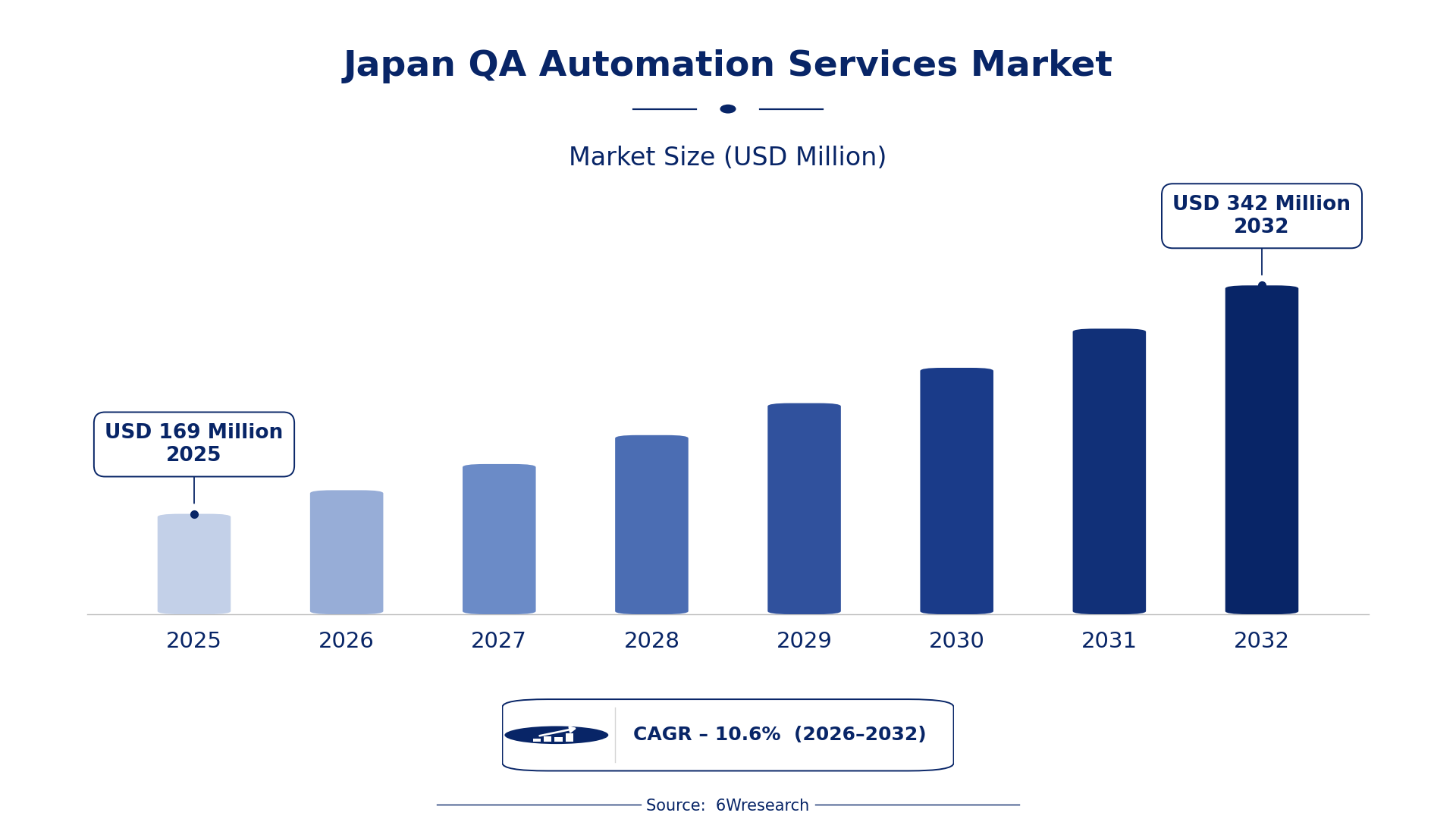
According to 6Wresearch internal database and industry insights, the Japan QA Automation Services Market was valued at USD 169 Million in 2025 and is projected to reach USD 342 Million by 2032, growing at a CAGR of approximately 10.6% during 2026–2032.
Japan QA Automation Services Market Highlights
| Report Metric | Details |
| Report Name | Japan QA Automation Services Market (2026-2032) |
| Market Size 2025 | USD 169 Million |
| Market Size 2032 | USD 342 Million |
| Absolute Growth 2025–2032 | USD 173 Million |
| CAGR 2026–2032 | 10.6% |
| Peak Annual Growth | 12.4% in 2026 |
| Forecast Period | 2026–2032 |
| Historical Data | 2022–2025 |
| Base Year | 2025 |
| Leading Service Type, 2025 | Functional Testing (37% share) |
| Leading Tool Type, 2025 | Selenium (42% share) |
| Leading Delivery Mode, 2025 | Cloud-Based (44% share) |
| Leading End User, 2025 | Software Companies (44% share) |
| Fastest-Growing Service Type | Performance Testing (13.7% CAGR) |
| Fastest-Growing Tool Type | JMeter (14.3% CAGR) |
| Fastest-Growing End User | Fintech Firms (13.9% CAGR) |
| Growing Sector | software development |
| Key End Users | software companies, fintech firms, e-commerce platforms, SaaS providers |
Japan QA Automation Services Market Year-wise Growth Rate and Key Drivers (2022–2032)
This graph illustrates the annual growth rates of the market from 2022 to 2032, highlighting a steady upward trajectory and projected market expansion over the forecast period.
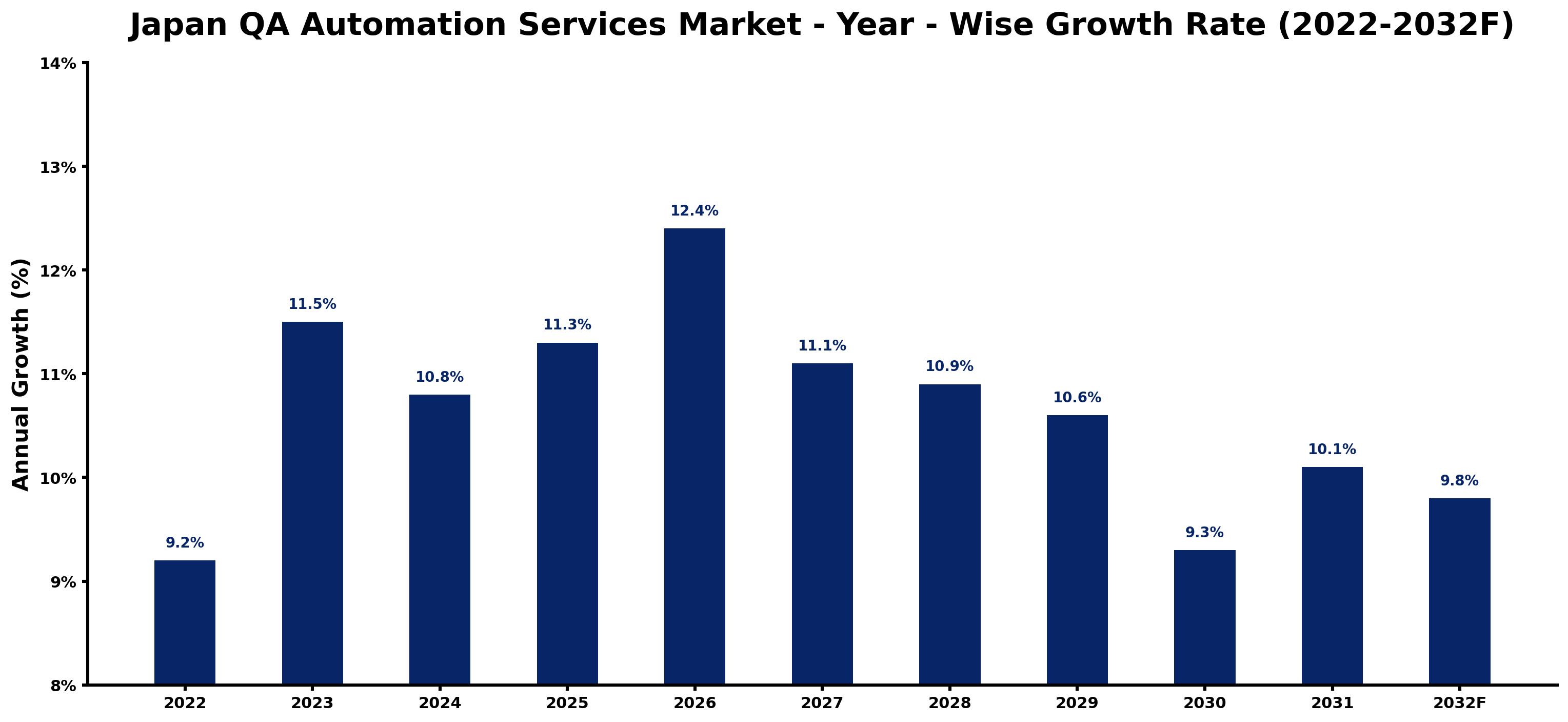
Below, each year's estimated growth is shown next to the factor that most influenced it.
| Year | Estimated Annual Growth (%) | Market Rationale |
| 2022 | 9.2 | The market showed solid demand from software companies and tech firms. |
| 2023 | 11.5 | Growth was driven by increased software complexity and rapid deployment needs. |
| 2024 | 10.8 | Demand remained strong, although growth slowed due to market saturation. |
| 2025 | 11.3 | The market benefited from rising investments in digital transformation initiatives. |
| 2026 | 12.4 | A peak in growth is anticipated as firms accelerate automation efforts. |
| 2027 | 11.1 | Demand will continue to rise, although growth is projected to decelerate slightly from the previous year. |
| 2028 | 10.9 | The market is expected to maintain its growth, driven by ongoing software development needs. |
| 2029 | 10.6 | Growth will slow as companies focus on optimising existing QA processes. |
| 2030 | 9.3 | The market will continue to expand, albeit at a slower rate than before. |
| 2031 | 10.1 | Demand is expected to increase as new technologies emerge, boosting QA automation services. |
| 2032 | 9.8 | Growth will slow again, but the market will remain strong due to ongoing software needs. |
Note: Market size estimations and growth projections presented in this report are based on 6Wresearch's proprietary forecasting methodology, utilizing the latest available industry data, government publications, and primary research inputs.
Japan QA Automation Services Market Synopsis
QA Automation Services in Japan encompass a variety of testing services that streamline the quality assurance process. These services are essential in industries such as fintech and e-commerce, where rapid deployment and high-quality standards are paramount. The Japan QA Automation Services Market is expanding due to increasing software complexity, a strong demand from over 50,000 registered software companies, and investments in digital transformation initiatives, such as the one launched by the Ministry of Economy, Trade and Industry in 2023. The growth is driven by the need for reliable software solutions that meet evolving market demands.
Market Dynamics Impact Analysis (2026–2032)
| Factor | Type | Impact | Primary Segment Affected |
| Growing demand for rapid software deployment | Driver | High | Functional Testing |
| Increased investment in digital transformation | Driver | High | Performance Testing |
| Rising need for reliable software solutions | Opportunity | High | API Testing |
| Expansion of the fintech sector | Opportunity | High | Software Companies |
| High competition among QA service providers | Restraint | Medium | Cloud-Based |
| Limited awareness of automation benefits | Restraint | Medium | On-Premise |
| High costs associated with automation tools | Challenge | High | Performance Testing |
| Shortage of skilled QA professionals | Challenge | Medium | Functional Testing |
Evaluation of Drivers in Japan QA Automation Services Market (2026–2032)
The following drivers explain most of the expected growth.
| Drivers | Primary Segment Affected | Why It Matters (Evidence) |
| Increased software complexity | Functional Testing | As software systems become more intricate, the demand for functional testing rises to ensure reliability, with firms investing over JPY 20 million annually in QA. |
| Investment in digital initiatives | Performance Testing | Companies are investing in performance testing tools to improve user experience and system stability, with spending projected to reach JPY 10 billion by 2025. |
| Growth in fintech sector | API Testing | The fintech industry's expansion drives the need for effective API testing to ensure secure transactions, valued at approximately $10 billion in Japan. |
| Adoption of cloud-based solutions | Cloud-Based | The shift to cloud-based services is increasing the demand for flexible QA automation solutions, with over 44% of companies adopting this model by 2025. |
| Rising e-commerce sales | Software Companies | With e-commerce sales reaching approximately $200 billion, software companies require efficient QA services to maintain quality, prompting investments in automation. |
Behind the steady rise in orders is the increasing complexity of software systems, with Japan's software industry employing over 1.3 million professionals. Companies are investing significantly in digital transformation, leading to heightened demand for performance testing tools, particularly in the fintech sector valued at around $10 billion. E-commerce sales, which reached approximately $200 billion in 2022, push software companies to refine their quality assurance processes. The shift towards cloud-based solutions further increases the need for flexible QA automation services, ensuring reliability and performance in software applications.
Evaluation of Restraints in Japan QA Automation Services Market
Several factors work against faster growth; the main ones are summarised below.
| Market Restraint | Primary Segment Affected | Why It Matters (Evidence) |
| High costs of automation tools | Performance Testing | The investment required for advanced performance testing tools limits adoption among smaller firms, with costs exceeding JPY 5 million for comprehensive solutions. |
| Limited understanding of automation benefits | On-Premise | Many companies lack awareness of how automation can improve QA processes, hindering market growth, especially among traditional firms with outdated practices. |
| High competition among service providers | Cloud-Based | Intense competition can lead to price wars, affecting profitability for QA service providers, with margins dropping by 15% in recent years. |
| Shortage of skilled professionals | Functional Testing | The lack of qualified QA engineers can delay project timelines and increase operational costs, with average salaries around ¥6 million per year making recruitment challenging. |
| Regulatory compliance requirements | API Testing | Stringent compliance standards can complicate the QA process for fintech firms, leading to increased testing times and costs. |
Japan QA Automation Services Market Challenges
In 2023, Japan's software industry employed over 1.3 million professionals, yet a skills shortage persists, limiting the availability of qualified QA engineers. This shortage arises from the rapid growth of the tech sector, which outpaces the training of new professionals, causing project delays for software companies. Rising operational costs hinder QA automation services, with the national minimum wage increasing to JPY 1,055 per hour, impacting profitability for service providers. Regulatory standards like JIS Q 9001 complicate operations, resulting in higher expenses for businesses striving to meet quality management requirements. Buyers may experience longer delivery times and diminished software quality as a result.
Trends in the Japan QA Automation Services Market
Four trends stand out in the Japan QA Automation Services Market.
- Adoption of Cloud-Based QA Solutions: The shift towards cloud-based QA automation services is accelerating, with a projected market share of 44% by 2025. This trend is evident in Tokyo, where tech firms are increasingly adopting flexible solutions to streamline their QA processes.
- Growing Need for Performance Testing Tools: The demand for performance testing tools like JMeter is increasing as companies focus on user experience. With a projected CAGR of 14.3%, this segment is becoming essential for maintaining system stability, particularly in the fintech sector.
- Prioritising API Testing in Fintech: API testing is gaining traction in the fintech sector, where secure transactions are critical. This trend is reflected in the rising demand for effective testing solutions, with a substantial portion of firms prioritising API quality assurance.
- Investment in QA Automation for E-commerce: E-commerce platforms are increasingly investing in QA automation to enhance user experience. As e-commerce sales reached approximately $200 billion in 2022, the demand for reliable QA services is expected to grow significantly.
Investment Opportunities in the Japan QA Automation Services Market
The following areas offer the clearest openings for investors and suppliers in the Japan QA Automation Services Market.
- Demand from Software Companies: Software companies in Japan are actively seeking QA automation services to enhance product quality. With over 50,000 registered firms, the demand for reliable testing solutions is substantial, estimated at JPY 30 billion in 2025.
- Expansion in the Fintech Sector: The fintech sector is rapidly expanding, creating opportunities for QA automation services. Firms require effective QA processes to ensure compliance and reliability, with investments expected to exceed ¥15 billion by 2025.
- Growing Interest in Cloud-Based Solutions: Cloud-based QA services are increasingly in demand due to their flexibility. Companies can partner with local providers to enhance their QA capabilities, tapping into a market projected to grow by 13.8% annually.
- Support from Digital Transformation Initiatives: The Japanese government's focus on digital transformation presents opportunities for QA automation services. With JPY 150 trillion allocated for decarbonisation investments, tech firms can utilise these funds for QA improvements.
Government Initiatives in the Japan QA Automation Services Market
The regulatory environment for QA automation services in Japan is shaped by laws such as JIS Q 9001, which establishes quality management standards, and the AI Promotion Act of 2025, which promotes AI research and development. These measures ensure that QA processes align with industry standards and improve software reliability, creating a more competitive market for service providers.
Significant funding has been allocated by the Ministry of Economy, Trade and Industry for digital innovation projects, supporting the QA automation sector. This funding aims to enhance the capabilities of tech startups in Tokyo, creating opportunities for advancements in quality assurance. With a focus on improving digital transformation, the government is facilitating the adoption of effective QA solutions.
Future Insight of the Japan QA Automation Services Market
The launch of the digital transformation initiative will facilitate the integration of QA automation services across various sectors by 2032. Japan's commitment to a JPY 150 trillion decarbonisation investment will drive demand for advanced software solutions, particularly in fintech and e-commerce. As firms increasingly adopt automated testing tools, efficiency will improve, especially with the rise of over 1,000 SaaS companies. The Tokyo Software Testing Conference will continue to promote best practices, creating a more competitive environment in the QA automation market.
Market Segmentation Analysis
Japan QA Automation Services Market report covers a detailed analysis of the following market segments:
By Service Type – Functional Testing Leads, Performance Testing Expected to Grow Fastest
According to Saurav Kr Singh, Senior Research Analyst at 6Wresearch, Functional Testing held 37% of the Japan QA Automation Services Market by service type in 2025. Functional testing holds the largest share because it is essential for validating software functionalities, particularly in sectors like fintech where precision is critical. Many companies in Tokyo's tech hub rely on this service to ensure their software meets high-quality standards. Performance Testing is set to record the highest CAGR in this split, 13.7% over 2026–2032. Performance testing is growing rapidly as organisations increasingly prioritise system responsiveness and stability, especially with the rise of complex software solutions. The expanding Japanese QA market aims to address the needs of applications that demand high performance. Suppliers should enhance their functional and performance testing services to meet the demands of software developers.
By Tool Type – Selenium Leads, JMeter Expected to Grow Fastest
Selenium accounted for 42% of the market by tool type in 2025. Selenium is the leading tool due to its extensive use for automating web applications, making it a preferred choice among numerous software companies in Japan. Its widespread adoption is evident among the over 50,000 registered software firms in the country. JMeter is projected to grow fastest, at a CAGR of 14.3% during 2026–2032. JMeter is experiencing the fastest growth because it is commonly utilised for performance testing, which is increasingly vital for applications in Japan's competitive landscape. The rising demand for high-performing applications drives this trend as companies strive to provide optimal user experiences. Buyers should invest in tools like JMeter to strengthen their performance testing capabilities.
By Delivery Mode – Cloud-Based Leads and Records the Fastest Growth
Cloud-Based took 44% of delivery mode revenue in 2025, more than any other category. Cloud-based delivery is the dominant mode as it offers the flexibility and scalability necessary for the changing requirements of Japanese software companies. This preference is reflected in the growing adoption of cloud services across various industries. The same category is also set to grow fastest, at a CAGR of 13.8% during 2026–2032. Cloud-based delivery is also the fastest-growing mode, as businesses continue to leverage its benefits for QA testing, ensuring agility in a rapidly changing market. This dual role solidifies its leadership position in the sector. Suppliers must focus on cloud-based solutions to align with the increasing demand for scalable QA services.
By End User – Software Companies Lead, Fintech Firms Expected to Grow Fastest
The largest end user category in 2025 was Software Companies, at 44% of revenue. Software companies lead the end-user segment as they are the primary consumers of QA automation services, crucial for maintaining software quality in a competitive environment. The presence of over 1.3 million professionals in Japan's software industry further reinforces this trend. Over 2026–2032, Fintech Firms are expected to post the fastest growth, at a CAGR of 13.9%. Fintech firms represent the fastest-growing end-user segment, heavily reliant on quality assurance to comply with regulations and ensure service reliability. This heightened emphasis on regulatory compliance drives their demand for QA solutions. Suppliers should customise their offerings to address the specific needs of fintech firms to capture this expanding market.
Key Attractiveness of the Report
- 10 Years of Market Numbers
- Historical Data Starting from 2022 to 2025
- Base Year 2025
- Forecast Data until 2032
- Key Performance Indicators Impacting the Market
- Major Upcoming Developments and Projects
Key Highlights of the Report:
- Japan QA Automation Services Market Outlook
- Market Size of Japan QA Automation Services Market, 2025
- Forecast of Japan QA Automation Services Market, 2032
- Historical Data and Forecast of Japan QA Automation Services Revenues & Volume for the Period 2022-2032F
- Japan QA Automation Services Market Trend Evolution
- Japan QA Automation Services Market Drivers and Challenges
- Japan QA Automation Services Price Trends
- Japan QA Automation Services Porter's Five Forces
- Japan QA Automation Services Industry Life Cycle
- Historical Data and Forecast of Japan QA Automation Services Market Revenues & Volume By Service Type for the Period 2022-2032F
- Historical Data and Forecast of Japan QA Automation Services Market Revenues & Volume By Functional Testing for the Period 2022-2032F
- Historical Data and Forecast of Japan QA Automation Services Market Revenues & Volume By Performance Testing for the Period 2022-2032F
- Historical Data and Forecast of Japan QA Automation Services Market Revenues & Volume By Regression Testing for the Period 2022-2032F
- Historical Data and Forecast of Japan QA Automation Services Market Revenues & Volume By API Testing for the Period 2022-2032F
- Historical Data and Forecast of Japan QA Automation Services Market Revenues & Volume By Tool Type for the Period 2022-2032F
- Historical Data and Forecast of Japan QA Automation Services Market Revenues & Volume By Selenium for the Period 2022-2032F
- Historical Data and Forecast of Japan QA Automation Services Market Revenues & Volume By JMeter for the Period 2022-2032F
- Historical Data and Forecast of Japan QA Automation Services Market Revenues & Volume By TestComplete for the Period 2022-2032F
- Historical Data and Forecast of Japan QA Automation Services Market Revenues & Volume By Postman for the Period 2022-2032F
- Historical Data and Forecast of Japan QA Automation Services Market Revenues & Volume By Delivery Mode for the Period 2022-2032F
- Historical Data and Forecast of Japan QA Automation Services Market Revenues & Volume By Cloud-Based for the Period 2022-2032F
- Historical Data and Forecast of Japan QA Automation Services Market Revenues & Volume By On-Premise for the Period 2022-2032F
- Historical Data and Forecast of Japan QA Automation Services Market Revenues & Volume By Hybrid for the Period 2022-2032F
- Historical Data and Forecast of Japan QA Automation Services Market Revenues & Volume By Managed Services for the Period 2022-2032F
- Historical Data and Forecast of Japan QA Automation Services Market Revenues & Volume By End User for the Period 2022-2032F
- Historical Data and Forecast of Japan QA Automation Services Market Revenues & Volume By Software Companies for the Period 2022-2032F
- Historical Data and Forecast of Japan QA Automation Services Market Revenues & Volume By Fintech Firms for the Period 2022-2032F
- Historical Data and Forecast of Japan QA Automation Services Market Revenues & Volume By E-commerce Platforms for the Period 2022-2032F
- Historical Data and Forecast of Japan QA Automation Services Market Revenues & Volume By SaaS Providers for the Period 2022-2032F
- Japan QA Automation Services Import Export Trade Statistics
- Market Opportunity Assessment By Service Type
- Market Opportunity Assessment By Tool Type
- Market Opportunity Assessment By Delivery Mode
- Market Opportunity Assessment By End User
- Japan QA Automation Services Top Companies Market Share
- Japan QA Automation Services Competitive Benchmarking By Technical and Operational Parameters
- Japan QA Automation Services Company Profiles
- Japan QA Automation Services Key Strategic Recommendations
Market Covered
The following segment groups are covered in the report.
By Service Type
- Functional Testing
- Performance Testing
- Regression Testing
- API Testing
By Tool Type
- Selenium
- JMeter
- TestComplete
- Postman
By Delivery Mode
- Cloud-Based
- On-Premise
- Hybrid
- Managed Services
By End User
- Software Companies
- Fintech Firms
- E-commerce Platforms
- SaaS Providers































