Japan Quality Control Equipment Market Size & Growth Rate
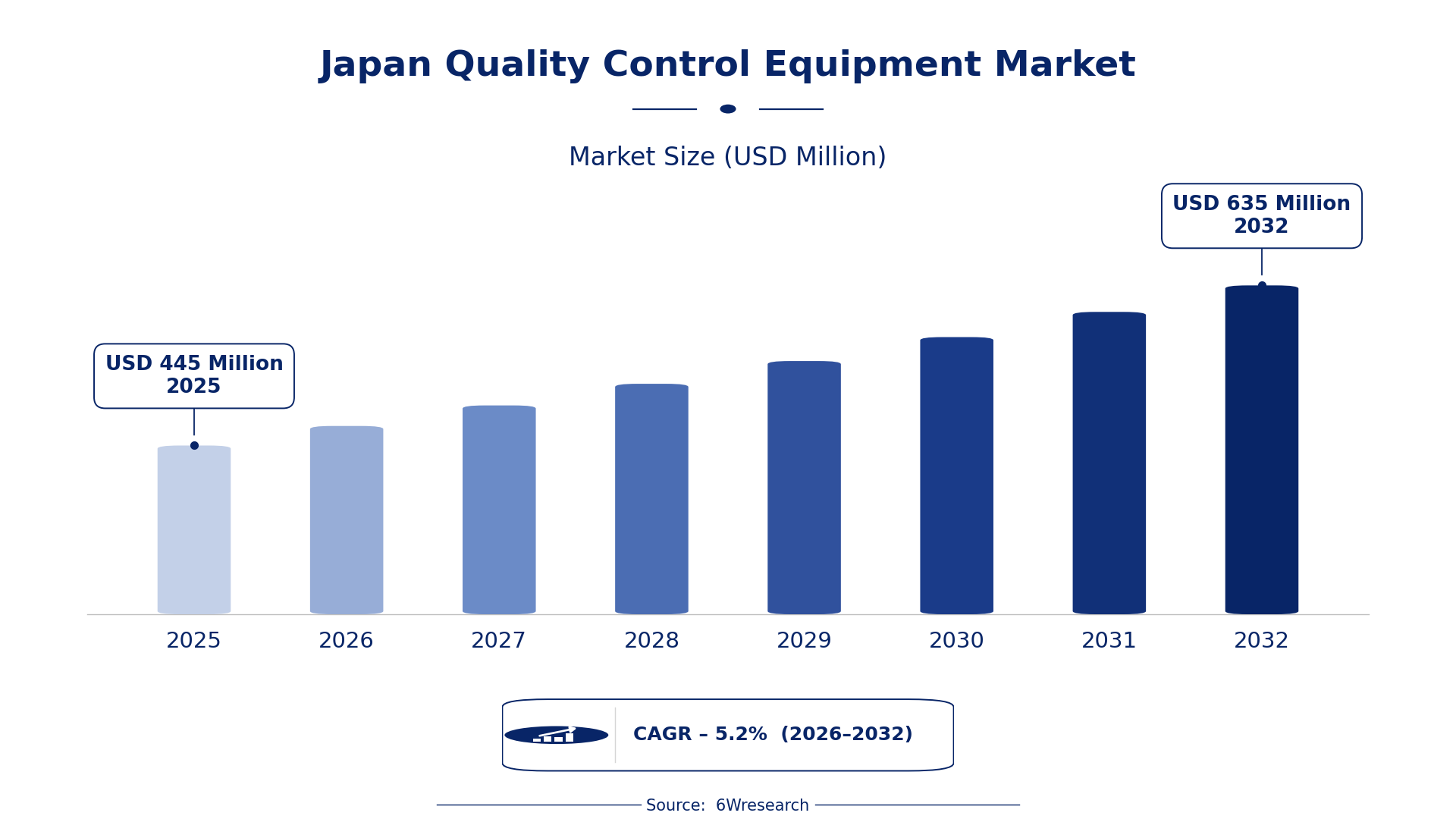
According to 6Wresearch internal database and industry insights, the Japan Quality Control Equipment Market was valued at USD 445 Million in 2025 and is projected to reach USD 635 Million by 2032, growing at a CAGR of approximately 5.2% during 2026–2032.
Japan Quality Control Equipment Market Highlights
| Report Metric | Details |
| Report Name | Japan Quality Control Equipment Market (2026-2032) |
| Market Size 2025 | USD 445 Million |
| Market Size 2032 | USD 635 Million |
| Absolute Growth 2025–2032 | USD 190 Million |
| CAGR 2026–2032 | 5.2% |
| Peak Annual Growth | 6.5% in 2032 |
| Forecast Period | 2026–2032 |
| Historical Data | 2022–2025 |
| Base Year | 2025 |
| Leading Equipment Type, 2025 | Coordinate Measuring Machines (45% share) |
| Leading Testing Method, 2025 | 3D Measurement (43% share) |
| Leading Industry Application, 2025 | Automotive (43% share) |
| Leading End User, 2025 | OEM Manufacturers (44% share) |
| Fastest-Growing Equipment Type | Optical Inspection Tools (7.3% CAGR) |
| Fastest-Growing Testing Method | Visual Inspection (7.5% CAGR) |
| Fastest-Growing Industry Application | Electronics (6.8% CAGR) |
| Fastest-Growing End User | PCB Manufacturers (6.9% CAGR) |
| Growing Sector | automotive |
| Key End Users | OEM Manufacturers, Electronics Manufacturers, Quality Labs, Aerospace Firms |
Japan Quality Control Equipment Market Year-wise Growth Rate and Key Drivers (2022–2032)
This graph illustrates the annual growth rates of the market from 2022 to 2032, highlighting a steady upward trajectory and projected market expansion over the forecast period.
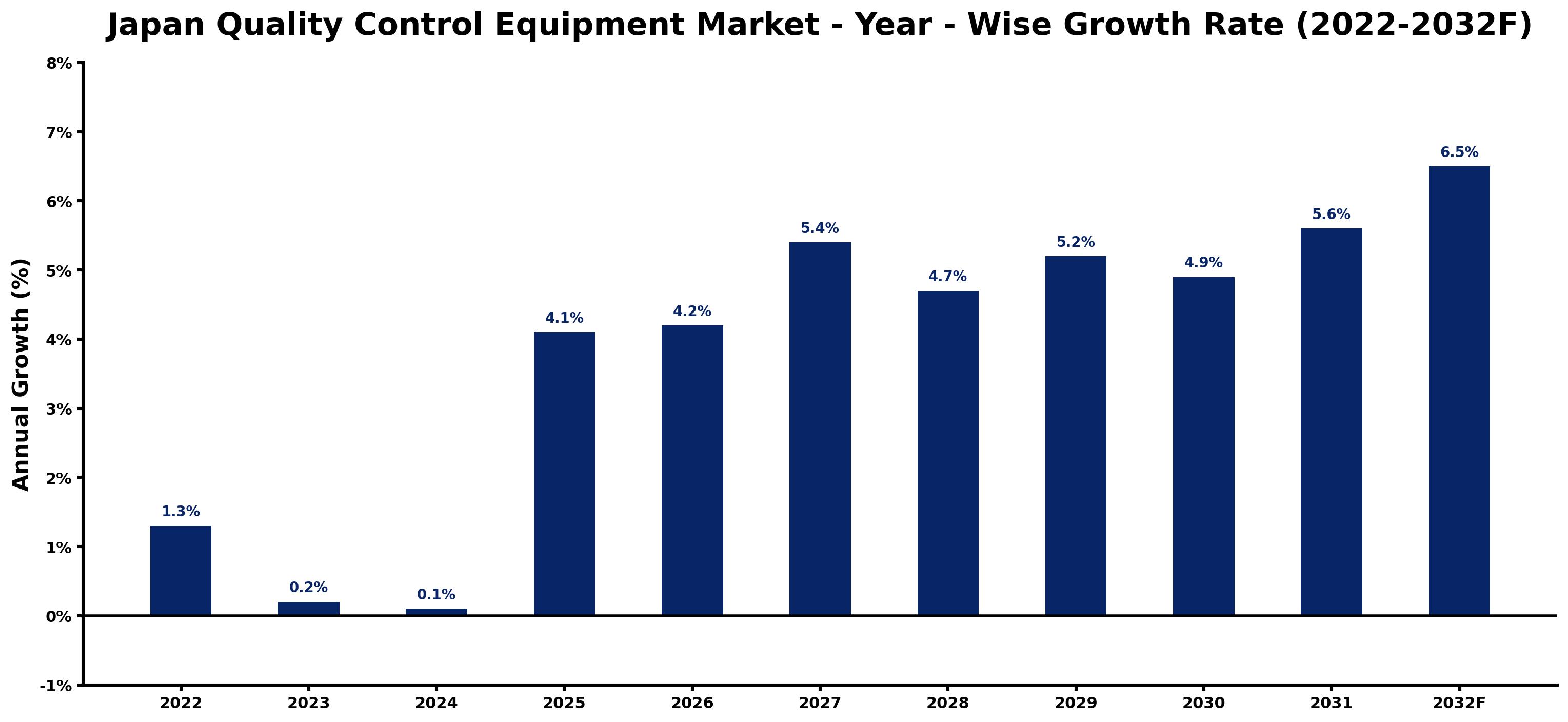
For each year, the table pairs the estimated growth rate with the leading influence on demand, showing how the drivers changed across the period.
| Year | Estimated Annual Growth (%) | Market Rationale |
| 2022 | 1.3 | The market experienced moderate growth, reflecting steady demand from key sectors. |
| 2023 | 0.2 | Growth slowed due to market adjustments and reduced investment in quality control. |
| 2024 | 0.1 | A further slowdown occurred as manufacturers focused on existing equipment rather than new purchases. |
| 2025 | 4.1 | Demand surged as the automotive sector ramped up production, driving quality control needs. |
| 2026 | 4.2 | Growth is expected to accelerate as technology adoption in quality assurance gains momentum. |
| 2027 | 5.4 | Investment in advanced quality control systems is projected to increase, boosting market performance. |
| 2028 | 4.7 | A slight slowdown is anticipated as the market stabilises after rapid growth in previous years. |
| 2029 | 5.2 | Demand is expected to rise again as manufacturers seek to improve quality standards in production. |
| 2030 | 4.9 | Growth will decelerate slightly as market conditions normalise after previous peaks. |
| 2031 | 5.6 | Demand is projected to pick up as new regulations prompt increased investment in quality control. |
| 2032 | 6.5 | The market is expected to peak as technological advancements drive significant quality control upgrades. |
Note: Market size estimations and growth projections presented in this report are based on 6Wresearch's proprietary forecasting methodology, utilizing the latest available industry data, government publications, and primary research inputs.
Japan Quality Control Equipment Market Synopsis
Quality control equipment includes tools and systems ensuring products meet specific standards, manufactured through precision engineering. The Japan Quality Control Equipment Market is expanding, driven by the automotive sector's production of 9.7 million vehicles in 2022 and the electronics industry's $100 billion valuation. Key factors include the adoption of ISO 9001 standards and government initiatives to improve quality assurance practices, leading to increased demand across various industries.
Market Dynamics Impact Analysis (2026–2032)
| Factor | Type | Impact | Primary Segment Affected |
| Increased automotive production drives demand for precise measurement tools. | Driver | High | Coordinate Measuring Machines |
| Growing electronics industry necessitates stringent quality checks. | Driver | High | Optical Inspection Tools |
| Rising investments in quality assurance technologies present opportunities. | Opportunity | High | Material Testing Machines |
| The push for compliance with international quality standards opens new markets. | Opportunity | Medium | X-Ray Inspection Tools |
| High costs of advanced equipment may limit small manufacturers' access. | Restraint | High | 3D Measurement |
| Slow adoption of new technologies can hinder market growth. | Restraint | Medium | Visual Inspection |
| Supply chain disruptions affect the availability of quality control tools. | Challenge | High | Load/Stress Testing |
| Competition from lower-cost alternatives impacts market pricing. | Challenge | Medium | Non-Destructive Testing |
Evaluation of Drivers in Japan Quality Control Equipment Market (2026–2032)
The main growth drivers and the segments they affect most are set out below.
| Drivers | Primary Segment Affected | Why It Matters (Evidence) |
| Increased vehicle production leads to higher demand for quality control equipment. | Coordinate Measuring Machines | Japan's automotive sector produced 9.7 million vehicles in 2022, necessitating precise measurements. |
| The electronics sector's growth drives demand for reliable inspection tools. | Optical Inspection Tools | The electronics industry is valued at approximately $100 billion, requiring stringent quality checks. |
| Technological advancements in quality assurance create new investment opportunities. | Material Testing Machines | The construction industry is projected to invest over $200 billion in 2023, impacting quality control needs. |
| Compliance with international standards boosts demand for testing equipment. | X-Ray Inspection Tools | ISO 9001 is widely adopted, increasing the need for quality management systems. |
| Government initiatives promote quality assurance practices in manufacturing. | 3D Measurement | In 2023, the government launched a program to enhance quality control in SMEs. |
Spending rises because the automotive sector's production of 9.7 million vehicles in 2022 necessitated precise quality control measures. The electronics industry, valued at approximately $100 billion, requires reliable inspection tools to ensure product functionality. The construction sector's projected investment of over $200 billion in 2023 drives demand for material testing machines.
Evaluation of Restraints in Japan Quality Control Equipment Market
The table below lists the restraints and the evidence behind each.
| Market Restraint | Primary Segment Affected | Why It Matters (Evidence) |
| High costs of advanced quality control equipment limit access for smaller manufacturers. | 3D Measurement | Smaller firms struggle to invest in sophisticated tools, impacting their production quality. |
| Slow adoption of new technologies can restrict market growth. | Visual Inspection | Manufacturers may hesitate to upgrade outdated systems, hindering quality improvements. |
| Supply chain disruptions can affect the availability of quality control tools. | Load/Stress Testing | Delays in component delivery can impede manufacturers' ability to maintain quality standards. |
| Intense competition from lower-cost alternatives impacts pricing strategies. | Non-Destructive Testing | Manufacturers may opt for cheaper solutions, affecting overall market value. |
| Limited awareness of quality control benefits may hinder adoption rates. | Optical Inspection Tools | Some sectors remain unaware of the advantages of advanced quality assurance technologies. |
Japan Quality Control Equipment Market Challenges
Japan's automotive sector produced 9.7 million vehicles in 2022, resulting in rising costs for producers who heavily invest in quality control equipment to meet strict standards. Regulatory requirements, such as ISO 9001, add financial pressures on manufacturers, causing delays in product launches and increasing operational expenses. A shortage of skilled technicians in precision engineering limits producers' capacity to uphold quality standards, potentially extending production timelines and disrupting delivery schedules. Intense competition from international markets forces local suppliers to reduce prices, squeezing profit margins and restricting their ability to invest in advanced quality control systems.
Trends in the Japan Quality Control Equipment Market
Several trends are reshaping the Japan Quality Control Equipment Market; the most important are set out below.
- Launch of Quality Control Initiatives: In 2023, the Japanese government initiated a program to improve quality control practices in SMEs, aiming to boost overall manufacturing standards. This initiative is expected to increase the adoption of advanced quality control equipment across various sectors.
- Shift Towards Automated Inspection Technologies: Tokyo is increasingly adopting automated optical inspection tools to improve production efficiency. This trend is evident as manufacturers seek to reduce human error and improve quality assurance processes, reflecting a growing investment in automation.
- Growth in Non-Destructive Testing Applications: The demand for non-destructive testing has surged, with over 1,000 companies in Japan relying on these methods to ensure product integrity. This approach is critical for industries such as aerospace, where safety standards are stringent.
- Increased Focus on Compliance with ISO Standards: OEM manufacturers are prioritising compliance with ISO 9001 standards to improve product quality and market competitiveness. This focus is driving the adoption of quality control equipment, as firms seek to meet international benchmarks.
Investment Opportunities in the Japan Quality Control Equipment Market
Where to invest in the Japan Quality Control Equipment Market: the main openings are set out below.
- Rising Investments in Quality Assurance Technologies: With the construction industry projected to invest over $200 billion in 2023, opportunities arise for suppliers of quality control equipment. Engaging with construction firms in regions like Aichi can facilitate market entry.
- Growing Demand for Advanced Testing Solutions: The electronics sector's considerable quality control needs create opportunities for investment in advanced testing solutions. Collaborating with PCB manufacturers can improve market penetration and drive sales.
- Expansion of Quality Control in SMEs: The government's initiative to enhance quality control practices in SMEs opens pathways for suppliers. Forming partnerships with local firms can ease access to this expanding market segment.
- Emergence of Smart Quality Control Systems: As technology progresses, the demand for smart quality control systems is on the rise. Investing in automation solutions for quality labs can satisfy the increasing expectations of OEM manufacturers.
Government Initiatives in the Japan Quality Control Equipment Market
The Electrical Appliance and Material Safety Act governs the safety of electrical appliances and materials in Japan. This legislation mandates manufacturers to ensure compliance with safety standards, affecting quality control equipment producers as they must follow rigorous testing and certification processes.
In 2023, the Ministry of Economy, Trade and Industry initiated a programme with a budget of JPY 5 billion to enhance quality control practices in SMEs. This initiative aims to assist over 1,000 small and medium-sized enterprises in improving their quality assurance systems.
Future Insight of the Japan Quality Control Equipment Market
The adoption of advanced non-destructive testing technologies will transform quality control practices by 2032, increasing precision in inspections. Government initiatives focused on enhancing quality assurance in small and medium enterprises will streamline operations and improve competitiveness. The construction industry's projected investment of over $200 billion will stimulate demand for quality control equipment, particularly in material testing. As the aerospace sector evolves, stricter regulations will require the development of new quality management protocols, prompting suppliers to innovate and refine their offerings.
Market Segmentation Analysis
Japan Quality Control Equipment Market report covers a detailed analysis of the following market segments:
By Equipment Type – Coordinate Measuring Machines Lead, Optical Inspection Tools Expected to Grow Fastest
According to Saurav Kr Singh, Senior Research Analyst at 6Wresearch, in 2025, Coordinate Measuring Machines led the equipment type split with a 45% share. Coordinate Measuring Machines hold the largest market share due to their critical role in ensuring precision during manufacturing processes, particularly in the automotive sector which produced 9.7 million vehicles in 2022. Their widespread application in key regions like Tokyo and Aichi further solidifies their dominant position. Optical Inspection Tools are set to record the highest CAGR in this split, 7.3% over 2026–2032. Optical Inspection Tools are experiencing the fastest growth as manufacturers increasingly adopt visual quality checks to meet stringent standards, particularly in the electronics industry valued at approximately $100 billion. This trend is expected to continue as the demand for high-quality products rises. Suppliers should focus on advancing the capabilities of optical inspection tools to capture the growing market.
By Testing Method – 3D Measurement Leads, Visual Inspection Expected to Grow Fastest
3D Measurement accounted for 43% of the market by testing method in 2025. 3D Measurement is the leading method as it is vital for accurate dimensional analysis in manufacturing, particularly in sectors like automotive that require high precision. The extensive use of this method across various industries underscores its importance in maintaining quality standards. Over 2026–2032, Visual Inspection is expected to post the fastest growth, at a CAGR of 7.5%. Visual Inspection is growing quickly due to its common practice in quality assurance, especially as companies seek to streamline processes and reduce costs. This method's accessibility and effectiveness make it a preferred choice among manufacturers. Buyers should consider investing in visual inspection technologies to improve efficiency and quality control.
By Industry Application – Automotive Leads, Electronics Expected to Grow Fastest
Automotive held 43% of the Japan Quality Control Equipment Market by industry application in 2025. The Automotive sector is the largest application area for quality control equipment, driven by the necessity for safety and performance in the production of over 9.7 million vehicles in 2022. This sector's strong demand guarantees a reliable market for quality assurance tools. Electronics is projected to grow fastest, at a CAGR of 6.8% during 2026–2032. Electronics is the fastest-growing application as the industry increasingly relies on quality control to ensure the reliability and functionality of components in a $100 billion market. This growth is expected to accelerate with the advancement of sophisticated electronic devices. Suppliers must customise their offerings to address the specific quality control requirements of the electronics industry.
By End User – OEM Manufacturers Lead, PCB Manufacturers Expected to Grow Fastest
With 44% of end user revenue in 2025, OEM Manufacturers was the largest category. OEM Manufacturers represent the largest segment of quality control equipment users, as they require stringent quality measures in their production processes to maintain a competitive edge. Their crucial role across diverse industries ensures a steady demand for quality assurance tools. The quickest growth will come from PCB Manufacturers, forecast to expand at a CAGR of 6.9% between 2026 and 2032. PCB Manufacturers are rapidly increasing their use of quality control equipment to ensure the reliability of electronic circuit boards, driven by the expanding electronics market. This segment's growth reflects the overall demand for high-quality electronic products. Suppliers should prioritise developing solutions specifically for PCB manufacturers to leverage this growth.
Key Attractiveness of the Report
- 10 Years of Market Numbers
- Historical Data Starting from 2022 to 2025
- Base Year 2025
- Forecast Data until 2032
- Key Performance Indicators Impacting the Market
- Major Upcoming Developments and Projects
Key Highlights of the Report:
- Japan Quality Control Equipment Market Outlook
- Market Size of Japan Quality Control Equipment Market, 2025
- Forecast of Japan Quality Control Equipment Market, 2032
- Historical Data and Forecast of Japan Quality Control Equipment Revenues & Volume for the Period 2022-2032F
- Japan Quality Control Equipment Market Trend Evolution
- Japan Quality Control Equipment Market Drivers and Challenges
- Japan Quality Control Equipment Price Trends
- Japan Quality Control Equipment Porter's Five Forces
- Japan Quality Control Equipment Industry Life Cycle
- Historical Data and Forecast of Japan Quality Control Equipment Market Revenues & Volume By Equipment Type for the Period 2022-2032F
- Historical Data and Forecast of Japan Quality Control Equipment Market Revenues & Volume By Coordinate Measuring Machines for the Period 2022-2032F
- Historical Data and Forecast of Japan Quality Control Equipment Market Revenues & Volume By Optical Inspection Tools for the Period 2022-2032F
- Historical Data and Forecast of Japan Quality Control Equipment Market Revenues & Volume By Material Testing Machines for the Period 2022-2032F
- Historical Data and Forecast of Japan Quality Control Equipment Market Revenues & Volume By X-Ray Inspection Tools for the Period 2022-2032F
- Historical Data and Forecast of Japan Quality Control Equipment Market Revenues & Volume By Testing Method for the Period 2022-2032F
- Historical Data and Forecast of Japan Quality Control Equipment Market Revenues & Volume By 3D Measurement for the Period 2022-2032F
- Historical Data and Forecast of Japan Quality Control Equipment Market Revenues & Volume By Visual Inspection for the Period 2022-2032F
- Historical Data and Forecast of Japan Quality Control Equipment Market Revenues & Volume By Load/Stress Testing for the Period 2022-2032F
- Historical Data and Forecast of Japan Quality Control Equipment Market Revenues & Volume By Non-Destructive Testing for the Period 2022-2032F
- Historical Data and Forecast of Japan Quality Control Equipment Market Revenues & Volume By Industry Application for the Period 2022-2032F
- Historical Data and Forecast of Japan Quality Control Equipment Market Revenues & Volume By Automotive for the Period 2022-2032F
- Historical Data and Forecast of Japan Quality Control Equipment Market Revenues & Volume By Electronics for the Period 2022-2032F
- Historical Data and Forecast of Japan Quality Control Equipment Market Revenues & Volume By Construction for the Period 2022-2032F
- Historical Data and Forecast of Japan Quality Control Equipment Market Revenues & Volume By Aerospace for the Period 2022-2032F
- Historical Data and Forecast of Japan Quality Control Equipment Market Revenues & Volume By End User for the Period 2022-2032F
- Historical Data and Forecast of Japan Quality Control Equipment Market Revenues & Volume By OEM Manufacturers for the Period 2022-2032F
- Historical Data and Forecast of Japan Quality Control Equipment Market Revenues & Volume By PCB Manufacturers for the Period 2022-2032F
- Historical Data and Forecast of Japan Quality Control Equipment Market Revenues & Volume By Quality Labs for the Period 2022-2032F
- Historical Data and Forecast of Japan Quality Control Equipment Market Revenues & Volume By Aviation Components Firms for the Period 2022-2032F
- Japan Quality Control Equipment Import Export Trade Statistics
- Market Opportunity Assessment By Equipment Type
- Market Opportunity Assessment By Testing Method
- Market Opportunity Assessment By Industry Application
- Market Opportunity Assessment By End User
- Japan Quality Control Equipment Top Companies Market Share
- Japan Quality Control Equipment Competitive Benchmarking By Technical and Operational Parameters
- Japan Quality Control Equipment Company Profiles
- Japan Quality Control Equipment Key Strategic Recommendations
Market Covered
The report covers the following segments.
By Equipment Type
- Coordinate Measuring Machines
- Optical Inspection Tools
- Material Testing Machines
- X-Ray Inspection Tools
By Testing Method
- 3D Measurement
- Visual Inspection
- Load/Stress Testing
- Non-Destructive Testing
By Industry Application
- Automotive
- Electronics
- Construction
- Aerospace
By End User
- OEM Manufacturers
- PCB Manufacturers
- Quality Labs
- Aviation Components Firms































