Japan Quality Control Market Size & Growth Rate
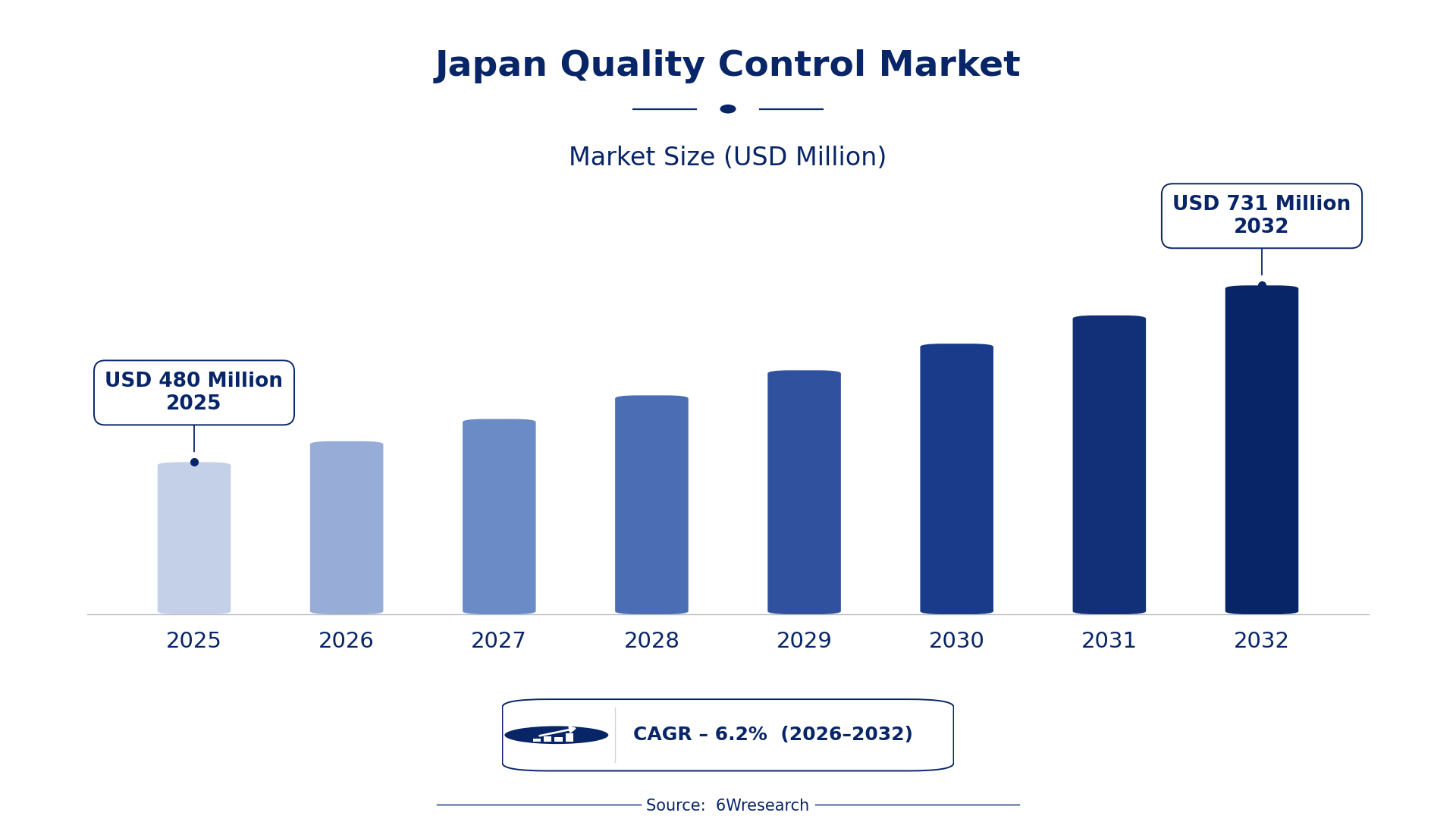
According to 6Wresearch internal database and industry insights, the Japan Quality Control Market was valued at USD 480 Million in 2025 and is projected to reach USD 731 Million by 2032, growing at a CAGR of approximately 6.2% during 2026–2032.
Japan Quality Control Market Highlights
| Report Metric | Details |
| Report Name | Japan Quality Control Market (2026-2032) |
| Market Size 2025 | USD 480 Million |
| Market Size 2032 | USD 731 Million |
| Absolute Growth 2025–2032 | USD 251 Million |
| CAGR 2026–2032 | 6.2% |
| Peak Annual Growth | 7.2% in 2031 |
| Forecast Period | 2026–2032 |
| Historical Data | 2022–2025 |
| Base Year | 2025 |
| Leading Control Type, 2025 | In-Process Control (50% share) |
| Leading Inspection Method, 2025 | Statistical Process Control (SPC) (44% share) |
| Leading Industry Area, 2025 | Manufacturing (40% share) |
| Leading End User, 2025 | Factory Units (41% share) |
| Fastest-Growing Control Type | Process Control (8.8% CAGR) |
| Fastest-Growing Inspection Method | Automation Tools (9.1% CAGR) |
| Fastest-Growing Industry Area | Medical Devices (7.5% CAGR) |
| Fastest-Growing End User | OEMs (8.1% CAGR) |
| Growing Sector | Manufacturing |
| Key End Users | Automotive manufacturers, Medical device producers, Regulatory teams, Factory units |
Japan Quality Control Market Year-wise Growth Rate and Key Drivers (2022–2032)
This graph illustrates the annual growth rates of the market from 2022 to 2032, highlighting a steady upward trajectory and projected market expansion over the forecast period.
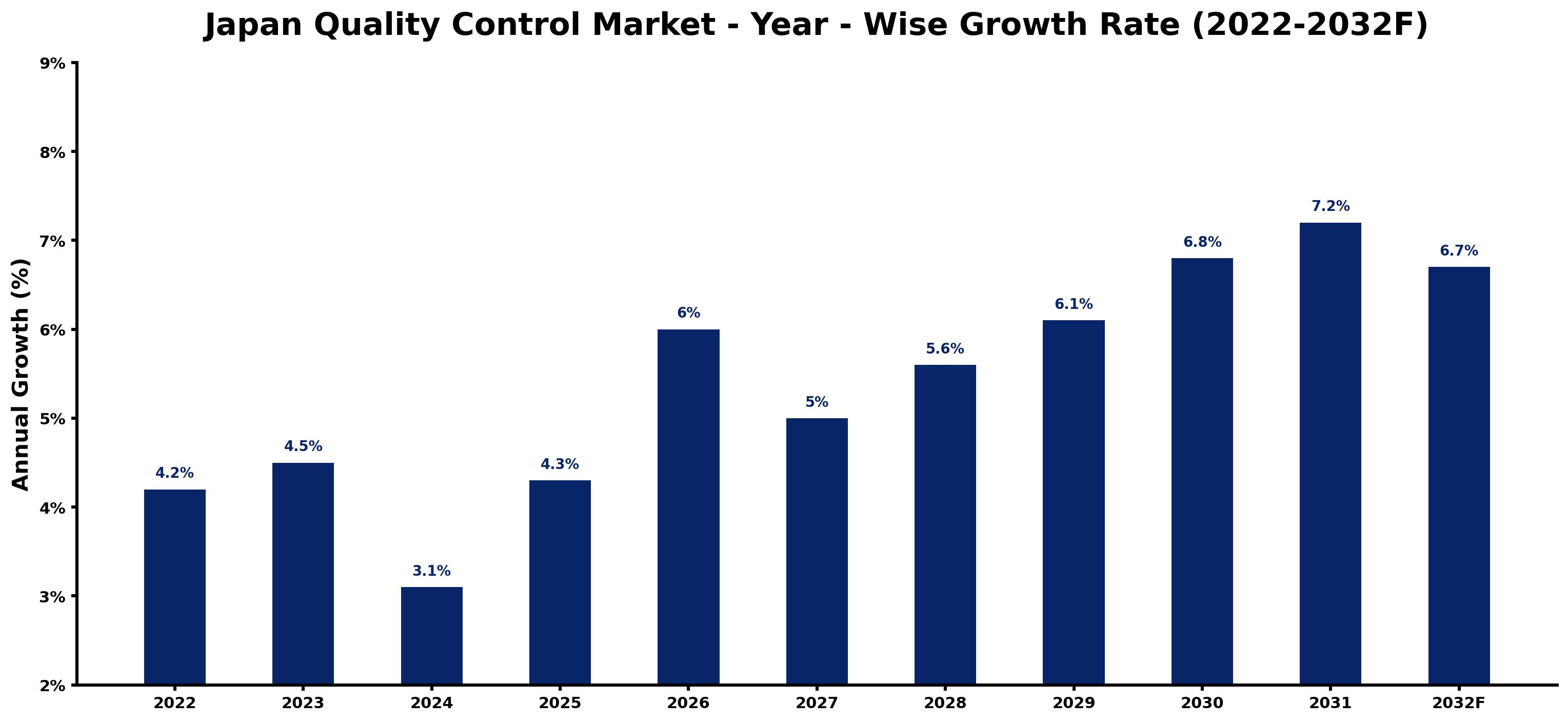
Year by year, the estimates below pair each growth rate with the development that shaped it.
| Year | Estimated Annual Growth (%) | Market Rationale |
| 2022 | 4.2 | The market experienced steady growth, driven by increased manufacturing activity. |
| 2023 | 4.5 | Demand for quality control measures rose as the automotive sector expanded. |
| 2024 | 3.1 | Growth slowed due to a temporary dip in production levels in key industries. |
| 2025 | 4.3 | Manufacturers adopted new quality standards, boosting market performance. |
| 2026 | 6.0 | The market is expected to grow as automation tools gain traction. |
| 2027 | 5.0 | A slowdown in growth is anticipated as the market stabilises. |
| 2028 | 5.6 | Investment in quality control technologies is expected to drive growth. |
| 2029 | 6.1 | Demand is projected to rise as the medical devices sector expands. |
| 2030 | 6.8 | A growing focus on compliance reviews is set to support market growth. |
| 2031 | 7.2 | The peak growth year will see heightened investments in quality control. |
| 2032 | 6.7 | Growth is expected to slow as the market matures. |
Note: Market size estimations and growth projections presented in this report are based on 6Wresearch's proprietary forecasting methodology, utilizing the latest available industry data, government publications, and primary research inputs.
Japan Quality Control Market Synopsis
Quality control involves systematic processes to ensure products meet specified requirements through inspections, testing, and audits. The Japan Quality Control Market is growing, driven by the automotive and electronics sectors, which are crucial to the economy. The adoption of standards like ISO 9001 and the widespread use of Statistical Process Control are improving quality measures across industries, leading to increased demand from manufacturers and regulatory bodies.
Market Dynamics Impact Analysis (2026–2032)
| Factor | Type | Impact | Primary Segment Affected |
| Increased adoption of automation tools enhances efficiency in quality checks. | Driver | High | Automation Tools |
| The automotive industry’s stringent quality standards drive demand for quality control measures. | Driver | High | Final Product Testing |
| Growing demand for compliance reviews in the pharmaceutical sector presents opportunities. | Opportunity | High | Compliance Reviews |
| The rise of medical devices necessitates advanced quality control measures. | Opportunity | High | Quality Auditing |
| The high cost of implementing advanced quality control systems can deter smaller manufacturers. | Restraint | Medium | In-Process Control |
| Limited availability of skilled quality control professionals may hinder market growth. | Restraint | Medium | Statistical Process Control (SPC) |
| The high initial investment for automation tools poses a challenge for smaller firms. | Challenge | High | Automation Tools |
| The complexity of compliance with multiple quality standards can overwhelm manufacturers. | Challenge | Medium | Final Product Testing |
Evaluation of Drivers in Japan Quality Control Market (2026–2032)
The factors lifting demand, and the evidence behind each, are summarised below.
| Drivers | Primary Segment Affected | Why It Matters (Evidence) |
| Increased production in the automotive sector drives demand for quality control measures. | Final Product Testing | With over 4 million vehicles produced annually, stringent quality checks are essential. |
| Growing adoption of Statistical Process Control improves production efficiency. | Statistical Process Control (SPC) | Over 60% of manufacturing firms use SPC to monitor processes effectively. |
| Rising investment in automation tools improves quality assurance processes. | Automation Tools | Quality control tool usage has risen by 30% since 2020, boosting efficiency. |
| The expansion of the medical devices sector necessitates rigorous quality audits. | Quality Auditing | Quality audits are mandated for all medical device manufacturers, ensuring compliance. |
| Increased regulatory scrutiny drives demand for compliance reviews. | Compliance Reviews | Regulatory teams enforce quality standards, necessitating thorough compliance checks. |
Purchasing is picking up as demand from the automotive sector rises, with over 4 million vehicles produced annually requiring stringent quality checks. The adoption of Statistical Process Control has increased, with over 60% of manufacturing firms implementing these methods to improve production efficiency. The medical devices sector is expanding, necessitating rigorous quality audits to ensure compliance with safety standards. Investment in automation tools has surged, with a 30% rise in usage since 2020, improving accuracy in quality assurance processes.
Evaluation of Restraints in Japan Quality Control Market
The key brakes on demand, and where they bite hardest, are shown below.
| Market Restraint | Primary Segment Affected | Why It Matters (Evidence) |
| The high cost of advanced quality control systems can deter smaller manufacturers from adoption. | In-Process Control | Initial investments can exceed budgets, limiting access to necessary technologies. |
| Limited availability of skilled quality control professionals may hinder implementation. | Statistical Process Control (SPC) | The total number of quality control professionals in Japan exceeds 500,000, yet demand continues to outpace supply. |
| Complex compliance requirements can overwhelm manufacturers, leading to delays. | Quality Auditing | Medical device manufacturers face stringent regulations that complicate quality assurance processes. |
| Resistance to change among traditional manufacturers may slow technology adoption. | Automation Tools | Many firms are hesitant to invest in new technologies, preferring established methods. |
| Market fluctuations in the manufacturing sector can impact quality control investments. | Final Product Testing | Economic downturns can lead to reduced production and lower quality control budgets. |
Japan Quality Control Market Challenges
Insufficient adoption of advanced quality control technology hinders producers in Japan, causing delays in inspections that can cost large firms up to JPY 500 million annually. Many manufacturers rely on outdated systems, resulting in inefficiencies that disrupt supply chains and lead to buyers facing delays in compliant products, potentially costing them 15% of their annual revenue. Regulatory pressures are intensifying, especially in the pharmaceutical sector, where mandatory compliance reviews increase operational costs for producers and risk penalties for non-compliance. The lack of skilled quality control professionals further complicates matters, as over 80% of factories struggle to implement effective measures.
Trends in the Japan Quality Control Market
Below are the shifts with the largest effect on the Japan Quality Control Market.
- Shift towards Automation in Quality Control: The rise of automation tools in quality control is transforming industry practices. In 2023, Japan experienced a 30% increase in automation tool usage, improving efficiency and accuracy in inspections.
- Transition from Manual to Statistical Process Control: Since 2021, manufacturers have increasingly adopted Statistical Process Control to monitor production. Over 60% of firms now employ SPC, streamlining quality assurance processes.
- Medical Devices Prioritised over Traditional Manufacturing: The medical devices sector is prioritising quality audits, with compliance mandatory for all manufacturers. This shift has led to a 7.5% growth in quality auditing measures since 2026.
- Increased Focus on Compliance Reviews: Regulatory teams are emphasising compliance reviews, especially in pharmaceuticals. This trend has resulted in a notable rise in demand for quality control measures across the sector.
Investment Opportunities in the Japan Quality Control Market
The following areas offer the clearest openings for investors and suppliers in the Japan Quality Control Market.
- OEMs Seeking Enhanced Quality Control: OEMs are increasingly investing in advanced quality control measures, driven by the need for stringent standards. With over 80% of factories implementing in-process control measures, there is a clear demand for new solutions.
- Growing Demand for Quality Auditing in Medical Devices: The medical devices sector requires rigorous quality audits, presenting a timely opportunity for investment. With a projected growth of 7.5% in this area, suppliers can enter through partnerships with regulatory teams.
- Expansion of Automation Tools in Manufacturing: The increasing need for efficiency in manufacturing presents a promising opportunity for automation tools. With a 30% rise in usage since 2020, suppliers can collaborate with factories to improve quality processes.
- Quality Control Training Programs for Professionals: The demand for quality control training programs is rising, with over 500,000 professionals in the field. Investing in training initiatives can help bridge the skills gap in quality assurance.
Government Initiatives in the Japan Quality Control Market
In 2023, a quality improvement program was initiated with a budget of ¥5 billion, augmenting existing regulations under the Electrical Appliance and Material Safety Act and the Industrial Safety and Health Act. This initiative aims to strengthen compliance and safety standards across various sectors, ensuring that manufacturers adhere to stringent quality measures.
The Japan Quality Assurance Organization utilises the compliance framework established by the quality improvement program to enforce quality audits for medical device manufacturers. This ensures that products meet safety standards and regulatory requirements, ultimately protecting consumers and maintaining industry integrity.
Future Insight of the Japan Quality Control Market
A policy-driven shift will emerge with a government-backed quality improvement programme, prompting suppliers to adopt advanced quality management standards. By 2032, automation in quality control tools will continue to rise, streamlining processes for suppliers and improving operational efficiency. Training initiatives will prepare a new generation of professionals, ensuring that the workforce is equipped to meet industry demands. The automotive sector will lead the way, with over 4 million vehicles produced annually, driving further advancements in quality assurance practices.
Market Segmentation Analysis
Japan Quality Control Market report covers a detailed analysis of the following market segments:
By Control Type – In-Process Control Leads, Process Control Expected to Grow Fastest
According to Saurav Kr Singh, Senior Research Analyst at 6Wresearch, with 50% of control type revenue in 2025, In-Process Control was the largest category. In-Process Control holds the largest share due to its critical role in monitoring quality during production processes, especially in sectors like automotive where precision is paramount. Its widespread adoption stems from its effectiveness in preventing defects and ensuring compliance with industry standards. The quickest growth will come from Process Control, forecast to expand at a CAGR of 8.8% between 2026 and 2032. Process Control is experiencing rapid growth as it integrates quality checks directly into production workflows, significantly enhancing operational efficiency. The notable increase in the use of automated quality control tools, which rose by 30% since 2020, is a key driver of this trend. Suppliers should prioritise the development of advanced in-process and process control solutions to align with the increasing market demand.
By Inspection Method – Statistical Process Control (SPC) Leads, Automation Tools Expected to Grow Fastest
Statistical Process Control (SPC) accounted for 44% of the market by inspection method in 2025. Statistical Process Control (SPC) is the leading method as it effectively applies statistical techniques to monitor production processes, ensuring consistent quality across various sectors. Its extensive application in manufacturing highlights its critical role in maintaining high product standards. Over 2026–2032, Automation Tools are expected to post the fastest growth, at a CAGR of 9.1%. Automation Tools are rapidly gaining traction as they significantly improve efficiency and accuracy in quality checks, aligning with the industry's trend towards streamlined operations. The marked increase in the adoption of these tools since 2020 reflects this growing preference. Buyers should consider investing in automation tools that enhance quality inspection processes and minimise human error.
By Industry Area – Manufacturing Leads, Medical Devices Expected to Grow Fastest
The largest industry area category in 2025 was Manufacturing, at 40% of revenue. Manufacturing is the predominant area for quality control, as it is vital for maintaining product integrity, especially given its substantial contribution of 20% to Japan's GDP. The sector's reliance on stringent quality measures underscores the importance of effective quality management. Medical Devices are projected to grow fastest, at a CAGR of 7.5% during 2026–2032. Medical Devices are the fastest-growing area, driven by the need for stringent quality control to ensure the safety and effectiveness of medical products. The rising regulatory requirements for this sector are a significant factor propelling this growth. Suppliers should customise their offerings to address the specific quality control requirements of the rapidly expanding medical device sector.
By End User – Factory Units Lead, OEMs Expected to Grow Fastest
Factory Units held 41% of the Japan Quality Control Market by end user in 2025. Factory Units represent the largest user group as they are the primary sites for implementing quality control measures, ensuring that products meet required standards during production. The extensive number of factory units in Japan reinforces their significance in the quality control market. OEMs are set to record the highest CAGR in this split, 8.1% over 2026–2032. OEMs are the fastest-growing end user group as they demand stringent quality standards for parts and components, reflecting the increasing complexity of manufacturing processes. Their focus on quality assurance is driving the need for advanced quality control solutions. Suppliers must develop tailored quality control solutions that address the specific requirements of OEMs to capture this growing market.
Key Attractiveness of the Report
- 10 Years of Market Numbers
- Historical Data Starting from 2022 to 2025
- Base Year 2025
- Forecast Data until 2032
- Key Performance Indicators Impacting the Market
- Major Upcoming Developments and Projects
Key Highlights of the Report:
- Japan Quality Control Market Outlook
- Market Size of Japan Quality Control Market, 2025
- Forecast of Japan Quality Control Market, 2032
- Historical Data and Forecast of Japan Quality Control Revenues & Volume for the Period 2022-2032F
- Japan Quality Control Market Trend Evolution
- Japan Quality Control Market Drivers and Challenges
- Japan Quality Control Price Trends
- Japan Quality Control Porter's Five Forces
- Japan Quality Control Industry Life Cycle
- Historical Data and Forecast of Japan Quality Control Market Revenues & Volume By Control Type for the Period 2022-2032F
- Historical Data and Forecast of Japan Quality Control Market Revenues & Volume By In-Process Control for the Period 2022-2032F
- Historical Data and Forecast of Japan Quality Control Market Revenues & Volume By Final Product Testing for the Period 2022-2032F
- Historical Data and Forecast of Japan Quality Control Market Revenues & Volume By Process Control for the Period 2022-2032F
- Historical Data and Forecast of Japan Quality Control Market Revenues & Volume By Quality Auditing for the Period 2022-2032F
- Historical Data and Forecast of Japan Quality Control Market Revenues & Volume By Inspection Method for the Period 2022-2032F
- Historical Data and Forecast of Japan Quality Control Market Revenues & Volume By Visual/Mechanical for the Period 2022-2032F
- Historical Data and Forecast of Japan Quality Control Market Revenues & Volume By Automation Tools for the Period 2022-2032F
- Historical Data and Forecast of Japan Quality Control Market Revenues & Volume By Statistical Process Control (SPC) for the Period 2022-2032F
- Historical Data and Forecast of Japan Quality Control Market Revenues & Volume By Compliance Reviews for the Period 2022-2032F
- Historical Data and Forecast of Japan Quality Control Market Revenues & Volume By Industry Area for the Period 2022-2032F
- Historical Data and Forecast of Japan Quality Control Market Revenues & Volume By Manufacturing for the Period 2022-2032F
- Historical Data and Forecast of Japan Quality Control Market Revenues & Volume By Automotive for the Period 2022-2032F
- Historical Data and Forecast of Japan Quality Control Market Revenues & Volume By Chemicals for the Period 2022-2032F
- Historical Data and Forecast of Japan Quality Control Market Revenues & Volume By Medical Devices for the Period 2022-2032F
- Historical Data and Forecast of Japan Quality Control Market Revenues & Volume By End User for the Period 2022-2032F
- Historical Data and Forecast of Japan Quality Control Market Revenues & Volume By Factory Units for the Period 2022-2032F
- Historical Data and Forecast of Japan Quality Control Market Revenues & Volume By OEMs for the Period 2022-2032F
- Historical Data and Forecast of Japan Quality Control Market Revenues & Volume By Chemical Plants for the Period 2022-2032F
- Historical Data and Forecast of Japan Quality Control Market Revenues & Volume By Regulatory Teams for the Period 2022-2032F
- Japan Quality Control Import Export Trade Statistics
- Market Opportunity Assessment By Control Type
- Market Opportunity Assessment By Inspection Method
- Market Opportunity Assessment By Industry Area
- Market Opportunity Assessment By End User
- Japan Quality Control Top Companies Market Share
- Japan Quality Control Competitive Benchmarking By Technical and Operational Parameters
- Japan Quality Control Company Profiles
- Japan Quality Control Key Strategic Recommendations
Market Covered
The following segment groups are covered in the report.
By Control Type
- In-Process Control
- Final Product Testing
- Process Control
- Quality Auditing
By Inspection Method
- Visual/Mechanical
- Automation Tools
- Statistical Process Control (SPC)
- Compliance Reviews
By Industry Area
- Manufacturing
- Automotive
- Chemicals
- Medical Devices
By End User
- Factory Units
- OEMs
- Chemical Plants
- Regulatory Teams































