Japan Quality Control Testing Market Size & Growth Rate
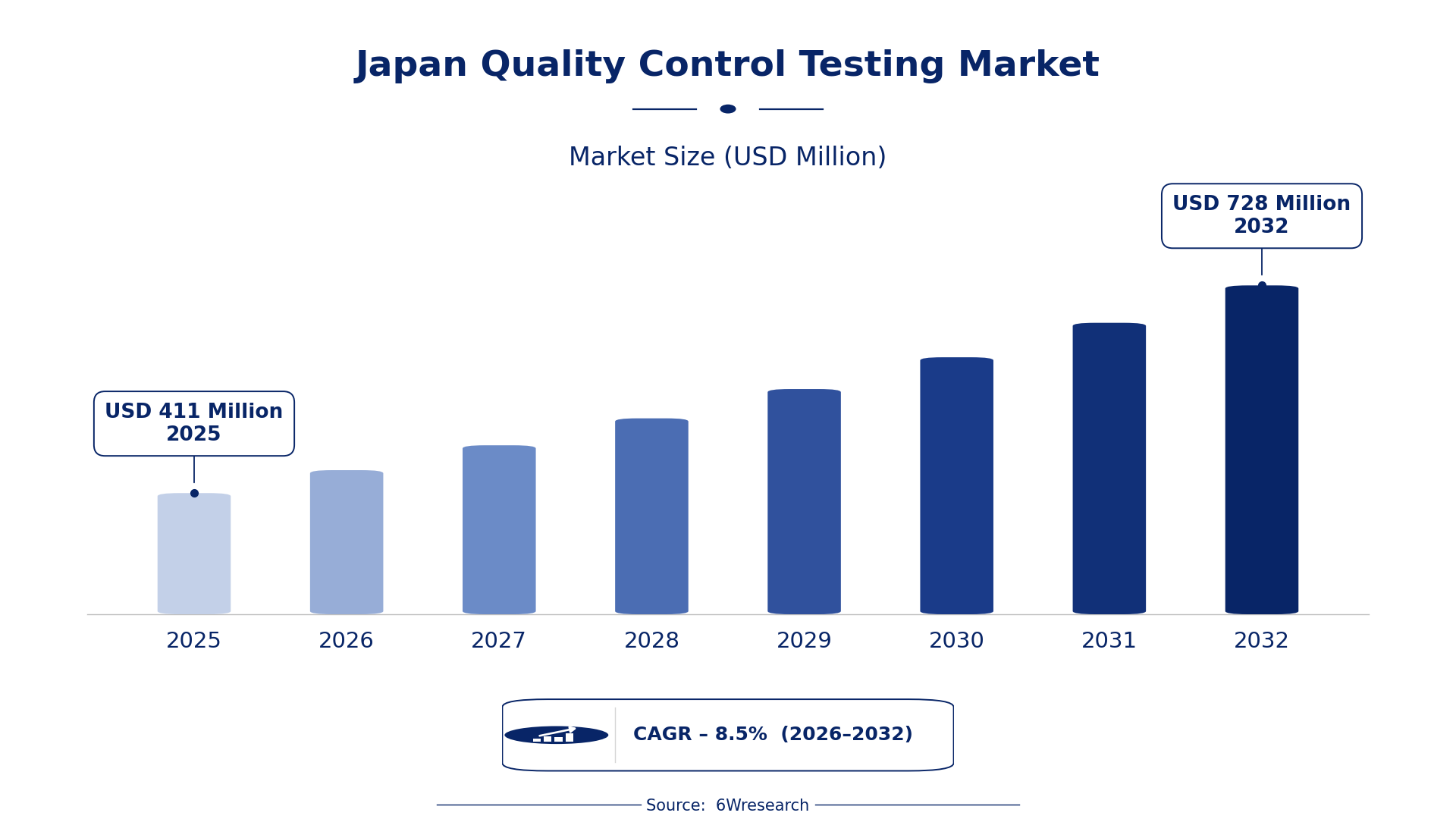
According to 6Wresearch internal database and industry insights, the Japan Quality Control Testing Market was valued at USD 411 Million in 2025 and is projected to reach USD 728 Million by 2032, growing at a CAGR of approximately 8.5% during 2026–2032.
Japan Quality Control Testing Market Highlights
| Report Metric | Details |
| Report Name | Japan Quality Control Testing Market (2026-2032) |
| Market Size 2025 | USD 411 Million |
| Market Size 2032 | USD 728 Million |
| Absolute Growth 2025–2032 | USD 317 Million |
| CAGR 2026–2032 | 8.5% |
| Peak Annual Growth | 9.5% in 2028 |
| Forecast Period | 2026–2032 |
| Historical Data | 2022–2025 |
| Base Year | 2025 |
| Leading Testing Type, 2025 | Tensile Testing (38% share) |
| Leading Material Type, 2025 | Metals/Polymers (36% share) |
| Leading Testing Standard, 2025 | ASTM/ISO (43% share) |
| Leading End User, 2025 | Mechanical Labs (36% share) |
| Fastest-Growing Testing Type | Chemical Testing (11.8% CAGR) |
| Fastest-Growing Material Type | Organic/Inorganic (12.7% CAGR) |
| Fastest-Growing Testing Standard | FDA/EPA (11.7% CAGR) |
| Fastest-Growing End User | Food & Beverage Firms (11.2% CAGR) |
| Growing Sector | Manufacturing |
| Key End Users | Mechanical Labs, Aerospace & Defense Firms, Electronics Manufacturers, Food & Beverage Firms |
Japan Quality Control Testing Market Year-wise Growth Rate and Key Drivers (2022–2032)
This graph illustrates the annual growth rates of the market from 2022 to 2032, highlighting a steady upward trajectory and projected market expansion over the forecast period.
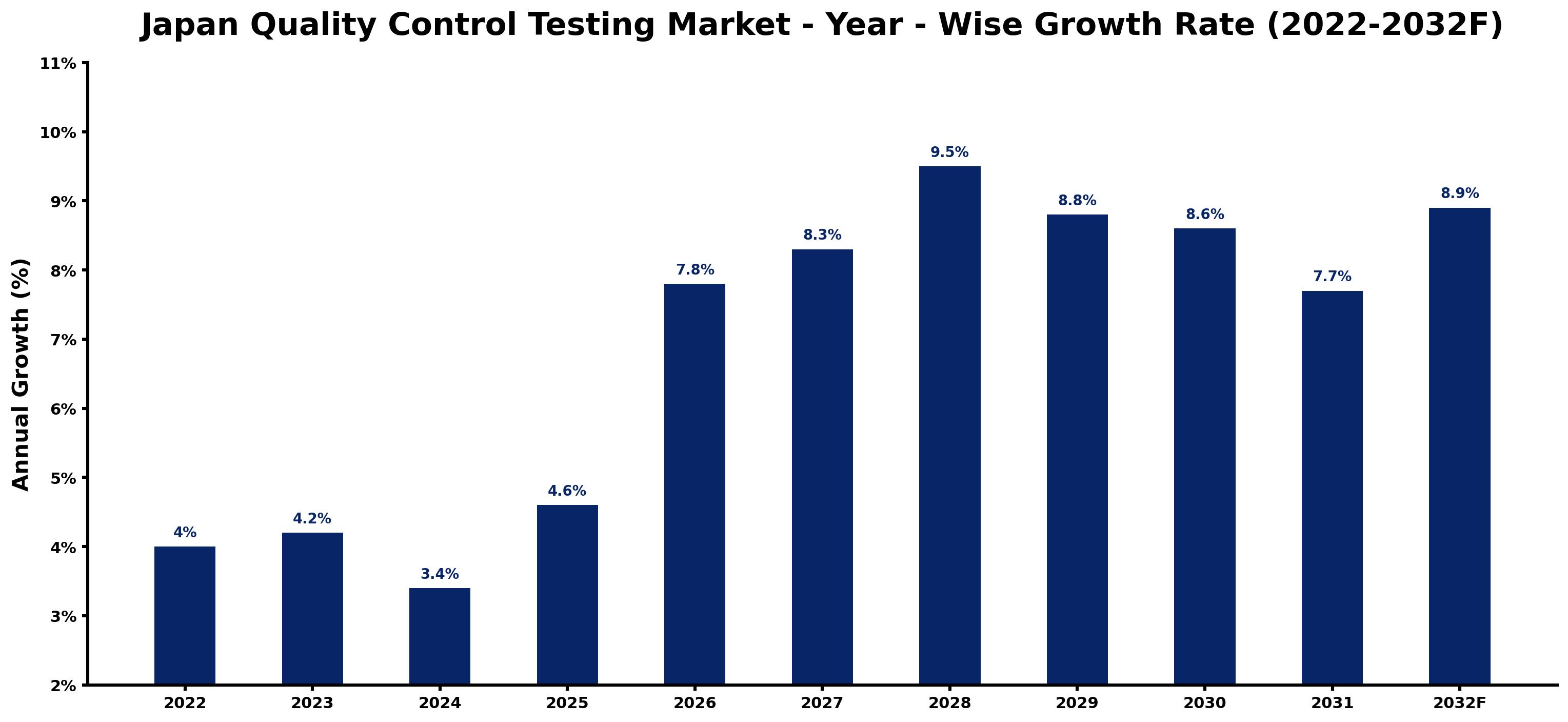
Below, each year's estimated growth is shown next to the factor that most influenced it.
| Year | Estimated Annual Growth (%) | Market Rationale |
| 2022 | 4.0 | The market showed steady growth due to consistent demand from manufacturing sectors. |
| 2023 | 4.2 | Demand increased as manufacturers focused on enhancing product quality and compliance. |
| 2024 | 3.4 | Growth slowed as some sectors faced temporary challenges in production capacity. |
| 2025 | 4.6 | The market rebounded with stronger demand for tensile testing services from various industries. |
| 2026 | 7.8 | Investment in advanced testing technologies drove significant growth in the sector. |
| 2027 | 8.3 | Increased focus on regulatory compliance led to a rise in chemical testing demand. |
| 2028 | 9.5 | The peak growth year saw heightened investments in nondestructive testing technologies. |
| 2029 | 8.8 | Growth slowed slightly as the market stabilised after rapid expansion. |
| 2030 | 8.6 | Demand remained strong, supported by ongoing investments in quality assurance. |
| 2031 | 7.7 | The market continued to grow, driven by persistent needs in aerospace and electronics. |
| 2032 | 8.9 | Growth accelerated again as new technologies and standards emerged. |
Note: Market size estimations and growth projections presented in this report are based on 6Wresearch's proprietary forecasting methodology, utilizing the latest available industry data, government publications, and primary research inputs.
Japan Quality Control Testing Market Synopsis
Quality control testing encompasses various methodologies to ensure products meet specified standards, including tensile, chemical, nondestructive, and environmental testing. Japan's Quality Control Testing Market is expanding, driven by strong demand from manufacturing sectors, particularly in aerospace and electronics. The installed base of testing equipment exceeds 500,000 units, and the annual demand for tensile testing services is estimated at 2 million tests. As manufacturers prioritise compliance with ASTM and ISO standards, investments in advanced testing technologies are expected to further boost market growth.
Market Dynamics Impact Analysis (2026–2032)
| Factor | Type | Impact | Primary Segment Affected |
| Strong demand for compliance with international standards | Driver | High | Tensile Testing |
| Increased investment in advanced testing technologies | Driver | High | Chemical Testing |
| Growing need for environmental compliance testing | Opportunity | High | Environmental Testing |
| Expansion of aerospace testing facilities in the Tokyo region | Opportunity | Medium | Nondestructive Testing |
| High operational costs for testing laboratories | Restraint | High | Tensile Testing |
| Limited availability of skilled professionals in testing fields | Restraint | Medium | Chemical Testing |
| Rising competition among testing laboratories | Challenge | High | Nondestructive Testing |
| Challenges in keeping up with evolving regulations | Challenge | Medium | Environmental Testing |
Evaluation of Drivers in Japan Quality Control Testing Market (2026–2032)
The table below links each growth driver to the segment it affects and the evidence for it.
| Drivers | Primary Segment Affected | Why It Matters (Evidence) |
| Rising demand for compliance with ASTM and ISO standards | Tensile Testing | This demand leads to increased testing volumes, with an estimated 2 million tensile tests conducted annually. |
| Investment in advanced testing technologies | Chemical Testing | Such investments prompt food and beverage firms to increase their chemical testing services, ensuring product safety. |
| Growing focus on environmental compliance | Environmental Testing | Stricter regulations drive demand for environmental testing, particularly in the manufacturing sector, enhancing service uptake. |
| Expansion of aerospace testing facilities in Tokyo | Nondestructive Testing | This expansion supports the aerospace industry's need for quality assurance, increasing demand for testing services. |
| Increased awareness of product safety and quality | Mechanical Labs | Mechanical labs are responding to this awareness by investing in more effective testing services. |
Most of the extra volume comes from rising demand for compliance with ASTM and ISO standards, leading to an estimated 2 million tensile tests conducted annually. Investment in advanced testing technologies is motivating food and beverage firms to enhance their chemical testing services, ensuring product safety. The expansion of aerospace testing facilities supports the aerospace industry's need for quality assurance, further increasing demand for nondestructive testing. Awareness of product safety and quality is driving mechanical labs to invest in improved testing services, boosting overall market growth.
Evaluation of Restraints in Japan Quality Control Testing Market
Below are the constraints most often cited by buyers and suppliers, with the segment each affects.
| Market Restraint | Primary Segment Affected | Why It Matters (Evidence) |
| High operational costs for maintaining testing laboratories | Tensile Testing | Such costs can limit the ability of laboratories to invest in advanced equipment and technologies, affecting service quality. |
| Limited availability of skilled professionals in testing fields | Chemical Testing | A shortage of qualified personnel can hinder firms' ability to meet growing testing demands, impacting service delivery. |
| Regulatory compliance costs can be burdensome | Environmental Testing | These costs may deter smaller firms from investing in necessary testing services, limiting market participation. |
| Competition among testing laboratories can drive prices down | Nondestructive Testing | This price pressure may impact profitability for some service providers, affecting their operational sustainability. |
| Technological advancements require continuous investment | Mechanical Labs | Failure to keep up with technology can lead to outdated practices and loss of market competitiveness. |
Japan Quality Control Testing Market Challenges
Stricter RoHS compliance measures for electronics have raised testing requirements, resulting in delays for producers who must navigate complex regulations. A shortage of skilled professionals in mechanical labs, employing over 50,000, hampers the ability to meet rising demands for quality control testing. Buyers face challenges as Japan's minimum wage increased to JPY 1,055 per hour, raising operational costs and impacting profitability. Increased government scrutiny on chemical testing in consumer products complicates processes for suppliers, leading to longer lead times and potential revenue loss.
Trends in the Japan Quality Control Testing Market
Buyers and suppliers in the Japan Quality Control Testing Market are adjusting to the following trends.
- Shift towards Environmental Testing Compliance: In 2023, Japan implemented stricter RoHS compliance measures for electronics, reflecting a growing emphasis on environmental testing. This shift is projected to increase demand for services that ensure compliance with these regulations.
- Transition from Traditional to Advanced Testing Technologies: The adoption of advanced nondestructive testing methods has gained traction in Japan, particularly in aerospace. This trend is likely to improve the quality assurance process, with over 500,000 units of testing equipment currently in use.
- Emergence of Organic and Inorganic Testing: Organic and inorganic testing is rapidly growing, driven by the need for chemical safety assessments. This segment is expected to grow at a CAGR of 12.7% from 2026 to 2032, reflecting heightened regulatory scrutiny.
- Focus on ISO 9001 Certification: ISO 9001 certification has become a common requirement for manufacturers in Japan, promoting quality management practices. This trend is anticipated to drive demand for quality control testing services across various sectors.
Investment Opportunities in the Japan Quality Control Testing Market
Several openings in the Japan Quality Control Testing Market merit attention from investors.
- Quality Control Testing Services: With the annual demand for tensile testing services estimated at 2 million tests, there is an opportunity for suppliers to meet this need. Mechanical labs are actively seeking partnerships to improve their testing capabilities.
- Investment in Advanced Testing Equipment: The installed base of testing equipment exceeds 500,000 units, indicating a gap for suppliers of advanced technologies. Collaborating with mechanical labs can facilitate entry into this growing market.
- Expansion of Aerospace Testing Facilities: The Tokyo region is a major hub for aerospace testing, presenting opportunities for suppliers to invest in testing services. The ongoing expansion of facilities indicates a growing demand for quality assurance.
- Compliance with Stricter Environmental Regulations: The implementation of stricter RoHS measures creates a demand for compliance testing services. Suppliers can enter this market by partnering with firms focused on environmental compliance.
Government Initiatives in the Japan Quality Control Testing Market
The Electrical Appliance and Material Safety Act, established in 1961, regulates the safety of electrical appliances and materials in Japan. This law mandates that producers ensure their products meet safety standards, impacting quality control testing practices across the industry. Additionally, the Chemical Substances Control Law requires evaluation and control of chemical substances, influencing testing requirements in various sectors, ensuring consumer safety and compliance.
The Ministry of the Environment oversees compliance with environmental testing standards, ensuring that laboratories adhere to regulations. The Japan Quality Assurance Organization provides certification for testing services, promoting adherence to quality standards. These agencies are instrumental in funding and approving initiatives that strengthen the quality control testing framework in Japan.
Future Insight of the Japan Quality Control Testing Market
Quality control testing will evolve significantly by 2032, driven by advancements in technology and regulatory changes. Buyers in manufacturing sectors will benefit from enhanced nondestructive testing technologies, which will improve product safety and reliability. The Japan Quality Assurance Organization is likely to expand its certification offerings, streamlining processes for suppliers. With annual demand for tensile testing services projected to rise, the government’s support for advanced testing technologies through subsidies will lead to greater efficiency and reduced costs.
Market Segmentation Analysis
Japan Quality Control Testing Market report covers a detailed analysis of the following market segments:
By Testing Type – Tensile Testing Leads, Chemical Testing Expected to Grow Fastest
According to Saurav Kr Singh, Senior Research Analyst at 6Wresearch, Tensile Testing held 38% of the Japan Quality Control Testing Market by testing type in 2025. Tensile testing holds the largest share as it is essential for assessing material strength across various sectors, particularly in manufacturing. This method is crucial for compliance with ASTM and ISO standards, which are widely adopted in Japan. Chemical Testing is set to record the highest CAGR in this split, 11.8% over 2026–2032. Chemical testing is experiencing rapid growth due to heightened safety regulations, especially in the food industry overseen by the Food Safety Commission. The increasing emphasis on safety and compliance is expected to drive the demand for chemical testing services further. Suppliers should focus on enhancing chemical testing offerings to meet the growing regulatory demands.
By Material Type – Metals/Polymers Lead, Organic/Inorganic Expected to Grow Fastest
With 36% of material type revenue in 2025, Metals/Polymers was the largest category. Metals and polymers lead the market as they are extensively utilised in various industries, including automotive and construction. Their widespread applications necessitate thorough quality control testing to ensure adherence to industry standards. Over 2026–2032, Organic/Inorganic is expected to post the fastest growth, at a CAGR of 12.7%. The organic and inorganic materials segment is experiencing the fastest growth due to increased awareness of chemical safety assessments, especially in the food and beverage sector. This trend is propelled by heightened regulatory scrutiny and consumer demand for safer products. Buyers in the food and beverage sector must ensure their suppliers can conduct organic and inorganic material testing.
By Testing Standard – ASTM/ISO Leads, FDA/EPA Expected to Grow Fastest
ASTM/ISO took 43% of testing standard revenue in 2025, more than any other category. ASTM and ISO standards lead the market as they provide standardized testing protocols that are mandatory for various industries in Japan. Their widespread adoption ensures consistency and reliability in quality control testing processes. FDA/EPA is projected to grow fastest, at a CAGR of 11.7% during 2026–2032. The FDA and EPA standards are growing rapidly due to increasing regulatory compliance requirements for health and safety in food and chemical products. This trend reflects a broader commitment to consumer safety and environmental protection. Suppliers must align their testing services with FDA and EPA standards to remain competitive in the market.
By End User – Mechanical Labs Lead, Food & Beverage Firms Expected to Grow Fastest
In 2025, Mechanical Labs led the end user split with a 36% share. Mechanical labs are the primary users of testing services, performing numerous assessments to ensure material quality and compliance with industry standards. Their established role in the testing ecosystem significantly contributes to the overall demand for various testing methodologies. The quickest growth will come from Food & Beverage Firms, forecast to expand at a CAGR of 11.2% between 2026 and 2032. Food and beverage firms are seeing the fastest growth in testing services due to the critical need for product safety and quality assurance in a highly regulated market. This sector's increasing focus on compliance is driving the demand for rigorous testing protocols. Suppliers should strategically target food and beverage firms to capitalise on the rising demand for comprehensive testing services.
Key Attractiveness of the Report
- 10 Years of Market Numbers
- Historical Data Starting from 2022 to 2025
- Base Year 2025
- Forecast Data until 2032
- Key Performance Indicators Impacting the Market
- Major Upcoming Developments and Projects
Key Highlights of the Report:
- Japan Quality Control Testing Market Outlook
- Market Size of Japan Quality Control Testing Market, 2025
- Forecast of Japan Quality Control Testing Market, 2032
- Historical Data and Forecast of Japan Quality Control Testing Revenues & Volume for the Period 2022-2032F
- Japan Quality Control Testing Market Trend Evolution
- Japan Quality Control Testing Market Drivers and Challenges
- Japan Quality Control Testing Price Trends
- Japan Quality Control Testing Porter's Five Forces
- Japan Quality Control Testing Industry Life Cycle
- Historical Data and Forecast of Japan Quality Control Testing Market Revenues & Volume By Testing Type for the Period 2022-2032F
- Historical Data and Forecast of Japan Quality Control Testing Market Revenues & Volume By Tensile Testing for the Period 2022-2032F
- Historical Data and Forecast of Japan Quality Control Testing Market Revenues & Volume By Chemical Testing for the Period 2022-2032F
- Historical Data and Forecast of Japan Quality Control Testing Market Revenues & Volume By Nondestructive Testing for the Period 2022-2032F
- Historical Data and Forecast of Japan Quality Control Testing Market Revenues & Volume By Environmental Testing for the Period 2022-2032F
- Historical Data and Forecast of Japan Quality Control Testing Market Revenues & Volume By Material Type for the Period 2022-2032F
- Historical Data and Forecast of Japan Quality Control Testing Market Revenues & Volume By Metals/Polymers for the Period 2022-2032F
- Historical Data and Forecast of Japan Quality Control Testing Market Revenues & Volume By Organic/Inorganic for the Period 2022-2032F
- Historical Data and Forecast of Japan Quality Control Testing Market Revenues & Volume By Composites/Alloys for the Period 2022-2032F
- Historical Data and Forecast of Japan Quality Control Testing Market Revenues & Volume By Coatings/Paints for the Period 2022-2032F
- Historical Data and Forecast of Japan Quality Control Testing Market Revenues & Volume By Testing Standard for the Period 2022-2032F
- Historical Data and Forecast of Japan Quality Control Testing Market Revenues & Volume By ASTM/ISO for the Period 2022-2032F
- Historical Data and Forecast of Japan Quality Control Testing Market Revenues & Volume By FDA/EPA for the Period 2022-2032F
- Historical Data and Forecast of Japan Quality Control Testing Market Revenues & Volume By ASNT/ISO for the Period 2022-2032F
- Historical Data and Forecast of Japan Quality Control Testing Market Revenues & Volume By RoHS/REACH for the Period 2022-2032F
- Historical Data and Forecast of Japan Quality Control Testing Market Revenues & Volume By End User for the Period 2022-2032F
- Historical Data and Forecast of Japan Quality Control Testing Market Revenues & Volume By Mechanical Labs for the Period 2022-2032F
- Historical Data and Forecast of Japan Quality Control Testing Market Revenues & Volume By Food & Beverage Firms for the Period 2022-2032F
- Historical Data and Forecast of Japan Quality Control Testing Market Revenues & Volume By Aerospace & Defense Firms for the Period 2022-2032F
- Historical Data and Forecast of Japan Quality Control Testing Market Revenues & Volume By Electronics Manufacturers for the Period 2022-2032F
- Japan Quality Control Testing Import Export Trade Statistics
- Market Opportunity Assessment By Testing Type
- Market Opportunity Assessment By Material Type
- Market Opportunity Assessment By Testing Standard
- Market Opportunity Assessment By End User
- Japan Quality Control Testing Top Companies Market Share
- Japan Quality Control Testing Competitive Benchmarking By Technical and Operational Parameters
- Japan Quality Control Testing Company Profiles
- Japan Quality Control Testing Key Strategic Recommendations
Market Covered
Segments analysed in this report are listed below.
By Testing Type
- Tensile Testing
- Chemical Testing
- Nondestructive Testing
- Environmental Testing
By Material Type
- Metals/Polymers
- Organic/Inorganic
- Composites/Alloys
- Coatings/Paints
By Testing Standard
- ASTM/ISO
- FDA/EPA
- ASNT/ISO
- RoHS/REACH
By End User
- Mechanical Labs
- Food & Beverage Firms
- Aerospace & Defense Firms
- Electronics Manufacturers































