Japan Quality Inspection AI Market Size & Growth Rate
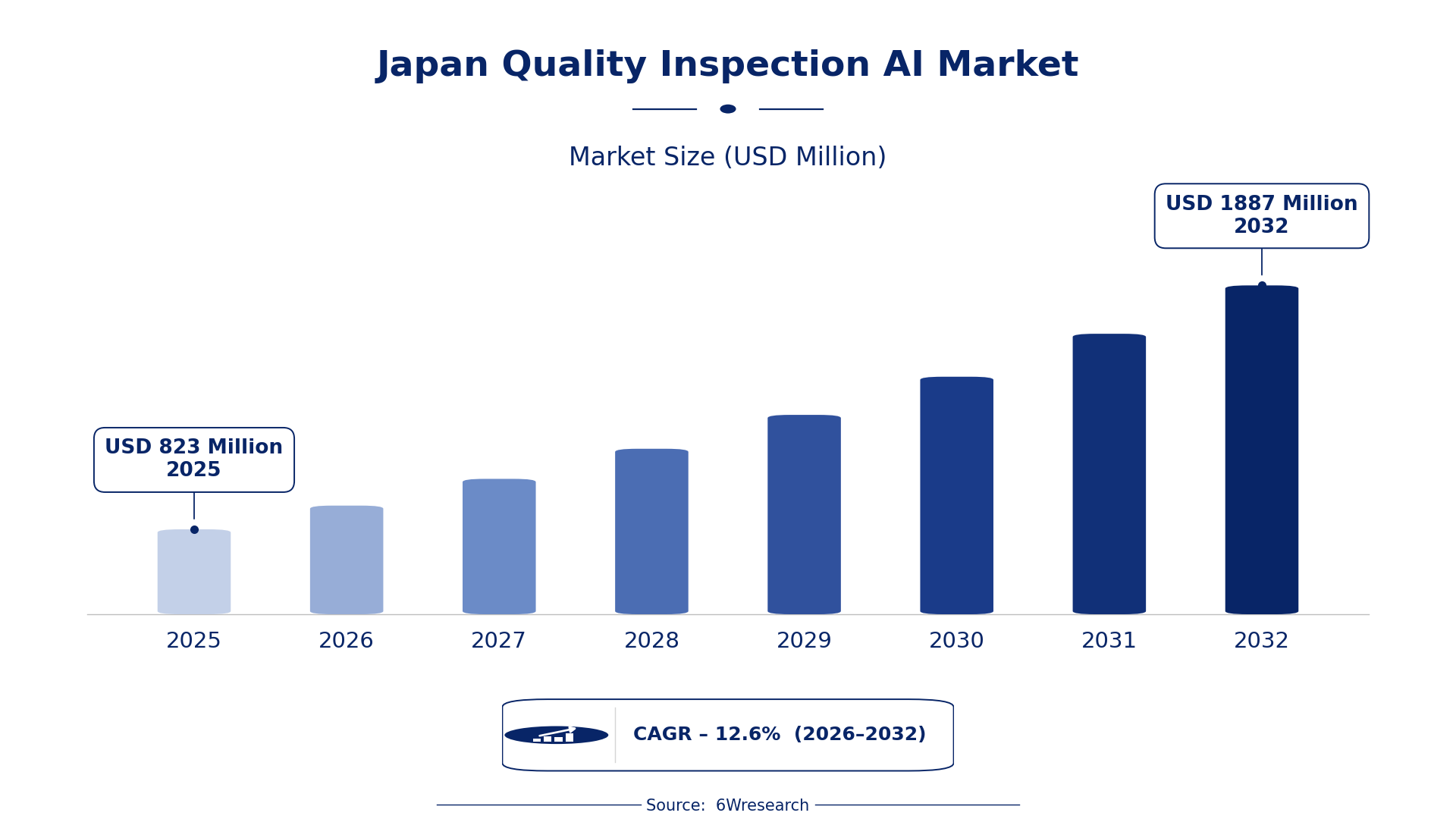
According to 6Wresearch internal database and industry insights, the Japan Quality Inspection AI Market was valued at USD 823 Million in 2025 and is projected to reach USD 1,887 Million by 2032, growing at a CAGR of approximately 12.6% during 2026–2032.
Japan Quality Inspection AI Market Highlights
| Report Metric | Details |
| Report Name | Japan Quality Inspection AI Market (2026-2032) |
| Market Size 2025 | USD 823 Million |
| Market Size 2032 | USD 1,887 Million |
| Absolute Growth 2025–2032 | USD 1,064 Million |
| CAGR 2026–2032 | 12.6% |
| Peak Annual Growth | 15.8% in 2026 |
| Forecast Period | 2026–2032 |
| Historical Data | 2022–2025 |
| Base Year | 2025 |
| Leading AI Technology Type, 2025 | Computer Vision (43% share) |
| Leading Inspection Area, 2025 | Surface Defect Detection (39% share) |
| Leading Deployment Mode, 2025 | On-Premise (39% share) |
| Leading End User, 2025 | Semiconductor Fabs (36% share) |
| Fastest-Growing AI Technology Type | Deep Learning Models (17.7% CAGR) |
| Fastest-Growing Inspection Area | Pattern Recognition (14.3% CAGR) |
| Fastest-Growing Deployment Mode | Cloud-Based (17.5% CAGR) |
| Fastest-Growing End User | Electronics Assembly Lines (16.4% CAGR) |
| Growing Sector | Semiconductor Manufacturing |
| Key End Users | Manufacturers, Electronics Assembly Lines, Semiconductor Fabs, Industrial Automation Firms |
Japan Quality Inspection AI Market Year-wise Growth Rate and Key Drivers (2022–2032)
This graph illustrates the annual growth rates of the market from 2022 to 2032, highlighting a steady upward trajectory and projected market expansion over the forecast period.
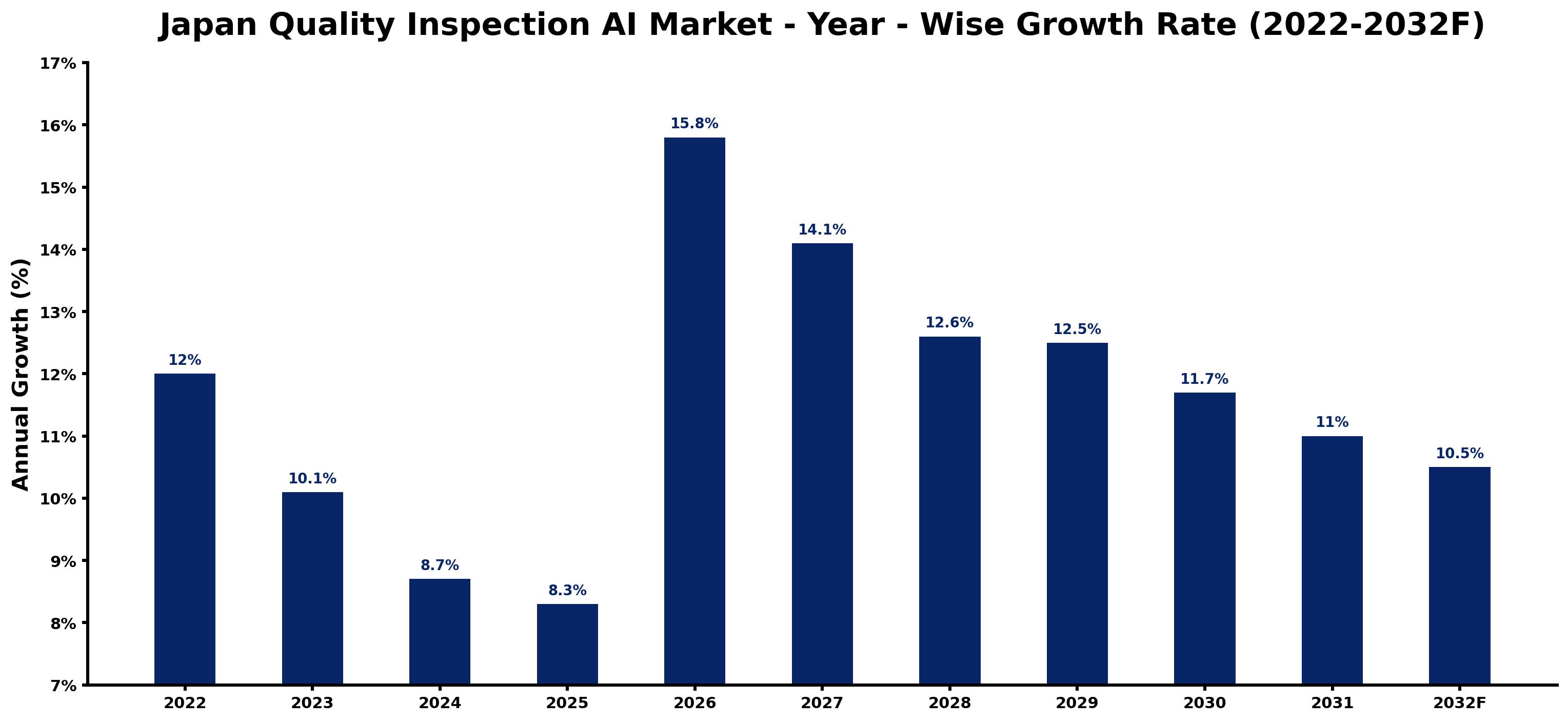
The following figures match every annual growth estimate with the main market development of that year, giving the reasoning behind each rise or slowdown.
| Year | Estimated Annual Growth (%) | Market Rationale |
| 2022 | 12.0 | The market experienced strong demand from the semiconductor industry, driving growth. |
| 2023 | 10.1 | Growth slowed due to market saturation in certain manufacturing sectors. |
| 2024 | 8.7 | Continued investment in smart factories led to a further slowdown in growth. |
| 2025 | 8.3 | Demand remained steady, but growth rates continued to slow slightly. |
| 2026 | 15.8 | A surge in AI adoption in manufacturing is expected to drive rapid growth in the market. |
| 2027 | 14.1 | Growth is projected to slow as the market begins to stabilise after the previous surge. |
| 2028 | 12.6 | Demand from electronics assembly lines is expected to contribute to a slight decrease in growth. |
| 2029 | 12.5 | The market will maintain steady growth, supported by ongoing technological advancements. |
| 2030 | 11.7 | Growth will continue to slow as the market matures and competition intensifies. |
| 2031 | 11.0 | A further slowdown is projected as buyers adjust to new technologies. |
| 2032 | 10.5 | The market is expected to stabilise as AI integration becomes standard. |
Note: Market size estimations and growth projections presented in this report are based on 6Wresearch's proprietary forecasting methodology, utilizing the latest available industry data, government publications, and primary research inputs.
Japan Quality Inspection AI Market Synopsis
Quality Inspection AI automates quality inspection processes in manufacturing, utilising machine learning and computer vision to detect defects. The Japan Quality Inspection AI Market is growing due to strong demand from the semiconductor and electronics sectors, which produced 1.4 trillion yen worth of chips in 2022. Initiatives like the Semiconductor and Digital Industry Strategy promote AI adoption, while the Electronics Industry Association of Japan supports innovation in smart manufacturing, driving further growth in this market.
Market Dynamics Impact Analysis (2026–2032)
| Factor | Type | Impact | Primary Segment Affected |
| Increased investment in smart factories | Driver | High | Smart Factories |
| Growing adoption of predictive maintenance strategies | Driver | High | Electronics Assembly Lines |
| Rising demand for real-time sorting technologies | Opportunity | Medium | Real-Time Sorting |
| Expansion of edge AI solutions in manufacturing | Opportunity | Medium | Industrial Automation Firms |
| Challenges in integrating AI with legacy systems | Restraint | High | Semiconductor Fabs |
| Limited awareness of AI capabilities among smaller manufacturers | Restraint | Medium | Electronics Assembly Lines |
| High costs associated with AI implementation | Challenge | High | Smart Factories |
| Capacity constraints in AI talent and expertise | Challenge | Medium | Industrial Automation Firms |
Evaluation of Drivers in Japan Quality Inspection AI Market (2026–2032)
These are the developments adding the most demand over the forecast period.
| Drivers | Primary Segment Affected | Why It Matters (Evidence) |
| Strong domestic semiconductor production | Semiconductor Fabs | Japan's semiconductor industry produced 1.4 trillion yen worth of chips in 2022, increasing demand for quality inspection AI. |
| Government initiatives promoting AI adoption | Smart Factories | The Semiconductor and Digital Industry Strategy supports AI integration in manufacturing, driving demand for quality inspection technologies. |
| Growing focus on predictive maintenance | Electronics Assembly Lines | Over 200 electronics assembly lines are implementing predictive maintenance strategies, boosting the need for quality inspection AI. |
| Rising demand for real-time sorting | Real-Time Sorting | Real-time sorting technologies are essential for automotive parts manufacturing, leading to increased adoption of quality inspection AI. |
| Advancements in edge AI technologies | Industrial Automation Firms | Edge AI solutions are gaining traction, enabling real-time processing and improving quality control in manufacturing. |
Orders keep climbing as the semiconductor industry thrives, producing 1.4 trillion yen worth of chips in 2022. The implementation of predictive maintenance strategies in over 200 electronics assembly lines further increases the need for quality inspection AI. Technologies for real-time sorting are essential in automotive parts manufacturing, pushing manufacturers to adopt these advanced solutions. The rise of edge AI technologies enables real-time processing, enhancing quality control in various manufacturing settings.
Evaluation of Restraints in Japan Quality Inspection AI Market
These are the pressures that could keep growth below its potential.
| Market Restraint | Primary Segment Affected | Why It Matters (Evidence) |
| Integration challenges with legacy systems | Semiconductor Fabs | Many manufacturers struggle to integrate AI with existing legacy systems, limiting AI adoption. |
| Lack of awareness about AI capabilities | Electronics Assembly Lines | Smaller manufacturers often lack knowledge of AI benefits, hindering market growth. |
| High implementation costs of AI technologies | Smart Factories | The costs associated with AI implementation can deter manufacturers from adopting these technologies. |
| Limited availability of skilled AI professionals | Industrial Automation Firms | The shortage of AI talent restricts the ability of firms to implement advanced quality inspection solutions. |
| Regulatory compliance issues | Electronics Assembly Lines | Manufacturers face challenges in meeting compliance standards, affecting their ability to adopt AI technologies. |
Japan Quality Inspection AI Market Challenges
Producers in Japan's semiconductor industry encounter supply chain disruptions due to dependence on a limited number of domestic suppliers, potentially delaying production timelines by three months. Technology integration challenges arise as manufacturers face difficulties in implementing AI solutions, leading to operational costs that may rise by 15% annually. Buyers find it challenging to locate effective quality inspection technologies, resulting in potential defects that could cost them up to 1 billion yen in lost revenue each year. Competition intensifies as global firms invest in advanced AI capabilities, compelling local producers to innovate or risk losing market share.
Trends in the Japan Quality Inspection AI Market
Several trends are reshaping the Japan Quality Inspection AI Market; the most important are set out below.
- Shift from Traditional to Smart Manufacturing: Manufacturers are increasingly adopting smart technologies for quality inspection. A government initiative launched in 2023 to promote AI in smart factories aims to boost operational efficiency, targeting a production increase of 20% by 2025.
- Increase in Edge AI Adoption: Edge AI solutions are gaining traction in Japan's manufacturing sector, with 30% of AI deployments in quality inspection being cloud-based as of 2023. This trend improves real-time processing capabilities.
- Growth of Predictive Maintenance Strategies: Over 200 electronics assembly lines are implementing predictive maintenance strategies, reflecting a shift towards proactive quality management in manufacturing, which is expected to increase AI adoption significantly.
- Expansion of Real-Time Sorting Technologies: Real-time sorting technologies are becoming essential in automotive parts manufacturing, driving increased demand for AI solutions that enable immediate quality assessments.
Investment Opportunities in the Japan Quality Inspection AI Market
Where to invest in the Japan Quality Inspection AI Market: the main openings are set out below.
- Partner with Local Manufacturers: With 1.4 trillion yen worth of chips produced in 2022, partnering with semiconductor fabs presents a strong opportunity for AI technology suppliers to enter the market.
- Invest in Smart Factory Solutions: The government initiative launched in 2023 to promote AI in smart factories creates a demand for advanced quality inspection technologies, providing an entry point for technology providers.
- Supply Edge AI Technologies: As edge AI solutions gain traction, investing in edge devices for real-time processing in manufacturing can meet the growing demand for quality inspection AI.
- Expand into Automotive Parts Manufacturing: The automotive sector's reliance on real-time sorting technologies presents an opportunity, as manufacturers seek to improve quality control processes.
Government Initiatives in the Japan Quality Inspection AI Market
The Semiconductor and Digital Industry Strategy, established by METI in June 2021, aims to secure domestic semiconductor manufacturing. This strategy encourages AI adoption in quality inspection processes, benefiting manufacturers by improving their production capabilities. The initiative targets a production increase of 20% by 2025, supporting local firms in enhancing their competitiveness.
The Ministry of Economy, Trade and Industry (METI) funds initiatives to support AI development in industrial automation. These initiatives promote the integration of AI technologies in manufacturing, enabling producers to improve quality inspection processes, with a budget of 5 billion yen allocated for these projects in 2023.
Future Insight of the Japan Quality Inspection AI Market
By 2032, government initiatives will drive a substantial shift towards AI integration in manufacturing, supported by the Ministry of Economy, Trade and Industry. Predictive maintenance strategies will be widely adopted, improving efficiency across various manufacturing sectors. The adoption of ISO 9001 standards will ensure consistent quality management practices, providing buyers with reliable quality assurance. As cloud-based solutions account for 30% of AI deployment, suppliers must adapt swiftly to technological advancements to maintain their competitive edge.
Market Segmentation Analysis
Japan Quality Inspection AI Market report covers a detailed analysis of the following market segments:
By AI Technology Type – Computer Vision Leads, Deep Learning Models Expected to Grow Fastest
According to Saurav Kr Singh, Senior Research Analyst at 6Wresearch, in 2025, Computer Vision led the ai technology type split with a 43% share. Computer Vision holds the largest share due to its critical role in visual inspection processes, especially in semiconductor manufacturing where precision is vital. This technology is extensively employed to identify defects in chips produced within Japan's thriving semiconductor industry. Over 2026–2032, Deep Learning Models are expected to post the fastest growth, at a CAGR of 17.7%. Deep Learning Models are witnessing rapid growth as they enhance defect detection accuracy through training on extensive datasets, essential for maintaining high standards in manufacturing. The government's initiative to boost AI in smart factories is likely to further accelerate the adoption of this technology. Suppliers should prioritise advancements in deep learning capabilities to address the increasing demand for precision in quality inspection.
By Inspection Area – Surface Defect Detection Leads, Pattern Recognition Expected to Grow Fastest
The largest inspection area category in 2025 was Surface Defect Detection, at 39% of revenue. Surface Defect Detection leads the market as it is essential for ensuring product quality in manufacturing, particularly in electronics where defects can result in significant losses. This method is crucial in Japan's semiconductor sector, which upholds stringent quality standards. Pattern Recognition is projected to grow fastest, at a CAGR of 14.3% during 2026–2032. Pattern Recognition is experiencing swift growth because it allows manufacturers to efficiently identify and categorise defects, which is increasingly necessary in fast-paced production environments. The emphasis on quality assurance in electronics assembly lines is a key factor propelling this growth. Buyers must invest in advanced pattern recognition technologies to improve their quality inspection processes and minimise defect rates.
By Deployment Mode – On-Premise Leads, Cloud-Based Expected to Grow Fastest
On-Premise took 39% of deployment mode revenue in 2025, more than any other category. On-Premise solutions are favoured for their ability to securely manage sensitive data, making them suitable for industries like semiconductor manufacturing where data integrity is critical. This preference is reflected in the operational practices of numerous semiconductor fabs across Japan. Cloud-Based is set to record the highest CAGR in this split, 17.5% over 2026–2032. Cloud-Based deployment is gaining momentum as it facilitates data storage and analytics, essential for contemporary manufacturing processes. The trend towards AI adoption in smart factories is encouraging more manufacturers to consider cloud solutions. Suppliers should explore offering flexible deployment options to meet the varied needs of manufacturers.
By End User – Semiconductor Fabs Lead, Electronics Assembly Lines Expected to Grow Fastest
With 36% of end user revenue in 2025, Semiconductor Fabs was the largest category. Semiconductor Fabs account for the largest segment as they extensively utilise AI for quality assurance in chip production, ensuring the high value of their products is maintained. The scale of production in this sector necessitates advanced quality inspection technologies. The quickest growth will come from Electronics Assembly Lines, forecast to expand at a CAGR of 16.4% between 2026 and 2032. Electronics Assembly Lines are rapidly embracing AI technologies to uphold high standards in product assembly, underscoring the importance of quality in this sector. The implementation of predictive maintenance strategies in over 200 assembly lines highlights this trend. Buyers in the electronics sector should prioritise AI solutions to enhance assembly line efficiency and product quality.
Key Attractiveness of the Report
- 10 Years of Market Numbers
- Historical Data Starting from 2022 to 2025
- Base Year 2025
- Forecast Data until 2032
- Key Performance Indicators Impacting the Market
- Major Upcoming Developments and Projects
Key Highlights of the Report:
- Japan Quality Inspection AI Market Outlook
- Market Size of Japan Quality Inspection AI Market, 2025
- Forecast of Japan Quality Inspection AI Market, 2032
- Historical Data and Forecast of Japan Quality Inspection AI Revenues & Volume for the Period 2022-2032F
- Japan Quality Inspection AI Market Trend Evolution
- Japan Quality Inspection AI Market Drivers and Challenges
- Japan Quality Inspection AI Price Trends
- Japan Quality Inspection AI Porter's Five Forces
- Japan Quality Inspection AI Industry Life Cycle
- Historical Data and Forecast of Japan Quality Inspection AI Market Revenues & Volume By AI Technology Type for the Period 2022-2032F
- Historical Data and Forecast of Japan Quality Inspection AI Market Revenues & Volume By Computer Vision for the Period 2022-2032F
- Historical Data and Forecast of Japan Quality Inspection AI Market Revenues & Volume By Deep Learning Models for the Period 2022-2032F
- Historical Data and Forecast of Japan Quality Inspection AI Market Revenues & Volume By Reinforcement Learning for the Period 2022-2032F
- Historical Data and Forecast of Japan Quality Inspection AI Market Revenues & Volume By Edge AI for the Period 2022-2032F
- Historical Data and Forecast of Japan Quality Inspection AI Market Revenues & Volume By Inspection Area for the Period 2022-2032F
- Historical Data and Forecast of Japan Quality Inspection AI Market Revenues & Volume By Surface Defect Detection for the Period 2022-2032F
- Historical Data and Forecast of Japan Quality Inspection AI Market Revenues & Volume By Pattern Recognition for the Period 2022-2032F
- Historical Data and Forecast of Japan Quality Inspection AI Market Revenues & Volume By Predictive Analytics for the Period 2022-2032F
- Historical Data and Forecast of Japan Quality Inspection AI Market Revenues & Volume By Real-Time Sorting for the Period 2022-2032F
- Historical Data and Forecast of Japan Quality Inspection AI Market Revenues & Volume By Deployment Mode for the Period 2022-2032F
- Historical Data and Forecast of Japan Quality Inspection AI Market Revenues & Volume By On-Premise for the Period 2022-2032F
- Historical Data and Forecast of Japan Quality Inspection AI Market Revenues & Volume By Cloud-Based for the Period 2022-2032F
- Historical Data and Forecast of Japan Quality Inspection AI Market Revenues & Volume By Hybrid for the Period 2022-2032F
- Historical Data and Forecast of Japan Quality Inspection AI Market Revenues & Volume By Edge Devices for the Period 2022-2032F
- Historical Data and Forecast of Japan Quality Inspection AI Market Revenues & Volume By End User for the Period 2022-2032F
- Historical Data and Forecast of Japan Quality Inspection AI Market Revenues & Volume By Semiconductor Fabs for the Period 2022-2032F
- Historical Data and Forecast of Japan Quality Inspection AI Market Revenues & Volume By Electronics Assembly Lines for the Period 2022-2032F
- Historical Data and Forecast of Japan Quality Inspection AI Market Revenues & Volume By Smart Factories for the Period 2022-2032F
- Historical Data and Forecast of Japan Quality Inspection AI Market Revenues & Volume By Industrial Automation Firms for the Period 2022-2032F
- Japan Quality Inspection AI Import Export Trade Statistics
- Market Opportunity Assessment By AI Technology Type
- Market Opportunity Assessment By Inspection Area
- Market Opportunity Assessment By Deployment Mode
- Market Opportunity Assessment By End User
- Japan Quality Inspection AI Top Companies Market Share
- Japan Quality Inspection AI Competitive Benchmarking By Technical and Operational Parameters
- Japan Quality Inspection AI Company Profiles
- Japan Quality Inspection AI Key Strategic Recommendations
Market Covered
Segments analysed in this report are listed below.
By AI Technology Type
- Computer Vision
- Deep Learning Models
- Reinforcement Learning
- Edge AI
By Inspection Area
- Surface Defect Detection
- Pattern Recognition
- Predictive Analytics
- Real-Time Sorting
By Deployment Mode
- On-Premise
- Cloud-Based
- Hybrid
- Edge Devices
By End User
- Semiconductor Fabs
- Electronics Assembly Lines
- Smart Factories
- Industrial Automation Firms































