Japan Quantum Computing Market Size & Growth Rate
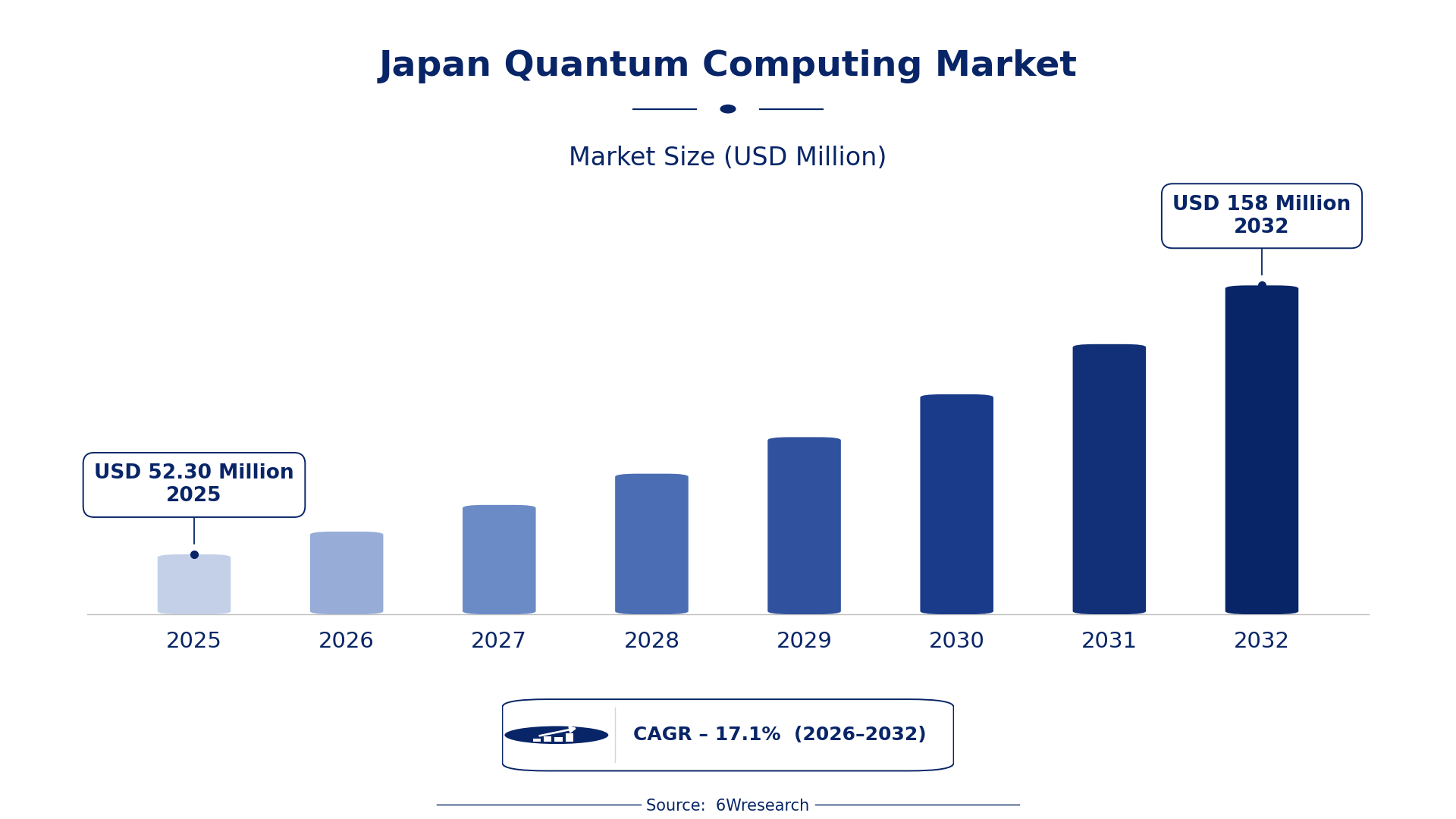
According to 6Wresearch internal database and industry insights, the Japan Quantum Computing Market was valued at USD 52.30 Million in 2025 and is projected to reach USD 158 Million by 2032, growing at a CAGR of approximately 17.1% during 2026–2032.
Japan Quantum Computing Market Highlights
| Report Metric | Details |
| Report Name | Japan Quantum Computing Market (2026-2032) |
| Market Size 2025 | USD 52.30 Million |
| Market Size 2032 | USD 158 Million |
| Absolute Growth 2025–2032 | USD 105.70 Million |
| CAGR 2026–2032 | 17.1% |
| Peak Annual Growth | 20.6% in 2028 |
| Forecast Period | 2026–2032 |
| Historical Data | 2022–2025 |
| Base Year | 2025 |
| Leading Offering, 2025 | Systems (62% share) |
| Leading Deployment, 2025 | On-premises (58% share) |
| Leading Technology, 2025 | Trapped Ions (47% share) |
| Leading Application, 2025 | Optimization (45% share) |
| Leading End User, 2025 | Space & Defense (42% share) |
| Fastest-Growing Offering | Services (18.5% CAGR) |
| Fastest-Growing Deployment | Cloud (18.6% CAGR) |
| Fastest-Growing Technology | Quantum Annealing (22.8% CAGR) |
| Fastest-Growing Application | Simulation (21.8% CAGR) |
| Fastest-Growing End User | Transportation & Logistics (22.7% CAGR) |
| Growing Sector | Space & Defense |
| Key End Users | Academia, Government, Banking & Finance, Space & Defense |
Japan Quantum Computing Market Year-wise Growth Rate and Key Drivers (2022–2032)
This graph illustrates the annual growth rates of the market from 2022 to 2032, highlighting a steady upward trajectory and projected market expansion over the forecast period.
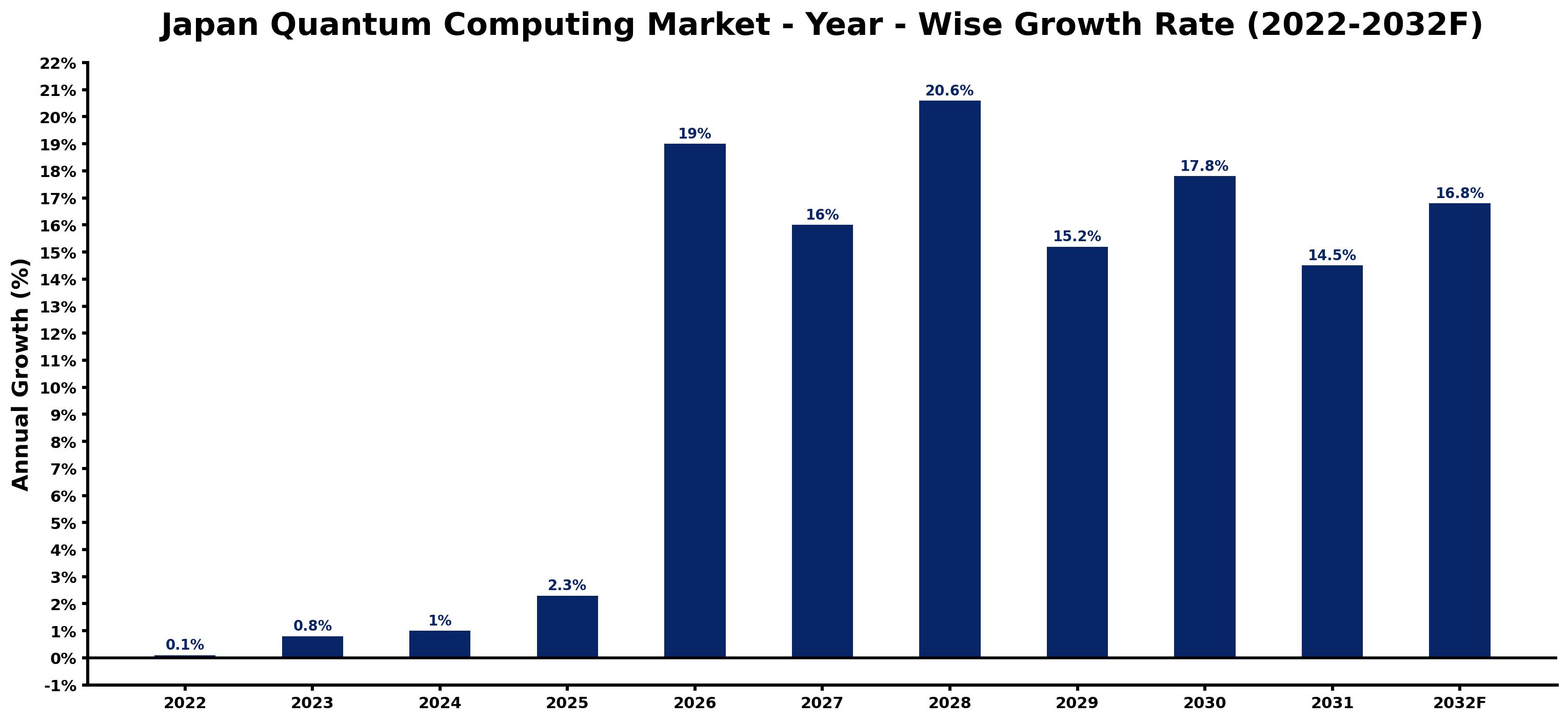
The yearly estimates that follow link every growth rate to its principal driver, so readers can see why the pace changed in each period.
| Year | Estimated Annual Growth (%) | Market Rationale |
| 2022 | 0.1 | The market showed minimal activity with a slight increase in interest. |
| 2023 | 0.8 | Growth accelerated as more research institutions began quantum initiatives. |
| 2024 | 1.0 | Demand continued to rise with increased funding for quantum projects. |
| 2025 | 2.3 | The market peaked historically as the government launched new programs. |
| 2026 | 19.0 | Rapid growth emerged as private investment surged in quantum technologies. |
| 2027 | 16.0 | Growth slowed slightly due to market maturation and consolidation. |
| 2028 | 20.6 | The market is expected to peak in growth driven by breakthrough innovations. |
| 2029 | 15.2 | A slowdown is projected as the market adjusts to new technologies. |
| 2030 | 17.8 | Growth is expected to resume as demand for optimization solutions increases. |
| 2031 | 14.5 | The market will continue to grow, supported by expanding applications. |
| 2032 | 16.8 | Growth is projected to remain strong as collaborations between sectors intensify. |
Note: Market size estimations and growth projections presented in this report are based on 6Wresearch's proprietary forecasting methodology, utilizing the latest available industry data, government publications, and primary research inputs.
Japan Quantum Computing Market Synopsis
Quantum computing is a transformative technology that uses quantum mechanics for high-speed computations, primarily involving advanced materials like superconductors. In Japan, the market is driven by over 100 research institutions focusing on quantum technologies, with substantial investments from the government. The Ministry of Education, Culture, Sports, Science and Technology initiated a five-year program in 2022 to support quantum research, while the National Institute of Advanced Industrial Science and Technology actively engages in projects. These initiatives reflect a growing demand for quantum solutions across sectors such as academia and government, creating a dynamic environment for innovation and collaboration.
Market Dynamics Impact Analysis (2026–2032)
| Factor | Type | Impact | Primary Segment Affected |
| Increased investment in research and development | Driver | High | Systems |
| Rising demand for optimization solutions | Driver | High | Optimization |
| Emerging applications in logistics | Opportunity | Medium | Quantum Annealing |
| Growing interest in quantum technology startups | Opportunity | Medium | Services |
| Limited awareness among potential users | Restraint | High | Services |
| High costs of quantum systems | Restraint | High | Systems |
| Shortage of skilled professionals | Challenge | High | Systems |
| Rapid technological advancements leading to obsolescence | Challenge | Medium | Optimization |
Evaluation of Drivers in Japan Quantum Computing Market (2026–2032)
Below are the drivers that matter most for revenue growth, with supporting evidence.
| Drivers | Primary Segment Affected | Why It Matters (Evidence) |
| Investment from over 100 research institutions | Systems | This investment leads to the development of advanced quantum systems that improve computational capabilities. |
| Government funding for quantum research | Optimization | The government allocated ¥10 billion in 2023, driving demand for optimization applications in various sectors. |
| Collaboration between academia and industry | Services | Collaborative efforts increase the deployment of quantum services, improving market accessibility. |
| Growing interest in quantum annealers | Quantum Annealing | The logistics sector is exploring quantum annealers for optimization, boosting demand for specific applications. |
| Support from the Quantum Computing Research Association | Systems | The association promotes collaboration, facilitating the development of advanced quantum systems. |
This funding improves the capabilities of over 100 research institutions, leading to advancements in quantum systems. Collaboration between academia and industry is also rising, which increases the deployment of quantum services. The logistics sector shows particular interest in quantum annealers for optimization, driving demand for these specific applications. The Quantum Computing Research Association facilitates innovation in quantum systems, contributing to the overall growth of the market.
Evaluation of Restraints in Japan Quantum Computing Market
These restraints slow adoption and weigh on supplier margins.
| Market Restraint | Primary Segment Affected | Why It Matters (Evidence) |
| Limited awareness of quantum computing benefits | Services | Many potential users lack understanding, hindering adoption and limiting market growth. |
| High costs associated with quantum systems | Systems | The investment required for quantum systems restricts access for smaller enterprises. |
| Shortage of skilled professionals in quantum technology | Systems | The lack of trained personnel affects the development and deployment of quantum solutions. |
| Rapid technological advancements causing obsolescence | Optimization | Frequent changes in technology can deter investment due to fear of obsolescence. |
| Regulatory hurdles in technology deployment | Services | Complex regulations can slow down the implementation of quantum services. |
Japan Quantum Computing Market Challenges
Tokyo's leading universities face challenges in sourcing advanced superconductors for quantum computing projects, resulting in research delays of up to six months. A shortage of domestic production for critical materials disrupts supply chains, forcing producers to depend on imports that can take weeks to arrive. Heightened competition from international markets compels local firms to innovate rapidly, which may lead to rushed development cycles and compromised quality. Compliance with ISO/IEC 27001 standards increases operational costs for startups by around 15%, limiting their growth potential and market entry.
Trends in the Japan Quantum Computing Market
Several trends are reshaping the Japan Quantum Computing Market; the most important are set out below.
- Space & Defense Prioritised over Other Sectors: The space and defense sectors are increasingly embracing quantum computing for advanced simulations, highlighting their growing significance. In 2023, these sectors represented 42% of the market share.
- Shift from Research to Practical Applications: The emphasis is shifting from theoretical research to practical applications in quantum computing. The 2022 five-year programme aims to enhance national competitiveness in this domain.
- Emergence of Quantum Annealers in Logistics: Quantum annealers are being tailored for specific optimisation challenges in the logistics sector, enhancing operational efficiency. This trend is anticipated to expand as logistics companies pursue competitive advantages.
- Increased Collaboration between Academia and Industry: Collaboration between universities and industry is broadening, resulting in practical quantum solutions. The Tokyo Metropolitan Government's programme supports startups, encouraging this collaboration.
Investment Opportunities in the Japan Quantum Computing Market
Below are the investment opportunities with the strongest case in the Japan Quantum Computing Market.
- Tokyo as a Hub for Quantum Startups: Tokyo is home to numerous startups focused on quantum technology, creating investment opportunities. The Tokyo Metropolitan Government has launched initiatives to support these ventures, committing ¥5 billion in funding.
- Growing Demand in Space & Defense: The space and defense sectors are increasingly investing in quantum solutions for simulations. This growth presents opportunities for suppliers to develop specialised quantum systems.
- Investment in Quantum Annealing Solutions: Demand for quantum annealing solutions in logistics is on the rise, driven by optimisation requirements. Suppliers can enter this market by partnering with logistics companies.
- Expansion of Quantum Services: As awareness increases, there is a growing need for quantum services to assist organisations in deployment. Collaborating with research institutions can ease entry into this emerging market.
Government Initiatives in the Japan Quantum Computing Market
The PRTR Law, enacted in 1999, requires businesses to report chemical substance releases, impacting quantum computing producers by ensuring compliance with environmental standards. The Green Growth Strategy, updated in 2021, identifies growth sectors, including quantum technologies, aiming for a sustainable future.
The Ministry of Education, Culture, Sports, Science and Technology oversees funding for quantum research initiatives. It supports projects that improve collaboration between academia and industry, contributing to the development of a strong quantum technology environment.
Future Insight of the Japan Quantum Computing Market
By 2032, research institutions will gain improved access to advanced materials due to government initiatives designed to advance quantum technology development. Collaboration between universities and industry will spur innovation in quantum applications. Startups, supported by local government programmes, will become key contributors to the quantum sector, driving advancements across various fields. The ongoing development of quantum annealers will specifically address complex logistical challenges, improving efficiency and reducing operational time for businesses.
Market Segmentation Analysis
Japan Quantum Computing Market report covers a detailed analysis of the following market segments:
By Offering – Systems Lead, Services Expected to Grow Fastest
According to Shubham Deep, Research Manager at 6Wresearch, Systems held 62% of the Japan Quantum Computing Market by offering in 2025. Systems hold the largest share due to their critical role in executing quantum computations, particularly within Japan's extensive network of over 100 research institutions. These institutions heavily depend on systems to drive advancements in quantum technology, ensuring sustained demand. The quickest growth will come from Services, forecast to expand at a CAGR of 18.5% between 2026 and 2032. Services are witnessing rapid growth as the need for support in deploying and managing complex quantum systems increases. The government's recent initiatives to enhance quantum research further stimulate the demand for these essential services. Suppliers should prioritise expanding service offerings to effectively meet the rising needs of research institutions.
By Deployment – On-premises Lead, Cloud Expected to Grow Fastest
The largest deployment category in 2025 was On-premises, at 58% of revenue. On-premises solutions lead the market as they are preferred for processing sensitive data, particularly in sectors like space and defense. This preference is reinforced by numerous projects that require stringent data security measures. Cloud is projected to grow fastest, at a CAGR of 18.6% during 2026–2032. Cloud deployment is gaining traction as organisations seek flexibility in accessing quantum computing resources. The government's push for a quantum ecosystem aligns with the growing interest in cloud solutions. Buyers may increasingly evaluate cloud options for their flexibility, prompting suppliers to adjust their offerings accordingly.
By Technology – Trapped Ions Lead, Quantum Annealing Expected to Grow Fastest
In 2025, Trapped Ions led the technology split with a 47% share. Trapped ions are the leading technology for quantum computing systems, providing high fidelity and coherence times essential for complex computations. This technology is widely adopted in research settings, particularly among Japan's prominent universities. Quantum Annealing is set to record the highest CAGR in this split, 22.8% over 2026–2032. Quantum annealing is experiencing rapid growth due to its specific applications in solving optimisation problems, especially within logistics. The heightened focus on optimisation across various sectors has led to increased interest in this technology. Suppliers should focus on developing quantum annealing capabilities to leverage its growing demand.
By Application – Optimization Leads, Simulation Expected to Grow Fastest
Optimization took 45% of application revenue in 2025, more than any other category. Optimization problems are the primary application of quantum computing, attracting significant interest from sectors aiming to improve operational efficiency. This focus is largely driven by the need for advanced solutions in industries such as space and defense. Over 2026–2032, Simulation is expected to post the fastest growth, at a CAGR of 21.8%. Simulation is rapidly expanding as it addresses the critical need for accurate modelling of quantum systems, essential for research and development. The establishment of initiatives to promote quantum research has intensified interest in simulation applications. Buyers should prioritise solutions that enhance simulation capabilities to maintain competitiveness in their respective fields.
By End User – Space & Defense Leads, Transportation & Logistics Expected to Grow Fastest
Space & Defense accounted for 42% of the market by end user in 2025. The space and defense sectors dominate the market as they leverage quantum computing for advanced simulations, vital for technological advancement. This leadership is reinforced by substantial investments in quantum technologies. The quickest growth will come from Transportation & Logistics, forecast to expand at a CAGR of 22.7% between 2026 and 2032. Transportation and logistics are emerging as a fast-growing sector for quantum applications, propelled by research into optimisation solutions for supply chain challenges. The ongoing exploration of these applications indicates a potential shift in industry focus. Suppliers should consider exploring partnerships in the transportation and logistics sectors to capture emerging opportunities.
Key Attractiveness of the Report
- 10 Years of Market Numbers
- Historical Data Starting from 2022 to 2025
- Base Year 2025
- Forecast Data until 2032
- Key Performance Indicators Impacting the Market
- Major Upcoming Developments and Projects
Key Highlights of the Report:
- Japan Quantum Computing Market Outlook
- Market Size of Japan Quantum Computing Market, 2025
- Forecast of Japan Quantum Computing Market, 2032
- Historical Data and Forecast of Japan Quantum Computing Revenues & Volume for the Period 2022-2032
- Japan Quantum Computing Market Trend Evolution
- Japan Quantum Computing Market Drivers and Challenges
- Japan Quantum Computing Price Trends
- Japan Quantum Computing Porter's Five Forces
- Japan Quantum Computing Industry Life Cycle
- Historical Data and Forecast of Japan Quantum Computing Market Revenues & Volume By Offering for the Period 2022-2032
- Historical Data and Forecast of Japan Quantum Computing Market Revenues & Volume By Systems for the Period 2022-2032
- Historical Data and Forecast of Japan Quantum Computing Market Revenues & Volume By Services for the Period 2022-2032
- Historical Data and Forecast of Japan Quantum Computing Market Revenues & Volume By Deployment for the Period 2022-2032
- Historical Data and Forecast of Japan Quantum Computing Market Revenues & Volume By On-premises for the Period 2022-2032
- Historical Data and Forecast of Japan Quantum Computing Market Revenues & Volume By Cloud for the Period 2022-2032
- Historical Data and Forecast of Japan Quantum Computing Market Revenues & Volume By Technology for the Period 2022-2032
- Historical Data and Forecast of Japan Quantum Computing Market Revenues & Volume By Trapped Ions for the Period 2022-2032
- Historical Data and Forecast of Japan Quantum Computing Market Revenues & Volume By Quantum Annealing for the Period 2022-2032
- Historical Data and Forecast of Japan Quantum Computing Market Revenues & Volume By Superconducting Qubits for the Period 2022-2032
- Historical Data and Forecast of Japan Quantum Computing Market Revenues & Volume By Others for the Period 2022-2032
- Historical Data and Forecast of Japan Quantum Computing Market Revenues & Volume By Application for the Period 2022-2032
- Historical Data and Forecast of Japan Quantum Computing Market Revenues & Volume By Optimization for the Period 2022-2032
- Historical Data and Forecast of Japan Quantum Computing Market Revenues & Volume By Simulation for the Period 2022-2032
- Historical Data and Forecast of Japan Quantum Computing Market Revenues & Volume By Machine Learning for the Period 2022-2032
- Historical Data and Forecast of Japan Quantum Computing Market Revenues & Volume By Others for the Period 2022-2032
- Historical Data and Forecast of Japan Quantum Computing Market Revenues & Volume By End User for the Period 2022-2032
- Historical Data and Forecast of Japan Quantum Computing Market Revenues & Volume By Space & Defense for the Period 2022-2032
- Historical Data and Forecast of Japan Quantum Computing Market Revenues & Volume By Transportation & Logistics for the Period 2022-2032
- Historical Data and Forecast of Japan Quantum Computing Market Revenues & Volume By Healthcare & Pharmaceuticals for the Period 2022-2032
- Historical Data and Forecast of Japan Quantum Computing Market Revenues & Volume By Chemicals, Banking & Finance for the Period 2022-2032
- Historical Data and Forecast of Japan Quantum Computing Market Revenues & Volume By Energy & Power for the Period 2022-2032
- Historical Data and Forecast of Japan Quantum Computing Market Revenues & Volume By Academia for the Period 2022-2032
- Historical Data and Forecast of Japan Quantum Computing Market Revenues & Volume By Government for the Period 2022-2032
- Japan Quantum Computing Import Export Trade Statistics
- Market Opportunity Assessment By Offering
- Market Opportunity Assessment By Deployment
- Market Opportunity Assessment By Technology
- Market Opportunity Assessment By Application
- Market Opportunity Assessment By End User
- Japan Quantum Computing Top Companies Market Share
- Japan Quantum Computing Competitive Benchmarking By Technical and Operational Parameters
- Japan Quantum Computing Company Profiles
- Japan Quantum Computing Key Strategic Recommendations
Market Covered
Segments analysed in this report are listed below.
By Offering
- Systems
- Services
By Deployment
- On-premises
- Cloud
By Technology
- Trapped Ions
- Quantum Annealing
- Superconducting Qubits
- Others
By Application
- Optimization
- Simulation
- Machine Learning
- Others
By End User
- Space & Defense
- Transportation & Logistics
- Healthcare & Pharmaceuticals
- Chemicals
- Banking & Finance
- Energy & Power
- Academia
- Government






































