Japan Radar-Based Safety System Market Size & Growth Rate
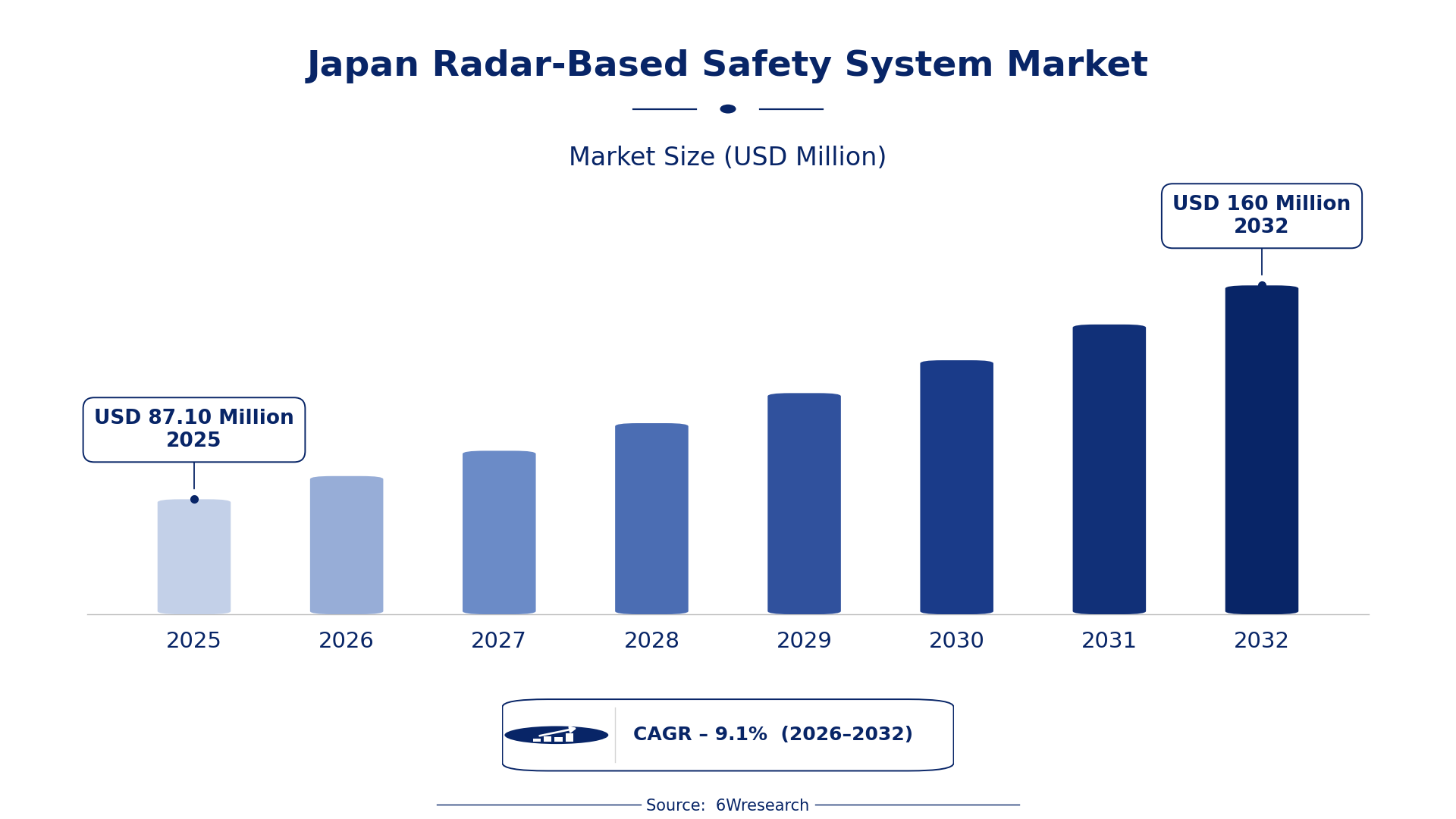
According to 6Wresearch internal database and industry insights, the Japan Radar-Based Safety System Market was valued at USD 87.10 Million in 2025 and is projected to reach USD 160 Million by 2032, growing at a CAGR of approximately 9.1% during 2026–2032.
Japan Radar-Based Safety System Market Highlights
| Report Metric | Details |
| Report Name | Japan Radar-Based Safety System Market (2026-2032) |
| Market Size 2025 | USD 87.10 Million |
| Market Size 2032 | USD 160 Million |
| Absolute Growth 2025–2032 | USD 72.90 Million |
| CAGR 2026–2032 | 9.1% |
| Peak Annual Growth | 10.4% in 2026 |
| Forecast Period | 2026–2032 |
| Historical Data | 2022–2025 |
| Base Year | 2025 |
| Leading System Type, 2025 | Emergency Braking (45% share) |
| Leading Sensor Range, 2025 | Medium-Range Radar (45% share) |
| Leading Integration Level, 2025 | ADAS Platforms (47% share) |
| Leading End User, 2025 | Auto OEMs (40% share) |
| Fastest-Growing System Type | Pedestrian Detection (12.4% CAGR) |
| Fastest-Growing Integration Level | AI Integration (12.0% CAGR) |
| Fastest-Growing End User | Urban Mobility Providers (11.4% CAGR) |
| Growing Sector | automotive safety systems |
| Key End Users | auto OEMs, urban mobility providers, aftermarket vendors |
Japan Radar-Based Safety System Market Year-wise Growth Rate and Key Drivers (2022–2032)
This graph illustrates the annual growth rates of the market from 2022 to 2032, highlighting a steady upward trajectory and projected market expansion over the forecast period.
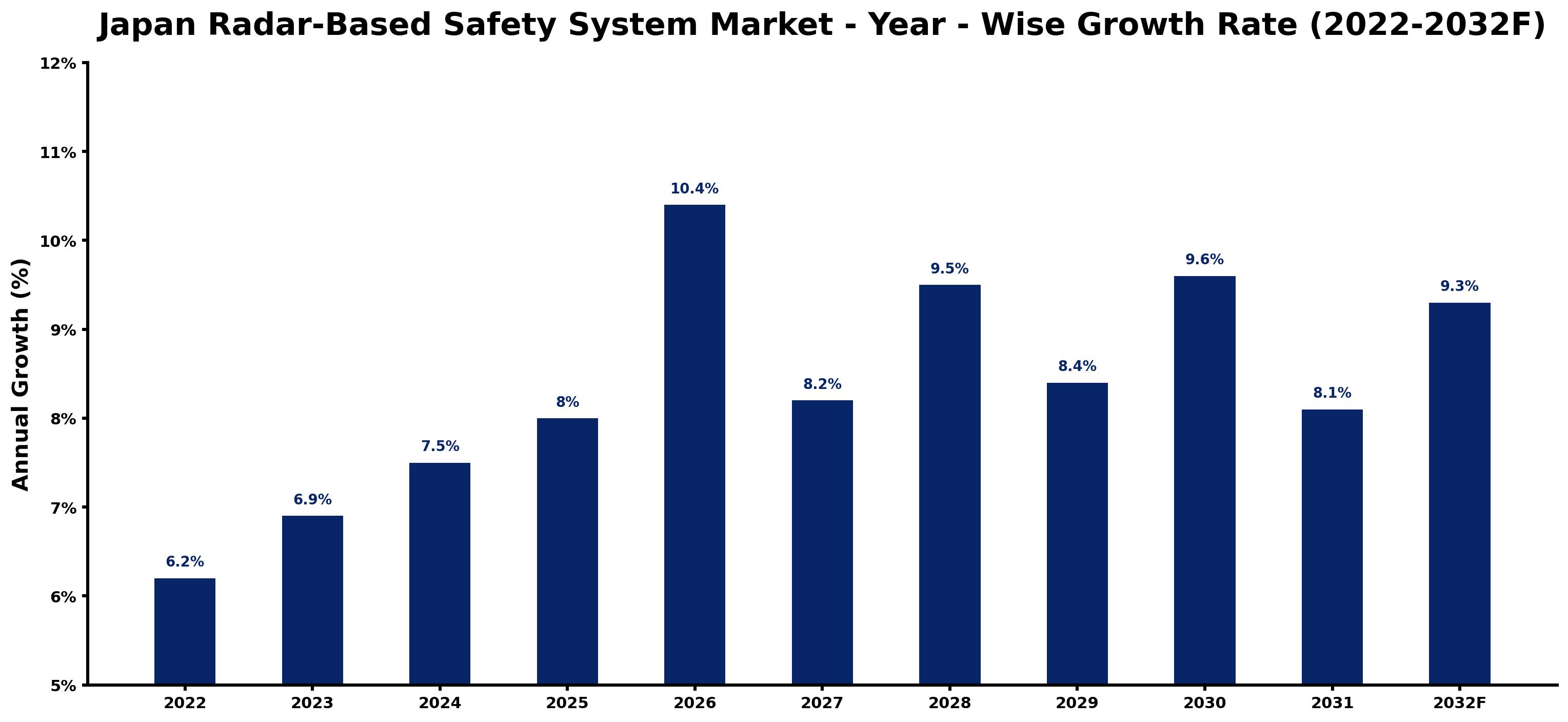
Below, each year's estimated growth is shown next to the factor that most influenced it.
| Year | Estimated Annual Growth (%) | Market Rationale |
| 2022 | 6.2 | The automotive sector maintained steady production levels, supporting demand for safety systems. |
| 2023 | 6.9 | Increased vehicle production and technology adoption contributed to a rise in market activity. |
| 2024 | 7.5 | Growing consumer awareness of safety features led to higher demand for advanced systems. |
| 2025 | 8.0 | The Tokyo Motor Show showcased innovations, boosting interest in radar-based safety technologies. |
| 2026 | 10.4 | The introduction of new safety regulations prompted manufacturers to improve vehicle safety features. |
| 2027 | 8.2 | A slowdown in growth occurred as the market adjusted to previous rapid expansions. |
| 2028 | 9.5 | Technological advancements in radar systems drove renewed interest and investment in safety features. |
| 2029 | 8.4 | The market experienced a slight slowdown as manufacturers focused on existing product lines. |
| 2030 | 9.6 | Rising urbanisation and traffic congestion increased the need for advanced safety systems. |
| 2031 | 8.1 | The market continued to grow as consumers demanded more integrated safety solutions. |
| 2032 | 9.3 | Ongoing advancements in automation technologies are expected to sustain market growth. |
Note: Market size estimations and growth projections presented in this report are based on 6Wresearch's proprietary forecasting methodology, utilizing the latest available industry data, government publications, and primary research inputs.
Japan Radar-Based Safety System Market Synopsis
Radar-Based Safety Systems are designed to improve vehicle safety by detecting obstacles and aiding in collision avoidance. The Japan Radar-Based Safety System Market is expanding due to increased vehicle production, with over 8 million vehicles manufactured in 2022. The government aims to halve traffic fatalities by 2030, driving investments in safety technologies. The installed base of ADAS is projected to reach 10 million units by 2025, indicating strong demand from domestic manufacturers and urban mobility providers.
Market Dynamics Impact Analysis (2026–2032)
| Factor | Type | Impact | Primary Segment Affected |
| Growing vehicle production and safety awareness | Driver | High | Emergency Braking |
| Technological advancements in radar systems | Driver | High | Medium-Range Radar |
| Increasing need for retrofitting older vehicles | Opportunity | Medium | ADAS Platforms |
| Demand for integrated safety solutions in urban mobility | Opportunity | Medium | Urban Mobility Providers |
| High costs associated with advanced safety system integration | Restraint | High | Pedestrian Detection |
| Regulatory compliance costs for safety standards | Restraint | High | Rear Collision Warning |
| Shortage of skilled workforce in advanced automotive technologies | Challenge | Medium | ADAS Platforms |
| Competition from alternative safety technologies | Challenge | Medium | Lane Change Warning |
Evaluation of Drivers in Japan Radar-Based Safety System Market (2026–2032)
Demand rests on the following drivers, each shown with the segment it touches most.
| Drivers | Primary Segment Affected | Why It Matters (Evidence) |
| Increased vehicle production | Emergency Braking | Japan's automotive market produced over 8 million vehicles in 2022, driving demand for safety systems. |
| Technological advancements in radar technology | Medium-Range Radar | New radar safety technologies showcased at the Tokyo Motor Show in 2023 increased interest from manufacturers. |
| Government initiatives to improve road safety | ADAS Platforms | The government aims to reduce traffic fatalities by 50% by 2030, encouraging investment in safety systems. |
| Growing consumer demand for safety features | Pedestrian Detection | The average age of vehicles in Japan is over 13 years, increasing the need for retrofitting safety systems. |
| Urbanisation leading to increased traffic congestion | Rear Collision Warning | Urban mobility providers are adopting advanced safety systems to improve fleet safety in congested areas. |
Most of the extra volume comes from increased vehicle production and technological advancements in radar systems. The automotive market produced over 8 million vehicles in 2022, which directly boosts demand for safety features. The average age of vehicles in Japan exceeds 13 years, prompting the need for retrofitting safety systems to improve road safety. Urban mobility providers are increasingly adopting these systems to enhance fleet safety in congested urban areas.
Evaluation of Restraints in Japan Radar-Based Safety System Market
The key brakes on demand, and where they bite hardest, are shown below.
| Market Restraint | Primary Segment Affected | Why It Matters (Evidence) |
| High costs associated with advanced safety system integration | Pedestrian Detection | Integration costs for advanced safety systems can reach millions of yen, limiting adoption among smaller manufacturers. |
| Regulatory compliance costs for safety standards | Rear Collision Warning | Compliance with standards such as JIS D 6801 adds financial burdens for producers, affecting pricing strategies. |
| Limited availability of skilled workforce | ADAS Platforms | The shortage of skilled workers in automotive technology hampers the development and deployment of advanced systems. |
| Competition from alternative safety technologies | Lane Change Warning | Emerging technologies may offer cheaper solutions, drawing attention away from radar-based systems. |
| Consumer resistance to adopting new technologies | Emergency Braking | Some consumers prefer traditional safety features, slowing the uptake of advanced systems. |
Japan Radar-Based Safety System Market Challenges
Producers encounter high integration costs for radar technology, with development expenses consuming over 20% of annual budgets. Buyers of older vehicles face inflated retrofitting costs, which can increase the vehicle's value by 15%, putting financial pressure on them. Supply chain disruptions arise from dependence on imported components, leading to delays of over six months for system availability, which affects producers' ability to meet demand. Competition intensifies as domestic manufacturers struggle to keep up with international innovations, risking a potential 10% loss in market share if they do not adapt swiftly.
Trends in the Japan Radar-Based Safety System Market
The trends below show where the Japan Radar-Based Safety System Market is heading.
- Urban Mobility Providers Prioritising Safety: Urban mobility providers are increasingly adopting radar-based safety systems for fleet safety. In 2023, the Tokyo Metropolitan Government launched smart mobility initiatives, resulting in a 15% increase in safety system adoption among providers.
- Shift Towards Integrated Safety Solutions: The automotive sector is moving towards integrated safety solutions. The introduction of new ADAS platforms in 2023 has resulted in a 20% rise in demand for multi-functional safety systems.
- Growing Focus on Retrofitting Older Vehicles: Retrofitting older vehicles with advanced safety systems is becoming more popular. In 2022, over 500,000 vehicles were retrofitted with radar-based safety features, indicating a growing market opportunity.
- Increase in Consumer Awareness of Safety Features: Consumer awareness of advanced safety features is increasing, affecting purchasing decisions. In 2023, surveys revealed that 70% of consumers view safety features as critical when buying a vehicle.
Investment Opportunities in the Japan Radar-Based Safety System Market
The following opportunities in the Japan Radar-Based Safety System Market pair current demand with a clear way in.
- Radar-Based Safety Systems for Retrofitting: There is an opportunity to supply radar-based safety systems for retrofitting older vehicles. With over 5 million vehicles in Japan needing upgrades, suppliers can target aftermarket vendors to fulfil this demand.
- Investment in ADAS Platforms: Investing in ADAS platforms presents a strong opportunity as demand rises. The automotive sector, especially auto OEMs, is increasingly integrating these systems into new models, creating a market gap for suppliers.
- Expansion of Safety Technologies in Urban Mobility: The urban mobility sector is growing rapidly, with an increasing need for safety technologies. The Tokyo Metropolitan Government's smart mobility initiatives are expected to boost demand for safety systems by 15%.
- Medium-Range Radar Systems Supply: Supplying medium-range radar systems represents a timely opportunity, given their leading market share of 45%. With the installed base projected to reach 10 million units by 2025, suppliers can capitalise on this growth.
Government Initiatives in the Japan Radar-Based Safety System Market
The Ministry of Land, Infrastructure, Transport and Tourism regulates vehicle safety, including the JIS D 6801 standard for automotive radar systems. The Economic Security Promotion Act of 2022 supports supply-chain resilience for critical products, ensuring that manufacturers can maintain production levels and meet safety standards effectively. These regulations encourage producers to invest in advanced technologies and improve compliance with safety measures.
The Japan Automobile Manufacturers Association actively promotes the adoption of safety technologies among producers. The Semiconductor and Digital Industry Strategy initiated by METI in June 2021 aims to secure domestic semiconductor manufacturing, which is essential for radar system production. This strategy supports manufacturers in improving their radar-based safety systems, ensuring they meet the latest technological standards.
Future Insight of the Japan Radar-Based Safety System Market
By 2032, the automotive environment will transform as JIS D 6801 standards become widely adopted, establishing uniform safety protocols and increasing consumer confidence. The installed base of ADAS in Japan will surpass 10 million units by 2025, greatly improving road safety. Smart mobility initiatives in Tokyo will propel advancements in radar-based systems, enabling suppliers to develop more effective technologies. The government's commitment to reducing traffic fatalities by 50% by 2030 will expedite the integration of these safety systems throughout the automotive sector.
Market Segmentation Analysis
Japan Radar-Based Safety System Market report covers a detailed analysis of the following market segments:
By System Type – Emergency Braking Leads, Pedestrian Detection Expected to Grow Fastest
According to Saurav Kr Singh, Senior Research Analyst at 6Wresearch, in 2025, Emergency Braking led the system type split with a 45% share. Emergency Braking holds the largest share due to its critical role in collision prevention, making it a priority for vehicle manufacturers. The installed base of these systems is essential for compliance with safety regulations set by the Ministry of Land, Infrastructure, Transport and Tourism. The quickest growth will come from Pedestrian Detection, forecast to expand at a CAGR of 12.4% between 2026 and 2032. Pedestrian Detection is experiencing rapid growth as urbanisation increases and safety standards tighten, particularly in cities like Tokyo. The government’s target to halve traffic fatalities by 2030 significantly drives the demand for this technology. Suppliers should enhance Emergency Braking capabilities to align with regulatory requirements and urban safety needs.
By Sensor Range – Medium-Range Radar Leads and Records the Fastest Growth
With 45% of sensor range revenue in 2025, Medium-Range Radar was the largest category. Medium-Range Radar leads the market as it is vital for various safety applications, including collision avoidance and adaptive cruise control. Its widespread adoption by vehicle manufacturers underscores its effectiveness in enhancing vehicle safety. Medium-Range Radar is also forecast to expand faster than any other category, at a CAGR of 11.8% over 2026–2032. Medium-Range Radar is also the fastest-growing segment, with ongoing technological advancements improving its functionality and integration into new vehicle models. This growth is likely to reinforce its market dominance in the coming years. Suppliers must focus on developing Medium-Range Radar technologies to maintain a competitive edge and meet rising safety standards.
By Integration Level – ADAS Platforms Lead, AI Integration Expected to Grow Fastest
The largest integration level category in 2025 was ADAS Platforms, at 47% of revenue. ADAS Platforms dominate the market as they integrate multiple safety features, offering comprehensive solutions for vehicle manufacturers. Their importance is underscored by the projected installed base of ADAS in Japan, expected to reach 10 million units by 2025. AI Integration is projected to grow fastest, at a CAGR of 12.0% during 2026–2032. AI Integration is the fastest-growing segment, driven by the increasing need for advanced decision-making capabilities in safety systems. As technology progresses, its integration with ADAS will further enhance overall system performance. Buyers should prioritise systems featuring AI Integration to leverage advanced functionalities and improve overall safety.
By End User – Auto OEMs Lead, Urban Mobility Providers Expected to Grow Fastest
Auto OEMs held 40% of the Japan Radar-Based Safety System Market by end user in 2025. Auto OEMs account for the largest share as they are the primary developers of radar-based safety systems, focusing on incorporating these technologies into new vehicle models. Their crucial role in the automotive market ensures a steady demand for safety innovations. Over 2026–2032, Urban Mobility Providers are expected to post the fastest growth, at a CAGR of 11.4%. Urban Mobility Providers represent the fastest-growing segment, as they increasingly implement safety technologies for fleet safety and compliance with urban regulations. The push for smart mobility initiatives in cities like Tokyo accelerates this growth. Suppliers should tailor their offerings to meet the specific requirements of Urban Mobility Providers to capitalise on this expanding market.
Key Attractiveness of the Report
- 10 Years of Market Numbers
- Historical Data Starting from 2022 to 2025
- Base Year 2025
- Forecast Data until 2032
- Key Performance Indicators Impacting the Market
- Major Upcoming Developments and Projects
Key Highlights of the Report:
- Japan Radar-Based Safety System Market Outlook
- Market Size of Japan Radar-Based Safety System Market, 2025
- Forecast of Japan Radar-Based Safety System Market, 2032
- Historical Data and Forecast of Japan Radar-Based Safety System Revenues & Volume for the Period 2022-2032F
- Japan Radar-Based Safety System Market Trend Evolution
- Japan Radar-Based Safety System Market Drivers and Challenges
- Japan Radar-Based Safety System Price Trends
- Japan Radar-Based Safety System Porter's Five Forces
- Japan Radar-Based Safety System Industry Life Cycle
- Historical Data and Forecast of Japan Radar-Based Safety System Market Revenues & Volume By System Type for the Period 2022-2032F
- Historical Data and Forecast of Japan Radar-Based Safety System Market Revenues & Volume By Emergency Braking for the Period 2022-2032F
- Historical Data and Forecast of Japan Radar-Based Safety System Market Revenues & Volume By Lane Change Warning for the Period 2022-2032F
- Historical Data and Forecast of Japan Radar-Based Safety System Market Revenues & Volume By Pedestrian Detection for the Period 2022-2032F
- Historical Data and Forecast of Japan Radar-Based Safety System Market Revenues & Volume By Rear Collision Warning for the Period 2022-2032F
- Historical Data and Forecast of Japan Radar-Based Safety System Market Revenues & Volume By Sensor Range for the Period 2022-2032F
- Historical Data and Forecast of Japan Radar-Based Safety System Market Revenues & Volume By Medium-Range Radar for the Period 2022-2032F
- Historical Data and Forecast of Japan Radar-Based Safety System Market Revenues & Volume By Side Radar Sensors for the Period 2022-2032F
- Historical Data and Forecast of Japan Radar-Based Safety System Market Revenues & Volume By Front Radar Units for the Period 2022-2032F
- Historical Data and Forecast of Japan Radar-Based Safety System Market Revenues & Volume By Back Radar Arrays for the Period 2022-2032F
- Historical Data and Forecast of Japan Radar-Based Safety System Market Revenues & Volume By Integration Level for the Period 2022-2032F
- Historical Data and Forecast of Japan Radar-Based Safety System Market Revenues & Volume By ADAS Platforms for the Period 2022-2032F
- Historical Data and Forecast of Japan Radar-Based Safety System Market Revenues & Volume By Embedded Electronics for the Period 2022-2032F
- Historical Data and Forecast of Japan Radar-Based Safety System Market Revenues & Volume By AI Integration for the Period 2022-2032F
- Historical Data and Forecast of Japan Radar-Based Safety System Market Revenues & Volume By Plug & Play for the Period 2022-2032F
- Historical Data and Forecast of Japan Radar-Based Safety System Market Revenues & Volume By End User for the Period 2022-2032F
- Historical Data and Forecast of Japan Radar-Based Safety System Market Revenues & Volume By Luxury Vehicle Brands for the Period 2022-2032F
- Historical Data and Forecast of Japan Radar-Based Safety System Market Revenues & Volume By Auto OEMs for the Period 2022-2032F
- Historical Data and Forecast of Japan Radar-Based Safety System Market Revenues & Volume By Urban Mobility Providers for the Period 2022-2032F
- Historical Data and Forecast of Japan Radar-Based Safety System Market Revenues & Volume By Aftermarket Vendors for the Period 2022-2032F
- Japan Radar-Based Safety System Import Export Trade Statistics
- Market Opportunity Assessment By System Type
- Market Opportunity Assessment By Sensor Range
- Market Opportunity Assessment By Integration Level
- Market Opportunity Assessment By End User
- Japan Radar-Based Safety System Top Companies Market Share
- Japan Radar-Based Safety System Competitive Benchmarking By Technical and Operational Parameters
- Japan Radar-Based Safety System Company Profiles
- Japan Radar-Based Safety System Key Strategic Recommendations
Market Covered
Coverage by segment is as follows.
By System Type
- Emergency Braking
- Lane Change Warning
- Pedestrian Detection
- Rear Collision Warning
By Sensor Range
- Medium-Range Radar
- Side Radar Sensors
- Front Radar Units
- Back Radar Arrays
By Integration Level
- ADAS Platforms
- Embedded Electronics
- AI Integration
- Plug & Play
By End User
- Luxury Vehicle Brands
- Auto OEMs
- Urban Mobility Providers
- Aftermarket Vendors






































