Japan Radar Jamming Devices Market Size & Growth Rate
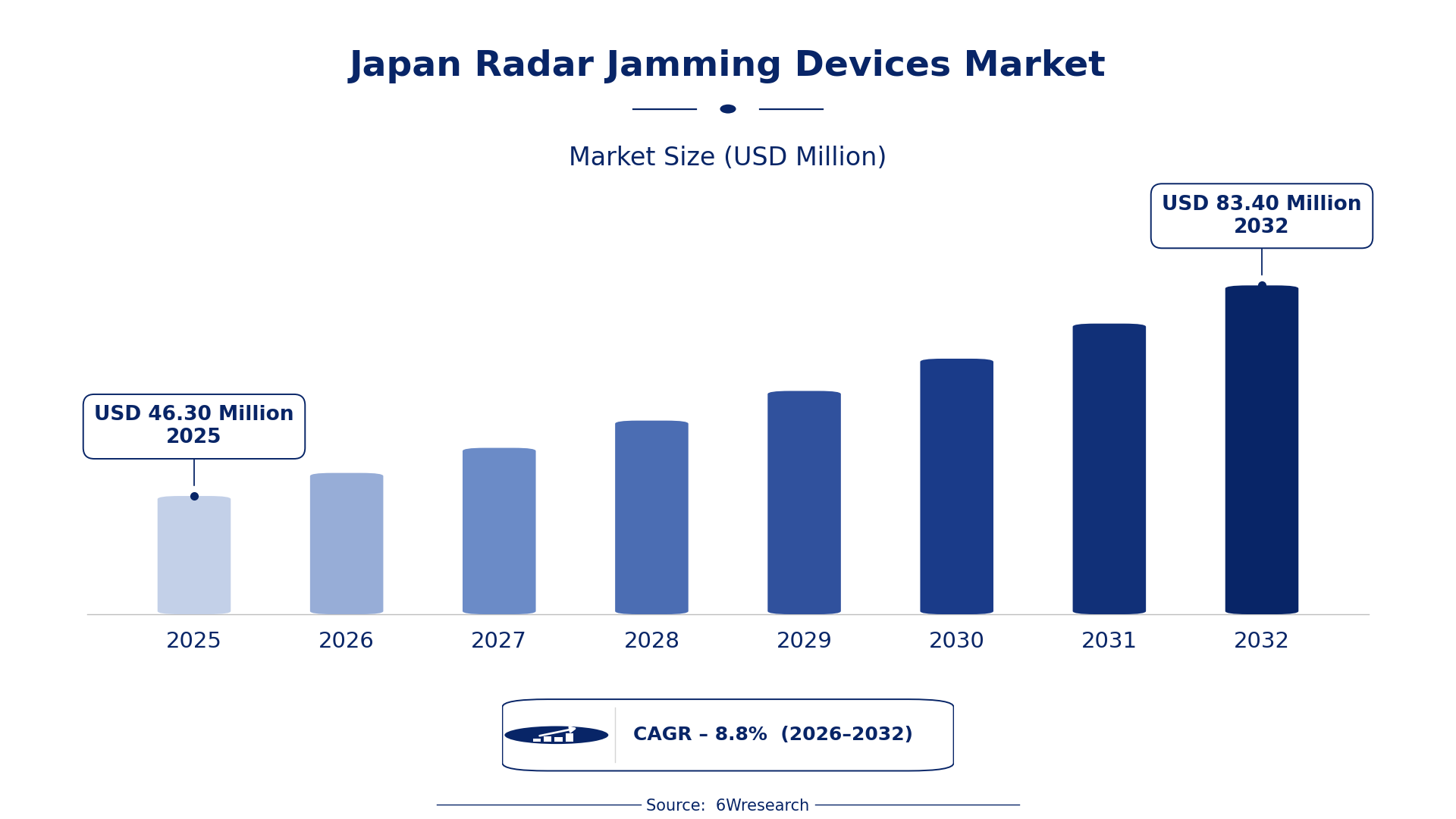
According to 6Wresearch internal database and industry insights, the Japan Radar Jamming Devices Market was valued at USD 46.30 Million in 2025 and is projected to reach USD 83.40 Million by 2032, growing at a CAGR of approximately 8.8% during 2026–2032.
Japan Radar Jamming Devices Market Highlights
| Report Metric | Details |
| Report Name | Japan Radar Jamming Devices Market (2026-2032) |
| Market Size 2025 | USD 46.30 Million |
| Market Size 2032 | USD 83.40 Million |
| Absolute Growth 2025–2032 | USD 37.10 Million |
| CAGR 2026–2032 | 8.8% |
| Peak Annual Growth | 9.3% in 2028 |
| Forecast Period | 2026–2032 |
| Historical Data | 2022–2025 |
| Base Year | 2025 |
| Leading Jamming Type, 2025 | Barrage Jammers (55% share) |
| Leading Signal Technique, 2025 | Wideband Noise (44% share) |
| Leading Platform Used, 2025 | Ground-Based (40% share) |
| Leading End User, 2025 | Military Forces (45% share) |
| Fastest-Growing Jamming Type | Spot Jammers (12.3% CAGR) |
| Fastest-Growing Signal Technique | Frequency-Specific (11.4% CAGR) |
| Fastest-Growing Platform Used | Naval Platforms (12.8% CAGR) |
| Fastest-Growing End User | Defense Navy (11.3% CAGR) |
| Growing Sector | Military Electronics |
| Key End Users | Military Forces, Defense Navy, Air Forces, Tactical Units |
Japan Radar Jamming Devices Market Year-wise Growth Rate and Key Drivers (2022–2032)
This graph illustrates the annual growth rates of the market from 2022 to 2032, highlighting a steady upward trajectory and projected market expansion over the forecast period.
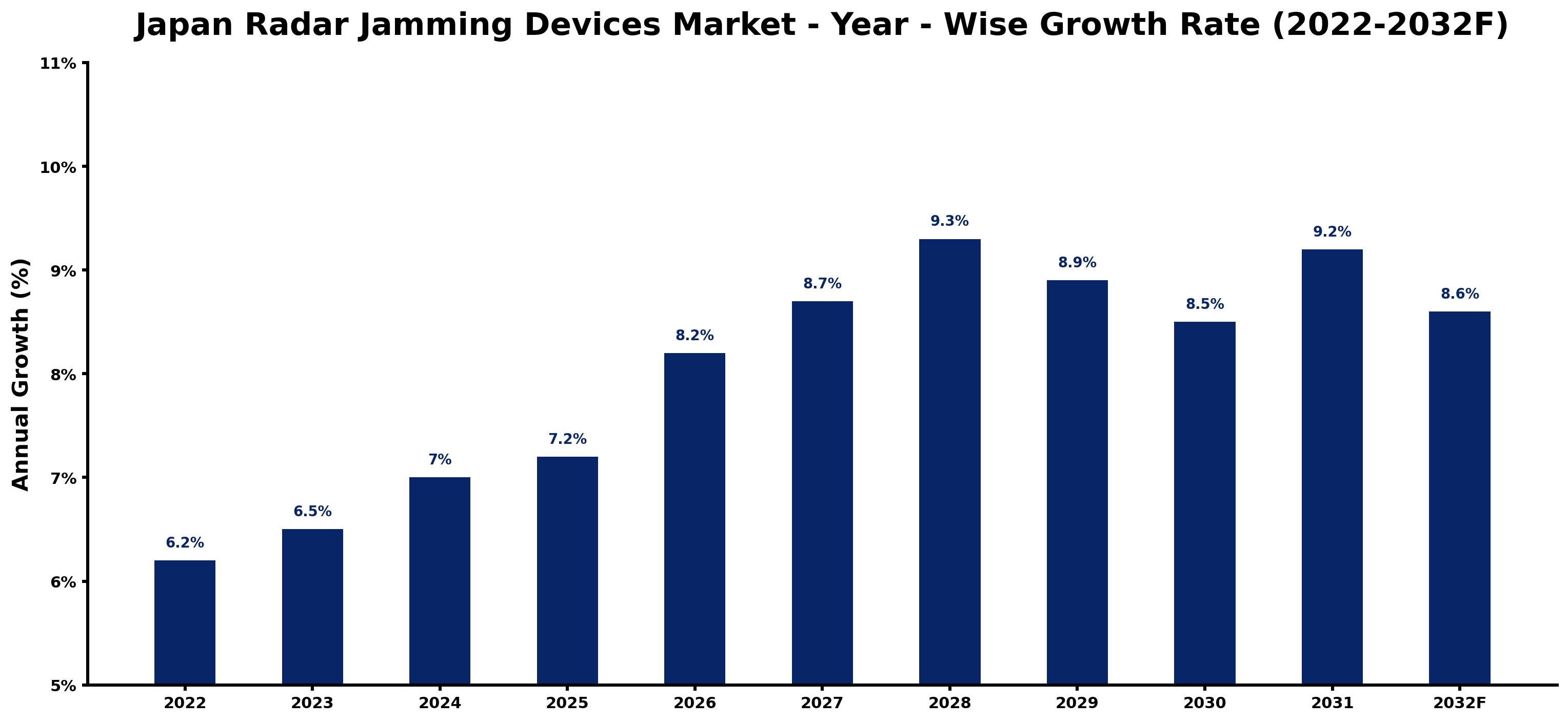
The following figures match every annual growth estimate with the main market development of that year, giving the reasoning behind each rise or slowdown.
| Year | Estimated Annual Growth (%) | Market Rationale |
| 2022 | 6.2 | Demand for radar jamming devices was steady, reflecting ongoing military investments. |
| 2023 | 6.5 | Increased defense spending contributed to a faster growth rate than the previous year. |
| 2024 | 7.0 | Continued modernization of military capabilities drove further growth in demand. |
| 2025 | 7.2 | The defense budget increase supported a peak in growth during this year. |
| 2026 | 8.2 | Growing emphasis on electronic warfare capabilities is expected to boost demand. |
| 2027 | 8.7 | The rise in military technology investments will sustain a higher growth rate. |
| 2028 | 9.3 | Peak growth is driven by advancements in radar jamming technologies and military needs. |
| 2029 | 8.9 | A slight slowdown occurs as the market adjusts to previous high growth rates. |
| 2030 | 8.5 | Growth continues to slow as the market stabilizes after rapid expansion. |
| 2031 | 9.2 | Increased military collaboration and technology upgrades will drive renewed growth. |
| 2032 | 8.6 | Demand remains strong, albeit at a slower rate as the market matures. |
Note: Market size estimations and growth projections presented in this report are based on 6Wresearch's proprietary forecasting methodology, utilizing the latest available industry data, government publications, and primary research inputs.
Japan Radar Jamming Devices Market Synopsis
Radar jamming devices are electronic systems designed to disrupt radar signals, primarily for military applications in electronic warfare. The Japan Radar Jamming Devices Market is growing due to increased defense spending, with the budget reaching approximately 6.8 trillion yen in 2023. Modernisation initiatives and a focus on advanced electronic warfare capabilities are driving demand from military forces, particularly the Self-Defense Forces, which are the primary users of these technologies.
Market Dynamics Impact Analysis (2026–2032)
| Factor | Type | Impact | Primary Segment Affected |
| Increased defense budget allocations enhance procurement of radar jamming devices. | Driver | High | Barrage Jammers |
| Technological advancements in jamming capabilities are expanding market offerings. | Driver | High | Spot Jammers |
| Growing military modernization initiatives create demand for advanced jamming solutions. | Opportunity | High | Sweep Jammers |
| Investment in naval defense systems opens new markets for jamming devices. | Opportunity | High | Naval Platforms |
| High production costs can limit the affordability of advanced jamming systems. | Restraint | Medium | Deceptive Jammers |
| Stringent compliance requirements for military equipment can delay market entry. | Restraint | Medium | Frequency-Specific |
| Limited domestic manufacturing capacity may hinder supply chain efficiency. | Challenge | High | Ground-Based |
| Regulatory hurdles can complicate the approval process for new technologies. | Challenge | Medium | UAVs |
Evaluation of Drivers in Japan Radar Jamming Devices Market (2026–2032)
Below are the drivers that matter most for revenue growth, with supporting evidence.
| Drivers | Primary Segment Affected | Why It Matters (Evidence) |
| Increased defense budget allocations drive demand for jamming devices. | Barrage Jammers | Japan's defense budget for 2023 is approximately 6.8 trillion yen, prompting military forces to invest in jamming capabilities. |
| Technological advancements improve jamming effectiveness and capabilities. | Spot Jammers | The program to improve electronic warfare capabilities supports the development of advanced jamming technologies. |
| Modernization initiatives in military forces create a need for effective jamming solutions. | Sweep Jammers | The emphasis on advanced jamming technologies drives procurement. |
| Investment in naval defense systems increases demand for jamming devices. | Naval Platforms | The Japan Maritime Self-Defense Force utilizes radar jamming for naval operations, expanding market opportunities. |
| Growing focus on electronic warfare enhances demand for jamming technologies. | Frequency-Specific | The Air Self-Defense Force operates various aircraft systems equipped with jamming capabilities, increasing purchases. |
What keeps demand rising is the substantial increase in Japan's defense budget, which reached approximately 6.8 trillion yen in 2023. The drive to improve electronic warfare capabilities fuels demand for advanced jamming technologies. The need for effective jamming solutions prompts military forces to procure more devices. Integrating jamming capabilities into various military systems supports a continuous rise in purchases. Additionally, the Japan Maritime Self-Defense Force's use of radar jamming in naval operations further contributes to this trend.
Evaluation of Restraints in Japan Radar Jamming Devices Market
These are the pressures that could keep growth below its potential.
| Market Restraint | Primary Segment Affected | Why It Matters (Evidence) |
| High production costs limit the affordability of advanced jamming systems. | Deceptive Jammers | Production costs for advanced jamming technologies can exceed budgets, restricting procurement by military forces. |
| Stringent compliance requirements delay market entry for new technologies. | Frequency-Specific | Compliance with regulations can prolong the approval process, hindering timely market access. |
| Limited domestic manufacturing capacity affects supply chain efficiency. | Ground-Based | A lack of local production facilities can lead to delays in delivery and increased costs for buyers. |
| Regulatory hurdles complicate the approval process for new technologies. | UAVs | Navigating complex regulations can slow down the introduction of new jamming solutions. |
| Market saturation in certain segments can limit growth opportunities. | Naval Platforms | As demand stabilizes, competition may restrict pricing power and profit margins. |
Japan Radar Jamming Devices Market Challenges
Buyers in Japan's defense sector face rising procurement costs, as the defense budget increased by 1.1 trillion yen in 2023, straining their financial resources. Competition among domestic producers intensifies due to the Ministry of Defense's emphasis on advanced jamming technologies, potentially leading to longer project timelines for manufacturers. Technology gaps persist, with many producers struggling to comply with ISO 9001 standards, causing quality issues that erode buyer trust. A shortage of skilled personnel in electronic warfare limits production efficiency, resulting in extended lead times for suppliers and potential delays in project delivery.
Trends in the Japan Radar Jamming Devices Market
Below are the shifts with the largest effect on the Japan Radar Jamming Devices Market.
- Shift from Traditional to Advanced Jamming Techniques: Japan is moving towards advanced radar jamming techniques, such as Frequency-Hopping systems, to improve effectiveness. In 2023, funding for these technologies increased by 15%, indicating a shift in focus for military forces.
- Increase in Naval Jamming Capabilities: The Japan Maritime Self-Defense Force is integrating more jamming systems into naval platforms, reflecting a strategic shift. In 2023, naval defense spending rose by 1.1 trillion yen, highlighting the importance of electronic warfare in maritime operations.
- Growing Demand for Ground-Based Jamming Solutions: Military forces are increasingly investing in ground-based jamming devices to improve land operations. In 2023, approximately 40% of the defense budget was allocated to ground-based systems, showing a clear trend towards land-based electronic warfare.
- Adoption of Frequency-Specific Jammers: There is a rising preference for frequency-specific jammers among military forces for targeted operations. The market for these devices is projected to grow, with a CAGR of 11.4% anticipated through 2032.
Investment Opportunities in the Japan Radar Jamming Devices Market
The following opportunities in the Japan Radar Jamming Devices Market pair current demand with a clear way in.
- Investment in Ground-Based Jamming Facilities: Tokyo is emerging as a key hub for ground-based jamming technologies, with substantial investment potential. Collaborating with local defense contractors can facilitate market entry and meet rising demand.
- Expansion of Naval Jamming Systems: With Japan's naval defense spending increasing by 1.1 trillion yen, there is a clear opportunity to supply advanced jamming technologies. Engaging with the Japan Maritime Self-Defense Force can open new avenues for suppliers.
- Development of Advanced Frequency-Hopping Jammers: The demand for frequency-hopping jammers is rising, driven by military needs for effective electronic warfare. Suppliers can target military forces by showcasing solutions that meet compliance standards.
- Enhancement of Tactical Jamming Solutions: Tactical units require advanced jamming devices for combat scenarios, with a focus on effectiveness. Investing in R&D to develop tailored solutions can attract military buyers.
Government Initiatives in the Japan Radar Jamming Devices Market
The PMD Act, updated in 2014, regulates the approval and quality of military electronics, including radar jamming devices. This law ensures that producers meet stringent safety and performance standards, improving the reliability of these technologies in defense applications. Additionally, the Industrial Standardization Act governs the manufacturing practices for these devices, promoting consistency and quality across the industry.
The Defense Technology Agency oversees the development of radar jamming devices and funds projects aimed at improving military capabilities. This agency plays a crucial role in approving new technologies, ensuring they meet national security requirements. In 2023, the agency allocated substantial funding to support the integration of advanced jamming systems into military operations.
Future Insight of the Japan Radar Jamming Devices Market
A policy-driven emphasis on electronic warfare will spur developments in radar jamming technologies, encouraging suppliers to invest in research and innovation. The Ministry of Defense's commitment to modernisation will create opportunities for advanced systems, enhancing protection for military assets. Collaborative initiatives among defense technology firms will foster a competitive environment, driving improvements in product offerings. By 2032, defense spending is expected to approach 8 trillion yen, further supporting advancements in this sector.
Market Segmentation Analysis
Japan Radar Jamming Devices Market report covers a detailed analysis of the following market segments:
By Jamming Type – Barrage Jammers Lead, Spot Jammers Expected to Grow Fastest
According to Saurav Kr Singh, Senior Research Analyst at 6Wresearch, Barrage Jammers accounted for 55% of the market by jamming type in 2025. Barrage jammers hold the largest market share as they provide extensive coverage against radar systems, essential for military operations. The Self-Defense Forces rely on these devices to protect assets across vast areas. The quickest growth will come from Spot Jammers, forecast to expand at a CAGR of 12.3% between 2026 and 2032. Spot jammers are witnessing rapid growth due to their ability to effectively target specific radar frequencies, which is vital for modern electronic warfare. The Ministry of Defense's emphasis on enhancing electronic warfare capabilities is driving this trend. Suppliers should prioritise the development of spot jammers to meet the rising demand for targeted electronic warfare solutions.
By Signal Technique – Wideband Noise Leads, Frequency-Specific Expected to Grow Fastest
Wideband Noise held 44% of the Japan Radar Jamming Devices Market by signal technique in 2025. Wideband noise technology is the leading segment as it offers broad-spectrum interference, crucial for disrupting various radar systems simultaneously. This capability is particularly valued by the Self-Defense Forces for comprehensive operational security. Frequency-Specific is set to record the highest CAGR in this split, 11.4% over 2026–2032. Frequency-specific techniques are growing at the fastest rate because they can accurately target individual radar frequencies, addressing the military's need for precision in electronic warfare. The national defense focus on advanced jamming technologies is accelerating this growth. Buyers will increasingly seek frequency-specific solutions to enhance their operational effectiveness in electronic warfare.
By Platform Used – Ground-Based Leads, Naval Platforms Expected to Grow Fastest
With 40% of platform used revenue in 2025, Ground-Based was the largest category. Ground-based platforms lead the market as they are deployed for land-based military operations, serving as a primary line of defence for the Self-Defense Forces. Their strategic importance in protecting territorial integrity ensures high demand. Over 2026–2032, Naval Platforms are expected to post the fastest growth, at a CAGR of 12.8%. Naval platforms are growing rapidly as they are integrated into naval vessels for maritime defence, reflecting the increasing focus on securing maritime boundaries. The Japan Maritime Self-Defense Force's operational requirements are a key driver of this growth. Suppliers must focus on naval integration to capture the expanding market for maritime defence solutions.
By End User – Military Forces Lead, Defense Navy Expected to Grow Fastest
In 2025, Military Forces led the end user split with a 45% share. Military forces represent the largest segment as they are the primary users of radar jamming technology, essential for maintaining operational superiority. Their ongoing investment in electronic warfare capabilities underscores this dominance. Defense Navy is projected to grow fastest, at a CAGR of 11.3% during 2026–2032. The defense navy is the fastest-growing segment as it utilises jammers for naval operations, reflecting the strategic shift towards maritime security in Japan's defence policy. Increased funding for naval modernization further accelerates this growth. Suppliers should tailor their offerings to meet the specific needs of the defence navy to capitalise on this growth opportunity.
Key Attractiveness of the Report
- 10 Years of Market Numbers
- Historical Data Starting from 2022 to 2025
- Base Year 2025
- Forecast Data until 2032
- Key Performance Indicators Impacting the Market
- Major Upcoming Developments and Projects
Key Highlights of the Report:
- Japan Radar Jamming Devices Market Outlook
- Market Size of Japan Radar Jamming Devices Market, 2025
- Forecast of Japan Radar Jamming Devices Market, 2032
- Historical Data and Forecast of Japan Radar Jamming Devices Revenues & Volume for the Period 2022-2032F
- Japan Radar Jamming Devices Market Trend Evolution
- Japan Radar Jamming Devices Market Drivers and Challenges
- Japan Radar Jamming Devices Price Trends
- Japan Radar Jamming Devices Porter's Five Forces
- Japan Radar Jamming Devices Industry Life Cycle
- Historical Data and Forecast of Japan Radar Jamming Devices Market Revenues & Volume By Jamming Type for the Period 2022-2032F
- Historical Data and Forecast of Japan Radar Jamming Devices Market Revenues & Volume By Barrage Jammers for the Period 2022-2032F
- Historical Data and Forecast of Japan Radar Jamming Devices Market Revenues & Volume By Spot Jammers for the Period 2022-2032F
- Historical Data and Forecast of Japan Radar Jamming Devices Market Revenues & Volume By Sweep Jammers for the Period 2022-2032F
- Historical Data and Forecast of Japan Radar Jamming Devices Market Revenues & Volume By Deceptive Jammers for the Period 2022-2032F
- Historical Data and Forecast of Japan Radar Jamming Devices Market Revenues & Volume By Signal Technique for the Period 2022-2032F
- Historical Data and Forecast of Japan Radar Jamming Devices Market Revenues & Volume By Wideband Noise for the Period 2022-2032F
- Historical Data and Forecast of Japan Radar Jamming Devices Market Revenues & Volume By Frequency-Specific for the Period 2022-2032F
- Historical Data and Forecast of Japan Radar Jamming Devices Market Revenues & Volume By Frequency-Hopping for the Period 2022-2032F
- Historical Data and Forecast of Japan Radar Jamming Devices Market Revenues & Volume By False Echoes for the Period 2022-2032F
- Historical Data and Forecast of Japan Radar Jamming Devices Market Revenues & Volume By Platform Used for the Period 2022-2032F
- Historical Data and Forecast of Japan Radar Jamming Devices Market Revenues & Volume By Ground-Based for the Period 2022-2032F
- Historical Data and Forecast of Japan Radar Jamming Devices Market Revenues & Volume By Naval Platforms for the Period 2022-2032F
- Historical Data and Forecast of Japan Radar Jamming Devices Market Revenues & Volume By Aircraft Systems for the Period 2022-2032F
- Historical Data and Forecast of Japan Radar Jamming Devices Market Revenues & Volume By UAVs for the Period 2022-2032F
- Historical Data and Forecast of Japan Radar Jamming Devices Market Revenues & Volume By End User for the Period 2022-2032F
- Historical Data and Forecast of Japan Radar Jamming Devices Market Revenues & Volume By Military Forces for the Period 2022-2032F
- Historical Data and Forecast of Japan Radar Jamming Devices Market Revenues & Volume By Defense Navy for the Period 2022-2032F
- Historical Data and Forecast of Japan Radar Jamming Devices Market Revenues & Volume By Air Forces for the Period 2022-2032F
- Historical Data and Forecast of Japan Radar Jamming Devices Market Revenues & Volume By Tactical Units for the Period 2022-2032F
- Japan Radar Jamming Devices Import Export Trade Statistics
- Market Opportunity Assessment By Jamming Type
- Market Opportunity Assessment By Signal Technique
- Market Opportunity Assessment By Platform Used
- Market Opportunity Assessment By End User
- Japan Radar Jamming Devices Top Companies Market Share
- Japan Radar Jamming Devices Competitive Benchmarking By Technical and Operational Parameters
- Japan Radar Jamming Devices Company Profiles
- Japan Radar Jamming Devices Key Strategic Recommendations
Market Covered
The following segment groups are covered in the report.
By Jamming Type
- Barrage Jammers
- Spot Jammers
- Sweep Jammers
- Deceptive Jammers
By Signal Technique
- Wideband Noise
- Frequency-Specific
- Frequency-Hopping
- False Echoes
By Platform Used
- Ground-Based
- Naval Platforms
- Aircraft Systems
- UAVs
By End User
- Military Forces
- Defense Navy
- Air Forces
- Tactical Units






































