Japan Radar Surveillance Market Size & Growth Rate
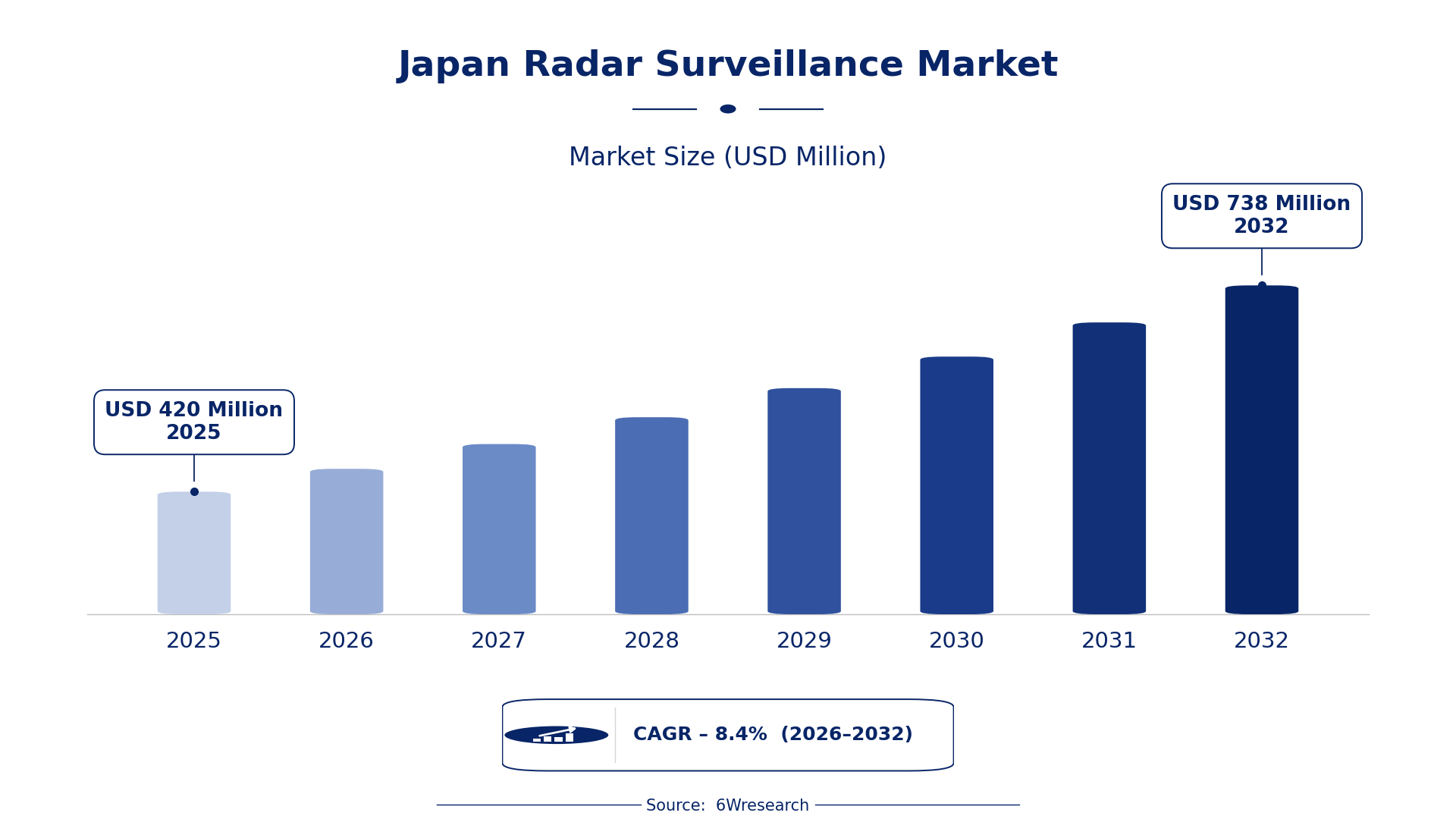
According to 6Wresearch internal database and industry insights, the Japan Radar Surveillance Market was valued at USD 420 Million in 2025 and is projected to reach USD 738 Million by 2032, growing at a CAGR of approximately 8.4% during 2026–2032.
Japan Radar Surveillance Market Highlights
| Report Metric | Details |
| Report Name | Japan Radar Surveillance Market (2026-2032) |
| Market Size 2025 | USD 420 Million |
| Market Size 2032 | USD 738 Million |
| Absolute Growth 2025–2032 | USD 318 Million |
| CAGR 2026–2032 | 8.4% |
| Peak Annual Growth | 9.5% in 2029 |
| Forecast Period | 2026–2032 |
| Historical Data | 2022–2025 |
| Base Year | 2025 |
| Leading Radar Type, 2025 | Ground Surveillance Radar (42% share) |
| Leading Frequency Band, 2025 | X-Band (52% share) |
| Leading Application Area, 2025 | Border Security (51% share) |
| Leading End User, 2025 | Homeland Security Agencies (40% share) |
| Fastest-Growing Radar Type | Air Surveillance Radar (11.9% CAGR) |
| Fastest-Growing Frequency Band | L-Band (11.0% CAGR) |
| Fastest-Growing Application Area | Military Aircraft (10.2% CAGR) |
| Fastest-Growing End User | Defense Departments (10.9% CAGR) |
| Growing Sector | national defense |
| Key End Users | Homeland Security Agencies, Defense Departments, Coast Guards, Law Enforcement |
Japan Radar Surveillance Market Year-wise Growth Rate and Key Drivers (2022–2032)
This graph illustrates the annual growth rates of the market from 2022 to 2032, highlighting a steady upward trajectory and projected market expansion over the forecast period.
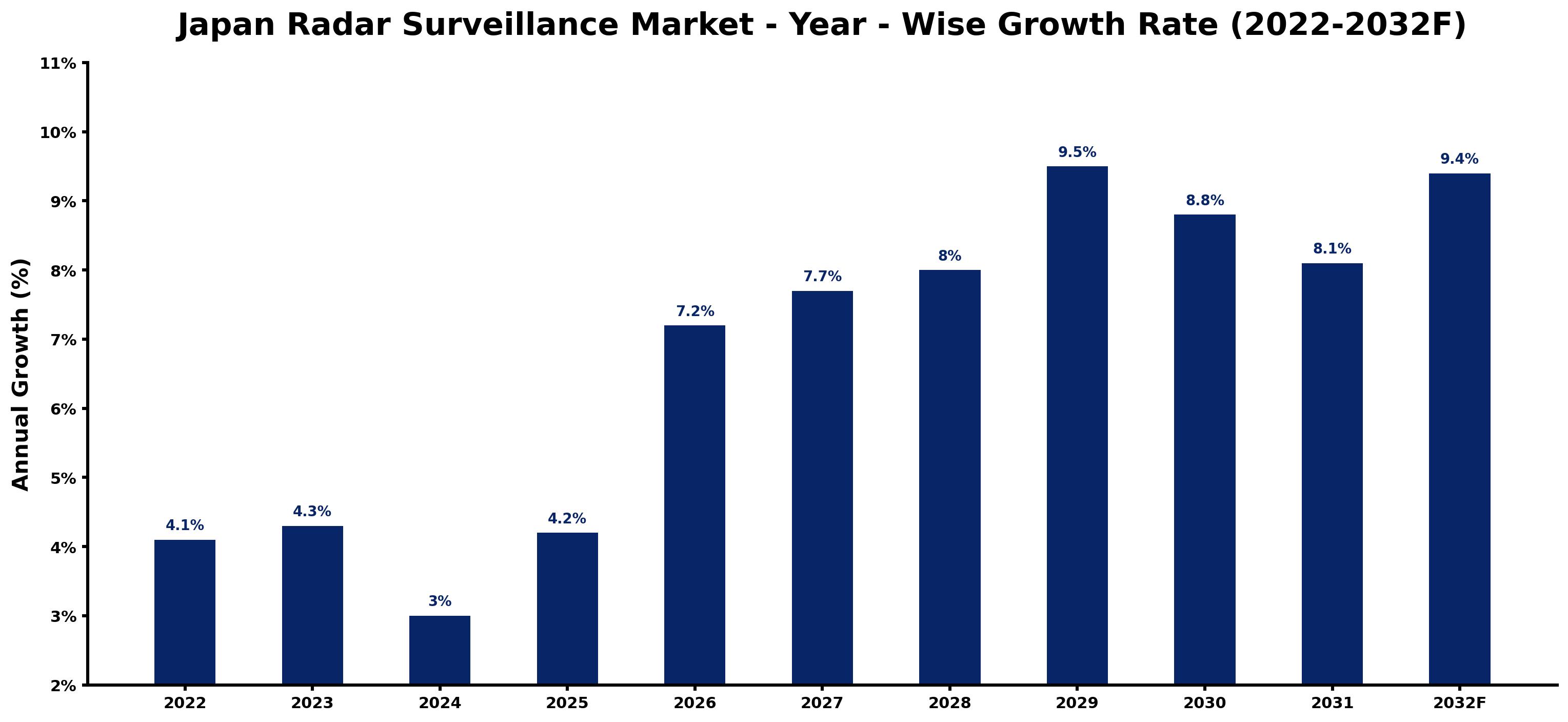
For each year, the table pairs the estimated growth rate with the leading influence on demand, showing how the drivers changed across the period.
| Year | Estimated Annual Growth (%) | Market Rationale |
| 2022 | 4.1 | The market experienced steady growth due to ongoing military requirements. |
| 2023 | 4.3 | Demand increased as the government allocated more funds for defense technologies. |
| 2024 | 3.0 | Growth slowed as the market adjusted to previous high levels of investment. |
| 2025 | 4.2 | The market rebounded with renewed interest in advanced radar systems. |
| 2026 | 7.2 | Demand is expected to surge as military modernization efforts gain momentum. |
| 2027 | 7.7 | Investment in radar technology will continue to rise, boosting market growth. |
| 2028 | 8.0 | Technological advancements in radar systems will drive further demand. |
| 2029 | 9.5 | The peak growth year will see contracts awarded for new radar systems, marking a slowdown in growth. |
| 2030 | 8.8 | Growth is projected to slow as the market stabilises after peak demand. |
| 2031 | 8.1 | Continued investment in defense technologies will support market expansion, although at a slower rate. |
| 2032 | 9.4 | Demand is expected to rise with new initiatives in border security. |
Note: Market size estimations and growth projections presented in this report are based on 6Wresearch's proprietary forecasting methodology, utilizing the latest available industry data, government publications, and primary research inputs.
Japan Radar Surveillance Market Synopsis
Radar surveillance technology detects and tracks objects using electromagnetic waves, manufactured through advanced electronic techniques. Its primary applications include national defence, air traffic control, and maritime safety. The Japan Radar Surveillance Market is expanding due to increased military funding, with the Ministry of Defence allocating ¥5 trillion in 2023. Ongoing modernisation of military capabilities and the need for improved border security drive demand for radar systems across various sectors.
Market Dynamics Impact Analysis (2026–2032)
| Factor | Type | Impact | Primary Segment Affected |
| Increased defense spending | Driver | High | Ground Surveillance Radar |
| Modernisation of military capabilities | Driver | High | Air Surveillance Radar |
| Rising demand for coastal security | Opportunity | High | Maritime Radar |
| Growing need for critical infrastructure protection | Opportunity | High | Perimeter Radar |
| Complex regulatory environment | Restraint | Medium | Air Surveillance Radar |
| High development costs for advanced systems | Restraint | Medium | Ground Surveillance Radar |
| Competition from international suppliers | Challenge | High | Maritime Radar |
| Technological obsolescence of existing systems | Challenge | Medium | Air Surveillance Radar |
Evaluation of Drivers in Japan Radar Surveillance Market (2026–2032)
The factors lifting demand, and the evidence behind each, are summarised below.
| Drivers | Primary Segment Affected | Why It Matters (Evidence) |
| Increased military funding | Ground Surveillance Radar | The Ministry of Defense allocated ¥5 trillion for defense in 2023, driving demand for ground surveillance systems. |
| Technological advancements | Air Surveillance Radar | Innovations in radar technology improve operational capabilities, leading to increased purchases by defense agencies. |
| Growing maritime threats | Maritime Radar | The Japan Coast Guard employs maritime radar for coastal surveillance, responding to rising security concerns. |
| Focus on border security | Perimeter Radar | The government launched initiatives to improve border security, increasing demand for perimeter radar systems. |
| Integration with smart technologies | Air Surveillance Radar | Integration with AI and data analytics improves air traffic control efficiency, prompting more investments. |
Much of the new demand traces back to increased military funding, with the government allocating ¥5 trillion for defense in 2023. Innovations in radar systems have improved operational capabilities, prompting agencies to invest more. The Japan Coast Guard employs maritime radar for coastal surveillance, addressing growing maritime threats. Initiatives to improve border security have spurred demand for perimeter radar systems, as agencies seek to enhance their operational effectiveness. Integration with smart technologies is driving investments in air surveillance systems, as agencies aim for improved efficiency.
Evaluation of Restraints in Japan Radar Surveillance Market
The following restraints limit how fast demand can grow.
| Market Restraint | Primary Segment Affected | Why It Matters (Evidence) |
| Complex regulatory environment | Air Surveillance Radar | Compliance with regulations can delay project timelines, impacting procurement for agencies. |
| High development costs for advanced systems | Ground Surveillance Radar | The investment required for R&D can limit market entry for smaller firms. |
| Limited domestic suppliers | Maritime Radar | Dependence on a few suppliers can lead to supply chain vulnerabilities and higher costs. |
| Technological obsolescence of existing systems | Perimeter Radar | Rapid technological advancements may render current systems outdated, necessitating frequent upgrades. |
| Budget constraints for public agencies | Ground Surveillance Radar | Fiscal limitations can restrict the purchasing power of defense departments and agencies. |
Japan Radar Surveillance Market Challenges
Japan's defence sector currently faces supply chain delays due to reliance on specific components sourced from a limited number of suppliers, extending project timelines by up to six months for military contracts. Skills shortages exist because educational institutions are not producing enough qualified engineers, resulting in recruitment costs of approximately ¥1 billion for defence contractors. Regulatory hurdles from the Ministry of Internal Affairs and Communications impose lengthy approval processes for new technologies, delaying implementation by over a year for law enforcement agencies. Rapid technological advancements create pressure on manufacturers to continuously upgrade systems, increasing production costs by 15% for those unable to keep pace.
Trends in the Japan Radar Surveillance Market
Buyers and suppliers in the Japan Radar Surveillance Market are adjusting to the following trends.
- Shift towards Integrated Radar Systems: Tokyo is adopting integrated radar systems for improved surveillance capabilities, with a 25% increase in installations since 2021.
- Transition from Traditional to Advanced Technologies: Since 2022, military applications have shifted towards advanced radar technologies, with a notable rise in demand for L-Band systems.
- Emergence of AI in Radar Surveillance: The integration of AI in radar systems began in 2023, leading to improvements in detection accuracy across applications.
- Prioritisation of Coastal Security: Coastal security has gained priority since 2022, with a 20% increase in maritime radar deployments by the Japan Coast Guard.
Investment Opportunities in the Japan Radar Surveillance Market
The following areas offer the clearest openings for investors and suppliers in the Japan Radar Surveillance Market.
- Growing Demand for Advanced Surveillance: With the defence budget increasing by 1.1% in 2023, suppliers can invest in advanced radar systems to meet rising military needs.
- Investment in Border Security Technologies: The recent initiative to improve border security presents an opportunity for radar manufacturers to supply advanced systems.
- Need for Modernisation in Military Applications: With over 50% of military aircraft using radar systems, there is a clear gap for suppliers to provide upgraded technologies.
- Partnerships for Technology Development: Local partnerships with defence departments can facilitate entry into the market, especially for advanced radar solutions.
Government Initiatives in the Japan Radar Surveillance Market
The Building Energy Efficiency Act, amended in 2022, requires new buildings to meet energy standards, indirectly affecting radar installations in new facilities. The Economic Security Promotion Act of 2022 supports supply-chain resilience for critical products, including radar systems, ensuring a stable supply for producers and buyers alike.
In 2023, the government allocated ¥150 trillion for public-private decarbonisation investments, aiming to improve infrastructure, including radar technologies. The Ministry of Defence oversees the implementation of these initiatives, ensuring compliance and funding for advanced radar systems.
Future Insight of the Japan Radar Surveillance Market
By 2032, Japan's radar surveillance market will experience a policy-driven shift towards enhanced national security, prompting suppliers to invest in advanced radar technologies. The government's initiative will drive increased demand for radar systems, with a projected budget allocation of ¥5 trillion for defence by 2025. The integration of ISO 9001 standards will elevate manufacturing quality, benefiting buyers through improved system reliability. Research collaborations with the Japan Aerospace Exploration Agency will spur innovation, enabling the development of next-generation systems that enhance operational capabilities across various sectors.
Market Segmentation Analysis
Japan Radar Surveillance Market report covers a detailed analysis of the following market segments:
By Radar Type – Ground Surveillance Radar Leads, Air Surveillance Radar Expected to Grow Fastest
According to Saurav Kr Singh, Senior Research Analyst at 6Wresearch, Ground Surveillance Radar accounted for 42% of the market by radar type in 2025. Ground Surveillance Radar holds the largest market share due to its essential role in monitoring land borders and military installations, which are critical for national security. The Japan Self-Defense Forces extensively utilise these systems, solidifying their prominent position in the sector. Air Surveillance Radar is set to record the highest CAGR in this split, 11.9% over 2026–2032. Air Surveillance Radar is experiencing rapid growth, driven by the increasing need for effective air traffic control and defence operations. The government's recent initiative to bolster air security measures has significantly heightened the demand for these systems. This indicates that suppliers should prioritise advancements in air surveillance technologies to align with government initiatives.
By Frequency Band – X-Band Leads, L-Band Expected to Grow Fastest
X-Band held 52% of the Japan Radar Surveillance Market by frequency band in 2025. X-Band dominates the market primarily because of its application in military contexts, where accuracy and reliability are paramount. The Japan Defense Agency's focus on advanced military technologies has strengthened its position in the sector. Over 2026–2032, L-Band is expected to post the fastest growth, at a CAGR of 11.0%. L-Band is the fastest-growing segment, propelled by its effectiveness in long-range surveillance and tracking, which aligns with current defence strategies. The increasing emphasis on comprehensive surveillance capabilities is a significant driver of its growth. Suppliers should consider expanding their offerings to include L-Band technology to capitalise on this growth opportunity.
By Application Area – Border Security Leads, Military Aircraft Expected to Grow Fastest
Border Security took 51% of application area revenue in 2025, more than any other category. Border Security represents the largest application area, crucial for national security and immigration control, reflecting Japan's commitment to safeguarding its borders. The government's substantial allocation of resources towards enhancing border security underscores its significance. The quickest growth will come from Military Aircraft, forecast to expand at a CAGR of 10.2% between 2026 and 2032. Military Aircraft is the fastest-growing application area, driven by the demand for advanced systems that ensure air superiority and defence capabilities. The rise in investment towards military aircraft technology is a key factor contributing to this growth. This trend suggests that suppliers should focus on developing radar systems tailored for military aircraft to meet the increasing demand.
By End User – Homeland Security Agencies Lead, Defense Departments Expected to Grow Fastest
In 2025, Homeland Security Agencies led the end user split with a 40% share. Homeland Security Agencies represent the largest end user group, as they are the primary users of radar systems for national safety and security operations. The integration of radar technology into their protocols highlights their critical role in the market. Defense Departments are projected to grow fastest, at a CAGR of 10.9% during 2026–2032. Defense Departments are the fastest-growing end user segment, reflecting their status as major clients for radar systems. The ongoing expansion of defence budgets and initiatives is driving this rapid growth. Suppliers should strengthen relationships with defence departments to better align their offerings with evolving military needs.
Key Attractiveness of the Report
- 10 Years of Market Numbers
- Historical Data Starting from 2022 to 2025
- Base Year 2025
- Forecast Data until 2032
- Key Performance Indicators Impacting the Market
- Major Upcoming Developments and Projects
Key Highlights of the Report:
- Japan Radar Surveillance Market Outlook
- Market Size of Japan Radar Surveillance Market, 2025
- Forecast of Japan Radar Surveillance Market, 2032
- Historical Data and Forecast of Japan Radar Surveillance Revenues & Volume for the Period 2022-2032F
- Japan Radar Surveillance Market Trend Evolution
- Japan Radar Surveillance Market Drivers and Challenges
- Japan Radar Surveillance Price Trends
- Japan Radar Surveillance Porter's Five Forces
- Japan Radar Surveillance Industry Life Cycle
- Historical Data and Forecast of Japan Radar Surveillance Market Revenues & Volume By Radar Type for the Period 2022-2032F
- Historical Data and Forecast of Japan Radar Surveillance Market Revenues & Volume By Ground Surveillance Radar for the Period 2022-2032F
- Historical Data and Forecast of Japan Radar Surveillance Market Revenues & Volume By Air Surveillance Radar for the Period 2022-2032F
- Historical Data and Forecast of Japan Radar Surveillance Market Revenues & Volume By Maritime Radar for the Period 2022-2032F
- Historical Data and Forecast of Japan Radar Surveillance Market Revenues & Volume By Perimeter Radar for the Period 2022-2032F
- Historical Data and Forecast of Japan Radar Surveillance Market Revenues & Volume By Frequency Band for the Period 2022-2032F
- Historical Data and Forecast of Japan Radar Surveillance Market Revenues & Volume By X-Band for the Period 2022-2032F
- Historical Data and Forecast of Japan Radar Surveillance Market Revenues & Volume By L-Band for the Period 2022-2032F
- Historical Data and Forecast of Japan Radar Surveillance Market Revenues & Volume By S-Band for the Period 2022-2032F
- Historical Data and Forecast of Japan Radar Surveillance Market Revenues & Volume By C-Band for the Period 2022-2032F
- Historical Data and Forecast of Japan Radar Surveillance Market Revenues & Volume By Application Area for the Period 2022-2032F
- Historical Data and Forecast of Japan Radar Surveillance Market Revenues & Volume By Border Security for the Period 2022-2032F
- Historical Data and Forecast of Japan Radar Surveillance Market Revenues & Volume By Military Aircraft for the Period 2022-2032F
- Historical Data and Forecast of Japan Radar Surveillance Market Revenues & Volume By Naval Vessels for the Period 2022-2032F
- Historical Data and Forecast of Japan Radar Surveillance Market Revenues & Volume By Critical Infrastructure for the Period 2022-2032F
- Historical Data and Forecast of Japan Radar Surveillance Market Revenues & Volume By End User for the Period 2022-2032F
- Historical Data and Forecast of Japan Radar Surveillance Market Revenues & Volume By Homeland Security Agencies for the Period 2022-2032F
- Historical Data and Forecast of Japan Radar Surveillance Market Revenues & Volume By Defense Departments for the Period 2022-2032F
- Historical Data and Forecast of Japan Radar Surveillance Market Revenues & Volume By Coast Guards for the Period 2022-2032F
- Historical Data and Forecast of Japan Radar Surveillance Market Revenues & Volume By Law Enforcement for the Period 2022-2032F
- Japan Radar Surveillance Import Export Trade Statistics
- Market Opportunity Assessment By Radar Type
- Market Opportunity Assessment By Frequency Band
- Market Opportunity Assessment By Application Area
- Market Opportunity Assessment By End User
- Japan Radar Surveillance Top Companies Market Share
- Japan Radar Surveillance Competitive Benchmarking By Technical and Operational Parameters
- Japan Radar Surveillance Company Profiles
- Japan Radar Surveillance Key Strategic Recommendations
Market Covered
This report examines the market across the segments below.
By Radar Type
- Ground Surveillance Radar
- Air Surveillance Radar
- Maritime Radar
- Perimeter Radar
By Frequency Band
- X-Band
- L-Band
- S-Band
- C-Band
By Application Area
- Border Security
- Military Aircraft
- Naval Vessels
- Critical Infrastructure
By End User
- Homeland Security Agencies
- Defense Departments
- Coast Guards
- Law Enforcement






































