Japan Radar Warning Receiver Market Size & Growth Rate
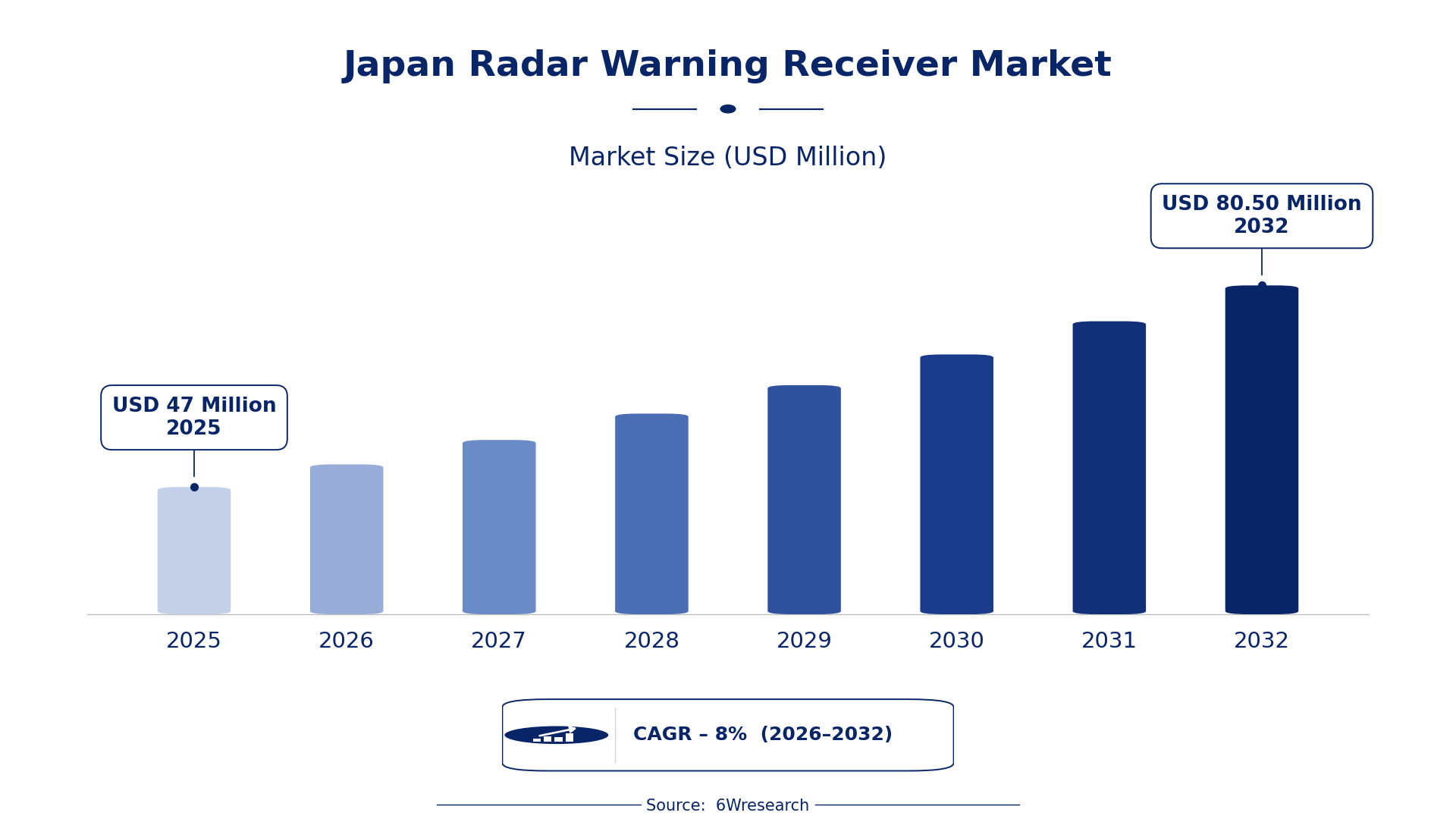
According to 6Wresearch internal database and industry insights, the Japan Radar Warning Receiver Market was valued at USD 47 Million in 2025 and is projected to reach USD 80.50 Million by 2032, growing at a CAGR of approximately 8% during 2026–2032.
Japan Radar Warning Receiver Market Highlights
| Report Metric | Details |
| Report Name | Japan Radar Warning Receiver Market (2026-2032) |
| Market Size 2025 | USD 47 Million |
| Market Size 2032 | USD 80.50 Million |
| Absolute Growth 2025–2032 | USD 33.50 Million |
| CAGR 2026–2032 | 8% |
| Peak Annual Growth | 8.9% in 2032 |
| Forecast Period | 2026–2032 |
| Historical Data | 2022–2025 |
| Base Year | 2025 |
| Leading Receiver Type, 2025 | Standalone RWR (34% share) |
| Leading Technology Used, 2025 | Analog Processing (48% share) |
| Leading Platform Type, 2025 | Fighter Jets (42% share) |
| Leading End User, 2025 | Air Forces (43% share) |
| Fastest-Growing Receiver Type | Integrated RWR (11.2% CAGR) |
| Fastest-Growing Technology Used | Digital Signal Process (11.6% CAGR) |
| Fastest-Growing Platform Type | Multirole Aircraft (11.4% CAGR) |
| Fastest-Growing End User | Defense Contractors (10.4% CAGR) |
| Growing Sector | military applications |
| Key End Users | Air Forces, Defense Contractors, Naval Forces |
Japan Radar Warning Receiver Market Year-wise Growth Rate and Key Drivers (2022–2032)
This graph illustrates the annual growth rates of the market from 2022 to 2032, highlighting a steady upward trajectory and projected market expansion over the forecast period.
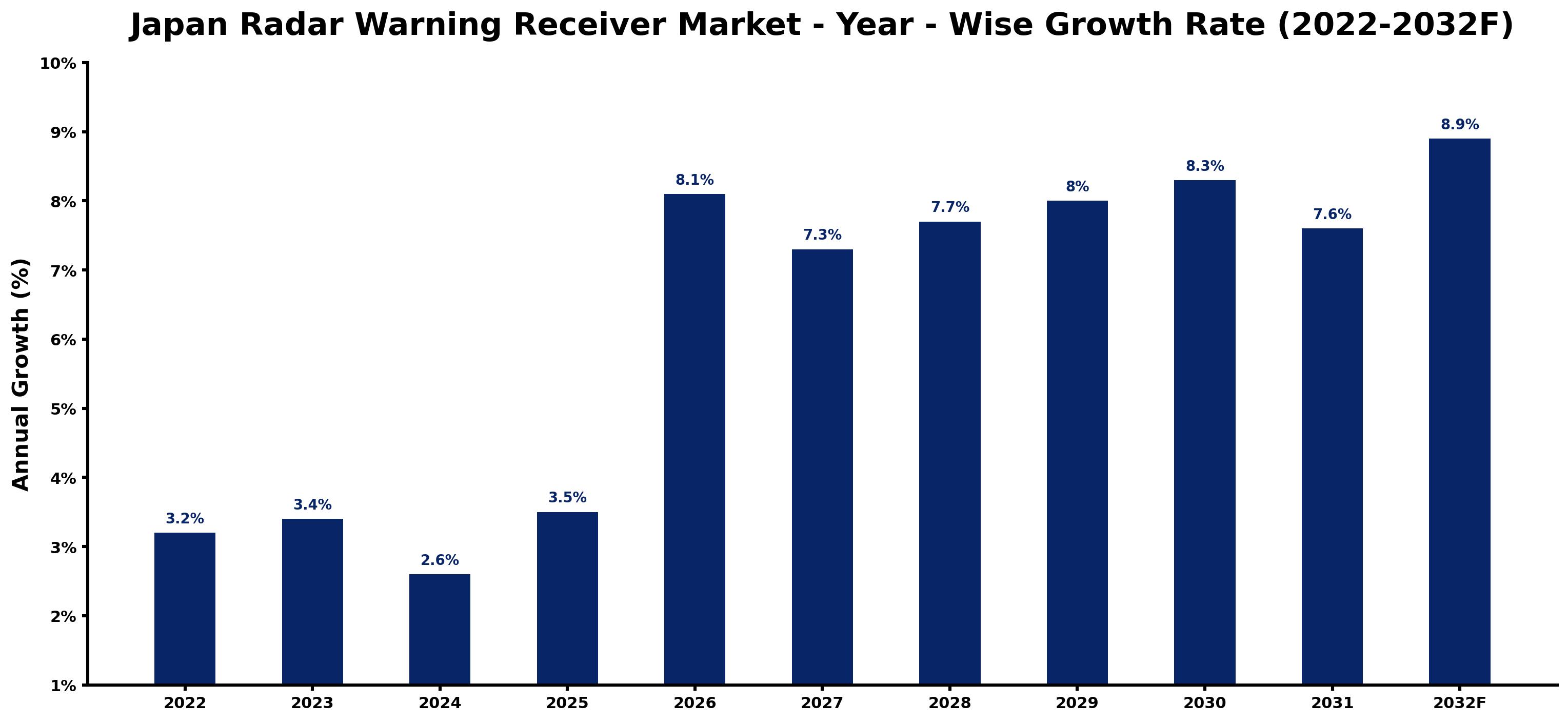
The following figures match every annual growth estimate with the main market development of that year, giving the reasoning behind each rise or slowdown.
| Year | Estimated Annual Growth (%) | Market Rationale |
| 2022 | 3.2 | Demand for RWR systems was steady, reflecting ongoing military operations. |
| 2023 | 3.4 | Growth was supported by increased defense spending and technological advancements. |
| 2024 | 2.6 | A slowdown occurred as the market adjusted to previous high growth rates. |
| 2025 | 3.5 | The market saw renewed interest due to the integration of RWR in new aircraft. |
| 2026 | 8.1 | Demand surged as modernization programs for military capabilities intensified. |
| 2027 | 7.3 | Growth slowed as supply chain issues impacted production timelines. |
| 2028 | 7.7 | Increased procurement from defense contractors boosted market activity. |
| 2029 | 8.0 | Demand rose as military operations expanded, requiring enhanced situational awareness. |
| 2030 | 8.3 | Technological improvements in RWR systems spurred further purchases. |
| 2031 | 7.6 | Growth decelerated as the market approached saturation in certain segments. |
| 2032 | 8.9 | The market peaked as advanced RWR systems became essential for military readiness. |
Note: Market size estimations and growth projections presented in this report are based on 6Wresearch's proprietary forecasting methodology, utilizing the latest available industry data, government publications, and primary research inputs.
Japan Radar Warning Receiver Market Synopsis
Radar Warning Receivers are electronic devices that detect and analyse radar signals, improving situational awareness for military aircraft and naval vessels. In Japan, the defence industry is growing, largely due to the Self-Defense Forces operating over 300 fighter jets equipped with RWR systems. The Ministry of Defense's allocation of ¥1 trillion for defence technology advancements in 2023 and the focus on modern electronic warfare capabilities are driving demand for RWR systems, creating opportunities for defence contractors and technology suppliers in the region.
Market Dynamics Impact Analysis (2026–2032)
| Factor | Type | Impact | Primary Segment Affected |
| Increased defense spending by the Ministry of Defense | Driver | High | Naval RWR |
| Integration of RWR in advanced platforms like F-35 | Driver | High | Integrated RWR |
| Growing need for enhanced situational awareness | Opportunity | High | Tactical RWR |
| Expansion of defense contractors in the Tokyo region | Opportunity | Medium | Standalone RWR |
| Supply chain disruptions affecting production timelines | Restraint | High | Digital Signal Process |
| High costs associated with RWR system upgrades | Restraint | Medium | Analog Processing |
| Limited domestic suppliers for advanced technology | Challenge | High | Integrated RWR |
| Regulatory hurdles slowing down product approvals | Challenge | Medium | Naval RWR |
Evaluation of Drivers in Japan Radar Warning Receiver Market (2026–2032)
Below are the drivers that matter most for revenue growth, with supporting evidence.
| Drivers | Primary Segment Affected | Why It Matters (Evidence) |
| Increased defense budget allocations | Fighter Jets | Japan's defense budget for 2023 allocates ¥1 trillion for technology advancements, driving demand for RWR systems in military aircraft. |
| Integration of RWR in advanced aircraft | Integrated RWR | The Japanese Air Self-Defense Force's integration of RWR into its F-35 fleet since 2020 boosts demand for modern RWR systems. |
| Focus on modern electronic warfare capabilities | Naval RWR | The National Defense Program Guidelines highlight the need for enhanced electronic warfare capabilities, increasing demand for RWR in naval operations. |
| Collaboration among defense contractors | Defense Contractors | The Tokyo region's defense contractors are collaborating to improve production capabilities, leading to increased supply of RWR systems. |
| Technological advancements in RWR systems | Digital Signal Process | The Semiconductor and Digital Industry Strategy promotes technological advancements, increasing demand for RWR systems from military contractors. |
Purchasing is picking up as Japan's defense budget for 2023 allocates ¥1 trillion for technology advancements, particularly in RWR systems. The integration of RWR in the Japanese Air Self-Defense Force's F-35 fleet since 2020 is driving demand for advanced systems. The focus on modern electronic warfare capabilities is prompting military operations to adopt RWR. Collaboration among defense contractors in the Tokyo region is improving production capabilities, while technological advancements in RWR systems are emphasised in the Semiconductor and Digital Industry Strategy, increasing demand from military contractors.
Evaluation of Restraints in Japan Radar Warning Receiver Market
The key brakes on demand, and where they bite hardest, are shown below.
| Market Restraint | Primary Segment Affected | Why It Matters (Evidence) |
| Intense competition among suppliers | Standalone RWR | Over 300 fighter jets equipped with RWR systems intensify competition, leading to price pressures and potential quality compromises. |
| Supply chain disruptions | Tactical RWR | Reliance on specific electronic components causes delays in production timelines, impacting readiness for military operations. |
| Costs of adhering to quality standards | Integrated RWR | Compliance with ISO 9001 standards incurs substantial costs for suppliers, which may increase prices for buyers. |
| Rapid technological advancements | Naval RWR | Ongoing investment in RWR technology strains budgets for defense contractors and military forces, hindering timely upgrades. |
| Market dependence on defense budgets | Air Forces | Fluctuations in defense budgets directly affect procurement plans for RWR systems, creating uncertainty for suppliers. |
Japan Radar Warning Receiver Market Challenges
Over 300 fighter jets equipped with RWR systems intensify competition among suppliers, leading to lower prices and potentially compromising quality for military forces. Supply chain disruptions arise from reliance on specific electronic components, causing delays in production timelines for manufacturers and affecting readiness for defence operations. Adherence to ISO 9001 standards incurs substantial costs for suppliers, which may increase prices for buyers seeking reliable systems. Rapid technological advancements require ongoing investment, straining budgets for both defence contractors and military forces, and hindering timely upgrades to RWR capabilities.
Trends in the Japan Radar Warning Receiver Market
These developments are changing demand patterns in the Japan Radar Warning Receiver Market.
- Shift from Analog to Digital Signal Processing: Since 2020, there has been a transition from analog processing to digital signal processing in RWR systems. This change is reflected in the Japanese Air Self-Defense Force's adoption of advanced digital technologies, improving threat detection capabilities significantly.
- Integration of RWR in Multirole Aircraft: The integration of RWR systems in multirole aircraft is becoming more prevalent, particularly in Japan's defense operations. This trend is highlighted by the increasing adoption of RWR in new aircraft models, which are expected to improve operational flexibility and effectiveness.
- Emphasis on Electronic Warfare Capabilities: The Digital Agency's initiatives have shifted focus towards improving electronic warfare capabilities within Japan's military. This strategic direction is reflected in the increased funding for RWR systems, which are critical for modern military operations and readiness.
- Expansion of Defense Contractors in Tokyo: The Tokyo region is witnessing an expansion of defense contractors specialising in RWR technology. This growth is supported by the Ministry of Defense's investment in local defence initiatives, which is expected to boost production capacity and innovation.
Investment Opportunities in the Japan Radar Warning Receiver Market
Investors looking at the Japan Radar Warning Receiver Market should consider the following areas.
- Supply of Advanced RWR Systems: With Japan's defence budget of ¥1 trillion for 2023, there is a substantial opportunity to supply advanced RWR systems to military forces, particularly in the Tokyo region.
- Investment in Integrated RWR Technology: The growing demand for Integrated RWR systems, projected to grow at 11.2%, presents an opportunity for investment in R&D and production capabilities, especially among defence contractors.
- Enhancing Naval RWR Capabilities: The Japan Maritime Self-Defense Force's focus on RWR for destroyers creates an opportunity for suppliers to improve naval defence systems, particularly in coastal regions.
- Expansion of Digital Signal Processing: The push for Digital Signal Processing technology in RWR systems offers a chance to invest in advanced solutions, aligning with the Semiconductor and Digital Industry Strategy.
Government Initiatives in the Japan Radar Warning Receiver Market
The Defense Agency of Japan oversees regulations and standards for military equipment, ensuring compliance with laws such as the National Defense Program Guidelines and the Defense Technology Strategy 2023. These frameworks set the stage for advancements in RWR systems, requiring producers to adhere to strict quality management standards like ISO 9001 to maintain competitiveness and ensure reliability in military applications.
The Semiconductor and Digital Industry Strategy facilitates the development of advanced technologies, allowing defense contractors to improve their production capabilities and meet the growing demand for RWR systems. This strategy is essential for securing domestic semiconductor manufacturing, which is vital for RWR systems and overall military readiness.
Future Insight of the Japan Radar Warning Receiver Market
The Tokyo region's defence contractors are initiating advanced RWR development projects by 2032, aiming to strengthen military capabilities. With a defence budget of ¥1 trillion earmarked for technology advancements, buyers will gain access to superior threat detection systems. Collaborative efforts among local contractors will stimulate innovation in RWR technology, ensuring suppliers remain competitive. As the Japanese Air Self-Defense Force continues to integrate RWR into its fleet, suppliers will need to align their products with updated military standards and operational requirements.
Market Segmentation Analysis
Japan Radar Warning Receiver Market report covers a detailed analysis of the following market segments:
By Receiver Type – Standalone RWR Leads, Integrated RWR Expected to Grow Fastest
According to Saurav Kr Singh, Senior Research Analyst at 6Wresearch, with 34% of receiver type revenue in 2025, Standalone RWR was the largest category. Standalone RWR maintains the largest share as it is specifically used in military aircraft for threat detection. The operational requirement of over 300 fighter jets in Japan's Self-Defense Forces underscores its critical role in aerial defence. Over 2026–2032, Integrated RWR is expected to post the fastest growth, at a CAGR of 11.2%. Integrated RWR is experiencing rapid growth due to its incorporation into various platforms for enhanced functionality. This shift is driven by the need for systems that can adapt to diverse military applications, ensuring broader operational capabilities. Suppliers should focus on developing integrated RWR solutions to meet the increasing demand for versatile military systems.
By Technology Used – Analog Processing Leads, Digital Signal Process Expected to Grow Fastest
Analog Processing accounted for 48% of the market by technology used in 2025. Analog Processing is the leading technology in RWR systems, primarily found in older models still in operation. Its long-standing presence in existing systems has established a significant installed base, although it is gradually being phased out. The quickest growth will come from Digital Signal Process, forecast to expand at a CAGR of 11.6% between 2026 and 2032. Digital Signal Processing is the fastest-growing technology, crucial for modern RWR systems that require advanced capabilities. The transition to digital technologies is vital for enhancing performance and effectiveness in current military applications. Buyers will increasingly seek RWR systems that utilise digital technologies to ensure operational effectiveness.
By Platform Type – Fighter Jets Lead, Multirole Aircraft Expected to Grow Fastest
Fighter Jets took 42% of platform type revenue in 2025, more than any other category. Fighter Jets are the primary platform type for RWR deployment, serving as the main aircraft for military operations. The integration of RWR systems in these jets significantly improves situational awareness and threat response capabilities. Multirole Aircraft is projected to grow fastest, at a CAGR of 11.4% during 2026–2032. Multirole Aircraft are the fastest-growing platform type due to their adaptability and extensive application in various military operations. The increasing demand for versatile aircraft capable of fulfilling multiple roles is driving this growth. Suppliers should prioritise the development of RWR solutions tailored for multirole aircraft to capitalise on this expanding market.
By End User – Air Forces Lead, Defense Contractors Expected to Grow Fastest
In 2025, Air Forces led the end user split with a 43% share. Air Forces represent the largest end user of RWR technology, as they are the main operators of these systems for aerial defence. The Japanese Air Self-Defense Force's integration of RWR in its F-35 fleet underscores the importance of this technology for air operations. Defense Contractors are set to record the highest CAGR in this split, 10.4% over 2026–2032. Defense Contractors are the fastest-growing end user group, as they are responsible for developing and supplying RWR systems. The increasing focus on advanced military technology and collaboration in the defense sector is propelling this segment's growth. Suppliers should engage with defense contractors to align their offerings with emerging trends in RWR technology development.
Key Attractiveness of the Report
- 10 Years of Market Numbers
- Historical Data Starting from 2022 to 2025
- Base Year 2025
- Forecast Data until 2032
- Key Performance Indicators Impacting the Market
- Major Upcoming Developments and Projects
Key Highlights of the Report:
- Japan Radar Warning Receiver Market Outlook
- Market Size of Japan Radar Warning Receiver Market, 2025
- Forecast of Japan Radar Warning Receiver Market, 2032
- Historical Data and Forecast of Japan Radar Warning Receiver Revenues & Volume for the Period 2022-2032F
- Japan Radar Warning Receiver Market Trend Evolution
- Japan Radar Warning Receiver Market Drivers and Challenges
- Japan Radar Warning Receiver Price Trends
- Japan Radar Warning Receiver Porter's Five Forces
- Japan Radar Warning Receiver Industry Life Cycle
- Historical Data and Forecast of Japan Radar Warning Receiver Market Revenues & Volume By Receiver Type for the Period 2022-2032F
- Historical Data and Forecast of Japan Radar Warning Receiver Market Revenues & Volume By Standalone RWR for the Period 2022-2032F
- Historical Data and Forecast of Japan Radar Warning Receiver Market Revenues & Volume By Integrated RWR for the Period 2022-2032F
- Historical Data and Forecast of Japan Radar Warning Receiver Market Revenues & Volume By Tactical RWR for the Period 2022-2032F
- Historical Data and Forecast of Japan Radar Warning Receiver Market Revenues & Volume By Naval RWR for the Period 2022-2032F
- Historical Data and Forecast of Japan Radar Warning Receiver Market Revenues & Volume By Technology Used for the Period 2022-2032F
- Historical Data and Forecast of Japan Radar Warning Receiver Market Revenues & Volume By Analog Processing for the Period 2022-2032F
- Historical Data and Forecast of Japan Radar Warning Receiver Market Revenues & Volume By Digital Signal Process for the Period 2022-2032F
- Historical Data and Forecast of Japan Radar Warning Receiver Market Revenues & Volume By Direction Finding for the Period 2022-2032F
- Historical Data and Forecast of Japan Radar Warning Receiver Market Revenues & Volume By EW Suite Integration for the Period 2022-2032F
- Historical Data and Forecast of Japan Radar Warning Receiver Market Revenues & Volume By Platform Type for the Period 2022-2032F
- Historical Data and Forecast of Japan Radar Warning Receiver Market Revenues & Volume By Fighter Jets for the Period 2022-2032F
- Historical Data and Forecast of Japan Radar Warning Receiver Market Revenues & Volume By Multirole Aircraft for the Period 2022-2032F
- Historical Data and Forecast of Japan Radar Warning Receiver Market Revenues & Volume By UAVs for the Period 2022-2032F
- Historical Data and Forecast of Japan Radar Warning Receiver Market Revenues & Volume By Warships for the Period 2022-2032F
- Historical Data and Forecast of Japan Radar Warning Receiver Market Revenues & Volume By End User for the Period 2022-2032F
- Historical Data and Forecast of Japan Radar Warning Receiver Market Revenues & Volume By Air Forces for the Period 2022-2032F
- Historical Data and Forecast of Japan Radar Warning Receiver Market Revenues & Volume By Defense Contractors for the Period 2022-2032F
- Historical Data and Forecast of Japan Radar Warning Receiver Market Revenues & Volume By Military Operations for the Period 2022-2032F
- Historical Data and Forecast of Japan Radar Warning Receiver Market Revenues & Volume By Naval Forces for the Period 2022-2032F
- Japan Radar Warning Receiver Import Export Trade Statistics
- Market Opportunity Assessment By Receiver Type
- Market Opportunity Assessment By Technology Used
- Market Opportunity Assessment By Platform Type
- Market Opportunity Assessment By End User
- Japan Radar Warning Receiver Top Companies Market Share
- Japan Radar Warning Receiver Competitive Benchmarking By Technical and Operational Parameters
- Japan Radar Warning Receiver Company Profiles
- Japan Radar Warning Receiver Key Strategic Recommendations
Market Covered
The following segment groups are covered in the report.
By Receiver Type
- Standalone RWR
- Integrated RWR
- Tactical RWR
- Naval RWR
By Technology Used
- Analog Processing
- Digital Signal Process
- Direction Finding
- EW Suite Integration
By Platform Type
- Fighter Jets
- Multirole Aircraft
- UAVs
- Warships
By End User
- Air Forces
- Defense Contractors
- Military Operations
- Naval Forces






































