Japan Radio Access Technology Market Size & Growth Rate
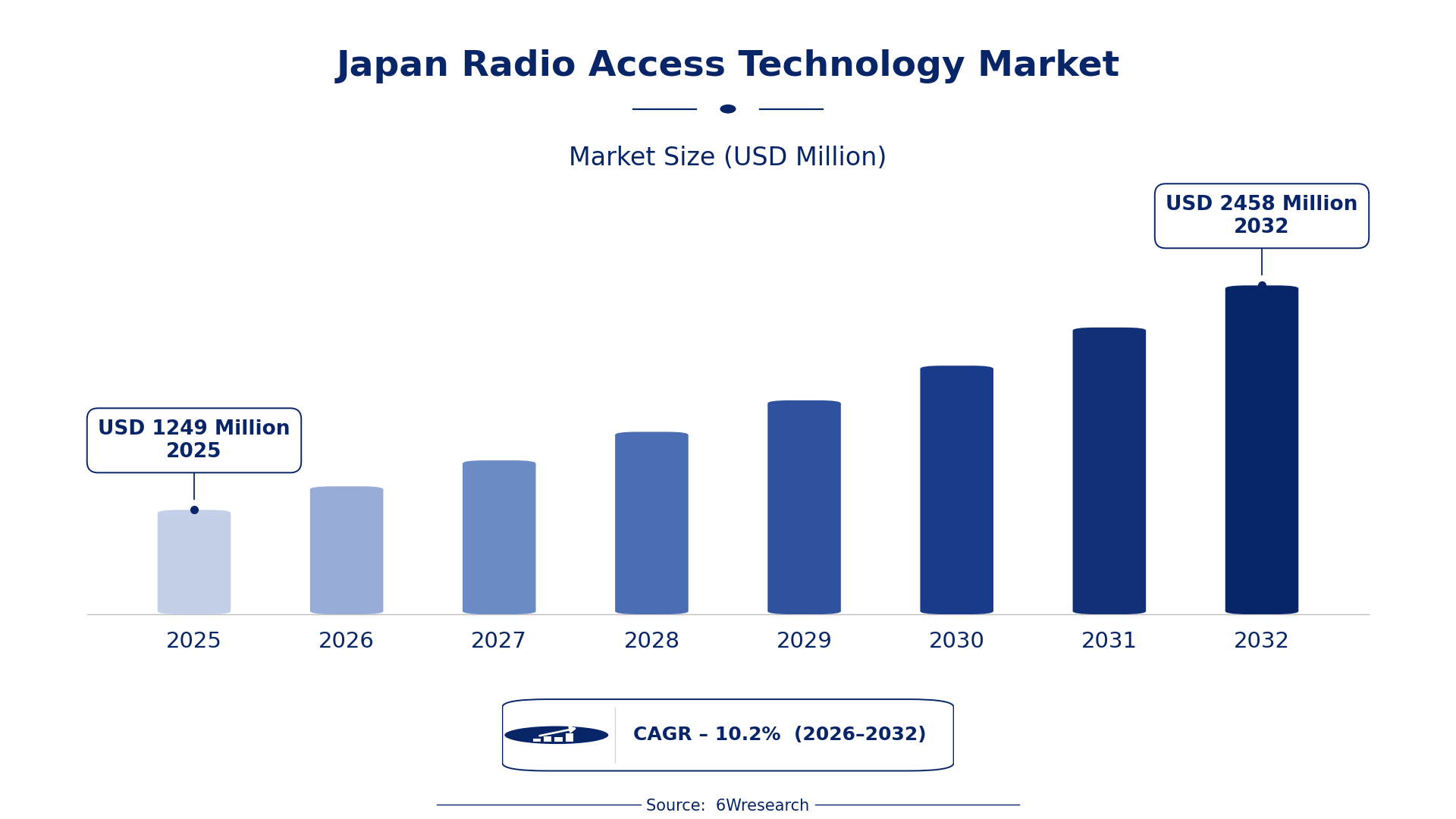
According to 6Wresearch internal database and industry insights, the Japan Radio Access Technology Market was valued at USD 1,249 Million in 2025 and is projected to reach USD 2,458 Million by 2032, growing at a CAGR of approximately 10.2% during 2026–2032.
Japan Radio Access Technology Market Highlights
| Report Metric | Details |
| Report Name | Japan Radio Access Technology Market (2026-2032) |
| Market Size 2025 | USD 1,249 Million |
| Market Size 2032 | USD 2,458 Million |
| Absolute Growth 2025–2032 | USD 1,209 Million |
| CAGR 2026–2032 | 10.2% |
| Peak Annual Growth | 11.0% in 2028 |
| Forecast Period | 2026–2032 |
| Historical Data | 2022–2025 |
| Base Year | 2025 |
| Leading Technology Type, 2025 | LTE (43% share) |
| Leading Network Generation, 2025 | 4G (43% share) |
| Leading Architecture Type, 2025 | FDD/TDD (47% share) |
| Leading End User, 2025 | Telecom Operators (43% share) |
| Fastest-Growing Technology Type | 5G NR (14.3% CAGR) |
| Fastest-Growing Network Generation | 5G (14.4% CAGR) |
| Fastest-Growing Architecture Type | SA/NSA (14.2% CAGR) |
| Fastest-Growing End User | Smart City Developers (13.0% CAGR) |
| Growing Sector | Smart City Developers |
| Key End Users | Telecom Operators, Smart City Developers, Rural Connectivity Providers, Telecom Service Providers |
Japan Radio Access Technology Market Year-wise Growth Rate and Key Drivers (2022–2032)
This graph illustrates the annual growth rates of the market from 2022 to 2032, highlighting a steady upward trajectory and projected market expansion over the forecast period.
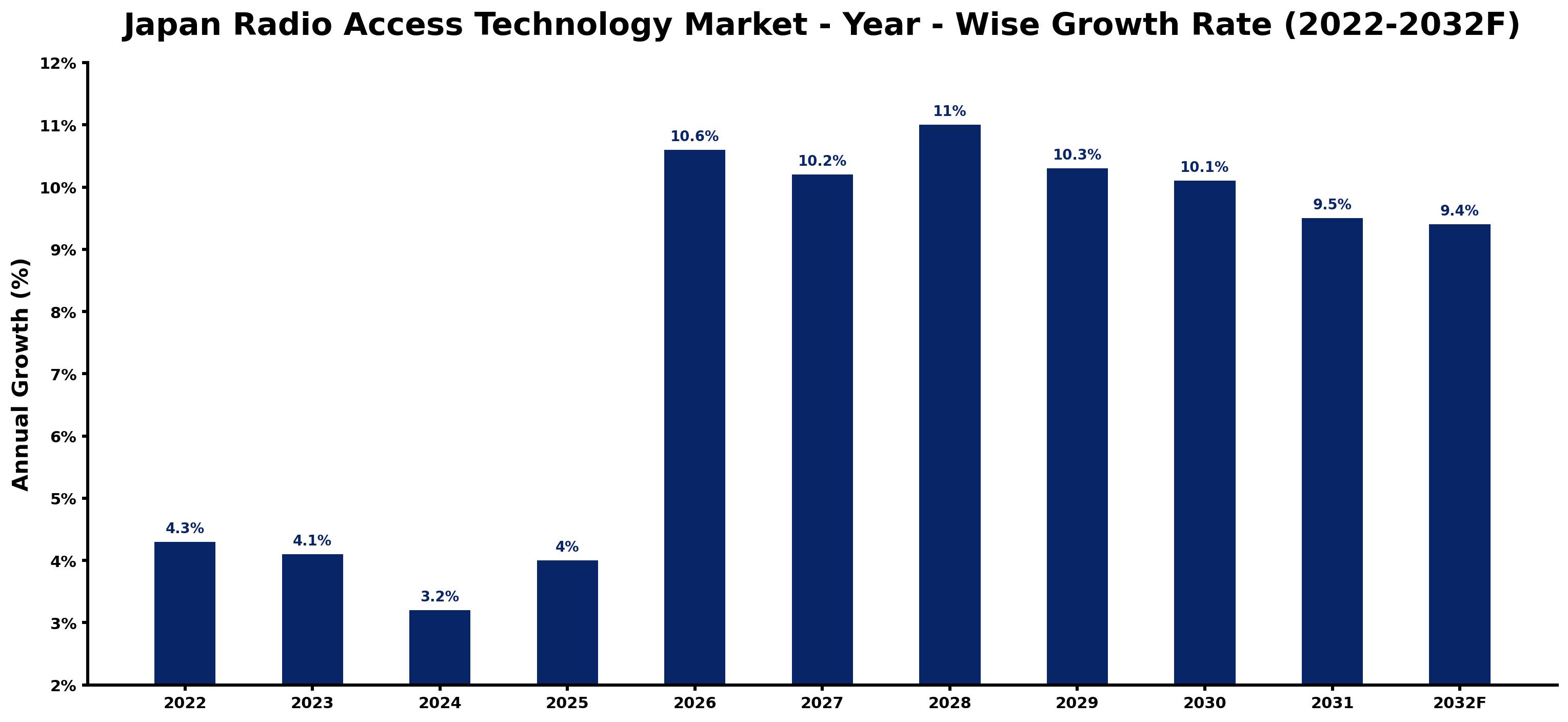
The following figures match every annual growth estimate with the main market development of that year, giving the reasoning behind each rise or slowdown.
| Year | Estimated Annual Growth (%) | Market Rationale |
| 2022 | 4.3 | Demand for mobile services remained strong, driven by a large population. |
| 2023 | 4.1 | Growth slowed slightly as the market adjusted to saturation in mobile subscriptions. |
| 2024 | 3.2 | The market continued to grow but at a slower pace due to increased competition. |
| 2025 | 4.0 | Demand picked up as telecom operators expanded their 5G offerings and infrastructure. |
| 2026 | 10.6 | Growth is expected to accelerate with investments in 5G technology and smart city projects. |
| 2027 | 10.2 | The growth rate is projected to slow as the market begins to stabilise after rapid expansion. |
| 2028 | 11.0 | A peak in growth is expected due to heightened investments in 5G infrastructure. |
| 2029 | 10.3 | Growth is projected to slow slightly as market saturation begins to impact new subscriptions. |
| 2030 | 10.1 | The market will continue to grow but at a moderated pace as 5G adoption stabilises. |
| 2031 | 9.5 | Growth is expected to slow further as the market matures and competition intensifies. |
| 2032 | 9.4 | The market will remain strong, driven by ongoing investments in advanced technologies. |
Note: Market size estimations and growth projections presented in this report are based on 6Wresearch's proprietary forecasting methodology, utilizing the latest available industry data, government publications, and primary research inputs.
Japan Radio Access Technology Market Synopsis
Radio Access Technology enables wireless communication between devices and networks, primarily through protocols and hardware. The Japan Radio Access Technology Market is growing, with over 90% of mobile subscriptions on 4G or higher networks. This expansion is propelled by investments in 5G infrastructure and a commitment to achieving 100% 5G coverage by 2030, supported by the '5G Promotion Strategy' and the 'National Strategy on Telecommunications.'
Market Dynamics Impact Analysis (2026–2032)
| Factor | Type | Impact | Primary Segment Affected |
| Increasing investments in 5G infrastructure drive demand for advanced Radio Access Technology solutions. | Driver | High | 5G NR |
| Growing smart city projects necessitate robust Radio Access Technology for urban connectivity. | Driver | High | Smart City Developers |
| The need for enhanced mobile services in rural areas presents opportunities for expansion. | Opportunity | High | Rural Connectivity Providers |
| Investment in IoT applications is rising, creating demand for specialized Radio Access Technology. | Opportunity | Medium | Telecom Operators |
| Legacy systems may hinder the transition to newer technologies, slowing market growth. | Restraint | Medium | CDMA/GSM |
| High competition among telecom operators can limit pricing power and profitability. | Restraint | High | Telecom Operators |
| Supply chain disruptions can impact the availability of essential components for RAT deployment. | Challenge | High | 5G NR |
| Rapid technological advancements require continuous investment, straining smaller operators. | Challenge | Medium | Telecom Service Providers |
Evaluation of Drivers in Japan Radio Access Technology Market (2026–2032)
Demand rests on the following drivers, each shown with the segment it touches most.
| Drivers | Primary Segment Affected | Why It Matters (Evidence) |
| Strong demand for mobile broadband services boosts the adoption of 5G NR technology. | 5G NR | Over 90% of mobile subscriptions are on 4G or higher networks, pushing operators to upgrade. |
| Smart city projects are increasing the need for advanced Radio Access Technology. | Smart City Developers | Japan aims for 100% 5G coverage by 2030, necessitating improved connectivity. |
| The expansion of rural connectivity initiatives drives demand for Radio Access Technology solutions. | Rural Connectivity Providers | Government support aims to improve services in underserved areas, increasing investment. |
| The growing number of IoT applications necessitates advanced Radio Access Technology. | Telecom Operators | Japan's telecom sector invested over 3 trillion yen in infrastructure in 2022 to support IoT. |
| FDD and TDD technologies are essential for optimizing spectrum use in urban areas. | 5G | The deployment of numerous 5G base stations highlights the need for efficient spectrum management. |
What keeps demand rising is the strong push for mobile broadband services, with a significant majority of mobile subscriptions on 4G or higher networks. The expansion of smart city projects increases the need for advanced Radio Access Technology, as Japan aims for 100% 5G coverage by 2030. Investment in IoT applications is rising, creating demand for specialized Radio Access Technology, with substantial investments in infrastructure supporting this growth. FDD and TDD technologies are critical for optimizing spectrum use, ensuring efficient urban communication as evidenced by the installation of numerous 5G base stations.
Evaluation of Restraints in Japan Radio Access Technology Market
The following restraints limit how fast demand can grow.
| Market Restraint | Primary Segment Affected | Why It Matters (Evidence) |
| Legacy systems may hinder the transition to newer technologies, slowing market growth. | CDMA/GSM | Many operators still rely on outdated systems, limiting their ability to upgrade. |
| High competition among telecom operators can limit pricing power and profitability. | Telecom Operators | Intense rivalry leads to price wars, reducing margins for service providers. |
| Supply chain disruptions can impact the availability of essential components for RAT deployment. | 5G NR | Global shortages in semiconductors have delayed equipment deliveries for operators. |
| Regulatory compliance costs can burden smaller operators, affecting their growth potential. | Telecom Service Providers | Adhering to regulations requires significant investment in infrastructure. |
| Market saturation in urban areas limits new subscription growth opportunities. | Telecom Operators | With high penetration rates, attracting new users becomes increasingly challenging. |
Japan Radio Access Technology Market Challenges
High infrastructure costs burden producers, with over 3 trillion yen spent in 2022, which reduces their profit margins. Buyers face increased monthly expenses as these costs are passed on to them, resulting in higher service fees. Regulatory complexities arise from compliance requirements, delaying service rollouts for producers and affecting their market responsiveness. A lack of skilled professionals in advanced technologies limits project execution, causing service availability delays that particularly impact buyers in urban areas, where demand is highest.
Trends in the Japan Radio Access Technology Market
The shifts below are changing how Japan Radio Access Technology Market products are bought and supplied.
- Shift Towards 5G Adoption: Telecom Operators are rapidly transitioning to 5G networks, driven by the need for faster mobile services. As of 2023, over 40,000 5G base stations have been installed, enhancing connectivity across urban areas.
- Integration of IoT in Smart Cities: Smart City Developers are increasingly incorporating IoT solutions into urban planning. The 'IoT Acceleration Consortium' promotes collaboration, creating applications that improve city management.
- Expansion of Rural Connectivity Initiatives: Rural Connectivity Providers are focusing on extending mobile services to underserved areas. Government support aims to improve access, with significant investments planned to enhance service availability.
- Advancements in Spectrum Management: Telecom Operators are prioritising efficient spectrum use through FDD and TDD technologies. The deployment of these technologies is crucial for meeting the growing demand for mobile data.
Investment Opportunities in the Japan Radio Access Technology Market
Where to invest in the Japan Radio Access Technology Market: the main openings are set out below.
- Telecom Operators Seeking 5G Solutions: Telecom Operators are investing heavily in 5G solutions, with Japan aiming for 100% coverage by 2030. This presents opportunities for suppliers of advanced RAT technologies.
- Investment in Smart City Projects: Smart City Developers are looking for advanced RAT solutions to enhance urban connectivity. With over 3 trillion yen invested in infrastructure, suppliers can engage in partnerships to meet these needs.
- Rural Connectivity Expansion: Rural Connectivity Providers require advanced technologies to improve services in underserved areas. With government support for infrastructure initiatives, suppliers can enter this market effectively.
- Growing Demand for IoT Applications: Telecom Operators are increasingly adopting IoT solutions, creating a demand for advanced RAT technologies. Suppliers can benefit from collaborations with operators to provide tailored solutions.
Government Initiatives in the Japan Radio Access Technology Market
The Telecommunications Business Law regulates the industry, ensuring fair competition among providers. This law mandates compliance with JIS standards for network quality, impacting how operators manage their services. The Industrial Standardization Act governs product and test standards, ensuring that all equipment meets necessary requirements for safety and performance. These regulations support the growth of the Radio Access Technology market by promoting a competitive environment.
The Digital Agency oversees initiatives that promote digital transformation in Japan. By funding projects aimed at enhancing connectivity, this agency supports telecom operators as they expand their networks. The '5G Promotion Strategy' initiated in 2020 encourages investment in 5G infrastructure, facilitating the rollout of advanced technologies across the country. This support is crucial for buyers seeking to implement cutting-edge solutions in their operations.
Future Insight of the Japan Radio Access Technology Market
By 2032, Japan will achieve full 5G coverage, prompting suppliers to upgrade technology and infrastructure to meet consumer demands. The integration of the ISO/IEC 30141 standard will facilitate IoT applications, benefiting over 150 million mobile devices. The establishment of the Digital Agency will streamline digital initiatives, while the Smart Mobility Challenge will encourage advancements in transportation technologies. Collaboration through the IoT Acceleration Consortium will further integrate RAT into urban planning, creating opportunities for both buyers and suppliers.
Market Segmentation Analysis
Japan Radio Access Technology Market report covers a detailed analysis of the following market segments:
By Technology Type – LTE Leads, 5G NR Expected to Grow Fastest
According to Saurav Kr Singh, Senior Research Analyst at 6Wresearch, with 43% of technology type revenue in 2025, LTE was the largest category. LTE holds the largest share in Japan's radio access technology market due to its extensive use for mobile broadband services, supported by a substantial installed base of over 150 million mobile devices. This widespread adoption is evident as more than 90% of mobile subscriptions are on 4G or higher networks. 5G NR is projected to grow fastest, at a CAGR of 14.3% during 2026–2032. 5G NR is experiencing rapid growth as it is essential for next-generation mobile communication, particularly for applications like autonomous vehicles. The national push for 100% 5G coverage by 2030 will likely allow LTE's lead to widen as users transition to 5G services. Suppliers must focus on advancing 5G solutions to meet the increasing demand from consumers.
By Network Generation – 4G Leads, 5G Expected to Grow Fastest
4G took 43% of network generation revenue in 2025, more than any other category. 4G leads the market as the primary technology for mobile networks, forming the backbone for most mobile services in Japan. The large installed base of mobile devices, surpassing 150 million, heavily relies on 4G connectivity for daily operations. Over 2026–2032, 5G is expected to post the fastest growth, at a CAGR of 14.4%. 5G is rapidly advancing as it represents the focal point for future network development, with Japan targeting 100% 5G coverage by 2030. The substantial investments in 5G infrastructure will further expedite its adoption across the country. Buyers should prepare for a transition to 5G to fully utilise advanced mobile services.
By Architecture Type – FDD/TDD Leads, SA/NSA Expected to Grow Fastest
The largest architecture type category in 2025 was FDD/TDD, at 47% of revenue. FDD/TDD architecture leads the market as it is crucial for optimising spectrum efficiency, particularly in urban settings where high connectivity demand exists. This architecture is particularly effective in major regions like Tokyo and Osaka, where telecom infrastructure is heavily developed. The quickest growth will come from SA/NSA, forecast to expand at a CAGR of 14.2% between 2026 and 2032. SA/NSA is the fastest-growing segment as it is vital for the deployment of 5G networks, offering enhanced capabilities for users. The ongoing emphasis on smart city initiatives will further drive the need for this architecture. Suppliers should invest in SA/NSA technologies to stay aligned with evolving market requirements.
By End User – Telecom Operators Lead, Smart City Developers Expected to Grow Fastest
In 2025, Telecom Operators led the end user split with a 43% share. Telecom operators are the primary users of radio access technology, accounting for the largest share due to their role in providing mobile services to the population. Their substantial investments in infrastructure, exceeding 3 trillion yen in 2022, solidify their market position. Smart City Developers are set to record the highest CAGR in this split, 13.0% over 2026–2032. Smart city developers are the fastest-growing segment as they integrate radio access technology for urban solutions, driven by initiatives like the 'Smart City Initiative'. This trend reflects the increasing focus on urban connectivity and IoT applications. Suppliers should target smart city developers to capitalise on emerging opportunities in urban infrastructure.
Key Attractiveness of the Report
- 10 Years of Market Numbers
- Historical Data Starting from 2022 to 2025
- Base Year 2025
- Forecast Data until 2032
- Key Performance Indicators Impacting the Market
- Major Upcoming Developments and Projects
Key Highlights of the Report:
- Japan Radio Access Technology Market Outlook
- Market Size of Japan Radio Access Technology Market, 2025
- Forecast of Japan Radio Access Technology Market, 2032
- Historical Data and Forecast of Japan Radio Access Technology Revenues & Volume for the Period 2022-2032F
- Japan Radio Access Technology Market Trend Evolution
- Japan Radio Access Technology Market Drivers and Challenges
- Japan Radio Access Technology Price Trends
- Japan Radio Access Technology Porter's Five Forces
- Japan Radio Access Technology Industry Life Cycle
- Historical Data and Forecast of Japan Radio Access Technology Market Revenues & Volume By Technology Type for the Period 2022-2032F
- Historical Data and Forecast of Japan Radio Access Technology Market Revenues & Volume By LTE for the Period 2022-2032F
- Historical Data and Forecast of Japan Radio Access Technology Market Revenues & Volume By 5G NR for the Period 2022-2032F
- Historical Data and Forecast of Japan Radio Access Technology Market Revenues & Volume By WiMAX for the Period 2022-2032F
- Historical Data and Forecast of Japan Radio Access Technology Market Revenues & Volume By CDMA/GSM for the Period 2022-2032F
- Historical Data and Forecast of Japan Radio Access Technology Market Revenues & Volume By Network Generation for the Period 2022-2032F
- Historical Data and Forecast of Japan Radio Access Technology Market Revenues & Volume By 4G for the Period 2022-2032F
- Historical Data and Forecast of Japan Radio Access Technology Market Revenues & Volume By 5G for the Period 2022-2032F
- Historical Data and Forecast of Japan Radio Access Technology Market Revenues & Volume By 4G/Legacy for the Period 2022-2032F
- Historical Data and Forecast of Japan Radio Access Technology Market Revenues & Volume By 2G/3G for the Period 2022-2032F
- Historical Data and Forecast of Japan Radio Access Technology Market Revenues & Volume By Architecture Type for the Period 2022-2032F
- Historical Data and Forecast of Japan Radio Access Technology Market Revenues & Volume By FDD/TDD for the Period 2022-2032F
- Historical Data and Forecast of Japan Radio Access Technology Market Revenues & Volume By SA/NSA for the Period 2022-2032F
- Historical Data and Forecast of Japan Radio Access Technology Market Revenues & Volume By OFDMA-Based for the Period 2022-2032F
- Historical Data and Forecast of Japan Radio Access Technology Market Revenues & Volume By Narrowband for the Period 2022-2032F
- Historical Data and Forecast of Japan Radio Access Technology Market Revenues & Volume By End User for the Period 2022-2032F
- Historical Data and Forecast of Japan Radio Access Technology Market Revenues & Volume By Telecom Operators for the Period 2022-2032F
- Historical Data and Forecast of Japan Radio Access Technology Market Revenues & Volume By Smart City Developers for the Period 2022-2032F
- Historical Data and Forecast of Japan Radio Access Technology Market Revenues & Volume By Rural Connectivity Providers for the Period 2022-2032F
- Historical Data and Forecast of Japan Radio Access Technology Market Revenues & Volume By Telecom Service Providers for the Period 2022-2032F
- Japan Radio Access Technology Import Export Trade Statistics
- Market Opportunity Assessment By Technology Type
- Market Opportunity Assessment By Network Generation
- Market Opportunity Assessment By Architecture Type
- Market Opportunity Assessment By End User
- Japan Radio Access Technology Top Companies Market Share
- Japan Radio Access Technology Competitive Benchmarking By Technical and Operational Parameters
- Japan Radio Access Technology Company Profiles
- Japan Radio Access Technology Key Strategic Recommendations
Market Covered
This report examines the market across the segments below.
By Technology Type
- LTE
- 5G NR
- WiMAX
- CDMA/GSM
By Network Generation
- 4G
- 5G
- 4G/Legacy
- 2G/3G
By Architecture Type
- FDD/TDD
- SA/NSA
- OFDMA-Based
- Narrowband
By End User
- Telecom Operators
- Smart City Developers
- Rural Connectivity Providers
- Telecom Service Providers































