Japan Rail Automation Components Market Size & Growth Rate
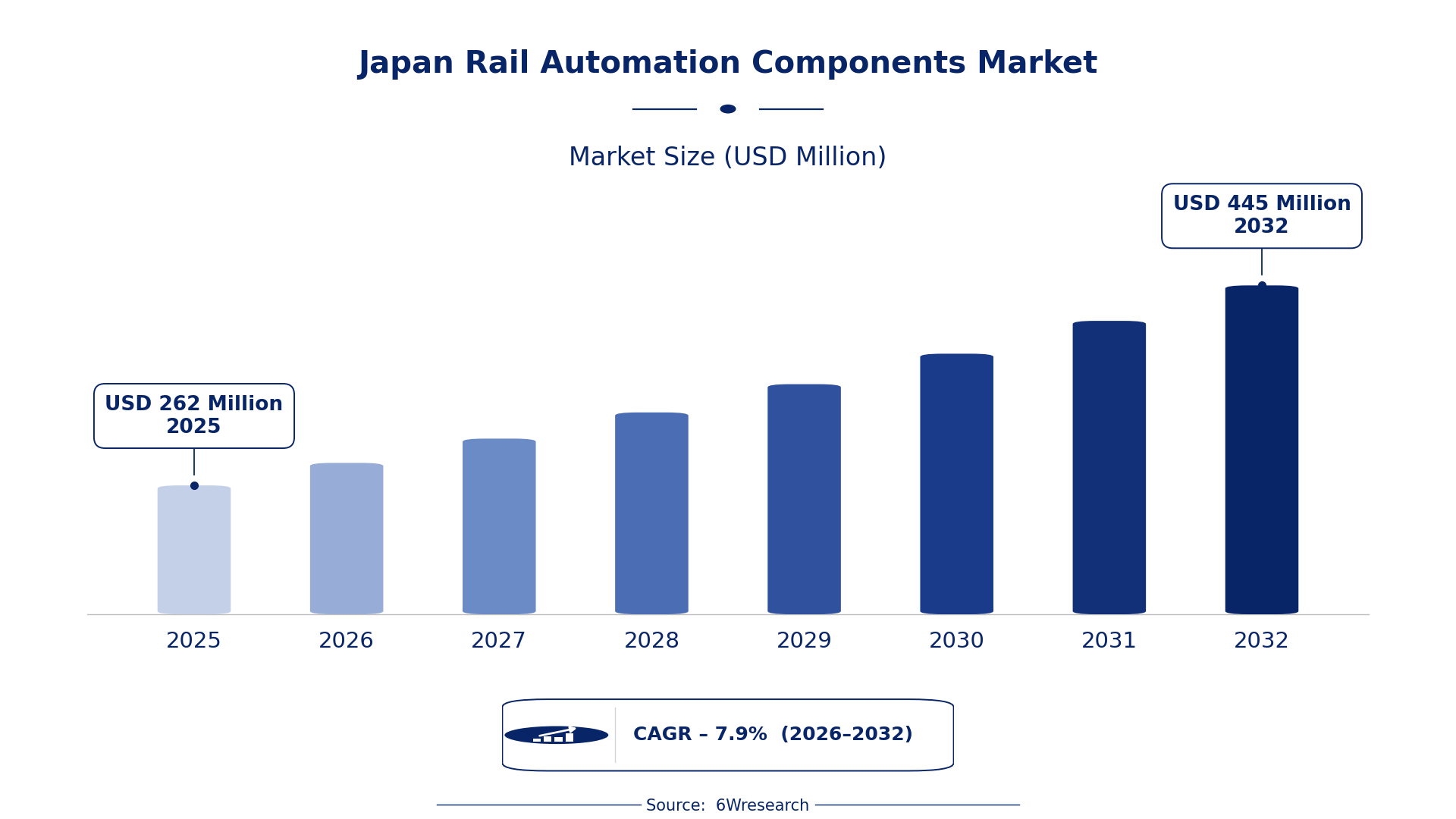
According to 6Wresearch internal database and industry insights, the Japan Rail Automation Components Market was valued at USD 262 Million in 2025 and is projected to reach USD 445 Million by 2032, growing at a CAGR of approximately 7.9% during 2026–2032.
Japan Rail Automation Components Market Highlights
| Report Metric | Details |
| Report Name | Japan Rail Automation Components Market (2026-2032) |
| Market Size 2025 | USD 262 Million |
| Market Size 2032 | USD 445 Million |
| Absolute Growth 2025–2032 | USD 183 Million |
| CAGR 2026–2032 | 7.9% |
| Peak Annual Growth | 9.2% in 2026 |
| Forecast Period | 2026–2032 |
| Historical Data | 2022–2025 |
| Base Year | 2025 |
| Leading Component Type, 2025 | Signal Controllers (37% share) |
| Leading Functionality, 2025 | Traffic Management (52% share) |
| Leading Integration Scope, 2025 | Network Control (39% share) |
| Leading End User, 2025 | Rail Network Operators (48% share) |
| Fastest-Growing Component Type | Onboard Sensors (11.0% CAGR) |
| Fastest-Growing Functionality | Monitoring Systems (10.1% CAGR) |
| Fastest-Growing Integration Scope | Locomotive Integration (9.9% CAGR) |
| Fastest-Growing End User | OEM Train Manufacturers (10.0% CAGR) |
| Growing Sector | OEM Train Manufacturers |
| Key End Users | Rail Network Operators, OEM Train Manufacturers, Transit Agencies, Rail Infrastructure Firms |
Japan Rail Automation Components Market Year-wise Growth Rate and Key Drivers (2022–2032)
This graph illustrates the annual growth rates of the market from 2022 to 2032, highlighting a steady upward trajectory and projected market expansion over the forecast period.
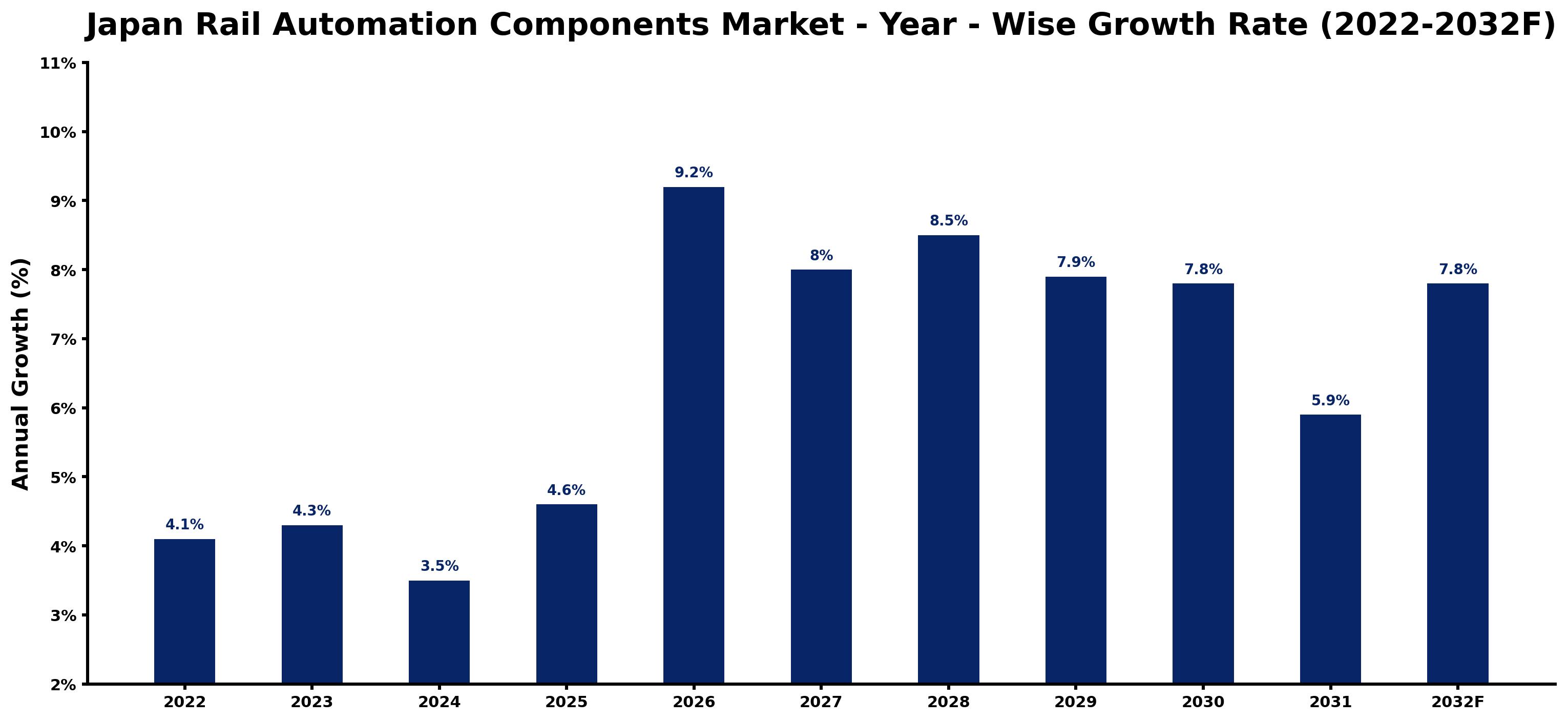
Each row of the following table gives one year's estimated growth and the event or demand shift that explains it.
| Year | Estimated Annual Growth (%) | Market Rationale |
| 2022 | 4.1 | The market showed steady growth, reflecting ongoing infrastructure projects and investments. |
| 2023 | 4.3 | Demand increased as rail network operators expanded automation systems for efficiency. |
| 2024 | 3.5 | Growth slowed slightly due to market saturation in certain automation technologies. |
| 2025 | 4.6 | Investment in traffic management systems surged, boosting market performance. |
| 2026 | 9.2 | The peak growth year saw advancements in monitoring systems and technology adoption. |
| 2027 | 8.0 | Growth decelerated as the market adjusted to previous high demand levels. |
| 2028 | 8.5 | A renewed focus on onboard sensors will lead to increased purchases and market expansion. |
| 2029 | 7.9 | Demand stabilises as rail operators optimise existing automation systems. |
| 2030 | 7.8 | Market growth slows again as operators reassess technology investments. |
| 2031 | 5.9 | A further slowdown occurs as competition intensifies among automation providers. |
| 2032 | 7.8 | Increased investment in rail infrastructure upgrades will revitalise market growth. |
Note: Market size estimations and growth projections presented in this report are based on 6Wresearch's proprietary forecasting methodology, utilizing the latest available industry data, government publications, and primary research inputs.
Japan Rail Automation Components Market Synopsis
Rail automation components are essential technologies in the railway industry, improving safety and efficiency through advanced electronics and software integration. The Japan Rail Automation Components Market is growing due to ongoing infrastructure projects and substantial investments in traffic management and monitoring systems. With over 27,000 kilometers of operational rail network, the demand for these components is driven by the need for improved operational efficiency and safety standards, particularly in the Tokyo metropolitan area.
Market Dynamics Impact Analysis (2026–2032)
| Factor | Type | Impact | Primary Segment Affected |
| Growing investment in traffic management systems | Driver | High | Traffic Management |
| Increased focus on safety and efficiency in rail operations | Driver | High | Monitoring Systems |
| Expansion of rail infrastructure projects | Opportunity | High | Rail Network Operators |
| Emerging demand for onboard sensors and monitoring technologies | Opportunity | Medium | Onboard Sensors |
| Market saturation in certain automation technologies | Restraint | High | Traffic Management |
| High initial costs for advanced automation systems | Restraint | Medium | Monitoring Systems |
| Rising costs of compliance with safety regulations | Challenge | High | Signaling Systems |
| Capacity constraints in manufacturing automation components | Challenge | Medium | Track Circuits |
Evaluation of Drivers in Japan Rail Automation Components Market (2026–2032)
Below are the drivers that matter most for revenue growth, with supporting evidence.
| Drivers | Primary Segment Affected | Why It Matters (Evidence) |
| Increased investment in traffic management systems | Traffic Management | Japan's rail network operators are investing heavily in traffic management systems, with over ¥50 billion allocated for upgrades in 2023. |
| Growing demand for monitoring systems | Monitoring Systems | Approximately 1,200 rail stations have modern monitoring systems, driving demand for advanced technologies. |
| Focus on safety improvements in rail operations | Signaling Systems | The advanced signaling systems in the Shinkansen ensure safety, leading to increased purchases. |
| Expansion of V2I communication technologies | V2I & LTE | Government promotion of V2I technologies supports communication between trains and infrastructure. |
| Rising passenger numbers on railways | Rail Network Operators | With over 20 million daily passengers, rail operators are investing in automation to improve service delivery. |
Volumes grow on the back of increased investment in traffic management systems, with rail network operators allocating over ¥50 billion for upgrades in 2023. The demand for monitoring systems rises as rail stations utilise advanced technologies, improving operational efficiency. Safety improvements drive purchases of signaling systems, particularly for the Shinkansen, which relies on advanced technology. The push for V2I communication technologies supports the integration of automation components, while the average daily ridership exceeding 20 million passengers motivates rail operators to invest in automation for better service delivery.
Evaluation of Restraints in Japan Rail Automation Components Market
The following restraints limit how fast demand can grow.
| Market Restraint | Primary Segment Affected | Why It Matters (Evidence) |
| Market saturation in traffic management technologies | Traffic Management | As many rail operators have implemented existing technologies, new investments are limited, affecting growth. |
| High initial costs for advanced automation systems | Monitoring Systems | The upfront investment required for advanced systems deters some operators from upgrading. |
| Compliance costs with safety regulations | Signaling Systems | Meeting stringent safety regulations increases operational costs for rail operators. |
| Limited manufacturing capacity for components | Track Circuits | Manufacturers face challenges in scaling production to meet rising demand, impacting supply. |
| Slow adoption of V2I technologies | V2I & LTE | Despite government promotion, the slow uptake of V2I technologies restricts market growth. |
Japan Rail Automation Components Market Challenges
Japan's regulatory environment enforces strict safety standards for rail automation components, extending certification timelines and delaying product availability for manufacturers. Buyers encounter rising project costs due to these delays, with budgets potentially increasing by 15%. Ongoing technological advancements compel manufacturers to upgrade their products, which can render existing offerings obsolete. This scenario creates procurement challenges for buyers, who must adjust their budgets to accommodate rapidly evolving technology, jeopardising project timelines and operational efficiency.
Trends in the Japan Rail Automation Components Market
The trends below show where the Japan Rail Automation Components Market is heading.
- Shift Towards Advanced Traffic Management Systems: In 2023, rail operators increasingly adopted advanced traffic management systems, with a rise in investments. This shift, backed by over ¥50 billion allocated for upgrades, improves operational efficiency and safety.
- Emergence of Onboard Sensors: Starting in 2026, onboard sensors became vital for real-time data collection in trains. Rail network operators are investing heavily, with a projected CAGR of 11.0% for this segment, ensuring improved monitoring.
- Adoption of V2I Communication Technologies: The Japanese government has promoted V2I technologies since 2021, leading to increased integration in rail systems. This trend is expected to improve communication and safety, with a growing number of installations.
- Focus on Safety and Compliance: With the implementation of the AI Promotion Act in 2025, rail operators are prioritising safety and compliance technologies. This focus is projected to drive demand for advanced signaling systems and monitoring solutions.
Investment Opportunities in the Japan Rail Automation Components Market
Where to invest in the Japan Rail Automation Components Market: the main openings are set out below.
- Supply Advanced Monitoring Systems: With a projected market gap for advanced monitoring systems, rail network operators are seeking suppliers to improve safety and efficiency, particularly in urban areas.
- Invest in Traffic Management Solutions: The market gap for traffic management solutions is substantial, with over ¥50 billion allocated for upgrades. Partnering with local firms can facilitate entry into this growing segment.
- Expand V2I Technology Offerings: The promotion of V2I technologies creates opportunities for suppliers. Rail infrastructure firms are looking for partners to improve communication systems, with government backing.
- Develop Cost-Effective Automation Components: As high initial costs deter some operators, there is a demand for cost-effective automation components. Collaborating with rail operators can open new market avenues.
Government Initiatives in the Japan Rail Automation Components Market
Japan's policy framework includes the New Robot Strategy (2015) and the AI Promotion Act (2025), which aim to advance automation across various sectors. These initiatives encourage the development and integration of rail automation components, ensuring safety and efficiency in operations.
The Ministry of Land, Infrastructure, Transport and Tourism oversees the enforcement of safety regulations and standards for rail automation components. It funds projects aimed at upgrading infrastructure, with allocations reaching ¥50 billion in 2023, benefiting rail operators and manufacturers alike.
Future Insight of the Japan Rail Automation Components Market
The upcoming decade will see a surge in investment for rail automation components, as Japan allocates ¥150 trillion for decarbonisation initiatives. This funding will stimulate demand for advanced technologies, particularly in the Tokyo metropolitan area. The adoption of V2I communication technologies will improve connectivity and safety across the rail network. As the rail network expands beyond 27,000 kilometers, the focus on ISO 9001 certification will raise quality standards, benefiting both buyers and suppliers.
Market Segmentation Analysis
Japan Rail Automation Components Market report covers a detailed analysis of the following market segments:
By Component Type – Signal Controllers Lead, Onboard Sensors Expected to Grow Fastest
According to Saurav Kr Singh, Senior Research Analyst at 6Wresearch, in 2025, Signal Controllers led the component type split with a 37% share. Signal controllers hold the largest share in Japan as they are essential for managing train signals and ensuring safety across the country's extensive rail network. With over 27,000 kilometers of operational railways, the reliability of signal management is paramount to maintain safety standards. Onboard Sensors are set to record the highest CAGR in this split, 11.0% over 2026–2032. Onboard sensors are experiencing rapid growth because they are crucial for real-time data collection and monitoring, particularly as Japan invests in rail infrastructure upgrades. This focus on safety and efficiency will further escalate the demand for these advanced monitoring technologies. Suppliers should prioritise the development of onboard sensors to meet the rising demand for enhanced monitoring capabilities in rail systems.
By Functionality – Traffic Management Leads, Monitoring Systems Expected to Grow Fastest
The largest functionality category in 2025 was Traffic Management, at 52% of revenue. Traffic management leads this segment as it is integral for optimising train schedules and flow, ensuring the smooth operation of Japan's busy railways. The average daily ridership exceeding 20 million passengers highlights the critical need for effective traffic control solutions to manage this volume. Monitoring Systems are projected to grow fastest, at a CAGR of 10.1% during 2026–2032. Monitoring systems are witnessing rapid growth due to their importance in overseeing system performance, especially as rail operators invest in automation to enhance safety and efficiency. This trend reflects a broader shift towards data-driven management within the rail industry. Buyers must invest in advanced monitoring systems to improve operational efficiency and safety in their rail networks.
By Integration Scope – Network Control Leads, Locomotive Integration Expected to Grow Fastest
With 39% of integration scope revenue in 2025, Network Control was the largest category. Network control dominates this category as it is vital for centralised management of rail networks, allowing for streamlined operations across Japan's extensive rail infrastructure. The integration of various automation components under a unified control system is essential for achieving operational success. Over 2026–2032, Locomotive Integration is expected to post the fastest growth, at a CAGR of 9.9%. Locomotive integration is the fastest growing area, as it is important for incorporating automation into trains, aligning with the industry's push for modernisation and efficiency. As rail operators seek to upgrade their fleets, the demand for integrated solutions will continue to rise. Suppliers should focus on developing integrated solutions that facilitate seamless automation within locomotives to capture emerging opportunities.
By End User – Rail Network Operators Lead, OEM Train Manufacturers Expected to Grow Fastest
Rail Network Operators held 48% of the Japan Rail Automation Components Market by end user in 2025. Rail network operators are the primary users of automation components, driving the largest share in this segment as they seek to enhance safety and efficiency in their operations. Their ongoing investments in technology underscore their critical role in advancing rail automation. The quickest growth will come from OEM Train Manufacturers, forecast to expand at a CAGR of 10.0% between 2026 and 2032. OEM train manufacturers are the fastest growing segment, as they are integral for producing advanced train systems that incorporate the latest automation technologies. The increasing focus on high-performance trains fuels this growth and highlights the need for modern solutions. Suppliers should collaborate closely with OEMs to tailor automation components that meet the specific needs of advanced train manufacturing.
Key Attractiveness of the Report
- 10 Years of Market Numbers
- Historical Data Starting from 2022 to 2025
- Base Year 2025
- Forecast Data until 2032
- Key Performance Indicators Impacting the Market
- Major Upcoming Developments and Projects
Key Highlights of the Report:
- Japan Rail Automation Components Market Outlook
- Market Size of Japan Rail Automation Components Market, 2025
- Forecast of Japan Rail Automation Components Market, 2032
- Historical Data and Forecast of Japan Rail Automation Components Revenues & Volume for the Period 2022-2032F
- Japan Rail Automation Components Market Trend Evolution
- Japan Rail Automation Components Market Drivers and Challenges
- Japan Rail Automation Components Price Trends
- Japan Rail Automation Components Porter's Five Forces
- Japan Rail Automation Components Industry Life Cycle
- Historical Data and Forecast of Japan Rail Automation Components Market Revenues & Volume By Component Type for the Period 2022-2032F
- Historical Data and Forecast of Japan Rail Automation Components Market Revenues & Volume By Signal Controllers for the Period 2022-2032F
- Historical Data and Forecast of Japan Rail Automation Components Market Revenues & Volume By Onboard Sensors for the Period 2022-2032F
- Historical Data and Forecast of Japan Rail Automation Components Market Revenues & Volume By Communication Modules for the Period 2022-2032F
- Historical Data and Forecast of Japan Rail Automation Components Market Revenues & Volume By Track Circuits for the Period 2022-2032F
- Historical Data and Forecast of Japan Rail Automation Components Market Revenues & Volume By Functionality for the Period 2022-2032F
- Historical Data and Forecast of Japan Rail Automation Components Market Revenues & Volume By Traffic Management for the Period 2022-2032F
- Historical Data and Forecast of Japan Rail Automation Components Market Revenues & Volume By Monitoring Systems for the Period 2022-2032F
- Historical Data and Forecast of Japan Rail Automation Components Market Revenues & Volume By V2I & LTE for the Period 2022-2032F
- Historical Data and Forecast of Japan Rail Automation Components Market Revenues & Volume By Train Detection for the Period 2022-2032F
- Historical Data and Forecast of Japan Rail Automation Components Market Revenues & Volume By Integration Scope for the Period 2022-2032F
- Historical Data and Forecast of Japan Rail Automation Components Market Revenues & Volume By Network Control for the Period 2022-2032F
- Historical Data and Forecast of Japan Rail Automation Components Market Revenues & Volume By Locomotive Integration for the Period 2022-2032F
- Historical Data and Forecast of Japan Rail Automation Components Market Revenues & Volume By Signaling Systems for the Period 2022-2032F
- Historical Data and Forecast of Japan Rail Automation Components Market Revenues & Volume By Track-Side Installation for the Period 2022-2032F
- Historical Data and Forecast of Japan Rail Automation Components Market Revenues & Volume By End User for the Period 2022-2032F
- Historical Data and Forecast of Japan Rail Automation Components Market Revenues & Volume By Rail Network Operators for the Period 2022-2032F
- Historical Data and Forecast of Japan Rail Automation Components Market Revenues & Volume By OEM Train Manufacturers for the Period 2022-2032F
- Historical Data and Forecast of Japan Rail Automation Components Market Revenues & Volume By Transit Agencies for the Period 2022-2032F
- Historical Data and Forecast of Japan Rail Automation Components Market Revenues & Volume By Rail Infrastructure Firms for the Period 2022-2032F
- Japan Rail Automation Components Import Export Trade Statistics
- Market Opportunity Assessment By Component Type
- Market Opportunity Assessment By Functionality
- Market Opportunity Assessment By Integration Scope
- Market Opportunity Assessment By End User
- Japan Rail Automation Components Top Companies Market Share
- Japan Rail Automation Components Competitive Benchmarking By Technical and Operational Parameters
- Japan Rail Automation Components Company Profiles
- Japan Rail Automation Components Key Strategic Recommendations
Market Covered
Segments analysed in this report are listed below.
By Component Type
- Signal Controllers
- Onboard Sensors
- Communication Modules
- Track Circuits
By Functionality
- Traffic Management
- Monitoring Systems
- V2I & LTE
- Train Detection
By Integration Scope
- Network Control
- Locomotive Integration
- Signaling Systems
- Track-Side Installation
By End User
- Rail Network Operators
- OEM Train Manufacturers
- Transit Agencies
- Rail Infrastructure Firms































