Japan Rail Automation Market Size & Growth Rate
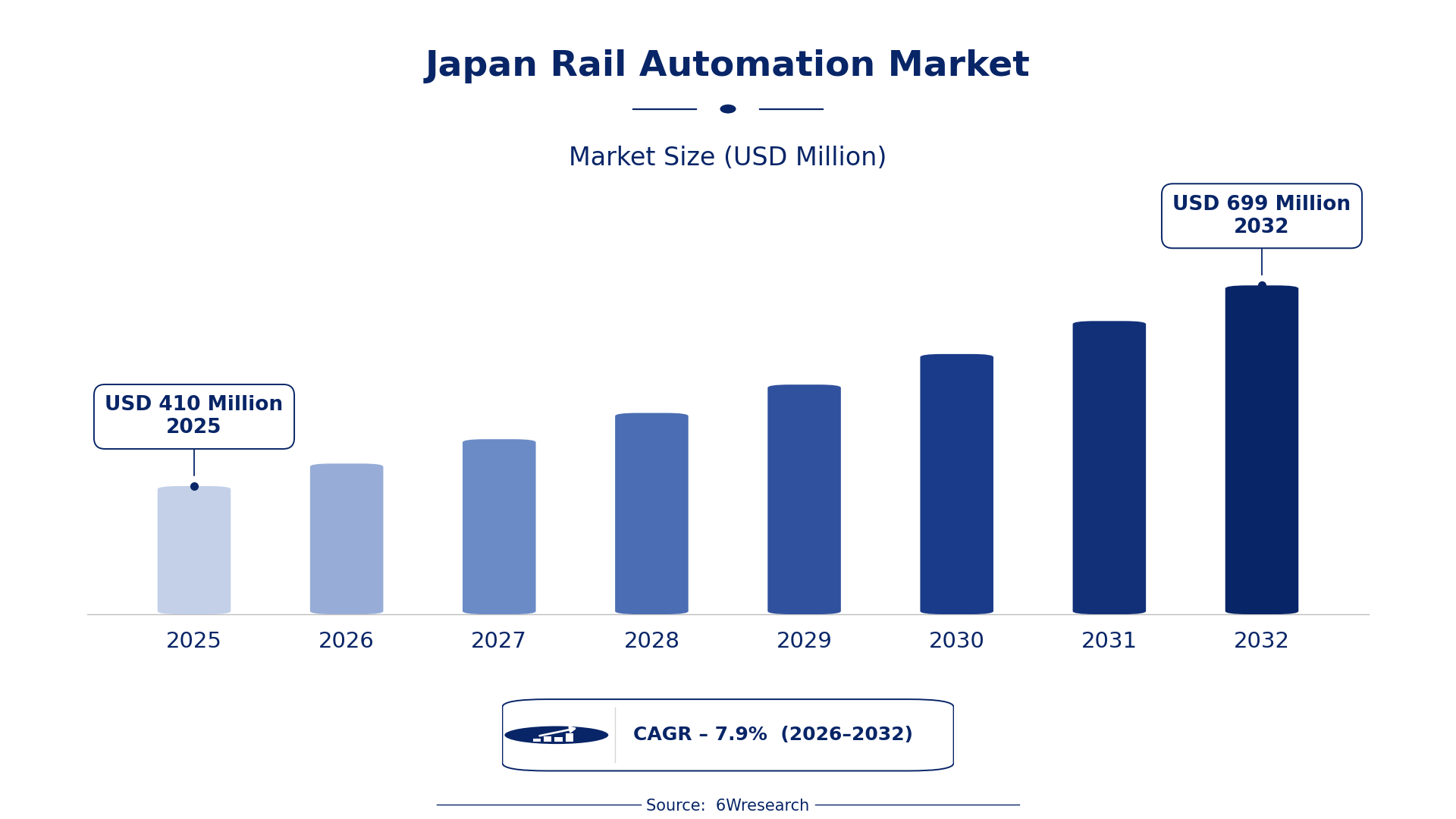
According to 6Wresearch internal database and industry insights, the Japan Rail Automation Market was valued at USD 410 Million in 2025 and is projected to reach USD 699 Million by 2032, growing at a CAGR of approximately 7.9% during 2026–2032.
Japan Rail Automation Market Highlights
| Report Metric | Details |
| Report Name | Japan Rail Automation Market (2026-2032) |
| Market Size 2025 | USD 410 Million |
| Market Size 2032 | USD 699 Million |
| Absolute Growth 2025–2032 | USD 289 Million |
| CAGR 2026–2032 | 7.9% |
| Peak Annual Growth | 8.7% in 2027 |
| Forecast Period | 2026–2032 |
| Historical Data | 2022–2025 |
| Base Year | 2025 |
| Leading Automation Type, 2025 | Train Control (40% share) |
| Leading System Component, 2025 | Centralized Traffic Control (39% share) |
| Leading Deployment Area, 2025 | Urban Transit Systems (37% share) |
| Leading End User, 2025 | National Rail Operators (40% share) |
| Fastest-Growing Automation Type | Station Automation (11.5% CAGR) |
| Fastest-Growing System Component | Predictive Maintenance (11.1% CAGR) |
| Fastest-Growing End User | Metro Authorities (10.1% CAGR) |
| Growing Sector | Urban Transit Systems |
| Key End Users | National Rail Operators, Metro Authorities, Infrastructure Managers |
Japan Rail Automation Market Year-wise Growth Rate and Key Drivers (2022–2032)
This graph illustrates the annual growth rates of the market from 2022 to 2032, highlighting a steady upward trajectory and projected market expansion over the forecast period.
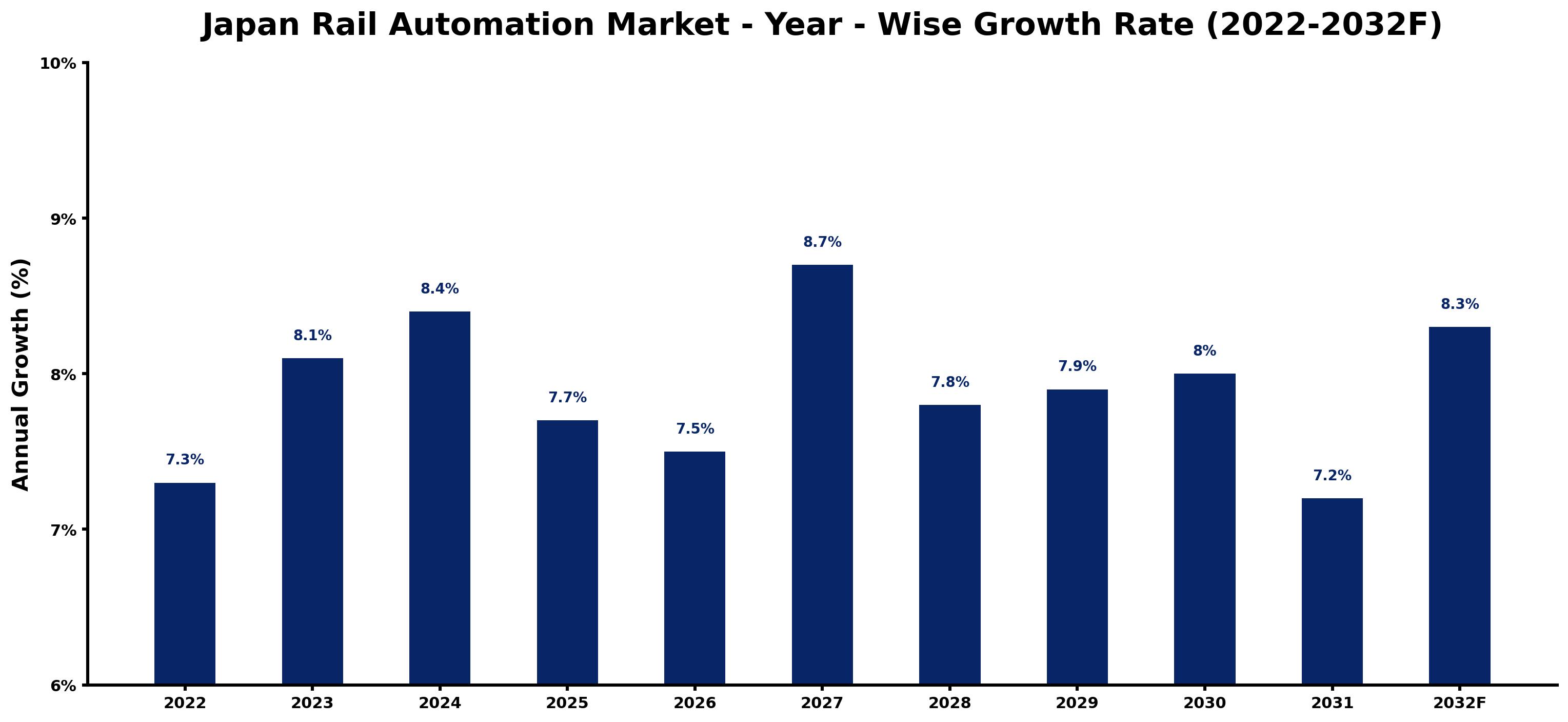
Below, each year's estimated growth is shown next to the factor that most influenced it.
| Year | Estimated Annual Growth (%) | Market Rationale |
| 2022 | 7.3 | The market showed steady growth, reflecting ongoing investments in rail automation technologies. |
| 2023 | 8.1 | Demand increased due to infrastructure projects and urban transit system upgrades. |
| 2024 | 8.4 | Growth accelerated as major rail operators adopted advanced automation solutions. |
| 2025 | 7.7 | A slight slowdown occurred as some projects reached completion, yet demand remained strong. |
| 2026 | 7.5 | Growth is expected to continue, albeit at a slower rate due to market saturation in some areas. |
| 2027 | 8.7 | A surge in demand is projected, driven by new infrastructure initiatives and technological advancements. |
| 2028 | 7.8 | Growth is anticipated to slow as the market stabilises following the peak demand of previous years. |
| 2029 | 7.9 | Demand is projected to rebound with increased investments in predictive maintenance technologies. |
| 2030 | 8.0 | The market is expected to maintain positive growth as urban transit systems expand automation efforts. |
| 2031 | 7.2 | Growth is projected to slow again as the market begins to mature, stabilising at a new level. |
| 2032 | 8.3 | An increase in demand is expected as new technologies are integrated into existing systems. |
Note: Market size estimations and growth projections presented in this report are based on 6Wresearch's proprietary forecasting methodology, utilizing the latest available industry data, government publications, and primary research inputs.
Japan Rail Automation Market Synopsis
Rail automation encompasses technologies that improve the efficiency and safety of transport systems, primarily through train control, station management, and predictive maintenance. The Japan Rail Automation Market is projected to grow, driven by Japan's commitment to decarbonisation, with an expected investment of JPY 150 trillion over the next decade. Upgrades to urban transit systems and the increasing adoption of predictive maintenance technologies are key factors fueling this growth.
Market Dynamics Impact Analysis (2026–2032)
| Factor | Type | Impact | Primary Segment Affected |
| Investment in urban transit systems | Driver | High | Urban Transit Systems |
| Adoption of predictive maintenance technologies | Driver | High | Predictive Maintenance |
| Growing demand for efficient rail transport | Opportunity | High | National Rail Operators |
| Need for advanced station automation | Opportunity | Medium | Station Automation |
| High initial investment costs | Restraint | High | Train Control |
| Limited skilled workforce in automation technologies | Restraint | Medium | Maintenance Automation |
| Compliance with stringent safety regulations | Challenge | High | Centralized Traffic Control |
| Capacity constraints in existing infrastructure | Challenge | Medium | Urban Transit Systems |
Evaluation of Drivers in Japan Rail Automation Market (2026–2032)
These are the developments adding the most demand over the forecast period.
| Drivers | Primary Segment Affected | Why It Matters (Evidence) |
| Investment in infrastructure upgrades | Urban Transit Systems | The Japanese government allocated ¥1 trillion for rail infrastructure upgrades in 2023, prompting increased automation investments. |
| Demand for operational efficiency | Predictive Maintenance | Rail automation contributes to a 30% reduction in operational costs for rail operators, prompting operators to adopt predictive maintenance solutions. |
| Technological advancements in automation | Station Automation | Tokyo Metro operates 13 lines with advanced station automation systems, improving passenger experience. |
| Focus on sustainability | Train Control | Japan targets a 46% cut in greenhouse-gas emissions by 2030, driving demand for efficient rail systems. |
| Expansion of urban transit networks | Centralized Traffic Control | Centralized Traffic Control systems are implemented in major urban areas like Tokyo, increasing safety and efficiency. |
Several shifts outside the market lift sales. Rail automation technologies are essential for achieving a 30% reduction in operational costs, prompting operators to adopt predictive maintenance solutions. The integration of advanced station automation systems in Tokyo Metro improves passenger experience and operational efficiency. Japan's commitment to cutting greenhouse-gas emissions by 2030 drives demand for more efficient train control systems, ensuring sustainable transport.
Evaluation of Restraints in Japan Rail Automation Market
The main factors holding the market back are set out below.
| Market Restraint | Primary Segment Affected | Why It Matters (Evidence) |
| High initial investment costs | Train Control | The implementation of advanced train control systems requires substantial financial resources, limiting adoption among smaller operators. |
| Limited skilled workforce | Maintenance Automation | A shortage of qualified personnel in automation technologies hampers the effective deployment of maintenance solutions. |
| Compliance with safety regulations | Centralized Traffic Control | Stringent safety regulations necessitate extensive testing and certification, which can delay project timelines. |
| Capacity constraints in existing infrastructure | Urban Transit Systems | Current infrastructure limitations restrict the expansion of automation technologies, affecting overall efficiency. |
| Market saturation in major urban areas | Station Automation | As urban transit systems mature, the potential for new automation projects diminishes, slowing growth. |
Japan Rail Automation Market Challenges
In 2022, Japan's rail passenger volume reached 8 billion annually, intensifying competition among rail operators striving to attract riders. This competition stems from consumer expectations for timely and reliable services, which can escalate marketing costs for operators. Many operators, over 70%, utilise predictive maintenance technologies, yet they face delays in obtaining essential components, causing service disruptions that frustrate passengers. Rising operational expenses, where automation could potentially cut costs by 30%, may lead to increased ticket prices for buyers if operators cannot manage these costs effectively.
Trends in the Japan Rail Automation Market
The following changes are redrawing the Japan Rail Automation Market.
- Shift towards Predictive Maintenance Technologies: Since 2022, there has been a notable shift towards predictive maintenance technologies in the rail sector. This change is reflected in over 70% of rail operators adopting such systems, which improve operational reliability.
- Transition from Manual to Automated Station Management: In 2023, Tokyo Metro implemented advanced station automation systems, improving passenger flow and operational efficiency. This transition has resulted in a smoother travel experience for over 9 million daily passengers.
- Emergence of Centralized Traffic Control Systems: Beginning in 2024, Centralized Traffic Control systems gained traction in major urban areas like Tokyo. This shift has improved rail traffic management, ensuring safer and more efficient operations.
- Growing Focus on Sustainability in Rail Automation: In 2023, Japan's GX Basic Policy aimed for substantial decarbonisation investments, leading to increased automation in rail systems. The goal of a 46% cut in emissions by 2030 drives this trend.
Investment Opportunities in the Japan Rail Automation Market
The opportunities below stand out in the Japan Rail Automation Market for new entrants and existing suppliers.
- Urban Transit Systems Expansion: Urban transit systems in Japan are expanding rapidly, with a projected investment of JPY 150 trillion over the next decade. This presents an opportunity for suppliers to provide advanced automation technologies to metro authorities.
- National Rail Operators Seeking Efficiency: National Rail Operators are increasingly looking to improve operational efficiency through automation. The demand for predictive maintenance solutions is expected to rise, creating opportunities for technology providers.
- Investment in Maintenance Automation: With over 70% of rail operators adopting predictive maintenance technologies, there is a gap in the market for innovative maintenance solutions. Collaborating with infrastructure managers can facilitate entry into this sector.
- Station Automation Demand Growth: As urban transit systems expand, the need for advanced station automation grows. Suppliers can target metro authorities to meet this demand and improve passenger experiences.
Government Initiatives in the Japan Rail Automation Market
The GX Promotion Act (2023) establishes a legal framework for Japan's decarbonisation strategy, focusing on rail automation technologies. This measure builds on previous laws by providing clear guidelines for investment and implementation in the rail sector, aiming for a 46% cut in greenhouse-gas emissions by 2030.
The Japan Railway Construction, Transport and Technology Agency oversees the approval of rail automation standards and funds infrastructure projects. In 2023, the agency allocated ¥1 trillion for rail upgrades, supporting the adoption of advanced technologies.
Future Insight of the Japan Rail Automation Market
Japan's strategy to achieve net zero greenhouse-gas emissions by 2050 will catalyse a shift towards advanced rail automation technologies. This transition will prompt suppliers to innovate solutions that enhance energy efficiency and operational reliability. The government's allocation of ¥1 trillion for rail infrastructure upgrades will encourage the development of smarter systems. By 2032, the integration of smart transportation initiatives is anticipated to transform urban transit, improving service responsiveness and operational effectiveness.
Market Segmentation Analysis
Japan Rail Automation Market report covers a detailed analysis of the following market segments:
By Automation Type – Train Control Leads, Station Automation Expected to Grow Fastest
According to Saurav Kr Singh, Senior Research Analyst at 6Wresearch, in 2025, Train Control led the automation type split with a 40% share. Train control holds the largest share due to its essential function in managing train movements and ensuring safety across Japan's extensive rail network. The reliance on advanced train control technologies is exemplified by the Shinkansen high-speed rail system, which is critical for operational reliability. The quickest growth will come from Station Automation, forecast to expand at a CAGR of 11.5% between 2026 and 2032. Station automation is experiencing rapid growth as it significantly enhances passenger experience and operational efficiency, particularly in bustling urban environments like Tokyo Metro. With over 9 million passengers served daily, the demand for improved station services is driving this growth. Suppliers should focus on developing advanced station automation solutions to meet the rising expectations of urban transit operators.
By System Component – Centralized Traffic Control Leads, Predictive Maintenance Expected to Grow Fastest
Centralized Traffic Control took 39% of system component revenue in 2025, more than any other category. Centralized traffic control is the leading component as it plays a crucial role in managing rail traffic effectively across Japan's extensive rail network. This system is widely adopted in major urban areas like Tokyo, ensuring smooth operations and safety for millions of passengers. Predictive Maintenance is projected to grow fastest, at a CAGR of 11.1% during 2026–2032. Predictive maintenance is the fastest-growing component, as it is vital for minimising downtime and enhancing safety, with over 70% of rail operators implementing these technologies. The competitive market's need for cost-effective solutions drives this trend forward. Buyers should prioritise investments in predictive maintenance technologies to ensure operational reliability and reduce costs.
By Deployment Area – Urban Transit Systems Lead and Record the Fastest Growth
The largest deployment area category in 2025 was Urban Transit Systems, at 37% of revenue. Urban transit systems dominate the market due to their substantial use of automation technologies aimed at improving efficiency and service quality. The Tokyo urban transit system exemplifies this trend, showcasing advanced automation solutions that cater to a high volume of passengers. Its lead should widen, with a projected CAGR of 9.5% during 2026–2032, the highest in this split. Urban transit systems are also the fastest-growing deployment area, as the increasing passenger volume drives the need for more efficient operations and services. This dual role is likely to further strengthen their market position in the coming years. Suppliers must tailor their offerings to meet the specific needs of urban transit systems to capitalise on this growth opportunity.
By End User – National Rail Operators Lead, Metro Authorities Expected to Grow Fastest
With 40% of end user revenue in 2025, National Rail Operators was the largest category. National rail operators represent the largest user group of automation technologies, relying heavily on these systems to enhance operational efficiency across their networks. Their significant investment in automation underscores its critical role in maintaining service quality and meeting passenger demands. Over 2026–2032, Metro Authorities are expected to post the fastest growth, at a CAGR of 10.1%. Metro authorities are the fastest-growing end user segment, as they are essential for urban rail efficiency and are increasingly adopting advanced technologies to improve service delivery. This trend is expected to persist as urban populations expand and demand for efficient transit solutions rises. Suppliers should focus on developing solutions that cater specifically to the needs of metro authorities to capture this growing market.
Key Attractiveness of the Report
- 10 Years of Market Numbers
- Historical Data Starting from 2022 to 2025
- Base Year 2025
- Forecast Data until 2032
- Key Performance Indicators Impacting the Market
- Major Upcoming Developments and Projects
Key Highlights of the Report:
- Japan Rail Automation Market Outlook
- Market Size of Japan Rail Automation Market, 2025
- Forecast of Japan Rail Automation Market, 2032
- Historical Data and Forecast of Japan Rail Automation Revenues & Volume for the Period 2022-2032F
- Japan Rail Automation Market Trend Evolution
- Japan Rail Automation Market Drivers and Challenges
- Japan Rail Automation Price Trends
- Japan Rail Automation Porter's Five Forces
- Japan Rail Automation Industry Life Cycle
- Historical Data and Forecast of Japan Rail Automation Market Revenues & Volume By Automation Type for the Period 2022-2032F
- Historical Data and Forecast of Japan Rail Automation Market Revenues & Volume By Train Control for the Period 2022-2032F
- Historical Data and Forecast of Japan Rail Automation Market Revenues & Volume By Station Automation for the Period 2022-2032F
- Historical Data and Forecast of Japan Rail Automation Market Revenues & Volume By Yard Automation for the Period 2022-2032F
- Historical Data and Forecast of Japan Rail Automation Market Revenues & Volume By Maintenance Automation for the Period 2022-2032F
- Historical Data and Forecast of Japan Rail Automation Market Revenues & Volume By System Component for the Period 2022-2032F
- Historical Data and Forecast of Japan Rail Automation Market Revenues & Volume By Centralized Traffic Control for the Period 2022-2032F
- Historical Data and Forecast of Japan Rail Automation Market Revenues & Volume By Access & Fare Gates for the Period 2022-2032F
- Historical Data and Forecast of Japan Rail Automation Market Revenues & Volume By Remote Switching for the Period 2022-2032F
- Historical Data and Forecast of Japan Rail Automation Market Revenues & Volume By Predictive Maintenance for the Period 2022-2032F
- Historical Data and Forecast of Japan Rail Automation Market Revenues & Volume By Deployment Area for the Period 2022-2032F
- Historical Data and Forecast of Japan Rail Automation Market Revenues & Volume By Mainline Railways for the Period 2022-2032F
- Historical Data and Forecast of Japan Rail Automation Market Revenues & Volume By Urban Transit Systems for the Period 2022-2032F
- Historical Data and Forecast of Japan Rail Automation Market Revenues & Volume By Freight Yards for the Period 2022-2032F
- Historical Data and Forecast of Japan Rail Automation Market Revenues & Volume By Depots & Workshops for the Period 2022-2032F
- Historical Data and Forecast of Japan Rail Automation Market Revenues & Volume By End User for the Period 2022-2032F
- Historical Data and Forecast of Japan Rail Automation Market Revenues & Volume By National Rail Operators for the Period 2022-2032F
- Historical Data and Forecast of Japan Rail Automation Market Revenues & Volume By Metro Authorities for the Period 2022-2032F
- Historical Data and Forecast of Japan Rail Automation Market Revenues & Volume By Logistics Companies for the Period 2022-2032F
- Historical Data and Forecast of Japan Rail Automation Market Revenues & Volume By Infrastructure Managers for the Period 2022-2032F
- Japan Rail Automation Import Export Trade Statistics
- Market Opportunity Assessment By Automation Type
- Market Opportunity Assessment By System Component
- Market Opportunity Assessment By Deployment Area
- Market Opportunity Assessment By End User
- Japan Rail Automation Top Companies Market Share
- Japan Rail Automation Competitive Benchmarking By Technical and Operational Parameters
- Japan Rail Automation Company Profiles
- Japan Rail Automation Key Strategic Recommendations
Market Covered
This report examines the market across the segments below.
By Automation Type
- Train Control
- Station Automation
- Yard Automation
- Maintenance Automation
By System Component
- Centralized Traffic Control
- Access & Fare Gates
- Remote Switching
- Predictive Maintenance
By Deployment Area
- Mainline Railways
- Urban Transit Systems
- Freight Yards
- Depots & Workshops
By End User
- National Rail Operators
- Metro Authorities
- Logistics Companies
- Infrastructure Managers































