Japan Rail Automation Systems Market Size & Growth Rate
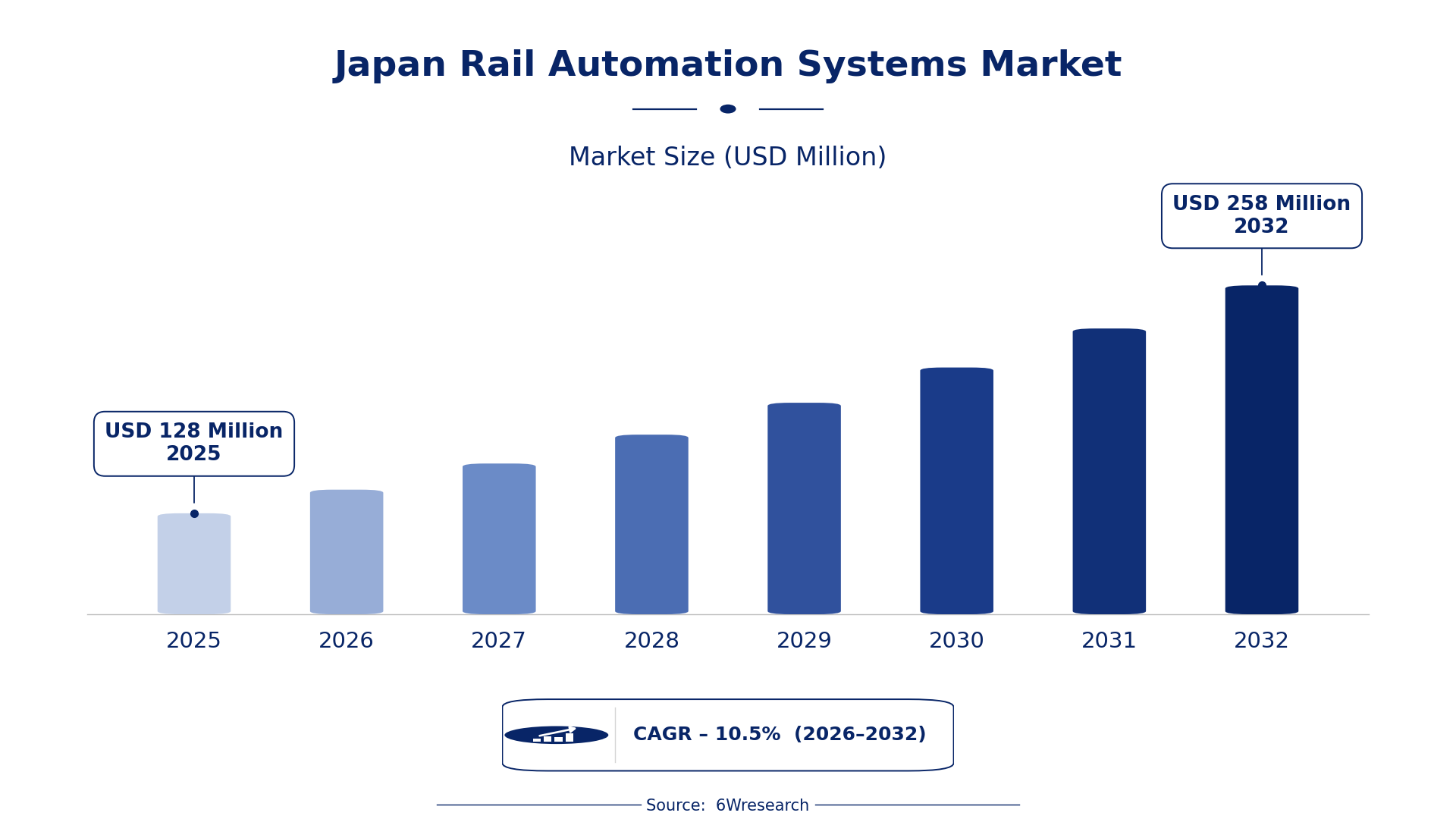
According to 6Wresearch internal database and industry insights, the Japan Rail Automation Systems Market was valued at USD 128 Million in 2025 and is projected to reach USD 258 Million by 2032, growing at a CAGR of approximately 10.5% during 2026–2032.
Japan Rail Automation Systems Market Highlights
| Report Metric | Details |
| Report Name | Japan Rail Automation Systems Market (2026-2032) |
| Market Size 2025 | USD 128 Million |
| Market Size 2032 | USD 258 Million |
| Absolute Growth 2025–2032 | USD 130 Million |
| CAGR 2026–2032 | 10.5% |
| Peak Annual Growth | 11.5% in 2028 |
| Forecast Period | 2026–2032 |
| Historical Data | 2022–2025 |
| Base Year | 2025 |
| Leading System Type, 2025 | Communication-Based Train Control (CBTC) (35% share) |
| Leading Technology Used, 2025 | Digital Signaling (50% share) |
| Leading Application Area, 2025 | Urban Rail Networks (48% share) |
| Leading End User, 2025 | Smart City Developers (45% share) |
| Fastest-Growing System Type | Automatic Train Operation (ATO) (14.6% CAGR) |
| Fastest-Growing Technology Used | Sensors & AI (15.2% CAGR) |
| Fastest-Growing Application Area | Passenger Rail Services (12.1% CAGR) |
| Fastest-Growing End User | Transport Ministries (13.3% CAGR) |
| Growing Sector | Urban Rail Networks |
| Key End Users | Rail Network Operators, Smart City Developers, Transport Ministries |
Japan Rail Automation Systems Market Year-wise Growth Rate and Key Drivers (2022–2032)
This graph illustrates the annual growth rates of the market from 2022 to 2032, highlighting a steady upward trajectory and projected market expansion over the forecast period.
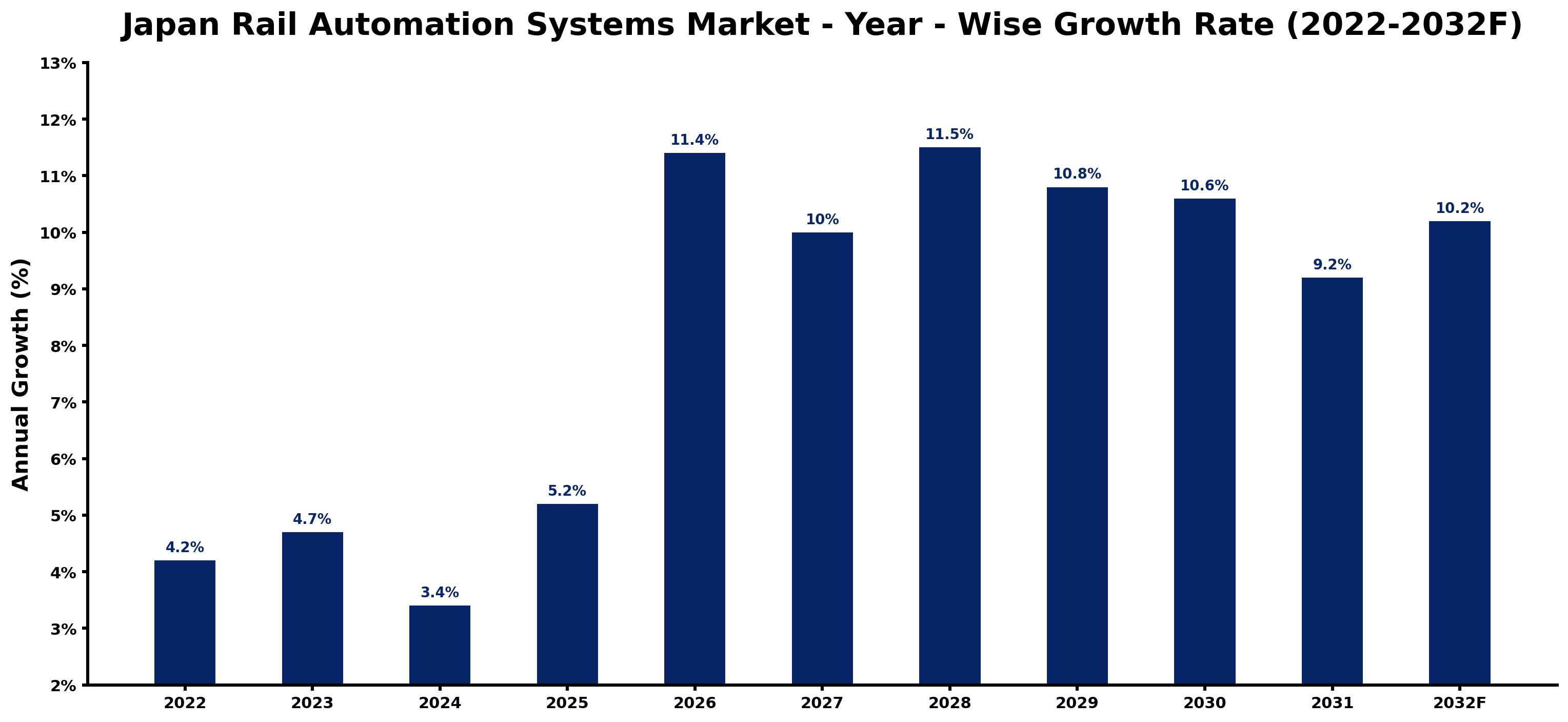
The yearly estimates that follow link every growth rate to its principal driver, so readers can see why the pace changed in each period.
| Year | Estimated Annual Growth (%) | Market Rationale |
| 2022 | 4.2 | The rail automation market experienced steady growth due to ongoing urbanisation efforts. |
| 2023 | 4.7 | Demand accelerated as smart city projects gained momentum, increasing investment in automation systems. |
| 2024 | 3.4 | Growth slowed as projects faced delays, yet demand remained strong overall. |
| 2025 | 5.2 | The market saw a surge in investment, particularly in urban rail networks. |
| 2026 | 11.4 | Demand is expected to rise sharply as advanced technologies gain traction in rail operations. |
| 2027 | 10.0 | Growth is projected to slow slightly as the market begins to stabilise after rapid expansion. |
| 2028 | 11.5 | A peak in demand is anticipated as major projects reach completion and automation is fully integrated. |
| 2029 | 10.8 | Growth will moderate as the market adjusts to new technologies and operational standards. |
| 2030 | 10.6 | Demand is expected to continue growing, driven by ongoing investments in infrastructure upgrades. |
| 2031 | 9.2 | The market is projected to experience a slowdown as saturation begins in certain urban areas. |
| 2032 | 10.2 | Growth is anticipated to accelerate again as new technologies and systems are adopted widely. |
Note: Market size estimations and growth projections presented in this report are based on 6Wresearch's proprietary forecasting methodology, utilizing the latest available industry data, government publications, and primary research inputs.
Japan Rail Automation Systems Market Synopsis
Rail Automation Systems in Japan improve the efficiency and safety of rail operations through advanced digital signaling, sensors, and AI technologies. Key buyer groups include rail network operators and smart city developers, both of which are driving demand through investments in infrastructure and technology. The Japan Rail Automation Systems Market is growing due to a commitment to decarbonisation, targeting JPY 150 trillion in investments over the next decade, alongside the integration of automation systems in urban rail networks.
Market Dynamics Impact Analysis (2026–2032)
| Factor | Type | Impact | Primary Segment Affected |
| Growing investment in smart city initiatives | Driver | High | Automatic Train Operation (ATO) |
| Increasing urbanisation leading to higher rail traffic | Driver | High | Communication-Based Train Control (CBTC) |
| Expansion of urban rail networks requiring advanced systems | Opportunity | High | Urban Rail Networks |
| Need for improved operational efficiency in rail services | Opportunity | Medium | Passenger Rail Services |
| High initial costs of implementation and maintenance | Restraint | High | Traffic Management Systems |
| Limited availability of skilled workforce for advanced systems | Restraint | Medium | Integrated Control Systems |
| Compliance with stringent safety regulations | Challenge | High | Digital Signaling |
| Capacity constraints in existing rail infrastructure | Challenge | Medium | Rail Operations Centers |
Evaluation of Drivers in Japan Rail Automation Systems Market (2026–2032)
The main growth drivers and the segments they affect most are set out below.
| Drivers | Primary Segment Affected | Why It Matters (Evidence) |
| Investment in smart city projects | Automatic Train Operation (ATO) | This investment leads to increased demand for automation systems, with JPY 1 trillion allocated for smart transportation initiatives. |
| Urbanisation and population growth | Communication-Based Train Control (CBTC) | As urban areas expand, the need for efficient rail systems rises, supported by over 27,000 kilometers of rail track in Japan. |
| Technological advancements in AI and sensors | Digital Signaling | These advancements improve safety and efficiency, with AI for predictive maintenance implemented since 2022. |
| Government decarbonisation targets | Traffic Management Systems | The commitment to a 46% cut in greenhouse-gas emissions by 2030 drives demand for efficient rail systems. |
| Integration of automation in existing rail networks | Integrated Control Systems | The need for streamlined operations in extensive networks increases demand for advanced automation solutions. |
Urbanisation and population growth in Japan further boost demand for efficient rail systems. Technological advancements in AI and sensors improve safety and operational efficiency, as seen with AI for predictive maintenance implemented since 2022. The commitment to a 46% reduction in greenhouse-gas emissions by 2030 also drives the adoption of efficient rail systems. The integration of automation in existing networks increases the demand for integrated control systems that streamline operations.
Evaluation of Restraints in Japan Rail Automation Systems Market
The table below lists the restraints and the evidence behind each.
| Market Restraint | Primary Segment Affected | Why It Matters (Evidence) |
| High initial costs of implementation and maintenance | Traffic Management Systems | These costs deter smaller rail operators from adopting advanced systems, limiting market growth. |
| Limited availability of skilled workforce for advanced systems | Integrated Control Systems | The shortage of qualified personnel hampers the implementation of sophisticated automation technologies. |
| Compliance with stringent safety regulations | Digital Signaling | Regulatory requirements necessitate extensive testing and certification, delaying project timelines. |
| Capacity constraints in existing rail infrastructure | Rail Operations Centers | Overcrowded networks limit the ability to implement new technologies effectively. |
| Resistance to change among traditional rail operators | Communication-Based Train Control (CBTC) | Established operators may hesitate to invest in new systems, slowing overall market adoption. |
Japan Rail Automation Systems Market Challenges
A shortage of skilled professionals in rail automation results from declining enrolment in engineering programs, causing delays for railway operators that may extend project timelines by up to 12 months. High implementation costs for advanced technologies burden operators, with initial investments reaching JPY 1 trillion for smart transportation initiatives, limiting participation from smaller firms. Rising operational costs, driven by Japan's minimum wage increase to JPY 1,055 per hour, pressure buyers as service prices rise. Intense competition among railway operators for automation contracts leads to aggressive bidding, forcing some to compromise on quality and reliability.
Trends in the Japan Rail Automation Systems Market
The shifts below are changing how Japan Rail Automation Systems Market products are bought and supplied.
- Shift from Manual to Automated Operations: Since 2022, the rail industry has increasingly adopted automated systems, with the Tokyo Subway integrating ATO systems across multiple lines for greater efficiency. This shift is expected to enhance operational reliability and reduce human error.
- Rise of AI in Predictive Maintenance: In 2023, railway operators began implementing AI for predictive maintenance, facilitating more efficient operations. This technology is projected to decrease downtime and maintenance costs.
- Transition to Digital Signaling Systems: The adoption of digital signaling systems has accelerated since 2023, capturing a 50% market share in Japan. This change improves safety and communication between trains, boosting overall network efficiency.
- Increased Focus on Urban Rail Networks: Urban Rail Networks have emerged as a priority since 2023, accounting for 48% of the market. This focus addresses the growing need for efficient public transport solutions in densely populated areas.
Investment Opportunities in the Japan Rail Automation Systems Market
Several openings in the Japan Rail Automation Systems Market merit attention from investors.
- Smart City Developers Seeking Automation Solutions: Smart City Developers are increasingly looking for advanced rail automation systems to improve urban transport. With JPY 150 trillion earmarked for decarbonisation, there is a gap in supply for these technologies.
- Growing Demand for Efficient Passenger Rail Services: As passenger numbers rise, the need for efficient rail systems is critical now. Investing in Automatic Train Operation systems can meet this demand, particularly in urban areas.
- Investment in Traffic Management Systems: Rail network operators are currently seeking advanced traffic management systems to optimise operations. With over 27,000 kilometers of rail track, the opportunity for supply is vast.
- Expansion of Integrated Control Systems: The demand for integrated control systems is rising, with a projected market gap of approximately USD 130 million. Rail operators are keen to improve operational efficiency through these systems.
Government Initiatives in the Japan Rail Automation Systems Market
The AI Promotion Act, established in 2025, creates a national framework for AI research and development, improving the capabilities of rail automation systems. This law builds on previous regulations to ensure effective integration of AI technologies into rail operations, promoting safety and efficiency across the sector.
The Ministry of Land, Infrastructure, Transport and Tourism oversees the approval of rail automation technologies and allocates funding for projects. In 2023, the government allocated ¥1 trillion for smart transportation initiatives, which includes support for the development and implementation of advanced rail automation systems.
Future Insight of the Japan Rail Automation Systems Market
By 2032, the integration of predictive maintenance will reshape demand for rail automation systems, enhancing service reliability. Japan's commitment to reducing greenhouse gas emissions will stimulate further investment in automation, with JPY 150 trillion allocated for decarbonisation initiatives. The implementation of advanced digital signalling technologies will streamline operations and improve traffic management. New interoperability standards, such as JIS and ISO 9001, will ensure compatibility across various rail networks, benefiting both buyers and suppliers.
Market Segmentation Analysis
Japan Rail Automation Systems Market report covers a detailed analysis of the following market segments:
By System Type – Communication-Based Train Control (CBTC) Leads, Automatic Train Operation (ATO) Expected to Grow Fastest
According to Saurav Kr Singh, Senior Research Analyst at 6Wresearch, Communication-Based Train Control (CBTC) accounted for 35% of the market by system type in 2025. Communication-Based Train Control (CBTC) holds the largest share due to its vital function in ensuring real-time train control and safety across Japan's extensive rail network. For instance, advanced CBTC systems are effectively managing the high-density rail services in the Tokyo metropolitan area. Automatic Train Operation (ATO) is set to record the highest CAGR in this split, 14.6% over 2026–2032. Automatic Train Operation (ATO) is experiencing rapid growth as it enables automated train running, significantly improving operational efficiency. The integration of ATO systems in the Tokyo Subway illustrates the increasing demand for automation in urban rail operations. Suppliers should focus on advancing ATO technologies to meet the rising demand for efficiency in urban rail systems.
By Technology Used – Digital Signaling Leads, Sensors & AI Expected to Grow Fastest
With 50% of technology used revenue in 2025, Digital Signaling was the largest category. Digital Signaling dominates the market as it enhances safety and communication between trains, which is essential for the reliability of Japan's rail operations. The Shinkansen bullet train network exemplifies the effective use of digital signaling technologies for efficient train management. Sensors & AI is projected to grow fastest, at a CAGR of 15.2% during 2026–2032. Sensors and AI are rapidly gaining traction as they facilitate predictive maintenance and operational analytics, which are crucial for improving efficiency in rail systems. The adoption of AI for predictive maintenance by railway operators since 2022 highlights the growing reliance on these technologies. Buyers should consider investing in sensor and AI technologies to enhance maintenance practices and operational efficiency.
By Application Area – Urban Rail Networks Lead, Passenger Rail Services Expected to Grow Fastest
The largest application area category in 2025 was Urban Rail Networks, at 48% of revenue. Urban Rail Networks account for the largest share as they are critical for providing efficient transportation solutions in densely populated areas. The extensive urban rail services in the Tokyo metropolitan area underscore the importance of automation in urban transit systems. Over 2026–2032, Passenger Rail Services are expected to post the fastest growth, at a CAGR of 12.1%. Passenger Rail Services are witnessing the fastest growth as they enhance the passenger experience and improve operational reliability. The focus on integrating advanced automation in these services reflects the increasing demand for efficient rail travel. Suppliers must prioritise solutions that enhance passenger experience to capitalise on the growing demand in this area.
By End User – Smart City Developers Lead, Transport Ministries Expected to Grow Fastest
In 2025, Smart City Developers led the end user split with a 45% share. Smart City Developers lead the market as they influence urban planning and transport integration, driving the adoption of rail automation systems. Their role in shaping smart city initiatives underscores the importance of efficient rail solutions in urban environments. The quickest growth will come from Transport Ministries, forecast to expand at a CAGR of 13.3% between 2026 and 2032. Transport Ministries are the fastest-growing end users as they regulate and oversee rail transport policies, ensuring the implementation of modern automation technologies. Their active involvement in initiatives like the Smart Mobility Challenge highlights the urgency for advancements in rail systems. Suppliers should engage with transport ministries to align their offerings with regulatory frameworks and smart city initiatives.
Key Attractiveness of the Report
- 10 Years of Market Numbers
- Historical Data Starting from 2022 to 2025
- Base Year 2025
- Forecast Data until 2032
- Key Performance Indicators Impacting the Market
- Major Upcoming Developments and Projects
Key Highlights of the Report:
- Japan Rail Automation Systems Market Outlook
- Market Size of Japan Rail Automation Systems Market, 2025
- Forecast of Japan Rail Automation Systems Market, 2032
- Historical Data and Forecast of Japan Rail Automation Systems Revenues & Volume for the Period 2022-2032F
- Japan Rail Automation Systems Market Trend Evolution
- Japan Rail Automation Systems Market Drivers and Challenges
- Japan Rail Automation Systems Price Trends
- Japan Rail Automation Systems Porter's Five Forces
- Japan Rail Automation Systems Industry Life Cycle
- Historical Data and Forecast of Japan Rail Automation Systems Market Revenues & Volume By System Type for the Period 2022-2032F
- Historical Data and Forecast of Japan Rail Automation Systems Market Revenues & Volume By Communication-Based Train Control (CBTC) for the Period 2022-2032F
- Historical Data and Forecast of Japan Rail Automation Systems Market Revenues & Volume By Automatic Train Operation (ATO) for the Period 2022-2032F
- Historical Data and Forecast of Japan Rail Automation Systems Market Revenues & Volume By Integrated Control Systems for the Period 2022-2032F
- Historical Data and Forecast of Japan Rail Automation Systems Market Revenues & Volume By Traffic Management Systems for the Period 2022-2032F
- Historical Data and Forecast of Japan Rail Automation Systems Market Revenues & Volume By Technology Used for the Period 2022-2032F
- Historical Data and Forecast of Japan Rail Automation Systems Market Revenues & Volume By Digital Signaling for the Period 2022-2032F
- Historical Data and Forecast of Japan Rail Automation Systems Market Revenues & Volume By Sensors & AI for the Period 2022-2032F
- Historical Data and Forecast of Japan Rail Automation Systems Market Revenues & Volume By SCADA for the Period 2022-2032F
- Historical Data and Forecast of Japan Rail Automation Systems Market Revenues & Volume By Data Analytics for the Period 2022-2032F
- Historical Data and Forecast of Japan Rail Automation Systems Market Revenues & Volume By Application Area for the Period 2022-2032F
- Historical Data and Forecast of Japan Rail Automation Systems Market Revenues & Volume By Urban Rail Networks for the Period 2022-2032F
- Historical Data and Forecast of Japan Rail Automation Systems Market Revenues & Volume By Passenger Rail Services for the Period 2022-2032F
- Historical Data and Forecast of Japan Rail Automation Systems Market Revenues & Volume By Rail Operations Centers for the Period 2022-2032F
- Historical Data and Forecast of Japan Rail Automation Systems Market Revenues & Volume By Intercity Rail for the Period 2022-2032F
- Historical Data and Forecast of Japan Rail Automation Systems Market Revenues & Volume By End User for the Period 2022-2032F
- Historical Data and Forecast of Japan Rail Automation Systems Market Revenues & Volume By Smart City Developers for the Period 2022-2032F
- Historical Data and Forecast of Japan Rail Automation Systems Market Revenues & Volume By Transport Ministries for the Period 2022-2032F
- Historical Data and Forecast of Japan Rail Automation Systems Market Revenues & Volume By Rail Network Operators for the Period 2022-2032F
- Historical Data and Forecast of Japan Rail Automation Systems Market Revenues & Volume By National Rail Corporations for the Period 2022-2032F
- Japan Rail Automation Systems Import Export Trade Statistics
- Market Opportunity Assessment By System Type
- Market Opportunity Assessment By Technology Used
- Market Opportunity Assessment By Application Area
- Market Opportunity Assessment By End User
- Japan Rail Automation Systems Top Companies Market Share
- Japan Rail Automation Systems Competitive Benchmarking By Technical and Operational Parameters
- Japan Rail Automation Systems Company Profiles
- Japan Rail Automation Systems Key Strategic Recommendations
Market Covered
The following segment groups are covered in the report.
By System Type
- Communication-Based Train Control (CBTC)
- Automatic Train Operation (ATO)
- Integrated Control Systems
- Traffic Management Systems
By Technology Used
- Digital Signaling
- Sensors & AI
- SCADA
- Data Analytics
By Application Area
- Urban Rail Networks
- Passenger Rail Services
- Rail Operations Centers
- Intercity Rail
By End User
- Smart City Developers
- Transport Ministries
- Rail Network Operators
- National Rail Corporations































