Japan Railing Systems Market Size & Growth Rate
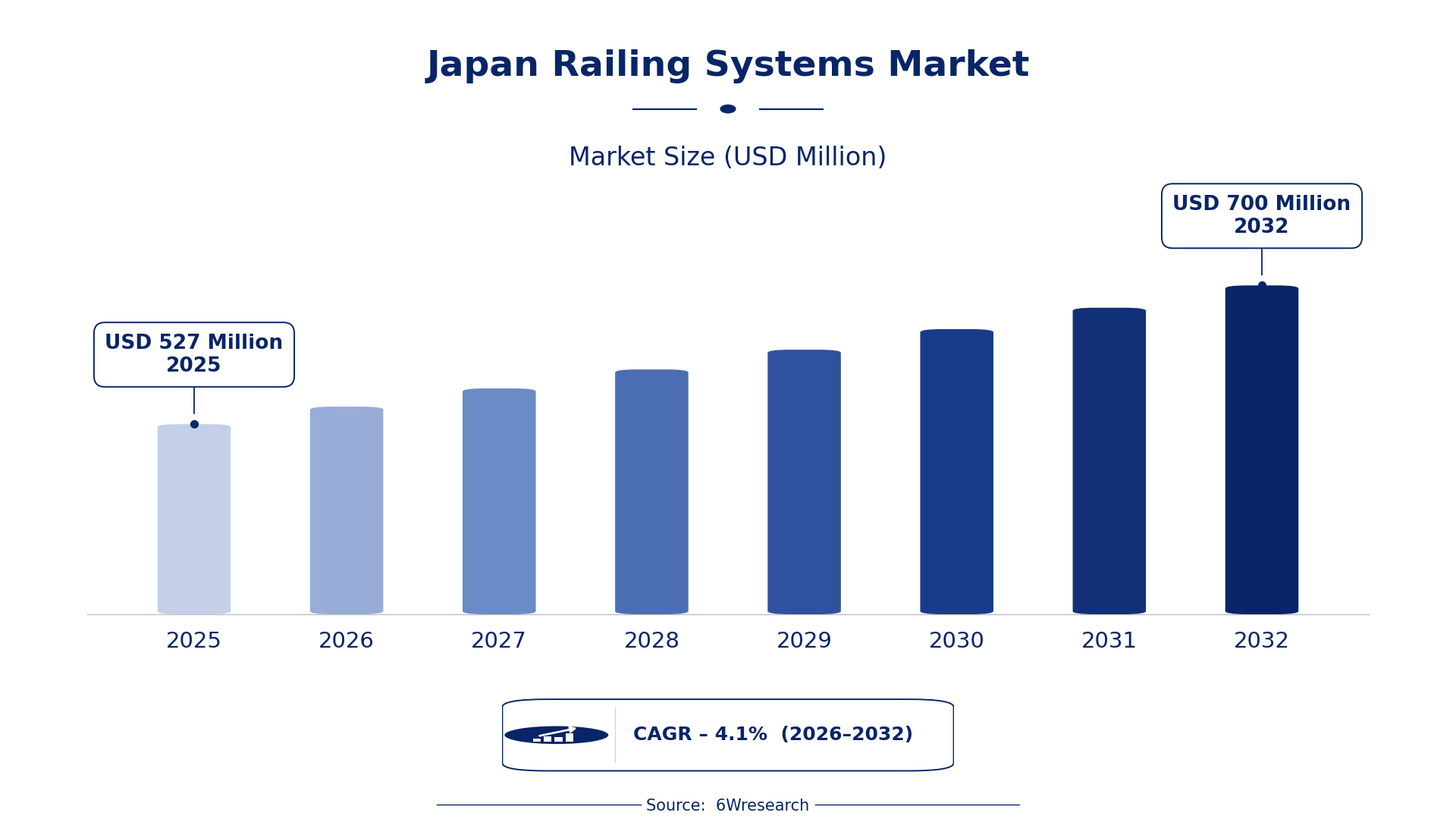
According to 6Wresearch internal database and industry insights, the Japan Railing Systems Market was valued at USD 527 Million in 2025 and is projected to reach USD 700 Million by 2032, growing at a CAGR of approximately 4.1% during 2026–2032.
Japan Railing Systems Market Highlights
| Report Metric | Details |
| Report Name | Japan Railing Systems Market (2026-2032) |
| Market Size 2025 | USD 527 Million |
| Market Size 2032 | USD 700 Million |
| Absolute Growth 2025–2032 | USD 173 Million |
| CAGR 2026–2032 | 4.1% |
| Peak Annual Growth | 5.1% in 2032 |
| Forecast Period | 2026–2032 |
| Historical Data | 2022–2025 |
| Base Year | 2025 |
| Leading Material Type, 2025 | Stainless Steel (42% share) |
| Leading Product Type, 2025 | Handrails (48% share) |
| Leading Installation Area, 2025 | Commercial Buildings (52% share) |
| Leading End User, 2025 | Contractors & Architects (46% share) |
| Fastest-Growing Material Type | Aluminum (5.8% CAGR) |
| Fastest-Growing Product Type | Guardrails (6.0% CAGR) |
| Fastest-Growing Installation Area | Industrial Platforms (5.1% CAGR) |
| Fastest-Growing End User | Factory Installers (5.4% CAGR) |
| Growing Sector | Construction |
| Key End Users | Contractors, Architects, Real Estate Developers, Factory Installers |
Japan Railing Systems Market Year-wise Growth Rate and Key Drivers (2022–2032)
This graph illustrates the annual growth rates of the market from 2022 to 2032, highlighting a steady upward trajectory and projected market expansion over the forecast period.
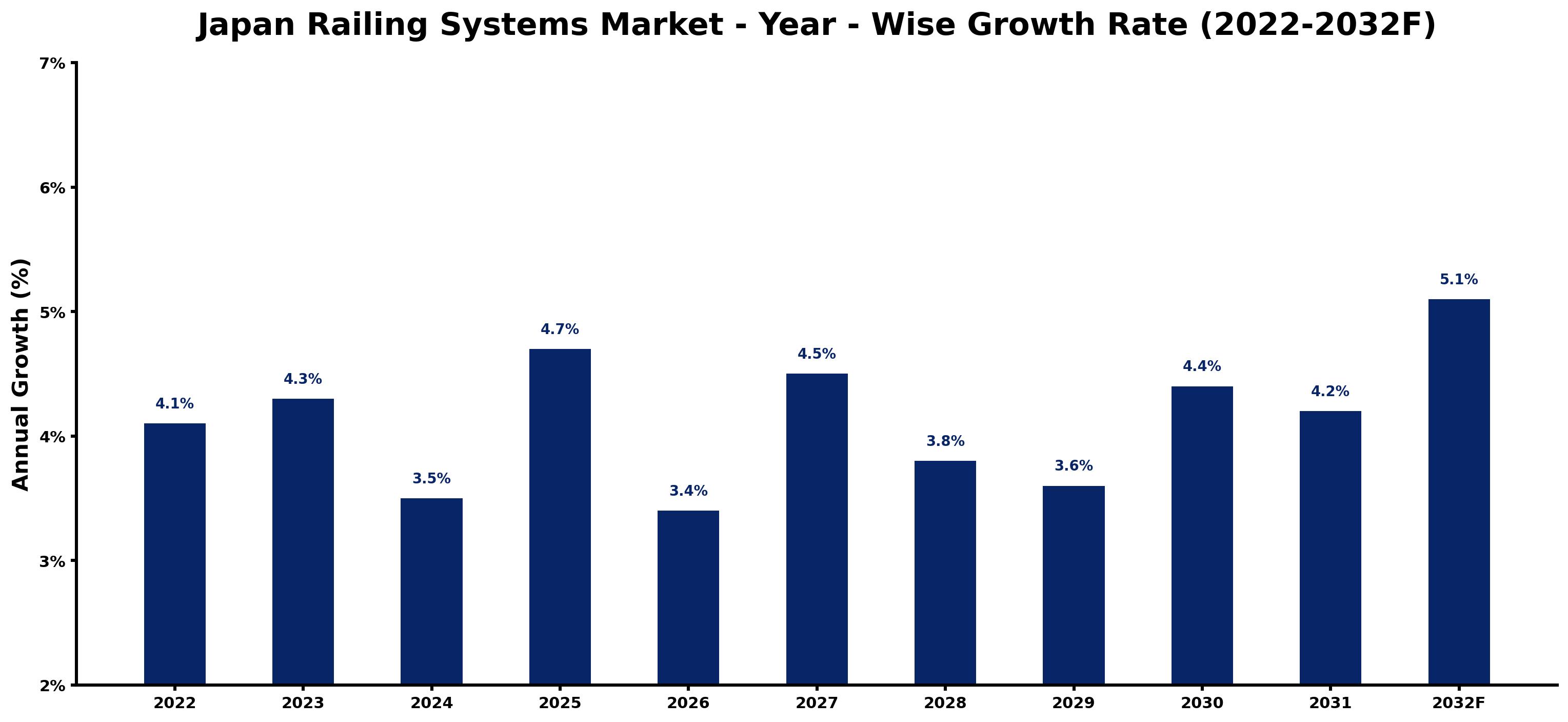
Below, each year's estimated growth is shown next to the factor that most influenced it.
| Year | Estimated Annual Growth (%) | Market Rationale |
| 2022 | 4.1 | The market experienced steady growth due to ongoing infrastructure projects and construction activity. |
| 2023 | 4.3 | Growth accelerated as residential construction surged, increasing demand for railing systems. |
| 2024 | 3.5 | Growth slowed as supply chain issues began to affect material availability and project timelines. |
| 2025 | 4.7 | A peak in growth was reached, driven by a surge in commercial building projects requiring railings. |
| 2026 | 3.4 | Demand is expected to stabilise as market adjustments take place following the peak demand year. |
| 2027 | 4.5 | Investments in industrial platforms are projected to boost demand for railing systems as construction activity increases. |
| 2028 | 3.8 | Growth is anticipated to slow as the market stabilises after the previous year's surge in demand. |
| 2029 | 3.6 | Demand is expected to continue slowing as construction activity normalises following the peak years. |
| 2030 | 4.4 | Growth is projected to accelerate again as new regulations encourage the use of sustainable materials in construction. |
| 2031 | 4.2 | Growth is expected to slow slightly as the market adjusts to the new regulatory environment. |
| 2032 | 5.1 | A final surge in growth is anticipated as new materials gain traction in the market. |
Note: Market size estimations and growth projections presented in this report are based on 6Wresearch's proprietary forecasting methodology, utilizing the latest available industry data, government publications, and primary research inputs.
Japan Railing Systems Market Synopsis
Railing systems are essential safety features made from materials like stainless steel, aluminum, glass, and wrought iron, manufactured through processes such as cutting, welding, and finishing. Increased construction activity, particularly in the Tokyo metropolitan area, which accounts for around 30% of Japan's construction sector, is driving the Japan Railing Systems Market. Demand is propelled by ongoing residential and commercial projects, with a projected annual requirement of 1.5 million railing units. The government's push for sustainable building materials and compliance with standards like JIS G 4305 further support this growth.
Market Dynamics Impact Analysis (2026–2032)
| Factor | Type | Impact | Primary Segment Affected |
| Increased construction projects in urban areas | Driver | High | Commercial Buildings |
| Rising demand for sustainable materials | Driver | High | Aluminum |
| Growing luxury residential projects | Opportunity | Medium | Glass |
| Expansion of industrial platforms | Opportunity | Medium | Industrial Platforms |
| Supply chain disruptions affecting material availability | Restraint | High | Stainless Steel |
| High installation costs for railing systems | Restraint | Medium | Handrails |
| Labor shortages in the construction sector | Challenge | High | Contractors & Architects |
| Fluctuating raw material prices | Challenge | Medium | Aluminum |
Evaluation of Drivers in Japan Railing Systems Market (2026–2032)
The main growth drivers and the segments they affect most are set out below.
| Drivers | Primary Segment Affected | Why It Matters (Evidence) |
| Increased urban construction projects | Commercial Buildings | The Tokyo metropolitan area accounts for around 30% of Japan's construction activity, driving demand for railing systems. |
| Rising preference for lightweight materials | Aluminum | The average lifespan of aluminum railings is estimated at 50 years, prompting buyers to invest in long-lasting solutions. |
| Compliance with safety standards | Stainless Steel | Stainless steel railings are compliant with JIS G 4305 standards, ensuring safety and durability. |
| Growing luxury market for aesthetics | Glass | The adoption of glass railings has increased by 15% in luxury residential projects, appealing to high-end buyers. |
| Investment in industrial safety | Industrial Platforms | Safety regulations in industrial environments increase the need for durable railing systems. |
Purchasing is picking up as urban construction projects expand, particularly in the Tokyo metropolitan area, which accounts for around 30% of Japan's construction activity. The average lifespan of aluminum railings is estimated at 50 years, prompting buyers to invest in long-lasting solutions. Compliance with safety standards for stainless steel railings ensures durability, driving demand among contractors. The luxury residential market is flourishing, with a 15% increase in the adoption of glass railings appealing to high-end buyers. Investment in industrial safety is rising, leading to increased demand for durable railing systems.
Evaluation of Restraints in Japan Railing Systems Market
The following restraints limit how fast demand can grow.
| Market Restraint | Primary Segment Affected | Why It Matters (Evidence) |
| Supply chain disruptions affecting material availability | Stainless Steel | Supply chain issues have led to delays in acquiring stainless steel, impacting project timelines. |
| High installation costs for railing systems | Handrails | The average cost of installing railings in commercial buildings is around 200,000 yen per project, affecting affordability. |
| Labor shortages in the construction sector | Contractors & Architects | Labor shortages have made it difficult for contractors to complete projects on time, limiting market growth. |
| Fluctuating raw material prices | Aluminum | Volatile prices for aluminum have created uncertainty for buyers, affecting purchasing decisions. |
| Limited availability of skilled installers | Guardrails | A shortage of skilled labor for installation has slowed project completions, impacting demand. |
Japan Railing Systems Market Challenges
A construction project in Tokyo experienced a 15% rise in stainless steel prices, increasing installation costs for contractors by about 30,000 yen per project. Urban buyers face challenges with limited choices, as 70% of new commercial buildings already feature railing systems, restricting their negotiating power. Supply chain disruptions have postponed aluminium railing deliveries, extending project timelines by two months for residential developers. Many manufacturers lack ISO 9001 certification, hindering their ability to innovate and meet specific market demands, which affects buyer satisfaction and safety standards.
Trends in the Japan Railing Systems Market
Buyers and suppliers in the Japan Railing Systems Market are adjusting to the following trends.
- Shift to Sustainable Building Materials: The trend towards sustainable building materials is gaining momentum, with 70% of new commercial buildings in urban areas incorporating railing systems. This shift aligns with the government's 2023 initiative promoting sustainable materials.
- Increase in Glass Railings for Aesthetic Appeal: Luxury residential projects are increasingly opting for glass railings, with a 15% rise observed in recent years. This change reflects a growing demand for aesthetically pleasing designs in high-end properties.
- Focus on Safety in Industrial Platforms: Industrial platforms are experiencing a rise in railing system installations, driven by stricter safety regulations. This trend is expected to continue as industries prioritise worker safety.
- Expansion of Railing Systems in Commercial Buildings: Commercial buildings are progressively integrating railing systems, with a projected 52% share in installations by 2025. This reflects an increasing focus on safety and design in urban construction.
Investment Opportunities in the Japan Railing Systems Market
Investors looking at the Japan Railing Systems Market should consider the following areas.
- Supply of Sustainable Railing Systems: With the government's initiative for sustainable materials, there is a growing opportunity to provide eco-friendly railing systems. The market is projected to require 1.5 million units annually, highlighting a notable gap.
- Investment in Industrial Safety Solutions: The industrial sector is on the rise, with a projected growth rate of 5.1% for railing systems in industrial platforms. Suppliers can penetrate this market by collaborating with local contractors.
- Demand for High-End Glass Railings: The luxury residential market is expanding, with a 15% increase in glass railings. Suppliers can focus on this segment by emphasising aesthetic designs and quality.
- Expansion into Commercial Building Installations: The commercial building sector is anticipated to require substantial railing installations. Suppliers should explore joint ventures with local contractors to access this growing market.
Government Initiatives in the Japan Railing Systems Market
The Economic Security Promotion Act, enacted in 2022, supports supply-chain resilience for critical products, including railing systems. This law mandates that producers ensure the availability of essential materials, supporting the construction industry's stability and growth.
In 2023, the government allocated 5 billion yen to promote sustainable building materials, overseen by the Ministry of Land, Infrastructure, Transport and Tourism. This funding aims to encourage the adoption of eco-friendly materials in construction projects.
Future Insight of the Japan Railing Systems Market
Advancements in smart technology will reshape demand for railing systems, introducing features that prioritise safety and user convenience. By 2032, the push for sustainable building materials will gain momentum, supported by government initiatives and shifting buyer expectations. The average lifespan of aluminium railings at 50 years will drive investments in long-lasting solutions, appealing to cost-conscious buyers. Compliance with updated industry standards will elevate product quality and reliability, creating a more competitive environment for suppliers.
Market Segmentation Analysis
Japan Railing Systems Market report covers a detailed analysis of the following market segments:
By Material Type – Stainless Steel Leads, Aluminum Expected to Grow Fastest
According to Saurav Kr Singh, Senior Research Analyst at 6Wresearch, Stainless Steel took 42% of material type revenue in 2025, more than any other category. Stainless steel railings dominate the market due to their high durability and corrosion resistance, making them ideal for outdoor use in various construction projects. This material is particularly favoured in the Tokyo metropolitan area, which accounts for a substantial portion of Japan's construction activity. Aluminum is set to record the highest CAGR in this split, 5.8% over 2026–2032. Aluminum railings are experiencing rapid growth as they are lightweight and resistant to rust, making them suitable for a variety of installations. The average lifespan of aluminum railings, estimated at 50 years, contributes to their increasing adoption in the market. Suppliers should focus on promoting the benefits of aluminum railings to capitalise on the growing demand.
By Product Type – Handrails Lead, Guardrails Expected to Grow Fastest
Handrails held 48% of the Japan Railing Systems Market by product type in 2025. Handrails hold the largest market share because they are essential for safety in stairways and balconies, which are critical in both commercial and residential buildings. The ongoing urban construction activities in Japan reinforce the demand for handrails, particularly in high-traffic areas. Over 2026–2032, Guardrails are expected to post the fastest growth, at a CAGR of 6.0%. Guardrails are witnessing rapid growth as they are crucial for preventing falls, especially in new commercial buildings where safety regulations are tightening. This increased focus on safety standards will likely lead to wider adoption of guardrails across various projects. Suppliers should prioritise compliance with safety regulations to capture the growing demand for guardrails.
By Installation Area – Commercial Buildings Lead, Industrial Platforms Expected to Grow Fastest
With 52% of installation area revenue in 2025, Commercial Buildings was the largest category. Commercial buildings represent the largest segment due to their significant need for safety and design installations, with around 70% of new structures incorporating railing systems. This trend is bolstered by Japan's robust construction sector, valued at approximately 20 trillion yen. Industrial Platforms are projected to grow fastest, at a CAGR of 5.1% during 2026–2032. Industrial platforms are experiencing the fastest growth as they are vital for ensuring safety in industrial environments, reflecting ongoing infrastructure projects across Japan. The increasing emphasis on safety solutions in these settings is driving a surge in installations. Suppliers should focus on the industrial sector to capitalise on the rising demand for safety solutions.
By End User – Contractors & Architects Lead, Factory Installers Expected to Grow Fastest
Contractors & Architects accounted for 46% of the market by end user in 2025. Contractors and architects dominate the market as they are the primary decision-makers in design and installation, significantly influencing the choice of railing systems for various projects. Their involvement is essential in ensuring compliance with safety standards in new constructions. The quickest growth will come from Factory Installers, forecast to expand at a CAGR of 5.4% between 2026 and 2032. Factory installers are experiencing the fastest growth as they are directly responsible for the installation of railing systems, which is crucial for timely project execution. The rise in construction projects necessitates a greater number of factory installers to meet this demand. Suppliers should engage with factory installers to optimise the installation process and improve project timelines.
Key Attractiveness of the Report
- 10 Years of Market Numbers
- Historical Data Starting from 2022 to 2025
- Base Year 2025
- Forecast Data until 2032
- Key Performance Indicators Impacting the Market
- Major Upcoming Developments and Projects
Key Highlights of the Report:
- Japan Railing Systems Market Outlook
- Market Size of Japan Railing Systems Market, 2025
- Forecast of Japan Railing Systems Market, 2032
- Historical Data and Forecast of Japan Railing Systems Revenues & Volume for the Period 2022-2032F
- Japan Railing Systems Market Trend Evolution
- Japan Railing Systems Market Drivers and Challenges
- Japan Railing Systems Price Trends
- Japan Railing Systems Porter's Five Forces
- Japan Railing Systems Industry Life Cycle
- Historical Data and Forecast of Japan Railing Systems Market Revenues & Volume By Material Type for the Period 2022-2032F
- Historical Data and Forecast of Japan Railing Systems Market Revenues & Volume By Stainless Steel for the Period 2022-2032F
- Historical Data and Forecast of Japan Railing Systems Market Revenues & Volume By Aluminum for the Period 2022-2032F
- Historical Data and Forecast of Japan Railing Systems Market Revenues & Volume By Glass for the Period 2022-2032F
- Historical Data and Forecast of Japan Railing Systems Market Revenues & Volume By Wrought Iron for the Period 2022-2032F
- Historical Data and Forecast of Japan Railing Systems Market Revenues & Volume By Product Type for the Period 2022-2032F
- Historical Data and Forecast of Japan Railing Systems Market Revenues & Volume By Handrails for the Period 2022-2032F
- Historical Data and Forecast of Japan Railing Systems Market Revenues & Volume By Guardrails for the Period 2022-2032F
- Historical Data and Forecast of Japan Railing Systems Market Revenues & Volume By Balustrades for the Period 2022-2032F
- Historical Data and Forecast of Japan Railing Systems Market Revenues & Volume By Stair Railings for the Period 2022-2032F
- Historical Data and Forecast of Japan Railing Systems Market Revenues & Volume By Installation Area for the Period 2022-2032F
- Historical Data and Forecast of Japan Railing Systems Market Revenues & Volume By Commercial Buildings for the Period 2022-2032F
- Historical Data and Forecast of Japan Railing Systems Market Revenues & Volume By Industrial Platforms for the Period 2022-2032F
- Historical Data and Forecast of Japan Railing Systems Market Revenues & Volume By Residential Spaces for the Period 2022-2032F
- Historical Data and Forecast of Japan Railing Systems Market Revenues & Volume By Hotels & Retail Spaces for the Period 2022-2032F
- Historical Data and Forecast of Japan Railing Systems Market Revenues & Volume By End User for the Period 2022-2032F
- Historical Data and Forecast of Japan Railing Systems Market Revenues & Volume By Contractors & Architects for the Period 2022-2032F
- Historical Data and Forecast of Japan Railing Systems Market Revenues & Volume By Factory Installers for the Period 2022-2032F
- Historical Data and Forecast of Japan Railing Systems Market Revenues & Volume By Real Estate Developers for the Period 2022-2032F
- Historical Data and Forecast of Japan Railing Systems Market Revenues & Volume By Interior Designers for the Period 2022-2032F
- Japan Railing Systems Import Export Trade Statistics
- Market Opportunity Assessment By Material Type
- Market Opportunity Assessment By Product Type
- Market Opportunity Assessment By Installation Area
- Market Opportunity Assessment By End User
- Japan Railing Systems Top Companies Market Share
- Japan Railing Systems Competitive Benchmarking By Technical and Operational Parameters
- Japan Railing Systems Company Profiles
- Japan Railing Systems Key Strategic Recommendations
Market Covered
The following segment groups are covered in the report.
By Material Type
- Stainless Steel
- Aluminum
- Glass
- Wrought Iron
By Product Type
- Handrails
- Guardrails
- Balustrades
- Stair Railings
By Installation Area
- Commercial Buildings
- Industrial Platforms
- Residential Spaces
- Hotels & Retail Spaces
By End User
- Contractors & Architects
- Factory Installers
- Real Estate Developers
- Interior Designers































