Japan Railway Air Brake Market Size & Growth Rate
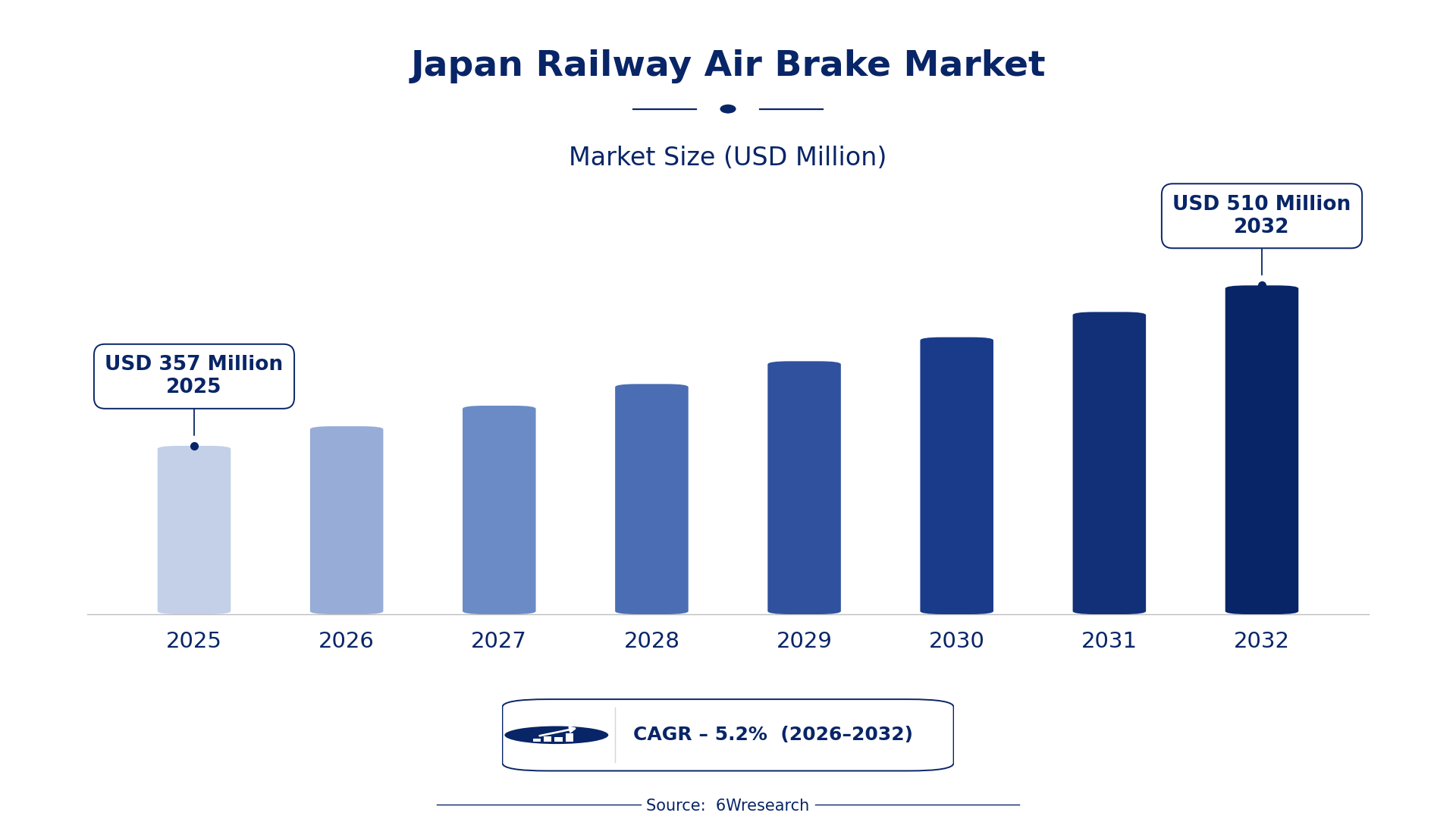
According to 6Wresearch internal database and industry insights, the Japan Railway Air Brake Market was valued at USD 357 Million in 2025 and is projected to reach USD 510 Million by 2032, growing at a CAGR of approximately 5.2% during 2026–2032.
Japan Railway Air Brake Market Highlights
| Report Metric | Details |
| Report Name | Japan Railway Air Brake Market (2026-2032) |
| Market Size 2025 | USD 357 Million |
| Market Size 2032 | USD 510 Million |
| Absolute Growth 2025–2032 | USD 153 Million |
| CAGR 2026–2032 | 5.2% |
| Peak Annual Growth | 6.0% in 2028 |
| Forecast Period | 2026–2032 |
| Historical Data | 2022–2025 |
| Base Year | 2025 |
| Leading Brake Type, 2025 | Automatic Air Brake (41% share) |
| Leading Control Mechanism, 2025 | Integrated Controls (38% share) |
| Leading Application Area, 2025 | High-Speed Trains (38% share) |
| Leading End User, 2025 | National Transport Firms (35% share) |
| Fastest-Growing Brake Type | Electro-Pneumatic Brake (7.4% CAGR) |
| Fastest-Growing Application Area | Passenger Coaches (6.2% CAGR) |
| Fastest-Growing End User | Urban Transit Authorities (6.7% CAGR) |
| Growing Sector | Railway Transportation |
| Key End Users | National Transport Firms, Rail OEMs, Urban Transit Authorities, Freight Car Builders |
Japan Railway Air Brake Market Year-wise Growth Rate and Key Drivers (2022–2032)
This graph illustrates the annual growth rates of the market from 2022 to 2032, highlighting a steady upward trajectory and projected market expansion over the forecast period.
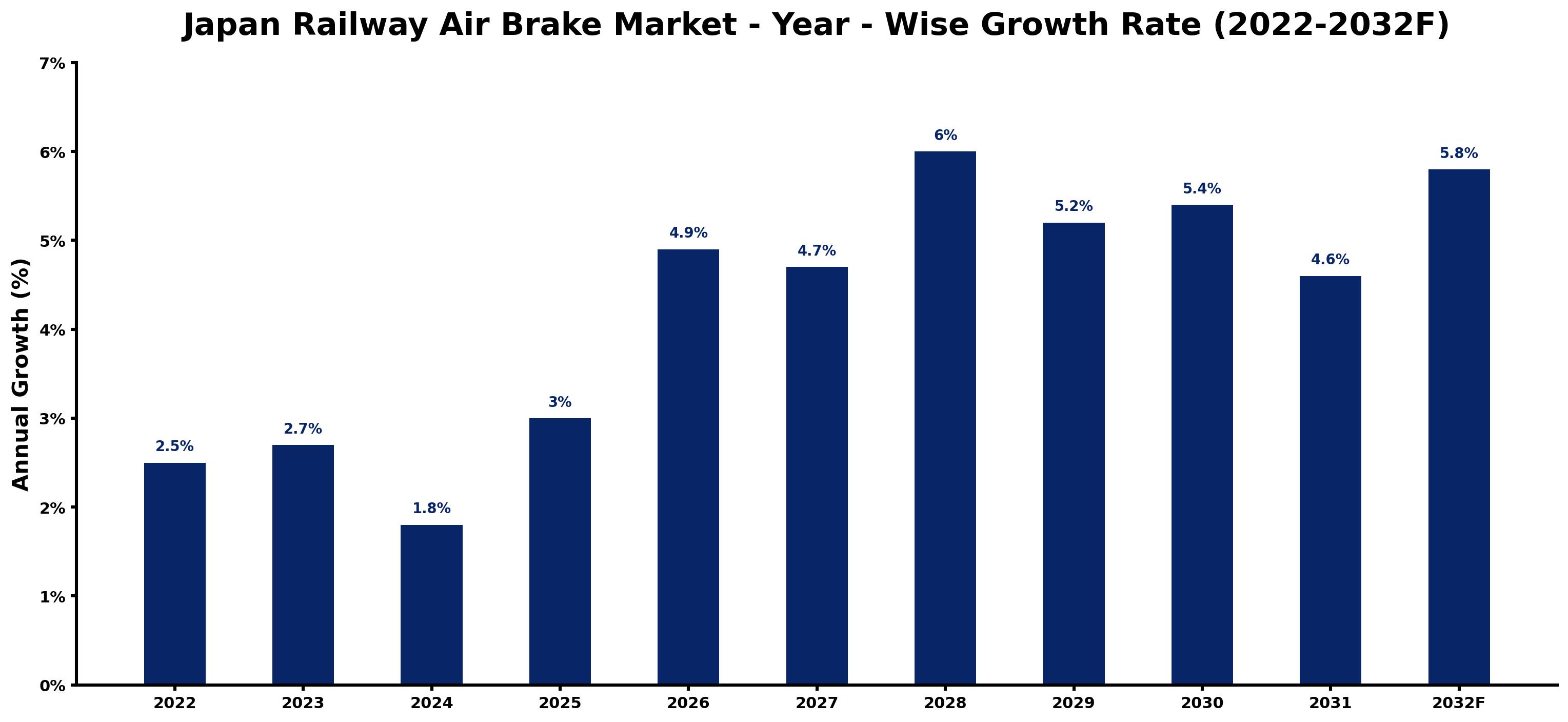
The yearly estimates that follow link every growth rate to its principal driver, so readers can see why the pace changed in each period.
| Year | Estimated Annual Growth (%) | Market Rationale |
| 2022 | 2.5 | Railway passenger volume was approximately 4.5 billion, indicating steady demand for air brakes. |
| 2023 | 2.7 | The market experienced growth faster than the previous year, driven by infrastructure investments. |
| 2024 | 1.8 | Growth slowed as the market adjusted to prior expansions and demand stabilised. |
| 2025 | 3.0 | Increased investments in high-speed rail systems contributed to a faster growth rate. |
| 2026 | 4.9 | Demand is expected to rise with the adoption of new technologies in railway systems. |
| 2027 | 4.7 | Growth is projected to slow slightly as the market begins to normalise after peaks. |
| 2028 | 6.0 | A surge in orders for modern braking systems is anticipated to drive growth to its peak. |
| 2029 | 5.2 | Growth is projected to slow as the market adjusts to peak demand levels. |
| 2030 | 5.4 | Continued investment in rail infrastructure will support a recovery in growth rates. |
| 2031 | 4.6 | Growth is expected to slow as the market stabilises after several years of rapid expansion. |
| 2032 | 5.8 | Increased focus on safety and efficiency in rail transport will drive demand for air brakes. |
Note: Market size estimations and growth projections presented in this report are based on 6Wresearch's proprietary forecasting methodology, utilizing the latest available industry data, government publications, and primary research inputs.
Japan Railway Air Brake Market Synopsis
Railway air brakes are pneumatic systems essential for slowing or stopping trains, made from various materials including valves and cylinders. The Japan Railway Air Brake Market is expanding due to ongoing investments in infrastructure, the adoption of modern braking technologies, and a strong emphasis on safety and efficiency in rail transport. In 2022, Japan's railway passenger volume reached approximately 4.5 billion, highlighting the substantial demand for advanced braking systems.
Market Dynamics Impact Analysis (2026–2032)
| Factor | Type | Impact | Primary Segment Affected |
| Growing demand for high-speed rail systems drives the need for advanced braking solutions. | Driver | High | Electro-Pneumatic Brake |
| Increasing focus on safety regulations enhances the adoption of modern air brake systems. | Driver | High | Automatic Air Brake |
| Investment in railway infrastructure creates opportunities for suppliers of braking systems. | Opportunity | High | Dynamic Brake Systems |
| The shift towards energy-efficient braking systems opens avenues for innovation. | Opportunity | Medium | Electro-Pneumatic Brake |
| High costs associated with upgrading older systems can limit market growth. | Restraint | High | Direct Air Brake |
| Regulatory compliance requirements may slow down the adoption of new technologies. | Restraint | Medium | Integrated Controls |
| Supply chain disruptions affect the availability of critical components for air brakes. | Challenge | High | Pneumatic Valve |
| Competition from alternative braking technologies poses a risk to market share. | Challenge | Medium | Manual Control |
Evaluation of Drivers in Japan Railway Air Brake Market (2026–2032)
Below are the drivers that matter most for revenue growth, with supporting evidence.
| Drivers | Primary Segment Affected | Why It Matters (Evidence) |
| Increasing passenger volume in rail transport boosts demand for air brakes. | Automatic Air Brake | In 2022, Japan's railway passenger volume was approximately 4.5 billion, resulting in higher orders for safety systems. |
| The adoption of high-speed rail systems necessitates advanced braking technologies. | Electro-Pneumatic Brake | The Shinkansen high-speed rail system operates at speeds up to 320 km/h, requiring efficient braking solutions. |
| Investment in railway infrastructure drives the demand for modern braking systems. | Dynamic Brake Systems | The Economic Security Promotion Act supports supply-chain resilience for critical products, prompting upgrades in braking systems. |
| Growing safety regulations drive the need for reliable air brake systems. | Direct Air Brake | The Japan Railway Association promotes safety and efficiency, increasing demand for compliant braking technologies. |
| Technological advancements in braking systems improve operational efficiency. | Integrated Controls | ISO 9001 standards are commonly adopted in railway manufacturing, leading to improved product quality. |
Behind the steady rise in orders sits the increasing passenger volume in rail transport, with approximately 4.5 billion passengers in 2022 driving demand for safety systems. The adoption of high-speed rail systems, such as the Shinkansen operating at speeds up to 320 km/h, necessitates advanced braking technologies. Technological advancements in braking systems lead to improved operational efficiency across the sector.
Evaluation of Restraints in Japan Railway Air Brake Market
Below are the constraints most often cited by buyers and suppliers, with the segment each affects.
| Market Restraint | Primary Segment Affected | Why It Matters (Evidence) |
| High costs associated with upgrading older braking systems limit market growth. | Direct Air Brake | Older systems require substantial investment for upgrades, impacting budget allocations for rail operators. |
| Regulatory compliance requirements slow down the adoption of new technologies. | Integrated Controls | Producers must navigate complex regulations, delaying the introduction of new braking solutions. |
| Supply chain disruptions affect the availability of critical components for air brakes. | Pneumatic Valve | Disruptions in the supply chain can lead to delays in production and increased costs for manufacturers. |
| Limited access to advanced technology can hinder market expansion. | Electro-Pneumatic Brake | Some manufacturers may lack the resources to invest in modern braking technologies. |
| Market competition from alternative braking technologies poses a risk to traditional air brakes. | Manual Control | Emerging technologies may attract investment away from conventional air brake systems. |
Japan Railway Air Brake Market Challenges
High costs for buyers stem from the necessity for advanced air brake systems, inflating expenses by up to 15%. Increased competition among local manufacturers drives price reductions, shrinking profit margins by about 10% for producers and limiting their capacity to invest in improvements. An ageing workforce contributes to skills shortages, delaying project timelines by an average of six months for companies attempting to adopt new technologies. Supply chain disruptions from natural disasters can halt production for weeks, extending lead times and risking service interruptions for buyers reliant on dependable deliveries.
Trends in the Japan Railway Air Brake Market
The shifts below are changing how Japan Railway Air Brake Market products are bought and supplied.
- Shift towards Advanced Braking Technologies: The adoption of electro-pneumatic brakes is increasing as rail operators seek improved efficiency. This segment has seen a growth rate of 7.4%, reflecting a shift in focus towards modern systems.
- Transition from Manual to Automated Systems: Railway operators are moving from manual control systems to integrated controls, improving safety and efficiency. This shift has been marked by a 38% market share for integrated controls in 2025.
- Emergence of Energy-Efficient Solutions: The demand for dynamic brake systems is rising as operators seek to improve energy efficiency. This trend aligns with the ongoing emphasis on sustainable transport solutions in Japan.
- Growing Focus on Safety Regulations: The Japan Railway Association's initiatives to promote safety are driving investments in advanced braking systems. This focus has resulted in increased compliance requirements for manufacturers.
Investment Opportunities in the Japan Railway Air Brake Market
Below are the investment opportunities with the strongest case in the Japan Railway Air Brake Market.
- Partnerships with Local Rail Operators: Now is an opportune time to partner with national transport firms to supply advanced braking systems. Collaboration can facilitate market entry as the demand for modern solutions continues to rise.
- Investment in Modern Rail Infrastructure: Investing in dynamic brake systems is timely due to ongoing infrastructure developments. The Tokyo region, with its high density of rail services, presents a prime opportunity for suppliers.
- Supply of Electro-Pneumatic Brakes: The growing demand for electro-pneumatic brakes offers a substantial investment opportunity. Rail OEMs are increasingly seeking these systems to improve operational efficiency.
- Approval for Advanced Technologies: Securing certification for integrated controls can open new markets. The shift towards automated systems is gaining traction, making this an ideal time for investment.
Government Initiatives in the Japan Railway Air Brake Market
The Economic Security Promotion Act of 2022 supports supply-chain resilience for critical products, including railway air brakes. This legislation encourages manufacturers to invest in local production capabilities, ensuring a steady supply of essential components and stabilising the market.
The Japan Railway Construction, Transport and Technology Agency funds projects aimed at modernising railway infrastructure. With a budget of approximately USD 200 million for 2023, the agency supports innovations that improve safety and efficiency in rail transport.
Future Insight of the Japan Railway Air Brake Market
Investment in new railway infrastructure projects will reshape operational capabilities by 2032. Innovations in rail systems will emerge from initiatives led by the Japan Railway Construction, Transport and Technology Agency. Stricter safety standards will evolve as manufacturers adopt ISO 9001, ensuring higher quality in production. By 2032, railway passenger volume is expected to reach approximately 5 billion, highlighting a growing demand for efficient rail services.
Market Segmentation Analysis
Japan Railway Air Brake Market report covers a detailed analysis of the following market segments:
By Brake Type – Automatic Air Brake Leads, Electro-Pneumatic Brake Expected to Grow Fastest
According to Saurav Kr Singh, Senior Research Analyst at 6Wresearch, the largest brake type category in 2025 was Automatic Air Brake, at 41% of revenue. The Automatic Air Brake holds the largest share in Japan's railway market because it is essential for ensuring safety and operational efficiency across the extensive railway network. Its widespread implementation across over 27,000 kilometres of railway lines underscores its importance for both passenger and freight transport. Electro-Pneumatic Brake is projected to grow fastest, at a CAGR of 7.4% during 2026–2032. The Electro-Pneumatic Brake is experiencing rapid growth as modern train systems adopt this technology for improved braking performance. Its use in high-speed rail systems, such as the Shinkansen, indicates a shift towards more advanced braking solutions that enhance overall safety. Suppliers must focus on developing advanced braking technologies to meet the increasing demand for safety and performance in railway operations.
By Control Mechanism – Integrated Controls Lead and Record the Fastest Growth
Integrated Controls took 38% of control mechanism revenue in 2025, more than any other category. Integrated Controls dominate this segment as they are integral to the functionality of advanced braking systems, ensuring improved safety and operational efficiency. Their widespread integration into various railway applications highlights their importance in maintaining high safety standards across the network. The same category are also set to grow fastest, at a CAGR of 7.5% during 2026–2032. Integrated Controls are also the fastest-growing segment, driven by ongoing advancements in railway technology that require more sophisticated control systems. As the leader, its growth will continue to widen alongside the modernisation of rail systems that increasingly rely on these advanced solutions. Buyers should prioritise investments in systems featuring integrated controls to enhance operational efficiency and safety in their railway operations.
By Application Area – High-Speed Trains Lead, Passenger Coaches Expected to Grow Fastest
High-Speed Trains accounted for 38% of the market by application area in 2025. High-Speed Trains represent the largest share in this market, largely due to Japan's investment in high-speed rail infrastructure, including the Shinkansen system. This investment drives demand for advanced braking systems that ensure safety at high velocities. Passenger Coaches are set to record the highest CAGR in this split, 6.2% over 2026–2032. The Passenger Coaches segment is growing rapidly as urbanisation increases the need for efficient public transport solutions. This growth is supported by rising passenger volumes, which reached approximately 4.5 billion in 2022. Suppliers must prioritise the development of braking systems tailored for passenger coaches to capitalise on this growing market.
By End User – National Transport Firms Lead, Urban Transit Authorities Expected to Grow Fastest
In 2025, National Transport Firms led the end user split with a 35% share. National Transport Firms account for the largest share as they manage the majority of railway operations in Japan, necessitating reliable braking systems. Their extensive networks require consistent safety measures across all services. The quickest growth will come from Urban Transit Authorities, forecast to expand at a CAGR of 6.7% between 2026 and 2032. Urban Transit Authorities are the fastest-growing segment due to the increasing focus on urban mobility solutions and public transport efficiency. This growth is driven by government policies promoting sustainable transport. Suppliers should engage with urban transit authorities to align their products with the evolving needs of urban rail systems.
Key Attractiveness of the Report
- 10 Years of Market Numbers
- Historical Data Starting from 2022 to 2025
- Base Year 2025
- Forecast Data until 2032
- Key Performance Indicators Impacting the Market
- Major Upcoming Developments and Projects
Key Highlights of the Report:
- Japan Railway Air Brake Market Outlook
- Market Size of Japan Railway Air Brake Market, 2025
- Forecast of Japan Railway Air Brake Market, 2032
- Historical Data and Forecast of Japan Railway Air Brake Revenues & Volume for the Period 2022-2032F
- Japan Railway Air Brake Market Trend Evolution
- Japan Railway Air Brake Market Drivers and Challenges
- Japan Railway Air Brake Price Trends
- Japan Railway Air Brake Porter's Five Forces
- Japan Railway Air Brake Industry Life Cycle
- Historical Data and Forecast of Japan Railway Air Brake Market Revenues & Volume By Brake Type for the Period 2022-2032F
- Historical Data and Forecast of Japan Railway Air Brake Market Revenues & Volume By Automatic Air Brake for the Period 2022-2032F
- Historical Data and Forecast of Japan Railway Air Brake Market Revenues & Volume By Direct Air Brake for the Period 2022-2032F
- Historical Data and Forecast of Japan Railway Air Brake Market Revenues & Volume By Electro-Pneumatic Brake for the Period 2022-2032F
- Historical Data and Forecast of Japan Railway Air Brake Market Revenues & Volume By Dynamic Brake Systems for the Period 2022-2032F
- Historical Data and Forecast of Japan Railway Air Brake Market Revenues & Volume By Control Mechanism for the Period 2022-2032F
- Historical Data and Forecast of Japan Railway Air Brake Market Revenues & Volume By Pneumatic Valve for the Period 2022-2032F
- Historical Data and Forecast of Japan Railway Air Brake Market Revenues & Volume By Manual Control for the Period 2022-2032F
- Historical Data and Forecast of Japan Railway Air Brake Market Revenues & Volume By Digital Sensors for the Period 2022-2032F
- Historical Data and Forecast of Japan Railway Air Brake Market Revenues & Volume By Integrated Controls for the Period 2022-2032F
- Historical Data and Forecast of Japan Railway Air Brake Market Revenues & Volume By Application Area for the Period 2022-2032F
- Historical Data and Forecast of Japan Railway Air Brake Market Revenues & Volume By Passenger Coaches for the Period 2022-2032F
- Historical Data and Forecast of Japan Railway Air Brake Market Revenues & Volume By Freight Wagons for the Period 2022-2032F
- Historical Data and Forecast of Japan Railway Air Brake Market Revenues & Volume By High-Speed Trains for the Period 2022-2032F
- Historical Data and Forecast of Japan Railway Air Brake Market Revenues & Volume By Metro Rail for the Period 2022-2032F
- Historical Data and Forecast of Japan Railway Air Brake Market Revenues & Volume By End User for the Period 2022-2032F
- Historical Data and Forecast of Japan Railway Air Brake Market Revenues & Volume By Rail OEMs for the Period 2022-2032F
- Historical Data and Forecast of Japan Railway Air Brake Market Revenues & Volume By Freight Car Builders for the Period 2022-2032F
- Historical Data and Forecast of Japan Railway Air Brake Market Revenues & Volume By National Transport Firms for the Period 2022-2032F
- Historical Data and Forecast of Japan Railway Air Brake Market Revenues & Volume By Urban Transit Authorities for the Period 2022-2032F
- Japan Railway Air Brake Import Export Trade Statistics
- Market Opportunity Assessment By Brake Type
- Market Opportunity Assessment By Control Mechanism
- Market Opportunity Assessment By Application Area
- Market Opportunity Assessment By End User
- Japan Railway Air Brake Top Companies Market Share
- Japan Railway Air Brake Competitive Benchmarking By Technical and Operational Parameters
- Japan Railway Air Brake Company Profiles
- Japan Railway Air Brake Key Strategic Recommendations
Market Covered
The following segment groups are covered in the report.
By Brake Type
- Automatic Air Brake
- Direct Air Brake
- Electro-Pneumatic Brake
- Dynamic Brake Systems
By Control Mechanism
- Pneumatic Valve
- Manual Control
- Digital Sensors
- Integrated Controls
By Application Area
- Passenger Coaches
- Freight Wagons
- High-Speed Trains
- Metro Rail
By End User
- Rail OEMs
- Freight Car Builders
- National Transport Firms
- Urban Transit Authorities































