Japan Railway Maintenance Equipment Market Size & Growth Rate
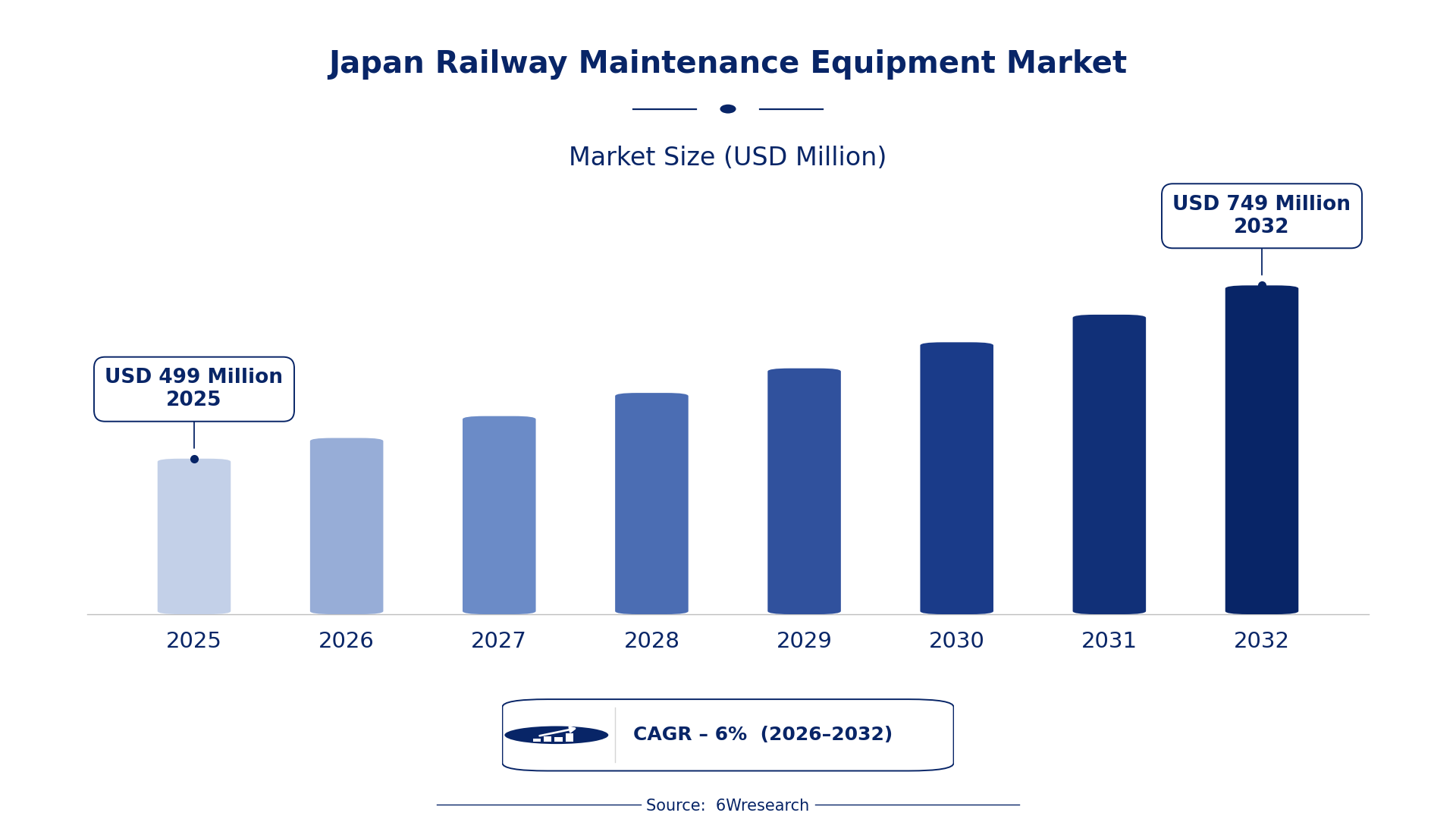
According to 6Wresearch internal database and industry insights, the Japan Railway Maintenance Equipment Market was valued at USD 499 Million in 2025 and is projected to reach USD 749 Million by 2032, growing at a CAGR of approximately 6% during 2026–2032.
Japan Railway Maintenance Equipment Market Highlights
| Report Metric | Details |
| Report Name | Japan Railway Maintenance Equipment Market (2026-2032) |
| Market Size 2025 | USD 499 Million |
| Market Size 2032 | USD 749 Million |
| Absolute Growth 2025–2032 | USD 250 Million |
| CAGR 2026–2032 | 6% |
| Peak Annual Growth | 6.4% in 2032 |
| Forecast Period | 2026–2032 |
| Historical Data | 2022–2025 |
| Base Year | 2025 |
| Leading Equipment Type, 2025 | Track Laying Machines (39% share) |
| Leading Maintenance Function, 2025 | Construction (44% share) |
| Leading Operation Mode, 2025 | Hydraulic (33% share) |
| Leading End User, 2025 | Infrastructure Providers (48% share) |
| Fastest-Growing Equipment Type | Ballast Regulators (8.4% CAGR) |
| Fastest-Growing Maintenance Function | Track Shaping (8.2% CAGR) |
| Fastest-Growing Operation Mode | Diesel (8.1% CAGR) |
| Fastest-Growing End User | Maintenance Contractors (7.8% CAGR) |
| Growing Sector | Railway Infrastructure |
| Key End Users | Infrastructure Providers, Maintenance Contractors, Service Providers |
Japan Railway Maintenance Equipment Market Year-wise Growth Rate and Key Drivers (2022–2032)
This graph illustrates the annual growth rates of the market from 2022 to 2032, highlighting a steady upward trajectory and projected market expansion over the forecast period.
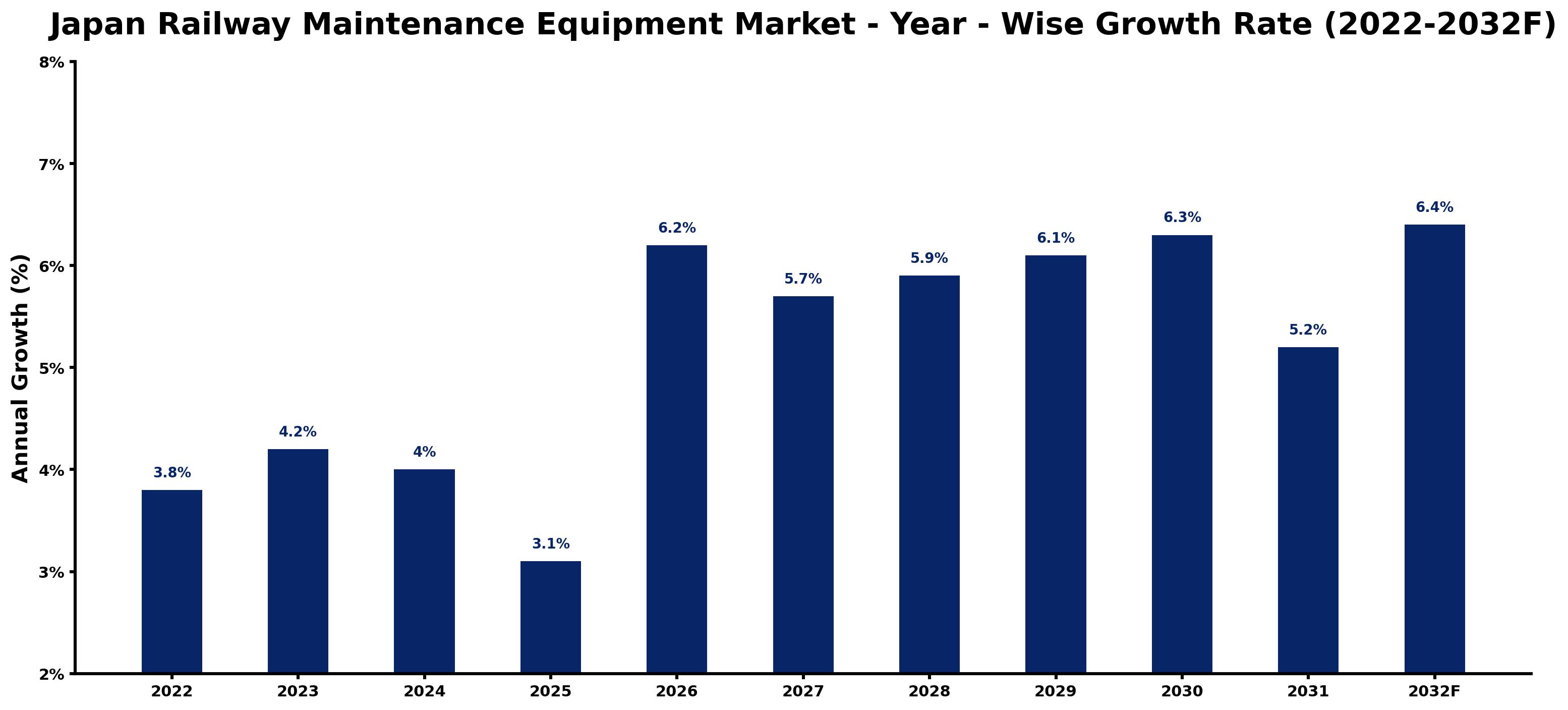
Below, each year's estimated growth is shown next to the factor that most influenced it.
| Year | Estimated Annual Growth (%) | Market Rationale |
| 2022 | 3.8 | The market showed steady growth due to ongoing infrastructure projects. |
| 2023 | 4.2 | Growth accelerated as demand for advanced maintenance equipment increased. |
| 2024 | 4.0 | A slowdown occurred as some projects faced delays and budget constraints. |
| 2025 | 3.1 | Continued investment in railway infrastructure maintained positive growth. |
| 2026 | 6.2 | Demand surged with new technology adoption in railway maintenance. |
| 2027 | 5.7 | Growth slowed as the market adjusted to higher operational costs. |
| 2028 | 5.9 | Increased focus on safety standards boosted equipment purchases. |
| 2029 | 6.1 | Demand rose as infrastructure providers expanded their operations. |
| 2030 | 6.3 | Investment in electrification projects drove further equipment needs. |
| 2031 | 5.2 | A slowdown was noted as market growth stabilised after rapid increases. |
| 2032 | 6.4 | Growth peaked as modernization initiatives reached completion. |
Note: Market size estimations and growth projections presented in this report are based on 6Wresearch's proprietary forecasting methodology, utilizing the latest available industry data, government publications, and primary research inputs.
Japan Railway Maintenance Equipment Market Synopsis
Railway maintenance equipment includes essential machines for the upkeep and construction of railways, such as track laying and rail welding machines. The Japan Railway Maintenance Equipment Market is expanding due to ongoing demand from domestic infrastructure providers and maintenance contractors, alongside substantial investments in railway infrastructure improvements. In 2023, the government allocated ¥50 billion for these projects, driving demand for advanced maintenance technologies and machinery.
Market Dynamics Impact Analysis (2026–2032)
| Factor | Type | Impact | Primary Segment Affected |
| Increased investment in railway infrastructure improvements | Driver | High | Track Laying Machines |
| Growing focus on safety and efficiency in rail operations | Driver | High | Rail Welding Machines |
| Rising demand for specialized maintenance equipment | Opportunity | High | Ballast Regulators |
| Expansion of electrified rail networks requiring advanced tools | Opportunity | High | Overhead Wire Systems |
| Budget constraints affecting infrastructure projects | Restraint | Medium | Construction |
| Aging equipment requiring replacement and upgrades | Restraint | Medium | Track Shaping |
| High initial investment costs for advanced machinery | Challenge | High | Electrical Lines |
| Technological advancements outpacing current equipment capabilities | Challenge | Medium | Hydraulic |
Evaluation of Drivers in Japan Railway Maintenance Equipment Market (2026–2032)
The following drivers explain most of the expected growth.
| Drivers | Primary Segment Affected | Why It Matters (Evidence) |
| Investment in railway infrastructure improvements | Track Laying Machines | The Japanese government allocated ¥50 billion for railway infrastructure improvements in 2023, driving demand for new track laying equipment. |
| Focus on safety and efficiency in rail operations | Rail Welding Machines | ISO 9001 standards are commonly applied, increasing the need for reliable rail welding machines to ensure safety. |
| Rising demand for specialized maintenance equipment | Ballast Regulators | Ballast regulators are extensively used in the Kansai region, increasing track stability and driving equipment purchases. |
| Expansion of electrified rail networks | Overhead Wire Systems | The growing electrified rail networks require advanced overhead wire systems, prompting increased procurement. |
| Adoption of electric operation modes | Electric | There has been a 15% increase in electric machines since 2020, reflecting a shift towards more efficient equipment. |
Several shifts outside the market lift sales. The expansion of electrified rail networks necessitates advanced overhead wire systems, further boosting equipment purchases. A 15% increase in electric machines since 2020 indicates a shift towards more efficient operation modes, prompting infrastructure providers to invest in modern technology.
Evaluation of Restraints in Japan Railway Maintenance Equipment Market
Several factors work against faster growth; the main ones are summarised below.
| Market Restraint | Primary Segment Affected | Why It Matters (Evidence) |
| Budget constraints affecting infrastructure projects | Construction | Budget constraints have delayed several infrastructure projects, reducing demand for construction machinery. |
| Aging equipment requiring replacement | Track Shaping | Aging equipment necessitates replacement, but high costs deter immediate upgrades among maintenance contractors. |
| High initial investment costs for advanced machinery | Electrical Lines | The high initial costs of advanced electrical line equipment limit purchases by smaller infrastructure providers. |
| Technological advancements outpacing current capabilities | Hydraulic | Rapid technological advancements create a gap, making existing hydraulic equipment less competitive. |
| Limited availability of skilled labour for operation and maintenance | Rail Welding Machines | A shortage of skilled labour affects the effective use of rail welding machines, slowing down project completions. |
Japan Railway Maintenance Equipment Market Challenges
High operational costs burden buyers as Japan's minimum wage reached JPY 1,055 per hour in October 2024, squeezing maintenance contractors' budgets. Many suppliers face challenges with outdated technology, as reliance on hydraulic systems extends maintenance times for infrastructure providers. Stringent safety regulations from the Ministry of Land, Infrastructure, Transport and Tourism create compliance hurdles, resulting in delays and increased costs for contractors. A critical shortage of skilled labour persists, with around 200,000 workers in the rail industry, hindering producers' ability to meet the growing demand for advanced maintenance equipment.
Trends in the Japan Railway Maintenance Equipment Market
The trends below show where the Japan Railway Maintenance Equipment Market is heading.
- Shift towards Electric Operation Modes: Infrastructure providers are increasingly adopting electric operation modes for railway maintenance, with a 15% increase in electric machines since 2020. This shift improves operational efficiency and reduces emissions.
- Growing Demand for Specialized Maintenance Equipment: The Kansai region has seen a rise in the use of ballast regulators, which are critical for track stability. This trend reflects a broader focus on maintaining track integrity across Japan.
- Increased Focus on Safety Standards: In 2023, the government launched a program to improve railway safety technology, driving demand for advanced maintenance equipment that meets new safety standards.
- Expansion of Electrified Rail Networks: Electrified rail networks are expanding, necessitating advanced overhead wire systems for maintenance. This growth is evident as infrastructure providers invest in specialised equipment.
Investment Opportunities in the Japan Railway Maintenance Equipment Market
Investors looking at the Japan Railway Maintenance Equipment Market should consider the following areas.
- Supply of Advanced Track Laying Machines: With the government allocating ¥50 billion for railway improvements, there is a strong opportunity to provide advanced track laying machines to infrastructure providers in urban areas.
- Investment in Ballast Regulators: The Kansai region's growing need for ballast regulators creates an opportunity for manufacturers to supply these critical machines, especially as demand increases for track stability.
- Development of Electric Maintenance Equipment: The shift towards electric operation modes presents an opportunity to develop and supply electric maintenance equipment, particularly for electrified rail networks in metropolitan areas.
- Improvement of Rail Welding Machines: As safety standards evolve, there is a pressing need for improved rail welding machines, providing a strong opportunity for suppliers to meet the new requirements.
Government Initiatives in the Japan Railway Maintenance Equipment Market
The Industrial Safety and Health Act of 1972 mandates employer responsibilities for hazardous substances and machinery, ensuring that producers of railway maintenance equipment adhere to safety standards. The Act on the Rational Use of Energy from 1979 requires large energy users to improve energy efficiency, which affects the design and operation of maintenance machinery.
The Japan Railway Construction, Transport and Technology Agency oversees railway safety regulations and funds projects aimed at improving railway infrastructure. The agency promotes modernisation, approving projects that align with national safety and efficiency goals.
Future Insight of the Japan Railway Maintenance Equipment Market
The upcoming railway infrastructure improvements project will introduce modern maintenance facilities by 2032, enhancing operational efficiency for buyers. Adoption of advanced technology will rise, with new electric machines supporting suppliers in offering sustainable solutions. The government's investment will drive upgrades across the rail network, opening fresh opportunities for suppliers to innovate. Enhanced railway safety technology programs will necessitate compliance, pushing buyers towards implementing state-of-the-art maintenance practices.
Market Segmentation Analysis
Japan Railway Maintenance Equipment Market report covers a detailed analysis of the following market segments:
By Equipment Type – Track Laying Machines Lead, Ballast Regulators Expected to Grow Fastest
According to Saurav Kr Singh, Senior Research Analyst at 6Wresearch, Track Laying Machines held 39% of the Japan Railway Maintenance Equipment Market by equipment type in 2025. Track laying machines are vital for laying new tracks, making them the preferred choice among buyers in Japan's extensive railway network. Their role is underscored by the need to maintain over 27,000 kilometers of railway tracks, which drives consistent demand. Over 2026–2032, Ballast Regulators are expected to post the fastest growth, at a CAGR of 8.4%. The rapid adoption of ballast regulators is attributed to their critical function in maintaining track stability, especially in the Kansai region where their use is prominent. This segment's growth is a response to the increasing emphasis on safe and efficient railway operations. Suppliers should prioritise the availability and advancement of ballast regulators to cater to the growing market demand.
By Maintenance Function – Construction Leads, Track Shaping Expected to Grow Fastest
Construction accounted for 44% of the market by maintenance function in 2025. Construction is fundamental for building new railways, which is a priority for Japan's infrastructure development. The government's allocation of ¥50 billion for railway improvements in 2023 underscores the importance of this function in the market. Track Shaping is projected to grow fastest, at a CAGR of 8.2% during 2026–2032. The growth of track shaping is propelled by its importance in maintaining track geometry, which is vital for safe operations. As the rail network expands, the need for precise track shaping will continue to rise. Buyers will need to invest in advanced track shaping technologies to ensure compliance with safety standards.
By Operation Mode – Hydraulic Leads, Diesel Expected to Grow Fastest
With 33% of operation mode revenue in 2025, Hydraulic was the largest category. Hydraulic systems are commonly used for heavy machinery in railway maintenance, making them the dominant operation mode in Japan. Their reliability and efficiency in powering essential equipment contribute to their widespread adoption. The quickest growth will come from Diesel, forecast to expand at a CAGR of 8.1% between 2026 and 2032. The diesel operation mode is experiencing growth due to its use in some older equipment, which remains prevalent in the market. As maintenance contractors seek to optimise their operations, diesel machines will continue to see increased demand. Suppliers should consider diversifying their offerings to include more diesel-powered options to cater to maintenance contractors.
By End User – Infrastructure Providers Lead, Maintenance Contractors Expected to Grow Fastest
Infrastructure Providers took 48% of end user revenue in 2025, more than any other category. Infrastructure providers are the main users of railway maintenance equipment, responsible for maintaining over 27,000 kilometres of railway tracks. Their ongoing investments in infrastructure improvements, such as the ¥50 billion allocated by the government in 2023, ensure a steady demand for these machines. Maintenance Contractors are set to record the highest CAGR in this split, 7.8% over 2026–2032. Maintenance contractors are experiencing rapid growth due to their crucial role in ensuring efficient railway operations. The increasing complexity of railway systems, highlighted by the recent government programme to enhance safety technology, is driving up the demand for their specialised services. This indicates that suppliers should focus on developing tailored solutions for maintenance contractors to capture emerging opportunities in the market.
Key Attractiveness of the Report
- 10 Years of Market Numbers
- Historical Data Starting from 2022 to 2025
- Base Year 2025
- Forecast Data until 2032
- Key Performance Indicators Impacting the Market
- Major Upcoming Developments and Projects
Key Highlights of the Report:
- Japan Railway Maintenance Equipment Market Outlook
- Market Size of Japan Railway Maintenance Equipment Market, 2025
- Forecast of Japan Railway Maintenance Equipment Market, 2032
- Historical Data and Forecast of Japan Railway Maintenance Equipment Revenues & Volume for the Period 2022-2032F
- Japan Railway Maintenance Equipment Market Trend Evolution
- Japan Railway Maintenance Equipment Market Drivers and Challenges
- Japan Railway Maintenance Equipment Price Trends
- Japan Railway Maintenance Equipment Porter's Five Forces
- Japan Railway Maintenance Equipment Industry Life Cycle
- Historical Data and Forecast of Japan Railway Maintenance Equipment Market Revenues & Volume By Equipment Type for the Period 2022-2032F
- Historical Data and Forecast of Japan Railway Maintenance Equipment Market Revenues & Volume By Track Laying Machines for the Period 2022-2032F
- Historical Data and Forecast of Japan Railway Maintenance Equipment Market Revenues & Volume By Ballast Regulators for the Period 2022-2032F
- Historical Data and Forecast of Japan Railway Maintenance Equipment Market Revenues & Volume By Rail Welding Machines for the Period 2022-2032F
- Historical Data and Forecast of Japan Railway Maintenance Equipment Market Revenues & Volume By Overhead Wire Systems for the Period 2022-2032F
- Historical Data and Forecast of Japan Railway Maintenance Equipment Market Revenues & Volume By Maintenance Function for the Period 2022-2032F
- Historical Data and Forecast of Japan Railway Maintenance Equipment Market Revenues & Volume By Construction for the Period 2022-2032F
- Historical Data and Forecast of Japan Railway Maintenance Equipment Market Revenues & Volume By Track Shaping for the Period 2022-2032F
- Historical Data and Forecast of Japan Railway Maintenance Equipment Market Revenues & Volume By Joint Repairs for the Period 2022-2032F
- Historical Data and Forecast of Japan Railway Maintenance Equipment Market Revenues & Volume By Electrical Lines for the Period 2022-2032F
- Historical Data and Forecast of Japan Railway Maintenance Equipment Market Revenues & Volume By Operation Mode for the Period 2022-2032F
- Historical Data and Forecast of Japan Railway Maintenance Equipment Market Revenues & Volume By Hydraulic for the Period 2022-2032F
- Historical Data and Forecast of Japan Railway Maintenance Equipment Market Revenues & Volume By Diesel for the Period 2022-2032F
- Historical Data and Forecast of Japan Railway Maintenance Equipment Market Revenues & Volume By Electric for the Period 2022-2032F
- Historical Data and Forecast of Japan Railway Maintenance Equipment Market Revenues & Volume By Trolley-Based for the Period 2022-2032F
- Historical Data and Forecast of Japan Railway Maintenance Equipment Market Revenues & Volume By End User for the Period 2022-2032F
- Historical Data and Forecast of Japan Railway Maintenance Equipment Market Revenues & Volume By Infrastructure Providers for the Period 2022-2032F
- Historical Data and Forecast of Japan Railway Maintenance Equipment Market Revenues & Volume By Maintenance Contractors for the Period 2022-2032F
- Historical Data and Forecast of Japan Railway Maintenance Equipment Market Revenues & Volume By Service Providers for the Period 2022-2032F
- Historical Data and Forecast of Japan Railway Maintenance Equipment Market Revenues & Volume By Electrified Rail Networks for the Period 2022-2032F
- Japan Railway Maintenance Equipment Import Export Trade Statistics
- Market Opportunity Assessment By Equipment Type
- Market Opportunity Assessment By Maintenance Function
- Market Opportunity Assessment By Operation Mode
- Market Opportunity Assessment By End User
- Japan Railway Maintenance Equipment Top Companies Market Share
- Japan Railway Maintenance Equipment Competitive Benchmarking By Technical and Operational Parameters
- Japan Railway Maintenance Equipment Company Profiles
- Japan Railway Maintenance Equipment Key Strategic Recommendations
Market Covered
The report covers the following segments.
By Equipment Type
- Track Laying Machines
- Ballast Regulators
- Rail Welding Machines
- Overhead Wire Systems
By Maintenance Function
- Construction
- Track Shaping
- Joint Repairs
- Electrical Lines
By Operation Mode
- Hydraulic
- Diesel
- Electric
- Trolley-Based
By End User
- Infrastructure Providers
- Maintenance Contractors
- Service Providers
- Electrified Rail Networks































