Japan Railway Maintenance Machinery Market Size, Share & Growth Rate
The Japan Railway Maintenance Machinery Market was estimated at USD 493 Million in 2025 and is projected to reach USD 614 Million by 2032, growing at a CAGR of 3.2% from 2026 to 2032. This growth trajectory reflects the increasing emphasis on upgrading and maintaining Japan's extensive railway infrastructure, including both high-speed and traditional rail lines. The ongoing demand for innovative maintenance solutions, driven by technological advancements and the necessity for safety and efficiency, is a key factor propelling this market forward.
Japan Railway Maintenance Machinery Market Year-wise Growth Rate and Key Drivers
This graph highlights how the Japan Railway Maintenance Machinery Market has steadily grown over the years, supported by major growth factors.
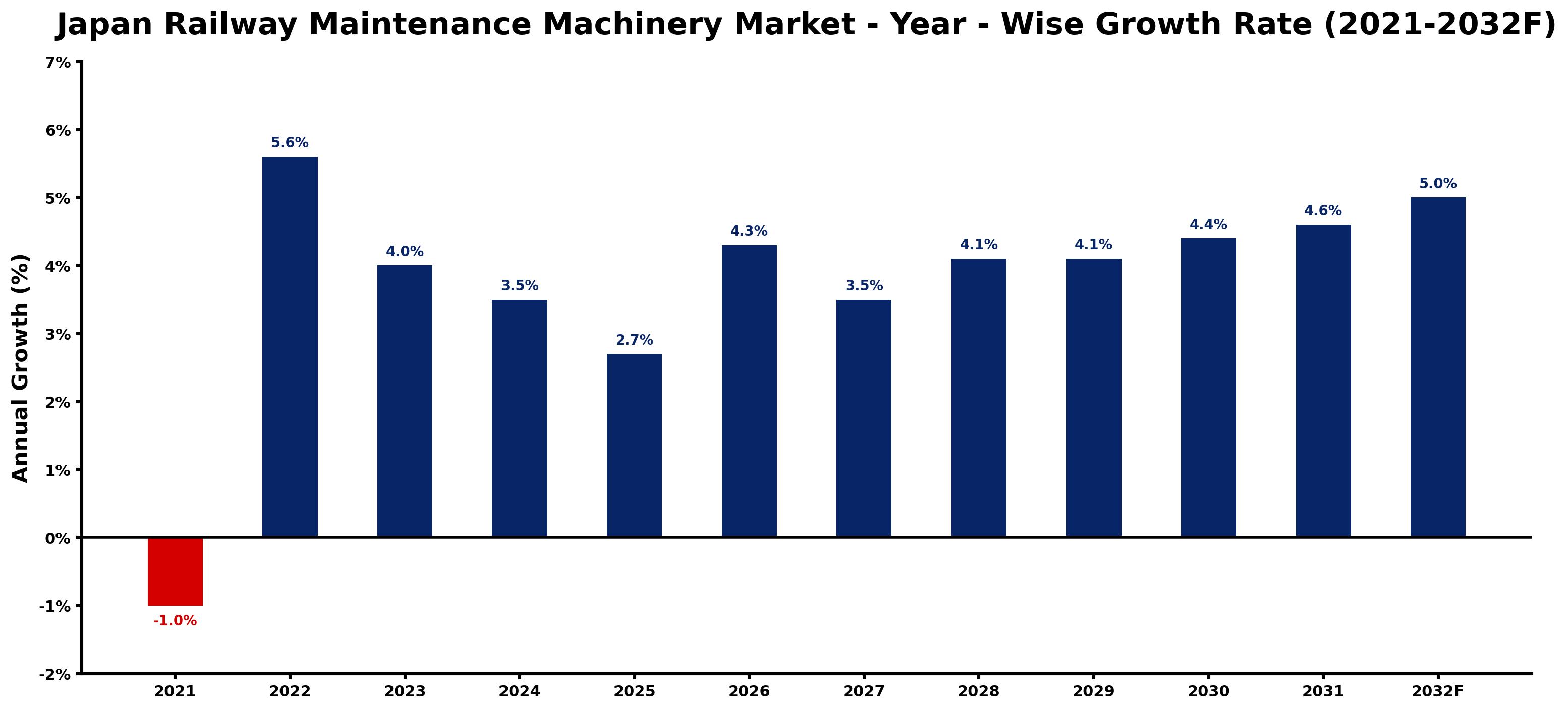
The table below presents the year‑wise growth rates along with the key drivers influencing the market
| Year | Growth Rate | Major Drivers |
| 2021 | -1.0% | Increasing industrial infrastructure investments |
| 2022 | 5.6% | Expansion of manufacturing activities |
| 2023 | 4.0% | Increasing industrial automation investments |
| 2024 | 3.5% | Increasing industrial infrastructure investments |
| 2025 | 2.7% | Increasing industrial infrastructure investments |
| 2026 | 4.3% | Increasing smart city development projects |
| 2027 | 3.5% | Increasing adoption of advanced technologies |
| 2028 | 4.1% | Increasing smart city development projects |
| 2029 | 4.1% | Growing urbanization and commercial development |
| 2030 | 4.4% | Increasing smart city development projects |
| 2031 | 4.6% | Increasing smart city development projects |
| 2032 | 5.0% | Rising electricity demand across industries |
Note - Market size estimations and growth projections presented in this report are based on 6Wresearch's advanced forecasting approach, validated with industry datasets as of June 2026.
Japan Railway Maintenance Machinery Market Synopsis
Recently, the Japan Railway Maintenance Machinery Market has seen robust growth fueled by significant investments in infrastructure modernization. However, as the market evolves, it is becoming increasingly vital to integrate cutting-edge technologies to enhance operational efficiency and sustainability. This shift represents both a challenge and an opportunity as stakeholders adapt to the rapid pace of technological innovation.
Looking ahead, the market is poised for steady expansion, driven by the need for reliable maintenance of Japan's rail networks. With advancements in predictive maintenance and automation becoming more prevalent, the landscape of railway maintenance is transforming into a more connected and data-driven environment.
Japan Railway Maintenance Machinery Market Key Takeaways
- The market is projected to experience a steady CAGR of 3.2% from 2026 to 2032, driven by modernization efforts.
- Technological advancements, particularly in automation and predictive maintenance, are reshaping market dynamics.
- Investment opportunities are emerging in eco-friendly and specialized maintenance equipment.
- Government policies are facilitating innovation and operational efficiency in railway maintenance.
- Stakeholders face challenges related to skilled labor availability and the high costs of advanced machinery.
Evaluation of Restraints in Japan Railway Maintenance Machinery Market
Several constraints hinder the growth of the Japan Railway Maintenance Machinery Market. One primary concern is the high capital expenditure associated with acquiring and maintaining advanced maintenance machinery, which can deter some operators from upgrading their equipment. Additionally, the industry is facing a shortage of skilled technicians capable of operating and maintaining sophisticated machinery, creating a skills gap that can hamper operational effectiveness. Moreover, the need for continuous innovation to remain competitive puts pressure on manufacturers to invest heavily in research and development, which can be a significant financial burden. Compliance with stringent safety regulations also necessitates ongoing investments to ensure equipment meets required standards.
Japan Railway Maintenance Machinery Market Trends
The Japan Railway Maintenance Machinery Market is currently undergoing a pivotal transformation marked by the adoption of advanced technologies. The integration of IoT and AI is increasingly prevalent, allowing for predictive maintenance capabilities that anticipate equipment failures before they occur. Additionally, the use of robotics and drones for inspection and repair tasks is gaining traction, enhancing safety and efficiency in maintenance operations. Sustainability is another focal point, with an emerging demand for eco-friendly maintenance solutions that minimize environmental impact. As data analytics becomes more sophisticated, railway operators are leveraging remote monitoring capabilities to optimize maintenance schedules and decision-making processes.
Japan Railway Maintenance Machinery Market Opportunities
There exists a wealth of investment opportunities within the Japan Railway Maintenance Machinery Market. The increasing complexity of railway systems necessitates specialized maintenance equipment, including rail grinders and track inspection vehicles. Furthermore, the demand for advanced technologies such as automated inspection tools and predictive maintenance systems is on the rise, presenting avenues for innovation and growth. Investors should also consider the potential in software solutions aimed at optimizing asset management and maintenance scheduling, all of which are essential for modern railway operations. With Japan's continued focus on high-speed rail and urban transit, the landscape for railway maintenance machinery is set to expand significantly.
Government Initiatives in the Japan Railway Maintenance Machinery Market
Government policies play a crucial role in shaping the Japan Railway Maintenance Machinery Market. The Japanese government has implemented regulations mandating regular maintenance and inspection of railway infrastructure, thereby enhancing safety and efficiency in operations. Additionally, there are various subsidies and funding initiatives designed to encourage the adoption of advanced maintenance technologies. This financial support not only facilitates the procurement of innovative machinery but also fosters collaboration among government entities, railway operators, and manufacturers, promoting a culture of innovation and sustainability within the sector.
Future Insights of the Japan Railway Maintenance Machinery Market
Looking ahead to 2026-2032, the Japan Railway Maintenance Machinery Market is expected to experience steady growth driven by the increasing emphasis on modernizing railway infrastructure. The government's focus on safety and efficiency will continue to fuel demand for advanced maintenance solutions. Additionally, technological advancements, particularly those related to automation and predictive maintenance, are likely to significantly enhance the efficiency of railway maintenance activities. As industry players invest in innovation, we anticipate the introduction of new products that align with the evolving demands of Japan's extensive railway network.
Japan Railway Maintenance Machinery Market Latest Developments (May 2025 - June 2026)
In recent months, the Japan Railway Maintenance Machinery Market has witnessed a flurry of activity aimed at enhancing operational efficiency and safety. Key developments include the launch of new automated maintenance solutions that leverage artificial intelligence to improve inspection accuracy. Additionally, various partnerships between technology firms and railway operators have emerged, focused on integrating IoT capabilities into existing maintenance frameworks. This collaborative approach highlights the industry's commitment to modernizing operations and addressing the growing need for sustainable practices.
Japan Railway Maintenance Machinery Market - Key Attractiveness of the Report
- 10 Years of Market Numbers
- Historical Data Starting from 2022 to 2025
- Base Year: 2025
- Forecast Data until 2032
- Key Performance Indicators Impacting the Market
- Major Upcoming Developments and Projects
Key Highlights of the Report:
- Japan Railway Maintenance Machinery Market Outlook
- Market Size of Japan Railway Maintenance Machinery Market, 2025
- Forecast of Japan Railway Maintenance Machinery Market, 2032
- Historical Data and Forecast of Japan Railway Maintenance Machinery Revenues & Volume for the Period 2022-2032F
- Japan Railway Maintenance Machinery Market Trend Evolution
- Japan Railway Maintenance Machinery Market Drivers and Challenges
- Japan Railway Maintenance Machinery Price Trends
- Japan Railway Maintenance Machinery Porter's Five Forces
- Japan Railway Maintenance Machinery Industry Life Cycle
- Historical Data and Forecast of Japan Railway Maintenance Machinery Market Revenues & Volume By Type for the Period 2022-2032F
- Historical Data and Forecast of Japan Railway Maintenance Machinery Market Revenues & Volume By Tamping Machine for the Period 2022-2032F
- Historical Data and Forecast of Japan Railway Maintenance Machinery Market Revenues & Volume By Stabilizing Machinery for the Period 2022-2032F
- Historical Data and Forecast of Japan Railway Maintenance Machinery Market Revenues & Volume By Rail Handling Machinery for the Period 2022-2032F
- Historical Data and Forecast of Japan Railway Maintenance Machinery Market Revenues & Volume By Ballast Cleaning Machine for the Period 2022-2032F
- Historical Data and Forecast of Japan Railway Maintenance Machinery Market Revenues & Volume By Other for the Period 2022-2032F
- Historical Data and Forecast of Japan Railway Maintenance Machinery Market Revenues & Volume By Applications for the Period 2022-2032F
- Historical Data and Forecast of Japan Railway Maintenance Machinery Market Revenues & Volume By Ballast Track for the Period 2022-2032F
- Historical Data and Forecast of Japan Railway Maintenance Machinery Market Revenues & Volume By Ballastless Track for the Period 2022-2032F
- Japan Railway Maintenance Machinery Import Export Trade Statistics
- Market Opportunity Assessment By Type
- Market Opportunity Assessment By Applications
- Japan Railway Maintenance Machinery Top Companies Market Share
- Japan Railway Maintenance Machinery Competitive Benchmarking By Technical and Operational Parameters
- Japan Railway Maintenance Machinery Company Profiles
- Japan Railway Maintenance Machinery Key Strategic Recommendations






































