Japan Railway Track Maintenance Equipment Market Size & Growth Rate
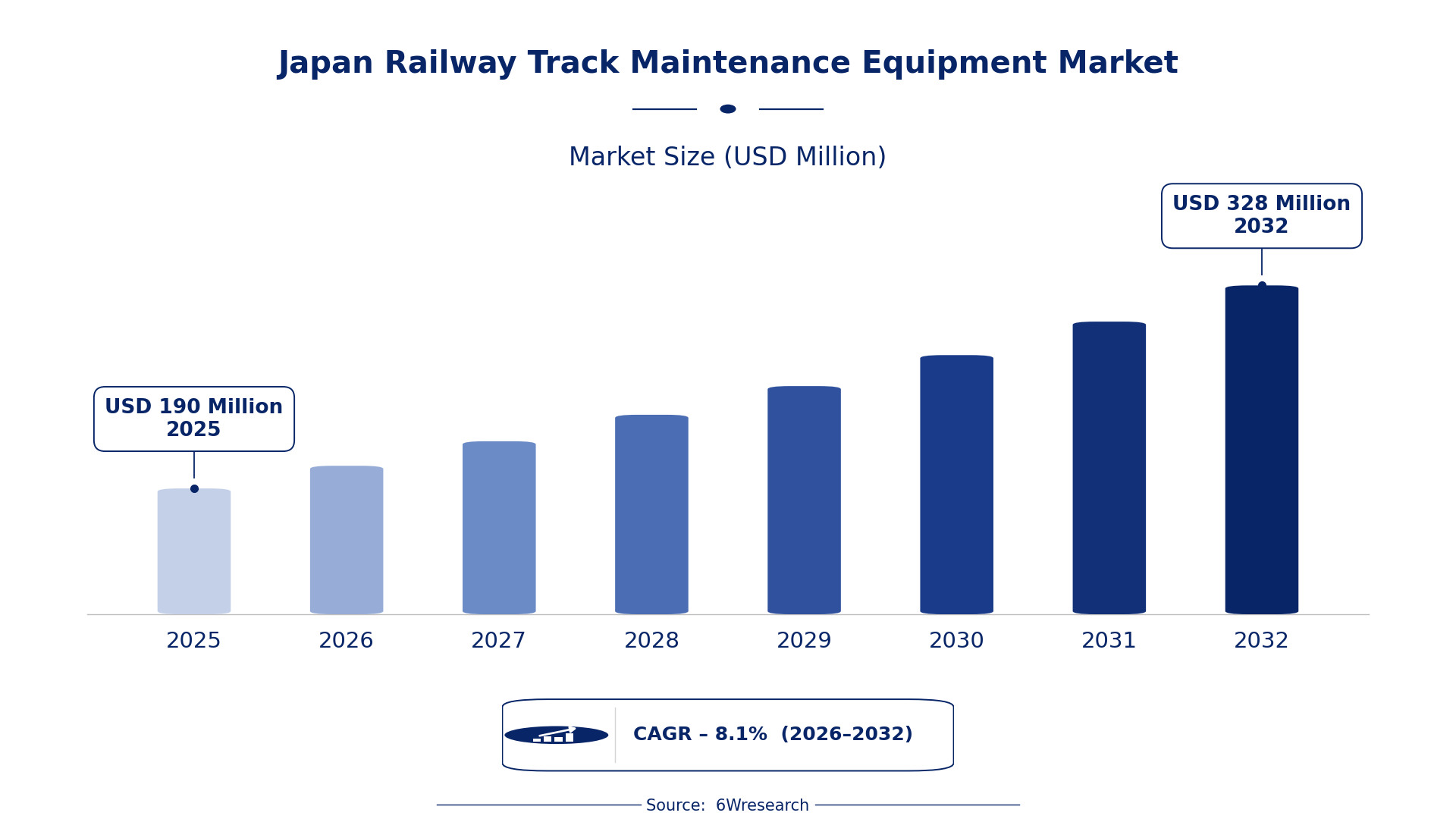
According to 6Wresearch internal database and industry insights, the Japan Railway Track Maintenance Equipment Market was valued at USD 190 Million in 2025 and is projected to reach USD 328 Million by 2032, growing at a CAGR of approximately 8.1% during 2026–2032.
Japan Railway Track Maintenance Equipment Market Highlights
| Report Metric | Details |
| Report Name | Japan Railway Track Maintenance Equipment Market (2026-2032) |
| Market Size 2025 | USD 190 Million |
| Market Size 2032 | USD 328 Million |
| Absolute Growth 2025–2032 | USD 138 Million |
| CAGR 2026–2032 | 8.1% |
| Peak Annual Growth | 9.3% in 2027 |
| Forecast Period | 2026–2032 |
| Historical Data | 2022–2025 |
| Base Year | 2025 |
| Leading Equipment Type, 2025 | Tamping Machines (37% share) |
| Leading Functionality, 2025 | Track Stabilization (42% share) |
| Leading Power Source, 2025 | Diesel (38% share) |
| Leading End User, 2025 | Railway Infrastructure Firms (40% share) |
| Fastest-Growing Equipment Type | Track Inspection Cars (10.8% CAGR) |
| Fastest-Growing Functionality | Rail Fault Detection (10.0% CAGR) |
| Fastest-Growing Power Source | Battery/Electric (11.8% CAGR) |
| Growing Sector | Railway Infrastructure |
| Key End Users | Railway Infrastructure Firms, National Maintenance Units, Rail System Contractors |
Japan Railway Track Maintenance Equipment Market Year-wise Growth Rate and Key Drivers (2022–2032)
This graph illustrates the annual growth rates of the market from 2022 to 2032, highlighting a steady upward trajectory and projected market expansion over the forecast period.
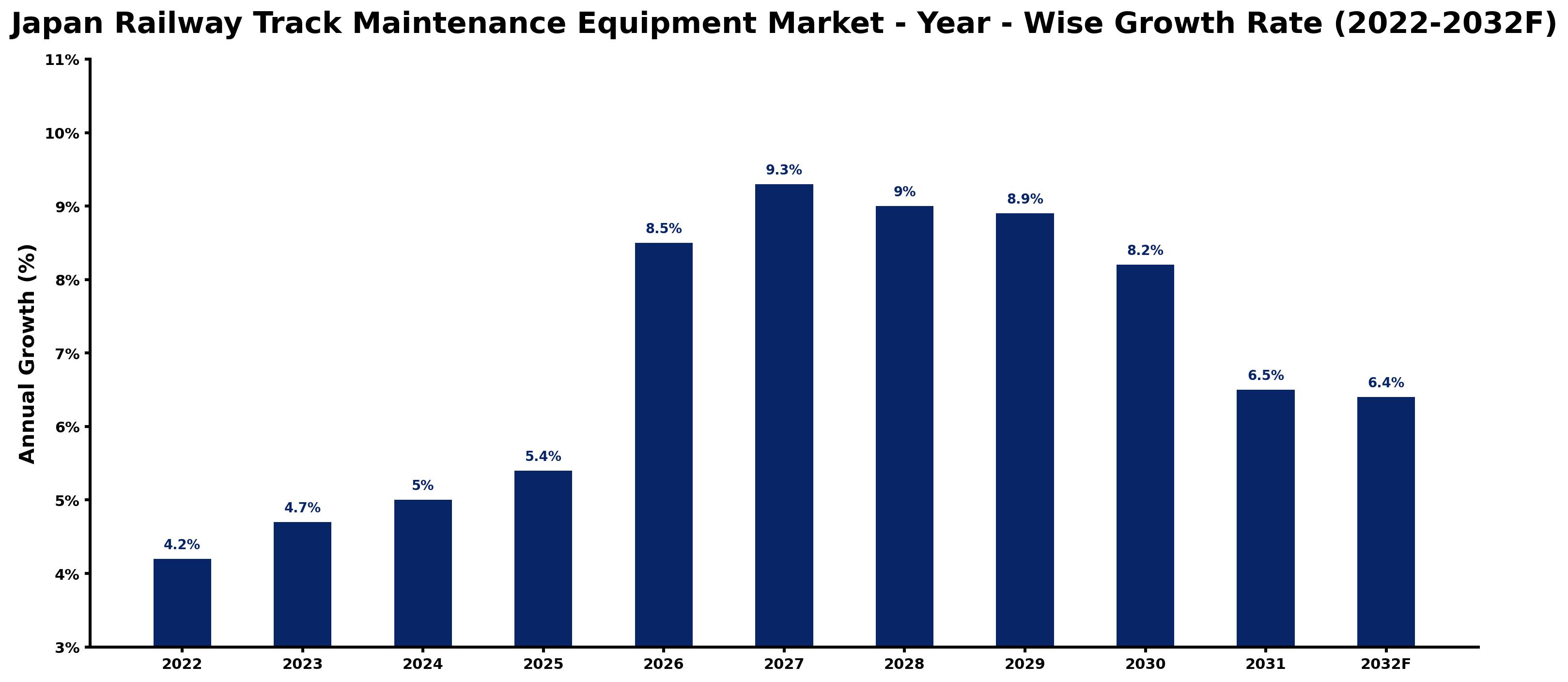
Each row of the following table gives one year's estimated growth and the event or demand shift that explains it.
| Year | Estimated Annual Growth (%) | Market Rationale |
| 2022 | 4.2 | The market experienced moderate growth due to ongoing maintenance needs. |
| 2023 | 4.7 | Growth accelerated as investments in rail infrastructure increased. |
| 2024 | 5.0 | The rise in passenger volume further boosted demand for maintenance equipment. |
| 2025 | 5.4 | The peak historical growth was driven by infrastructure upgrades. |
| 2026 | 8.5 | A surge in track inspection initiatives is expected to spur higher demand. |
| 2027 | 9.3 | The market will reach its peak growth due to public investments. |
| 2028 | 9.0 | Growth is projected to slow slightly as the market begins to stabilise. |
| 2029 | 8.9 | Demand will continue to grow, albeit at a slower pace than before. |
| 2030 | 8.2 | The market is expected to maintain growth, supported by ongoing infrastructure projects. |
| 2031 | 6.5 | Growth will further slow as the market approaches maturity. |
| 2032 | 6.4 | The market is expected to stabilise with consistent maintenance needs. |
Note: Market size estimations and growth projections presented in this report are based on 6Wresearch's proprietary forecasting methodology, utilizing the latest available industry data, government publications, and primary research inputs.
Japan Railway Track Maintenance Equipment Market Synopsis
Railway Track Maintenance Equipment includes various machines and tools crucial for maintaining the safety and efficiency of railway tracks. In Japan, the Shinkansen network fuels demand for this equipment, supported by both public and private investments in rail infrastructure. The market is growing due to rising passenger volumes, with around 7.5 billion passengers recorded in 2022, and ongoing efforts to upgrade ageing rail infrastructure, creating a favourable investment climate. This growth is further driven by technological advancements and increasing public sector funding for infrastructure projects.
Market Dynamics Impact Analysis (2026–2032)
| Factor | Type | Impact | Primary Segment Affected |
| Growing investments in rail infrastructure projects | Driver | High | Track Stabilization |
| Increasing passenger volume driving maintenance needs | Driver | High | Rail Fault Detection |
| Technological advancements in equipment efficiency | Opportunity | Medium | Track Inspection Cars |
| Government initiatives to modernise rail systems | Opportunity | High | Tamping Machines |
| High costs associated with advanced machinery | Restraint | High | Rail Grinders |
| Aging infrastructure requiring frequent updates | Restraint | Medium | Tie Replacers |
| Limited availability of skilled technicians | Challenge | High | Track Inspection Cars |
| Rising operational costs impacting maintenance budgets | Challenge | Medium | Tamping Machines |
Evaluation of Drivers in Japan Railway Track Maintenance Equipment Market (2026–2032)
The main growth drivers and the segments they affect most are set out below.
| Drivers | Primary Segment Affected | Why It Matters (Evidence) |
| Increased public and private sector investments | Track Stabilization | Japan's railway infrastructure projects received substantial funding, with over 27,000 kilometers of tracks needing maintenance. |
| Rising passenger volumes | Rail Fault Detection | With approximately 7.5 billion passengers in 2022, the demand for reliable rail services drives fault detection equipment purchases. |
| Technological advancements in maintenance equipment | Track Inspection Cars | Innovations in inspection technology are improving efficiency, prompting railway firms to upgrade their equipment. |
| Government initiatives for infrastructure upgrades | Tamping Machines | The Act on the Rational Use of Energy encourages investments in efficient track maintenance, leading to increased purchases of tamping machines. |
| Environmental regulations promoting cleaner technologies | Battery/Electric | The adoption of battery/electric powered equipment is rising to comply with environmental standards. |
A wider customer base explains much of the growth, as public and private sector investments in railway infrastructure have surged. In 2022, Japan's rail services recorded approximately 7.5 billion passengers, increasing demand for reliable rail fault detection systems. Technological advancements in maintenance equipment have led to more efficient track inspection tools, prompting railway firms to upgrade their machinery. The rising adoption of battery/electric powered equipment is expanding market opportunities, aligning with environmental compliance efforts.
Evaluation of Restraints in Japan Railway Track Maintenance Equipment Market
The table below lists the restraints and the evidence behind each.
| Market Restraint | Primary Segment Affected | Why It Matters (Evidence) |
| High costs associated with advanced machinery | Rail Grinders | The investment required for modern rail grinders can deter smaller firms from upgrading their equipment. |
| Aging infrastructure requiring frequent updates | Tie Replacers | The average age of railway tracks exceeds 30 years, necessitating continuous maintenance efforts. |
| Limited availability of skilled technicians | Track Inspection Cars | A shortage of qualified personnel to operate advanced machinery can hinder maintenance operations. |
| Rising operational costs impacting maintenance budgets | Tamping Machines | Increased costs for materials and labour can limit the budget available for maintenance equipment. |
| Regulatory compliance costs for manufacturers | Battery/Electric | Manufacturers must invest in compliance with standards like ISO 9001, increasing production costs. |
Japan Railway Track Maintenance Equipment Market Challenges
Japan's outdated railway infrastructure presents a major hurdle for track maintenance equipment. With the average age of railway tracks exceeding 30 years, railway operators face frequent repairs that delay services. High technology costs deter buyers from adopting advanced maintenance solutions, leading to inefficiencies in operations. In 2022, Japan's railway passenger volume reached approximately 7.5 billion, intensifying the urgency for timely maintenance. Regulatory compliance with standards like ISO 9001 raises operational costs for manufacturers, limiting their capacity to deliver equipment on schedule to buyers.
Trends in the Japan Railway Track Maintenance Equipment Market
The following changes are redrawing the Japan Railway Track Maintenance Equipment Market.
- Tokyo Metropolitan Area Leading in Equipment Adoption: The high density of railway lines in the Tokyo metropolitan area drives demand for railway maintenance equipment. With over 27,000 kilometers of tracks requiring advanced machinery, this region is critical for ensuring safety and efficiency.
- Railway Infrastructure Firms Prioritising Modernisation: Railway Infrastructure Firms are increasingly investing in modern maintenance technologies to improve operational efficiency. In 2023, a new initiative was launched to upgrade aging rail infrastructure, reflecting the industry's commitment to safety.
- Shift Towards Battery/Electric Powered Equipment: Since 2022, there has been a marked increase in the adoption of battery/electric powered equipment for environmental compliance. This shift is expected to continue as firms seek to reduce their carbon footprint.
- Focus on Rail Fault Detection Technologies: The growing emphasis on rail safety has led to advancements in rail fault detection technologies. With a projected CAGR of 10.0% for this segment, firms are investing in innovative solutions to improve monitoring.
Investment Opportunities in the Japan Railway Track Maintenance Equipment Market
Several openings in the Japan Railway Track Maintenance Equipment Market merit attention from investors.
- Collaborate with Railway Infrastructure Firms: Railway Infrastructure Firms are in search of advanced maintenance solutions, creating opportunities for partnerships. With substantial investments in rail infrastructure, suppliers can engage through joint ventures.
- Invest in Battery/Electric Powered Equipment: The rise in environmental regulations generates demand for battery/electric powered equipment. Suppliers can target railway firms in urban areas, where compliance is essential.
- Support Upgrading Aging Rail Infrastructure: The initiative to upgrade ageing rail infrastructure presents opportunities for suppliers of maintenance equipment. With an average track age exceeding 30 years, firms require reliable solutions.
- Expand into Track Inspection Technologies: The increasing emphasis on rail safety generates a need for advanced track inspection technologies. Suppliers can enter the market by collaborating with national maintenance units.
Government Initiatives in the Japan Railway Track Maintenance Equipment Market
The Industrial Standardization Act, amended in 2019, governs product and test standards for railway maintenance equipment. This law ensures that manufacturers adhere to quality benchmarks, promoting safety and efficiency in the industry. Additionally, the Act on the Rational Use of Energy, established in 1979, mandates improvements in energy efficiency, influencing equipment design and operational practices.
The Japan Railway Construction, Transport and Technology Agency oversees railway infrastructure projects and provides funding for upgrades. This agency has approved numerous projects aimed at improving safety and efficiency, benefiting railway infrastructure firms. The Ministry of Land, Infrastructure, Transport and Tourism also allocates resources to ensure compliance with safety standards, directly impacting maintenance practices.
Future Insight of the Japan Railway Track Maintenance Equipment Market
A policy-driven shift towards modernising rail infrastructure will encourage suppliers to invest in advanced maintenance technologies by 2032. Increased funding for track maintenance will improve operational safety and efficiency across the network. A new initiative launched in 2023 aims to upgrade ageing rail systems, driving innovation in equipment design. As battery-powered solutions gain popularity for environmental compliance, buyers will benefit from reduced operational costs and improved sustainability in their maintenance practices.
Market Segmentation Analysis
Japan Railway Track Maintenance Equipment Market report covers a detailed analysis of the following market segments:
By Equipment Type – Tamping Machines Lead, Track Inspection Cars Expected to Grow Fastest
According to Saurav Kr Singh, Senior Research Analyst at 6Wresearch, Tamping Machines took 37% of equipment type revenue in 2025, more than any other category. Tamping Machines hold the largest market share due to their critical role in track stabilization, which is vital for maintaining safety across Japan's extensive railway network. Their significance is particularly highlighted in high-speed rail areas, such as the Shinkansen network, where effective maintenance is essential. Track Inspection Cars are projected to grow fastest, at a CAGR of 10.8% during 2026–2032. Track Inspection Cars are experiencing rapid growth driven by their crucial function in rail fault detection, especially as the focus on safety and operational efficiency intensifies. The recent initiative to upgrade aging rail infrastructure has significantly increased their demand. Suppliers should enhance the availability of Track Inspection Cars to meet the rising safety standards within the railway sector.
By Functionality – Track Stabilization Leads, Rail Fault Detection Expected to Grow Fastest
Track Stabilization accounted for 42% of the market by functionality in 2025. Track Stabilization leads the market as it is fundamental to ensuring the safety and longevity of railway tracks, particularly given the average age of over 30 years. The National Railway Safety Program underscores the importance of this functionality in maintaining operational efficiency. Rail Fault Detection is set to record the highest CAGR in this split, 10.0% over 2026–2032. Rail Fault Detection is the fastest-growing segment, driven by heightened safety regulations and the need for real-time monitoring of track conditions. The emphasis on advanced technologies for fault detection is likely to propel this segment further. Buyers will benefit from investing in advanced fault detection technologies to improve safety and reduce maintenance costs.
By Power Source – Diesel Leads, Battery/Electric Expected to Grow Fastest
With 38% of power source revenue in 2025, Diesel was the largest category. Diesel-powered equipment dominates the market due to its established reliability and performance in various maintenance operations across Japan's railway network. The existing infrastructure is heavily reliant on these machines for effective track maintenance. Over 2026–2032, Battery/Electric is expected to post the fastest growth, at a CAGR of 11.8%. Battery/Electric powered equipment is rapidly gaining traction as environmental compliance becomes increasingly important in the railway sector. The shift towards greener technologies is expected to drive further adoption of these power sources. Suppliers must adapt to the growing demand for Battery/Electric equipment to align with environmental regulations and customer preferences.
By End User – Railway Infrastructure Firms Lead and Record the Fastest Growth
The largest end user category in 2025 was Railway Infrastructure Firms, at 40% of revenue. Railway Infrastructure Firms account for the largest share as they are the primary buyers of maintenance equipment responsible for the upkeep of Japan's extensive railway system. Their considerable investments in rail infrastructure directly influence the demand for various maintenance solutions. The same category are also set to grow fastest, at a CAGR of 9.9% during 2026–2032. Railway Infrastructure Firms are also the fastest-growing segment, as their ongoing projects and upgrades to ageing infrastructure require modern maintenance equipment. This dual role as both leader and fastest suggests a sustained trend of investment in rail maintenance. Suppliers should prioritise partnerships with Railway Infrastructure Firms to capitalise on their ongoing projects and maintenance needs.
Key Attractiveness of the Report
- 10 Years of Market Numbers
- Historical Data Starting from 2022 to 2025
- Base Year 2025
- Forecast Data until 2032
- Key Performance Indicators Impacting the Market
- Major Upcoming Developments and Projects
Key Highlights of the Report:
- Japan Railway Track Maintenance Equipment Market Outlook
- Market Size of Japan Railway Track Maintenance Equipment Market, 2025
- Forecast of Japan Railway Track Maintenance Equipment Market, 2032
- Historical Data and Forecast of Japan Railway Track Maintenance Equipment Revenues & Volume for the Period 2022-2032F
- Japan Railway Track Maintenance Equipment Market Trend Evolution
- Japan Railway Track Maintenance Equipment Market Drivers and Challenges
- Japan Railway Track Maintenance Equipment Price Trends
- Japan Railway Track Maintenance Equipment Porter's Five Forces
- Japan Railway Track Maintenance Equipment Industry Life Cycle
- Historical Data and Forecast of Japan Railway Track Maintenance Equipment Market Revenues & Volume By Equipment Type for the Period 2022-2032F
- Historical Data and Forecast of Japan Railway Track Maintenance Equipment Market Revenues & Volume By Tamping Machines for the Period 2022-2032F
- Historical Data and Forecast of Japan Railway Track Maintenance Equipment Market Revenues & Volume By Track Inspection Cars for the Period 2022-2032F
- Historical Data and Forecast of Japan Railway Track Maintenance Equipment Market Revenues & Volume By Rail Grinders for the Period 2022-2032F
- Historical Data and Forecast of Japan Railway Track Maintenance Equipment Market Revenues & Volume By Tie Replacers for the Period 2022-2032F
- Historical Data and Forecast of Japan Railway Track Maintenance Equipment Market Revenues & Volume By Functionality for the Period 2022-2032F
- Historical Data and Forecast of Japan Railway Track Maintenance Equipment Market Revenues & Volume By Track Stabilization for the Period 2022-2032F
- Historical Data and Forecast of Japan Railway Track Maintenance Equipment Market Revenues & Volume By Rail Fault Detection for the Period 2022-2032F
- Historical Data and Forecast of Japan Railway Track Maintenance Equipment Market Revenues & Volume By Surface Polishing for the Period 2022-2032F
- Historical Data and Forecast of Japan Railway Track Maintenance Equipment Market Revenues & Volume By Sleeper Installation for the Period 2022-2032F
- Historical Data and Forecast of Japan Railway Track Maintenance Equipment Market Revenues & Volume By Power Source for the Period 2022-2032F
- Historical Data and Forecast of Japan Railway Track Maintenance Equipment Market Revenues & Volume By Diesel for the Period 2022-2032F
- Historical Data and Forecast of Japan Railway Track Maintenance Equipment Market Revenues & Volume By Battery/Electric for the Period 2022-2032F
- Historical Data and Forecast of Japan Railway Track Maintenance Equipment Market Revenues & Volume By Hydraulic for the Period 2022-2032F
- Historical Data and Forecast of Japan Railway Track Maintenance Equipment Market Revenues & Volume By Manual/Electric for the Period 2022-2032F
- Historical Data and Forecast of Japan Railway Track Maintenance Equipment Market Revenues & Volume By End User for the Period 2022-2032F
- Historical Data and Forecast of Japan Railway Track Maintenance Equipment Market Revenues & Volume By Railway Infrastructure Firms for the Period 2022-2032F
- Historical Data and Forecast of Japan Railway Track Maintenance Equipment Market Revenues & Volume By National Maintenance Units for the Period 2022-2032F
- Historical Data and Forecast of Japan Railway Track Maintenance Equipment Market Revenues & Volume By Rail System Contractors for the Period 2022-2032F
- Historical Data and Forecast of Japan Railway Track Maintenance Equipment Market Revenues & Volume By Construction Companies for the Period 2022-2032F
- Japan Railway Track Maintenance Equipment Import Export Trade Statistics
- Market Opportunity Assessment By Equipment Type
- Market Opportunity Assessment By Functionality
- Market Opportunity Assessment By Power Source
- Market Opportunity Assessment By End User
- Japan Railway Track Maintenance Equipment Top Companies Market Share
- Japan Railway Track Maintenance Equipment Competitive Benchmarking By Technical and Operational Parameters
- Japan Railway Track Maintenance Equipment Company Profiles
- Japan Railway Track Maintenance Equipment Key Strategic Recommendations
Market Covered
Coverage by segment is as follows.
By Equipment Type
- Tamping Machines
- Track Inspection Cars
- Rail Grinders
- Tie Replacers
By Functionality
- Track Stabilization
- Rail Fault Detection
- Surface Polishing
- Sleeper Installation
By Power Source
- Diesel
- Battery/Electric
- Hydraulic
- Manual/Electric
By End User
- Railway Infrastructure Firms
- National Maintenance Units
- Rail System Contractors
- Construction Companies































