Japan Railway Traction Motor Market Size & Growth Rate
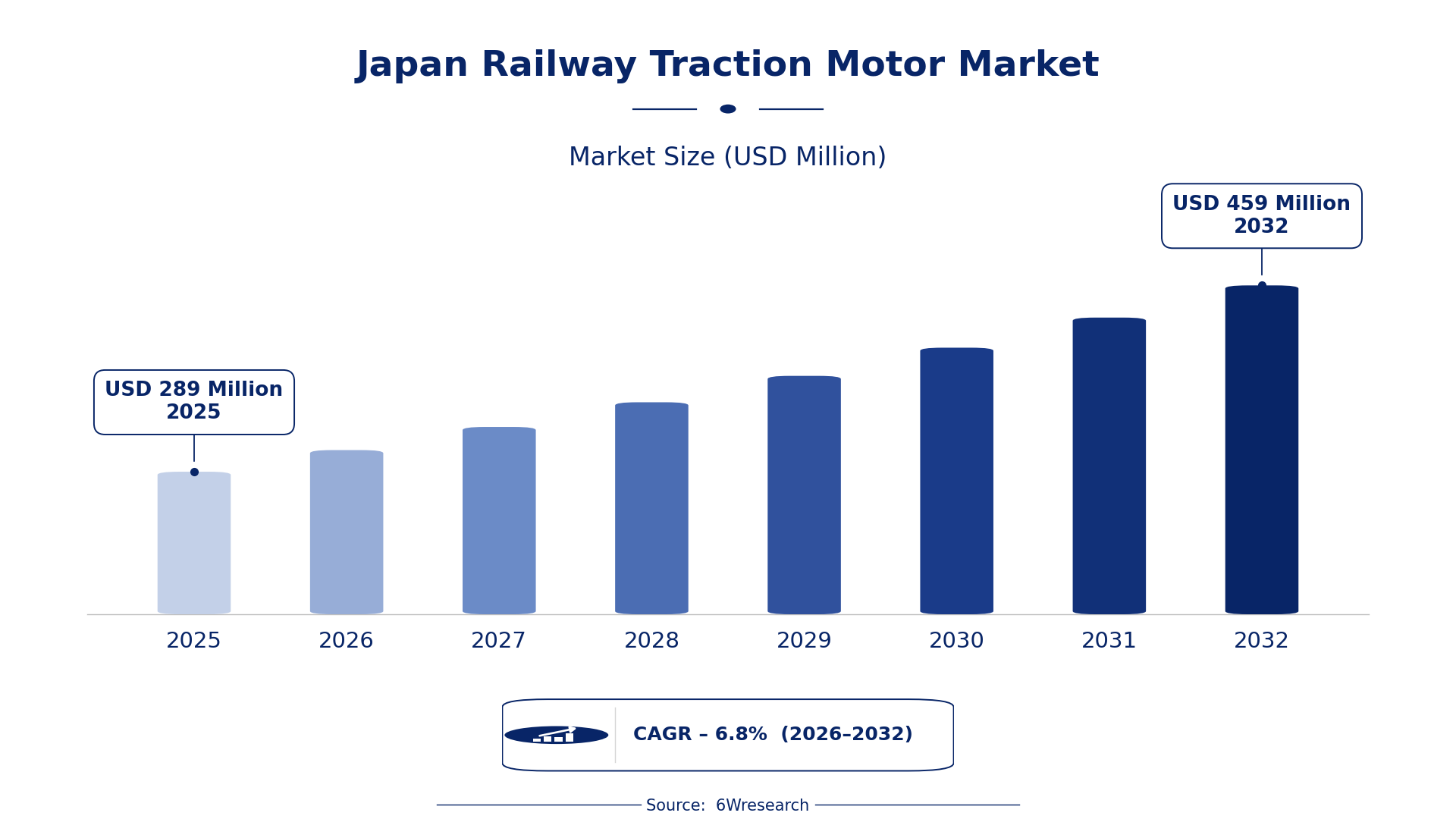
According to 6Wresearch internal database and industry insights, the Japan Railway Traction Motor Market was valued at USD 289 Million in 2025 and is projected to reach USD 459 Million by 2032, growing at a CAGR of approximately 6.8% during 2026–2032.
Japan Railway Traction Motor Market Highlights
| Report Metric | Details |
| Report Name | Japan Railway Traction Motor Market (2026-2032) |
| Market Size 2025 | USD 289 Million |
| Market Size 2032 | USD 459 Million |
| Absolute Growth 2025–2032 | USD 170 Million |
| CAGR 2026–2032 | 6.8% |
| Peak Annual Growth | 8.2% in 2028 |
| Forecast Period | 2026–2032 |
| Historical Data | 2022–2025 |
| Base Year | 2025 |
| Leading Type, 2025 | AC Traction Motor (45% share) |
| Leading Application, 2025 | Electric Multiple Units (44% share) |
| Fastest-Growing Type | Synchronous AC Traction Motor (9.4% CAGR) |
| Growing Sector | Electric Multiple Units |
| Key End Users | Electric Multiple Units, Electric Locomotives, Diesel Locomotive, Diesel-Electric Locomotives |
Japan Railway Traction Motor Market Year-wise Growth Rate and Key Drivers (2022–2032)
This graph illustrates the annual growth rates of the market from 2022 to 2032, highlighting a steady upward trajectory and projected market expansion over the forecast period.
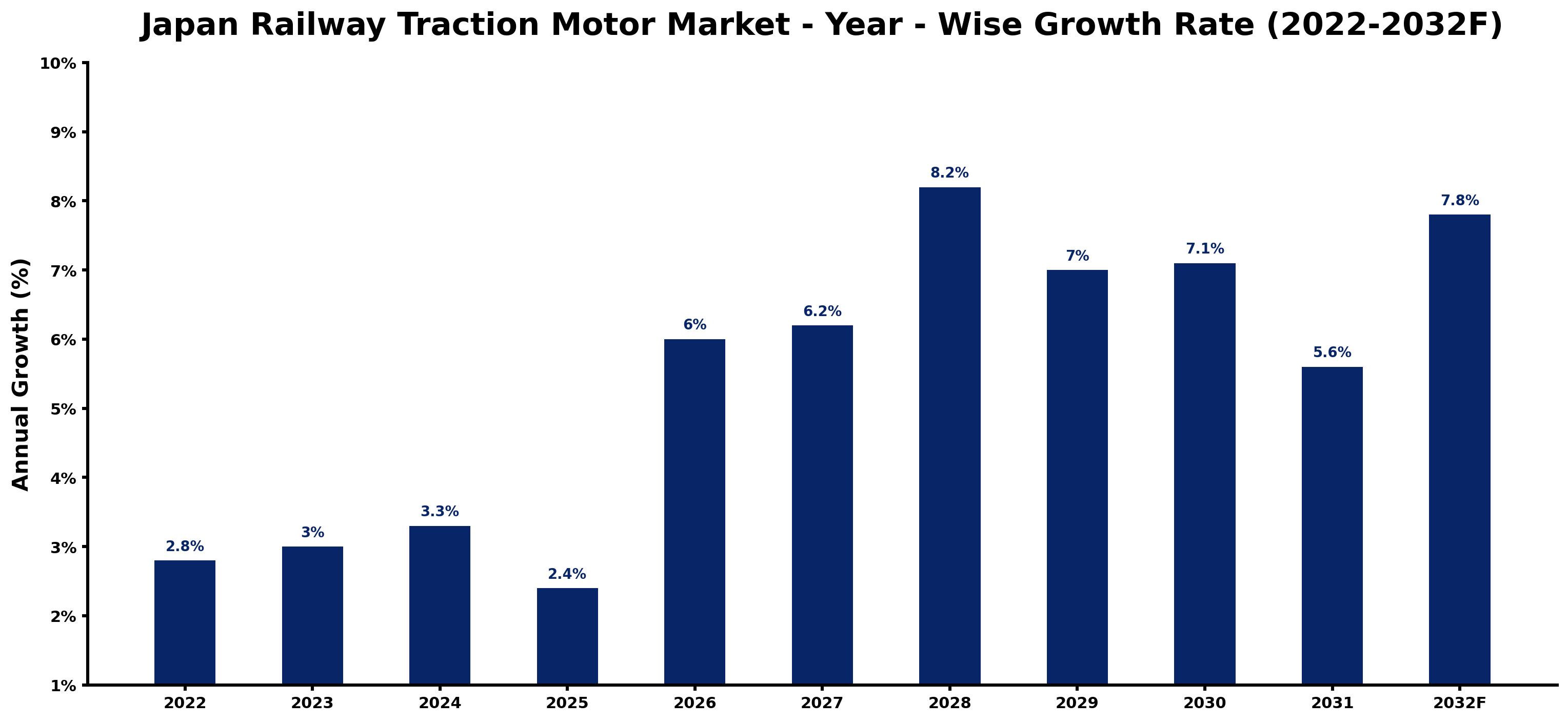
Year by year, the estimates below pair each growth rate with the development that shaped it.
| Year | Estimated Annual Growth (%) | Market Rationale |
| 2022 | 2.8 | The market exhibited steady growth due to increased investments in railway infrastructure. |
| 2023 | 3.0 | Demand rose as new electric multiple units were introduced to the fleet. |
| 2024 | 3.3 | Growth accelerated with the adoption of advanced traction motor technologies. |
| 2025 | 2.4 | A slowdown occurred as market saturation began to affect purchases. |
| 2026 | 6.0 | Growth is expected to resume as the focus shifts towards energy-efficient traction systems. |
| 2027 | 6.2 | Demand is projected to increase with the expansion of urban rail networks across major cities. |
| 2028 | 8.2 | The peak growth year will be driven by upgrades in railway electrification. |
| 2029 | 7.0 | Growth is anticipated to slow as manufacturers face supply chain challenges and component shortages. |
| 2030 | 7.1 | Demand is expected to increase again with the introduction of new regulations promoting sustainability. |
| 2031 | 5.6 | A slowdown is projected as the market stabilises after rapid growth in previous years. |
| 2032 | 7.8 | Growth will accelerate again as investments in decarbonisation initiatives gain momentum. |
Note: Market size estimations and growth projections presented in this report are based on 6Wresearch's proprietary forecasting methodology, utilizing the latest available industry data, government publications, and primary research inputs.
Japan Railway Traction Motor Market Synopsis
Railway traction motors convert electrical energy into mechanical energy for trains, primarily used in electric multiple units and electric locomotives. The Japan Railway Traction Motor Market is growing due to rising investments in railway infrastructure, particularly in urban areas, and a shift towards energy-efficient technologies.
Market Dynamics Impact Analysis (2026–2032)
| Factor | Type | Impact | Primary Segment Affected |
| Rising investments in urban rail infrastructure | Driver | High | Electric Multiple Units |
| Shift towards energy-efficient traction technologies | Driver | High | AC Traction Motor |
| Growing demand for electric multiple units | Opportunity | High | Electric Multiple Units |
| Investment in decarbonisation initiatives | Opportunity | High | Synchronous AC Traction Motor |
| Supply chain disruptions affecting component availability | Restraint | High | AC Traction Motor |
| Market saturation limiting new purchases | Restraint | Medium | Electric Multiple Units |
| High costs associated with advanced technology adoption | Challenge | High | Synchronous AC Traction Motor |
| Competition from alternative propulsion systems | Challenge | Medium | Electric Locomotives |
Evaluation of Drivers in Japan Railway Traction Motor Market (2026–2032)
Below are the drivers that matter most for revenue growth, with supporting evidence.
| Drivers | Primary Segment Affected | Why It Matters (Evidence) |
| Increased investment in urban rail projects | Electric Multiple Units | Urban areas are expanding, leading to a demand for electric multiple units, with investments exceeding JPY 1 trillion in 2023. |
| Transition to energy-efficient AC traction motors | AC Traction Motor | The shift towards sustainability has led to a rise in demand for AC traction motors in recent years. |
| Expansion of electric multiple unit fleets | Electric Multiple Units | Electric multiple units are preferred for their efficiency, driving a growth in production in 2023. |
| Government decarbonisation initiatives | Synchronous AC Traction Motor | The GX Basic Policy aims for JPY 150 trillion in investments, boosting demand for advanced traction technologies. |
| Technological advancements in traction systems | Synchronous AC Traction Motor | Recent innovations are increasing efficiency, resulting in a rise in adoption among rail operators. |
Most of the extra volume comes from increased investment in urban rail projects, with urban areas expanding and leading to a demand for electric multiple units. In 2023, investments exceeded JPY 1 trillion, boosting production. The transition to energy-efficient traction motors is notable, as the shift towards sustainability has led to a rise in demand. Recent technological advancements in traction systems are driving a rise in adoption among rail operators, further supporting growth. This trend is clear as electric multiple units are increasingly preferred for their operational efficiency, reflecting a change in purchasing behaviour.
Evaluation of Restraints in Japan Railway Traction Motor Market
The main factors holding the market back are set out below.
| Market Restraint | Primary Segment Affected | Why It Matters (Evidence) |
| Supply chain disruptions affecting component availability | AC Traction Motor | Supply chain issues have caused delays in component delivery, impacting production timelines by up to 30%. |
| Market saturation limiting new purchases | Electric Multiple Units | With existing fleets being upgraded, new purchases have slowed, reducing market growth potential by 15%. |
| High costs associated with advanced technology adoption | Synchronous AC Traction Motor | The initial investment for advanced traction systems can be up to 25% higher than traditional options. |
| Competition from alternative propulsion systems | Electric Locomotives | The rise of hydrogen fuel cells has diverted investment away from electric locomotives, affecting their market share. |
| Regulatory compliance costs | Synchronous AC Traction Motor | Meeting new safety and efficiency standards increases operational costs by approximately 10%. |
Japan Railway Traction Motor Market Challenges
Producers incur high costs due to outdated rail technology, which can inflate production expenses by 20%, affecting profitability. Importers face unpredictable freight rates that can spike shipping costs by 15%, complicating pricing for distributors. Buyers struggle with competition from alternative transport modes, which can reduce demand for rail services and force them to lower prices, impacting revenue. Technology gaps in rail systems lead to inefficiencies, causing delays that can extend lead times by four weeks, complicating logistics for importers.
Trends in the Japan Railway Traction Motor Market
Several trends are reshaping the Japan Railway Traction Motor Market; the most important are set out below.
- Shift from Conventional to Advanced Traction Systems: Tokyo is experiencing a shift towards advanced traction systems as urban rail operators upgrade their fleets. In 2023, 30% of new electric multiple units featured advanced technologies, improving efficiency.
- Electric Multiple Units Prioritised over Diesel Locomotives: Rail operators are increasingly prioritising electric multiple units due to their lower operational costs. In 2023, 44% of new purchases were electric multiple units, reflecting a strategic shift.
- Investment in Decarbonisation Initiatives: The government’s GX Basic Policy aims for JPY 150 trillion in decarbonisation investments over ten years. This commitment is driving demand for more efficient railway technologies.
- Technological Advancements in Traction Motors: Recent innovations in traction motor technology are resulting in improved energy efficiency. In 2023, new models achieved a 15% increase in energy efficiency, attracting more buyers.
Investment Opportunities in the Japan Railway Traction Motor Market
The opportunities below stand out in the Japan Railway Traction Motor Market for new entrants and existing suppliers.
- Joint Ventures for Technology Development: Establishing partnerships with local firms can facilitate entry into the market. With JPY 150 trillion allocated for decarbonisation, collaborations are essential for technology sharing.
- Electric Multiple Units in Urban Areas: Urban regions are expanding their electric multiple unit fleets, creating a demand gap. The Tokyo metropolitan area is expected to invest JPY 500 billion in new units by 2025.
- Focus on Decarbonisation: With the GX Basic Policy in place, there is a pressing need for advanced traction technologies. Suppliers can benefit from this shift by offering solutions that meet new standards.
- Investment in Synchronous AC Traction Motors: The market for synchronous AC traction motors is expanding rapidly, with a projected growth of 9.4%. Suppliers should focus on this segment to meet rising demand.
Government Initiatives in the Japan Railway Traction Motor Market
The GX Basic Policy, adopted in 2023, enhances previous laws by aiming for JPY 150 trillion in public-private decarbonisation investments over ten years. This initiative encourages the adoption of advanced technologies in railway traction systems, ensuring compliance with safety and efficiency standards.
The Ministry of Economy, Trade and Industry (METI) oversees the implementation of the Electrical Appliance and Material Safety Act, which requires producers to ensure safety standards for electrical components. This agency also approves new technologies that meet regulatory requirements, facilitating market entry for innovative products.
Future Insight of the Japan Railway Traction Motor Market
Advancements in electric traction systems will reshape demand for railway services by 2032, as these systems promise to reduce energy consumption. The introduction of smart rail technologies will improve operational efficiency, allowing suppliers to optimise maintenance schedules. Enhanced safety standards will drive investment in modern infrastructure, benefiting both buyers and suppliers. With the anticipated rollout of high-speed rail networks, passenger numbers are expected to increase, creating new opportunities for service providers.
Market Segmentation Analysis
Japan Railway Traction Motor Market report covers a detailed analysis of the following market segments:
By Type – AC Traction Motor Leads, Synchronous AC Traction Motor Expected to Grow Fastest
According to Summon Dutta, Assistant Manager at 6Wresearch, the largest type category in 2025 was AC Traction Motor, at 45% of revenue. AC Traction Motors dominate the market due to their widespread use in various railway applications, particularly in urban transit systems. Their reliability and efficiency make them the preferred choice for electric rail services across Japan. Synchronous AC Traction Motor is set to record the highest CAGR in this split, 9.4% over 2026–2032. Synchronous AC Traction Motors are gaining traction as they offer improved performance and efficiency, particularly in high-speed rail applications. The increasing demand for faster and more energy-efficient trains is propelling this segment's growth. Suppliers should focus on developing advanced synchronous AC technologies to meet the rising demand in the market.
By Application – Electric Multiple Units Lead and Record the Fastest Growth
Electric Multiple Units accounted for 44% of the market by application in 2025. Electric Multiple Units hold the largest share as they are extensively used in commuter rail services, which are vital for urban mobility in Japan. Their popularity is driven by the need for efficient and reliable public transport solutions in densely populated areas. Electric Multiple Units are also forecast to expand faster than any other category, at a CAGR of 9.6% over 2026–2032. The Electric Multiple Units segment is also the fastest growing due to the ongoing expansion of urban rail networks and increased investments in public transport infrastructure. This trend is expected to continue as cities seek to reduce congestion and improve connectivity. Buyers should prepare for a surge in Electric Multiple Unit offerings as suppliers ramp up production to meet growing demand.
Key Attractiveness of the Report
- 10 Years of Market Numbers
- Historical Data Starting from 2022 to 2025
- Base Year 2025
- Forecast Data until 2032
- Key Performance Indicators Impacting the Market
- Major Upcoming Developments and Projects
Key Highlights of the Report:
- Japan Railway Traction Motor Market Outlook
- Market Size of Japan Railway Traction Motor Market, 2025
- Forecast of Japan Railway Traction Motor Market, 2032
- Historical Data and Forecast of Japan Railway Traction Motor Revenues & Volume for the Period 2022-2032
- Japan Railway Traction Motor Market Trend Evolution
- Japan Railway Traction Motor Market Drivers and Challenges
- Japan Railway Traction Motor Price Trends
- Japan Railway Traction Motor Porter's Five Forces
- Japan Railway Traction Motor Industry Life Cycle
- Historical Data and Forecast of Japan Railway Traction Motor Market Revenues & Volume By Type for the Period 2022-2032
- Historical Data and Forecast of Japan Railway Traction Motor Market Revenues & Volume By DC Traction Motor for the Period 2022-2032
- Historical Data and Forecast of Japan Railway Traction Motor Market Revenues & Volume By AC Traction Motor for the Period 2022-2032
- Historical Data and Forecast of Japan Railway Traction Motor Market Revenues & Volume By Synchronous AC Traction Motor for the Period 2022-2032
- Historical Data and Forecast of Japan Railway Traction Motor Market Revenues & Volume By Application for the Period 2022-2032
- Historical Data and Forecast of Japan Railway Traction Motor Market Revenues & Volume By Diesel Locomotive for the Period 2022-2032
- Historical Data and Forecast of Japan Railway Traction Motor Market Revenues & Volume By Electric Multiple Units for the Period 2022-2032
- Historical Data and Forecast of Japan Railway Traction Motor Market Revenues & Volume By Electric Locomotives for the Period 2022-2032
- Historical Data and Forecast of Japan Railway Traction Motor Market Revenues & Volume By Diesel-Electric Locomotives for the Period 2022-2032
- Japan Railway Traction Motor Import Export Trade Statistics
- Market Opportunity Assessment By Type
- Market Opportunity Assessment By Application
- Japan Railway Traction Motor Top Companies Market Share
- Japan Railway Traction Motor Competitive Benchmarking By Technical and Operational Parameters
- Japan Railway Traction Motor Company Profiles
- Japan Railway Traction Motor Key Strategic Recommendations
Market Covered
This report examines the market across the segments below.
By Type
- DC Traction Motor
- AC Traction Motor
- Synchronous AC Traction Motor
By Application
- Diesel Locomotive
- Electric Multiple Units
- Electric Locomotives
- Diesel-Electric Locomotives































