Japan RAN Equipment Market Size & Growth Rate
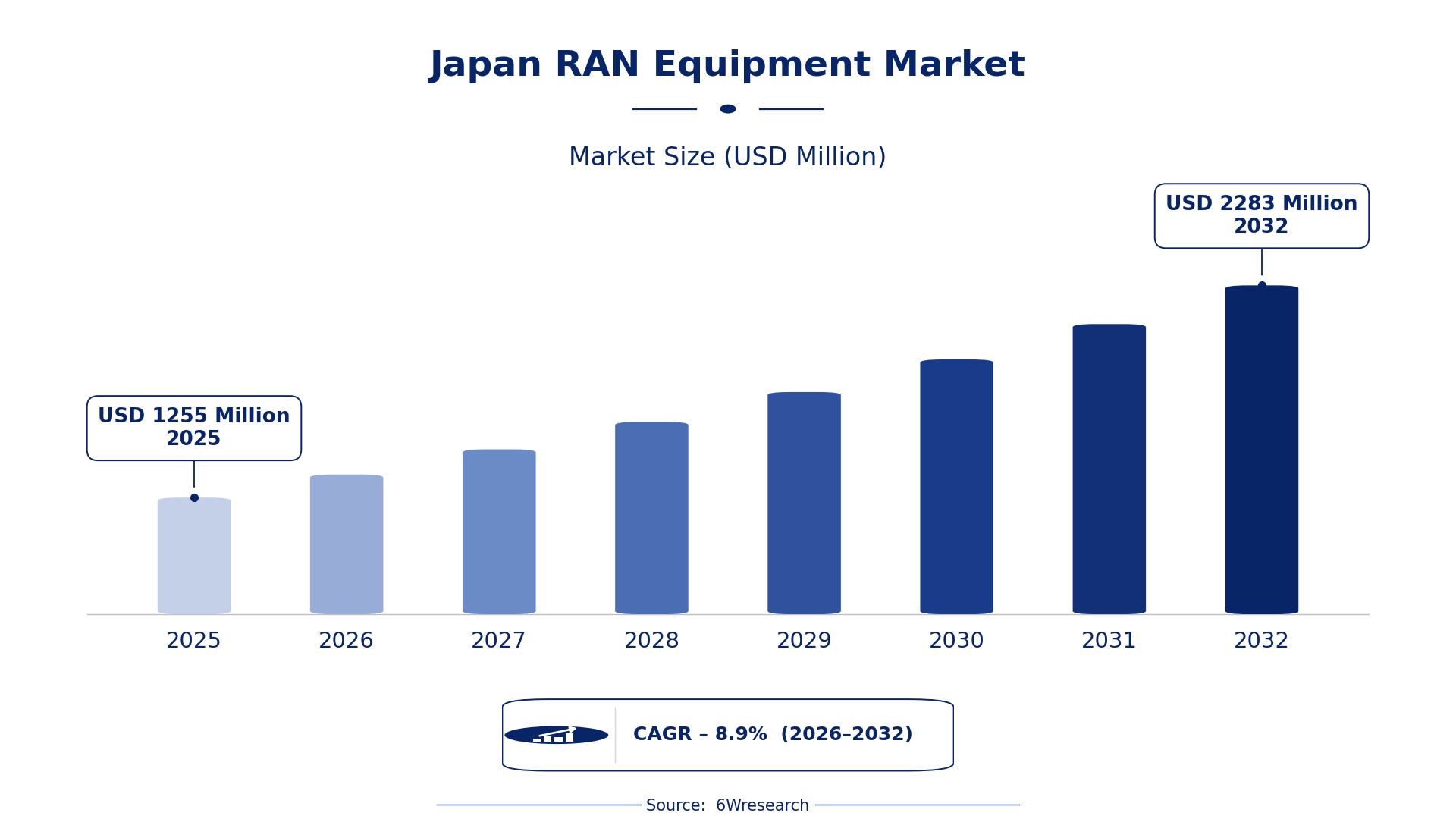
According to 6Wresearch internal database and industry insights, the Japan RAN Equipment Market was valued at USD 1,255 Million in 2025 and is projected to reach USD 2,283 Million by 2032, growing at a CAGR of approximately 8.9% during 2026–2032.
Japan RAN Equipment Market Highlights
| Report Metric | Details |
| Report Name | Japan RAN Equipment Market (2026-2032) |
| Market Size 2025 | USD 1,255 Million |
| Market Size 2032 | USD 2,283 Million |
| Absolute Growth 2025–2032 | USD 1,028 Million |
| CAGR 2026–2032 | 8.9% |
| Peak Annual Growth | 9.7% in 2032 |
| Forecast Period | 2026–2032 |
| Historical Data | 2022–2025 |
| Base Year | 2025 |
| Leading Equipment Type, 2025 | Baseband Units (41% share) |
| Leading Technology Generation, 2025 | 5G/4G (40% share) |
| Leading Deployment Model, 2025 | On-Premise (47% share) |
| Leading End User, 2025 | Telecom Operators (48% share) |
| Fastest-Growing Equipment Type | Remote Radio Heads (12.5% CAGR) |
| Fastest-Growing Technology Generation | Massive MIMO (12.9% CAGR) |
| Fastest-Growing Deployment Model | Rooftop/Tower (13.5% CAGR) |
| Fastest-Growing End User | Network Providers (12.2% CAGR) |
| Growing Sector | Telecommunications |
| Key End Users | Telecom Operators, Network Providers, Urban Network Deployers |
Japan RAN Equipment Market Year-wise Growth Rate and Key Drivers (2022–2032)
This graph illustrates the annual growth rates of the market from 2022 to 2032, highlighting a steady upward trajectory and projected market expansion over the forecast period.
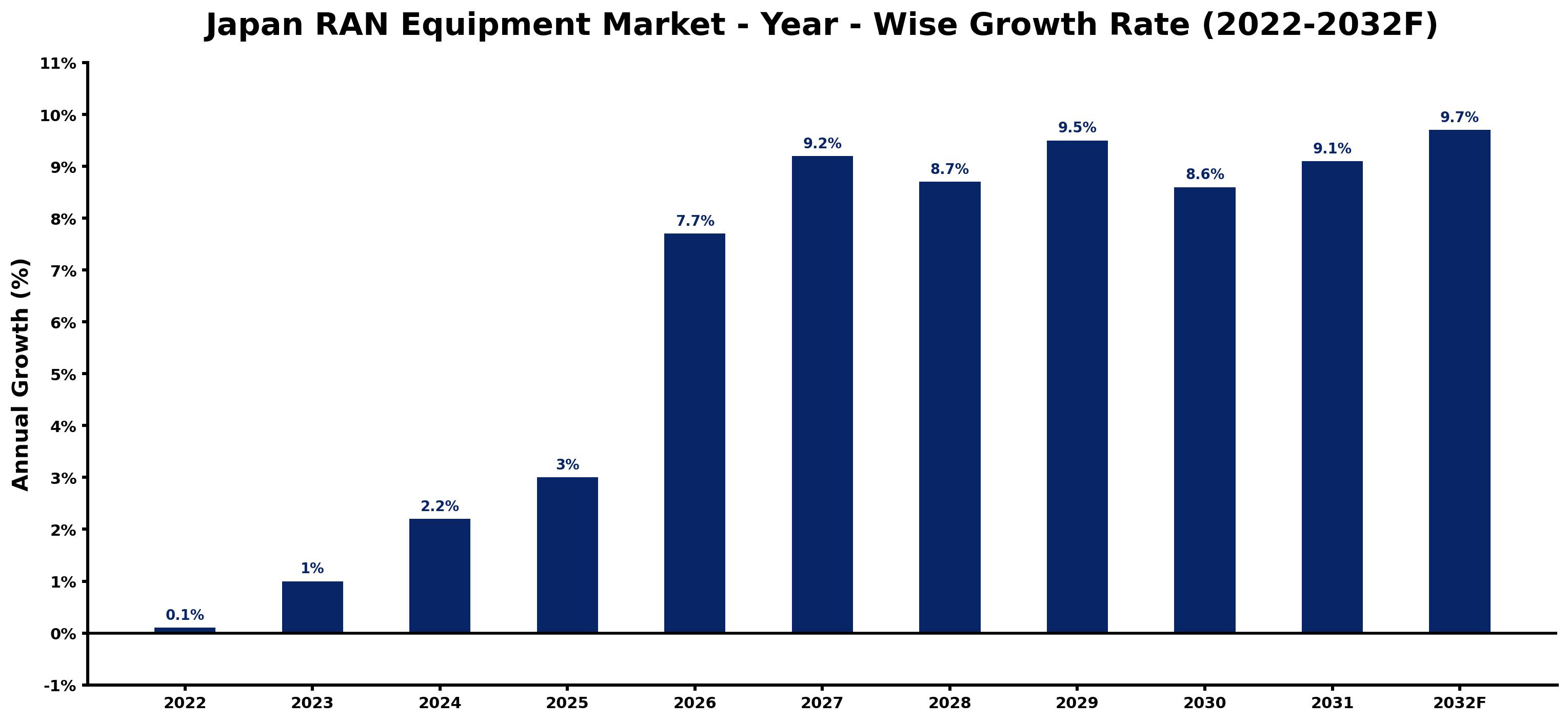
For each year, the table pairs the estimated growth rate with the leading influence on demand, showing how the drivers changed across the period.
| Year | Estimated Annual Growth (%) | Market Rationale |
| 2022 | 0.1 | The market experienced minimal growth as operators began implementing basic upgrades to existing networks. |
| 2023 | 1.0 | Demand increased as telecom operators focused on enhancing service quality and expanding their subscriber base. |
| 2024 | 2.2 | The introduction of new technologies contributed to a more significant rise in demand for RAN Equipment. |
| 2025 | 3.0 | Investment in telecom infrastructure peaked, driven by the need for improved network capabilities. |
| 2026 | 7.7 | The market is expected to accelerate as 5G deployment gains momentum across urban areas. |
| 2027 | 9.2 | Rising demand for advanced RAN solutions is anticipated as urban network deployers adopt new technologies. |
| 2028 | 8.7 | Growth is projected to slow slightly as the market adjusts to the rapid pace of technological advancements. |
| 2029 | 9.5 | Demand is expected to rise again as telecom operators expand their networks to meet user needs. |
| 2030 | 8.6 | A slight slowdown is anticipated as the market stabilises after a period of rapid growth. |
| 2031 | 9.1 | Continued investment in RAN technologies is expected to drive demand higher as competition intensifies. |
| 2032 | 9.7 | The market is projected to peak as comprehensive 5G coverage becomes a reality across Japan. |
Note: Market size estimations and growth projections presented in this report are based on 6Wresearch's proprietary forecasting methodology, utilizing the latest available industry data, government publications, and primary research inputs.
Japan RAN Equipment Market Synopsis
RAN Equipment facilitates wireless communication between devices and the core network, integrating advanced hardware and software. In Japan, the telecom market, with over 100 million mobile subscribers, is primarily driven by domestic telecom operators and network providers. The government’s 2023 programme promoting Open RAN technologies and the anticipated 90% population coverage by 2025 are key factors contributing to the market's growth, alongside substantial investments in telecom infrastructure, which reached ¥1 trillion in 2023.
Market Dynamics Impact Analysis (2026–2032)
| Factor | Type | Impact | Primary Segment Affected |
| Increasing mobile subscriber base drives demand for RAN Equipment. | Driver | High | Telecom Operators |
| Rapid urbanisation necessitates enhanced network coverage and capacity. | Driver | High | Urban Network Deployers |
| Rising investments in telecom infrastructure create opportunities for suppliers. | Opportunity | High | Network Providers |
| Growing adoption of Open RAN technologies opens new market avenues. | Opportunity | High | Telecom Operators |
| High costs of advanced RAN technologies may limit adoption. | Restraint | Medium | Virtualized RAN Units |
| Regulatory compliance can delay market entry for new technologies. | Restraint | Medium | Open RAN |
| Competition among suppliers can lead to price wars, affecting margins. | Challenge | High | Mobile Network Vendors |
| Technological advancements require constant investment, straining budgets. | Challenge | Medium | Telecom Operators |
Evaluation of Drivers in Japan RAN Equipment Market (2026–2032)
Key forces behind demand, with the segment each one moves most, are listed below.
| Drivers | Primary Segment Affected | Why It Matters (Evidence) |
| Growing mobile subscriber base. | Telecom Operators | Japan's telecom market has over 100 million mobile subscribers as of 2023, increasing demand for RAN Equipment. |
| Investment in urban network infrastructure. | Urban Network Deployers | The total investment in telecom infrastructure in Japan reached ¥1 trillion in 2023, driving demand for RAN solutions. |
| Adoption of 5G technologies. | 5G/4G | 5G networks are expected to cover 90% of Japan's population by 2025, boosting demand for related RAN Equipment. |
| Implementation of Open RAN standards. | Open RAN | The government launched a programme in 2023 to promote Open RAN technologies, increasing market opportunities. |
| Deployment of Massive MIMO technology. | Massive MIMO | Massive MIMO technology is being deployed in urban areas for better capacity, leading to higher demand for RAN Equipment. |
What keeps demand rising is the substantial mobile subscriber base in Japan, with over 100 million users driving the need for RAN Equipment. The total investment in telecom infrastructure reached ¥1 trillion in 2023, prompting operators to upgrade their networks. The anticipated coverage of 90% for 5G networks by 2025 will further stimulate demand for advanced RAN solutions. Urban network deployers are increasingly adopting new technologies to improve capacity, contributing to rising demand.
Evaluation of Restraints in Japan RAN Equipment Market
Several factors work against faster growth; the main ones are summarised below.
| Market Restraint | Primary Segment Affected | Why It Matters (Evidence) |
| High costs associated with advanced RAN technologies. | Virtualized RAN Units | The costs for implementing advanced Virtualized RAN Units can limit their adoption among smaller telecom operators. |
| Regulatory compliance requirements delay technology deployment. | Open RAN | Compliance with regulations set by the Ministry of Internal Affairs and Communications can slow the introduction of new Open RAN technologies. |
| Intense competition among suppliers affects pricing strategies. | Mobile Network Vendors | Increased competition can lead to price wars, impacting profit margins for suppliers. |
| Technological advancements require continuous investment. | Telecom Operators | The need for ongoing investment in RAN technologies can strain budgets, especially for smaller operators. |
| Market saturation in urban areas limits growth potential. | Urban Network Deployers | As urban areas become saturated with RAN Equipment, growth opportunities may diminish. |
Japan RAN Equipment Market Challenges
Buyers face supply chain disruptions due to reliance on specific component suppliers, which can delay network upgrades and increase costs by up to 15%. Producers struggle with outdated technology, as rapid innovation outpaces their production capabilities, leading to a 20% longer time-to-market for new RAN solutions. Regulatory demands from the Ministry of Internal Affairs and Communications impose additional burdens, forcing manufacturers to allocate resources that could otherwise support product development. Rising operational costs, linked to the national minimum wage increase to JPY 1,055 per hour, strain profit margins for smaller network providers.
Trends in the Japan RAN Equipment Market
These developments are changing demand patterns in the Japan RAN Equipment Market.
- Government Initiative to Promote Open RAN Technologies: In 2023, the government initiated a programme to promote Open RAN technologies, aiming to improve interoperability. This initiative is expected to increase market participation, potentially boosting RAN Equipment sales by 20%.
- Telecom Operators Focusing on Urban Deployments: Telecom operators are prioritising urban network deployments to meet the growing demand for mobile connectivity. This shift is reflected in the rapid expansion of infrastructure in Tokyo, which houses over 10 million mobile subscribers.
- Surge in 5G Infrastructure Investment: Japan's telecom infrastructure investment reached ¥1 trillion in 2023, reflecting a strong commitment to 5G deployment. This investment is driving demand for RAN Equipment, particularly in urban areas with high subscriber density.
- Shift Towards Cloud-Based RAN Solutions: Cloud-based RAN solutions are gaining traction as operators seek scalability and flexibility. This trend is supported by the projected growth of cloud-based systems by 2026, improving overall network efficiency.
Investment Opportunities in the Japan RAN Equipment Market
The opportunities below stand out in the Japan RAN Equipment Market for new entrants and existing suppliers.
- Telecom Operators Seeking Advanced Solutions: Telecom operators require advanced RAN Equipment to support 5G deployment, with growth expected to reach ¥500 billion by 2026. Suppliers can enter this market by partnering with local telecom firms to meet these needs.
- Urban Network Deployers Expanding Coverage: Urban network deployers are looking for solutions to improve connectivity in densely populated areas. With over 100 million mobile subscribers, there is a substantial opportunity to supply small cells and other RAN Equipment, potentially worth ¥300 billion.
- Investment in Open RAN Technologies: The push for Open RAN technologies presents a promising opportunity for suppliers. The government’s 2023 programme aims to increase adoption, providing a pathway for new entrants in the telecom sector, with an expected market value of ¥200 billion.
- Rooftop Installations Gaining Popularity: Rooftop installations are becoming a preferred choice for antenna setups in urban areas, driven by the need for better signal reach. This trend offers opportunities for suppliers of rooftop RAN Equipment, estimated to be worth ¥150 billion.
Government Initiatives in the Japan RAN Equipment Market
The Industrial Safety and Health Act mandates that producers of RAN Equipment must ensure safe working conditions, which includes rigorous testing and certification of machinery used in manufacturing. Compliance with this law is critical for maintaining operational standards and avoiding penalties. The Act impacts all telecom infrastructure projects, ensuring that safety protocols are adhered to, thus improving the overall reliability of RAN systems in the market.
In 2023, the government launched a programme to promote Open RAN technologies, administered by the Ministry of Internal Affairs and Communications. This initiative aims to enhance interoperability and innovation within the telecom sector, providing funding to support research and development. The programme is expected to facilitate the adoption of new technologies, benefiting telecom operators and network providers by improving service delivery and expanding market reach.
Future Insight of the Japan RAN Equipment Market
Telecom operators will benefit from enhanced network flexibility as new technologies emerge, allowing for more adaptable infrastructure. By 2025, 5G networks are expected to cover 90% of Japan's population, enabling seamless connectivity for millions. Government initiatives aimed at promoting advanced RAN technologies will drive innovation, particularly in urban settings where virtualized solutions are set to grow. As standards like ISO/IEC 30133 gain traction, suppliers will need to ensure their products align with these evolving requirements.
Market Segmentation Analysis
Japan RAN Equipment Market report covers a detailed analysis of the following market segments:
By Equipment Type – Baseband Units Lead, Remote Radio Heads Expected to Grow Fastest
According to Saurav Kr Singh, Senior Research Analyst at 6Wresearch, with 41% of equipment type revenue in 2025, Baseband Units was the largest category. Baseband Units hold the largest share because they are essential for processing signals in RAN systems, which is critical for effective mobile communication. Their widespread use in urban areas, where demand for connectivity is highest, solidifies their market position. Remote Radio Heads are set to record the highest CAGR in this split, 12.5% over 2026–2032. Remote Radio Heads are rapidly growing as they are crucial for wireless signal transmission, particularly in densely populated regions. Their deployment is accelerating with the rollout of 5G networks, which are expected to cover 90% of Japan's population by 2025. Suppliers must focus on enhancing Remote Radio Heads to meet the rising demand from telecom operators.
By Technology Generation – 5G/4G Leads, Massive MIMO Expected to Grow Fastest
In 2025, 5G/4G led the technology generation split with a 40% share. 5G/4G technologies dominate the market as they are fundamental for current mobile communication standards, serving a vast base of over 100 million mobile subscribers in Japan. Their established infrastructure ensures they remain relevant and widely adopted among users. Over 2026–2032, Massive MIMO is expected to post the fastest growth, at a CAGR of 12.9%. Massive MIMO technology is experiencing rapid growth due to its ability to enhance network capacity and efficiency, especially in urban environments. The substantial investment in telecom infrastructure, reaching ¥1 trillion in 2023, supports the swift adoption of this technology. Buyers should consider investing in Massive MIMO solutions to improve network performance and address increasing data demands.
By Deployment Model – On-Premise Leads, Rooftop/Tower Expected to Grow Fastest
The largest deployment model category in 2025 was On-Premise, at 47% of revenue. On-Premise deployment is the most common model for telecom operators, providing them with control over their infrastructure and ensuring reliability. This model is particularly favoured in urban settings where high-quality service is essential for customer satisfaction. Rooftop/Tower is projected to grow fastest, at a CAGR of 13.5% during 2026–2032. Rooftop/Tower installations are growing rapidly as they are widely used for antenna installations, enabling better signal reach in urban environments. The trend towards utilising rooftops for telecom equipment aligns with the increasing density of urban populations. Suppliers should prioritise solutions that facilitate efficient Rooftop/Tower deployments to capitalise on this growing trend.
By End User – Telecom Operators Lead, Network Providers Expected to Grow Fastest
Telecom Operators accounted for 48% of the market by end user in 2025. Telecom Operators are the primary users of RAN Equipment, significantly shaping market trends with their extensive networks and large subscriber bases. Their continuous investments in infrastructure development ensure a steady demand for RAN Equipment. The quickest growth will come from Network Providers, forecast to expand at a CAGR of 12.2% between 2026 and 2032. Network Providers are witnessing the fastest growth as they play a vital role in supporting telecom service infrastructure, particularly with the rise of Open RAN technologies. Their active involvement in network expansion initiatives enhances their market influence. Suppliers should tailor their offerings to meet the changing requirements of Network Providers as they expand their roles within the telecom sector.
Key Attractiveness of the Report
- 10 Years of Market Numbers
- Historical Data Starting from 2022 to 2025
- Base Year 2025
- Forecast Data until 2032
- Key Performance Indicators Impacting the Market
- Major Upcoming Developments and Projects
Key Highlights of the Report:
- Japan RAN Equipment Market Outlook
- Market Size of Japan RAN Equipment Market, 2025
- Forecast of Japan RAN Equipment Market, 2032
- Historical Data and Forecast of Japan RAN Equipment Revenues & Volume for the Period 2022-2032F
- Japan RAN Equipment Market Trend Evolution
- Japan RAN Equipment Market Drivers and Challenges
- Japan RAN Equipment Price Trends
- Japan RAN Equipment Porter's Five Forces
- Japan RAN Equipment Industry Life Cycle
- Historical Data and Forecast of Japan RAN Equipment Market Revenues & Volume By Equipment Type for the Period 2022-2032F
- Historical Data and Forecast of Japan RAN Equipment Market Revenues & Volume By Baseband Units for the Period 2022-2032F
- Historical Data and Forecast of Japan RAN Equipment Market Revenues & Volume By Remote Radio Heads for the Period 2022-2032F
- Historical Data and Forecast of Japan RAN Equipment Market Revenues & Volume By Small Cells for the Period 2022-2032F
- Historical Data and Forecast of Japan RAN Equipment Market Revenues & Volume By Virtualized RAN Units for the Period 2022-2032F
- Historical Data and Forecast of Japan RAN Equipment Market Revenues & Volume By Technology Generation for the Period 2022-2032F
- Historical Data and Forecast of Japan RAN Equipment Market Revenues & Volume By 5G/4G for the Period 2022-2032F
- Historical Data and Forecast of Japan RAN Equipment Market Revenues & Volume By Massive MIMO for the Period 2022-2032F
- Historical Data and Forecast of Japan RAN Equipment Market Revenues & Volume By mmWave/Low-Band for the Period 2022-2032F
- Historical Data and Forecast of Japan RAN Equipment Market Revenues & Volume By Open RAN for the Period 2022-2032F
- Historical Data and Forecast of Japan RAN Equipment Market Revenues & Volume By Deployment Model for the Period 2022-2032F
- Historical Data and Forecast of Japan RAN Equipment Market Revenues & Volume By On-Premise for the Period 2022-2032F
- Historical Data and Forecast of Japan RAN Equipment Market Revenues & Volume By Rooftop/Tower for the Period 2022-2032F
- Historical Data and Forecast of Japan RAN Equipment Market Revenues & Volume By Indoor/Outdoor for the Period 2022-2032F
- Historical Data and Forecast of Japan RAN Equipment Market Revenues & Volume By Cloud-Based for the Period 2022-2032F
- Historical Data and Forecast of Japan RAN Equipment Market Revenues & Volume By End User for the Period 2022-2032F
- Historical Data and Forecast of Japan RAN Equipment Market Revenues & Volume By Telecom Operators for the Period 2022-2032F
- Historical Data and Forecast of Japan RAN Equipment Market Revenues & Volume By Network Providers for the Period 2022-2032F
- Historical Data and Forecast of Japan RAN Equipment Market Revenues & Volume By Urban Network Deployers for the Period 2022-2032F
- Historical Data and Forecast of Japan RAN Equipment Market Revenues & Volume By Mobile Network Vendors for the Period 2022-2032F
- Japan RAN Equipment Import Export Trade Statistics
- Market Opportunity Assessment By Equipment Type
- Market Opportunity Assessment By Technology Generation
- Market Opportunity Assessment By Deployment Model
- Market Opportunity Assessment By End User
- Japan RAN Equipment Top Companies Market Share
- Japan RAN Equipment Competitive Benchmarking By Technical and Operational Parameters
- Japan RAN Equipment Company Profiles
- Japan RAN Equipment Key Strategic Recommendations
Market Covered
Segments analysed in this report are listed below.
By Equipment Type
- Baseband Units
- Remote Radio Heads
- Small Cells
- Virtualized RAN Units
By Technology Generation
- 5G/4G
- Massive MIMO
- mmWave/Low-Band
- Open RAN
By Deployment Model
- On-Premise
- Rooftop/Tower
- Indoor/Outdoor
- Cloud-Based
By End User
- Telecom Operators
- Network Providers
- Urban Network Deployers
- Mobile Network Vendors































