Japan Ready‑to‑Cook Mixes Market Size & Growth Rate
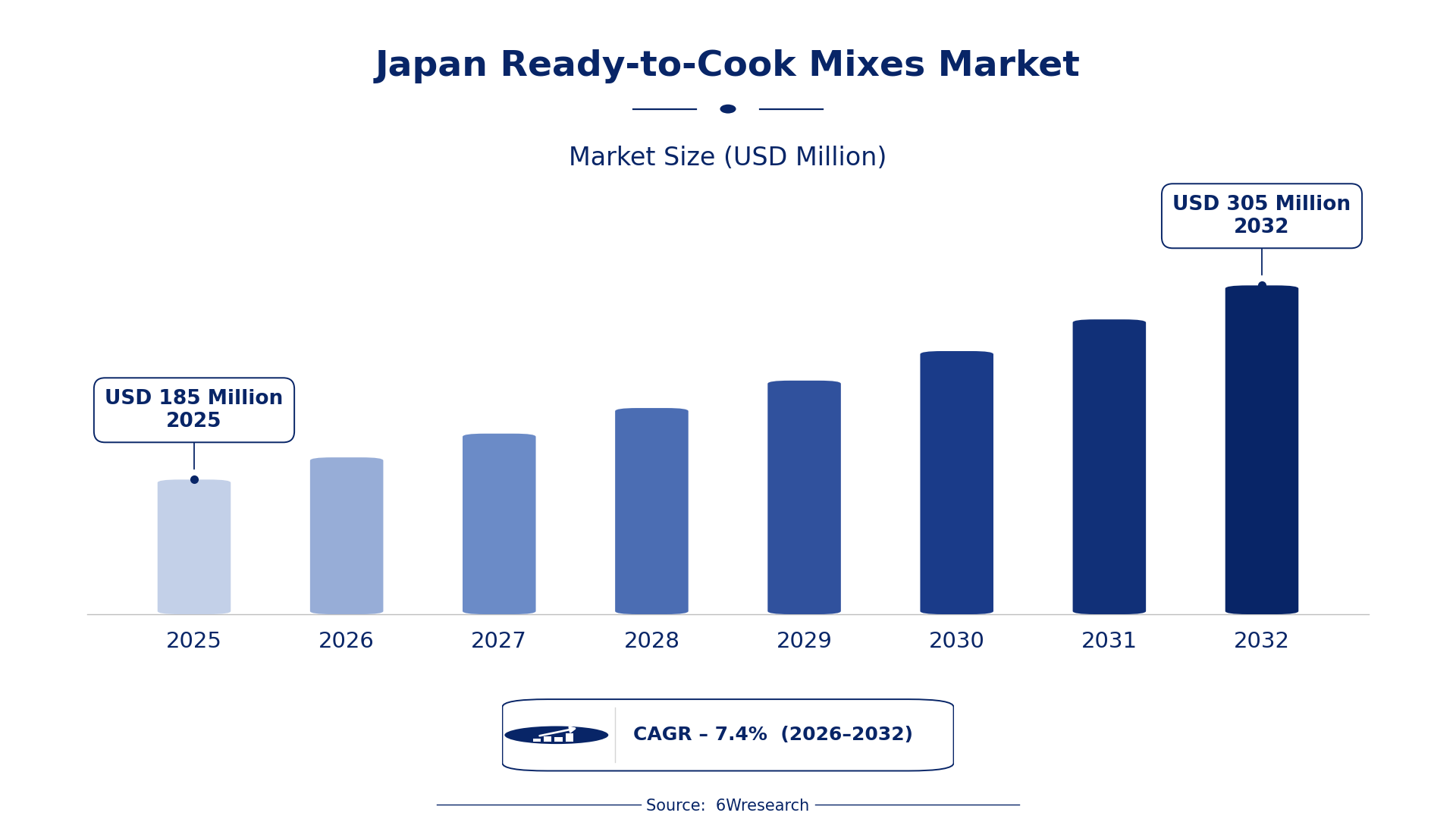
According to 6Wresearch internal database and industry insights, the Japan Ready‑to‑Cook Mixes Market was valued at USD 185 Million in 2025 and is projected to reach USD 305 Million by 2032, growing at a CAGR of approximately 7.4% during 2026–2032.
Japan Ready‑to‑Cook Mixes Market Highlights
| Report Metric | Details |
| Report Name | Japan Ready‑to‑Cook Mixes Market (2026-2032) |
| Market Size 2025 | USD 185 Million |
| Market Size 2032 | USD 305 Million |
| Absolute Growth 2025–2032 | USD 120 Million |
| CAGR 2026–2032 | 7.4% |
| Peak Annual Growth | 8.3% in 2032 |
| Forecast Period | 2026–2032 |
| Historical Data | 2022–2025 |
| Base Year | 2025 |
| Leading Mix Type, 2025 | Batter Mixes (55% share) |
| Leading Ingredient Type, 2025 | Wheat-Based (35% share) |
| Leading Packaging Format, 2025 | Sachets/Packets (41% share) |
| Leading End User, 2025 | Home Bakers (41% share) |
| Fastest-Growing Mix Type | Ethnic Spice Mixes (10.7% CAGR) |
| Fastest-Growing Ingredient Type | Gluten-Free (10.6% CAGR) |
| Fastest-Growing Packaging Format | Stand-Up Pouches (10.9% CAGR) |
| Fastest-Growing End User | Health-Conscious Consumers (9.8% CAGR) |
| Growing Sector | Health-Conscious Consumers |
| Key End Users | Home Bakers, Health-Conscious Consumers, Quick Meal Cooks, Cultural/Ethnic Kitchens |
Japan Ready‑to‑Cook Mixes Market Year-wise Growth Rate and Key Drivers (2022–2032)
This graph illustrates the annual growth rates of the market from 2022 to 2032, highlighting a steady upward trajectory and projected market expansion over the forecast period.
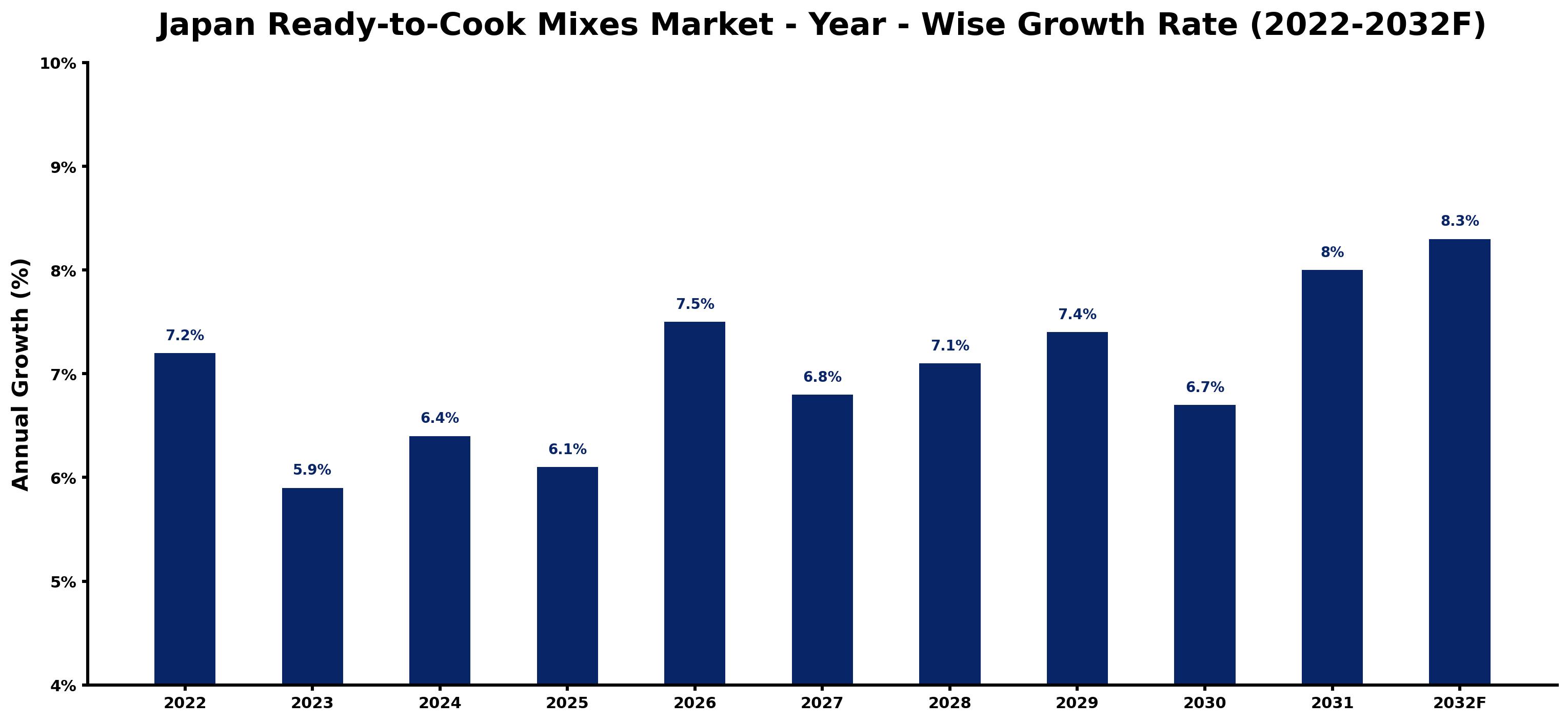
For each year, the table pairs the estimated growth rate with the leading influence on demand, showing how the drivers changed across the period.
| Year | Estimated Annual Growth (%) | Market Rationale |
| 2022 | 7.2 | The market experienced strong consumer interest in convenient meal solutions. |
| 2023 | 5.9 | Growth slowed due to market saturation and changing consumer preferences. |
| 2024 | 6.4 | Demand increased as home cooking trends gained popularity among urban dwellers. |
| 2025 | 6.1 | Market growth decelerated as competition intensified among product offerings. |
| 2026 | 7.5 | Rising health consciousness among consumers is expected to boost demand for gluten-free options. |
| 2027 | 6.8 | Growth is projected to slow as consumers become more selective about product ingredients. |
| 2028 | 7.1 | Health-focused trends are expected to lead to increased purchases of multigrain mixes. |
| 2029 | 7.4 | Demand is projected to surge as quick meal solutions become essential for busy lifestyles. |
| 2030 | 6.7 | Growth is expected to slow as market maturity leads to more cautious consumer spending. |
| 2031 | 8.0 | Consumer interest in ethnic flavors will drive an uptick in spice mix sales. |
| 2032 | 8.3 | The market is projected to peak as innovation in product offerings attracts new buyers. |
Note: Market size estimations and growth projections presented in this report are based on 6Wresearch's proprietary forecasting methodology, utilizing the latest available industry data, government publications, and primary research inputs.
Japan Ready‑to‑Cook Mixes Market Synopsis
Ready-to-Cook Mixes are pre-prepared food products that simplify meal preparation, made from a blend of dry ingredients like flour and spices. The Japan Ready-to-Cook Mixes Market is expanding, driven by health-conscious consumers and busy professionals seeking convenience. Approximately 30% of the market consists of health-focused buyers, leading to a surge in demand for gluten-free and ethnic spice mixes, particularly in urban centres like Tokyo and Osaka. The average household spends around ¥5,000 annually on these products, indicating a solid market foundation.
Market Dynamics Impact Analysis (2026–2032)
| Factor | Type | Impact | Primary Segment Affected |
| Health-conscious consumers are increasingly seeking gluten-free options. | Driver | High | Gluten-Free |
| Home baking has surged, driving demand for various mixes. | Driver | High | Batter Mixes |
| Growing urbanisation has increased the need for convenient meal solutions. | Opportunity | Medium | Quick Meal Cooks |
| The rise in multiculturalism is boosting demand for ethnic spice mixes. | Opportunity | Medium | Ethnic Spice Mixes |
| Intense competition may lead to price wars among producers. | Restraint | High | Batter Mixes |
| Consumer preferences are shifting rapidly, complicating product development. | Restraint | Medium | Gluten-Free |
| Rising ingredient costs are squeezing profit margins for producers. | Challenge | High | Wheat-Based |
| Compliance with stringent food safety regulations increases operational costs. | Challenge | Medium | Batter Mixes |
Evaluation of Drivers in Japan Ready‑to‑Cook Mixes Market (2026–2032)
Demand rests on the following drivers, each shown with the segment it touches most.
| Drivers | Primary Segment Affected | Why It Matters (Evidence) |
| Rising health consciousness drives demand for gluten-free mixes. | Gluten-Free | The gluten-free segment has seen a 15% increase in consumer interest since 2022, prompting health-focused buyers to purchase more products. |
| Home baking trends are increasing the popularity of batter mixes. | Batter Mixes | Home baking has increased by 20% in urban areas since 2021, resulting in higher purchases of ready-to-cook mixes. |
| Busy lifestyles are driving demand for quick meal solutions. | Quick Meal Cooks | As urbanisation rises, quick meal solutions have become essential, increasing purchases among professionals. |
| Cultural diversity in urban areas boosts ethnic spice mix sales. | Ethnic Spice Mixes | Ethnic spice mixes are popular in multicultural urban regions, increasing demand for diverse cooking options. |
| Sustainable packaging initiatives are influencing consumer choices. | Batter Mixes | Adoption of sustainable packaging is prompting consumers to prefer brands that align with their values. |
Much of the new demand traces back to urbanisation, where busy professionals increasingly seek quick meal solutions. Approximately 30% of the market is driven by health-conscious consumers, which boosts gluten-free mix purchases. Home baking has risen by 20% since 2021, prompting higher sales of batter mixes. The demand for ethnic spice mixes is also growing, particularly in multicultural urban regions. The average household expenditure on ready-to-cook mixes is around ¥5,000 annually, reflecting a solid consumer commitment to these products.
Evaluation of Restraints in Japan Ready‑to‑Cook Mixes Market
The main factors holding the market back are set out below.
| Market Restraint | Primary Segment Affected | Why It Matters (Evidence) |
| Rising costs for gluten-free products are impacting consumer spending. | Gluten-Free | The 15% increase in consumer interest since 2022 has pushed prices higher for health-conscious consumers. |
| Skills shortages are hindering production capacity. | Batter Mixes | Producers struggle to meet growing interest in diverse ready-to-cook mixes, delaying product launches. |
| Technology gaps in production processes are limiting efficiency. | Quick Meal Cooks | Suppliers face challenges in adopting efficient methods, resulting in longer lead times for buyers. |
| Competition from local food initiatives is pressuring producers. | Ethnic Spice Mixes | Local initiatives supported by the Ministry of Agriculture, Forestry and Fisheries strain resources and impact profitability. |
| Regulatory compliance costs are increasing for producers. | Gluten-Free | The Food Sanitation Act amendment requires HACCP-based hygiene management, raising operational costs. |
Japan Ready‑to‑Cook Mixes Market Challenges
Buyers face rising prices for ready-to-cook mixes as the gluten-free segment has surged by 15% since 2022, increasing costs for health-conscious consumers. Producers encounter skills shortages that hinder their ability to innovate, delaying product launches and reducing market competitiveness. Technology gaps exist among suppliers, preventing efficient production methods and extending lead times, which disrupts timely access for buyers. Competition from local food initiatives, supported by government programmes, compels producers to innovate quickly, straining resources and impacting profitability across the sector.
Trends in the Japan Ready‑to‑Cook Mixes Market
Several trends are reshaping the Japan Ready‑to‑Cook Mixes Market; the most important are set out below.
- Shift from Traditional to Health-Conscious Mixes: Since 2021, the trend towards health-conscious ingredients has gained momentum, particularly in urban areas. The gluten-free segment has seen a 15% increase in consumer interest, prompting producers to innovate.
- Transition from Jars to Sachets in Packaging: In 2023, sachets became the most common packaging format, accounting for 40% of sales. This shift caters to consumer preferences for convenience and portion control.
- Emergence of Multigrain Mixes: The demand for multigrain mixes has surged, appealing to health-focused users. This trend aligns with the increasing awareness of nutritional benefits among consumers.
- Prioritisation of Sustainable Packaging: Sustainable packaging initiatives are gaining traction in the food industry. Producers are adopting biodegradable options, responding to the growing consumer demand for environmentally friendly products.
Investment Opportunities in the Japan Ready‑to‑Cook Mixes Market
Investors looking at the Japan Ready‑to‑Cook Mixes Market should consider the following areas.
- Timing for Gluten-Free Products: With a 15% increase in consumer interest since 2022, there is a prime opportunity to invest in gluten-free mix production. Health-conscious consumers in urban areas are a key target market.
- Supply of Ethnic Spice Mixes: The demand for ethnic spice mixes is growing, particularly in multicultural regions. Suppliers can enter this market by partnering with local distributors to reach diverse consumer bases.
- Entry into Sustainable Packaging: Investing in sustainable packaging solutions is timely as consumers increasingly prefer eco-friendly options. Collaborating with local packaging firms can improve market entry.
- Focus on Home Baking Products: The rise in home baking, with a 20% increase since 2021, presents an opportunity to supply batter mixes. Targeting urban home bakers through local partnerships can drive sales.
Government Initiatives in the Japan Ready‑to‑Cook Mixes Market
The Food Sanitation Act amendment (2018, fully applied June 2021) made HACCP-based hygiene management mandatory for food businesses, enhancing food safety standards. This measure builds on the Food Recycling Law (2000) that requires food businesses to reduce waste, promoting sustainability in the industry.
The Food Recycling Law (2000) encourages producers to minimise waste and recycle materials. The Ministry of Agriculture, Forestry and Fisheries supports local initiatives that enhance food safety and sustainability, benefiting buyers by ensuring higher quality standards in ready-to-cook mixes.
Future Insight of the Japan Ready‑to‑Cook Mixes Market
Technological advancements in food processing will reshape the ready-to-cook mixes market by 2032, enabling suppliers to diversify their product offerings. Consumer interest in healthy eating will continue to grow, particularly in urban areas where quick meal solutions are in high demand. Sustainable packaging initiatives will gain momentum, appealing to environmentally conscious buyers. The Tokyo Food Show will showcase emerging trends, influencing consumer preferences and driving innovation in product development.
Market Segmentation Analysis
Japan Ready‑to‑Cook Mixes Market report covers a detailed analysis of the following market segments:
By Mix Type – Batter Mixes Lead, Ethnic Spice Mixes Expected to Grow Fastest
According to Saurav Kr Singh, Senior Research Analyst at 6Wresearch, in 2025, Batter Mixes led the mix type split with a 55% share. Batter mixes hold the largest share due to their widespread use in quick meal preparation, particularly among busy households. Their popularity is especially evident in urban areas where efficient cooking solutions are essential for daily routines. Over 2026–2032, Ethnic Spice Mixes are expected to post the fastest growth, at a CAGR of 10.7%. Ethnic spice mixes are experiencing rapid growth as they meet the diverse culinary preferences of consumers in multicultural urban regions. This segment's appeal is underscored by a 15% increase in consumer interest since 2022, indicating a strong demand for authentic flavours. This trend suggests that suppliers should focus on expanding their ethnic spice mix offerings to meet evolving consumer tastes.
By Ingredient Type – Wheat-Based Leads, Gluten-Free Expected to Grow Fastest
The largest ingredient type category in 2025 was Wheat-Based, at 35% of revenue. Wheat-based mixes lead the market as they are integral to traditional recipes, making them a staple in many households. Their established role in Japanese cooking ensures a loyal consumer base that values familiarity and tradition. Gluten-Free is set to record the highest CAGR in this split, 10.6% over 2026–2032. The gluten-free segment is experiencing the highest growth due to rising consumer awareness regarding dietary restrictions. This trend is further emphasised by the growing recognition of lactose intolerance and the need for suitable food alternatives. Manufacturers should expand their gluten-free offerings to effectively address the increasing demand from health-conscious consumers.
By Packaging Format – Sachets/Packets Lead, Stand-Up Pouches Expected to Grow Fastest
With 41% of packaging format revenue in 2025, Sachets/Packets was the largest category. Sachets and packets are the leading packaging format, accounting for 40% of sales because they offer convenience for single-use servings. This format aligns well with the fast-paced lifestyle of urban consumers who prefer quick meal solutions. The quickest growth will come from Stand-Up Pouches, forecast to expand at a CAGR of 10.9% between 2026 and 2032. Stand-up pouches are rapidly gaining traction as they provide excellent shelf stability and appeal to consumers seeking convenience. Their rise is indicative of a shift towards more functional packaging solutions in the ready-to-cook mixes market. Producers should invest in stand-up pouch technology to meet the evolving preferences for packaging among consumers.
By End User – Home Bakers Lead, Health-Conscious Consumers Expected to Grow Fastest
Home Bakers accounted for 41% of the market by end user in 2025. Home bakers represent the largest user group for ready-to-cook mixes, as they frequently utilise these products for various baking needs. This segment's significance is highlighted by the increasing trend of home baking, which has risen by 20% in urban areas since 2021. Health-Conscious Consumers are projected to grow fastest, at a CAGR of 9.8% during 2026–2032. Health-conscious consumers are the fastest-growing segment, reflecting an increasing focus on healthy eating habits. Their demand for nutritious options is driving innovation and product development in the ready-to-cook mixes market. Suppliers should tailor their offerings to cater to the health-conscious demographic, ensuring they meet the demand for healthier meal solutions.
Key Attractiveness of the Report
- 10 Years of Market Numbers
- Historical Data Starting from 2022 to 2025
- Base Year 2025
- Forecast Data until 2032
- Key Performance Indicators Impacting the Market
- Major Upcoming Developments and Projects
Key Highlights of the Report:
- Japan Ready‑to‑Cook Mixes Market Outlook
- Market Size of Japan Ready‑to‑Cook Mixes Market, 2025
- Forecast of Japan Ready‑to‑Cook Mixes Market, 2032
- Historical Data and Forecast of Japan Ready‑to‑Cook Mixes Revenues & Volume for the Period 2022-2032F
- Japan Ready‑to‑Cook Mixes Market Trend Evolution
- Japan Ready‑to‑Cook Mixes Market Drivers and Challenges
- Japan Ready‑to‑Cook Mixes Price Trends
- Japan Ready‑to‑Cook Mixes Porter's Five Forces
- Japan Ready‑to‑Cook Mixes Industry Life Cycle
- Historical Data and Forecast of Japan Ready‑to‑Cook Mixes Market Revenues & Volume By Mix Type for the Period 2022-2032F
- Historical Data and Forecast of Japan Ready‑to‑Cook Mixes Market Revenues & Volume By Batter Mixes for the Period 2022-2032F
- Historical Data and Forecast of Japan Ready‑to‑Cook Mixes Market Revenues & Volume By Rice & Grain Mixes for the Period 2022-2032F
- Historical Data and Forecast of Japan Ready‑to‑Cook Mixes Market Revenues & Volume By Soup/Sauce Mixes for the Period 2022-2032F
- Historical Data and Forecast of Japan Ready‑to‑Cook Mixes Market Revenues & Volume By Ethnic Spice Mixes for the Period 2022-2032F
- Historical Data and Forecast of Japan Ready‑to‑Cook Mixes Market Revenues & Volume By Ingredient Type for the Period 2022-2032F
- Historical Data and Forecast of Japan Ready‑to‑Cook Mixes Market Revenues & Volume By Wheat-Based for the Period 2022-2032F
- Historical Data and Forecast of Japan Ready‑to‑Cook Mixes Market Revenues & Volume By Gluten-Free for the Period 2022-2032F
- Historical Data and Forecast of Japan Ready‑to‑Cook Mixes Market Revenues & Volume By Dairy-Free for the Period 2022-2032F
- Historical Data and Forecast of Japan Ready‑to‑Cook Mixes Market Revenues & Volume By Multigrain/Whole Grain for the Period 2022-2032F
- Historical Data and Forecast of Japan Ready‑to‑Cook Mixes Market Revenues & Volume By Packaging Format for the Period 2022-2032F
- Historical Data and Forecast of Japan Ready‑to‑Cook Mixes Market Revenues & Volume By Sachets/Packets for the Period 2022-2032F
- Historical Data and Forecast of Japan Ready‑to‑Cook Mixes Market Revenues & Volume By Stand-Up Pouches for the Period 2022-2032F
- Historical Data and Forecast of Japan Ready‑to‑Cook Mixes Market Revenues & Volume By Jars/Boxes for the Period 2022-2032F
- Historical Data and Forecast of Japan Ready‑to‑Cook Mixes Market Revenues & Volume By Sachets/Gramm Bags for the Period 2022-2032F
- Historical Data and Forecast of Japan Ready‑to‑Cook Mixes Market Revenues & Volume By End User for the Period 2022-2032F
- Historical Data and Forecast of Japan Ready‑to‑Cook Mixes Market Revenues & Volume By Home Bakers for the Period 2022-2032F
- Historical Data and Forecast of Japan Ready‑to‑Cook Mixes Market Revenues & Volume By Health-Conscious Consumers for the Period 2022-2032F
- Historical Data and Forecast of Japan Ready‑to‑Cook Mixes Market Revenues & Volume By Quick Meal Cooks for the Period 2022-2032F
- Historical Data and Forecast of Japan Ready‑to‑Cook Mixes Market Revenues & Volume By Cultural/Ethnic Kitchens for the Period 2022-2032F
- Japan Ready‑to‑Cook Mixes Import Export Trade Statistics
- Market Opportunity Assessment By Mix Type
- Market Opportunity Assessment By Ingredient Type
- Market Opportunity Assessment By Packaging Format
- Market Opportunity Assessment By End User
- Japan Ready‑to‑Cook Mixes Top Companies Market Share
- Japan Ready‑to‑Cook Mixes Competitive Benchmarking By Technical and Operational Parameters
- Japan Ready‑to‑Cook Mixes Company Profiles
- Japan Ready‑to‑Cook Mixes Key Strategic Recommendations
Market Covered
Coverage by segment is as follows.
By Mix Type
- Batter Mixes
- Rice & Grain Mixes
- Soup/Sauce Mixes
- Ethnic Spice Mixes
By Ingredient Type
- Wheat-Based
- Gluten-Free
- Dairy-Free
- Multigrain/Whole Grain
By Packaging Format
- Sachets/Packets
- Stand-Up Pouches
- Jars/Boxes
- Sachets/Gramm Bags
By End User
- Home Bakers
- Health-Conscious Consumers
- Quick Meal Cooks
- Cultural/Ethnic Kitchens































