Japan Ready‑to‑Eat Bakery Market Size & Growth Rate
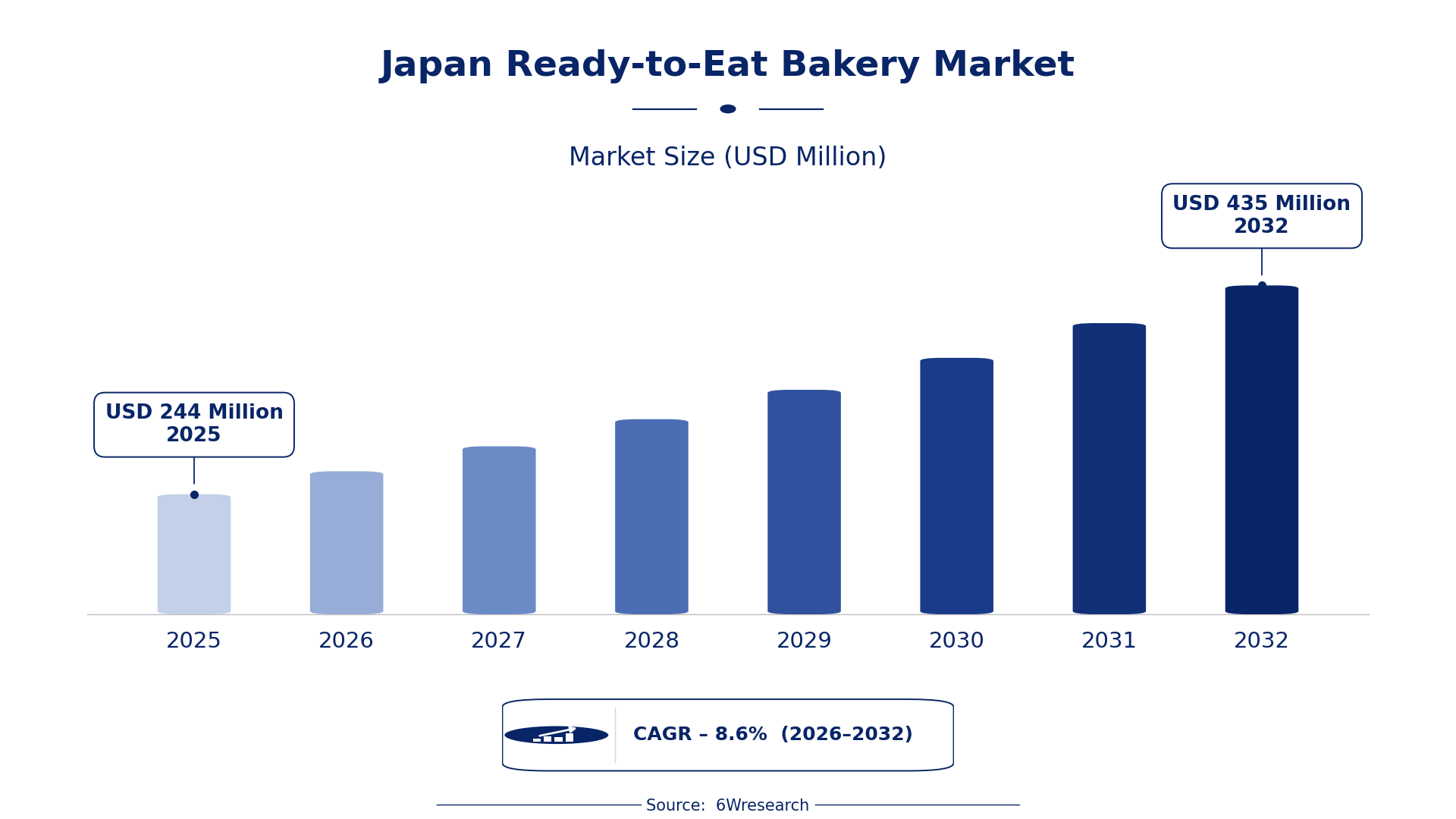
According to 6Wresearch internal database and industry insights, the Japan Ready‑to‑Eat Bakery Market was valued at USD 244 Million in 2025 and is projected to reach USD 435 Million by 2032, growing at a CAGR of approximately 8.6% during 2026–2032.
Japan Ready‑to‑Eat Bakery Market Highlights
| Report Metric | Details |
| Report Name | Japan Ready‑to‑Eat Bakery Market (2026-2032) |
| Market Size 2025 | USD 244 Million |
| Market Size 2032 | USD 435 Million |
| Absolute Growth 2025–2032 | USD 191 Million |
| CAGR 2026–2032 | 8.6% |
| Peak Annual Growth | 9.8% in 2032 |
| Forecast Period | 2026–2032 |
| Historical Data | 2022–2025 |
| Base Year | 2025 |
| Leading Product Type, 2025 | Bread & Rolls (37% share) |
| Leading Ingredient Type, 2025 | Whole Grain/Gluten-Free (37% share) |
| Leading Packaging, 2025 | Plastic Pouches (40% share) |
| Leading End User, 2025 | Daily Commuters (41% share) |
| Fastest-Growing Product Type | Pastries & Cakes (12.7% CAGR) |
| Fastest-Growing Ingredient Type | Dairy/Sugar-Reduced (12.5% CAGR) |
| Fastest-Growing Packaging | Flow-Wrap Trays (11.5% CAGR) |
| Fastest-Growing End User | Office Workers (11.6% CAGR) |
| Growing Sector | urban convenience food |
| Key End Users | Daily Commuters, Office Workers, Students & Families |
Japan Ready‑to‑Eat Bakery Market Year-wise Growth Rate and Key Drivers (2022–2032)
This graph illustrates the annual growth rates of the market from 2022 to 2032, highlighting a steady upward trajectory and projected market expansion over the forecast period.
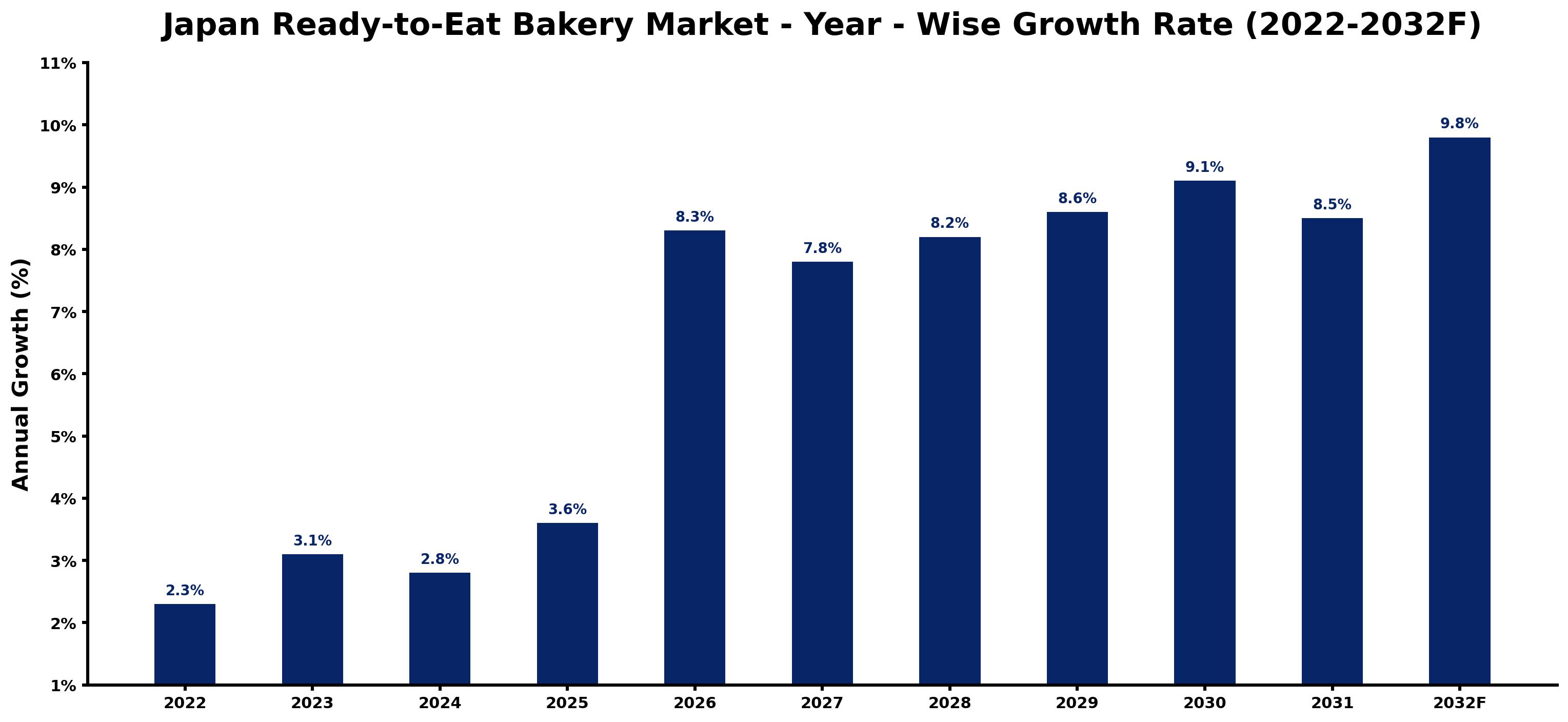
Below, each year's estimated growth is shown next to the factor that most influenced it.
| Year | Estimated Annual Growth (%) | Market Rationale |
| 2022 | 2.3 | Consumer spending on ready-to-eat bakery products was stable, reflecting ongoing demand for convenience. |
| 2023 | 3.1 | Growth accelerated as urban lifestyles continued to favour quick meal options for busy consumers. |
| 2024 | 2.8 | Growth slowed slightly due to market saturation in densely populated areas. |
| 2025 | 3.6 | A resurgence in demand was driven by new product launches and effective marketing strategies. |
| 2026 | 8.3 | Rapid growth is anticipated as health trends encourage more consumers to seek convenient options. |
| 2027 | 7.8 | Growth is projected to moderate as competition intensifies among producers for market share. |
| 2028 | 8.2 | Demand is expected to increase again, supported by rising consumer awareness of health benefits. |
| 2029 | 8.6 | Growth will continue as new product lines attract health-conscious buyers looking for convenience. |
| 2030 | 9.1 | Demand is expected to surge with new packaging solutions improving product visibility. |
| 2031 | 8.5 | Growth will slow due to increased market competition and a wider range of consumer choices. |
| 2032 | 9.8 | A peak in growth is anticipated as the market adapts to evolving consumer preferences. |
Note: Market size estimations and growth projections presented in this report are based on 6Wresearch's proprietary forecasting methodology, utilizing the latest available industry data, government publications, and primary research inputs.
Japan Ready‑to‑Eat Bakery Market Synopsis
Ready-to-eat bakery products in Japan are crafted using processed ingredients and advanced baking technology, ensuring consistency and shelf stability. The Japan Ready-to-Eat Bakery Market is thriving, driven by urban consumers seeking convenient meal solutions. The average Japanese consumer spends approximately ¥5,000 monthly on these products, and the market is expected to reach 1.2 million tons by 2025. Factors such as the increasing number of convenience stores, which exceed 50,000 nationwide, and the growing popularity of healthy options are propelling market growth.
Market Dynamics Impact Analysis (2026–2032)
| Factor | Type | Impact | Primary Segment Affected |
| Rising consumer preference for convenient meal solutions | Driver | High | Savory Items |
| Growing health consciousness among consumers | Driver | High | Whole Grain/Gluten-Free |
| Increasing demand for innovative packaging solutions | Opportunity | Medium | Flow-Wrap Trays |
| Expansion of convenience store networks in urban areas | Opportunity | High | Plastic Pouches |
| Intense competition among producers affecting pricing strategies | Restraint | High | Pastries & Cakes |
| Market saturation in urban areas leading to slower growth | Restraint | Medium | Cookies & Snacks |
| Rising costs of raw materials impacting profit margins | Challenge | High | Bread & Rolls |
| Consumer demand for healthier options requiring reformulation | Challenge | Medium | Savory Items |
Evaluation of Drivers in Japan Ready‑to‑Eat Bakery Market (2026–2032)
Below are the drivers that matter most for revenue growth, with supporting evidence.
| Drivers | Primary Segment Affected | Why It Matters (Evidence) |
| Increased urbanisation and busy lifestyles | Savory Items | This trend drives demand for quick meal solutions, with the average consumer spending approximately ¥5,000 monthly on ready-to-eat bakery products. |
| Health trends promoting gluten-free options | Whole Grain/Gluten-Free | Health-conscious consumers are increasingly seeking gluten-free products, leading to a 10% growth in this segment in 2023. |
| Adoption of flow-wrap packaging improving product appeal | Flow-Wrap Trays | Flow-wrap packaging is widely adopted for its efficiency, contributing to the growing market share of ready-to-eat bakery items. |
| Expansion of convenience stores boosting accessibility | Plastic Pouches | With over 1,000 convenience stores in the Kanto region, these outlets significantly enhance the availability of ready-to-eat bakery products. |
| Consumer preference for diverse snack options | Pastries & Cakes | Pastries and cakes accounted for 30% of the total ready-to-eat bakery market share in Japan. |
What keeps demand rising is Tokyo's extensive convenience store network, which fuels demand for ready-to-eat bakery products and improves accessibility. The average Japanese consumer spends approximately ¥5,000 monthly on these products, reflecting a strong preference for quick meal solutions. Health trends are driving interest in gluten-free options, which grew by 10% in 2023. New packaging, such as flow-wrap trays, is widely adopted for its efficiency, attracting more buyers. The popularity of pastries and cakes, comprising 30% of the market, illustrates the diverse consumer preferences in Japan.
Evaluation of Restraints in Japan Ready‑to‑Eat Bakery Market
Several factors work against faster growth; the main ones are summarised below.
| Market Restraint | Primary Segment Affected | Why It Matters (Evidence) |
| Intense competition among producers affecting pricing strategies | Pastries & Cakes | Producers face pressure to lower prices, impacting profitability as they compete for market share. |
| Market saturation in urban areas leading to slower growth | Cookies & Snacks | Increased choices for consumers have resulted in slower growth rates in densely populated regions. |
| Rising costs of raw materials impacting profit margins | Bread & Rolls | Higher ingredient costs are squeezing margins, making it challenging for producers to maintain profitability. |
| Consumer demand for healthier options requiring reformulation | Savory Items | Producers must invest in reformulating products to meet health standards, which raises production costs. |
| Regulatory compliance costs affecting small producers | Whole Grain/Gluten-Free | Smaller producers struggle with the costs associated with meeting food safety standards like ISO 22000. |
Japan Ready‑to‑Eat Bakery Market Challenges
Producers face high compliance costs due to strict adherence to ISO 22000 standards, costing around ¥500,000 annually per facility. This financial burden limits smaller bakeries' ability to invest in innovation, affecting their competitiveness. Intense competition among over 1,000 registered bakeries in the Kanto region forces many to reduce prices, which can decrease profit margins by up to 20%. Supply chain disruptions lead to delays in raw material availability, causing potential losses of ¥300,000 for buyers who rely on timely deliveries. A shortage of skilled workers in baking technology restricts producers' capacity to develop gluten-free options, impacting their market responsiveness.
Trends in the Japan Ready‑to‑Eat Bakery Market
The trends below show where the Japan Ready‑to‑Eat Bakery Market is heading.
- Shift in Consumer Preferences Towards Healthier Options: Health-conscious consumers are increasingly opting for gluten-free and whole grain products, with gluten-free options growing by 10% in 2023. This trend encourages producers to adapt their offerings to meet new demands.
- Transition to More Efficient Packaging Solutions: The adoption of flow-wrap trays has increased, with a projected growth rate of 11.5% over the next few years. This shift improves product freshness and convenience for consumers.
- Emergence of Savory Items as Quick Meal Solutions: Savory items have seen a 15% increase in consumer preference over the past two years, reflecting a growing trend for quick meal options among busy urban dwellers.
- Rise of Pastries and Cakes in Snack Consumption: Pastries and cakes are becoming increasingly popular for snacks, comprising 30% of the total ready-to-eat bakery market share in Japan, indicating a shift in consumer snacking habits.
Investment Opportunities in the Japan Ready‑to‑Eat Bakery Market
The opportunities below stand out in the Japan Ready‑to‑Eat Bakery Market for new entrants and existing suppliers.
- Partnerships with Local Bakeries: Now is an ideal time to collaborate with local bakeries in urban areas, where demand for ready-to-eat products is high. The Tokyo Metropolitan Government supports local bakeries through funding programs for innovation.
- Investment in Health-Conscious Product Lines: With gluten-free products growing by 10%, there is an opportunity for health-focused options. Targeting health-conscious consumers can yield high returns in the Whole Grain/Gluten-Free segment.
- Expansion into Urban Convenience Stores: The growing number of convenience stores presents an opportunity for suppliers to enter the market. Focusing on urban areas can lead to increased sales and brand visibility.
- Utilisation of Efficient Packaging Technologies: Investing in flow-wrap packaging can enhance product appeal and shelf life. This technology is gaining traction, with a projected growth rate of 11.5%.
Government Initiatives in the Japan Ready‑to‑Eat Bakery Market
The Food Sanitation Act amendment, fully applied in June 2021, mandates HACCP-based hygiene management for food businesses, enhancing food safety protocols for ready-to-eat bakery producers. This law requires bakeries to implement stringent hygiene practices, ensuring that products meet safety standards. As a result, producers must invest in training and equipment to comply, which can increase operational costs but ultimately leads to higher consumer confidence in product safety.
The Ministry of Agriculture, Forestry and Fisheries oversees funding programs that support local bakeries in Japan, particularly those focusing on innovation in healthy bakery options. These programs aim to boost the production of nutritious products, with funding allocated to projects that promote health-conscious baking practices. The ministry's initiatives help bakeries adapt to changing consumer preferences, ensuring they can compete effectively in the evolving market.
Future Insight of the Japan Ready‑to‑Eat Bakery Market
Health-conscious consumers will shift towards gluten-free and reduced-sugar products by 2032, influenced by government initiatives targeting a 20% reduction in sugar content. Adoption of advanced packaging technologies will extend product shelf life, ensuring suppliers can offer fresher options. Increased funding for local bakeries will stimulate innovation, allowing them to meet changing dietary preferences effectively. By 2025, the ready-to-eat bakery market will reach 1.2 million tons, reflecting strong demand for convenient meal solutions.
Market Segmentation Analysis
Japan Ready‑to‑Eat Bakery Market report covers a detailed analysis of the following market segments:
By Product Type – Bread & Rolls Lead, Pastries & Cakes Expected to Grow Fastest
According to Saurav Kr Singh, Senior Research Analyst at 6Wresearch, Bread & Rolls held 37% of the Japan Ready‑to‑Eat Bakery Market by product type in 2025. Bread and rolls hold the largest share in Japan's ready-to-eat bakery market as they are a staple food, widely consumed across various demographics. Their significance is highlighted by the average monthly expenditure of ¥5,000 on bakery products, indicating strong consumer reliance on these items. Over 2026–2032, Pastries & Cakes are expected to post the fastest growth, at a CAGR of 12.7%. The rapid growth of pastries and cakes is fuelled by an increasing consumer preference for snacks and desserts, particularly in urban areas. This segment's popularity is evidenced by its 30% share of the total market, suggesting a shift towards indulgent options. Suppliers should consider diversifying their offerings to include more pastries and cakes to align with evolving consumer preferences.
By Ingredient Type – Whole Grain/Gluten-Free Leads, Dairy/Sugar-Reduced Expected to Grow Fastest
With 37% of ingredient type revenue in 2025, Whole Grain/Gluten-Free was the largest category. Whole grain and gluten-free options dominate the market as they cater to the health-conscious consumer segment, which is increasingly prioritising nutritional value. This shift is supported by the Ministry of Agriculture, Forestry and Fisheries' programme promoting healthy bakery options. The quickest growth will come from Dairy/Sugar-Reduced, forecast to expand at a CAGR of 12.5% between 2026 and 2032. Dairy and sugar-reduced products are gaining traction as consumers become more health-focused, driving demand for lower-calorie alternatives. The Japanese government's target to reduce sugar content in bakery products by 20% by 2025 further fuels this growth. Manufacturers should invest in developing dairy and sugar-reduced products to meet the rising demand from health-conscious consumers.
By Packaging – Plastic Pouches Lead, Flow-Wrap Trays Expected to Grow Fastest
Plastic Pouches accounted for 40% of the market by packaging in 2025. Plastic pouches dominate the packaging segment due to their convenience, making them a preferred choice for ready-to-eat bakery products. This packaging aligns with the fast-paced lifestyles of urban consumers, ensuring easy access and portability of bakery items. Flow-Wrap Trays are projected to grow fastest, at a CAGR of 11.5% during 2026–2032. Flow-wrap trays are experiencing rapid adoption as they effectively preserve freshness, which is crucial for maintaining product quality. Their efficiency in packaging is likely to attract more manufacturers seeking to enhance consumer satisfaction. Investing in flow-wrap technology could significantly improve product appeal by ensuring freshness, thereby meeting consumer expectations for high-quality bakery items.
By End User – Daily Commuters Lead, Office Workers Expected to Grow Fastest
The largest end user category in 2025 was Daily Commuters, at 41% of revenue. Daily commuters form the largest consumer group for ready-to-eat bakery products, seeking quick meal solutions to fit their busy schedules. Their substantial presence highlights the critical role of convenience in purchasing decisions. Office Workers are set to record the highest CAGR in this split, 11.6% over 2026–2032. Office workers are increasingly influencing growth in the market as they favour convenient snacks during work hours. This trend suggests a sustained rise in demand for quick meal options among this demographic. Retailers should focus on offering products tailored to the preferences of office workers, ensuring convenient options are readily available.
Key Attractiveness of the Report
- 10 Years of Market Numbers
- Historical Data Starting from 2022 to 2025
- Base Year 2025
- Forecast Data until 2032
- Key Performance Indicators Impacting the Market
- Major Upcoming Developments and Projects
Key Highlights of the Report:
- Japan Ready‑to‑Eat Bakery Market Outlook
- Market Size of Japan Ready‑to‑Eat Bakery Market, 2025
- Forecast of Japan Ready‑to‑Eat Bakery Market, 2032
- Historical Data and Forecast of Japan Ready‑to‑Eat Bakery Revenues & Volume for the Period 2022-2032F
- Japan Ready‑to‑Eat Bakery Market Trend Evolution
- Japan Ready‑to‑Eat Bakery Market Drivers and Challenges
- Japan Ready‑to‑Eat Bakery Price Trends
- Japan Ready‑to‑Eat Bakery Porter's Five Forces
- Japan Ready‑to‑Eat Bakery Industry Life Cycle
- Historical Data and Forecast of Japan Ready‑to‑Eat Bakery Market Revenues & Volume By Product Type for the Period 2022-2032F
- Historical Data and Forecast of Japan Ready‑to‑Eat Bakery Market Revenues & Volume By Bread & Rolls for the Period 2022-2032F
- Historical Data and Forecast of Japan Ready‑to‑Eat Bakery Market Revenues & Volume By Pastries & Cakes for the Period 2022-2032F
- Historical Data and Forecast of Japan Ready‑to‑Eat Bakery Market Revenues & Volume By Cookies & Snacks for the Period 2022-2032F
- Historical Data and Forecast of Japan Ready‑to‑Eat Bakery Market Revenues & Volume By Savory Items for the Period 2022-2032F
- Historical Data and Forecast of Japan Ready‑to‑Eat Bakery Market Revenues & Volume By Ingredient Type for the Period 2022-2032F
- Historical Data and Forecast of Japan Ready‑to‑Eat Bakery Market Revenues & Volume By Whole Grain/Gluten-Free for the Period 2022-2032F
- Historical Data and Forecast of Japan Ready‑to‑Eat Bakery Market Revenues & Volume By Dairy/Sugar-Reduced for the Period 2022-2032F
- Historical Data and Forecast of Japan Ready‑to‑Eat Bakery Market Revenues & Volume By Oat-Based for the Period 2022-2032F
- Historical Data and Forecast of Japan Ready‑to‑Eat Bakery Market Revenues & Volume By Multi-Seed for the Period 2022-2032F
- Historical Data and Forecast of Japan Ready‑to‑Eat Bakery Market Revenues & Volume By Packaging for the Period 2022-2032F
- Historical Data and Forecast of Japan Ready‑to‑Eat Bakery Market Revenues & Volume By Plastic Pouches for the Period 2022-2032F
- Historical Data and Forecast of Japan Ready‑to‑Eat Bakery Market Revenues & Volume By Flow-Wrap Trays for the Period 2022-2032F
- Historical Data and Forecast of Japan Ready‑to‑Eat Bakery Market Revenues & Volume By Boxes/Resealable Bags for the Period 2022-2032F
- Historical Data and Forecast of Japan Ready‑to‑Eat Bakery Market Revenues & Volume By Plastic Trays for the Period 2022-2032F
- Historical Data and Forecast of Japan Ready‑to‑Eat Bakery Market Revenues & Volume By End User for the Period 2022-2032F
- Historical Data and Forecast of Japan Ready‑to‑Eat Bakery Market Revenues & Volume By Daily Commuters for the Period 2022-2032F
- Historical Data and Forecast of Japan Ready‑to‑Eat Bakery Market Revenues & Volume By Office Workers for the Period 2022-2032F
- Historical Data and Forecast of Japan Ready‑to‑Eat Bakery Market Revenues & Volume By Students & Families for the Period 2022-2032F
- Historical Data and Forecast of Japan Ready‑to‑Eat Bakery Market Revenues & Volume By Grab-and-Go Shoppers for the Period 2022-2032F
- Japan Ready‑to‑Eat Bakery Import Export Trade Statistics
- Market Opportunity Assessment By Product Type
- Market Opportunity Assessment By Ingredient Type
- Market Opportunity Assessment By Packaging
- Market Opportunity Assessment By End User
- Japan Ready‑to‑Eat Bakery Top Companies Market Share
- Japan Ready‑to‑Eat Bakery Competitive Benchmarking By Technical and Operational Parameters
- Japan Ready‑to‑Eat Bakery Company Profiles
- Japan Ready‑to‑Eat Bakery Key Strategic Recommendations
Market Covered
The study includes the following segmentation.
By Product Type
- Bread & Rolls
- Pastries & Cakes
- Cookies & Snacks
- Savory Items
By Ingredient Type
- Whole Grain/Gluten-Free
- Dairy/Sugar-Reduced
- Oat-Based
- Multi-Seed
By Packaging
- Plastic Pouches
- Flow-Wrap Trays
- Boxes/Resealable Bags
- Plastic Trays
By End User
- Daily Commuters
- Office Workers
- Students & Families
- Grab-and-Go Shoppers































