Japan Real‑Time AQ Alert System Market Size & Growth Rate
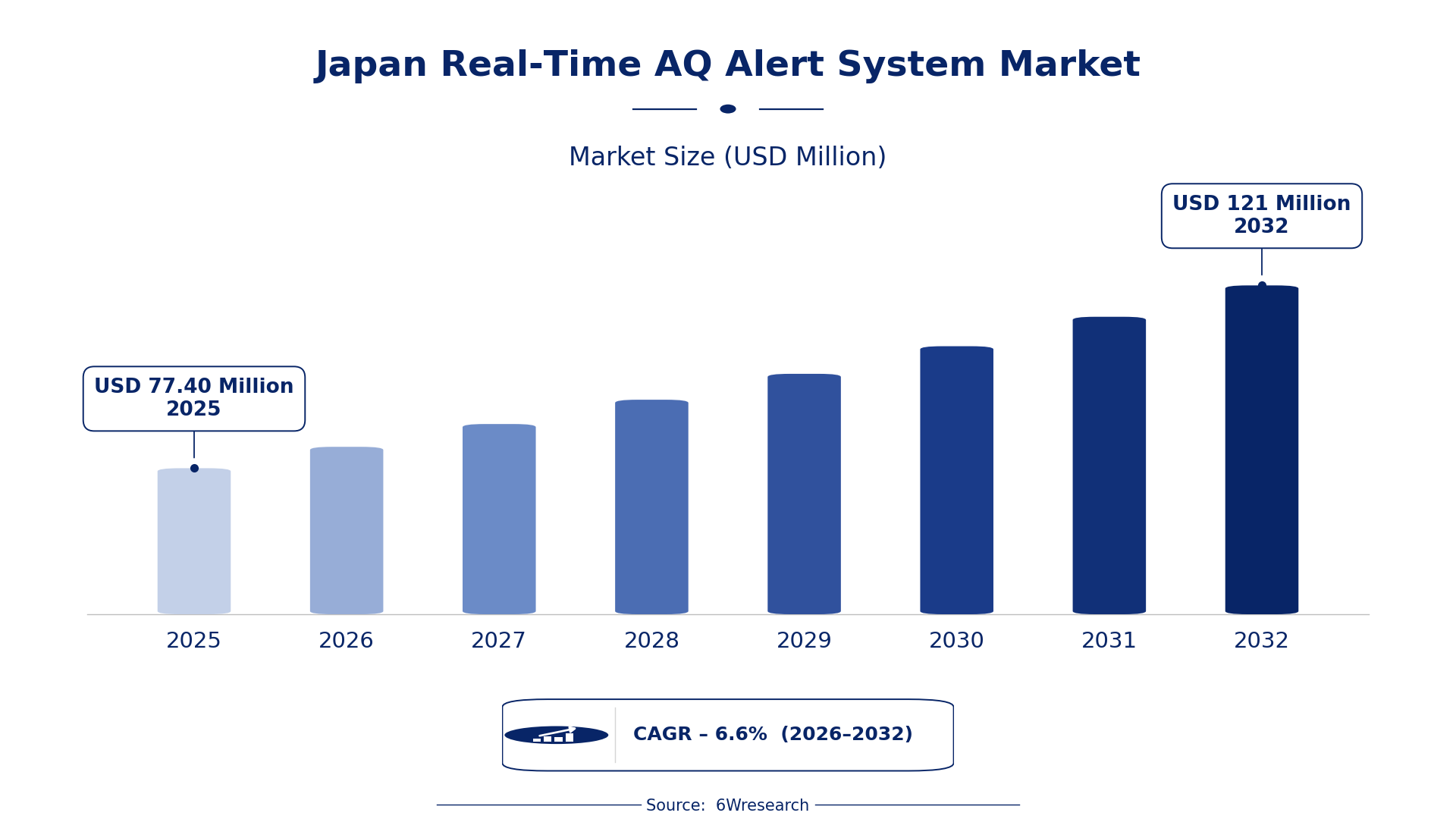
According to 6Wresearch internal database and industry insights, the Japan Real‑Time AQ Alert System Market was valued at USD 77.40 Million in 2025 and is projected to reach USD 121 Million by 2032, growing at a CAGR of approximately 6.6% during 2026–2032.
Japan Real‑Time AQ Alert System Market Highlights
| Report Metric | Details |
| Report Name | Japan Real‑Time AQ Alert System Market (2026-2032) |
| Market Size 2025 | USD 77.40 Million |
| Market Size 2032 | USD 121 Million |
| Absolute Growth 2025–2032 | USD 43.60 Million |
| CAGR 2026–2032 | 6.6% |
| Peak Annual Growth | 7.5% in 2032 |
| Forecast Period | 2026–2032 |
| Historical Data | 2022–2025 |
| Base Year | 2025 |
| Leading Sensor Type, 2025 | Fixed Outdoor AQ Sensors (45% share) |
| Leading Alert Model, 2025 | Threshold-Based Alerts (39% share) |
| Leading Deployment Setting, 2025 | Urban Monitoring (39% share) |
| Leading End User, 2025 | Municipal Environmental Agencies (38% share) |
| Fastest-Growing Sensor Type | Portable Air Quality Monitors (10.2% CAGR) |
| Fastest-Growing Alert Model | Predictive Alerts (9.3% CAGR) |
| Fastest-Growing Deployment Setting | Wearable Devices (9.8% CAGR) |
| Fastest-Growing End User | Workers in Utilities/Construction (8.7% CAGR) |
| Growing Sector | Public Health |
| Key End Users | Municipal Environmental Agencies, Public Health Units, Facility Managers, Workers in Utilities/Construction |
Japan Real‑Time AQ Alert System Market Year-wise Growth Rate and Key Drivers (2022–2032)
This graph illustrates the annual growth rates of the market from 2022 to 2032, highlighting a steady upward trajectory and projected market expansion over the forecast period.
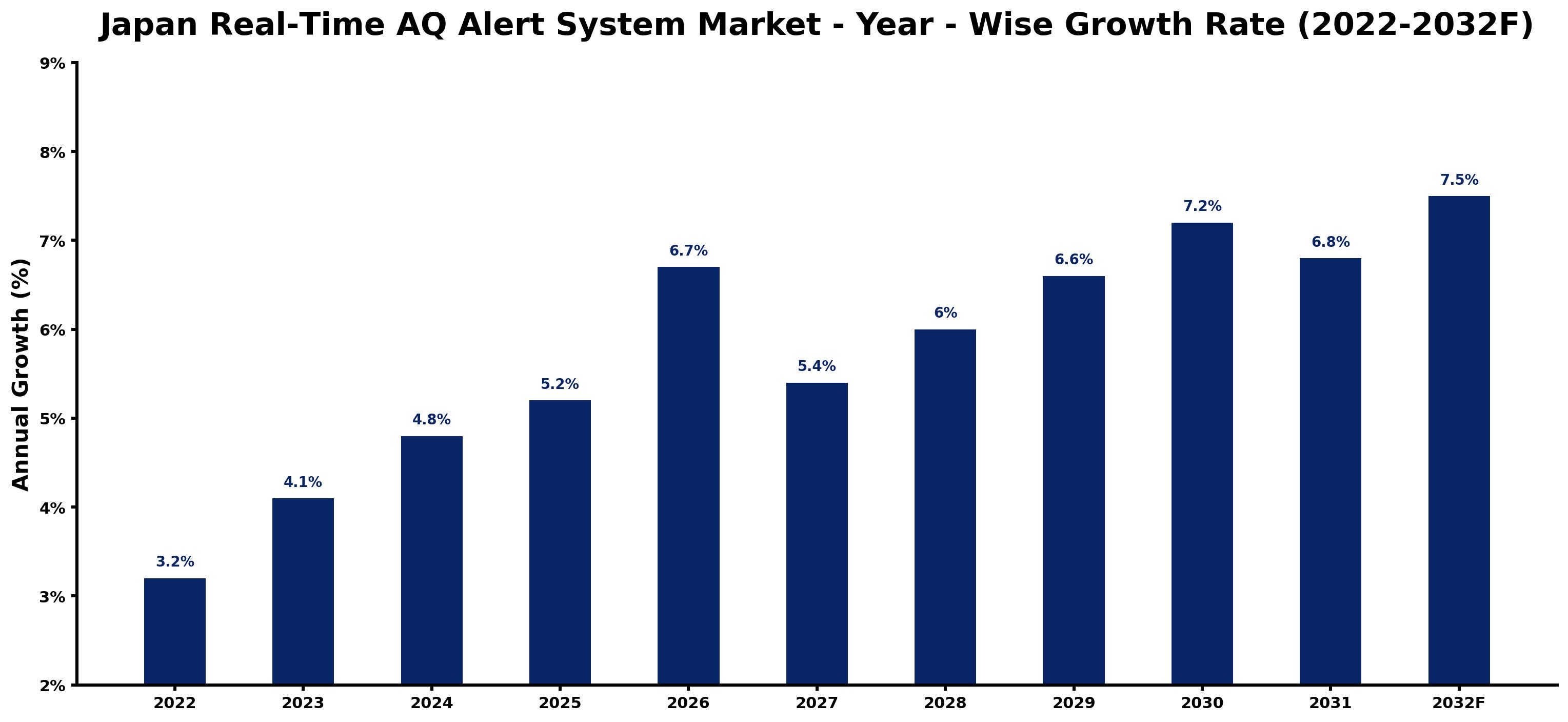
Annual growth estimates for each year appear below with the principal reason behind them, explaining the shifts that set the pace of the market.
| Year | Estimated Annual Growth (%) | Market Rationale |
| 2022 | 3.2 | The market showed positive growth due to increasing urbanisation and awareness of air quality issues. |
| 2023 | 4.1 | Demand accelerated as municipalities implemented new air quality monitoring initiatives across major cities. |
| 2024 | 4.8 | Growth continued as public health units expanded their monitoring capabilities to address pollution concerns. |
| 2025 | 5.2 | The introduction of new standards for air quality monitoring contributed to a stronger market performance. |
| 2026 | 6.7 | Investment in smart city technologies is expected to rise, driving demand for real-time monitoring systems. |
| 2027 | 5.4 | Growth is expected to slow as market saturation begins to affect new system deployments in urban areas. |
| 2028 | 6.0 | Demand is projected to increase again as urban monitoring initiatives gain momentum in response to health crises. |
| 2029 | 6.6 | Public health campaigns will further drive the need for real-time alerts about air quality changes. |
| 2030 | 7.2 | The integration of IoT technologies in urban planning is expected to support a rise in system installations. |
| 2031 | 6.8 | Growth is projected to moderate as competition intensifies among providers of air quality monitoring solutions. |
| 2032 | 7.5 | The market is expected to peak as municipalities adopt advanced monitoring systems to comply with new regulations. |
Note: Market size estimations and growth projections presented in this report are based on 6Wresearch's proprietary forecasting methodology, utilizing the latest available industry data, government publications, and primary research inputs.
Japan Real‑Time AQ Alert System Market Synopsis
Real-Time AQ Alert Systems are advanced technology solutions designed to monitor air quality continuously using integrated sensors and software. They primarily serve municipal environmental agencies and public health units, ensuring compliance with regulations and providing health alerts. The Japan Real-Time AQ Alert System Market is expanding due to a growing urban population of approximately 126 million, increasing investment in smart city technologies, and new initiatives launched in 2023 that emphasise IoT integration for improved air quality management.
Market Dynamics Impact Analysis (2026–2032)
| Factor | Type | Impact | Primary Segment Affected |
| Growing urban population drives demand for air quality monitoring solutions. | Driver | High | Urban Monitoring |
| Investment in smart city technologies enhances the need for real-time monitoring systems. | Driver | High | IoT-Connected Nodes |
| Increased public health awareness creates opportunities for real-time alert systems. | Opportunity | High | Real-Time Mobile Alerts |
| Expansion of urban monitoring initiatives offers a significant market entry point. | Opportunity | High | Urban Monitoring |
| Regulatory compliance costs can limit the adoption of advanced monitoring systems. | Restraint | Medium | Fixed Outdoor AQ Sensors |
| Market saturation in urban areas may slow growth in new system deployments. | Restraint | Medium | Indoor AQ Systems |
| Competition among providers can lead to pricing pressures affecting profitability. | Challenge | High | Portable Air Quality Monitors |
| Technological integration challenges may delay system deployments in facilities. | Challenge | Medium | Smart Buildings |
Evaluation of Drivers in Japan Real‑Time AQ Alert System Market (2026–2032)
The table below links each growth driver to the segment it affects and the evidence for it.
| Drivers | Primary Segment Affected | Why It Matters (Evidence) |
| Increasing urbanisation leads to a higher demand for air quality monitoring. | Urban Monitoring | Japan's urban population of approximately 126 million necessitates effective air quality management. |
| Investment in smart city technologies is rising, driving demand for monitoring capabilities. | IoT-Connected Nodes | Investment in smart city technologies is expected to increase by 15% by 2025. |
| Public health initiatives are driving demand for real-time alerts about air quality. | Real-Time Mobile Alerts | Public Health Units in Japan are increasingly using real-time alerts to address pollution. |
| Regulatory standards are pushing municipalities to adopt advanced monitoring systems. | Fixed Outdoor AQ Sensors | The Ministry of the Environment has set stringent standards for air quality monitoring. |
| Construction sites require portable monitors to ensure worker safety and compliance. | Portable Air Quality Monitors | Portable air quality monitors are increasingly used in construction sites for worker safety. |
The strongest pull on demand comes from urban areas, where the population exceeds 126 million, creating a pressing need for effective air quality monitoring solutions. Investment in smart city technologies is expected to rise by 15% by 2025, which will drive the adoption of real-time monitoring systems.
Evaluation of Restraints in Japan Real‑Time AQ Alert System Market
The key brakes on demand, and where they bite hardest, are shown below.
| Market Restraint | Primary Segment Affected | Why It Matters (Evidence) |
| Regulatory compliance costs can limit the adoption of advanced monitoring systems. | Fixed Outdoor AQ Sensors | Compliance with the Economic Security Promotion Act can impose financial burdens on municipalities. |
| Market saturation in urban areas may slow growth in new system deployments. | Indoor AQ Systems | As urban areas become saturated with monitoring systems, new deployments face challenges. |
| Technological integration challenges may delay system deployments in facilities. | Smart Buildings | Complexity in integrating air quality systems with existing building technologies can hinder adoption. |
| Competition among providers can lead to pricing pressures affecting profitability. | Portable Air Quality Monitors | Increased competition in the portable monitor market can drive prices down, impacting margins. |
| Limited awareness of air quality issues in rural areas restricts market growth. | Urban Monitoring | Demand for urban monitoring solutions is less pronounced in less populated regions. |
Japan Real‑Time AQ Alert System Market Challenges
Japan has over 1,000 fixed outdoor sensors, yet many municipalities face high operational costs because they rely on outdated technology, raising expenses for public health units needing accurate air quality data. Producers encounter sourcing challenges for advanced sensors, causing delays in system deployment for buyers requiring timely air quality alerts. The Ministry of the Environment's standards for air quality monitoring impose additional burdens on producers, forcing them to invest in upgrades that can postpone system rollouts for municipal agencies. A lack of skilled technicians in the tech sector restricts producers' capacity to implement effective solutions, leading to insufficient monitoring in urban areas with high pollution levels.
Trends in the Japan Real‑Time AQ Alert System Market
Buyers and suppliers in the Japan Real‑Time AQ Alert System Market are adjusting to the following trends.
- Shift from Fixed to Mobile Monitoring Solutions: In 2023, the trend towards mobile air quality monitoring solutions gained traction, particularly in urban areas. Portable air quality monitors are increasingly used in construction sites, with a reported increase of 15% in their adoption.
- Municipal Agencies Prioritising Real-Time Alerts: Municipal Environmental Agencies are increasingly prioritising real-time alerts to improve public health responses. The Tokyo Metropolitan Government's initiative for real-time air quality alerts has seen a 30% increase in public engagement.
- Growing Integration of IoT in Air Quality Management: The 2023 initiative emphasises the integration of IoT technologies in urban air quality management. This shift is expected to improve data sharing capabilities by 25% across major cities.
- Rise of Predictive Alerts in Air Quality Monitoring: Predictive alerts are becoming more popular among environmental agencies, with a CAGR of 9.3% projected from 2026 to 2032. This trend is driven by the need for improved air quality management.
Investment Opportunities in the Japan Real‑Time AQ Alert System Market
Below are the investment opportunities with the strongest case in the Japan Real‑Time AQ Alert System Market.
- Municipal Environmental Agencies Seeking Advanced Solutions: Municipal Environmental Agencies are increasingly looking for advanced air quality monitoring solutions. With Japan's urban population at 126 million, there is a growing opportunity to supply real-time alert systems to these agencies.
- Investment in Portable Monitoring Solutions: There is a growing need for portable air quality monitors, especially in construction sites. With the construction sector expanding, suppliers can enter this market by partnering with local construction firms.
- Urban Areas Demanding Comprehensive Monitoring Systems: Urban areas are demanding comprehensive air quality monitoring systems to comply with new regulations. Suppliers can target municipalities in regions like Tokyo and Osaka, where compliance is critical.
- Growing Need for Indoor Monitoring Systems: Indoor AQ Systems are increasingly required in hospitals and schools to ensure safe environments. Suppliers can enter this market by obtaining relevant certifications and partnering with facility managers.
Government Initiatives in the Japan Real‑Time AQ Alert System Market
The Semiconductor and Digital Industry Strategy (METI, June 2021) sets measures to secure domestic semiconductor manufacturing, aiding the production of air quality monitoring systems. This law complements the Economic Security Promotion Act, supporting supply-chain resilience for critical products and ensuring compliance for public health.
The Ministry of the Environment oversees the implementation of air quality monitoring standards and funds initiatives aimed at improving urban air quality. Their support for projects is vital for advancing air quality management technologies.
Future Insight of the Japan Real‑Time AQ Alert System Market
Public health units will increasingly rely on real-time air quality alert systems by 2032, as the JIS Z 8801 standard gains traction. Investment in smart city technologies is projected to rise significantly, allowing suppliers to offer enhanced monitoring solutions. The Tokyo Metropolitan Government's initiative for real-time alerts will transform urban air quality management, improving health outcomes for residents. As the Well Building Standard becomes more prevalent, facilities will focus on air quality, driving demand for advanced monitoring technologies.
Market Segmentation Analysis
Japan Real‑Time AQ Alert System Market report covers a detailed analysis of the following market segments:
By Sensor Type – Fixed Outdoor AQ Sensors Lead, Portable Air Quality Monitors Expected to Grow Fastest
According to Saurav Kr Singh, Senior Research Analyst at 6Wresearch, with 45% of sensor type revenue in 2025, Fixed Outdoor AQ Sensors was the largest category. Fixed Outdoor AQ Sensors dominate the market because they are essential for continuous outdoor air quality monitoring in Japan's densely populated urban areas. The extensive air quality monitoring network, which includes over 1,000 fixed outdoor sensors, highlights their critical importance. Portable Air Quality Monitors are projected to grow fastest, at a CAGR of 10.2% during 2026–2032. The growth of Portable Air Quality Monitors is spurred by increasing awareness of personal health, particularly in construction sites where monitoring is crucial for worker safety. This heightened focus on health will likely drive demand for these localized assessment tools. Suppliers should focus on developing portable monitors to cater to the rising need for personal air quality tracking.
By Alert Model – Threshold-Based Alerts Lead, Predictive Alerts Expected to Grow Fastest
Threshold-Based Alerts took 39% of alert model revenue in 2025, more than any other category. Threshold-Based Alerts hold the largest market share as they are vital for providing immediate notifications when air quality exceeds safe levels, directly influencing public health. This alert model aligns with the standards set by the Ministry of the Environment in Japan. The quickest growth will come from Predictive Alerts, forecast to expand at a CAGR of 9.3% between 2026 and 2032. Predictive Alerts are experiencing rapid growth due to advancements in data analytics that improve the forecasting of air quality trends. This capability is especially valuable in urban areas where proactive measures can significantly mitigate health risks. Buyers may benefit from integrating predictive alert systems into their air quality management practices.
By Deployment Setting – Urban Monitoring Leads, Wearable Devices Expected to Grow Fastest
In 2025, Urban Monitoring led the deployment setting split with a 39% share. Urban Monitoring is the leading segment as it is essential for assessing air quality in densely populated areas, where pollution levels can be critical. This focus is underscored by initiatives like the Smart City Strategy 2023 that prioritises urban air quality management. Wearable Devices are set to record the highest CAGR in this split, 9.8% over 2026–2032. Wearable Devices are gaining traction as individuals seek personal air quality tracking solutions, particularly in environments with variable pollution levels. This growth reflects a broader trend towards personal health monitoring technologies. Suppliers should consider developing wearable solutions to meet the rising consumer demand for personal air quality awareness.
By End User – Municipal Environmental Agencies Lead, Workers in Utilities/Construction Expected to Grow Fastest
Municipal Environmental Agencies accounted for 38% of the market by end user in 2025. Municipal Environmental Agencies are the primary users of real-time AQ alert systems, focusing on regulatory compliance and public health initiatives. Their role is critical as they enforce government standards for effective air quality monitoring. Over 2026–2032, Workers in Utilities/Construction is expected to post the fastest growth, at a CAGR of 8.7%. The segment for Workers in Utilities/Construction is growing quickly as air quality monitoring becomes essential for ensuring safety in high-risk environments. This trend is driven by increased regulations and awareness of pollution's health impacts. Suppliers should tailor their products to meet the specific needs of workers in utilities and construction to improve safety compliance.
Key Attractiveness of the Report
- 10 Years of Market Numbers
- Historical Data Starting from 2022 to 2025
- Base Year 2025
- Forecast Data until 2032
- Key Performance Indicators Impacting the Market
- Major Upcoming Developments and Projects
Key Highlights of the Report:
- Japan Real‑Time AQ Alert System Market Outlook
- Market Size of Japan Real‑Time AQ Alert System Market, 2025
- Forecast of Japan Real‑Time AQ Alert System Market, 2032
- Historical Data and Forecast of Japan Real‑Time AQ Alert System Revenues & Volume for the Period 2022-2032F
- Japan Real‑Time AQ Alert System Market Trend Evolution
- Japan Real‑Time AQ Alert System Market Drivers and Challenges
- Japan Real‑Time AQ Alert System Price Trends
- Japan Real‑Time AQ Alert System Porter's Five Forces
- Japan Real‑Time AQ Alert System Industry Life Cycle
- Historical Data and Forecast of Japan Real‑Time AQ Alert System Market Revenues & Volume By Sensor Type for the Period 2022-2032F
- Historical Data and Forecast of Japan Real‑Time AQ Alert System Market Revenues & Volume By Fixed Outdoor AQ Sensors for the Period 2022-2032F
- Historical Data and Forecast of Japan Real‑Time AQ Alert System Market Revenues & Volume By Portable Air Quality Monitors for the Period 2022-2032F
- Historical Data and Forecast of Japan Real‑Time AQ Alert System Market Revenues & Volume By Indoor AQ Systems for the Period 2022-2032F
- Historical Data and Forecast of Japan Real‑Time AQ Alert System Market Revenues & Volume By IoT-Connected Nodes for the Period 2022-2032F
- Historical Data and Forecast of Japan Real‑Time AQ Alert System Market Revenues & Volume By Alert Model for the Period 2022-2032F
- Historical Data and Forecast of Japan Real‑Time AQ Alert System Market Revenues & Volume By Threshold-Based Alerts for the Period 2022-2032F
- Historical Data and Forecast of Japan Real‑Time AQ Alert System Market Revenues & Volume By Predictive Alerts for the Period 2022-2032F
- Historical Data and Forecast of Japan Real‑Time AQ Alert System Market Revenues & Volume By LEED/Well Cert Alerts for the Period 2022-2032F
- Historical Data and Forecast of Japan Real‑Time AQ Alert System Market Revenues & Volume By Real-Time Mobile Alerts for the Period 2022-2032F
- Historical Data and Forecast of Japan Real‑Time AQ Alert System Market Revenues & Volume By Deployment Setting for the Period 2022-2032F
- Historical Data and Forecast of Japan Real‑Time AQ Alert System Market Revenues & Volume By Urban Monitoring for the Period 2022-2032F
- Historical Data and Forecast of Japan Real‑Time AQ Alert System Market Revenues & Volume By Wearable Devices for the Period 2022-2032F
- Historical Data and Forecast of Japan Real‑Time AQ Alert System Market Revenues & Volume By Smart Buildings for the Period 2022-2032F
- Historical Data and Forecast of Japan Real‑Time AQ Alert System Market Revenues & Volume By Smart City Networks for the Period 2022-2032F
- Historical Data and Forecast of Japan Real‑Time AQ Alert System Market Revenues & Volume By End User for the Period 2022-2032F
- Historical Data and Forecast of Japan Real‑Time AQ Alert System Market Revenues & Volume By Municipal Environmental Agencies for the Period 2022-2032F
- Historical Data and Forecast of Japan Real‑Time AQ Alert System Market Revenues & Volume By Workers in Utilities/Construction for the Period 2022-2032F
- Historical Data and Forecast of Japan Real‑Time AQ Alert System Market Revenues & Volume By Facility Managers for the Period 2022-2032F
- Historical Data and Forecast of Japan Real‑Time AQ Alert System Market Revenues & Volume By Public Health Units for the Period 2022-2032F
- Japan Real‑Time AQ Alert System Import Export Trade Statistics
- Market Opportunity Assessment By Sensor Type
- Market Opportunity Assessment By Alert Model
- Market Opportunity Assessment By Deployment Setting
- Market Opportunity Assessment By End User
- Japan Real‑Time AQ Alert System Top Companies Market Share
- Japan Real‑Time AQ Alert System Competitive Benchmarking By Technical and Operational Parameters
- Japan Real‑Time AQ Alert System Company Profiles
- Japan Real‑Time AQ Alert System Key Strategic Recommendations
Market Covered
The report covers the following segments.
By Sensor Type
- Fixed Outdoor AQ Sensors
- Portable Air Quality Monitors
- Indoor AQ Systems
- IoT-Connected Nodes
By Alert Model
- Threshold-Based Alerts
- Predictive Alerts
- LEED/Well Cert Alerts
- Real-Time Mobile Alerts
By Deployment Setting
- Urban Monitoring
- Wearable Devices
- Smart Buildings
- Smart City Networks
By End User
- Municipal Environmental Agencies
- Workers in Utilities/Construction
- Facility Managers
- Public Health Units































