Japan Real‑Time Data Processing Market Size & Growth Rate
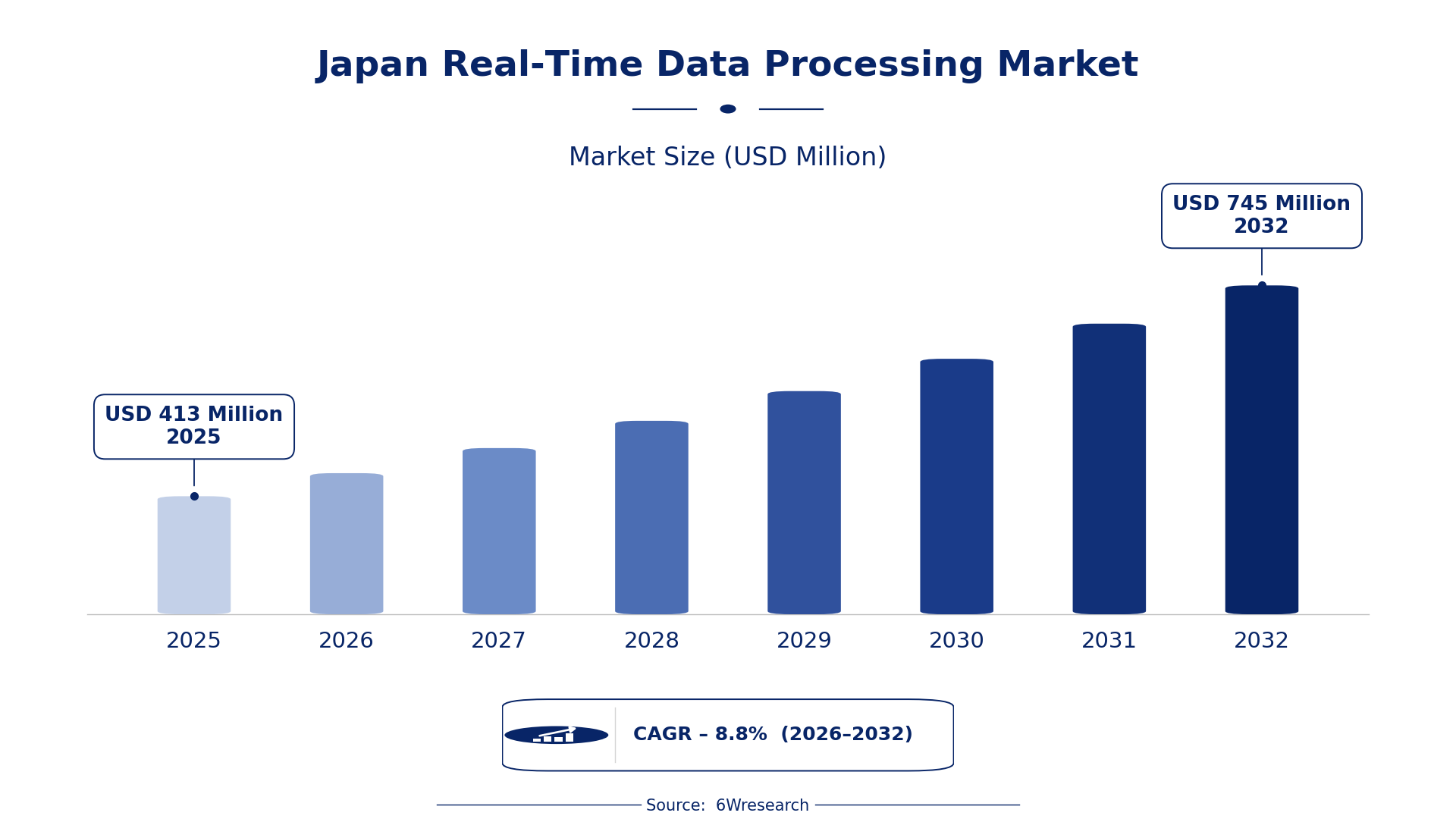
According to 6Wresearch internal database and industry insights, the Japan Real‑Time Data Processing Market was valued at USD 413 Million in 2025 and is projected to reach USD 745 Million by 2032, growing at a CAGR of approximately 8.8% during 2026–2032.
Japan Real‑Time Data Processing Market Highlights
| Report Metric | Details |
| Report Name | Japan Real‑Time Data Processing Market (2026-2032) |
| Market Size 2025 | USD 413 Million |
| Market Size 2032 | USD 745 Million |
| Absolute Growth 2025–2032 | USD 332 Million |
| CAGR 2026–2032 | 8.8% |
| Peak Annual Growth | 9.8% in 2028 |
| Forecast Period | 2026–2032 |
| Historical Data | 2022–2025 |
| Base Year | 2025 |
| Leading Data Source, 2025 | IoT Sensor Data (45% share) |
| Leading Processing Engine, 2025 | Apache Flink/Spark (37% share) |
| Leading Deployment Architecture, 2025 | Edge/Cloud Hybrid (39% share) |
| Leading End User, 2025 | Telecom Operators (48% share) |
| Fastest-Growing Data Source | Financial Market Data (13.5% CAGR) |
| Fastest-Growing Processing Engine | CEP Systems (12.2% CAGR) |
| Fastest-Growing Deployment Architecture | On-Premise/Cloud (13.1% CAGR) |
| Fastest-Growing End User | Investment Banks (11.2% CAGR) |
| Growing Sector | telecommunications |
| Key End Users | telecom operators, investment banks, media & marketing firms, research institutions |
Japan Real‑Time Data Processing Market Year-wise Growth Rate and Key Drivers (2022–2032)
This graph illustrates the annual growth rates of the market from 2022 to 2032, highlighting a steady upward trajectory and projected market expansion over the forecast period.
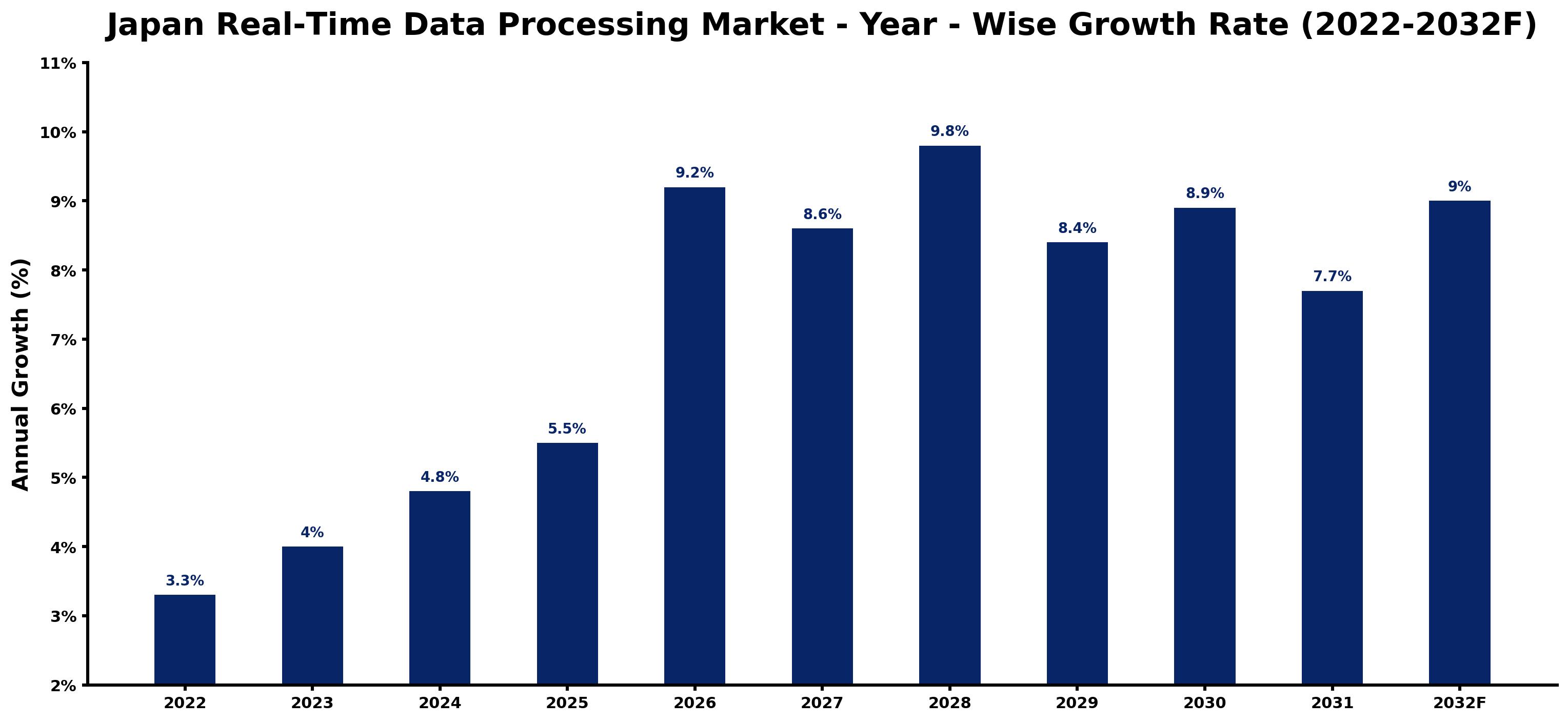
The following figures match every annual growth estimate with the main market development of that year, giving the reasoning behind each rise or slowdown.
| Year | Estimated Annual Growth (%) | Market Rationale |
| 2022 | 3.3 | The market was characterised by moderate growth as businesses began to adopt real-time data solutions. |
| 2023 | 4.0 | Demand increased due to heightened interest in IoT applications among various sectors. |
| 2024 | 4.8 | Growth accelerated as financial institutions invested in real-time analytics for trading. |
| 2025 | 5.5 | The market peaked historically as telecom operators expanded their data processing capabilities. |
| 2026 | 9.2 | Demand is expected to surge with the integration of advanced cloud solutions in data processing. |
| 2027 | 8.6 | Growth is projected to slow slightly as market saturation begins to affect new investments. |
| 2028 | 9.8 | A renewed interest in real-time analytics is expected to drive the highest growth rate of the forecast period. |
| 2029 | 8.4 | Growth is anticipated to decelerate as competition intensifies among service providers in the sector. |
| 2030 | 8.9 | Demand is expected to rebound as new technologies emerge, improving data processing efficiency. |
| 2031 | 7.7 | Growth is projected to moderate as the market stabilises, reflecting mature adoption rates. |
| 2032 | 9.0 | A resurgence in investment in data processing technologies is expected to drive growth. |
Note: Market size estimations and growth projections presented in this report are based on 6Wresearch's proprietary forecasting methodology, utilizing the latest available industry data, government publications, and primary research inputs.
Japan Real‑Time Data Processing Market Synopsis
Real-Time Data Processing enables continuous input, processing, and output of information, essential for monitoring IoT devices, financial transactions, and social media analytics. The Japan Real-Time Data Processing Market is expanding due to strong demand from telecommunications and finance sectors, with the IoT market projected to reach 1 trillion yen by 2025. The increasing reliance on real-time analytics, particularly in financial transactions, drives this growth, as 70% of transactions depend on real-time processing.
Market Dynamics Impact Analysis (2026–2032)
| Factor | Type | Impact | Primary Segment Affected |
| Rising IoT adoption across various sectors | Driver | High | IoT Sensor Data |
| Increased investment in financial data processing technologies | Driver | High | Financial Market Data |
| Growing demand for real-time analytics in healthcare | Opportunity | Medium | Genomic/Health Data |
| Expansion of telecom networks requiring enhanced data processing | Opportunity | High | Telecom Operators |
| Limited infrastructure for data processing in some regions | Restraint | Medium | Social Media Streams |
| High competition among service providers leading to price pressures | Restraint | High | Financial Market Data |
| Challenges in data privacy regulations affecting implementation | Challenge | High | Genomic/Health Data |
| Need for continuous updates in technology to stay competitive | Challenge | Medium | Telecom Operators |
Evaluation of Drivers in Japan Real‑Time Data Processing Market (2026–2032)
These are the developments adding the most demand over the forecast period.
| Drivers | Primary Segment Affected | Why It Matters (Evidence) |
| Increased IoT device deployment | IoT Sensor Data | The IoT market is projected to reach 1 trillion yen by 2025, driving demand for real-time data processing. |
| Growing financial transaction volume | Financial Market Data | Real-time analytics is essential for 70% of financial transactions in Japan, prompting banks to invest in processing technologies. |
| Healthcare sector investments in data analytics | Genomic/Health Data | The healthcare sector is investing heavily in genomic data analytics, increasing the need for real-time processing. |
| Telecom operators enhancing service quality | Telecom Operators | With over 180 million active subscribers, telecom operators are investing in real-time data processing for improved customer experience. |
| Rising demand for social media analytics | Social Media Streams | Media and marketing firms require real-time analytics for audience engagement, increasing the need for processing capabilities. |
What keeps demand rising is the increasing deployment of IoT devices, with Japan's IoT market expected to reach 1 trillion yen by 2025. Financial institutions are investing in real-time data processing, as 70% of financial transactions rely on real-time analytics. The healthcare sector is also investing heavily in genomic data analytics, driving demand for processing technologies. Telecom operators are improving service quality through real-time data processing, while media and marketing firms are using analytics for audience engagement, further boosting demand.
Evaluation of Restraints in Japan Real‑Time Data Processing Market
The main factors holding the market back are set out below.
| Market Restraint | Primary Segment Affected | Why It Matters (Evidence) |
| Limited infrastructure in rural areas | Social Media Streams | Inadequate infrastructure in rural regions hampers the deployment of real-time data processing solutions. |
| High competition leading to price pressures | Financial Market Data | Intense competition among service providers can lead to reduced profit margins for data processing solutions. |
| Data privacy regulations complicating implementation | Genomic/Health Data | Strict data privacy regulations can delay the adoption of real-time processing technologies in healthcare. |
| Skills gap in data processing expertise | Telecom Operators | A shortage of skilled professionals in real-time data processing can hinder project execution and innovation. |
| Dependency on legacy systems | Financial Market Data | Many financial institutions still rely on legacy systems, limiting their ability to adopt real-time data processing. |
Japan Real‑Time Data Processing Market Challenges
Japan's real-time data processing market faces a skills shortage, as only 30% of tech graduates specialise in analytics, which delays project timelines by up to six months for producers. Many importers encounter technology challenges due to outdated infrastructure, leading to inefficiencies that can increase operational costs by 20%. Regulatory hurdles, such as compliance with JIS Q 15001:2017, impose additional burdens on buyers, raising processing solution costs by up to 15%. Frequent demand fluctuations from the financial sector complicate revenue forecasting, creating budgeting challenges for suppliers.
Trends in the Japan Real‑Time Data Processing Market
The following changes are redrawing the Japan Real‑Time Data Processing Market.
- Telecom Operators Prioritising Real-Time Analytics: Telecom operators are focusing on real-time analytics to improve customer experience, with over 180 million active subscribers driving demand for immediate insights.
- Shift from Traditional to Cloud-Based Processing: The transition towards cloud-based processing began in 2021, as more organisations adopted cloud solutions, with cloud computing adoption projected to exceed 30% by 2025.
- Growing Focus on Genomic Data Analytics: The healthcare sector is shifting towards genomic data analytics, with substantial investments aimed at improving real-time health monitoring and research capabilities.
- Increased Use of Financial Market Data: Since 2022, financial institutions have been adopting real-time data processing for trading, reflecting a growing trend in the financial market.
Investment Opportunities in the Japan Real‑Time Data Processing Market
Several openings in the Japan Real‑Time Data Processing Market merit attention from investors.
- Partnerships with Telecom Operators: As the telecom sector expands, forming partnerships can facilitate entry into real-time data processing, with demand expected to grow significantly in the coming years.
- Investment in Genomic Data Analytics: The healthcare sector is investing heavily in genomic data analytics, creating opportunities for suppliers to provide processing solutions, especially as the market grows.
- Approval for Cloud-Based Solutions: With cloud computing adoption projected to exceed 30% by 2025, investing in cloud-based real-time data processing solutions presents a timely opportunity.
- Joint Ventures in Financial Market Data: Investment banks are seeking advanced data processing solutions, making joint ventures an attractive entry point for suppliers in this sector.
Government Initiatives in the Japan Real‑Time Data Processing Market
The AI Promotion Act, established in 2025, sets a national framework for AI research and development, benefiting producers of real-time data processing by providing guidelines for technology integration and usage. The Next-Generation Medical Infrastructure Act facilitates the use of real-time processing in healthcare by allowing certified entities to anonymise medical data for research and development purposes, promoting innovation in the sector.
The Digital Agency oversees the approval of projects related to digital transformation, funding initiatives that improve data utilisation strategies. The Japan Data Strategy Council supports projects aimed at enhancing data processing capabilities, ensuring compliance with standards like JIS Q 15001:2017.
Future Insight of the Japan Real‑Time Data Processing Market
Investment in real-time data processing technologies will surge, driven by Japan's Digital Agency initiatives, which will create substantial demand for advanced solutions. By 2032, the IoT market will reach 1 trillion yen, significantly increasing the need for processing capabilities. Cloud computing adoption will exceed 30%, allowing for quicker handling and analysis of information. The Japan Data Strategy Council will promote collaboration among stakeholders, streamlining data utilisation and improving overall market efficiency.
Market Segmentation Analysis
Japan Real‑Time Data Processing Market report covers a detailed analysis of the following market segments:
By Data Source – IoT Sensor Data Leads, Financial Market Data Expected to Grow Fastest
According to Saurav Kr Singh, Senior Research Analyst at 6Wresearch, IoT Sensor Data accounted for 45% of the market by data source in 2025. IoT Sensor Data captures the largest share as it is crucial for monitoring applications in sectors like telecommunications. With Japan's IoT market projected to reach 1 trillion yen by 2025, the demand for this data source is expected to grow significantly. Financial Market Data is set to record the highest CAGR in this split, 13.5% over 2026–2032. Financial Market Data is experiencing rapid growth due to its essential role in real-time trading and investment decisions. The reliance on real-time analytics for 70% of financial transactions in Japan highlights the increasing importance of this data source. Suppliers must focus on enhancing their financial market data offerings to meet the rising demand.
By Processing Engine – Apache Flink/Spark Leads, CEP Systems Expected to Grow Fastest
Apache Flink/Spark held 37% of the Japan Real‑Time Data Processing Market by processing engine in 2025. Apache Flink/Spark dominates the market as these frameworks are widely used for processing high-velocity data streams across various industries. Their established presence in Japan ensures a robust installed base among users who require efficient data processing solutions. Over 2026–2032, CEP Systems are expected to post the fastest growth, at a CAGR of 12.2%. CEP Systems are growing quickly because they are specifically designed for event processing, which is becoming increasingly important in real-time data applications. This segment's rapid expansion is driven by the need for effective event handling in diverse environments. Buyers should consider adopting CEP Systems to improve their event processing capabilities.
By Deployment Architecture – Edge/Cloud Hybrid Leads, On-Premise/Cloud Expected to Grow Fastest
In 2025, Edge/Cloud Hybrid led the deployment architecture split with a 39% share. Edge/Cloud Hybrid architecture leads the market as it effectively supports real-time data processing by combining the benefits of both edge computing and cloud infrastructure. This model is particularly beneficial for sectors like telecommunications that require low latency and high reliability. On-Premise/Cloud is projected to grow fastest, at a CAGR of 13.1% during 2026–2032. On-Premise/Cloud architecture is rapidly gaining traction due to its flexibility and control over data management, appealing to organisations with stringent data security requirements. The growing adoption of cloud computing in Japan further fuels this segment's expansion. Suppliers must offer versatile deployment options to cater to the diverse needs of end users.
By End User – Telecom Operators Lead, Investment Banks Expected to Grow Fastest
Telecom Operators took 48% of end user revenue in 2025, more than any other category. Telecom Operators constitute the largest user group for real-time data processing technologies, primarily for network monitoring and enhancing customer experience. The presence of over 180 million active telecom subscribers in Japan indicates a substantial demand from this sector. The quickest growth will come from Investment Banks, forecast to expand at a CAGR of 11.2% between 2026 and 2032. Investment Banks are witnessing the fastest growth as their dependence on real-time data for trading and risk management intensifies. The financial sector's pressing need for timely information is accelerating this segment's adoption. Suppliers should customise their solutions to address the specific needs of investment banks to seize this growing market.
Key Attractiveness of the Report
- 10 Years of Market Numbers
- Historical Data Starting from 2022 to 2025
- Base Year 2025
- Forecast Data until 2032
- Key Performance Indicators Impacting the Market
- Major Upcoming Developments and Projects
Key Highlights of the Report:
- Japan Real‑Time Data Processing Market Outlook
- Market Size of Japan Real‑Time Data Processing Market, 2025
- Forecast of Japan Real‑Time Data Processing Market, 2032
- Historical Data and Forecast of Japan Real‑Time Data Processing Revenues & Volume for the Period 2022-2032F
- Japan Real‑Time Data Processing Market Trend Evolution
- Japan Real‑Time Data Processing Market Drivers and Challenges
- Japan Real‑Time Data Processing Price Trends
- Japan Real‑Time Data Processing Porter's Five Forces
- Japan Real‑Time Data Processing Industry Life Cycle
- Historical Data and Forecast of Japan Real‑Time Data Processing Market Revenues & Volume By Data Source for the Period 2022-2032F
- Historical Data and Forecast of Japan Real‑Time Data Processing Market Revenues & Volume By IoT Sensor Data for the Period 2022-2032F
- Historical Data and Forecast of Japan Real‑Time Data Processing Market Revenues & Volume By Financial Market Data for the Period 2022-2032F
- Historical Data and Forecast of Japan Real‑Time Data Processing Market Revenues & Volume By Social Media Streams for the Period 2022-2032F
- Historical Data and Forecast of Japan Real‑Time Data Processing Market Revenues & Volume By Genomic/Health Data for the Period 2022-2032F
- Historical Data and Forecast of Japan Real‑Time Data Processing Market Revenues & Volume By Processing Engine for the Period 2022-2032F
- Historical Data and Forecast of Japan Real‑Time Data Processing Market Revenues & Volume By Apache Flink/Spark for the Period 2022-2032F
- Historical Data and Forecast of Japan Real‑Time Data Processing Market Revenues & Volume By CEP Systems for the Period 2022-2032F
- Historical Data and Forecast of Japan Real‑Time Data Processing Market Revenues & Volume By Stream Analytics for the Period 2022-2032F
- Historical Data and Forecast of Japan Real‑Time Data Processing Market Revenues & Volume By Real-Time Analytics DBs for the Period 2022-2032F
- Historical Data and Forecast of Japan Real‑Time Data Processing Market Revenues & Volume By Deployment Architecture for the Period 2022-2032F
- Historical Data and Forecast of Japan Real‑Time Data Processing Market Revenues & Volume By Edge/Cloud Hybrid for the Period 2022-2032F
- Historical Data and Forecast of Japan Real‑Time Data Processing Market Revenues & Volume By On-Premise/Cloud for the Period 2022-2032F
- Historical Data and Forecast of Japan Real‑Time Data Processing Market Revenues & Volume By SaaS Platforms for the Period 2022-2032F
- Historical Data and Forecast of Japan Real‑Time Data Processing Market Revenues & Volume By Cloud-Based for the Period 2022-2032F
- Historical Data and Forecast of Japan Real‑Time Data Processing Market Revenues & Volume By End User for the Period 2022-2032F
- Historical Data and Forecast of Japan Real‑Time Data Processing Market Revenues & Volume By Telecom Operators for the Period 2022-2032F
- Historical Data and Forecast of Japan Real‑Time Data Processing Market Revenues & Volume By Investment Banks for the Period 2022-2032F
- Historical Data and Forecast of Japan Real‑Time Data Processing Market Revenues & Volume By Media & Marketing Firms for the Period 2022-2032F
- Historical Data and Forecast of Japan Real‑Time Data Processing Market Revenues & Volume By Research Institutions for the Period 2022-2032F
- Japan Real‑Time Data Processing Import Export Trade Statistics
- Market Opportunity Assessment By Data Source
- Market Opportunity Assessment By Processing Engine
- Market Opportunity Assessment By Deployment Architecture
- Market Opportunity Assessment By End User
- Japan Real‑Time Data Processing Top Companies Market Share
- Japan Real‑Time Data Processing Competitive Benchmarking By Technical and Operational Parameters
- Japan Real‑Time Data Processing Company Profiles
- Japan Real‑Time Data Processing Key Strategic Recommendations
Market Covered
The following segment groups are covered in the report.
By Data Source
- IoT Sensor Data
- Financial Market Data
- Social Media Streams
- Genomic/Health Data
By Processing Engine
- Apache Flink/Spark
- CEP Systems
- Stream Analytics
- Real-Time Analytics DBs
By Deployment Architecture
- Edge/Cloud Hybrid
- On-Premise/Cloud
- SaaS Platforms
- Cloud-Based
By End User
- Telecom Operators
- Investment Banks
- Media & Marketing Firms
- Research Institutions































