Japan Real‑Time Monitoring Software Market Size & Growth Rate
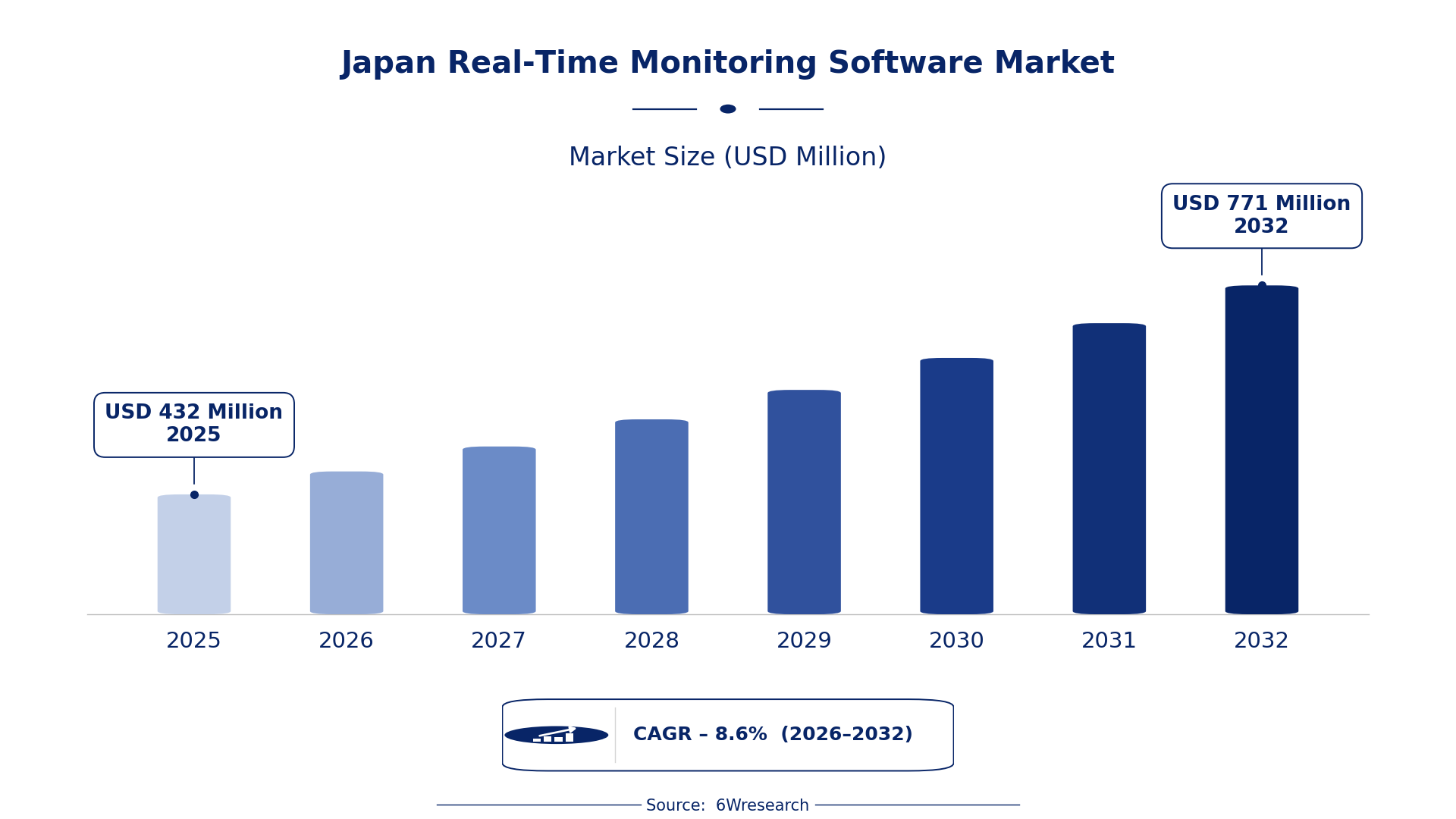
According to 6Wresearch internal database and industry insights, the Japan Real‑Time Monitoring Software Market was valued at USD 432 Million in 2025 and is projected to reach USD 771 Million by 2032, growing at a CAGR of approximately 8.6% during 2026–2032.
Japan Real‑Time Monitoring Software Market Highlights
| Report Metric | Details |
| Report Name | Japan Real‑Time Monitoring Software Market (2026-2032) |
| Market Size 2025 | USD 432 Million |
| Market Size 2032 | USD 771 Million |
| Absolute Growth 2025–2032 | USD 339 Million |
| CAGR 2026–2032 | 8.6% |
| Peak Annual Growth | 9.9% in 2028 |
| Forecast Period | 2026–2032 |
| Historical Data | 2022–2025 |
| Base Year | 2025 |
| Leading Monitoring Type, 2025 | Network Performance (35% share) |
| Leading Data Source, 2025 | SNMP/NetFlow/IPFIX (40% share) |
| Leading Platform Model, 2025 | SaaS/Cloud-Based (38% share) |
| Leading End User, 2025 | Telecom Providers (39% share) |
| Fastest-Growing Monitoring Type | Application Performance (11.7% CAGR) |
| Fastest-Growing Data Source | SIEM/Log Streams (12.6% CAGR) |
| Fastest-Growing End User | Financial Institutions (10.8% CAGR) |
| Growing Sector | telecommunications |
| Key End Users | telecom providers, financial institutions, enterprise IT teams |
Japan Real‑Time Monitoring Software Market Year-wise Growth Rate and Key Drivers (2022–2032)
This graph illustrates the annual growth rates of the market from 2022 to 2032, highlighting a steady upward trajectory and projected market expansion over the forecast period.
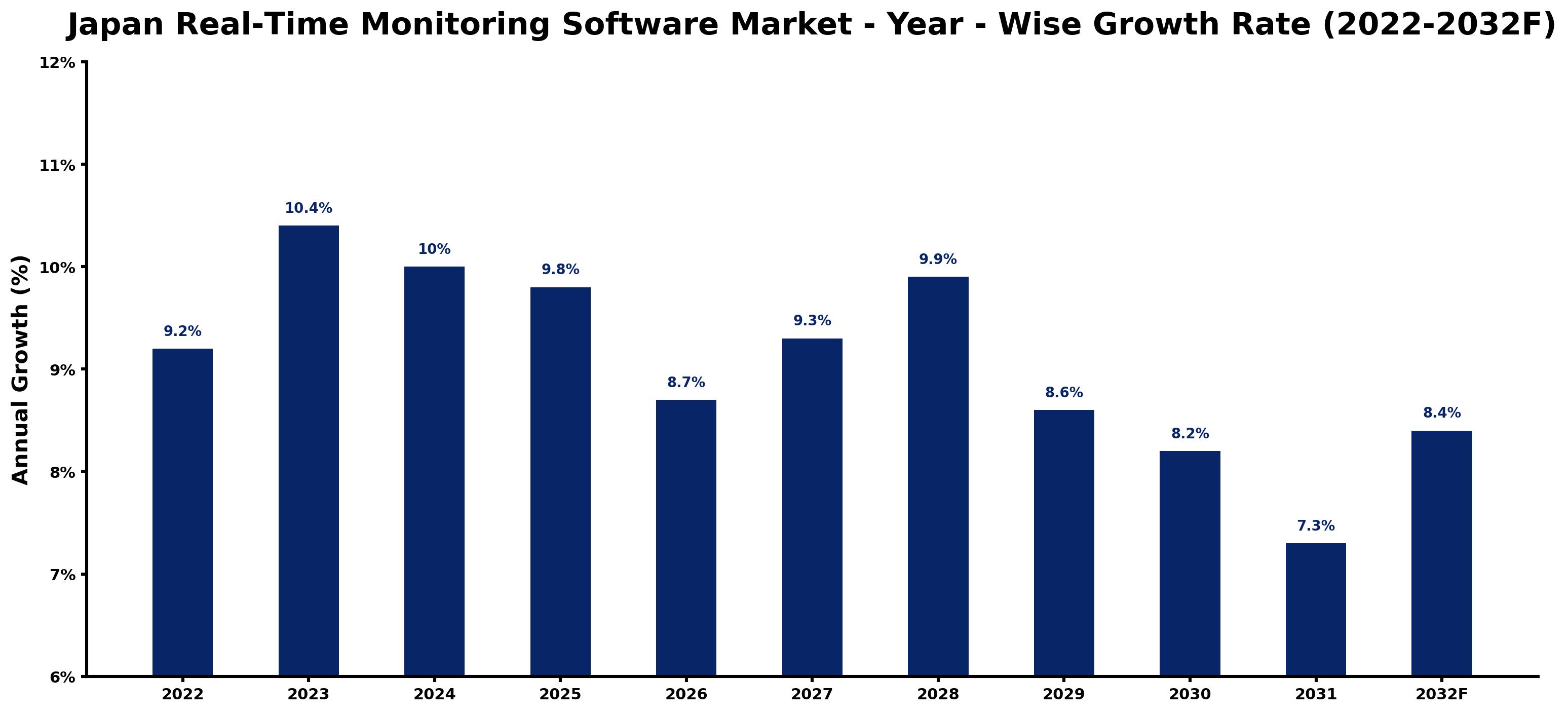
Annual growth estimates for each year appear below with the principal reason behind them, explaining the shifts that set the pace of the market.
| Year | Estimated Annual Growth (%) | Market Rationale |
| 2022 | 9.2 | The market experienced strong growth due to increased digital transformation efforts. |
| 2023 | 10.4 | Demand surged as cybersecurity incidents rose, prompting investments in monitoring solutions. |
| 2024 | 10.0 | Growth slowed as companies adjusted to previous rapid expansions in IT infrastructure. |
| 2025 | 9.8 | The market continued to grow, driven by ongoing investments in network reliability. |
| 2026 | 8.7 | Demand growth is expected to slow as market saturation begins to affect new investments. |
| 2027 | 9.3 | Increased interest in application performance optimization will lead to a rise in demand. |
| 2028 | 9.9 | A peak in growth is projected as real-time monitoring becomes a standard requirement. |
| 2029 | 8.6 | Growth is expected to slow as competition intensifies among monitoring software providers. |
| 2030 | 8.2 | Demand will continue to rise, driven by the need for improved security measures. |
| 2031 | 7.3 | Growth is projected to slow as the market matures and companies focus on efficiency. |
| 2032 | 8.4 | A resurgence in demand is expected as new technologies emerge. |
Note: Market size estimations and growth projections presented in this report are based on 6Wresearch's proprietary forecasting methodology, utilizing the latest available industry data, government publications, and primary research inputs.
Japan Real‑Time Monitoring Software Market Synopsis
Real-Time Monitoring Software provides continuous tracking of system performance and security through advanced algorithms and data analytics. Its primary applications include ensuring network reliability, optimizing application performance, and detecting security threats. The Japan Real-Time Monitoring Software Market is expanding due to rising demand from sectors like telecommunications and finance, alongside increasing cybersecurity incidents and the adoption of cloud services, which reached 30% in 2023. The market is projected to grow as organizations seek to improve operational efficiencies and security measures.
Market Dynamics Impact Analysis (2026–2032)
| Factor | Type | Impact | Primary Segment Affected |
| Increased cybersecurity incidents drive demand for monitoring solutions. | Driver | High | Security Monitoring |
| Growing adoption of cloud services enhances the need for real-time monitoring. | Driver | High | Application Performance |
| The rise in financial regulations creates opportunities for compliance monitoring. | Opportunity | High | Financial Institutions |
| The Tokyo Metropolitan Government's Smart City initiative boosts demand for real-time data solutions. | Opportunity | High | Telecom Providers |
| High competition among providers can lead to price wars, affecting profitability. | Restraint | Medium | Network Performance |
| The complexity of integration with existing systems can hinder adoption rates. | Restraint | Medium | Infrastructure Metrics |
| Talent shortages in cybersecurity can limit the effectiveness of monitoring solutions. | Challenge | High | Security Monitoring |
| Rapid technological changes can outpace current monitoring capabilities. | Challenge | Medium | Application Performance |
Evaluation of Drivers in Japan Real‑Time Monitoring Software Market (2026–2032)
Key forces behind demand, with the segment each one moves most, are listed below.
| Drivers | Primary Segment Affected | Why It Matters (Evidence) |
| Increased cybersecurity incidents necessitate monitoring solutions. | Security Monitoring | The number of reported cybersecurity incidents rose by 25% in 2023, prompting organizations to invest more in monitoring. |
| Growing cloud service adoption drives demand for performance monitoring. | Application Performance | With a 30% adoption rate of cloud services in 2023, businesses require real-time monitoring to optimize application performance. |
| Financial regulations mandate real-time monitoring for compliance. | Financial Institutions | The Financial Services Agency's requirements for transaction monitoring have led to increased software purchases. |
| The Tokyo Smart City initiative promotes the use of real-time data. | Telecom Providers | This initiative encourages telecom providers to invest in monitoring technologies to improve service delivery. |
| Rising IT services market value supports investment in monitoring technologies. | Network Performance | Japan's IT services market was valued at approximately 20 trillion JPY in 2022, indicating strong demand for monitoring solutions. |
Much of the new demand traces back to the increased number of cybersecurity incidents reported in Japan, which rose by 25% in 2023. The adoption of cloud services reached 30% in 2023, leading enterprises to seek performance monitoring to optimize user experience. The growth of Japan's IT services market, valued at approximately 20 trillion JPY in 2022, supports further investments in monitoring software.
Evaluation of Restraints in Japan Real‑Time Monitoring Software Market
Below are the constraints most often cited by buyers and suppliers, with the segment each affects.
| Market Restraint | Primary Segment Affected | Why It Matters (Evidence) |
| High competition can lead to price wars among software providers. | Network Performance | Intense competition may reduce profit margins as providers lower prices to attract clients. |
| Integration complexities with existing systems can slow adoption. | Infrastructure Metrics | Organizations may face challenges in integrating new monitoring solutions with legacy systems, delaying implementation. |
| Talent shortages in cybersecurity can limit monitoring effectiveness. | Security Monitoring | A lack of skilled professionals affects the ability to effectively utilize monitoring software. |
| Rapid technological advancements may outpace current monitoring capabilities. | Application Performance | New technologies can render existing solutions obsolete, requiring constant updates. |
| Budget constraints may limit investment in advanced monitoring solutions. | Financial Institutions | Financial institutions may prioritize other expenditures over monitoring software, affecting growth. |
Japan Real‑Time Monitoring Software Market Challenges
Real-Time Monitoring Software encounters challenges due to a lack of advanced technology integration, which affects system performance tracking for producers. This issue is exacerbated by the adoption rate of cloud services being only 30%, which hinders operational efficiency for IT firms. Intense competition among over 1,000 cybersecurity firms drives prices down, impacting profit margins for software developers. Skills shortages in the IT sector, with average salaries around 6 million JPY, lead to project delays for buyers, particularly in the finance sector. Supply chain disruptions, driven by a 25% rise in cybersecurity incidents in 2023, further complicate the reliability of monitoring solutions for users.
Trends in the Japan Real‑Time Monitoring Software Market
Buyers and suppliers in the Japan Real‑Time Monitoring Software Market are adjusting to the following trends.
- Telecom Providers Prioritising Real-Time Data: Telecom providers are increasingly implementing real-time monitoring solutions to enhance service reliability. The Tokyo Metropolitan Government's Smart City initiative has accelerated this trend, with investments exceeding 1 billion JPY in 2023.
- Shift from On-Premise to Cloud-Based Solutions: Since 2023, there has been a notable shift towards cloud-based monitoring solutions. The adoption rate of cloud services in Japan reached 30%, reflecting a preference for scalable and flexible options.
- Financial Institutions Emphasising Compliance Monitoring: Financial institutions have heightened their focus on compliance monitoring in response to regulatory pressures. The Financial Services Agency's mandates have significantly driven software investments in recent years.
- Increased Focus on Cybersecurity Monitoring: The rise in reported cybersecurity incidents has led to a stronger emphasis on security monitoring. In 2023, Japan experienced a 25% increase in such incidents, resulting in greater demand for monitoring solutions.
Investment Opportunities in the Japan Real‑Time Monitoring Software Market
The following areas offer the clearest openings for investors and suppliers in the Japan Real‑Time Monitoring Software Market.
- Investment in Compliance Monitoring Solutions: With financial regulations tightening, there is an increasing need for compliance monitoring solutions. The Financial Services Agency's requirements present a market opportunity for software providers, especially in the financial sector.
- Expansion of Cloud-Based Monitoring Services: The ongoing transition towards cloud services offers an opportunity for monitoring software. The Tokyo metropolitan area, with its robust IT infrastructure, is an ideal location for investment as demand for cloud solutions rises.
- Development of Advanced Security Monitoring Tools: The growing number of cybersecurity incidents creates a demand for advanced security monitoring tools. Investing in effective solutions can attract financial institutions seeking protection against threats.
- Collaboration with Smart City Initiatives: The Tokyo Metropolitan Government's Smart City initiative presents opportunities for real-time data monitoring solutions. Partnering with local authorities can strengthen market presence and drive sales.
Government Initiatives in the Japan Real‑Time Monitoring Software Market
The Industrial Standardization Act, amended in 2019, sets the framework for product standards in Japan, impacting monitoring software producers by requiring compliance with JIS standards. Additionally, the AI Promotion Act of 2025 aims to encourage AI development, promoting innovation in monitoring technologies.
The Digital Agency, established in September 2021, oversees government digital transformation efforts and approves funding for projects that improve IT infrastructure, including real-time monitoring solutions. This agency plays a key role in promoting standards and best practices in the industry.
Future Insight of the Japan Real‑Time Monitoring Software Market
Investment in real-time monitoring technologies is set to rise, driven by the Tokyo Metropolitan Government's Smart City initiative and the Financial Services Agency's mandate for financial transaction monitoring. By 2032, demand for secure and efficient data management will grow, benefiting both buyers and suppliers. The adoption of ISO/IEC 27001 standards will improve information security practices across sectors. As Japan's IT services market is valued at approximately 20 trillion JPY, suppliers will need to adapt to meet evolving customer requirements.
Market Segmentation Analysis
Japan Real‑Time Monitoring Software Market report covers a detailed analysis of the following market segments:
By Monitoring Type – Network Performance Leads, Application Performance Expected to Grow Fastest
According to Saurav Kr Singh, Senior Research Analyst at 6Wresearch, with 35% of monitoring type revenue in 2025, Network Performance was the largest category. Network Performance holds the largest share as it is essential for maintaining uptime and reliability across various sectors. The increasing number of cybersecurity incidents reported in Japan highlights the critical need for effective network monitoring solutions, particularly in telecommunications. Over 2026–2032, Application Performance is expected to post the fastest growth, at a CAGR of 11.7%. Application Performance is experiencing rapid growth as it is vital for optimising user experience, especially in the finance sector where real-time data is crucial. The Financial Services Agency's mandate for real-time monitoring of financial transactions significantly drives this segment's expansion. Suppliers should prioritise the development of application performance solutions to address the growing compliance requirements from financial institutions.
By Data Source – SNMP/NetFlow/IPFIX Leads, SIEM/Log Streams Expected to Grow Fastest
SNMP/NetFlow/IPFIX took 40% of data source revenue in 2025, more than any other category. SNMP/NetFlow/IPFIX leads the market as it is extensively utilised for network traffic analysis, providing vital insights for performance monitoring. Its established presence in telecommunications, where reliable data flow is critical, reinforces its dominant position. The quickest growth will come from SIEM/Log Streams, forecast to expand at a CAGR of 12.6% between 2026 and 2032. SIEM/Log Streams are rapidly growing due to their importance in security event management, particularly in light of the rise in reported cybersecurity incidents. The Ministry of Internal Affairs and Communications' support for cybersecurity initiatives further accelerates this growth, indicating a shift towards integrated security solutions. Buyers should explore the integration of SIEM/Log Streams to enhance their security monitoring capabilities in response to escalating threats.
By Platform Model – SaaS/Cloud-Based Leads and Records the Fastest Growth
SaaS/Cloud-Based accounted for 38% of the market by platform model in 2025. SaaS/Cloud-Based solutions dominate the market because they provide scalability and flexibility, appealing to a broad range of users. This model's popularity is particularly pronounced in the Tokyo metropolitan area, which boasts a robust IT infrastructure supporting diverse applications. SaaS/Cloud-Based is also forecast to expand faster than any other category, at a CAGR of 12.4% over 2026–2032. SaaS/Cloud-Based solutions are also the fastest-growing segment, as their scalability aligns with the rising adoption of cloud services, which reached 30% in 2023. This dual role strengthens their lead in the market and signals sustained demand for cloud solutions. Suppliers must continue to innovate within the SaaS/Cloud-Based model to retain their competitive advantage as demand increases.
By End User – Telecom Providers Lead, Financial Institutions Expected to Grow Fastest
The largest end user category in 2025 was Telecom Providers, at 39% of revenue. Telecom Providers are the primary users of real-time monitoring software, relying on it for effective network monitoring to ensure service reliability. Their substantial investments in IT infrastructure in Japan support this segment's leading position and ongoing demand. Financial Institutions are set to record the highest CAGR in this split, 10.8% over 2026–2032. Financial Institutions are rapidly adopting real-time monitoring software to meet compliance and security requirements, particularly following regulatory mandates. Their increasing focus on cybersecurity and risk management will likely accelerate this segment's growth, making it a key area for suppliers. Suppliers should tailor their offerings to address the specific compliance and security needs of financial institutions to capture this growing market.
Key Attractiveness of the Report
- 10 Years of Market Numbers
- Historical Data Starting from 2022 to 2025
- Base Year 2025
- Forecast Data until 2032
- Key Performance Indicators Impacting the Market
- Major Upcoming Developments and Projects
Key Highlights of the Report:
- Japan Real‑Time Monitoring Software Market Outlook
- Market Size of Japan Real‑Time Monitoring Software Market, 2025
- Forecast of Japan Real‑Time Monitoring Software Market, 2032
- Historical Data and Forecast of Japan Real‑Time Monitoring Software Revenues & Volume for the Period 2022-2032F
- Japan Real‑Time Monitoring Software Market Trend Evolution
- Japan Real‑Time Monitoring Software Market Drivers and Challenges
- Japan Real‑Time Monitoring Software Price Trends
- Japan Real‑Time Monitoring Software Porter's Five Forces
- Japan Real‑Time Monitoring Software Industry Life Cycle
- Historical Data and Forecast of Japan Real‑Time Monitoring Software Market Revenues & Volume By Monitoring Type for the Period 2022-2032F
- Historical Data and Forecast of Japan Real‑Time Monitoring Software Market Revenues & Volume By Network Performance for the Period 2022-2032F
- Historical Data and Forecast of Japan Real‑Time Monitoring Software Market Revenues & Volume By Application Performance for the Period 2022-2032F
- Historical Data and Forecast of Japan Real‑Time Monitoring Software Market Revenues & Volume By Infrastructure Metrics for the Period 2022-2032F
- Historical Data and Forecast of Japan Real‑Time Monitoring Software Market Revenues & Volume By Security Monitoring for the Period 2022-2032F
- Historical Data and Forecast of Japan Real‑Time Monitoring Software Market Revenues & Volume By Data Source for the Period 2022-2032F
- Historical Data and Forecast of Japan Real‑Time Monitoring Software Market Revenues & Volume By SNMP/NetFlow/IPFIX for the Period 2022-2032F
- Historical Data and Forecast of Japan Real‑Time Monitoring Software Market Revenues & Volume By APM Tools for the Period 2022-2032F
- Historical Data and Forecast of Japan Real‑Time Monitoring Software Market Revenues & Volume By Sensor APIs for the Period 2022-2032F
- Historical Data and Forecast of Japan Real‑Time Monitoring Software Market Revenues & Volume By SIEM/Log Streams for the Period 2022-2032F
- Historical Data and Forecast of Japan Real‑Time Monitoring Software Market Revenues & Volume By Platform Model for the Period 2022-2032F
- Historical Data and Forecast of Japan Real‑Time Monitoring Software Market Revenues & Volume By SaaS/Cloud-Based for the Period 2022-2032F
- Historical Data and Forecast of Japan Real‑Time Monitoring Software Market Revenues & Volume By On-Premise for the Period 2022-2032F
- Historical Data and Forecast of Japan Real‑Time Monitoring Software Market Revenues & Volume By Hybrid Deployment for the Period 2022-2032F
- Historical Data and Forecast of Japan Real‑Time Monitoring Software Market Revenues & Volume By Managed Service for the Period 2022-2032F
- Historical Data and Forecast of Japan Real‑Time Monitoring Software Market Revenues & Volume By End User for the Period 2022-2032F
- Historical Data and Forecast of Japan Real‑Time Monitoring Software Market Revenues & Volume By Telecom Providers for the Period 2022-2032F
- Historical Data and Forecast of Japan Real‑Time Monitoring Software Market Revenues & Volume By Enterprise IT Teams for the Period 2022-2032F
- Historical Data and Forecast of Japan Real‑Time Monitoring Software Market Revenues & Volume By Industrial Enterprises for the Period 2022-2032F
- Historical Data and Forecast of Japan Real‑Time Monitoring Software Market Revenues & Volume By Financial Institutions for the Period 2022-2032F
- Japan Real‑Time Monitoring Software Import Export Trade Statistics
- Market Opportunity Assessment By Monitoring Type
- Market Opportunity Assessment By Data Source
- Market Opportunity Assessment By Platform Model
- Market Opportunity Assessment By End User
- Japan Real‑Time Monitoring Software Top Companies Market Share
- Japan Real‑Time Monitoring Software Competitive Benchmarking By Technical and Operational Parameters
- Japan Real‑Time Monitoring Software Company Profiles
- Japan Real‑Time Monitoring Software Key Strategic Recommendations
Market Covered
The report covers the following segments.
By Monitoring Type
- Network Performance
- Application Performance
- Infrastructure Metrics
- Security Monitoring
By Data Source
- SNMP/NetFlow/IPFIX
- APM Tools
- Sensor APIs
- SIEM/Log Streams
By Platform Model
- SaaS/Cloud-Based
- On-Premise
- Hybrid Deployment
- Managed Service
By End User
- Telecom Providers
- Enterprise IT Teams
- Industrial Enterprises
- Financial Institutions































