Japan Real‑Time Rendering Market Size & Growth Rate
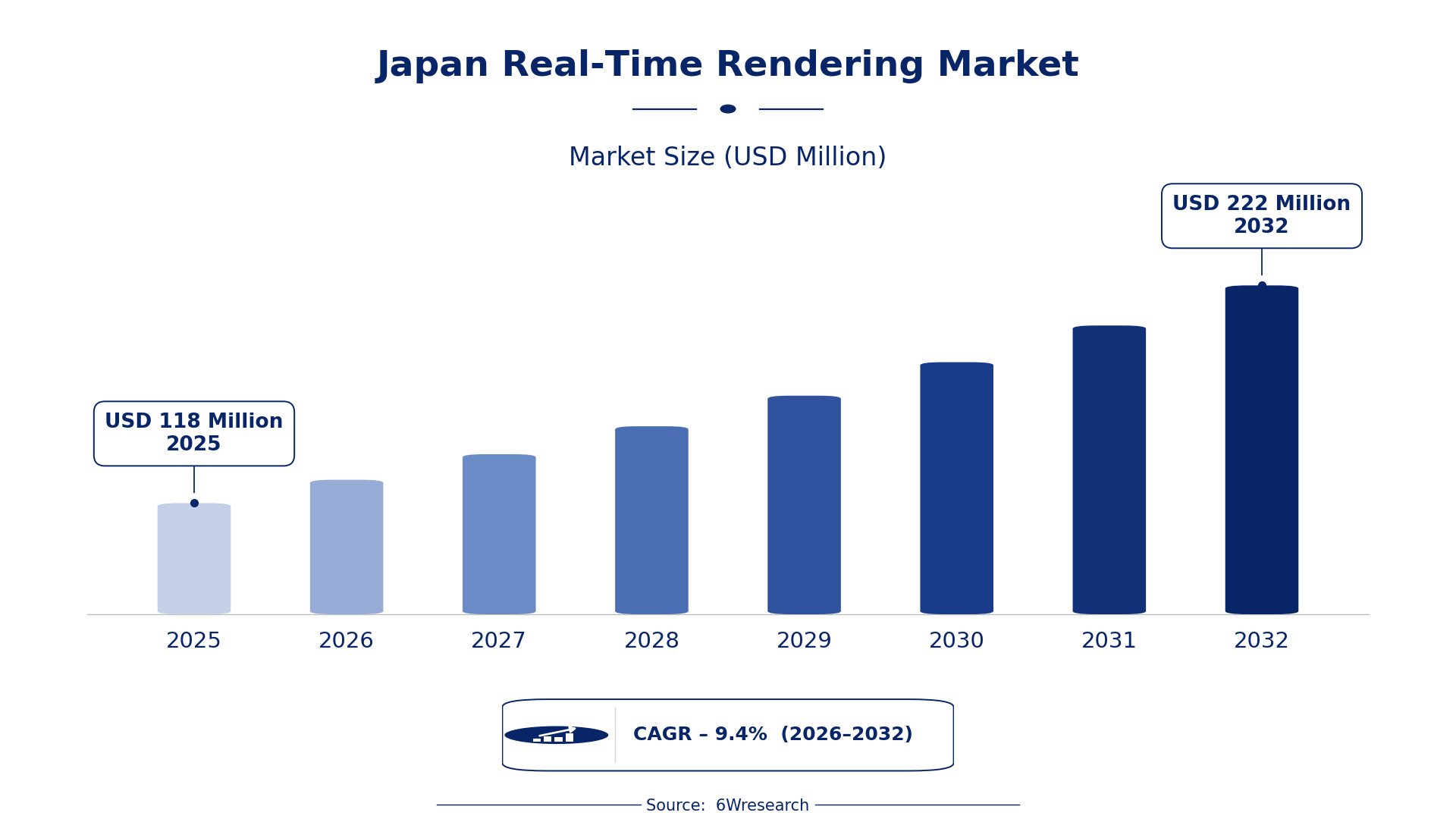
According to 6Wresearch internal database and industry insights, the Japan Real‑Time Rendering Market was valued at USD 118 Million in 2025 and is projected to reach USD 222 Million by 2032, growing at a CAGR of approximately 9.4% during 2026–2032.
Japan Real‑Time Rendering Market Highlights
| Report Metric | Details |
| Report Name | Japan Real‑Time Rendering Market (2026-2032) |
| Market Size 2025 | USD 118 Million |
| Market Size 2032 | USD 222 Million |
| Absolute Growth 2025–2032 | USD 104 Million |
| CAGR 2026–2032 | 9.4% |
| Peak Annual Growth | 11.8% in 2032 |
| Forecast Period | 2026–2032 |
| Historical Data | 2022–2025 |
| Base Year | 2025 |
| Leading Rendering Type, 2025 | Game Engine Rendering (37% share) |
| Leading Technology Platform, 2025 | Unreal/Unity (50% share) |
| Leading Delivery Mode, 2025 | On-Premise/Cloud (50% share) |
| Leading End User, 2025 | Game Developers (41% share) |
| Fastest-Growing Rendering Type | AR/VR Visualization (13.9% CAGR) |
| Fastest-Growing Technology Platform | Edge Streaming (13.5% CAGR) |
| Fastest-Growing Delivery Mode | App/Browser-Based (12.9% CAGR) |
| Fastest-Growing End User | Architects & Engineers (12.7% CAGR) |
| Growing Sector | gaming and design |
| Key End Users | game developers, architects, film studios, engineers |
Japan Real‑Time Rendering Market Year-wise Growth Rate and Key Drivers (2022–2032)
This graph illustrates the annual growth rates of the market from 2022 to 2032, highlighting a steady upward trajectory and projected market expansion over the forecast period.
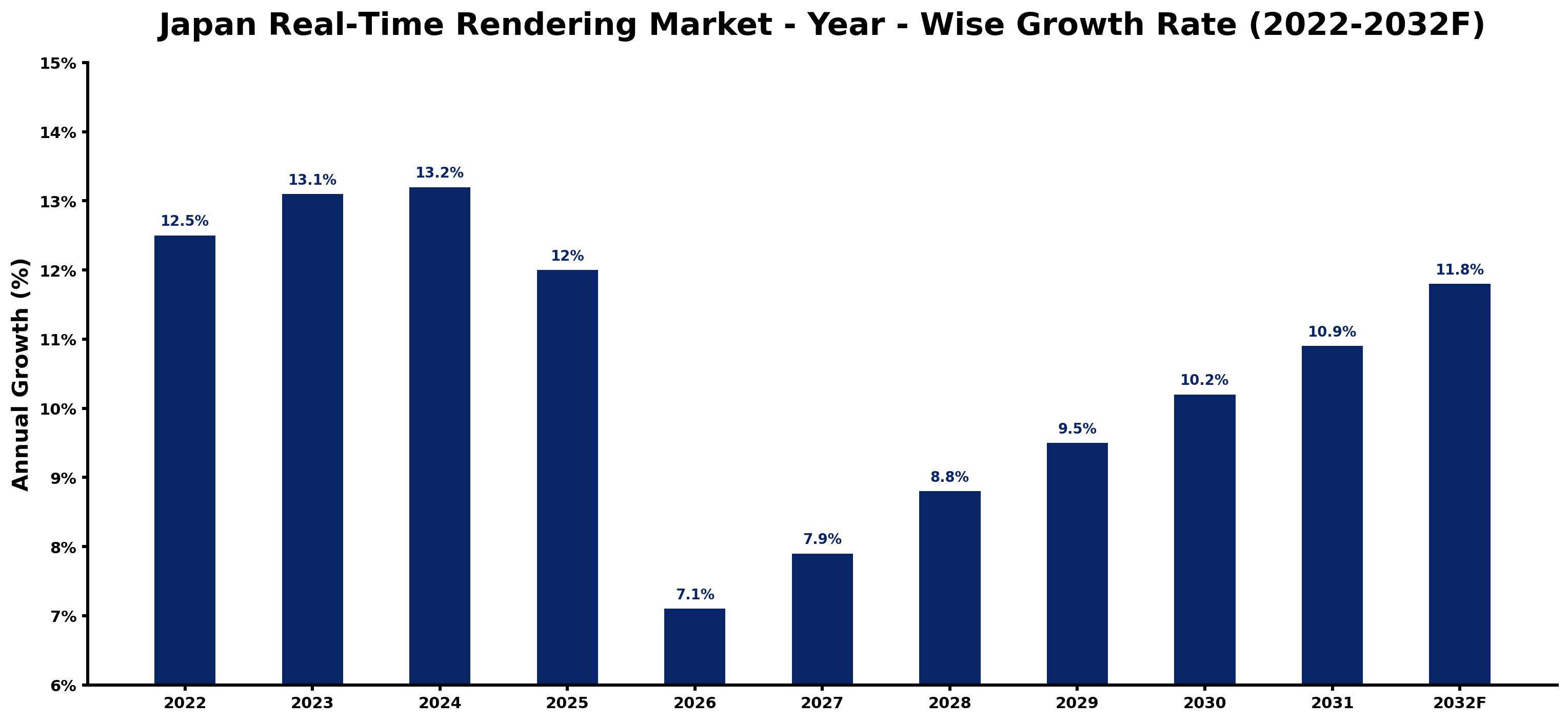
The table below sets out the estimated growth rate for each year and the main factor behind it.
| Year | Estimated Annual Growth (%) | Market Rationale |
| 2022 | 12.5 | The market experienced strong growth due to increased demand from the gaming sector. |
| 2023 | 13.1 | Growth accelerated as the number of active game developers continued to rise. |
| 2024 | 13.2 | The market maintained momentum with advancements in rendering technologies. |
| 2025 | 12.0 | Growth slowed as the market adjusted to previous high rates of expansion. |
| 2026 | 7.1 | The market growth rate is expected to decrease as demand stabilises after rapid increases. |
| 2027 | 7.9 | Demand will rise again with increased investment in AR/VR applications. |
| 2028 | 8.8 | Growth is projected to continue as more industries adopt real-time rendering solutions. |
| 2029 | 9.5 | The market is expected to expand further with rising interest in live visual effects. |
| 2030 | 10.2 | Increased adoption of GPU-accelerated technologies will spur demand. |
| 2031 | 10.9 | Demand will continue to rise as the gaming industry remains strong. |
| 2032 | 11.8 | The peak growth rate will be reached, driven by innovations in rendering. |
Note: Market size estimations and growth projections presented in this report are based on 6Wresearch's proprietary forecasting methodology, utilizing the latest available industry data, government publications, and primary research inputs.
Japan Real‑Time Rendering Market Synopsis
Real-Time Rendering enables the immediate generation of images from 3D models, essential for gaming, design, and visual effects. The Japan Real‑Time Rendering Market is expanding due to a thriving gaming industry that generated approximately ¥2 trillion in 2023, alongside over 1,000 active game developers. The rise in AR/VR users, reaching 10 million in 2023, fuels market growth, while Tokyo's prominence as a development hub strengthens sector expansion.
Market Dynamics Impact Analysis (2026–2032)
| Factor | Type | Impact | Primary Segment Affected |
| Rising demand for interactive gaming experiences | Driver | High | Game Engine Rendering |
| Growing adoption of AR/VR technologies | Driver | High | AR/VR Visualization |
| Emerging demand for real-time visual effects in broadcasting | Opportunity | Medium | Live VFX |
| Increasing interest in immersive design visualization | Opportunity | Medium | CAD/3D Design |
| High costs associated with advanced GPU technologies | Restraint | High | GPU-Accelerated |
| Limited availability of skilled professionals in rendering | Restraint | Medium | Game Engine Rendering |
| Compliance with international rendering standards | Challenge | High | Real-Time Compositing |
| Capacity constraints in meeting rising demand | Challenge | Medium | On-Premise/Cloud |
Evaluation of Drivers in Japan Real‑Time Rendering Market (2026–2032)
The following drivers explain most of the expected growth.
| Drivers | Primary Segment Affected | Why It Matters (Evidence) |
| Increased investment in gaming technologies | Game Engine Rendering | The gaming industry generated approximately ¥2 trillion in 2023, driving demand for real-time rendering. |
| Growth in AR/VR user base | AR/VR Visualization | The number of AR/VR users in Japan reached 10 million in 2023, boosting demand for immersive experiences. |
| Focus on live visual effects in film and broadcasting | Live VFX | The Tokyo Game Show 2023 highlighted innovations, increasing demand for real-time rendering in productions. |
| Rising need for design visualization among architects | CAD/3D Design | Local workstations are preferred by 70% of architects for high-performance rendering in design. |
| Demand for GPU-accelerated rendering solutions | GPU-Accelerated | The increasing need for high-quality visual effects in the film industry is driving this demand. |
Buyers are adding capacity as investment in gaming technologies rises, with the gaming industry generating approximately ¥2 trillion in 2023. The number of AR/VR users in Japan reached 10 million, leading to greater interest in immersive experiences. Innovations in rendering showcased at industry events have heightened demand for live visual effects, prompting producers to improve their offerings. Architects increasingly prefer high-performance rendering solutions, with 70% opting for local workstations. The demand for GPU-accelerated rendering solutions is rising in Japan's film industry, enhancing visual capabilities.
Evaluation of Restraints in Japan Real‑Time Rendering Market
The main factors holding the market back are set out below.
| Market Restraint | Primary Segment Affected | Why It Matters (Evidence) |
| High costs of advanced GPU technologies | GPU-Accelerated | These costs limit accessibility for smaller studios, affecting their ability to invest in rendering solutions. |
| Shortage of skilled professionals in rendering | Game Engine Rendering | Limited talent pool hampers project timelines and quality in the gaming sector. |
| Compliance with international rendering standards | Real-Time Compositing | Meeting these standards requires additional investments and resources for producers. |
| Capacity constraints in meeting rising demand | On-Premise/Cloud | Limited infrastructure can delay project delivery for clients seeking rapid rendering. |
| Market saturation in specific segments | Live VFX | Increased competition can lead to price wars, affecting profitability for producers. |
Japan Real‑Time Rendering Market Challenges
Intense competition among developers drives down prices, squeezing profit margins for producers and forcing them to accelerate innovation. Buyers face rising demands for superior graphics quality, increasing pressure on developers and potentially causing project delays. Upgrading technology poses a considerable financial burden; for instance, GPU improvements can exceed ¥1 million, affecting smaller studios' budgets and extending project timelines. Complying with standards such as ISO/IEC 30170:2012 can incur additional costs, delaying delivery schedules for both buyers and suppliers.
Trends in the Japan Real‑Time Rendering Market
The shifts below are changing how Japan Real‑Time Rendering Market products are bought and supplied.
- Shift towards AR/VR Integration: The integration of AR/VR technologies is becoming more common, with 10 million users in Japan in 2023. This trend is encouraging game developers to adopt real-time rendering for immersive experiences.
- Transition from Local to Cloud Rendering: An increasing number of projects are shifting from local workstations to cloud-based solutions, reflecting the demand for flexibility. App/Browser-Based rendering is growing at a CAGR of 12.9%.
- Emergence of Edge Streaming: Edge streaming technologies are gaining popularity, enabling low-latency content delivery. This trend is apparent in the rising interest from game developers seeking efficient rendering solutions.
- Focus on Real-Time Compositing: Real-time compositing is becoming crucial for live broadcasting, with studios adopting advanced rendering techniques. This trend is underscored by the focus on live visual effects in recent productions.
Investment Opportunities in the Japan Real‑Time Rendering Market
Below are the investment opportunities with the strongest case in the Japan Real‑Time Rendering Market.
- Joint Ventures for Technology Development: Partnering with local firms presents a market opportunity, with Japan's gaming industry generating ¥2 trillion. Collaborating with game developers can provide access to advanced rendering solutions.
- Investment in Cloud Rendering Infrastructure: The demand for cloud-based rendering solutions is increasing, with a market gap of 50%. Establishing partnerships with technology providers can effectively address this demand.
- Expansion in AR/VR Content Creation: The growth of AR/VR users, reaching 10 million, offers opportunities for content developers. Focusing on immersive experiences can attract substantial investment.
- Enhancing Local Workstation Capabilities: With 70% of architects opting for local workstations, investing in high-performance systems can meet their requirements. Collaborating with design firms can facilitate market entry.
Government Initiatives in the Japan Real‑Time Rendering Market
The Digital Agency, established in September 2021, introduced standards that support digital transformation efforts in rendering technologies. This complements existing laws like the Water Supply Act and the Sewerage Act, which establish quality benchmarks for related industries. These measures ensure that producers maintain high standards, benefiting buyers by improving rendering quality and efficiency.
The Japan Computer Graphics Society actively promotes advancements in rendering technology, assisting local firms in meeting new standards. This initiative helps buyers access improved rendering solutions and ensures compliance with evolving industry requirements.
Future Insight of the Japan Real‑Time Rendering Market
Investment in GPU technology will increase by 2032, driven by the expanding market for high-quality rendering in gaming and design. This trend will enable suppliers to develop more efficient rendering solutions, strengthening their market position. The government's commitment to advancing digital content will encourage innovation and partnerships in the industry. With AR/VR users projected to reach 20 million, demand for sophisticated rendering capabilities will rise, creating new opportunities for buyers and suppliers.
Market Segmentation Analysis
Japan Real‑Time Rendering Market report covers a detailed analysis of the following market segments:
By Rendering Type – Game Engine Rendering Leads, AR/VR Visualization Expected to Grow Fastest
According to Saurav Kr Singh, Senior Research Analyst at 6Wresearch, the largest rendering type category in 2025 was Game Engine Rendering, at 37% of revenue. Game Engine Rendering holds the largest share due to its fundamental role in creating interactive gaming experiences, particularly in Japan's vibrant gaming sector. The segment thrives with over 1,000 active game developers, especially in Tokyo, who rely on this technology for their projects. AR/VR Visualization is projected to grow fastest, at a CAGR of 13.9% during 2026–2032. AR/VR Visualization is experiencing rapid growth as it is vital for immersive experiences in gaming and training, with AR/VR users in Japan reaching 10 million in 2023. This surge in user engagement will likely further enhance the dominance of Game Engine Rendering. Suppliers should prioritise advancements in AR/VR technologies to leverage the increasing demand.
By Technology Platform – Unreal/Unity Leads, Edge Streaming Expected to Grow Fastest
Unreal/Unity held 50% of the Japan Real‑Time Rendering Market by technology platform in 2025. Unreal/Unity dominates the market as widely used platforms for game and application development, providing essential tools for developers in Japan's thriving gaming sector. Their established presence and extensive user base contribute to their leading position. Over 2026–2032, Edge Streaming is expected to post the fastest growth, at a CAGR of 13.5%. Edge Streaming is the fastest growing segment due to its potential for delivering content with low latency, aligning with the increasing demand for real-time experiences. As developers seek efficient solutions, Unreal/Unity's dominance will likely continue to expand. Buyers will benefit from exploring new technologies like Edge Streaming to improve content delivery efficiency.
By Delivery Mode – On-Premise/Cloud Leads, App/Browser-Based Expected to Grow Fastest
In 2025, On-Premise/Cloud led the delivery mode split with a 50% share. On-Premise/Cloud delivery modes dominate the market as they provide flexibility and scalability for various applications across industries. This widespread adoption supports a diverse range of users, reinforcing its leading position. App/Browser-Based is set to record the highest CAGR in this split, 12.9% over 2026–2032. App/Browser-Based solutions are quickly gaining popularity as they align with the trend towards more accessible rendering platforms. The versatility of On-Premise/Cloud options will help sustain their leadership as demand for user-friendly solutions rises. Suppliers need to adapt offerings to accommodate the growing preference for App/Browser-Based solutions.
By End User – Game Developers Lead, Architects & Engineers Expected to Grow Fastest
Game Developers accounted for 41% of the market by end user in 2025. Game Developers represent the largest user group of real-time rendering technologies, driving significant demand within Japan's dynamic gaming industry. Their continuous push for innovation and development secures their leading status in the market. The quickest growth will come from Architects & Engineers, forecast to expand at a CAGR of 12.7% between 2026 and 2032. Architects & Engineers are the fastest growing segment as they increasingly adopt real-time rendering for design visualisation, highlighting the expanding use cases of this technology. The robust foundation of Game Developers will support ongoing growth in this sector. Suppliers should develop tailored solutions for Architects & Engineers to tap into this burgeoning market.
Key Attractiveness of the Report
- 10 Years of Market Numbers
- Historical Data Starting from 2022 to 2025
- Base Year 2025
- Forecast Data until 2032
- Key Performance Indicators Impacting the Market
- Major Upcoming Developments and Projects
Key Highlights of the Report:
- Japan Real‑Time Rendering Market Outlook
- Market Size of Japan Real‑Time Rendering Market, 2025
- Forecast of Japan Real‑Time Rendering Market, 2032
- Historical Data and Forecast of Japan Real‑Time Rendering Revenues & Volume for the Period 2022-2032F
- Japan Real‑Time Rendering Market Trend Evolution
- Japan Real‑Time Rendering Market Drivers and Challenges
- Japan Real‑Time Rendering Price Trends
- Japan Real‑Time Rendering Porter's Five Forces
- Japan Real‑Time Rendering Industry Life Cycle
- Historical Data and Forecast of Japan Real‑Time Rendering Market Revenues & Volume By Rendering Type for the Period 2022-2032F
- Historical Data and Forecast of Japan Real‑Time Rendering Market Revenues & Volume By Game Engine Rendering for the Period 2022-2032F
- Historical Data and Forecast of Japan Real‑Time Rendering Market Revenues & Volume By CAD/3D Design for the Period 2022-2032F
- Historical Data and Forecast of Japan Real‑Time Rendering Market Revenues & Volume By Live VFX for the Period 2022-2032F
- Historical Data and Forecast of Japan Real‑Time Rendering Market Revenues & Volume By AR/VR Visualization for the Period 2022-2032F
- Historical Data and Forecast of Japan Real‑Time Rendering Market Revenues & Volume By Technology Platform for the Period 2022-2032F
- Historical Data and Forecast of Japan Real‑Time Rendering Market Revenues & Volume By Unreal/Unity for the Period 2022-2032F
- Historical Data and Forecast of Japan Real‑Time Rendering Market Revenues & Volume By GPU-Accelerated for the Period 2022-2032F
- Historical Data and Forecast of Japan Real‑Time Rendering Market Revenues & Volume By Real-Time Compositing for the Period 2022-2032F
- Historical Data and Forecast of Japan Real‑Time Rendering Market Revenues & Volume By Edge Streaming for the Period 2022-2032F
- Historical Data and Forecast of Japan Real‑Time Rendering Market Revenues & Volume By Delivery Mode for the Period 2022-2032F
- Historical Data and Forecast of Japan Real‑Time Rendering Market Revenues & Volume By On-Premise/Cloud for the Period 2022-2032F
- Historical Data and Forecast of Japan Real‑Time Rendering Market Revenues & Volume By Local Workstations for the Period 2022-2032F
- Historical Data and Forecast of Japan Real‑Time Rendering Market Revenues & Volume By Broadcast Pipelines for the Period 2022-2032F
- Historical Data and Forecast of Japan Real‑Time Rendering Market Revenues & Volume By App/Browser-Based for the Period 2022-2032F
- Historical Data and Forecast of Japan Real‑Time Rendering Market Revenues & Volume By End User for the Period 2022-2032F
- Historical Data and Forecast of Japan Real‑Time Rendering Market Revenues & Volume By Game Developers for the Period 2022-2032F
- Historical Data and Forecast of Japan Real‑Time Rendering Market Revenues & Volume By Architects & Engineers for the Period 2022-2032F
- Historical Data and Forecast of Japan Real‑Time Rendering Market Revenues & Volume By Film & Broadcast Studios for the Period 2022-2032F
- Historical Data and Forecast of Japan Real‑Time Rendering Market Revenues & Volume By Marketing Agencies for the Period 2022-2032F
- Japan Real‑Time Rendering Import Export Trade Statistics
- Market Opportunity Assessment By Rendering Type
- Market Opportunity Assessment By Technology Platform
- Market Opportunity Assessment By Delivery Mode
- Market Opportunity Assessment By End User
- Japan Real‑Time Rendering Top Companies Market Share
- Japan Real‑Time Rendering Competitive Benchmarking By Technical and Operational Parameters
- Japan Real‑Time Rendering Company Profiles
- Japan Real‑Time Rendering Key Strategic Recommendations
Market Covered
The study includes the following segmentation.
By Rendering Type
- Game Engine Rendering
- CAD/3D Design
- Live VFX
- AR/VR Visualization
By Technology Platform
- Unreal/Unity
- GPU-Accelerated
- Real-Time Compositing
- Edge Streaming
By Delivery Mode
- On-Premise/Cloud
- Local Workstations
- Broadcast Pipelines
- App/Browser-Based
By End User
- Game Developers
- Architects & Engineers
- Film & Broadcast Studios
- Marketing Agencies































