Japan Rebar Manufacturing Market Size & Growth Rate
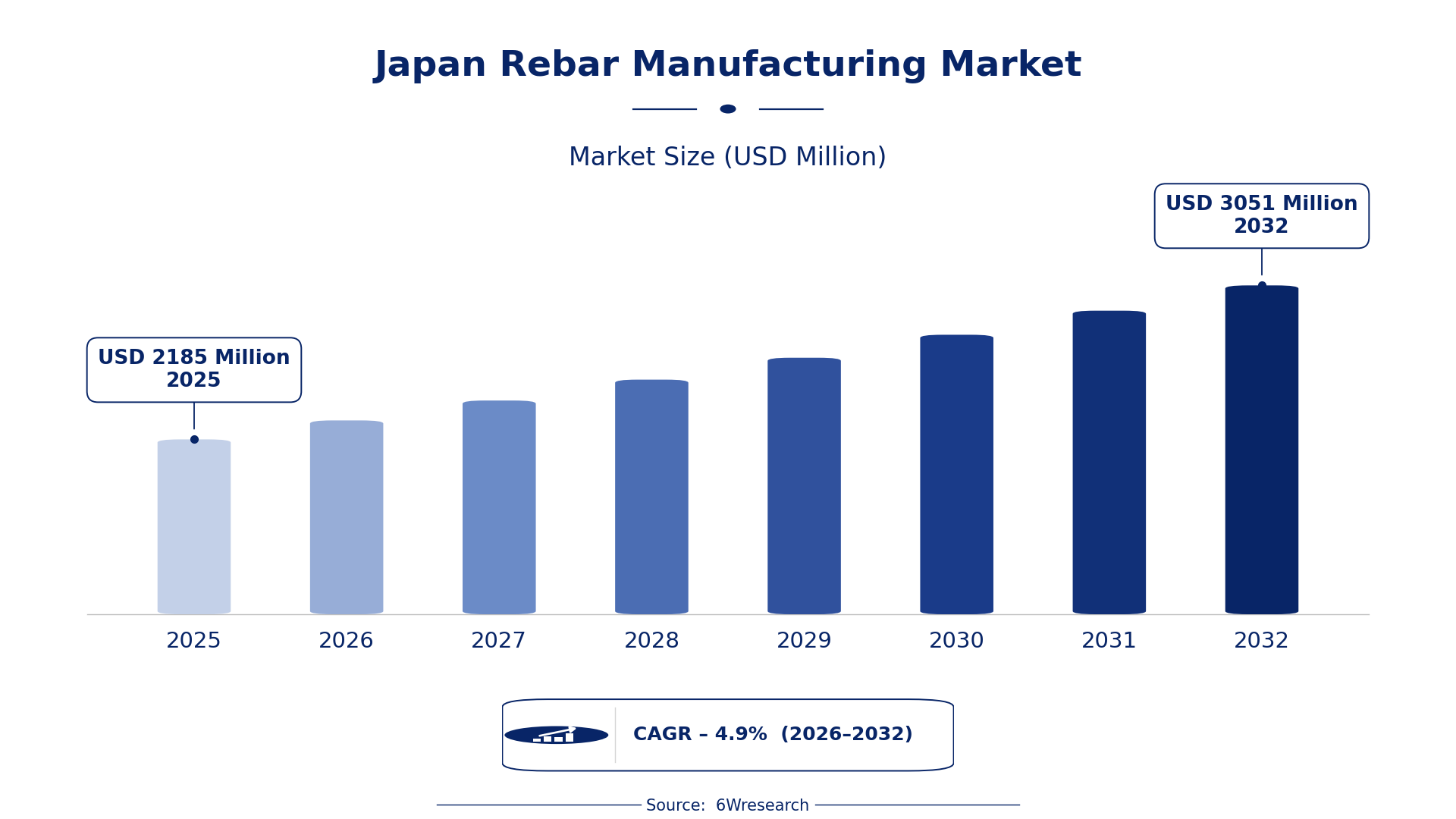
According to 6Wresearch internal database and industry insights, the Japan Rebar Manufacturing Market was valued at USD 2,185 Million in 2025 and is projected to reach USD 3,051 Million by 2032, growing at a CAGR of approximately 4.9% during 2026–2032.
Japan Rebar Manufacturing Market Highlights
| Report Metric | Details |
| Report Name | Japan Rebar Manufacturing Market (2026-2032) |
| Market Size 2025 | USD 2,185 Million |
| Market Size 2032 | USD 3,051 Million |
| Absolute Growth 2025–2032 | USD 866 Million |
| CAGR 2026–2032 | 4.9% |
| Peak Annual Growth | 5.6% in 2027 |
| Forecast Period | 2026–2032 |
| Historical Data | 2022–2025 |
| Base Year | 2025 |
| Leading Product Type, 2025 | Deformed Bar (35% share) |
| Leading Steel Grade, 2025 | Fe 500D/550D (43% share) |
| Leading Process, 2025 | Hot-Rolled (43% share) |
| Leading End User, 2025 | Construction Firms (48% share) |
| Fastest-Growing Product Type | Epoxy-Coated Rebar (6.9% CAGR) |
| Fastest-Growing Process | Thermo-Mechanical (7.4% CAGR) |
| Fastest-Growing End User | Infrastructure Developers (6.4% CAGR) |
| Growing Sector | Infrastructure Developers |
| Key End Users | Construction Firms, Infrastructure Developers, Marine Construction, Precast Segment Makers |
Japan Rebar Manufacturing Market Year-wise Growth Rate and Key Drivers (2022–2032)
This graph illustrates the annual growth rates of the market from 2022 to 2032, highlighting a steady upward trajectory and projected market expansion over the forecast period.
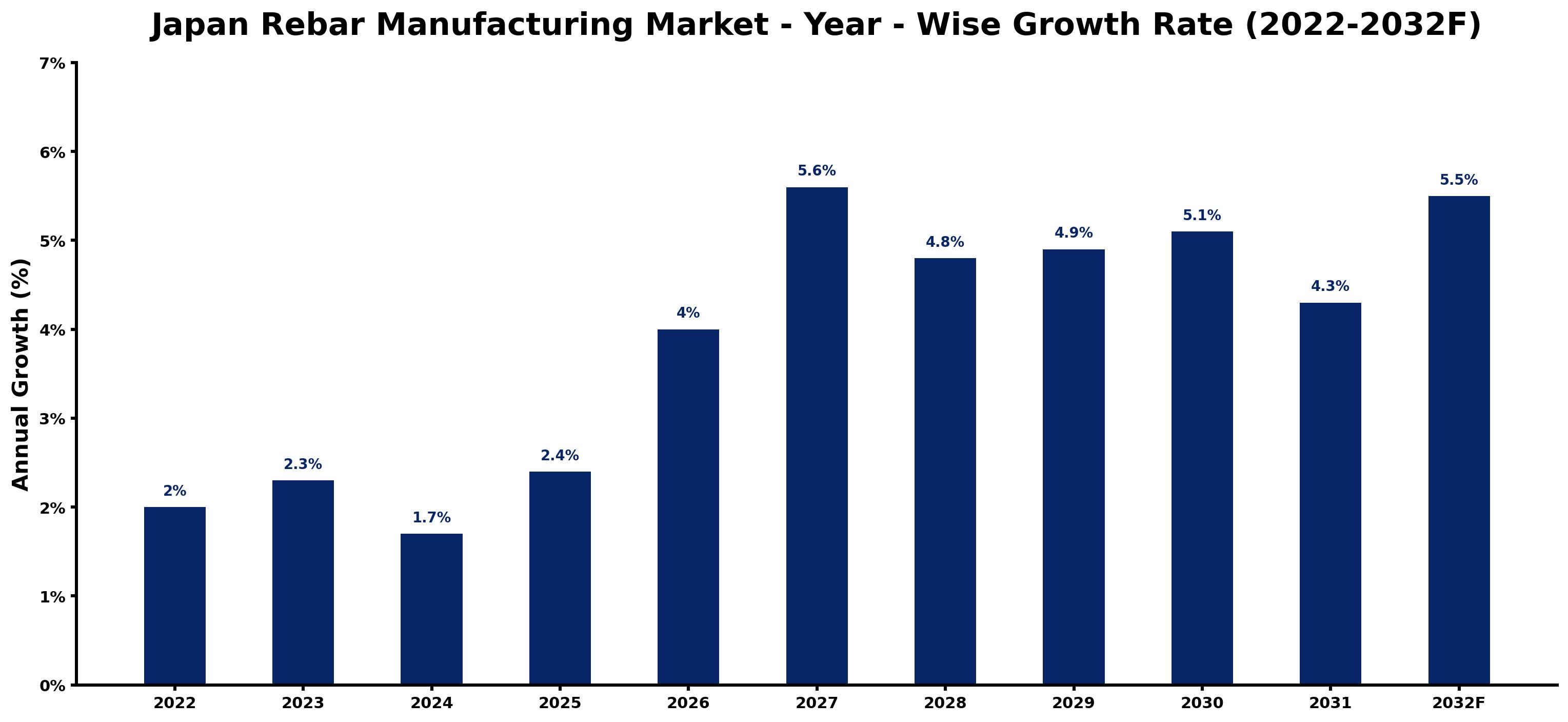
The yearly estimates that follow link every growth rate to its principal driver, so readers can see why the pace changed in each period.
| Year | Estimated Annual Growth (%) | Market Rationale |
| 2022 | 2.0 | The market exhibited steady growth, reflecting ongoing construction activities across the country. |
| 2023 | 2.3 | Demand increased due to heightened infrastructure projects following the Tokyo 2020 Olympics. |
| 2024 | 1.7 | Growth slowed as construction firms adjusted to market saturation and project completions. |
| 2025 | 2.4 | A resurgence in construction activity led to faster growth as projects ramped up. |
| 2026 | 4.0 | Investment in infrastructure resilience initiatives is expected to spur demand for rebar. |
| 2027 | 5.6 | The peak growth year is driven by major public works projects and urban development. |
| 2028 | 4.8 | Growth is projected to moderate as the market stabilises after the peak demand period. |
| 2029 | 4.9 | Continued urbanisation and infrastructure upgrades will maintain a strong demand for rebar. |
| 2030 | 5.1 | Investment in earthquake-resistant structures will further boost demand for high-strength rebar. |
| 2031 | 4.3 | Growth is expected to slow as the market adjusts to previous years' high activity levels. |
| 2032 | 5.5 | The market is projected to grow steadily as infrastructure investments continue. |
Note: Market size estimations and growth projections presented in this report are based on 6Wresearch's proprietary forecasting methodology, utilizing the latest available industry data, government publications, and primary research inputs.
Japan Rebar Manufacturing Market Synopsis
Rebar manufacturing involves producing steel bars that reinforce concrete structures, primarily through the casting of molten steel into bars followed by rolling. The Japan Rebar Manufacturing Market is growing due to substantial infrastructure investments and a thriving construction sector, valued at approximately $500 billion annually. The Tokyo Metropolitan Area serves as a central demand hub, while the uptake of high-strength rebar, such as Fe 500D, is rising in response to seismic safety standards and ongoing urban development.
Market Dynamics Impact Analysis (2026–2032)
| Factor | Type | Impact | Primary Segment Affected |
| Rising infrastructure investments are driving demand for rebar in construction projects. | Driver | High | Deformed Bar |
| The increasing focus on corrosion resistance is creating demand for epoxy-coated rebar. | Driver | High | Epoxy-Coated Rebar |
| The shift towards sustainable construction practices opens opportunities for innovative rebar solutions. | Opportunity | High | Welded Mesh |
| The demand for high-strength rebar is growing in seismic zones, creating market potential. | Opportunity | High | Fe 500D/550D |
| Fluctuating raw material prices can impact production costs for rebar manufacturers. | Restraint | Medium | Hot-Rolled |
| Compliance with stringent construction standards can increase operational costs for producers. | Restraint | Medium | Thermo-Mechanical |
| Limited capacity for production expansion can hinder market growth for suppliers. | Challenge | High | Plain Bar |
| The need for advanced technology adoption can pose challenges for manufacturers. | Challenge | Medium | Cold-Coating |
Evaluation of Drivers in Japan Rebar Manufacturing Market (2026–2032)
The table below links each growth driver to the segment it affects and the evidence for it.
| Drivers | Primary Segment Affected | Why It Matters (Evidence) |
| Increased public spending on infrastructure projects boosts demand for rebar. | Deformed Bar | Japan's construction sector, valued at approximately $500 billion annually, drives orders for deformed bars. |
| Growing urbanisation leads to higher demand for reinforced concrete in buildings. | Epoxy-Coated Rebar | The Tokyo Metropolitan Area accounted for a substantial portion of Japan's rebar demand in 2022. |
| The need for earthquake-resistant structures is pushing demand for high-strength rebar. | Fe 500D/550D | Fe 500D is commonly used in earthquake-resistant structures, improving safety in construction. |
| Technological advancements in manufacturing processes improve rebar quality and strength. | Thermo-Mechanical | Thermo-mechanical processed rebar is gaining popularity for its increased strength and ductility. |
| The rise in marine construction projects is increasing demand for corrosion-resistant rebar. | Epoxy-Coated Rebar | Marine construction projects benefit from the average lifespan of epoxy-coated rebar, estimated at 50 years. |
Behind the steady rise in orders sits increased public spending on infrastructure projects, which boosts demand for rebar, particularly in the Tokyo Metropolitan Area, a major hub for construction. The construction sector, valued at approximately $500 billion annually, drives orders for deformed bars. The need for earthquake-resistant structures is pushing demand for high-strength rebar like Fe 500D, commonly used in seismic zones. Technological advancements in manufacturing processes improve rebar quality, with thermo-mechanical processed rebar gaining popularity for its increased strength. The rise in marine construction projects increases demand for epoxy-coated rebar, which has an average lifespan of 50 years, ensuring durability in harsh conditions.
Evaluation of Restraints in Japan Rebar Manufacturing Market
These are the pressures that could keep growth below its potential.
| Market Restraint | Primary Segment Affected | Why It Matters (Evidence) |
| Fluctuating raw material prices can lead to increased production costs for manufacturers. | Hot-Rolled | The volatility in steel prices directly affects the overall cost structure of rebar production. |
| Compliance with stringent construction standards can increase operational costs for producers. | Thermo-Mechanical | Manufacturers must invest in quality assurance and certification processes to meet JIS G 3112 standards. |
| Limited production capacity can restrict the ability to meet rising demand. | Plain Bar | Manufacturers may struggle to expand operations to keep pace with growing infrastructure projects. |
| Technological adoption can be slow due to high initial investment costs. | Cold-Coating | The need for advanced technology can deter smaller manufacturers from upgrading their processes. |
| Market saturation in certain regions can limit growth opportunities for producers. | Deformed Bar | In areas with high competition, price wars can erode profit margins for rebar manufacturers. |
Japan Rebar Manufacturing Market Challenges
High production costs stem from fluctuating raw material prices, causing rebar prices to rise by up to 15% for construction firms. Buyers in the Tokyo Metropolitan Area encounter delays due to stringent regulations from the Ministry of Land, Infrastructure, Transport and Tourism, which can extend project timelines by several months. Complex compliance with JIS G 3112 standards complicates sourcing for suppliers, leading to increased operational costs. Slow adoption of technology restricts producers' efficiency, potentially reducing profit margins by 10%.
Trends in the Japan Rebar Manufacturing Market
These developments are changing demand patterns in the Japan Rebar Manufacturing Market.
- Construction Firms Adopting Sustainable Practices: Construction firms are increasingly focusing on sustainable practices, such as incorporating recycled materials in rebar production. The Japan Construction Industry Association supports these methods, promoting a more environmentally friendly approach within the sector.
- Tokyo Metropolitan Area Driving Urban Development: The Tokyo Metropolitan Area is witnessing a surge in urban development projects, significantly driving up rebar demand. In 2022, this area accounted for a considerable portion of Japan's 7 million tons of rebar production.
- Shift Towards High-Strength Rebar: A clear shift towards high-strength rebar, particularly Fe 500D, is evident due to its suitability for earthquake-resistant structures. This trend aligns with Japan's commitment to improving building safety standards.
- Expansion of Epoxy-Coated Rebar Usage: The utilisation of epoxy-coated rebar is on the rise, particularly in marine construction projects, to combat corrosion. This trend is bolstered by the average lifespan of epoxy-coated rebar, estimated at 50 years.
Investment Opportunities in the Japan Rebar Manufacturing Market
Where to invest in the Japan Rebar Manufacturing Market: the main openings are set out below.
- Osaka Prefecture's Industrial Growth: Osaka Prefecture is experiencing industrial growth, generating demand for high-quality rebar. With Japan's construction market valued at around $500 billion annually, suppliers can explore opportunities through local partnerships.
- Infrastructure Resilience Initiatives: Ongoing infrastructure resilience initiatives offer suppliers a chance to provide high-strength rebar. The government has established targets for reducing carbon emissions in steel production by 2030, promoting sustainable practices.
- Marine Construction Projects: Marine construction projects increasingly require corrosion-resistant rebar, particularly epoxy-coated varieties. With an estimated lifespan of 50 years, suppliers can target marine construction firms for long-term contracts.
- Urban Development in Tokyo: The surge in urban development in Tokyo creates a pressing demand for rebar. Suppliers can form joint ventures with local construction firms to address the growing needs.
Government Initiatives in the Japan Rebar Manufacturing Market
The Building Energy Efficiency Act, amended in 2022, mandates that all new buildings meet energy standards from April 2025, prompting rebar producers to invest in compliant materials. This act aims to promote sustainability in construction and reduce energy consumption in new structures.
The Ministry of Land, Infrastructure, Transport and Tourism supervises compliance with construction standards, ensuring that rebar used in projects meets safety and quality requirements. This oversight encourages the use of high-quality materials, benefiting producers who comply with these standards.
Future Insight of the Japan Rebar Manufacturing Market
By 2032, construction firms will increasingly seek thermo-mechanical processed rebar, recognised for its strength in earthquake-resistant applications. Infrastructure resilience initiatives will elevate rebar needs, with projects averaging 200 tons per build to satisfy safety standards. The Japan Steel Federation will advocate for new sustainability standards, aligning with the government's carbon reduction targets for 2030. Government support for innovation will enable suppliers to adopt advanced manufacturing technologies.
Market Segmentation Analysis
Japan Rebar Manufacturing Market report covers a detailed analysis of the following market segments:
By Product Type – Deformed Bar Leads, Epoxy-Coated Rebar Expected to Grow Fastest
According to Saurav Kr Singh, Senior Research Analyst at 6Wresearch, Deformed Bar held 35% of the Japan Rebar Manufacturing Market by product type in 2025. Deformed Bar holds the largest share due to its widespread use in structural reinforcement across various construction projects. For instance, the Tokyo Metropolitan Area relies heavily on this type of rebar for building resilience against earthquakes. Epoxy-Coated Rebar is projected to grow fastest, at a CAGR of 6.9% during 2026–2032. The rapid growth of Epoxy-Coated Rebar is driven by increasing demand for corrosion-resistant materials in marine and industrial applications. Recent infrastructure resilience initiatives have further accelerated its adoption in critical projects. Suppliers should focus on expanding their offerings of epoxy-coated options to meet the growing demand.
By Steel Grade – Fe 500D/550D Leads and Records the Fastest Growth
The largest steel grade category in 2025 was Fe 500D/550D, at 43% of revenue. Fe 500D/550D commands the largest share due to its critical application in high-strength structures, particularly in seismic zones where safety is paramount. The compliance with the JIS G 3112 standard reinforces its status as the preferred choice among construction professionals. Its lead should widen, with a projected CAGR of 7.1% during 2026–2032, the highest in this split. Fe 500D/550D is also the fastest-growing segment, driven by its essential role in earthquake-resistant structures, which are increasingly required by construction regulations. This ongoing trend suggests that demand for this grade will continue to rise, further solidifying its market position. Buyers should prioritise sourcing Fe 500D/550D to comply with safety standards and ensure robust structural performance.
By Process – Hot-Rolled Leads, Thermo-Mechanical Expected to Grow Fastest
Hot-Rolled accounted for 43% of the market by process in 2025. Hot-Rolled rebar is the leading production method, recognised for its reliability and consistent quality in the manufacturing process. Its extensive application in Japan's construction sector highlights its importance for builders seeking dependable materials for their projects. The quickest growth will come from Thermo-Mechanical, forecast to expand at a CAGR of 7.4% between 2026 and 2032. Thermo-Mechanical processing is witnessing rapid growth as it significantly enhances the strength and ductility of rebar, aligning with the industry's focus on safety and performance. This increasing emphasis on superior characteristics is propelling its swift adoption among manufacturers. Suppliers should consider investing in thermo-mechanical processing capabilities to stay competitive in the evolving market.
By End User – Construction Firms Lead, Infrastructure Developers Expected to Grow Fastest
Construction Firms took 48% of end user revenue in 2025, more than any other category. Construction Firms represent the largest consumer group for rebar, using it extensively across various building projects in Japan. The significant workforce within this sector, exceeding 4 million, underscores the high demand for rebar in construction activities. Infrastructure Developers are set to record the highest CAGR in this split, 6.4% over 2026–2032. Infrastructure Developers are currently experiencing the fastest growth, as they require substantial quantities of rebar for public works and infrastructure projects. Recent government initiatives aimed at enhancing infrastructure resilience are further accelerating this demand. Suppliers should strategically target infrastructure developers to capitalise on emerging opportunities in public works initiatives.
Key Attractiveness of the Report
- 10 Years of Market Numbers
- Historical Data Starting from 2022 to 2025
- Base Year 2025
- Forecast Data until 2032
- Key Performance Indicators Impacting the Market
- Major Upcoming Developments and Projects
Key Highlights of the Report:
- Japan Rebar Manufacturing Market Outlook
- Market Size of Japan Rebar Manufacturing Market, 2025
- Forecast of Japan Rebar Manufacturing Market, 2032
- Historical Data and Forecast of Japan Rebar Manufacturing Revenues & Volume for the Period 2022-2032F
- Japan Rebar Manufacturing Market Trend Evolution
- Japan Rebar Manufacturing Market Drivers and Challenges
- Japan Rebar Manufacturing Price Trends
- Japan Rebar Manufacturing Porter's Five Forces
- Japan Rebar Manufacturing Industry Life Cycle
- Historical Data and Forecast of Japan Rebar Manufacturing Market Revenues & Volume By Product Type for the Period 2022-2032F
- Historical Data and Forecast of Japan Rebar Manufacturing Market Revenues & Volume By Plain Bar for the Period 2022-2032F
- Historical Data and Forecast of Japan Rebar Manufacturing Market Revenues & Volume By Deformed Bar for the Period 2022-2032F
- Historical Data and Forecast of Japan Rebar Manufacturing Market Revenues & Volume By Epoxy-Coated Rebar for the Period 2022-2032F
- Historical Data and Forecast of Japan Rebar Manufacturing Market Revenues & Volume By Welded Mesh for the Period 2022-2032F
- Historical Data and Forecast of Japan Rebar Manufacturing Market Revenues & Volume By Steel Grade for the Period 2022-2032F
- Historical Data and Forecast of Japan Rebar Manufacturing Market Revenues & Volume By Fe 415/500 for the Period 2022-2032F
- Historical Data and Forecast of Japan Rebar Manufacturing Market Revenues & Volume By Fe 500D/550D for the Period 2022-2032F
- Historical Data and Forecast of Japan Rebar Manufacturing Market Revenues & Volume By Anti-Corrosive Coated for the Period 2022-2032F
- Historical Data and Forecast of Japan Rebar Manufacturing Market Revenues & Volume By Grade A III for the Period 2022-2032F
- Historical Data and Forecast of Japan Rebar Manufacturing Market Revenues & Volume By Process for the Period 2022-2032F
- Historical Data and Forecast of Japan Rebar Manufacturing Market Revenues & Volume By Hot-Rolled for the Period 2022-2032F
- Historical Data and Forecast of Japan Rebar Manufacturing Market Revenues & Volume By Thermo-Mechanical for the Period 2022-2032F
- Historical Data and Forecast of Japan Rebar Manufacturing Market Revenues & Volume By Cold-Coating for the Period 2022-2032F
- Historical Data and Forecast of Japan Rebar Manufacturing Market Revenues & Volume By Laser-Welded Mesh for the Period 2022-2032F
- Historical Data and Forecast of Japan Rebar Manufacturing Market Revenues & Volume By End User for the Period 2022-2032F
- Historical Data and Forecast of Japan Rebar Manufacturing Market Revenues & Volume By Construction Firms for the Period 2022-2032F
- Historical Data and Forecast of Japan Rebar Manufacturing Market Revenues & Volume By Infrastructure Developers for the Period 2022-2032F
- Historical Data and Forecast of Japan Rebar Manufacturing Market Revenues & Volume By Marine Construction for the Period 2022-2032F
- Historical Data and Forecast of Japan Rebar Manufacturing Market Revenues & Volume By Precast Segment Makers for the Period 2022-2032F
- Japan Rebar Manufacturing Import Export Trade Statistics
- Market Opportunity Assessment By Product Type
- Market Opportunity Assessment By Steel Grade
- Market Opportunity Assessment By Process
- Market Opportunity Assessment By End User
- Japan Rebar Manufacturing Top Companies Market Share
- Japan Rebar Manufacturing Competitive Benchmarking By Technical and Operational Parameters
- Japan Rebar Manufacturing Company Profiles
- Japan Rebar Manufacturing Key Strategic Recommendations
Market Covered
Coverage by segment is as follows.
By Product Type
- Plain Bar
- Deformed Bar
- Epoxy-Coated Rebar
- Welded Mesh
By Steel Grade
- Fe 415/500
- Fe 500D/550D
- Anti-Corrosive Coated
- Grade A III
By Process
- Hot-Rolled
- Thermo-Mechanical
- Cold-Coating
- Laser-Welded Mesh
By End User
- Construction Firms
- Infrastructure Developers
- Marine Construction
- Precast Segment Makers































