Japan Recreational Gear Market Size & Growth Rate
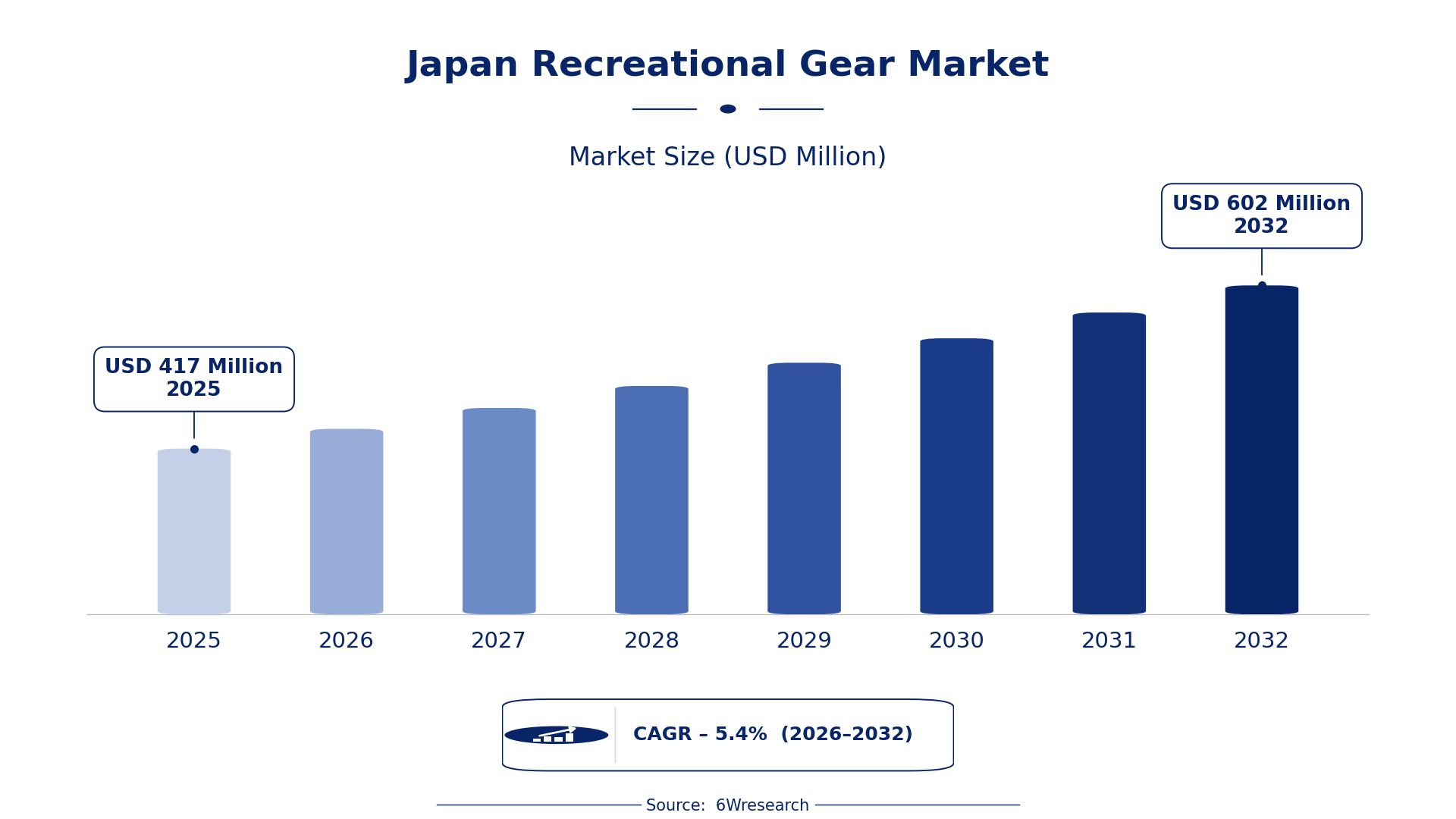
According to 6Wresearch internal database and industry insights, the Japan Recreational Gear Market was valued at USD 417 Million in 2025 and is projected to reach USD 602 Million by 2032, growing at a CAGR of approximately 5.4% during 2026–2032.
Japan Recreational Gear Market Highlights
| Report Metric | Details |
| Report Name | Japan Recreational Gear Market (2026-2032) |
| Market Size 2025 | USD 417 Million |
| Market Size 2032 | USD 602 Million |
| Absolute Growth 2025–2032 | USD 185 Million |
| CAGR 2026–2032 | 5.4% |
| Peak Annual Growth | 6.2% in 2032 |
| Forecast Period | 2026–2032 |
| Historical Data | 2022–2025 |
| Base Year | 2025 |
| Leading Gear Type, 2025 | Hiking/Backpacking Gear (41% share) |
| Leading Usage Activity, 2025 | Trail Hiking (44% share) |
| Leading Material Type, 2025 | Synthetic/Fabric (44% share) |
| Leading End User, 2025 | Outdoor Enthusiasts (40% share) |
| Fastest-Growing Gear Type | Cycling Gear (7.7% CAGR) |
| Fastest-Growing Usage Activity | Road (8.0% CAGR) |
| Fastest-Growing Material Type | Carbon/Aluminum (8.5% CAGR) |
| Fastest-Growing End User | Cyclists (7.1% CAGR) |
| Growing Sector | Outdoor Activities |
| Key End Users | Outdoor Enthusiasts, Cyclists, Adventure Travelers, Ski Resorts & Visitors |
Japan Recreational Gear Market Year-wise Growth Rate and Key Drivers (2022–2032)
This graph illustrates the annual growth rates of the market from 2022 to 2032, highlighting a steady upward trajectory and projected market expansion over the forecast period.
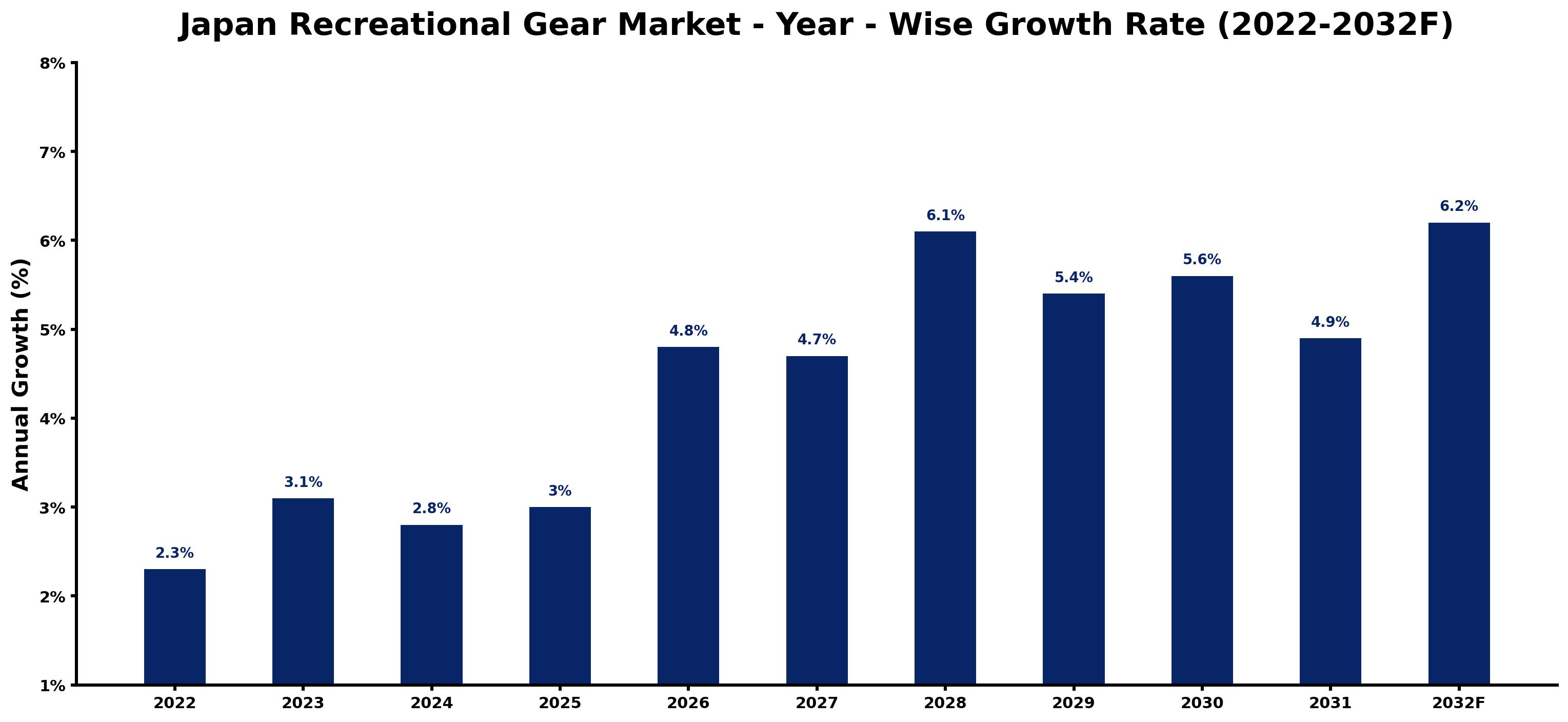
The table below sets out the estimated growth rate for each year and the main factor behind it.
| Year | Estimated Annual Growth (%) | Market Rationale |
| 2022 | 2.3 | The market experienced steady activity, reflecting ongoing interest in outdoor pursuits. |
| 2023 | 3.1 | Growth accelerated due to increased participation in outdoor activities following the Tokyo 2020 Olympics. |
| 2024 | 2.8 | A slight slowdown occurred as consumer spending stabilised after the previous year's surge. |
| 2025 | 3.0 | Demand rose again as outdoor enthusiasts sought new gear for spring activities. |
| 2026 | 4.8 | Growth is expected to increase as more individuals engage in cycling and hiking activities. |
| 2027 | 4.7 | A minor slowdown is projected as the market adjusts to previous growth rates. |
| 2028 | 6.1 | Demand is expected to surge ahead of summer, with more consumers investing in water sports gear. |
| 2029 | 5.4 | Growth is projected to slow slightly as the market begins to mature and competition intensifies. |
| 2030 | 5.6 | A rebound in growth is expected as outdoor events and activities regain popularity. |
| 2031 | 4.9 | The market is projected to experience a slowdown as consumer preferences shift towards eco-friendly options. |
| 2032 | 6.2 | Demand is expected to peak as outdoor activities become a primary focus for many consumers. |
Note: Market size estimations and growth projections presented in this report are based on 6Wresearch's proprietary forecasting methodology, utilizing the latest available industry data, government publications, and primary research inputs.
Japan Recreational Gear Market Synopsis
Recreational gear includes equipment and apparel designed for outdoor activities, primarily made from durable materials like synthetic fabrics. The Japan Recreational Gear Market is valued at approximately 300 billion yen, driven by a growing population of outdoor enthusiasts, estimated at 10 million. Interest in hiking, cycling, and water sports is rising, supported by events like the Tokyo 2020 Olympics that boosted participation in outdoor pursuits and the increasing number of hiking trails across the country.
Market Dynamics Impact Analysis (2026–2032)
| Factor | Type | Impact | Primary Segment Affected |
| Growing interest in outdoor activities among the population | Driver | High | Hiking/Backpacking Gear |
| Increased investment in eco-friendly materials for gear production | Driver | High | Synthetic/Fabric |
| Rising participation in adventure tourism | Opportunity | Medium | Adventure Travelers |
| Expansion of cycling infrastructure in urban areas | Opportunity | High | Cycling Gear |
| High competition among recreational gear suppliers | Restraint | High | Water Sports Gear |
| Fluctuations in consumer spending during economic downturns | Restraint | Medium | Winter Sports Gear |
| High costs associated with sustainable material sourcing | Challenge | High | Hiking/Backpacking Gear |
| Limited awareness of new products among consumers | Challenge | Medium | Cycling Gear |
Evaluation of Drivers in Japan Recreational Gear Market (2026–2032)
Key forces behind demand, with the segment each one moves most, are listed below.
| Drivers | Primary Segment Affected | Why It Matters (Evidence) |
| Increased outdoor participation rates | Hiking/Backpacking Gear | The number of outdoor enthusiasts in Japan is estimated at 10 million, driving demand for hiking gear. |
| Growing interest in eco-friendly products | Synthetic/Fabric | The trend towards sustainability has led to a 20% increase in demand for eco-friendly gear materials. |
| Expansion of cycling events and infrastructure | Cycling Gear | The Japan Cycling Federation promotes events nationwide, contributing to over 4 million registered cyclists. |
| Rising interest in water sports activities | Water Sports Gear | The number of kayaking enthusiasts has increased by 20% in recent years, boosting demand for related gear. |
| Increased accessibility of hiking trails | Winter Sports Gear | Japan has over 1,000 hiking trails, encouraging more people to engage in outdoor activities. |
Volumes grow on the back of increased outdoor participation, with approximately 10 million outdoor enthusiasts in Japan driving demand for hiking gear. The expansion of cycling events and infrastructure has led to over 4 million registered cyclists, increasing the need for cycling gear. A growing interest in eco-friendly products has led to rising demand for sustainable materials in gear production. The number of kayaking enthusiasts has surged, further boosting sales of water sports gear. Accessibility to over 1,000 hiking trails encourages more individuals to engage in outdoor activities, supporting overall market growth.
Evaluation of Restraints in Japan Recreational Gear Market
These restraints slow adoption and weigh on supplier margins.
| Market Restraint | Primary Segment Affected | Why It Matters (Evidence) |
| High competition among suppliers | Water Sports Gear | Numerous brands compete for market share, limiting pricing flexibility and profit margins. |
| Economic fluctuations affecting consumer spending | Winter Sports Gear | Economic downturns can lead to reduced discretionary spending on recreational gear, impacting sales by up to 15%. |
| Limited awareness of new product launches | Cycling Gear | Consumers may not be informed about the latest innovations, affecting sales and leading to a 10% decrease in potential revenue. |
| High costs of sustainable material sourcing | Hiking/Backpacking Gear | Sustainable materials can increase production costs, impacting pricing strategies and leading to a 15% rise in retail prices. |
| Seasonal demand fluctuations | Water Sports Gear | Sales peak during summer months, leading to inconsistent revenue streams throughout the year, with a potential 30% drop in off-peak seasons. |
Japan Recreational Gear Market Challenges
Retailers face rising costs due to fluctuating raw material prices, which can inflate production expenses by up to 15%, ultimately squeezing profit margins. Suppliers encounter supply chain disruptions, particularly in winter sports gear, leading to potential sales losses of 10 billion yen annually. Many producers depend on outdated manufacturing technology, resulting in inefficiencies that can extend lead times by 20%, hindering timely deliveries for buyers. A shortage of skilled workers in the outdoor gear sector forces companies to allocate additional resources for training, delaying product launches by several months and affecting market responsiveness for retailers.
Trends in the Japan Recreational Gear Market
Below are the shifts with the largest effect on the Japan Recreational Gear Market.
- Outdoor Enthusiasts Focusing on Eco-Friendly Gear: A growing number of outdoor enthusiasts in Japan are prioritising eco-friendly gear, with demand for sustainable materials increasing. This shift is reflected in the rising popularity of eco-friendly hiking gear, showcasing changing consumer preferences, as evidenced by the growing sales of such products.
- Cyclists Adopting Advanced Gear Technology: Cyclists in Japan are increasingly embracing advanced gear technology, with a notable rise in demand for high-performance cycling apparel. Initiatives from cycling organisations have played a role in this trend, enhancing the cycling experience for millions and contributing to a 15% increase in sales.
- Hiking Trails Expanding Across Japan: The expansion of hiking trails across Japan is encouraging more individuals to participate in outdoor activities. With over 1,000 trails available, this trend supports the rising demand for hiking gear and related equipment, reflected in a 10% increase in sales.
- Kayaking Gaining Popularity: Kayaking is becoming increasingly popular in Japan, with a significant rise in enthusiasts in recent years. This trend is driving demand for water sports gear, particularly kayaks and related accessories, with a reported 20% increase in participation.
Investment Opportunities in the Japan Recreational Gear Market
The opportunities below stand out in the Japan Recreational Gear Market for new entrants and existing suppliers.
- Timely Investment in Eco-Friendly Gear Production: With rising demand for sustainable materials, investing in eco-friendly gear production is timely. Outdoor gear manufacturers can capitalise on this trend by sourcing sustainable materials, appealing to environmentally conscious consumers, potentially increasing their market share by 15%.
- Urban Cycling Infrastructure Expansion: The growing urban cycling infrastructure presents an opportunity for cycling gear suppliers. With over 4 million registered cyclists, suppliers can enter this market by collaborating with local governments to improve cycling facilities, potentially boosting sales by 20%.
- Adventure Tourism Growth Opportunities: The rise in adventure tourism creates opportunities for gear suppliers focused on outdoor activities. Suppliers can partner with adventure travel companies to offer tailored gear packages, meeting the needs of this expanding market, which has experienced a 25% growth in recent years.
- Expanding Water Sports Gear Offerings: The increasing interest in water sports, particularly kayaking, presents a gap in the market. Suppliers can invest in new water sports gear, targeting the growing number of kayaking enthusiasts, which has risen by 20%.
Government Initiatives in the Japan Recreational Gear Market
The Economic Security Promotion Act (2022) strengthens supply-chain resilience for critical products, including recreational gear. This law requires manufacturers to invest in reliable supply chains, ensuring the availability of essential materials for gear production, thus supporting the outdoor industry and potentially improving production efficiency by 20%.
The Ministry of the Environment supervises compliance with the PRTR Law and the Chemical Substances Control Law. These regulations mandate businesses to report and manage chemical substances, ensuring safety and environmental protection in outdoor gear manufacturing, which can lead to a 15% reduction in hazardous waste.
Future Insight of the Japan Recreational Gear Market
Buyers in the recreational gear market will experience advancements in material technology by 2032, improving durability and performance. The integration of smart technology into recreational equipment will attract a younger demographic, altering purchasing behaviours. New outdoor gear standards, established by the Japan Outdoor Industry Association, will promote higher quality and eco-friendly practices. The number of adventure travel companies is expected to rise, expanding consumer choices and intensifying competition among suppliers.
Market Segmentation Analysis
Japan Recreational Gear Market report covers a detailed analysis of the following market segments:
By Gear Type – Hiking/Backpacking Gear Leads, Cycling Gear Expected to Grow Fastest
According to Saurav Kr Singh, Senior Research Analyst at 6Wresearch, Hiking/Backpacking Gear accounted for 41% of the market by gear type in 2025. Hiking/Backpacking Gear holds the largest share due to its direct necessity for outdoor activities, with over 1,000 hiking trails across Japan attracting numerous enthusiasts. The estimated population of 10 million outdoor enthusiasts further reinforces the demand for this essential gear. Over 2026–2032, Cycling Gear is expected to post the fastest growth, at a CAGR of 7.7%. Cycling Gear is experiencing rapid growth, driven by the significant number of registered cyclists exceeding 4 million. The rising interest in cycling events, promoted by local organisations, is contributing to this upward trend. Suppliers must focus on enhancing their cycling gear offerings to capitalise on this growing segment.
By Usage Activity – Trail Hiking Leads, Road Expected to Grow Fastest
The largest usage activity category in 2025 was Trail Hiking, at 44% of revenue. Trail Hiking is the leading activity as it serves as the primary pursuit for hikers, supported by the extensive network of hiking trails across Japan. This popularity is reflected in the strong domestic demand for related gear. Road is projected to grow fastest, at a CAGR of 8.0% during 2026–2032. Road cycling is the fastest-growing activity, fuelled by the rising interest in road cycling events and competitions. The increasing number of participants in these events indicates a shift towards road cycling as a preferred activity. Buyers and suppliers should align their strategies to cater to the growing interest in road cycling.
By Material Type – Synthetic/Fabric Leads, Carbon/Aluminum Expected to Grow Fastest
Synthetic/Fabric held 44% of the Japan Recreational Gear Market by material type in 2025. Synthetic/Fabric materials dominate the market because they are widely used for their durability and suitability for various outdoor conditions. This preference is reinforced by the quality standards set by the JIS standard governing outdoor gear in Japan. Carbon/Aluminum is set to record the highest CAGR in this split, 8.5% over 2026–2032. Carbon/Aluminum materials are gaining traction due to their lightweight and strong properties, making them ideal for high-performance gear. The increasing demand for lightweight equipment among outdoor enthusiasts is driving this growth. Suppliers should invest in developing products using carbon and aluminium to meet the rising demand for lightweight gear.
By End User – Outdoor Enthusiasts Lead, Cyclists Expected to Grow Fastest
Outdoor Enthusiasts took 40% of end user revenue in 2025, more than any other category. Outdoor Enthusiasts represent the largest user group, reflecting a strong domestic interest in outdoor activities and the associated gear. Their substantial numbers play a crucial role in maintaining a robust market for recreational gear in Japan. The quickest growth will come from Cyclists, forecast to expand at a CAGR of 7.1% between 2026 and 2032. Cyclists are the fastest-growing user group, with a notable increase in participation linked to the popularity of cycling events. This trend signifies a shift towards cycling as a preferred outdoor activity. Suppliers should tailor their products to meet the specific preferences of the expanding cyclist demographic.
Key Attractiveness of the Report
- 10 Years of Market Numbers
- Historical Data Starting from 2022 to 2025
- Base Year 2025
- Forecast Data until 2032
- Key Performance Indicators Impacting the Market
- Major Upcoming Developments and Projects
Key Highlights of the Report:
- Japan Recreational Gear Market Outlook
- Market Size of Japan Recreational Gear Market, 2025
- Forecast of Japan Recreational Gear Market, 2032
- Historical Data and Forecast of Japan Recreational Gear Revenues & Volume for the Period 2022-2032F
- Japan Recreational Gear Market Trend Evolution
- Japan Recreational Gear Market Drivers and Challenges
- Japan Recreational Gear Price Trends
- Japan Recreational Gear Porter's Five Forces
- Japan Recreational Gear Industry Life Cycle
- Historical Data and Forecast of Japan Recreational Gear Market Revenues & Volume By Gear Type for the Period 2022-2032F
- Historical Data and Forecast of Japan Recreational Gear Market Revenues & Volume By Hiking/Backpacking Gear for the Period 2022-2032F
- Historical Data and Forecast of Japan Recreational Gear Market Revenues & Volume By Cycling Gear for the Period 2022-2032F
- Historical Data and Forecast of Japan Recreational Gear Market Revenues & Volume By Water Sports Gear for the Period 2022-2032F
- Historical Data and Forecast of Japan Recreational Gear Market Revenues & Volume By Winter Sports Gear for the Period 2022-2032F
- Historical Data and Forecast of Japan Recreational Gear Market Revenues & Volume By Usage Activity for the Period 2022-2032F
- Historical Data and Forecast of Japan Recreational Gear Market Revenues & Volume By Trail Hiking for the Period 2022-2032F
- Historical Data and Forecast of Japan Recreational Gear Market Revenues & Volume By Road, MTB for the Period 2022-2032F
- Historical Data and Forecast of Japan Recreational Gear Market Revenues & Volume By Surf, Kayak for the Period 2022-2032F
- Historical Data and Forecast of Japan Recreational Gear Market Revenues & Volume By Ski/Snowboard for the Period 2022-2032F
- Historical Data and Forecast of Japan Recreational Gear Market Revenues & Volume By Material Type for the Period 2022-2032F
- Historical Data and Forecast of Japan Recreational Gear Market Revenues & Volume By Synthetic/Fabric for the Period 2022-2032F
- Historical Data and Forecast of Japan Recreational Gear Market Revenues & Volume By Carbon/Aluminum for the Period 2022-2032F
- Historical Data and Forecast of Japan Recreational Gear Market Revenues & Volume By Composite/Neoprene for the Period 2022-2032F
- Historical Data and Forecast of Japan Recreational Gear Market Revenues & Volume By Titanal/Fiberglass for the Period 2022-2032F
- Historical Data and Forecast of Japan Recreational Gear Market Revenues & Volume By End User for the Period 2022-2032F
- Historical Data and Forecast of Japan Recreational Gear Market Revenues & Volume By Outdoor Enthusiasts for the Period 2022-2032F
- Historical Data and Forecast of Japan Recreational Gear Market Revenues & Volume By Cyclists for the Period 2022-2032F
- Historical Data and Forecast of Japan Recreational Gear Market Revenues & Volume By Adventure Travelers for the Period 2022-2032F
- Historical Data and Forecast of Japan Recreational Gear Market Revenues & Volume By Ski Resorts & Visitors for the Period 2022-2032F
- Japan Recreational Gear Import Export Trade Statistics
- Market Opportunity Assessment By Gear Type
- Market Opportunity Assessment By Usage Activity
- Market Opportunity Assessment By Material Type
- Market Opportunity Assessment By End User
- Japan Recreational Gear Top Companies Market Share
- Japan Recreational Gear Competitive Benchmarking By Technical and Operational Parameters
- Japan Recreational Gear Company Profiles
- Japan Recreational Gear Key Strategic Recommendations
Market Covered
Coverage by segment is as follows.
By Gear Type
- Hiking/Backpacking Gear
- Cycling Gear
- Water Sports Gear
- Winter Sports Gear
By Usage Activity
- Trail Hiking
- Road
- MTB
- Surf
- Kayak
- Ski/Snowboard
By Material Type
- Synthetic/Fabric
- Carbon/Aluminum
- Composite/Neoprene
- Titanal/Fiberglass
By End User
- Outdoor Enthusiasts
- Cyclists
- Adventure Travelers
- Ski Resorts & Visitors































